Most hiring processes are built on the two weakest predictors in the research: years of experience and an unstructured conversation.
Neither is useless. Both are far weaker than they feel.
Predicting job performance is a measurement problem, and personnel psychology has been measuring it for more than a century. The answers changed in 2022, when a major re-analysis lowered the validity estimates for almost every selection method and reshuffled the rankings. This guide covers what the current evidence says about the best predictors of job performance, which common methods underperform, how to combine predictors, and how to build a prediction system you can defend.
Key takeaways
- Structured interviews are the strongest single predictor of job performance in the most recent large-scale evidence, ahead of cognitive ability tests.
- Cognitive ability still predicts performance and especially training success, but its lead over other methods was overstated for decades.
- Years of experience and unstructured interviews are among the weakest predictors employers commonly rely on.
- Personality measures predict modestly on their own, and work-specific measures predict better than general ones.
- The best results come from combining a few validated, non-overlapping predictors, chosen through a job analysis and monitored for adverse impact.
Define Job Performance Before Predicting It
You cannot predict job performance until you define it. A predictor is only as useful as the performance criteria it is tested against.
Define the criteria first. “Good performance” for an account executive (pipeline, win rate, retention) is different from good performance for an operations manager (throughput, error rates, team stability). Write down what success looks like in the role before comparing selection methods. Otherwise you are choosing a tool to predict an outcome you have not specified.
Task performance versus contextual performance. Task performance is how well someone does the core technical work of the job. Contextual performance is everything around it: helping colleagues, following through on commitments, adapting to change, and supporting the team. Different predictors are better at different parts. Cognitive ability and job knowledge lean toward task performance. Personality and integrity measures lean toward contextual performance.
Rating reliability matters. Most validity research measures performance with supervisor ratings, and supervisors disagree with each other. A predictor can look weaker than it is simply because the performance ratings it is compared against are noisy. Consistent, structured performance criteria make every predictor easier to evaluate.
The Best Predictors of Job Performance
The best predictors of job performance, according to the most recent large-scale evidence, are structured interviews, job knowledge tests, empirically keyed biodata, work sample tests, and cognitive ability tests.
The evidence hierarchy. For 24 years, the standard reference was Schmidt and Hunter’s 1998 meta-analysis, which ranked cognitive ability as the best single predictor of job performance.
In 2022, Sackett, Zhang, Berry, and Lievens revisited those meta-analytic estimates. They found that a common statistical correction, for restriction of range, had been applied in situations where it did not belong, which systematically inflated validity estimates. After addressing that systematic overcorrection, most estimates fell, and the rankings changed.
Predictive validity across selection methods. Validity is the correlation between scores on a selection method and later job performance, from 0 (no relationship) to 1 (perfect prediction). The revised estimates:
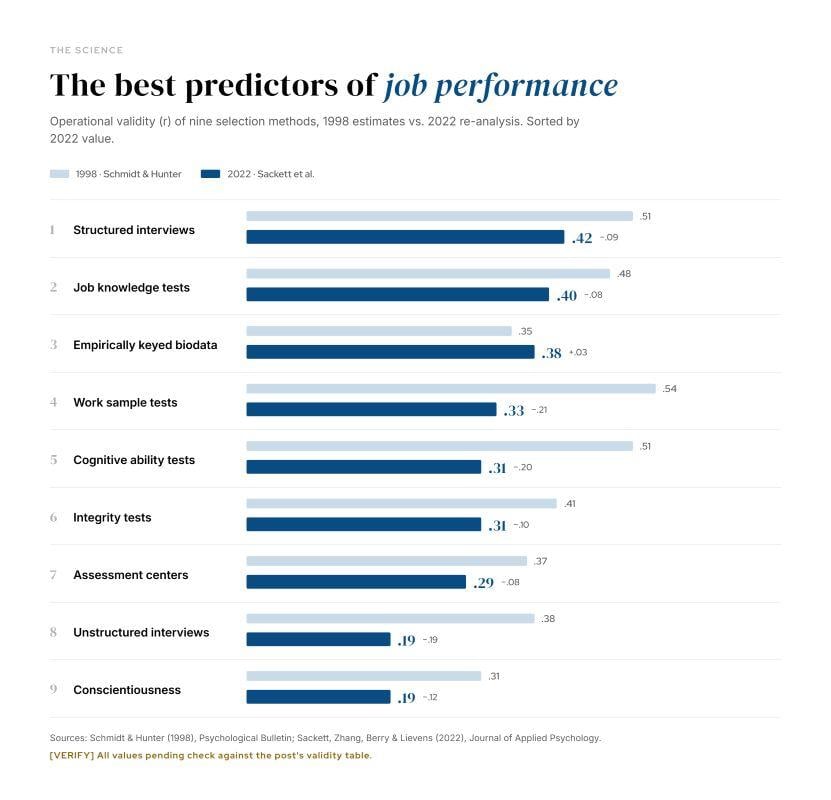
The best predictor for general hiring. On current evidence, a well-designed structured interview is the strongest single predictor for most roles. That does not make it sufficient on its own. Structured interview validity also varies widely between studies, which means a poorly designed “structured” interview can perform much worse than the average.
Cognitive Ability Tests and Cognitive Assessments
Cognitive ability tests measure general mental ability: how quickly and accurately someone learns, reasons, and solves problems.
How cognitive ability supports learning. Every job requires learning: new products, new systems, new problems. People with higher general cognitive ability absorb new information faster, which is why the effect shows up in nearly every role studied.
Training success. Cognitive ability has long been one of the strongest predictors of training success. The 1998 analysis estimated its validity for training performance at .56, higher than for job performance itself.
Stronger effects in complex roles. The more information-heavy and unpredictable a job, the more cognitive ability matters. For routine roles, the effect is smaller.
What changed. At .31, cognitive ability is still a useful predictor. It is no longer the clear front-runner it was treated as for two decades. Sackett and colleagues suggest reframing selection around structured interviews as the focal method, with other predictors evaluated by what they add.
Job Knowledge Tests and Job Knowledge
Job knowledge tests measure what a candidate already knows about the specific work: the regulations, tools, procedures, and technical content the role requires.
Role-specific measurement. A job knowledge test for a payroll specialist covers payroll. One for a network engineer covers networking. That specificity is the source of their strength.
Versus cognitive ability tests. Cognitive ability tests measure capacity to learn. Job knowledge tests measure what has already been learned. One predicts how fast someone will get there. The other tells you whether they are already there.
Validate content against the job. A job knowledge test is only as good as its match to the actual role. Build items from a job analysis and have subject matter experts confirm they reflect real job requirements, not trivia.
When job knowledge predicts readiness. Job knowledge tests work best for experienced hires who are expected to perform quickly. They are poorly suited to entry-level roles where the knowledge will be taught after hiring.
Work Samples, Structured Interviews, and Integrity Tests
Work samples, structured interviews, and integrity tests each measure something cognitive tests do not: actual task behavior, job-relevant experience under consistent questioning, and counterproductive work tendencies.
Work sample tests. A work sample asks candidates to perform a realistic task from the job: a sales call role-play, a data analysis exercise, a coding problem, a mock client email. Candidates show what they can do rather than describe it. Their estimated validity fell in the 2022 revision, but they remain a solid predictor and are well accepted by candidates because they feel fair.
Structured interview scoring. A structured interview asks every candidate the same job-related questions, in the same order, and scores each answer against a predefined rubric. Questions are built from a job analysis. Interviewers score independently before discussing. Free-flowing conversation and follow-up hunches are what make an interview unstructured, and they are what drag its validity down. We cover how to build these questions in Best Interview Questions for Hiring: Behavioral, Technical, and Culture-Fit.
Integrity tests as behavioral predictors. Integrity tests assess attitudes and tendencies related to honesty, rule-following, and counterproductive work behavior. They predict overall job performance about as well as cognitive ability in the revised estimates, and they add information that cognitive tests miss.
Practical validity across methods. The practical question is not just validity but cost and fit. Work samples are expensive to build for every role. Structured interviews are cheap to implement but require discipline. Integrity tests are cheap and scalable but measure a narrower slice of behavior.
Personality, Applied Psychology, and Human Resources
Personality measures predict job performance modestly on their own, with conscientiousness the strongest of the Big Five traits, and they are most useful for predicting contextual performance and role-specific behavior.
Conscientiousness as a predictor. Conscientious people tend to be organized, dependable, and persistent. They meet deadlines and follow through on commitments. Conscientiousness is the most consistent personality predictor across roles. In the revised estimates, general measures of it reached .19.
Contextual performance behaviors. Much of what personality predicts is contextual: helping colleagues, staying composed under pressure, sticking with difficult work. These behaviors rarely show up in a task checklist and often decide whether a team works.
What applied psychology research means for HR decisions. One of the more useful findings in the 2022 re-analysis: contextualized personality measures, which ask about behavior at work rather than behavior in general, predicted better than general measures. Contextualized conscientiousness reached .25 against .19 for general measures, and contextualized emotional stability reached .23 against .09.
Role-specific relevance. Which traits matter depends on the role. Persistence through rejection matters for sales. Precision and structure matter for compliance. Personality is most predictive when the traits measured are chosen because the job demands them.
The practical takeaway: choose behavioral measures that ask about behavior at work, tied to what the role demands. And check reliability before validity, since a measure that changes from week to week cannot predict anything. Ask any vendor for its test-retest figures. Like any behavioral measure, it is one structured input into a hiring decision, never the sole basis for it.
Incremental Validity: Combining Complementary Predictors
Incremental validity is the additional predictive power a selection method contributes beyond what other methods in the process already provide.
Why it matters. Two methods that measure the same thing add little together. Two methods that measure different things can predict much better combined than either alone. The goal is not more assessments. It is assessments that do not overlap.
Cognitive ability and integrity tests. These are a classic complementary pair. Cognitive ability tests measure capacity to learn and solve problems. Integrity tests measure tendencies toward dependable, rule-following behavior. The two are largely unrelated to each other, so each adds information the other misses. In the 1998 analysis, cognitive ability combined with an integrity test was among the highest-validity combinations.
Combine non-redundant measures. A strong system for most roles pairs a structured interview with one or two measures that capture something the interview does not: a cognitive or job knowledge test for task performance, and a behavioral or integrity measure for how someone will work. A validated behavioral assessment can fill that last slot as one structured input, never the sole basis for the decision.
Avoid unnecessary complexity. Each extra assessment adds cost, time, and candidate drop-off, and the gain shrinks with every addition. Three well-chosen predictors usually outperform six overlapping ones.
Design teams with data, not gut feel.
Most org-design decisions come down to role fit, leadership style, and team dynamics. OAD reads those signals from a 7-minute behavioral survey, so you can reconfigure roles and teams with evidence instead of guesswork.
First Impressions and Other Weak Predictors
The weakest predictors in common use are first impressions, unstructured interviews, years of experience, and education level used as a proxy for performance.
Why first impressions distort judgment. Interviewers often form a view within the first minutes of an interview and spend the rest of it looking for confirmation. Confidence, appearance, and similarity to the interviewer shape that early view, and none of them predict performance well.
Unstructured interviews. At .19 in the revised estimates, unstructured interviews do better than chance, but not by much, and far less well than the same interview with structure added. Tricky or “creative” questions that have no clear link to the job make it worse.
Experience as a standalone predictor. Years of experience reached .07 in the revised estimates. Experience tells you how long someone has been in a role, not how well they performed in it. It is useful as a minimum threshold for some roles, not as a ranking tool.
Education as a performance proxy. Degrees and grades signal general ability and persistence, but they overlap heavily with what cognitive tests measure more directly. Requiring a degree where the job does not need one also shrinks your candidate pool for little predictive gain.
The pattern across all four is the same. They measure presentation and history. The strongest predictors measure behavior and capability directly.
How to Build a Defensible Prediction System
A defensible prediction system starts with a job analysis, uses validated measures, administers them consistently, and monitors outcomes for adverse impact.
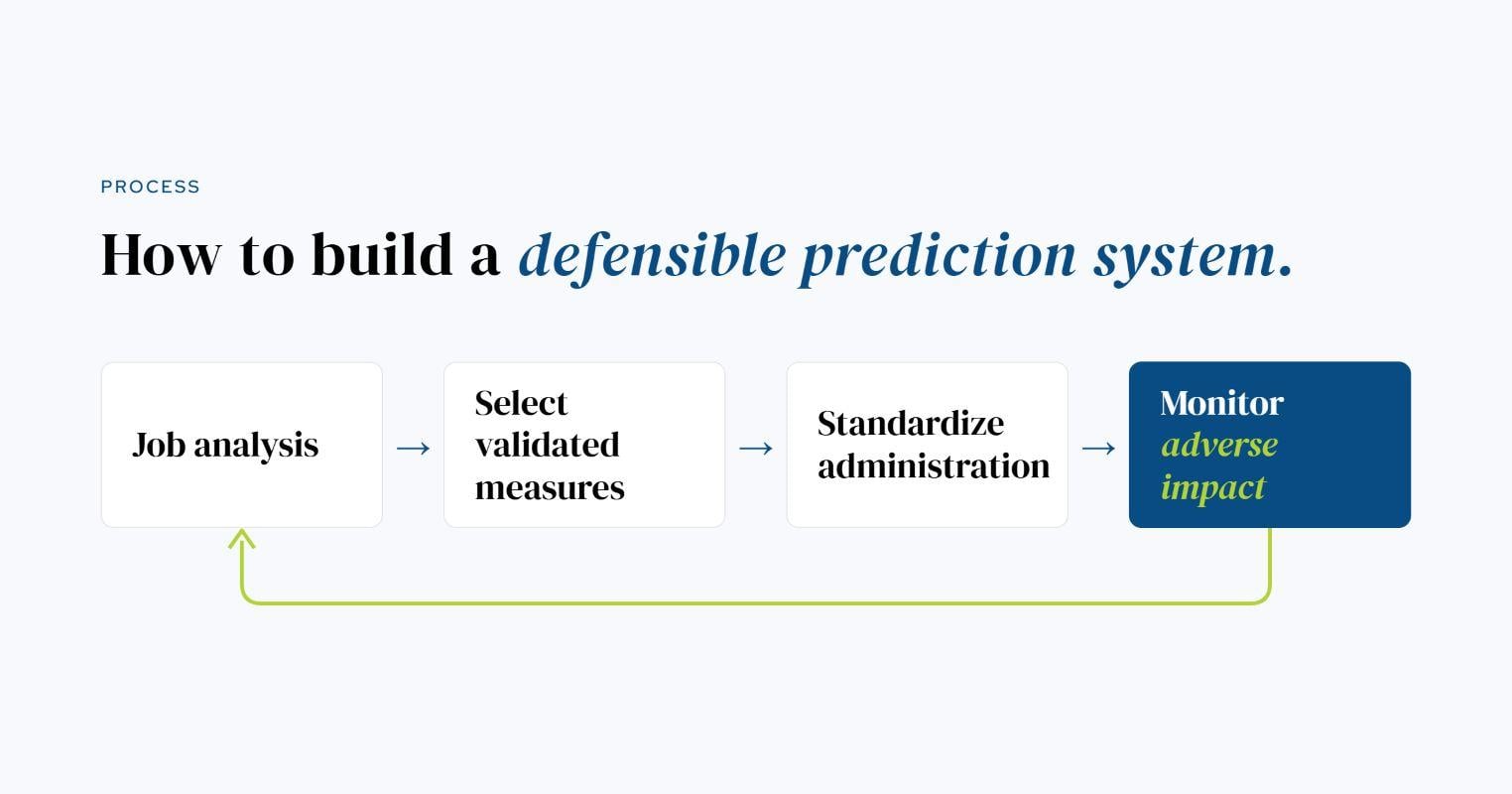
Begin with a job analysis. Document what the role requires: the tasks, the knowledge, and the behaviors that separate strong from weak performers. Every predictor you choose should trace back to something in that analysis.
Select validated measures. Use tools with published evidence of validity for similar roles and purposes. Ask vendors for their validation evidence and their adverse impact data. If they cannot provide either, treat that as a no.
Standardize administration. Every candidate for a role should go through the same steps, under the same conditions, scored the same way. Skipping an assessment for a candidate a manager already likes undermines both the prediction and its defensibility.
Monitor adverse impact. Track selection rates by group at every stage. Under the federal Uniform Guidelines on Employee Selection Procedures, a selection rate for any group below four-fifths of the highest group’s rate is generally treated as evidence of adverse impact. This matters for method choice too: cognitive ability, work sample, and job knowledge tests tend to show larger group differences in scores than personality-based measures.
Choosing the Best Predictor Across Roles
There is no single best predictor for every role. The right mix depends on job complexity, the stage of the career, and what the role demands.
Compare predictors by job complexity. For complex, information-heavy roles, cognitive ability and structured interviews carry more weight. For experienced hires, job knowledge tests and work samples become practical. For entry-level roles, where skills will be trained, cognitive ability and behavioral measures matter more than current knowledge.
Selection prediction versus performance development. Predicting who will perform is a different task from developing the people you already have. Selection tools rank candidates. Development tools diagnose gaps. Some behavioral measures do both, which is where an existing team’s data becomes valuable: your current top performers show what a strong hire in that role looks like.
No universal measure fits every role. Validity estimates are averages across many jobs and studies, with wide variation around them. Treat them as a starting point, then check how your chosen predictors perform against your own hiring outcomes. For a closer look at which assessments hold up, see Skills Assessment in Hiring: What Actually Predicts Performance and What Doesn’t.
Frequently Asked Questions About Predicting Job Performance
What is the best predictor of job performance?
According to the 2022 re-analysis by Sackett and colleagues, structured interviews are the strongest single predictor of job performance on average, with an estimated validity of .42. Job knowledge tests, empirically keyed biodata, work samples, and cognitive ability tests follow. The best results come from combining a structured interview with one or two predictors that measure something different.
Do interviews predict job performance?
Structured interviews predict job performance well. Unstructured interviews predict it poorly, with roughly half the validity in the most recent estimates. The difference is consistency: the same job-related questions for every candidate, scored against a predefined rubric by interviewers who rate independently.
How does experience affect prediction?
Years of experience is one of the weakest predictors of job performance, with an estimated validity of .07 in the 2022 re-analysis. Experience shows how long someone has done a job, not how well. It can serve as a minimum threshold for some roles, but it should not be used to rank candidates.
What should employers do in practice?
Start with a job analysis to define what performance means in the role. Replace unstructured interviews with structured ones. Add one or two validated measures that capture what the interview cannot, apply them to every candidate the same way, and monitor selection rates for adverse impact.
The strongest predictor of who will perform in a role is already on your payroll: the people who perform in it now. Measure what they do, and make it your hiring standard. Get Your Free Top Performer Profile: 7 minutes, results in 24 hours, no credit card.