If you’re hiring at a 50+ person company, “best interview questions” is a misleading phrase. The best questions are the ones that produce reliable evidence for the specific role you’re filling, in the time you actually have, with interviewers who are not mind readers.
This guide is for HR leaders, hiring managers, and executives who want a repeatable interview process that:
- Links questions to the job description
- Makes answers comparable across candidates
- Reduces bias by forcing evidence and scoring
- Helps you spot red flags early without turning interviews into interrogations
Why “best interview questions” depend on role, level, and risk
A question that works for a junior coordinator can be useless for a senior leader.
- Role risk: Some hires break a team if they fail. Others just slow things down. Your questions should match that risk.
- Level: Senior roles need questions that surface judgment, trade-offs, and influence, not just task execution.
- Context: A high-compliance environment (healthcare, finance) needs different evidence than a fast-moving product team. In these cases, conducting a background check may also be appropriate to assess candidate honesty and ensure compliance with legal or company requirements.
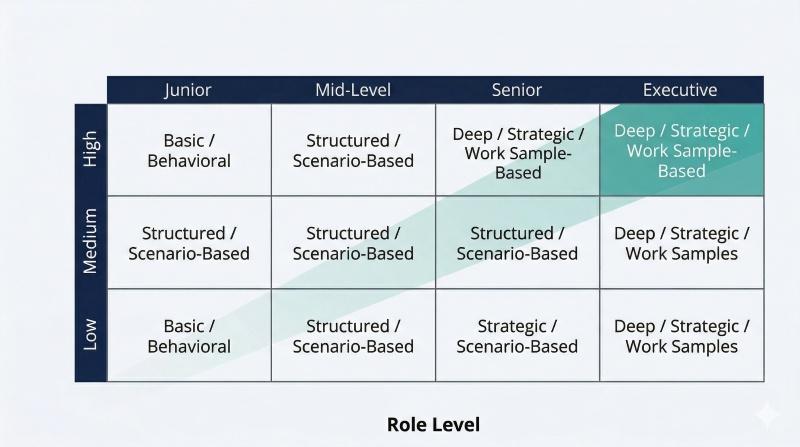
A simple rule: if the answer cannot be scored against the job’s outcomes, it’s not a great question.
Where OAD fits: using behavioral data to sharpen interviews (not replace them)
Interviews are good for context, communication, and decision style. They are also valuable for assessing soft skills such as adaptability and communication, helping you evaluate a candidate’s fit beyond technical expertise. They are bad at consistent measurement, especially when different interviewers ask different questions and “go with their gut.”
This is where a validated behavioral assessment like the OAD Survey helps. It gives you structured, comparable signals you can use to:
- Choose which competencies need deeper probing
- Tailor follow-ups without improvising
- Calibrate scoring when two candidates sound equally polished
If you want to see how OAD performs on your own roles and candidates, start with the free Top Performer Profile: 7 minutes, results in 24 hours, no credit card. Compare candidates with data instead of vibes.
Align interview questions with the job description and hiring process
Most interview processes fail for a boring reason: the questions are not tied to the job. They’re tied to whatever the interviewer feels like asking that day.
A candidate based approach ensures that interview questions evaluate the candidate’s interests, values, and preparation as they relate to the role.
Your baseline: every interview question should test one of three things:
- A must-have competency from the job description
- A decision-making requirement (judgment, prioritization, trade-offs)
- A culture or team behavior that affects retention and performance

Map each question to must-have competencies in the job description
Start by extracting three to five critical competencies. Not fifteen. Not “strong communication skills” as a placeholder for everything. Real competencies tied to outcomes.
Use this template:
- Outcome: What does success look like in 90 days and 12 months?
- Tasks: What work produces that outcome?
- Behaviors: What behaviors make that work repeatable under pressure?
- Last position: What relevant experience and impact did the candidate have in their last position? How does their career progression align with the competencies needed?
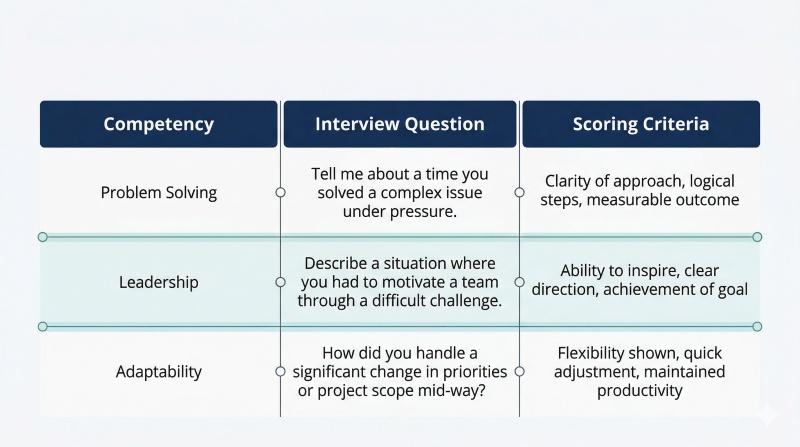
Then map questions like this:
- Competency: Stakeholder management
Question type: Behavioral (“describe a time”)
Scoring: clarity, boundaries, outcome - Competency: Problem solving skills
Question type: live exercise / case
Scoring: framing, assumptions, reasoning - Competency: Leadership positions (if relevant)
Question type: decision making process
Scoring: trade-offs, data use, accountability - Competency: Relevant experience in last position
Question type: “Can you describe your responsibilities and achievements in your last position?”
Scoring: relevance, progression, impact
If a question cannot be connected to a competency, it is entertainment. Hiring managers love entertainment. Your hiring outcomes won’t.
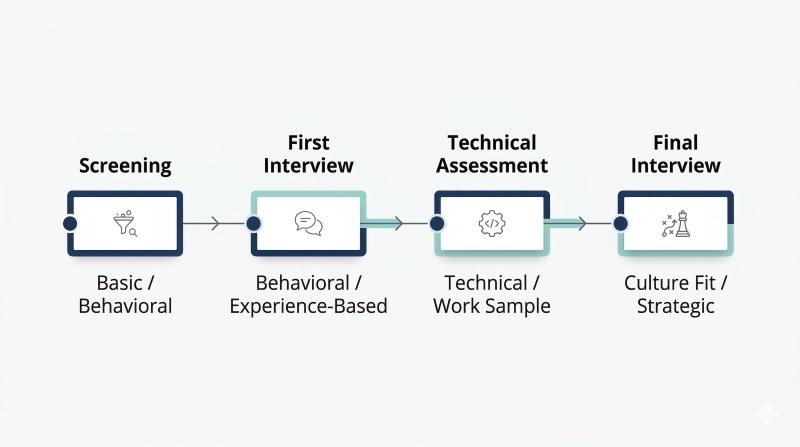
Place questions in the hiring process timeline (screen, onsite, final)
You get cleaner signal when you stop asking everything everywhere.
Phone screen (15–30 minutes)
- Confirm basics: work history, role fit, motivation
- Test early red flags: unclear answers, unrealistic expectations, evasiveness
- Clarify what candidates can expect regarding interview structure and remote work preferences
- One “day one” question to check prioritization
First interview (45–60 minutes)
- Core behavioral questions (“about a time”) linked to job description
- Probe communication skills and ownership with follow-ups
- Score with a simple rubric, same for every candidate
Technical / case round (role dependent)
- Timeboxed, small problem live
- Focus on process and clarity, not trivia
- Use the same exercise or a tightly controlled variant
Final interview (30–60 minutes)
- Decision making process, stakeholder tension, culture-fit behaviors
- Confirm what earlier rounds suggested, do not restart from zero
- Align internally: get interviewers on the same page with one shared scorecard view
When to pair questions with OAD behavior fit reports assessment results
Use assessment data to sharpen the interview, not to justify a decision you already made.
Practical pairing rules:
- If interview answers are polished but vague: use OAD results to target follow-ups that force concrete examples.
- If two candidates look identical on paper: use OAD, starting with flexible OAD pricing plans, to identify where their work style likely differs, then test it with one behavioral question.
- If the role is high-risk (leadership, customer-facing, safety-critical): use OAD to decide which behaviors must be verified in the interview, then score those behaviors explicitly.
Example approach:
- OAD suggests a candidate prefers fast action and low structure.
- You do not reject them for that.
- You ask a “describe a time” question about operating in a structured environment and score how they adapted.
That’s how you stay evidence-based without turning assessments into astrology.

Selection criteria: what great interview questions focus on
Most candidates can sound competent for 45 minutes. The point of great interview questions is to force evidence, not performance. Great questions help you spot the difference between candidates who simply perform well in interviews and those who provide real evidence of fit for your role.
Use these criteria to decide whether a question belongs in your interview process.
[Image: Hiring team reviewing a list of interview questions and removing weak ones. Alt: “Hiring team selecting great interview questions for a structured interview process”]
Role-specific skills and culture add behavioral interview questions, not vague “culture fit”
“Culture fit” is a lazy label that often means “similar to us.” That’s how you get a homogenous team and a surprise turnover bill.
What you actually want is one of these:
- Culture add: brings fresh perspectives while still working within your company’s culture
- Team fit: complements the team’s current gaps (execution vs strategy, direct vs diplomatic, etc.)
- Role fit: matches the day-to-day reality of the job, not the title
So your questions should test behaviors that affect performance and retention, like:
- How someone handles conflict
- How they communicate under pressure
- How they set boundaries with stakeholders
- How they recover from mistakes
- How they demonstrate genuine interest in the role and the organization
Behavioral evidence over hypotheticals
Hypotheticals invite fantasy. Behavioral questions force recall.
Prefer questions that start with:
- “Describe a time…”
- “Tell me about a time…”
- “Walk me through what you did when…”
Then require concrete examples:
- What was the situation?
- What did you do?
- How did you respond to the challenge or question?
- What was the result?
- What did you learn or change next time?
If the candidate stays abstract, it’s either lack of experience or avoidance. Both matter.

Decision-making, trade-offs, and measurable outcomes
Strong hires can explain how they think. Weak hires talk in slogans.
Your decision making process questions should reveal:
- How they set priorities
- What data they use (and what they ignore)
- Which trade-offs they considered
- How they generate and evaluate ideas when making decisions
- What outcome they achieved
- What they’d do differently
Insist on outcomes. Not “we improved the process,” but what changed. If they cannot name a measurable outcome, the work may not have moved the business.
Use a simple scoring rubric for every question
If you don’t score answers, you’re collecting opinions.
Keep it simple. Use a 1–5 scale and define it once:
- 1 = no evidence (vague, theoretical, unclear role)
- 3 = solid evidence (clear ownership, reasonable outcome, some reflection)
- 5 = strong evidence (high ownership, meaningful outcome, clear learning, repeatable method)
Score two dimensions for most questions:
- Behavior quality (ownership, judgment, collaboration)
- Impact (results, scale, durability)
This keeps you from hiring the best storyteller in the room.
Best interview questions to use in your hiring process
Use these questions as a core set, then tailor the follow-ups based on the job description. The best interview questions not only assess skills and fit, but also help you understand a candidate’s career trajectory and professional development goals. Keep the phrasing consistent across candidates. Your “customization” should happen in probing and scoring, not in making up new questions mid-interview.

Describe a time you led change (about a time)
Exact question phrasing
“Describe a time you led change at work. What was the change, what resistance did you face, and what happened in the end?”
This question tests whether the candidate can move work forward when people, systems, or incentives push back.
What this reveals
- Initiative vs. compliance (did they lead, or just participate?)
- Influence style (facts, relationships, authority, coalition-building)
- Execution under uncertainty (did they adjust when plans broke?)
- Ownership (do they credit the team while staying clear about their role?)
Three probing follow-ups
- “What did you do in the first week to get traction?”
- “Who resisted most, and how did you handle it?”
- “What would you do differently if you ran it again?”
If the candidate cannot name resistance, either the change was trivial or they were not driving it.
Probing and scoring
Score two dimensions separately: initiative and impact. This prevents “charismatic but ineffective” hires.
Initiative (1–5)
- 1: Describes change as something that happened to them. No clear actions.
- 3: Took clear steps, influenced at least one stakeholder group.
- 5: Drove a structured approach, adapted tactics, managed resistance thoughtfully.
Impact (1–5)
- 1: No outcome, or outcome is vague.
- 3: Clear outcome with reasonable scope (team, project, measurable improvement).
- 5: Meaningful outcome with durability (process sticks, adoption stays, measurable results).
Red flags (lack of ownership)
- Overuses “we” without ever naming their role.
- Blames resistance without explaining what they tried.
- Cannot explain trade-offs or constraints.
- Describes a “win” that sounds like a slide deck, not a changed reality.

Describe a time you failed and learned
Exact question phrasing “Describe a time you made a mistake or failed at work. What happened, what did you do next, and what changed because of it?”
This wording invites honest answers without rewarding oversharing or melodrama. You’re testing self awareness and accountability, not fishing for trauma. Asking candidates to describe a time they made a big mistake at work can reveal their willingness to admit errors and seek help, which is crucial for problem-solving skills.
What this reveals
- Accountability (do they own it or dodge it?)
- Learning speed (do they extract a lesson or just feel bad?)
- Remediation (did they fix the underlying cause?)
- Integrity under pressure (do they tell the truth when it costs them something?)
- Honesty about mistakes demonstrates integrity and self-awareness, which are essential for building trust and assessing genuine character.
Three probing follow-ups
- “What was the first thing you did after you realized it?”
- “Who did you tell, and how did you communicate it?”
- “What guardrail did you put in place so it wouldn’t happen again?”
If they cannot name a real mistake, assume one of two things: they have limited experience, or they are managing the impression hard. Neither is ideal.
Probing and scoring
Score learning and accountability separately. Candidates often have one without the other.
Accountability (1–5)
- 1: Blames tools, teammates, or “unclear expectations.” No ownership.
- 3: Owns their part and explains what they did to repair trust.
- 5: Owns it early, communicates clearly, minimizes downstream damage.
Learning (1–5)
- 1: Lesson is generic (“I learned to communicate better”).
- 3: Specific insight plus a concrete behavior change.
- 5: System-level improvement (process change, checklist, peer review, measurement), and they can show it stuck.
Red flags
- No remediation steps, just a story.
- “I’m a perfectionist” disguised as failure.
- They frame the failure as someone else’s problem.
- They cannot explain how they’d prevent a repeat.

Ideal roles
This question is especially useful for:
- Leadership positions
- Senior individual contributors
- Roles with high autonomy or high visibility
- Any position where mistakes are expensive (customer impact, compliance, revenue systems)
It’s less useful for very junior roles unless you prompt for a smaller scope mistake (school project, internship, first job), otherwise most candidates will either freeze or manufacture a story.
Walk me through a tough decision
Exact question phrasing
“Walk me through a tough decision you had to make at work. What options did you consider, what information did you use, and what was the outcome?”

This is a critical thinking and judgment test. It also exposes whether someone can explain their decision making process without hiding behind jargon.
What this reveals
- How they define the problem (or whether they skip that part)
- Whether they consider alternatives or latch onto the first idea
- How they weigh trade-offs (time, cost, risk, people impact)
- Whether they can connect decisions to outcomes, not just activity
Probing follow-ups
- “What was the strongest alternative, and why didn’t you choose it?”
- “What did you assume, and how did you validate those assumptions?”
- “What did you measure after the decision to confirm it worked?”
- “If you had to redo it with half the time, what would you change?”
Candidates who only describe “I trusted my gut” are not automatically wrong. They are just high-risk unless they can show pattern recognition built from real experience and feedback loops.

Probing and scoring
Score use of data, alternatives, and outcomes.
Use of data (1–5)
- 1: No data, no validation, mostly opinion.
- 3: Uses relevant inputs (metrics, customer feedback, stakeholder constraints).
- 5: Uses data appropriately, acknowledges limits, validates assumptions.
Alternatives (1–5)
- 1: Presents one path only.
- 3: Compares at least two real options with pros and cons.
- 5: Explores multiple options, stress-tests them, explains trade-offs clearly.
Outcomes (1–5)
- 1: Outcome is unclear or purely narrative.
- 3: Outcome is clear, with at least one concrete result.
- 5: Outcome includes measurable impact and a review loop (what they learned, what changed next).
Red flags
- No trade-offs discussed, everything sounds “obvious.”
- They cannot explain why the decision was hard.
- They avoid accountability by blaming “stakeholders” or “leadership.”
- They describe motion (meetings, decks) instead of decisions and results.
Describe a time you said no to a stakeholder (about a time)
Exact question phrasing
“Describe a time you had to say no to a stakeholder. What did they want, why did you say no, and how did you handle the relationship afterward?”

This tests boundary-setting, influence, and communication skills without turning it into a weird dominance contest.
What this reveals
- Whether they can protect priorities without burning relationships
- How they explain constraints (scope, time, compliance, budget)
- Whether they escalate appropriately or avoid conflict
- How they handle power dynamics (especially with senior stakeholders)
Probing follow-ups
- “What did you offer instead of a flat no?”
- “How did you explain the trade-off in business terms?”
- “What did you do if they pushed back again?”
- “How did you make sure the stakeholder still felt heard?”
If the story ends with “they were angry but I didn’t care,” that’s not “strong.” It’s expensive.

How to judge professional communication
Look for three signals in the answer:
- Clarity: They can explain the constraint in plain language.
- Empathy: They acknowledge what the stakeholder was trying to achieve.
- Resolution: They move toward a workable path (alternative, timeline, escalation).
Avoid rewarding “smooth talk.” You want a person who can say no and still keep the business moving.
Ideal roles
This question is especially useful for:
- HR roles (policy, performance issues, stakeholder alignment)
- Customer-facing roles (account management, support leadership)
- Product, operations, and project roles where prioritization conflicts are constant
- Leadership positions where trade-offs are unavoidable
How does this job match your strengths
Exact question phrasing
“Looking at the job description, which parts of this role match your strengths best, and which parts will stretch you?”
This is a role-fit reality check. It also surfaces whether the candidate actually read the job description or just applied to a title.
What this reveals
- Self awareness (can they name strengths without buzzwords?)
- Whether they understand the role’s actual work
- Whether expectations are realistic (scope, pace, autonomy)
- Whether they can separate must-haves from nice-to-haves
- Whether the candidate has conducted research on the company and role, enabling them to clearly articulate how their strengths align with the job
Probing follow-ups
- “Which must-have skill on this job description have you used most recently? Walk me through a concrete example.”
- “Which part of the role will be hardest in the first 60 days, and how would you handle it?”
- “What support or resources do you typically need to perform at your best?”
- “What did your supervisor in your last job rely on you for most?”
Candidates who only talk about what they want to learn, without proving what they can already do, are telling you they want the job to train them. Sometimes that’s fine. Most of the time it’s not what the hiring manager thinks they’re buying.

Probing and scoring
Score alignment to must-haves separately from alignment to nice-to-haves.
Must-have alignment (1–5)
- 1: Talks generally, no concrete examples, weak connection to the job description.
- 3: Clear fit for most must-haves with at least one solid example.
- 5: Strong fit across must-haves with multiple concrete examples and clear outcomes.
Nice-to-have alignment (1–5)
- 1: Over-indexes on extras while missing basics.
- 3: Has some nice-to-haves or a clear plan to ramp.
- 5: Adds meaningful extra capability without drifting away from role needs.
Red flags
- Inflated confidence with no evidence.
- Unrealistic expectations (“I’ll own strategy in month one” for an execution role).
- They frame core tasks as beneath them.
- They cannot explain what “good” looks like in this job.
Tell me about a time you resolved conflict
Exact question phrasing
“Tell me about a time you had a conflict with someone at work. What was the conflict, what did you do, and what was the outcome?”
Keep your tone neutral when you ask it. If you sound like you’re hunting for drama, most candidates will give you a sanitized story that teaches you nothing.
What this reveals
- Communication skills under stress
- Whether they take perspective or default to blame
- How they repair working relationships
- Whether they can disagree and still deliver outcomes
Probing follow-ups
- “What do you think they were optimizing for?”
- “What did you say or do that changed the trajectory?”
- “What feedback did you get afterward?”
- “If you met that person again in your next job, what would you do differently?”
You’re listening for maturity, not “who was right.”

Probing and scoring
Score collaboration and EQ (emotional regulation and perspective-taking).
Collaboration (1–5)
- 1: Avoids conflict, escalates immediately, or “wins” at the cost of the relationship.
- 3: Addresses the issue directly and gets to a workable agreement.
- 5: Resolves the conflict and improves how the team works afterward.
EQ (1–5)
- 1: Blames, labels, or dismisses the other person.
- 3: Shows perspective-taking and manages tone under pressure.
- 5: Names emotions and constraints without weaponizing them, stays constructive, de-escalates.
Red flags
- “I don’t have conflicts” (unrealistic) or “people are just sensitive” (worse).
- They describe a pattern of friction across teams.
- They cannot name what they contributed to the conflict.
- Outcome is “we stopped talking” framed as success.
Ideal roles
This question is high-signal for:
- Cross-functional roles (product, ops, HR, finance partners)
- Managerial roles
- Any job where teamwork and stakeholder alignment are daily work
Solve this small problem live
Exact question phrasing
“I’m going to give you a small problem similar to what you’d do in this job. Take a minute to frame it, then talk me through how you’d solve it.”
This is your problem solving skills check without turning the interview into a trivia contest. The goal is to see how they think, not whether they memorized the “right” answer.
How to run it (timeboxed)
- 2 minutes: clarify the problem and restate it in their own words
- 8–12 minutes: work through a solution out loud
- 3–5 minutes: review and refine, call out risks and next steps
Keep the exercise small. If it becomes a full project, you stop measuring ability and start measuring endurance.

What to evaluate (process over perfection)
- Problem framing: do they define the goal and constraints?
- Assumptions: do they state them and test them?
- Structure: can they break it into steps?
- Communication: can they explain clearly as they go?
- Judgment: do they choose a reasonable path for the time available?
Optional follow-up: take-home (only if needed)
If the role truly requires deeper work, use a short take-home and score it with a rubric. Keep it respectful of time. In many regions (and increasingly in the US), long unpaid assignments are a fast way to lose strong candidates.
Probing and scoring
Score framing, assumptions, and clarity.
Problem framing (1–5)
- 1: Jumps straight into solution, unclear goal.
- 3: Defines goal and constraints, proposes a reasonable approach.
- 5: Frames clearly, identifies key risks, prioritizes what matters most.
Assumptions (1–5)
- 1: Hidden assumptions drive the answer.
- 3: States assumptions and asks at least one clarifying question.
- 5: States assumptions, tests them, adjusts based on new info.
Clarity (1–5)
- 1: Hard to follow, scattered, unclear steps.
- 3: Mostly clear, logical order, explains reasoning.
- 5: Very clear, structured, checks understanding, summarizes.
Red flags
- Cannot restate the problem.
- Gets stuck without trying to narrow scope.
- Overconfident with no validation.
- Uses jargon to cover gaps in logic.
What would you do first on day one
Exact question phrasing
“What would you do first on day one in this role, and why?”
This is a phone screen workhorse. It shows how candidates prioritize, whether they understand onboarding realities, and how they translate a job into action.
What this reveals
- Prioritization and judgment
- Whether they seek context before acting
- How they work with people and systems
- Whether they can create a sensible first-week plan without pretending they already know everything
Probing follow-ups
- “What information would you need before making decisions?”
- “Who would you meet first, and what would you ask them?”
- “What would you aim to deliver by the end of week one?”
- “What’s the biggest risk you’d want to avoid early?”
If the answer is all execution and no context gathering, that can be a red flag in roles that require stakeholder alignment. If the answer is all meetings and no output, that’s a different red flag.

Early red flags to filter quickly
- They cannot connect day-one actions to the job description.
- They assume authority they won’t have (“I’ll restructure the team immediately”).
- They ignore onboarding basics (systems, stakeholders, constraints).
- They focus on optics over substance.
Ideal roles
Best for:
- Junior hires and volume recruiting
- Roles where ramp speed matters, including building and promoting winning sales teams
- Positions with clear early deliverables (ops, support, coordinators)
Less useful for niche senior roles unless you narrow it: “first day,” “first week,” or “first 30 days” depending on the level.
What motivates you most here
Exact question phrasing
“What about this role and company interests you most, and what motivates you to do your best work?”
Keep it neutral. If you lead with “We’re fast-paced and entrepreneurial,” you’ll get the same rehearsed answer from most candidates.
What this reveals
- Whether they understand the work beyond the title
- What they optimize for (growth, stability, recognition, mastery, autonomy) and how their internal motivators and behavioral needs show up in daily work
- Whether their motivators match your company’s culture and the team’s reality
- Retention risk signals (misalignment shows up early if you listen)
- What achievements or work they are most proud of, which can reveal their values and motivation
Probing follow-ups
- “Which part of the work energizes you most week to week?”
- “What kind of manager helps you perform at your best?”
- “What frustrates you quickly at work?”
- “What would make you leave a role like this within a year?”
- “Can you describe a piece of work or achievement you are particularly proud of?”
Candidates rarely lie about motivators. They just describe them in flattering language. Your job is to translate it into fit or mismatch.

Probing and scoring
Score motivation-role alignment and motivation-culture alignment.
Motivation-role alignment (1–5)
- 1: Motivators are generic (“I like challenges”) with no link to the job.
- 3: Motivators connect to real tasks in the position with at least one example.
- 5: Clear match to core responsibilities, realistic expectations, specific drivers.
Motivation-culture alignment (1–5)
- 1: Motivators clash with how the company actually operates.
- 3: Mostly aligned, with one manageable tension.
- 5: Strong alignment with how decisions are made, feedback is given, and work gets done.
Red flags
- They want autonomy but the role is tightly governed.
- They want stability but the team is in constant change.
- They want deep individual work but the role is stakeholder-heavy.
- They want rapid promotion without evidence of owning outcomes.
Using OAD insights to validate responses
If OAD results indicate, for example, a strong need for structure or high social influence, don’t treat that as “good” or “bad.” Use it to choose follow-ups:
- “Tell me about a time you worked with high ambiguity.”
- “Describe a time you had to influence without authority.”
That’s how you keep the interview grounded in evidence instead of first impressions.

Quick comparison of interview question types
Behavioral questions (best for past-driven evidence)
Use “describe a time” questions when you need proof from past experiences. They’re strongest for ownership, teamwork, conflict, communication skills, and leadership behaviors.
Decision-making questions (best for leadership assessment)
Use these when the job requires trade-offs, prioritization, and judgment under constraints. They’re high-signal for senior roles and roles with real stakeholder tension.
Technical questions (best for role competency checks)
Use timeboxed live exercises to assess how someone thinks and solves problems. Evaluate process and clarity more than the exact answer.
Culture-fit questions (best for retention potential)
Use motivator questions to predict whether someone will thrive in your company’s culture. Treat “culture fit” as behavior and work preferences, not personality similarity.
How to choose interview questions for your role
If you want interview answers that are comparable, stop improvising. Build a small set of similar questions per role, tied to the job description and the level of decision-making required.

Choose based on the job description
Start with three critical competencies. Not a brainstorm list. Three things the role must do well for the hire to succeed.
A clean method:
- Extract the outcomes
- What must be true after 90 days?
- What must be true after 12 months?
- Translate outcomes into competencies
Examples:
- Outcome: Reduce escalations, improve customer retention
Competency: stakeholder management + de-escalation + follow-through - Outcome: Ship predictable releases
Competency: planning, cross-team coordination, risk management - Outcome: Improve hiring quality and, for investors, post-acquisition integration ROI
Competency: structured interviewing, decision discipline, calibration supported by PE-focused hiring strategy
- Map one question per competency
- One behavioral (“describe a time”)
- One decision-making (“walk me through a tough decision”) if the role has complexity
- One technical/live exercise only if the role actually needs it
This keeps you from asking 18 questions and learning nothing.
Choose based on decision-making complexity
Different roles require different judgment. If you ask junior-level questions for a senior role, you select for confidence, not competence.
Define the role’s decision level:
- Execution decisions: follow defined processes, escalate when needed
- Tactical decisions: prioritize work, manage trade-offs within a team
- Strategic decisions: set direction, allocate resources, manage multi-team tension
Then choose scenarios that match:
- Execution: “What would you do first on day one?” plus one “describe a time” about follow-through
- Tactical: “Walk me through a tough decision” plus stakeholder “say no” question
- Strategic: change leadership question plus a decision question that forces trade-offs across constraints (time, budget, people)
If the candidate cannot explain trade-offs, they are not operating at the level you need.
Choose based on culture and team needs
Do this without turning into a vibes committee.
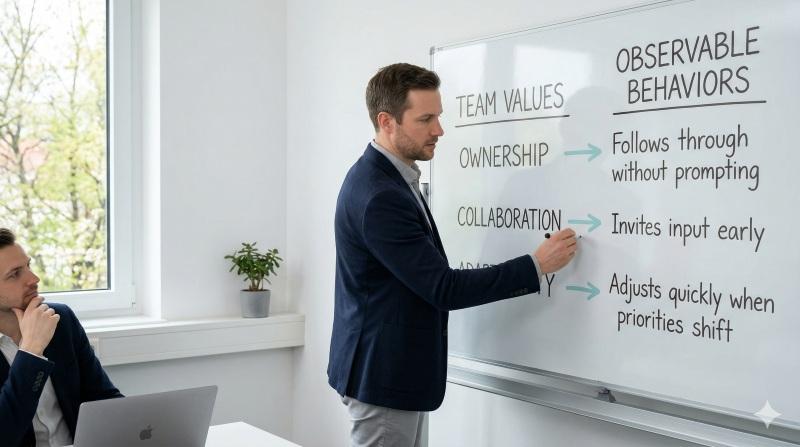
- Define top three behaviors that matter in your team’s reality. Examples:
- “Raises issues early”
- “Disagrees directly, stays constructive”
- “Works well with ambiguity”
- “Documents decisions and follows through”
- Define top three culture signals that affect retention:
- Speed vs. precision
- Autonomy vs. process
- Debate vs. harmony
- Individual ownership vs. consensus
- Pick questions that expose motivators and behavior, not identity:
- Motivation question to surface what they optimize for
- Conflict question to surface collaboration under stress
- Stakeholder “no” question to surface boundary-setting and communication
This is where “culture fit” becomes measurable enough to use.
Interview design tips and hiring process integration
If you want better hiring outcomes, stop treating interviews like casual conversations. Treat them like a measurement process that still feels human.
Standardized scorecards and interviewer calibration
A scorecard is non-negotiable if you want consistency across interviewers and across candidates.
Minimum scorecard structure
- Competency being tested (linked to job description)
- Question asked (exact phrasing)
- 2–3 scoring criteria (behavior + impact)
- 1–5 scale definitions (what a 1, 3, 5 look like)
- Red flags to watch for
Calibration step (15 minutes per role)
Before interviews start, align interviewers with two sample answers:
- “What would score as a 3?”
- “What would score as a 5?”
This prevents the common failure where one interviewer gives a 5 for confidence and another gives a 2 for the same answer because they are silently scoring different things.
Probing consistently and reducing bias
The easiest way to introduce bias is to probe one candidate deeply and let another candidate off with a shallow answer because they “seem sharp.”
Rules that actually work:
- Ask the same core question to every candidate.
- Use the same three follow-ups unless there’s a clear reason not to.
- Push for concrete examples when answers are abstract.
- Take notes on behaviors and outcomes, not “likability.”
Bias-reducing micro-habit:
- Write down the candidate’s claim, then ask “what did you do” and “what changed.”
That single move filters out fluff fast.

Combining OAD assessment output with individual application access for your team and interview notes
Use OAD results as a decision aid, not a veto stamp.
A practical integration method:
- Before interviews: identify 2–3 role-critical behaviors (e.g., boundary-setting, collaboration, drive, attention to detail).
- Use OAD to choose what needs validation: where the assessment suggests a potential mismatch, plan targeted probing.
- Validate in the interview: ask a behavioral question that forces evidence.
- Score the behavior based on the interview evidence, not on what you expected from the assessment.
Example:
- Assessment suggests low preference for structure.
- You ask: “Describe a time you had to work in a highly structured process. How did you adapt?”
- You score adaptation behavior and outcomes.
This keeps you from hiring purely on charm or rejecting purely on labels, and early risk and readiness alerts help you spot burnout or misalignment before it turns into turnover.
Design teams with data, not gut feel.
Most org-design decisions come down to role fit, leadership style, and team dynamics. OAD reads those signals from a 7-minute behavioral survey, so you can reconfigure roles and teams with evidence instead of guesswork.
Questions to avoid and legal considerations
You can run the cleanest scoring rubric on earth and still create legal exposure by asking the wrong thing. The fix is simple: stop asking about protected characteristics directly or indirectly, and ask about job requirements instead.
Common illegal or bias-prone topics
Global baseline: avoid questions that reveal (or pressure candidates to reveal) protected characteristics like age, disability/health, religion, race/ethnicity, sexual orientation, pregnancy/family status, and similar categories. The exact list and enforcement vary by country, but the risk pattern is consistent.
High-risk categories to avoid:
- Health and disability (pre-offer): In the US, the EEOC is explicit that employers generally should not ask disability-related or medical questions before a job offer.
In the UK, Section 60 of the Equality Act restricts pre-employment health/disability questions in most cases. - Age: “What year did you graduate?” is the classic “I’m not asking your age, I’m just asking your age” move.
- Family status / pregnancy: Anything about children, childcare, family planning, marital status.
- Nationality / citizenship: In the US, you can ask if someone is authorized to work, not where they’re “really from.”
- Religion: Questions about holidays, worship, or “cultural fit” that basically means religion.
- Race/ethnicity and related proxies: “Where are you originally from?” “What’s your native language?” unless language is a genuine job requirement.
Neutral alternatives that still get you what you need
Instead of asking about personal traits, ask about job performance constraints.
Instead of: “Do you have any disabilities?”
Ask: “This role requires X (lifting 15kg, standing for long periods, frequent travel). Can you perform these essential functions with or without reasonable accommodation?” (Align with EEOC-style guidance.)
Instead of: “Do you have kids / will childcare be an issue?”
Ask: “This role requires availability for X schedule and occasional late calls. Can you meet those requirements?”
Instead of: “What religion are you / will you need time off for holidays?”
Ask: “This role has fixed coverage windows. Are there any scheduling constraints we should be aware of for consistent coverage?” (Then apply the same standard to everyone.)
Instead of: “How old are you?”
Ask: “Are you legally eligible to work in this role in this location?” (If your jurisdiction has minimum age requirements for the role, keep it job-justified and consistent.)
Instead of: “Where are you from originally?”
Ask: “Are you currently authorized to work in [country], and will you require sponsorship now or in the future?” (US framing differs by employer and context, but this is the intent-safe version.)
Global note with slight US preference
- US (practical baseline): Treat EEOC pre-employment guidance on disability/medical inquiries as a hard line: no medical/disability questions and no medical exams before an offer, and keep questions tied to ability to perform the job.
- UK: Assume pre-offer health/disability questions are generally off-limits except narrow exceptions; design your interview guide so you never need them.
- EU: Anti-discrimination protections are grounded in EU directives and implemented through national laws. Don’t improvise country-specific legal judgments in interviews. Standardize questions around job requirements and documented competencies.
Practical process control (works everywhere): build your interview guide so every question maps to the job description, and train interviewers to stop “curiosity” questions. Curiosity is how you get lawsuits.
Common interviewing mistakes and how to avoid them
Interviewing stands as the defining moment in talent acquisition — where organizations either unlock exceptional potential or watch it slip through structural blind spots. Even seasoned hiring leaders fall prey to predictable patterns that sabotage their ability to surface truly transformational talent. These moments demand more than intuition; they require engineered precision that cuts through surface impressions to reveal authentic capability. By mastering these hidden dynamics and architecting a more intentional interview framework, you don’t just improve hiring outcomes — you transform your organization’s capacity to identify candidates whose skills, collaborative instincts, and cultural alignment will drive sustainable performance and unlock the full potential of your teams.
Over-relying on gut feeling
Successful hiring decisions separate thriving organizations from struggling ones — and intuition-driven processes guarantee inconsistency, bias, and missed potential. Forward-thinking leaders understand that first impressions, while inevitable, must never overshadow evidence-based assessment. The solution isn’t complex: engineer your interview process through preparation, structure, and measurable criteria. Deploy behavioral interview questions — “describe a time you overcame a challenge” or “tell me about a situation where you had to adapt quickly” — that unlock specific past experiences and reveal true capability patterns. Then implement a structured scoring system that evaluates every response against clear, job-relevant criteria. This approach transforms subjective impressions into objective assessment — ensuring that every candidate navigates the same rigorous evaluation process, measured against the skills that drive success, not just personal chemistry with the interviewer.
Asking leading or illegal questions
Strategic hiring conversations aren’t built on chance encounters with talent — they’re engineered through disciplined focus and intentional design. The temptation to drift into personal territory, exploring family dynamics or age-related assumptions, doesn’t just threaten legal compliance; it undermines the very foundation of performance-driven recruitment. Every question becomes a strategic instrument when anchored firmly in role requirements and behavioral competencies that fuel organizational success. Transform your interviews into powerful discovery tools with open-ended inquiries like “can you describe a project you worked on with a team?” or “how do you handle a difficult team member?” — questions that unlock authentic examples of capability and cultural alignment. This disciplined approach doesn’t just protect against discrimination claims; it elevates the entire conversation from surface-level pleasantries to meaningful exchanges about performance potential and collaborative excellence, where job relevance becomes the compass that guides every interaction toward sustainable talent decisions.
Failing to probe for evidence
True candidate assessment rises or falls on one critical factor: how deeply you excavate beneath surface-level responses to uncover authentic capability. Surface-level acceptance isn’t just a mistake — it’s a barrier to unlocking the real talent that drives sustainable hiring success. To engineer genuine insight into a candidate’s abilities, you must architect your approach through science-backed probing that demands concrete evidence. Transform your behavioral interviews by embedding the STAR method (Situation, Task, Action, Result) as your foundation, then challenge candidates to “describe a time” they navigated specific complexities. When a candidate shares their experience, don’t just accept — elevate the conversation with follow-ups that flow naturally: “can you walk me through your thought process?” or “what measurable outcome emerged from your actions?” This methodology doesn’t just gather information — it reveals authentic patterns of how candidates have performed under pressure, transforming your evaluation process from guesswork into reliable, evidence-based decision making that unlocks the full potential of your hiring strategy.
Ignoring role-specific competencies
Successful organizations distinguish themselves through one critical capability: their precision in identifying talent that drives measurable performance. Generic interview approaches may appear comprehensive, but they systematically fail to reveal the competencies that determine role success — leaving leaders with data that misleads rather than illuminates. To engineer meaningful hiring outcomes, align your interview methodology with the specific competencies that define excellence in each position. Focus relentlessly on the capabilities that generate sustainable impact — whether that’s sophisticated communication, systematic problem-solving, or transformative leadership. Deploy targeted inquiries such as “can you give an example of a time when you had to communicate complex information to a non-technical audience?” or “how do you approach problem-solving in your work?” This strategic approach transforms your assessment process from guesswork into a predictive system that identifies candidates who don’t just fill roles — they elevate performance and unlock organizational potential.
Not calibrating interviewers
Organizations rise or fall on one critical juncture: the moment they evaluate talent. Misaligned interviewers don’t just create inconsistent evaluations — they architect bias into the very foundation of their hiring decisions. True interview excellence isn’t accidental; it’s systematically engineered through rigorous preparation, unified standards, and unwavering consistency.
Exceptional hiring performance emerges when all interviewers operate from a shared framework of understanding. They master standardized processes, embrace evidence-based evaluation criteria, and deploy sophisticated scoring systems that transform subjective impressions into measurable insights. Armed with structured interview guides and precision-crafted questions that illuminate relevant capabilities — such as “describe a project you orchestrated from conception to completion” or “how do you navigate team dynamics when accountability falters” — these leaders conduct calibration sessions that align perspectives and eliminate bias. This systematic approach doesn’t just improve hiring decisions; it transforms recruitment into a competitive advantage.
By transcending these pervasive interviewing pitfalls, forward-thinking organizations engineer more powerful and equitable talent acquisition systems. They craft interview frameworks anchored to role specifications, pursue concrete behavioral evidence, and deploy consistent evaluation methodologies that unlock superior talent identification. With this structured excellence, they don’t just assess skills, cultural alignment, and potential — they architect sustainable competitive advantage, positioning their enterprises to thrive in an increasingly complex marketplace.
FAQ: Best interview questions (People Also Ask)
What are the best interview questions to ask a candidate?
The best interview questions produce scorable evidence tied to the job description. Use a small set that covers: past behavior (“describe a time”), judgment (“walk me through a tough decision”), role skill (a small live problem if needed), and motivation (retention risk). Then score behavior and impact, consistently, across candidates.
How many interview questions should you ask in a 30-minute or 60-minute interview?
- 30 minutes: 3 core questions + 2–3 follow-ups each (phone screen style). Prioritize role fit, one behavioral, one motivation or day-one question.
- 60 minutes: 5–6 core questions with structured probing. More than that usually turns into shallow answers and messy notes.
What are the best interview questions for managers and leadership positions?
Focus on decision making process, influence, and accountability:
- “Describe a time you led change.”
- “Walk me through a tough decision.”
- “Describe a time you said no to a stakeholder.”
- “Describe a time you failed and learned.”
Score for trade-offs, data use, ownership, and measurable outcomes.
What are good interview questions to identify red flags quickly?
Use questions that force concrete examples and expose avoidance:
- “Describe a time you made a mistake. What changed because of it?”
- “Tell me about a conflict at work and how you handled it.”
- “What would you do first on day one, and why?”
Red flags show up as vague answers, missing ownership, blaming, or outcomes that never materialize.
What interview questions should you avoid?
Avoid questions that can reveal protected characteristics or medical/disability information before an offer, and avoid “curiosity” questions unrelated to job requirements. In the US, the EEOC is explicit that pre-offer disability-related and medical questions are generally restricted.
In the UK, Section 60 of the Equality Act restricts most pre-employment health questions.
Can I ask about work authorization or citizenship in the US?
The safer approach is to ask whether the candidate is authorized to work (and about sponsorship needs), rather than asking about citizenship.
Final recommendations and next steps
Shortlist 6–9 core questions per role
Use a balanced set:
- 3–4 behavioral questions (“describe a time”) for past evidence
- 1 decision-making question for judgment and trade-offs
- 1 technical/live problem only if the job truly requires it
- 1 motivation question to reduce retention risk
Run a pilot round and adjust based on signal
After 5–8 candidates, review:
- Which questions produced consistent, comparable evidence
- Which questions generated vague answers (rewrite or replace)
- Whether interviewers scored similarly (calibration problem) or wildly differently (scorecard problem)
Use OAD to calibrate behavioral signals
If you want to reduce “gut feel” and improve consistency, use OAD as a supporting layer to target probing and compare candidates more cleanly. Start with the free Top Performer Profile: 7 minutes, results in 24 hours, no credit card.