
OAD’s behavioral diagnostic isn’t a personality test or a culture-fit questionnaire. It’s a validated psychometric instrument with more longitudinal performance data behind it than any competitor on the market, with the compliance credentials to prove it in any jurisdiction.
1986
1992
2001
2011
2019
2025
Assessments completed — more longitudinal data than any competitor
Of continuous validation since 1986 across 40+ countries
Independent third-party validation cycles completed. Next: 2028.
Successful legal challenges in 38 years of use in hiring decisions
Most assessments measure who someone is: their personality type, their values, their communication style. OAD measures something different: how someone is behaviorally wired to operate under role-specific pressure. That distinction is what makes it predictive of performance rather than merely descriptive of character.
The diagnostic uses a free-choice word-selection format, not a Likert scale, not agree/disagree statements, not forced-choice scenarios. Respondents select words that feel natural to them in a work context. Because there are no “correct” answers and the format is non-transparent, results cannot be coached, gamed, or socially desired.
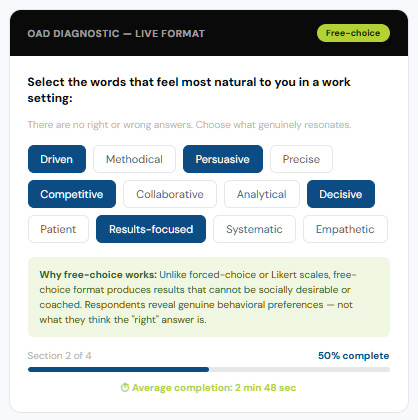
Each dimension is independently validated against job performance outcomes across 38 years and 40+ industries. Together they form a behavioral fingerprint that predicts how someone will perform in a specific role, not just whether they seem like a good fit.
DriveThe engine of performance
Measures intrinsic motivation and the intensity of goal-directed behavior. High Drive predicts persistence through rejection, self-starting behavior, and quota attainment in sales roles.
High score predicts
The rep you passed on last quarter? They might have been your next top performer. You’ll never know.
InfluenceHow someone moves people
Measures the natural tendency to persuade, inspire, and build relationships. Predicts client-facing performance, leadership emergence, and ability to navigate complex stakeholder environments.
High score predicts
Strong performance in sales, CS, and people management
ResilienceHow someone handles pressure
Measures the behavioral capacity to sustain performance under stress, rejection, and uncertainty. Critical predictor of retention and consistent output in high-pressure roles.
High score predicts
Retention, consistency, and performance under pressure
StructureHow someone operates in process
Measures preference for systematic, procedural, and rule-based environments. High Structure predicts operational reliability in roles requiring consistent execution to defined standards.
High score predicts
Excellence in ops, compliance, and execution-heavy roles
LeadershipHow someone develops others
Measures the behavioral drive to develop, direct, and take responsibility for others’ outcomes. Predicts management effectiveness — independent of individual contributor performance.
High score predicts
Management effectiveness and team development capacity
A psychometric instrument is only as credible as its validation. OAD has been validated on all three dimensions that matter to employers, regulators, and courts. Every study is published and available to enterprise clients under NDA.
Criterion Validity: Does it predict performance?
Statistical correlation between OAD profile scores and measurable job performance outcomes (quota attainment, retention, throughput, and manager ratings) confirmed across 38 years and multiple industries. Correlation coefficients available in the full technical report.
Content Validity: Does it measure what it claims?
Independent content validity studies confirm that OAD measures behavioral drive, not personality type, cognitive ability, or any protected characteristic. The five dimensions are operationally defined and independently verified by external psychologists.
Construct Validity: Is the theory sound?
Confirmatory factor analysis confirms the five-dimension structure is statistically stable across populations, industries, and geographies. The construct is replicable and not subject to cultural, demographic, or language-based distortion.
The EEOC’s Uniform Guidelines on Employee Selection Procedures require that any selection tool used in hiring must demonstrate no adverse impact on race, gender, age, national origin, religion, or disability status. OAD has been tested against all protected classes in all jurisdictions where it is deployed. The result has been consistent for 38 years.
Race & EthnicityNo statistically significant score differences across racial or ethnic groups in any jurisdiction studied. Four-fifths rule satisfied in all populations tested.
GenderNo adverse impact on female, male, or non-binary respondents. Score distributions are statistically equivalent across gender groups.
AgeNo correlation between age and OAD scores. The instrument is equally valid and equally neutral across all working-age demographics.
Disability StatusThe free-choice format requires no specific cognitive ability and creates no systemic disadvantage for any disability group. Accessible on all devices.
OAD.ai meets the compliance requirements of every major regulatory body governing the use of psychometric assessments in employment decisions.
EEOC
Equal Employment Opportunity Commission
United States federal employment law
✓ Fully compliant · Since 2001
APA
American Psychological Association
Standards for Educational & Psychological Testing
✓ Certified · Independently reviewed 2023
BPS
British Psychological Society
UK, EU, and Commonwealth jurisdictions
✓ Level B Certified · Since 2011
Most assessment tools claim to predict performance. Very few have the longitudinal validation data to prove it. Here’s how OAD compares on the dimensions that matter most to enterprise procurement teams.
Criteria
oad.ai
Predictive Index
Culture Index
DISC / Personality Tests
Validation
Years of longitudinal data
38 years
~30 years
~20 years
Varies
Total assessments in dataset
10M+
~20M
~5M
Varies
Independent third-party validation
✓
✓
Partial
✗
Criterion validity (predicts job performance)
✓
✓
Partial
✗
Compliance
EEOC compliant — no adverse impact
✓
✓
Varies
✗
APA standards met
✓
✓
—
✗
BPS Level B certified (UK/EU)
✓
Partial
—
✗
Successful legal challenges in 38 years
0
Unknown
Unknown
Multiple
Assessment Design
Cannot be gamed or coached
✓
Partial
Partial
✗
Cannot be gamed or coached
✓
✓
✓
✗
Completes in under 5 minutes
3 min
6–8 min
5–7 min
10–20 min
The value of a behavioral assessment isn’t just what it measures, it’s what the benchmarks are built from. OAD’s 10M+ assessment dataset means the role benchmarks your candidates are measured against are built from more real-world performance data than any competitor can match.
Total assessments completed since 1986 — the foundation of every benchmark
Countries in the dataset — geographic and cultural diversity built into every norm group
Industry verticals with sufficient sample sizes for role-specific benchmarks
Assessments from existing OAD.ai clients feeding the benchmark model continuously
Is OAD a personality test?
No. OAD measures behavioral drive — how someone is wired to operate in a specific role context — not personality type, cognitive ability, or emotional intelligence. The distinction matters legally: personality tests used in hiring have faced adverse impact challenges. OAD has not, because it measures job-relevant behavioral tendencies, not personal characteristics.
Can candidates challenge a hiring decision based on OAD results?
In 38 years and 10M+ assessments across multiple jurisdictions, there has not been a successful legal challenge to a hiring decision made using OAD. This is because OAD satisfies the three requirements for a defensible selection tool: it is job-related, consistent with business necessity, and shows no adverse impact on protected classes.
How often is the assessment re-validated?
OAD undergoes full independent third-party validation every five years. The most recent cycle was completed in 2023. The next scheduled validation is 2028. Between full validation cycles, ongoing criterion validity monitoring is conducted using live client performance data with appropriate consent provisions.
Can the assessment be translated for non-English speakers?
Yes. OAD is available in multiple languages and has been validated in non-English speaking populations. Translation equivalence studies have been conducted to ensure that translated versions produce equivalent results to the English-language version. Contact your Performance Director for specific language availability.
What is the test-retest reliability of OAD?
OAD scores show high test-retest reliability over short intervals (r = 0.88 at 30 days) and moderate stability over longer periods (r = 0.72 at 12 months), consistent with the understanding that behavioral drive can evolve with significant life or role changes. Full reliability coefficients are available in the technical manual.
Does OAD comply with AI regulations like the EU AI Act?
OAD’s behavioral diagnostic is a validated psychometric instrument, not an AI system making autonomous decisions. The AI components of OAD.ai (coaching guides, interview questions, executive reports) are AI-assisted tools for human review, not automated decision-making systems. We are monitoring EU AI Act implementation and will publish full compliance guidance ahead of enforcement dates.
The free Top Performer Profile puts the science to work on your actual best performer. See what the data reveals in 24 hours, and understand why it’s been predicting performance for four decades.
No contract · No credit card · Results in 24 hours · EEOC & APA compliant