Every candidate who sits a personality test in a hiring process knows one thing: the job is on the line.
So some of them answer as the person they think you want. Organized. Calm. A natural team player. Never stressed.
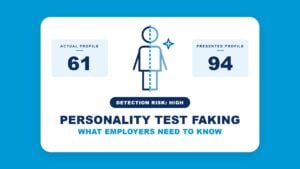
That is a fake personality, and it is the main reason many hiring leaders do not trust personality assessment results. The worry is reasonable. Applicants do inflate their answers. But the useful questions are how much, on which traits, and what you can do about it. This guide covers what faking looks like, why employers use personality tests anyway, which tools are built for hiring and which are not, and how to keep one polished set of answers from deciding a hire.
Key takeaways
- A fake personality in a personality test is a deliberate effort to present an idealized version of yourself instead of how you typically behave at work.
- Job applicants measurably inflate their scores, most on traits that look desirable for the role, such as conscientiousness and emotional stability.
- Personality tests have no right or wrong answers, but their results only mean something when compared against what the specific job requires.
- Some popular tools, including the Myers-Briggs Type Indicator, are not designed for hiring decisions, according to their own publishers.
- No personality assessment should be the sole basis for a hiring decision. Combine it with structured interviews and other evidence.
What a Fake Personality Means in a Personality Test
A fake personality, in a hiring context, is a deliberate attempt to answer a personality assessment as an idealized candidate rather than as yourself.
It is different from normal adaptation. Everyone behaves somewhat differently in different situations. You are more formal with a client than with a colleague. You are more structured on a deadline than on a Friday afternoon. Being different in different social contexts does not, by itself, mean someone is fake.
The line is intent. Authentic behavior is how someone typically operates, including how they adjust to the demands of a role. Deliberate self-presentation is choosing answers because they seem to be what the employer wants to hear, regardless of whether they are true.
That distinction matters for employers. You want to know how someone naturally works and how they adapt. You do not want a candidate’s guess about your ideal profile.
Why Employers Use Personality Tests in the Hiring Process
Employers use personality tests to add structured, comparable information about how candidates are likely to behave at work, which interviews and résumés capture poorly.
How employers interpret results. A personality assessment produces a profile across several traits or preferences. Used well, that profile is compared with what the role demands: a sales role that requires persistence through rejection, an operations role that requires precision and follow-through. Used badly, it is read in isolation as a verdict on the person.
How tests support candidate screening. Assessments give every candidate the same questions, scored the same way. That consistency is the point. An interview rewards whoever is most articulate and confident. A structured assessment gives quieter candidates the same chance to show how they work.
The risk of treating results as objective truth. No assessment is a perfect measure. Scores carry error, candidates can distort answers, and many tools were never validated for hiring at all. Treating a profile as fact rather than evidence is how good candidates get screened out for the wrong reasons.
Privacy concerns around workplace personality data. Personality data is sensitive. Candidates are right to ask who sees their results, how long they are stored, and whether they will follow them into a new job. Employers should be able to answer all three. Before using any tool, get those answers from the vendor in writing, including which data protection laws it complies with.
One legal boundary is worth knowing. In the US, a test designed to identify mental disorders can count as a medical examination under the Americans with Disabilities Act. In Karraker v. Rent-A-Center (2005), a federal appeals court found that using the Minnesota Multiphasic Personality Inventory (MMPI) to screen employees for promotion violated the ADA, because that test was designed to reveal mental impairments. Personality measures built for workplace behavior are a different category from clinical instruments.
Personality Assessment Through Psychometric Tests
Psychometric tests measure personality by asking structured questions about behavioral preferences and scoring the pattern of answers against a defined model.
How they measure behavioral preferences. Most use one of two formats. Likert-type items ask you to rate a statement from “strongly disagree” to “strongly agree.” Forced-choice items ask you to choose between options that sound equally desirable, such as “I finish what I start” versus “I get along with almost everyone.”
Why there are no right or wrong answers. A personality test does not have right answers the way a math test does. A high score on assertiveness is a strength in some roles and a liability in others. The “right” profile depends entirely on the job, which is why results only become useful when compared with what top performers in that role actually look like.
Validation scales that detect inconsistent responses. Many hiring assessments include checks that flag questionable answering patterns: social desirability scales that catch candidates claiming implausibly perfect behavior, and consistency checks that compare answers to similar questions asked in different ways. These do not prove a candidate is lying. They flag a result that deserves a closer look.
Personality Traits Employers Commonly Review
The traits employers most often review are reliability, adaptability, and communication style, because they connect directly to how someone will perform and fit the demands of a role.
Reliability. Does this person do what they commit to? In Big Five terms, reliability sits mostly within conscientiousness, one of the more consistent predictors of job performance across roles.
Adaptability. How does someone respond to changing priorities, ambiguity, and setbacks? Some roles reward steady routine. Others punish it.
Communication style. Direct or diplomatic, fast or deliberate, detail-heavy or big-picture. No style is better in the abstract. The question is whether it matches what the role and the team actually need.
Notice that each of these is only meaningful relative to the job. That is also why faking is harder than candidates think: a candidate guessing at “good” answers does not know which profile the role actually calls for.
Myers Briggs Type Indicator and Other Personality Testing Models
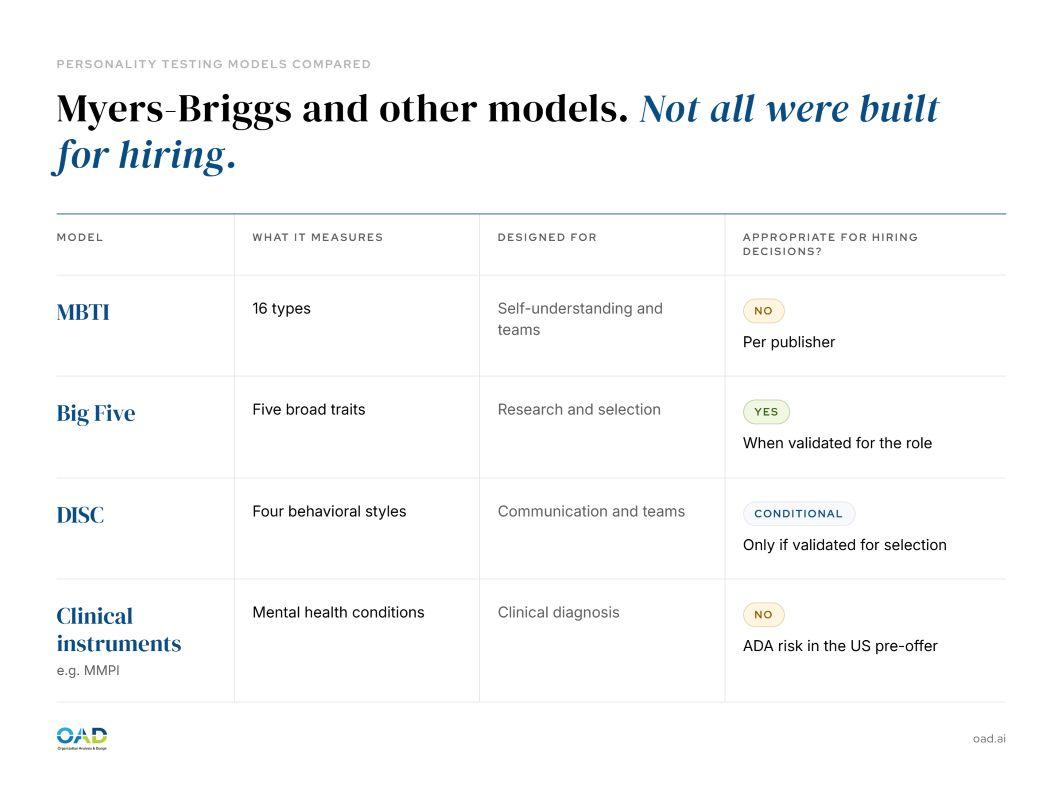
The Myers-Briggs Type Indicator, the Big Five, and DISC are the most familiar personality models, but they were built for different purposes, and only some are designed for hiring decisions.
Myers-Briggs Type Indicator (MBTI). The MBTI sorts people into 16 personality types based on four preference pairs. It is popular for team building and self-understanding. Its own publisher and the Myers & Briggs Foundation state that it should not be used for hiring or selection, because it does not measure ability or predict job performance.
Big Five. The Big Five model measures five broad traits: openness, conscientiousness, extraversion, agreeableness, and emotional stability. It is the most widely accepted framework in personality research and has the strongest evidence linking traits to workplace performance.
DISC. DISC is a workplace-focused model built around four behavioral styles: dominance, influence, steadiness, and conscientiousness. It is commonly used for communication training and team development. Employers using any tool for selection should confirm it has been validated for that purpose.
Personality models are not clinical evaluations. Workplace personality assessments describe normal-range behavioral tendencies. Clinical psychological evaluations diagnose mental health conditions. Confusing the two is both a scientific error and, as the Karraker case shows, a legal risk.
Can You Pass a Personality Test Without Faking It?
There is no guaranteed way to pass a personality test, because there is no single passing profile. Results are compared against what a specific role requires.
Why candidates cannot guarantee a passing score. A candidate cannot know which profile the employer is looking for. The answers that look strong for a sales role may look like a mismatch for a compliance role. Gaming the test means guessing at a target you cannot see.
How role fit shapes the outcome. A “fail” on a well-designed assessment usually means a poor match with the demands of that particular role, not a judgment on the person. For the candidate, that can be useful information. A role that requires constant behavior against your natural tendencies is a role that tends to burn people out.
One test rarely decides the hire. Responsible employers use personality assessment as one structured input alongside interviews, work samples, and references. Treat that as a non-negotiable rule: an assessment is one structured input into a hiring decision, never the sole basis for it.
Design teams with data, not gut feel.
Most org-design decisions come down to role fit, leadership style, and team dynamics. OAD reads those signals from a 7-minute behavioral survey, so you can reconfigure roles and teams with evidence instead of guesswork.
Answer Honestly
The best advice an employer can give candidates is to answer honestly, because honest answers produce the only results that are useful to both sides.
Respond based on typical workplace behavior. Candidates should answer as they usually behave at work, not as they behave on their best day or think they should behave.
Answer without outside help. Asking a friend, searching for “the right answers,” or using an AI tool to pick responses defeats the purpose. It produces a profile of what someone thinks employers want, not a profile of the candidate.
Trust the first reasonable response. Overthinking an item usually pulls answers toward what seems desirable. The first honest reaction tends to be the more accurate one.
Employers can reinforce this by saying it plainly in the invitation: there are no right or wrong answers, results are compared with the role’s demands, and honest answers give candidates the best chance of landing in a job that suits them.
Avoid Extreme Answers
Extreme answers are fine when they are true and a warning sign when they are strategic. The pattern matters more than any single response.
When extreme answers are accurate. Some people really do always meet deadlines or strongly prefer working alone. If “strongly agree” is honest, it is the right answer.
When they are strategic. Choosing “strongly agree” on every desirable-sounding item and “strongly disagree” on every undesirable one produces a profile that looks too good. Real people have trade-offs. A profile with none is less credible, not more.
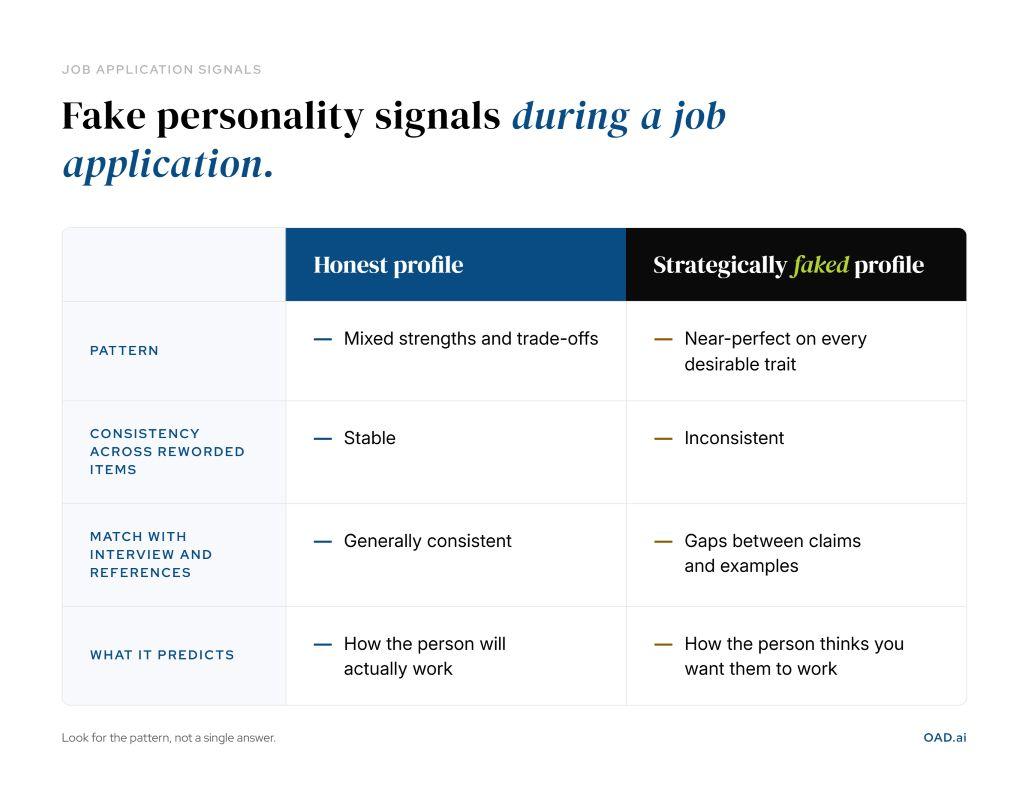
How repeated items reveal manipulation. Many assessments ask about the same tendency in several ways. A candidate answering strategically struggles to stay consistent across differently worded items, and the inconsistency shows up in the results.
Fake Personality Signals During a Job Application
The clearest signals of deliberate answer manipulation are implausibly perfect profiles, inconsistent answers to similar items, and a mismatch between assessment results and evidence from the rest of the process.
What research says about applicant faking. It is real, and it is targeted. A meta-analysis of 33 studies found job applicants scored higher than non-applicants on several traits, with the largest gaps on conscientiousness and emotional stability, and that applicants inflated the traits that looked most relevant to the specific job, such as extraversion for sales roles.
Inconsistent answers undermine credibility. A profile that is extreme on desirable traits but inconsistent across related items is a weaker basis for a decision than an honest, mixed profile.
Presenting an idealized persona can backfire. A candidate who fakes their way into a role that does not fit their natural behavior has won a job they will struggle in. For the employer, that is a mis-hire waiting to surface.
Candidates should review the role’s actual expectations. The legitimate way to prepare is to read the job description and understand what the role demands, then decide honestly whether it fits. That is preparation, not faking.
What employers can do about it. Format matters. A 2019 meta-analysis found that forced-choice personality measures, which ask candidates to choose between equally desirable options, showed much less score inflation in high-stakes settings than single-statement rating scales.
Design matters too. Some assessments measure natural behavior separately from how a person believes the role requires them to behave. When they do, the gap between the two is information in its own right.
Design teams with data, not gut feel.
Most org-design decisions come down to role fit, leadership style, and team dynamics. OAD reads those signals from a 7-minute behavioral survey, so you can reconfigure roles and teams with evidence instead of guesswork.
Personality Testing Versus Job Interviews
Personality tests and job interviews measure different things, and the most reliable hiring decisions combine both.
Timing across the hiring process. Many employers place an online assessment early, after the application and before interviews, so results can shape which questions to ask. Others use it later as a final check. Earlier tends to be more useful, because it informs the interview instead of just confirming a decision.
What interviews add. Interviews provide behavioral context: specific examples of how someone handled a real situation. They are also open to faking. Candidates rehearse answers, and interviewers reward confidence. A personality profile tells you where to probe. A structured interview tests whether the stories back it up.
Why recruiters should combine multiple evidence sources. Every method can be gamed on its own. It is much harder to fake consistently across a validated assessment, a structured interview, a work sample, and references at once. When the evidence agrees, you can trust it. When it conflicts, you know exactly where to dig. For how to structure the interview half, see How to Assess Personality Traits in Hiring: A Practical Guide.
Build Self Awareness Before Responding
Self-awareness is the best preparation for a personality assessment, because candidates who know their own patterns answer more consistently and accurately.
Reflect on recurring traits. Candidates can ask themselves how colleagues and managers would describe them, and what feedback keeps coming back.
Review workplace strengths. Knowing where you consistently perform well makes it easier to answer honestly instead of aspirationally.
Identify situations that change typical behavior. Most people behave differently under pressure, with new teams, or in unfamiliar roles. Knowing those shifts helps candidates answer about their typical behavior rather than their best or worst day.
Self-awareness makes answers more consistent. A candidate who knows themselves well produces a stable, credible profile. That is the profile both sides need: one that predicts how the person will actually work once the offer is signed.
Faking is a problem when a personality profile is compared with an imagined ideal. It matters far less when it is compared with what your top performers actually do. Get Your Free Top Performer Profile: 7 minutes, results in 24 hours, no credit card.