A résumé tells you what someone claims they did. An interview tells you how well they talk about it.
Neither tells you how they will think, learn, or behave in your role.
That gap is why employers use pre-employment tests. But “employment test” covers everything from a ten-minute typing check to a full cognitive battery, and the types differ widely in what they measure, how well they predict job performance, and how much legal risk they carry. This guide walks through the main employment test types, what each one measures, which roles they fit, and how to build a testing process that is fast, fair, and defensible.
Key takeaways
- Employment tests are standardized assessments that give every candidate the same questions, scored the same way, which makes candidates directly comparable.
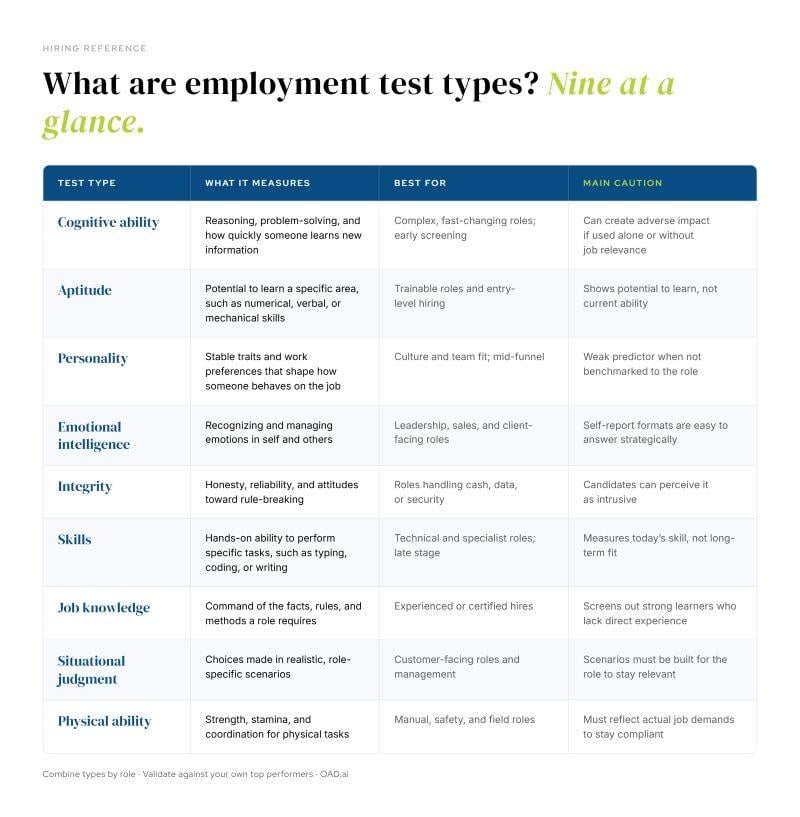
- The main types are cognitive ability, aptitude, personality, emotional intelligence, integrity, skills, job knowledge, situational judgment, and physical ability tests.
- No single test type predicts everything. The strongest hiring processes combine one or two tests with a structured interview.
- Every test must be job-related, validated for its purpose, and monitored for adverse impact. Under EEOC guidance, the employer stays responsible for that, not just the vendor.
- Track what happens after hiring. A test that does not predict performance or retention in your roles is costing candidates time for nothing.
What Are Employment Test Types?
Employment tests are standardized assessments that measure a candidate’s abilities, knowledge, skills, or behavioral tendencies using the same questions and scoring for every applicant.
Assessments versus résumés. A résumé is self-reported history, written to impress. Two candidates with identical résumés can perform very differently. An assessment measures something directly, under the same conditions for everyone, and produces data you can compare.
How tests support structured hiring decisions. Tests replace “I liked her” with evidence: this candidate scored in the top quartile on numerical reasoning, this one showed a behavioral profile close to your top performers in the role. That evidence does not make the decision for you. It gives every decision the same starting point.
Why Use Employment Tests in the Hiring Process?
Employment tests make screening more consistent, speed up candidate comparison, scale to high volume hiring, and, when chosen well, improve hiring outcomes.
Screening consistency. Without tests, the first screen depends on which recruiter reads the application and how tired they are. A test applies the same criteria to every applicant.
Faster candidate comparisons. Scores put candidates on a common scale. Instead of rereading thirty applications, recruiters can see who meets the threshold and focus interview time there.
High volume hiring. For roles with hundreds of applicants, short, automatically scored assessments are often the only practical way to evaluate everyone rather than the first fifty who applied.
Stronger hiring outcomes. Well-chosen tests predict performance better than the methods many employers rely on most. In the most recent large-scale re-analysis of selection research, years of experience predicted job performance at just .07, while job knowledge tests reached .40 and cognitive ability tests .31. We break down that research in Predicting Job Performance: What the Evidence Says Actually Works.
Cognitive Ability Tests Measure General Reasoning
Cognitive ability tests measure general reasoning: how well someone understands information, solves problems, and learns new material. Most combine three formats.
Verbal Reasoning Tests
Verbal reasoning tests measure how well candidates interpret written workplace information. A typical item gives a short passage, such as a policy update or a project brief, followed by statements to judge as true, false, or cannot determine from the text.
The skill being tested is not vocabulary. It is reading precisely and not assuming more than the text says. Verbal reasoning matters most in communication-heavy roles: account management, compliance, operations, and anything involving contracts or customer correspondence.
Numerical Reasoning Tests
Numerical reasoning tests measure how well candidates work with data. Items usually present a chart or table, such as quarterly sales by region or cost breakdowns, and ask questions that require calculation and interpretation.
This is practical data-driven decision making: reading a dashboard correctly, spotting the trend that matters, and not being misled by a misleading axis. Finance roles, analysts, and managers who own budgets or targets typically require it.
Inductive Reasoning Tests
Inductive reasoning tests measure pattern recognition. Candidates see a sequence of shapes or symbols and identify the rule that produces the next one.
Because the items are abstract, they depend less on language and specific education, which makes them useful across international candidate pools. Inductive reasoning is closely linked to learning agility: the ability to work out how a new system works without being told.
Aptitude Tests and Ability Tests Reveal Potential
Aptitude tests measure a candidate’s capacity to acquire new skills, which makes them most useful when you are hiring for potential rather than current expertise.
Aptitude versus job-specific knowledge. A job knowledge test asks what someone already knows about the work. An aptitude test asks how quickly they could learn it. The first suits experienced hires. The second suits roles where you will do the training.
Ability tests and learning capacity. Ability tests, including the cognitive formats above plus specialized ones like mechanical or spatial reasoning, measure the raw capacity that learning builds on. Spatial reasoning tests, for example, gauge how well someone understands objects and space, which matters in engineering, logistics, and technical trades.
Entry-level hiring. For graduate programs, apprenticeships, and entry-level roles, candidates have little relevant history to evaluate. Aptitude tests give you something more predictive to go on than a GPA or a first-job résumé.
Training potential. Cognitive ability has long been one of the strongest predictors of training success. If a role comes with a steep learning curve, aptitude results tell you who is likely to get up the curve fastest.
Personality, Emotional Intelligence Tests, and Integrity Tests
Personality, emotional intelligence, and integrity tests measure how candidates tend to behave rather than what they can do, which makes them most useful for predicting how someone will work, not whether they can do the work.
Personality Tests
Personality tests measure workplace preferences and tendencies: how someone approaches structure, people, pressure, and risk. The Big Five model (openness, conscientiousness, extraversion, agreeableness, emotional stability) has the strongest research base. The Myers-Briggs Type Indicator is widely known but, according to its own publisher, is not designed for hiring decisions.
Connect traits to role requirements. A trait is only useful in hiring if the role demands it. Persistence through rejection matters for sales. Precision matters for compliance. Measuring personality without defining what the job needs produces data you cannot use.
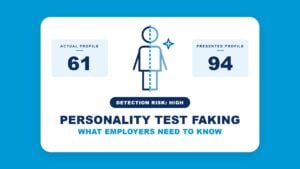
Do not use personality results alone. Personality measures predict job performance modestly on their own. Measures that ask about behavior at work tend to predict better than general ones. Results can also be distorted by candidates trying to present an ideal profile, and by temporary factors like mood on the day. Use them as one input alongside a structured interview, never as a standalone gate. We cover the faking problem in Fake Personality on Personality Tests.
Whatever you use, compare results with what the role actually demands, and ideally with how your current top performers in that role work. Like any behavioral measure, it is one structured input into a hiring decision, never the sole basis for it.
Design teams with data, not gut feel.
Most org-design decisions come down to role fit, leadership style, and team dynamics. OAD reads those signals from a 7-minute behavioral survey, so you can reconfigure roles and teams with evidence instead of guesswork.
Emotional Intelligence Tests
Emotional intelligence tests assess how well candidates recognize and manage emotions, both their own and other people’s. They typically cover self-awareness, empathy, and emotional regulation.
Leadership and teamwork. Emotional intelligence is commonly linked with leadership and team effectiveness, where reading people and staying composed under pressure matter as much as technical skill.
Customer-facing roles. Support, sales, healthcare, and hospitality roles all involve managing someone else’s frustration without escalating it. Emotional regulation is often the difference between a defused complaint and a lost customer.
Format matters here. Self-report emotional intelligence measures (which ask how you typically react) performed better in the 2022 re-analysis than ability-based ones (which test your skill at reading emotions), at about .30 versus .22.
Integrity Tests
Integrity tests measure attitudes and tendencies related to honesty, rule-following, and ethical judgment at work.
Workplace risk reduction. Integrity tests are designed to predict counterproductive work behavior such as theft, fraud, and policy violations, which makes them common in finance, retail, and roles with access to cash, data, or confidential information. They also predict overall job performance at a level comparable to cognitive ability tests in the revised estimates.
Realistic confidentiality scenarios. Stronger integrity measures go beyond “have you ever stolen anything?” A scenario-based item might describe a colleague sharing client data with a friend and ask what the candidate would do. Realistic scenarios are harder to answer strategically than obvious questions.
The faking caveat. Like personality tests, integrity tests are self-report, and candidates can shade their answers toward what looks good. Treat results as one signal, not a verdict.
Skills, Job Knowledge, and Situational Judgment Tests
Skills tests, job knowledge tests, and situational judgment tests measure job-specific capability: what a candidate can do, what they know, and how they would handle real workplace situations.
Skills tests for practical requirements. Skills assessments verify a candidate’s practical expertise in the tools and tasks of the role: coding assessments for developers, software proficiency tests for analysts, typing tests for high-volume data entry. They provide objective data that a résumé line like “advanced Excel” does not.
Job knowledge versus task performance. A job knowledge test measures what someone knows about the work, for example the rules governing a payroll calculation. A skills test or work sample measures whether they can actually do the task. Knowing the rule and executing it accurately under time pressure are related but different.
Situational judgment tests for workplace scenarios. A situational judgment test describes a realistic situation, such as an angry customer, a missed deadline, or a conflict between two team members, and asks the candidate to choose or rank possible responses. It measures practical judgment and is often well received by candidates because it looks like the job.
Match test content to daily responsibilities. The closer a test mirrors the actual work, the more it predicts and the more defensible it is. A test built on tasks the role never involves is both less useful and harder to justify.
Choosing Employment Test Types for High Volume Hiring
For high volume hiring, choose short, automatically scored assessments early in the process and keep evaluation standards identical across every candidate.
Short assessments for early screening. Long assessments at the first stage drive drop-off, often among the candidates with the most options. Put the shortest, highest-signal test first and save longer exercises for the shortlist.
Compare completion times. Before choosing between tools, check how long each takes candidates to complete. Ten minutes and forty minutes are very different asks for someone who has not spoken to you yet.
Automated scoring for recruiter efficiency. Automatic scoring removes manual review from the first stage and makes results available immediately, so strong candidates move forward before a competitor reaches them.
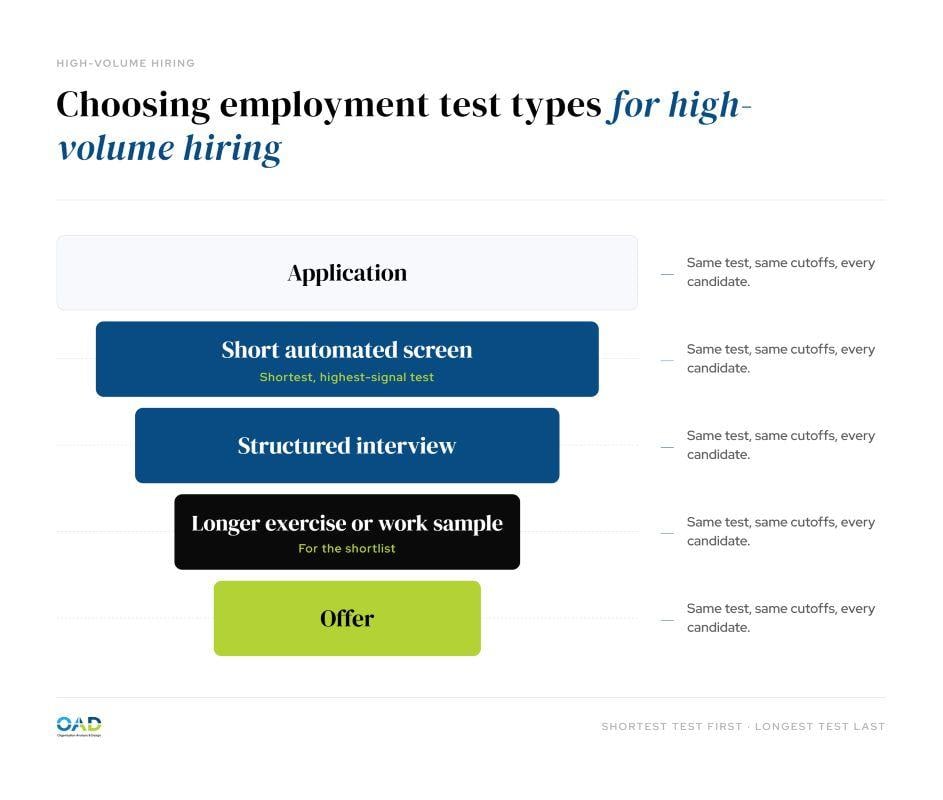
Preserve consistent standards. Speed should never mean shortcuts. Every candidate for a role takes the same assessment, under the same conditions, against the same cutoffs.
Data Driven Decision Making for Better Hiring Outcomes
Data-driven hiring means setting score benchmarks before you test, combining results with structured interviews, and checking afterward whether the tests actually predicted performance and retention.
Define score benchmarks before launching. Decide what a qualifying score looks like for each role before any candidate takes the test. Setting cutoffs after you see the results invites bias toward the candidates you already liked. The strongest benchmark is your own: what do your current top performers in the role score?
Design teams with data, not gut feel.
Most org-design decisions come down to role fit, leadership style, and team dynamics. OAD reads those signals from a 7-minute behavioral survey, so you can reconfigure roles and teams with evidence instead of guesswork.
Combine results with structured interviews. Tests and structured interviews measure different things. A test result tells you where to probe. The interview tests whether the candidate’s examples back it up.
Monitor predictive validity after hiring. Published validity research tells you what a test type predicts on average. It does not tell you what it predicts in your roles. Compare test scores with six- and twelve-month performance for the people you hire.
Compare results against retention. If candidates who scored well are leaving at the same rate as those who scored poorly, the test may be measuring the wrong thing for that role.
Fairness, Accessibility, and Legal Compliance
Employment tests must be validated against job requirements, reviewed for adverse impact, administered consistently, and adjusted with reasonable accommodations where needed.
Validate each test against job requirements. Under EEOC guidance, tests must be job-related and validated for the positions and purposes for which they are used. A vendor’s validation documentation helps, but the employer remains responsible for making sure the test is valid for its use.
Review results for adverse impact. A neutral test can still screen out a disproportionate share of a protected group. Under Title VII, a test with that effect must be shown to be job-related and consistent with business necessity. Track pass rates by group at every stage.
Physical ability tests. Physical ability tests measure strength, endurance, and other physical demands. They are appropriate only where the job genuinely requires those demands, and they need particular care: they can disproportionately screen out women and must not unlawfully screen out candidates with disabilities.
Provide reasonable accommodations. Candidates with disabilities may need accommodations to take a test fairly: extra time, screen-reader compatibility, or an alternative format. Under the ADA, employers must provide reasonable accommodations in testing unless doing so would cause undue hardship. Tell candidates how to request them before the test, not after.
Document administration procedures. Record which test was used for which role, the cutoffs, and how exceptions were handled. Consistent, documented administration is your best defense if a hiring decision is ever challenged.
Employer Branding and Candidate Experience
How you run assessments shapes how candidates see your company. A clear, respectful testing experience strengthens your employer brand. A confusing or excessive one sends good candidates elsewhere.
Communicate expectations before testing. Tell candidates what the assessment covers, how long it takes, and when in the process it happens.
Minimize unnecessary effort. Every extra minute of testing should earn its place. If two assessments measure the same thing, cut one.
Provide accessible instructions. Plain-language instructions, mobile-friendly formats, and clear practice items reduce anxiety and make results more accurate.
Explain how results are used. Candidates are more willing to engage when they know the test is one input alongside interviews, not a hidden pass-or-fail gate.
Measuring Hiring Outcomes After Implementation
Measure whether your employment tests are working by tracking time to hire, quality of hire, new-hire retention, and candidate completion rates.
Time to hire. Effective early-stage tests should shorten the process by focusing interviews on qualified candidates. If time to hire grows, the assessment may be adding a step without removing one.
Quality of hire. Compare first-year performance ratings, ramp-up speed, and manager satisfaction for hires made before and after introducing tests.
New-hire retention. Track 90-day and one-year retention. Early exits often signal a mismatch the test should have caught.
Candidate completion rates. If many candidates abandon the assessment, it is too long, too hard to access, or poorly explained, and you are losing applicants before you ever evaluate them.
The most useful benchmark for any employment test is the one you already have: the people who succeed in the role today. Start there. Get Your Free Top Performer Profile: 7 minutes, results in 24 hours, no credit card.