Hiring teams keep adding steps when results disappoint. More interviews. More stakeholders. More “culture fit” talk. None of that fixes the core problem: most hiring processes still rely on weak predictors of future performance.
A good skills assessment process does two things well:
-
- It tests job-relevant capability with minimal noise.
- It produces comparable data you can use to make decisions consistently.
This article is for HR leaders, hiring managers, and executives in 50–250 employee companies who need better hiring outcomes without building a slow, candidate-hostile process, including PE-backed leaders who need a hiring strategy that protects deal ROI and team fit.
Thesis: The best predictors of performance are not the most common ones. Resumes, unstructured interviews, and credentials are weak on their own. Work samples, structured interviews, and validated assessments consistently outperform them across roles.
Two recommendations you can implement this quarter:
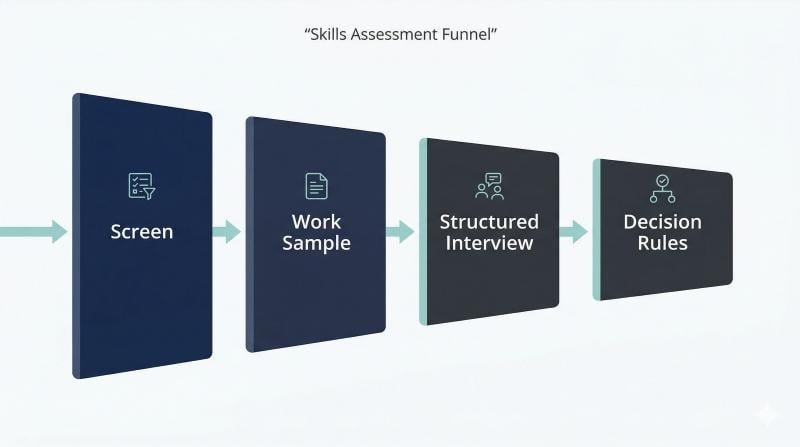
- Replace “gut feel” steps with two high-signal methods: a short work sample (or simulation) plus a structured interview with a scorecard.
- Add validated behavioral data to improve role fit and retention (especially when performance depends on collaboration, judgment, and consistency under pressure), then track results at 30/90/180 days.
Why Skills Assessment Matters for HR Leaders
Bad hires are expensive in the obvious ways (time, recruiting spend, onboarding). The real damage is what happens to delivery timelines, manager capacity, and team morale. And in mid-sized companies, you feel that pain faster because you have less slack.
A commonly cited U.S. Department of Labor estimate puts the cost of a bad hire at up to 30% of first-year earnings. For managerial roles, estimates are often higher.
Even if your internal numbers differ, the point stays the same: one preventable hiring miss can erase months of progress.
Predictive assessments help because they shift hiring from “interpretation” to “measurement.” When you test candidates using the same job-relevant tasks and the same scoring rules, you reduce randomness. That improves consistency across hiring managers, and it gives you data you can tie back to outcomes like ramp time and retention.
Research syntheses in personnel selection have also shown that combining stronger predictors beats relying on any single method. For example, Schmidt and Hunter’s meta-analysis reports high combined validity when cognitive ability is paired with a work sample or a structured interview.
For HR leaders and CEOs, that matters because it turns “improve hiring” into something operational, especially when you’re hiring with long-term leadership and culture fit in mind:
- Fewer false positives (people who interview well but fail on the job)
- Faster time-to-productivity (less rework and less manager coaching time)
- Better team fit (especially in roles where behavior drives performance as much as skill), whether that’s giving employees secure individual access to their own behavioral insights or using behavioral interview questions to assess culture add and fit

What to Measure (Goals and Metrics)
A skills assessment only helps if you define success in job terms. Otherwise you just measure “test performance,” which is how companies end up hiring great test-takers.
Start with three outcome buckets:
- Performance quality
What “good” looks like in outputs (accuracy, speed, quality bar, customer outcomes, error rate). - Time-to-productivity
How quickly a new hire can operate with normal oversight. - Retention and team impact
Whether performance holds over time and whether collaboration improves or degrades.
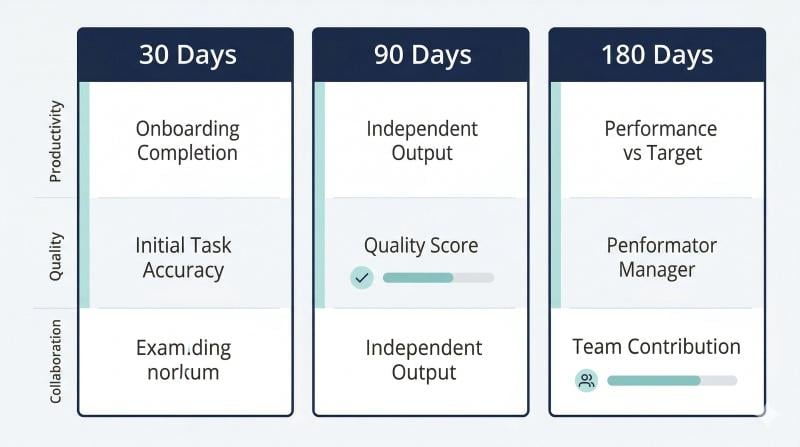
Minimum tracking cadence (simple, realistic) pairs well with risk and readiness alerts for turnover and burnout:
- 30 days: ramp progress, manager effort required, early errors
- 90 days: role competence, consistent output quality, collaboration signals
- 180 days: performance stability, retention risk, promotability signals
The 4 Predictors That Actually Work
There’s a reason the same methods keep showing up in the research: they reduce guesswork and increase signal.
Work samples and job simulations (best overall)
If you want to know whether someone can do the job, give them a slice of the job.
What works:
- 20–40 minutes, role-relevant, no trivia
- A clear rubric (what good looks like, what fails)
- One layer of complexity (prioritization, tradeoffs, constraints)
Examples:
- Customer support lead: triage a queue, draft responses, escalate correctly
- Sales: analyze a short account brief, write an outreach sequence, handle objections while you screen for sales team fit and leadership potential
- Ops: fix a broken workflow, identify failure points, propose a checklist
- Engineering: implement a small feature or debug a realistic issue, reviewed with a rubric
If you need technical testing, keep it here. Generic timed tests mostly measure “who memorized what” and “who had time to grind platforms.”

Structured interviews with scorecards
Interviews are useful when you stop treating them like a vibe check.
Rules:
- Same questions for every candidate (per role)
- Score each answer against a rubric (1–5)
- Make the decision based on evidence, not the last person who spoke
Soft skills belong here when measured properly, especially when you need to assess communication skills rigorously in interviews:
- Use scenario prompts (“You have a conflict between two leads. What do you do first?”)
- Score for clarity, judgment, prioritization, and accountability
- Require behavioral examples, not opinions
Design teams with data, not gut feel.
Most org-design decisions come down to role fit, leadership style, and team dynamics. OAD reads those signals from a 7-minute behavioral survey, so you can reconfigure roles and teams with evidence instead of guesswork.
Cognitive ability (use carefully)
Cognitive ability tends to predict performance across many roles, especially where learning speed and problem-solving matter.
How to keep it useful:
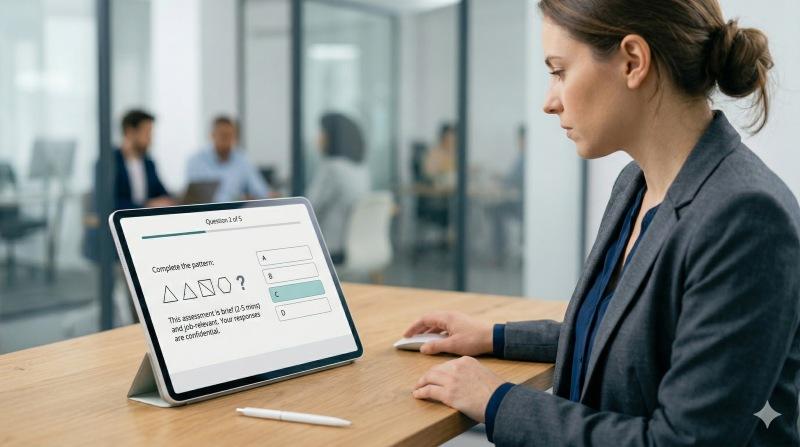
- Keep it short (10–15 minutes)
- Use it as a screen, not the final decision
- Pair it with a work sample so you reward capability, not just abstract reasoning
“AI-resistant” is mostly about design: novel items, time limits that prevent outsourcing, and questions that require reasoning not recall.
Behavioral assessments
Skills predict whether someone can do the work. Behavior predicts whether they will do it consistently in your environment, and motivation insights into what drives your hires help you tailor roles, feedback, and development.
Behavioral assessment adds value when tools like Job Behavior Insights for role-to-personality fit help you see beyond resumes and interviews:
- performance depends on collaboration, follow-through, adaptability, stress tolerance
- you need consistent decision-making, not occasional heroics
- the role interacts with customers, stakeholders, or cross-functional teams
This is where OAD fits: a short behavioral assessment can help you predict role fit, team fit, and leadership trajectory, then validate those signals against your 90/180-day outcomes.
If you want to test whether behavioral data improves your hiring accuracy, you can test OAD with one role using the Top Performer Profile and track results against your existing process.
What Doesn’t Predict Performance Reliably
These signals are not useless. They’re just weak when used as decision drivers:
- Resumes and credentials: good for minimum qualification screening, not performance prediction
- Unstructured interviews: confident talkers win; consistent performers do not necessarily
- Generic tests: trivia, canned “skills” quizzes, timed puzzles detached from the role
- Job titles and years of experience: proxies that hide massive variance in real capability
Design teams with data, not gut feel.
Most org-design decisions come down to role fit, leadership style, and team dynamics. OAD reads those signals from a 7-minute behavioral survey, so you can reconfigure roles and teams with evidence instead of guesswork.
A Practical Assessment Strategy for Mid-Sized Companies
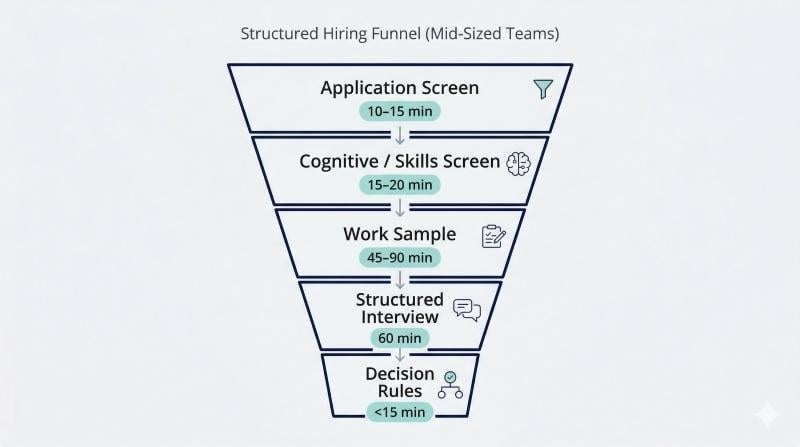
You want high signal with low candidate burden. Use a simple sequence:
- Minimum qualifications screen (fast)
- Work sample / simulation (20–40 min)
- Structured interview (rubric-scored)
- Behavioral assessment (for fit and long-term consistency)
- Decision rule (predefined threshold, no committee chaos)
Mini example: A mid-sized company struggling with early attrition can pilot this flow for one role, then compare 90-day performance and 6-month retention versus hires made through resume + unstructured interviews alone.
Fairness and Integrity (Without Making Candidates Hate You)
Global principle with a slight US lean: keep assessments job-related, consistent, and documented.
Do this:
- Standardize scoring (same rubric, trained reviewers)
- Offer reasonable accommodations where needed
- Use integrity measures that respect privacy (clear instructions, limited windows, role-relevant tasks)
Avoid:
- invasive proctoring by default
- “gotcha” trick questions
- long multi-hour funnels unless the role truly requires it
FAQ: Skills Assessment in Hiring
What is a skills assessment in hiring?
A structured way to evaluate job-relevant capability using standardized tasks, questions, and scoring, so decisions rely less on subjective impressions.
What type of assessment best predicts job performance?
Work samples and structured methods consistently perform well across roles, especially when combined with other high-signal predictors.
How long should a skills assessment take?
For most mid-sized hiring workflows: 20–40 minutes for a work sample plus a structured interview. Longer only when the role truly demands it.
How do you assess skills fairly?
Keep tasks job-related, apply the same rubric to everyone, document decision rules, and support accommodations where appropriate.
Conclusion and Next Steps
If you want hiring decisions to predict real performance, stop optimizing for “good interviews.” Optimize for job signal.
The three changes that move the needle fastest:
- Add a role-relevant work sample
- Use structured interviews with scoring rubrics
- Add validated behavioral data to reduce fit and retention failures
If you want to see how this works with your roles and candidates, test OAD and run a pilot cohort so you can compare outcomes with data instead of gut feel.