You ran the workshop. People took the quiz, nodded through the debrief, and signed the attendance sheet.
Six months later, your shortlists look the same.
That is not a failure of effort. It is what the research predicts. The evidence on why unconscious bias training doesn’t work is consistent: a single session can raise awareness, but awareness alone rarely changes who gets hired or promoted. Bias lives in decisions, and decisions are shaped by systems. This guide covers what bias training can and cannot do, why it often fails, where it can backfire, and the structural changes that reduce bias where it actually enters your process.
Key takeaways
- Unconscious bias training can raise awareness and shift attitudes in the short term. There is little evidence that it changes hiring or promotion decisions on its own.
- Mandatory, one-off sessions that focus on individual mindsets tend to provoke resistance and ignore the systems that produce biased outcomes.
- The Implicit Association Test is useful for showing that associations exist. It is not reliable enough to diagnose any one person’s bias.
- Structural changes (standardized criteria, structured interviews, consistent assessment, outcome tracking) reduce the room bias has to operate.
- If you cannot measure whether an intervention changed decisions, you do not know whether it worked.
What Unconscious Bias Training Can Actually Achieve
Unconscious bias is an automatic, unintended association between a group and a trait that can influence judgments and decisions without a person’s conscious awareness.
In the workplace, it shows up in small calls that compound: whose résumé gets a second look, whose confidence reads as leadership and whose reads as arrogance, who “feels like a fit.” Affinity bias (favoring people who resemble us) and gender bias are two of the most common types.
Unconscious bias training aims to make people aware of these associations so they can correct for them.
Awareness is not behavior change. Knowing that a bias exists is one step. Consistently overriding it in a 30-minute interview, under time pressure, with incomplete information, is a different skill. Most training programs deliver the first and assume the second will follow.
Training cannot eliminate discrimination on its own. Bias in organizations is not only inside people’s heads. It is built into job criteria, referral networks, unstructured interviews, and promotion processes that reward visibility. A training session leaves all of those untouched.
That is the honest scope. Training can start a conversation. It cannot carry the outcome.
Why Providing Unconscious Bias Training Often Fails
Bias training often fails because it is mandatory, delivered once, aimed at individuals instead of systems, and disconnected from the decisions where bias actually happens.
Mandatory attendance creates resistance
People resist being told what to think. In their widely cited Harvard Business Review analysis of three decades of data, sociologists Frank Dobbin and Alexandra Kalev found that five years after companies introduced mandatory diversity training for managers, the share of white women, Black men, and Hispanic people in management had not improved, and the share of Black women had fallen by 9% on average. Voluntary programs performed better.
Their explanation: mandatory training signals control, and singling out managers implies they are the problem. Managers resent the implication and resist the message.
Individual responsibility overlooks organizational systems
Most programs frame bias as a personal flaw to fix. But a fair-minded manager working inside an unstructured hiring process will still produce inconsistent results, because the process gives them nothing consistent to work with. Fixing the person and leaving the system unchanged is like retraining drivers on a road with no lane markings.
Content is disconnected from everyday decisions
Many training sessions teach concepts (heuristics, affinity bias, the history of the IAT) without connecting them to the specific moments where those concepts matter: screening a résumé, scoring an interview answer, deciding who gets the stretch project. Participants leave knowing more and doing nothing differently.
The gap between the session and the practice
A two-hour workshop is followed by months of unsupported decisions. There is no feedback, no follow-up, and no measure of whether anything changed. Many organizations treat bias training as a one-time event instead of an ongoing strategy, and then wonder why it did not stick.
How Unconscious Biases Can Become More Salient
Some research suggests bias training can backfire, making stereotypes more accessible rather than less. The evidence here is mixed, and it is worth knowing both what the studies found and where they have been challenged.
Stereotype suppression and rebound. In a well-known 1994 study, Macrae and colleagues found that people instructed to suppress stereotypic thoughts later relied on those stereotypes more than people who had not been told to suppress them. Telling someone “don’t think about it” can keep it on their mind.
“Everyone is biased” can normalize bias. Duguid and Thomas-Hunt (2015) found that telling people stereotyping is common led them to express more stereotypes, not fewer. In one study, managers given that message were less willing to work with a woman who negotiated assertively. The fix was simple: adding that most people actively work to overcome their stereotypes removed the effect.
Introspection can harden judgments. Uhlmann and Cohen (2007) found that priming people to feel objective increased gender discrimination in hiring evaluations, especially among those who held stereotypic beliefs. Feeling unbiased can become a license to trust your gut.
Moral licensing. Monin and Miller (2001) found that people who first established their credentials as non-prejudiced were later more willing to make choices that could look prejudiced. The concern for training: completing a bias course could function as a credential.
Two caveats matter. These are mostly lab studies with students, not workplace trials. And some have not held up: a 2024 registered replication of Monin and Miller found no consistent licensing effect.
The safest reading is not “training makes bias worse.” It is that training is an unreliable lever in either direction, which is reason enough not to rely on it alone.
What the Implicit Association Test Reveals About Implicit Bias
The Implicit Association Test (IAT) measures how quickly people pair concepts, such as a social group and a positive or negative word, to reveal automatic associations they may not report.
As an awareness tool, it works. Taking the IAT is often the moment people realize associations can operate below conscious awareness. That is a legitimate teaching use.
As a diagnostic, it does not. IAT results should never be used to label an individual as biased. Its test-retest reliability is modest, so the same person can score differently from one week to the next. Even the test’s developers have written that this, combined with small effect sizes, makes it problematic to use for classifying individuals as likely to discriminate.
Its link to behavior is weak. A 2013 meta-analysis by Oswald and colleagues found that IAT scores were poor predictors of discriminatory behavior, and did no better than explicit measures.
The practical rule: use the IAT to start a conversation, never to evaluate a person.
Why Bias Training Evidence Remains Mixed
Bias training evidence is mixed because most studies measure short-term changes in attitudes or implicit scores, while very few measure long-term changes in actual workplace decisions.
Short-term attitude change versus long-term outcomes. A 2019 meta-analysis of 492 studies with more than 87,000 participants found that implicit measures can be shifted, but the effects were mostly small and short-lived, and changes in implicit measures did not translate into changes in behavior.
Effects on hiring and promotion. The UK Equality and Human Rights Commission reviewed the evidence in 2018. It found that training can raise awareness and can reduce implicit bias in the short term, but that evidence for lasting behavior change was limited, and that poorly designed training risks backfiring.
Promising features versus assumptions. The same reviews point to features that seem to help: voluntary participation, practical bias-mitigation strategies rather than theory alone, and training delivered as part of wider process change. What lacks support is the assumption that a single awareness session, by itself, changes outcomes.
Activities That Expose Unconscious Bias Without Promising a Cure
Interactive exercises can make social categorization visible in a way a slide deck cannot, as long as the debrief connects the insight to real decisions and never labels individuals.
The tag game. Participants receive colored dots on their foreheads that they cannot see, then are asked to form groups without speaking. Almost every room sorts itself by color within minutes, even though no one was told to. The exercise shows how quickly people categorize others on visible cues.
Debrief without blame. The point is not “you are biased.” It is “this is how fast categorization happens, for everyone, and it is why our process needs guardrails.” Framing matters: tell participants that most people actively work to counter their stereotypes, so the takeaway is a norm of correction rather than a norm of bias.
Connect it to a decision point. End the activity by asking where the same instinct shows up in your workflow: the first 30 seconds of an interview, the résumé from an unfamiliar school, the candidate who “reminds me of someone.” That turns an icebreaker into a process discussion.
Designing Better Unconscious Bias Training
If you are going to run bias training, design it around real decisions, practice, feedback, and follow-up instead of awareness alone.
Use realistic recruitment scenarios. Replace abstract concepts with your own hiring situations: anonymized résumés from real roles, interview answers to score, a promotion slate to review.
Practice interrupting bias. Give participants structured exercises where they apply a specific technique, such as scoring each answer against a rubric before discussing a candidate, or naming the evidence behind a “not a fit” verdict.
Provide feedback after decisions. Training should include immediate feedback. Show participants how their scores compared with a rubric, or how their ratings varied across otherwise identical candidates.
Schedule follow-up coaching. Revisit the skills a few months later, ideally in the context of live hiring cycles. Training that ends when the session ends has already been forgotten.
The best version of bias training is less a training and more a calibration exercise for your hiring process.
Structural Alternatives to Standalone Bias Training
Structural changes reduce bias more reliably than training because they shrink the space where bias can operate, regardless of what any individual believes.
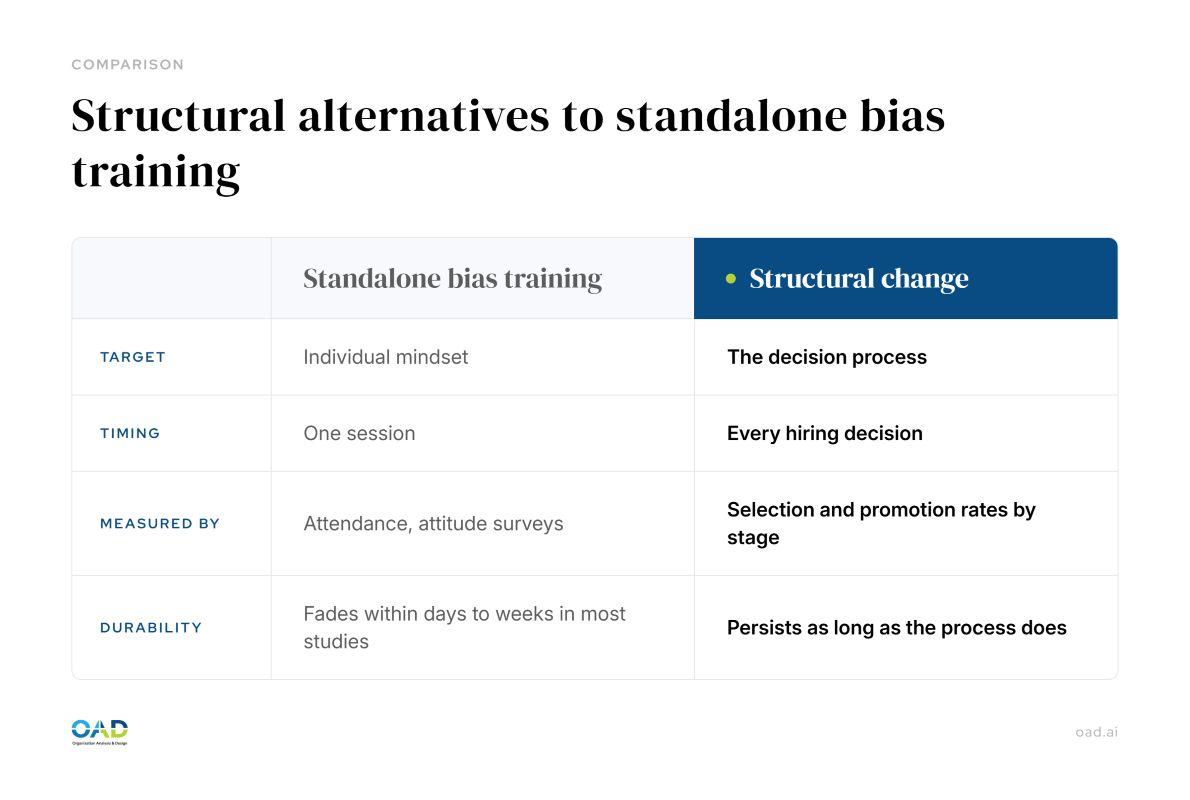
Audit hiring criteria for unnecessary subjectivity. Look at every requirement and every evaluation step. Where does the decision rest on “feel,” “presence,” or “culture fit” with no definition? Replace vague criteria with observable, job-related ones.
Standardize interview questions across candidates. Structured interviews, where every candidate answers the same job-related questions and is scored against the same rubric, are one of the most widely supported ways to reduce inconsistency in hiring. We cover how to build them in Best Interview Questions for Hiring: Behavioral, Technical, and Culture-Fit.
Use consistent, validated assessment. A structured, validated assessment gives every candidate the same input, measured the same way, against what the role actually demands. That replaces “do I like this person” with “does this person fit what the job requires.”
Consistency is the whole point. Dobbin and Kalev’s research found that hiring tests did not reduce bias when managers applied them selectively, testing some candidates and waving others through. A structured input only reduces bias if it is applied to every candidate and validated for fairness. That is why any assessment should be validated, monitored for adverse impact, and used as one structured input into a hiring decision, never the sole basis for it.
Design teams with data, not gut feel.
Most org-design decisions come down to role fit, leadership style, and team dynamics. OAD reads those signals from a 7-minute behavioral survey, so you can reconfigure roles and teams with evidence instead of guesswork.
Require diverse panels for important decisions. Multiple evaluators, scoring independently before they discuss, make it harder for one person’s instinct to decide the outcome.
Track promotion and hiring outcomes across demographic groups. You cannot fix what you cannot see. The federal Uniform Guidelines on Employee Selection Procedures generally treat a selection rate for any group below four-fifths of the highest group’s rate as evidence of adverse impact, which is why monitoring selection rates at each stage is standard practice.
If your pipeline uses AI screening, the same logic applies with higher stakes, because a biased model repeats its error across every application. We cover that in AI Hiring Bias: The Risk, the Liability, and the Fix.
How to Measure Whether Interventions Work
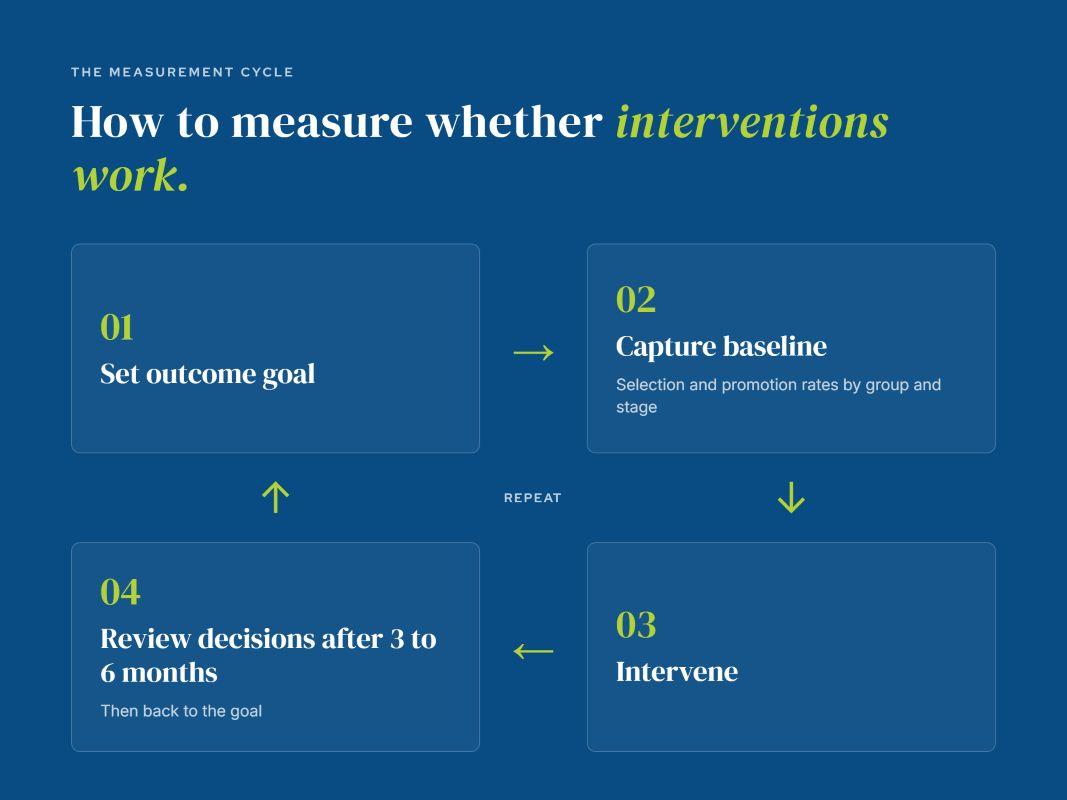
You measure whether a bias intervention works by setting outcome goals before launch, comparing results against a baseline, and checking behavior months later, not by counting attendance.
Establish measurable goals before launching training. “Raise awareness” is not a goal. “Reduce the gap in interview-to-offer rates between groups for engineering roles” is.
Compare workplace outcomes against baseline data. Capture where you are before the intervention: selection rates at each hiring stage, promotion rates, rating distributions by group. Without a baseline, any after-number is a guess.
Review participant behavior after several months. Look at decisions, not survey responses. Did interviewers score more consistently? Did rating gaps narrow? Did the shortlist change?
Publish accountability reports for leaders. Dobbin and Kalev found that accountability, where managers know their decisions are visible, was one of the mechanisms behind programs that actually worked. Report outcomes to the leaders who own the decisions, and make the numbers part of how those leaders are reviewed.
Bias training asks people to fix themselves. Structure fixes the process they decide inside. Start with the behavioral standard your best people already set. Get Your Free Top Performer Profile: 7 minutes, results in 24 hours, no credit card.