AI hire technology is changing how recruiters and hiring managers run the entire hiring process, from job descriptions to final offers. Instead of manually sifting through resumes and interviews, AI powered tools help you identify qualified candidates faster, reduce bias, and improve candidate experience. This article explains what an AI hire stack looks like in practice, where it adds real value, and where people science is still essential for making the right hiring decisions.
What Is an AI Hire?
Why AI hire is suddenly everywhere in recruitment
Across HR, leaders are under pressure to fill roles faster, at lower cost, and with fewer people on the recruiting team. That is why AI hire solutions are gaining traction. Instead of a single tool, “ai hire” usually means a stack of AI powered capabilities that support the hiring process from job description to offer, layered on top of your existing systems. Adoption is moving fast: SHRM’s 2025 Talent Trends research found that AI use in HR tasks climbed to 43% of organizations in 2025, up from 26% a year earlier.
For candidates, AI hire solutions can also speed up the job search by matching them to relevant roles faster and making it easier to connect with employers.
AI hire vs traditional hiring tools
Traditional tools such as an ATS focus on tracking applicants and storing resumes. AI hire solutions go further. They analyze unstructured data, predict which candidates are most likely to succeed, and automate parts of the recruiting process such as sourcing, screening, and scheduling. The goal is not to replace recruiters, but to help hiring managers and recruiting teams hire smarter and streamline the recruiting process, especially in high volume recruitment.
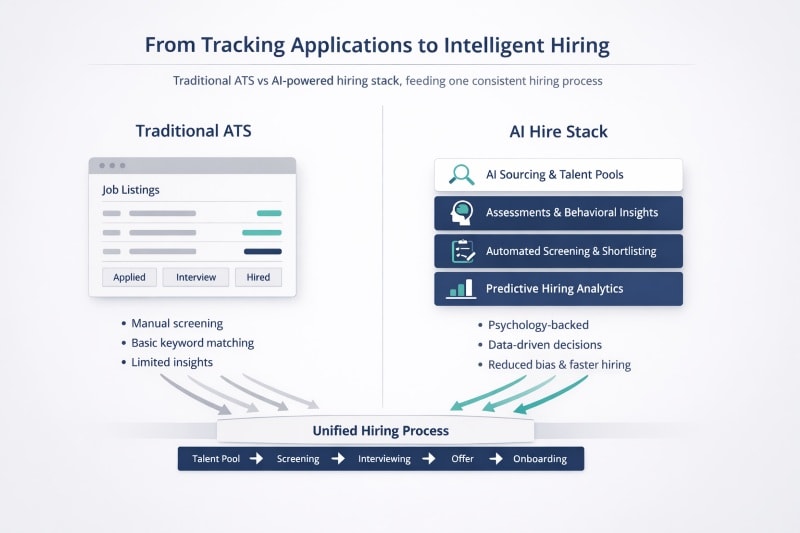
How AI Hire Supports Recruiters and Hiring Managers Across the Hiring Process
From job description to shortlist of qualified candidates
AI tools can analyze historic performance data, similar roles in the market, and internal success profiles to help you tailor job descriptions for each position. Instead of vague lists of requirements, you get focused criteria and skills. The same models then scan your talent pool and inbound applications to highlight qualified candidates who match that success profile.
From interviews to offers and onboarding
Once candidates enter the interview stage, AI hire can help with scheduling, reminders, and note capture. Some tools summarize interviews and extract key skills or red flags so that the entire team sees the same information. After a hire is made, the same data can feed onboarding, early performance tracking, and training plans, connecting your hiring journey to longer term employee success and giving new employees a smoother start from day one.
Core Benefits of AI Hire for Recruiting Teams and Candidates
Save time and reduce costs in high volume recruitment
For roles with hundreds or thousands of applicants, AI driven sourcing and screening can remove hours of manual work. How much time and cost you save depends on your volume and how manual your process is today, so measure your own time to hire and cost per hire before and after rather than relying on vendor averages.
Improve candidate experience and communication
Candidates judge your employer brand by how clearly you communicate and how quickly you respond. AI supported messaging, status updates, and self service portals let applicants track where they are in the hiring process, reschedule interviews, and get timely answers to basic questions. This reduces frustration, improves candidate experience, and supports stronger offer acceptance rates.
Reduce bias and support fairer hiring decisions
Used responsibly, AI can help reduce some forms of bias. For example, structured scoring of resumes and skills based screening can reduce the influence of irrelevant signals. Some HR teams report better diversity outcomes when AI is used for parts of recruiting, especially sourcing and screening, but only when the tools are audited regularly.
Free recruiters to focus on what really matters
The most effective AI hire setups remove repetitive tasks so recruiters can focus on high value work: clarifying roles with hiring managers, preparing structured interviews, and coaching the business on talent decisions. In other words, AI handles volume, humans handle judgment and context.

Key Features To Look For in an AI Hire Solution
AI powered screening, matching, and assessments
Look for tools that can read resumes, extract skills, and match candidates against the specific job description and your internal definition of top talent. For technical or specialized roles, AI powered assessments can help evaluate candidates’ skills and fit in a consistent way, instead of relying on unstructured impressions.
AI interviewers and automated video interviews
Some platforms include an AI interviewer that runs automated video interviews, asks structured questions, and scores answers based on predefined criteria. This can be useful in high volume recruitment, where you need a fast first pass. The key is to use these interviews as an input into the recruiting process, not as the only evaluation step, and to be transparent with candidates about how their answers are evaluated.
Integrations, security, and multi language support
AI hire tools need to connect to your ATS, HRIS, calendar, and collaboration platforms so that data flows in both directions. Security, audit trails, and role based access are essential when you are working with sensitive candidate data. For global companies, support for multiple languages in both interfaces and candidate facing workflows is no longer optional.
Writing Better Job Descriptions With AI To Attract Qualified Candidates
Clarifying skills, outcomes, and success profile
AI can help you turn vague requests from hiring managers into precise job descriptions. Instead of copying an industry template, you can analyze what your best employees in similar roles actually do and which skills drive performance. The result is a job description that signals the role clearly to qualified candidates and filters out noise at the top of the funnel.
Aligning the entire team on what “top talent” looks like
When HR, recruiters, and hiring managers use a shared, data informed success profile, you avoid misalignment later in the hiring journey. AI hire tools can visualize required skills, preferred experience, and behavioral expectations so that everyone evaluates candidates against the same criteria instead of personal preference.
Evaluating Candidates: Combining AI Scores With Human Judgment
Combining AI scores with structured interviews
AI generated scores, rankings, and flags are decision support, not a verdict. The most reliable hiring processes combine them with structured interviews and scoring guides that ask each candidate comparable questions. This structure reduces noise and makes it easier to see where AI and human assessments agree or disagree.
Separating technical skills, soft skills, and behavioral fit
Technical tests or AI powered assessments can help you evaluate hard skills. Soft skills, values, and behavioral fit are harder. That is where dedicated assessments and well designed interviews come in. Using a behavioral tool alongside your AI hire stack gives you a view of how a candidate is likely to communicate, handle pressure, and fit with the manager and team.
Design teams with data, not gut feel.
Most org-design decisions come down to role fit, leadership style, and team dynamics. OAD reads those signals from a 7-minute behavioral survey, so you can reconfigure roles and teams with evidence instead of guesswork.
Candidate Experience and Engagement in an AI Driven Hiring Journey
Designing a fair and transparent AI supported process
Candidates are increasingly aware that AI is part of hiring. You build trust when you explain where AI is used, what data is processed, and how human recruiters stay in the loop. Clear privacy notices, FAQs, and opt in consents are now part of a fair candidate experience, especially as regulations around AI hiring tools evolve.
Avoiding over automation that feels cold or unfair
There is a real risk of candidates feeling they are talking to bots instead of people. Over reliance on automated video interviews or chatbots can harm your employer brand, and AI based interviews can disadvantage people whose speech the system handles poorly, such as candidates with strong accents or speech-related disabilities. Human oversight, alternative assessment routes, and accessibility checks are essential safeguards.

Best Practices for AI Hiring
Start with your process, not the technology. Map how hiring works today, find the steps that cost the most time or produce the most inconsistency, and apply AI there first: resume screening, interview scheduling, or structured scoring. Make sure any tool connects cleanly to your ATS and HRIS so candidate data does not end up split across systems.
Be open with candidates about how you use AI, what data you collect, and where people stay involved in decisions. Review your AI screening and assessments regularly with a mix of stakeholders (HR, hiring managers, legal) to catch bias and unintended discrimination early. Fairness does not happen by default; it takes ongoing checks.
Train recruiters and hiring managers to read AI outputs critically and to know when human judgment should override them. AI handles volume and repetition; your people handle evaluation, relationships, and the final decision. Track time to hire, cost per hire, and candidate satisfaction so you can see what is working and adjust.
Common Challenges in AI Hiring
Data quality is the first challenge. AI tools only work as well as the data behind them. Incomplete resumes, inconsistent job profiles, and vague success criteria all reduce accuracy. Before rolling out AI, clean up your data and define clearly what a successful hire looks like for each role.
Integration is the second. Many ATS and HRIS platforms were not built with AI in mind. Choose tools with proven integrations, strong security, and multi language support so the rollout does not create new silos.
Bias and candidate trust are the third. AI can repeat existing patterns in your hiring data if nobody checks it. Regular audits, clear fairness rules, and human review of decisions keep that in check. Some candidates will also be skeptical of automated interviews or algorithmic scoring, so explain how the tools are used and offer an alternative route where it makes sense.
The fourth challenge is people. Recruiters and hiring managers need training to interpret AI insights and combine them with their own judgment. Ongoing training and open feedback loops make adoption stick and help the tools deliver the time savings and better candidate experience they promise.
Risks, Limits, and Common Myths About AI Hire
The myth of the “perfect hire” and fully automated recruitment
Vendors sometimes promise that AI will find the perfect hire with minimal human effort. In reality, AI is only as good as the data and constraints you give it. Over trusting a black box model is risky, especially when the cost of a bad hire can reach a large share of the employee’s annual salary once you factor in productivity loss, team disruption, and replacement costs.
Bias in, bias out: how AI can amplify existing problems
Algorithmic bias in hiring is well documented. When historical data reflects unequal access to jobs or advancement, models that learn from that data can repeat and amplify those patterns unless you intervene. Multidisciplinary research and legal commentary now emphasize bias audits, fairness metrics, and independent oversight as basic requirements for AI driven recruitment.
Measuring Success and ROI of AI Hire
Core metrics for recruiting teams and HR leaders
To justify investment in AI hire technology, you need clear metrics. Typical measures include time to fill, cost per hire, conversion rates at each stage of the recruiting funnel, and early performance or retention of new hires. When evaluated properly, AI hire should shorten time to hire and improve quality of hire, not just generate more dashboards.
Tracking fairness, security, and long term outcomes
Alongside operational metrics, track the diversity of your hires, adverse impact indicators, and complaints related to fairness or privacy. Over time, compare promotion rates and performance for employees hired with support from AI tools against those hired without them. This broader view of ROI reflects how AI hire affects not just the recruiting process but long term workforce outcomes.
Implementation Roadmap: Bringing AI Hire Into a Mid Sized Organization
Map your current recruiting process and pick first use cases
Before buying any platform, document your current hiring process. Identify where recruiters, managers, and candidates experience friction: manual screening, scheduling, interview coordination, or feedback collection. Then choose one or two focused AI use cases that will clearly save time or improve candidate experience without rewriting your entire stack.
Pilot, train, and scale with clear guardrails
Run a controlled pilot in one function or region. Train recruiters and hiring managers on how to interpret AI outputs and when to push back. Establish governance rules for which decisions must always involve a human, how to handle candidate questions, and how to review the system regularly for bias and performance drift.
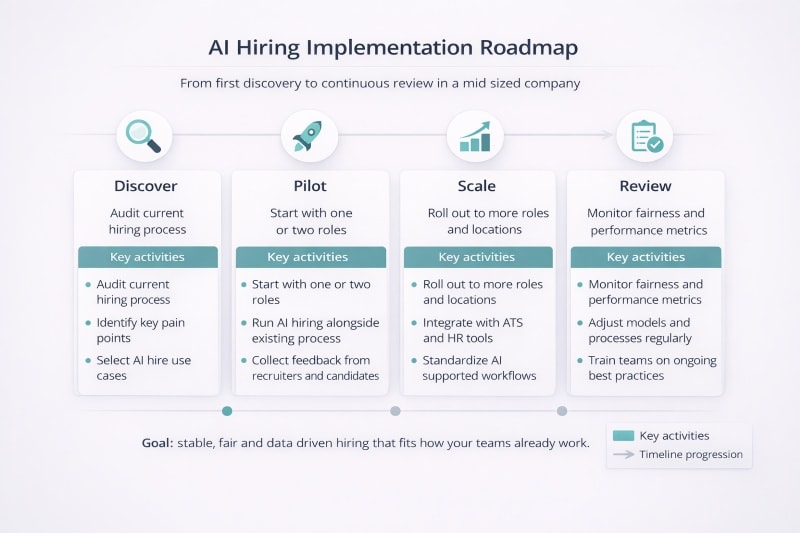
Where AI Hire Ends and People Science Begins
Why the “perfect candidate” still depends on your context
Even the smartest AI hire solution cannot tell you what success means in your specific culture, leadership style, and business model. Two companies hiring for the same job title may need very different behavioral profiles. Context still decides whether a candidate is a great fit or a future problem.
How OAD complements AI driven hiring
This is where people science matters. OAD uses a validated behavioral diagnostic to show how people prefer to communicate, make decisions, and handle pressure at work. Combined with AI shortlists, this lets you compare top candidates on deeper traits, understand team dynamics, and flag potential friction points before you make a final decision, as one structured input alongside interviews and references.
Design teams with data, not gut feel.
Most org-design decisions come down to role fit, leadership style, and team dynamics. OAD reads those signals from a 7-minute behavioral survey, so you can reconfigure roles and teams with evidence instead of guesswork.
How to test OAD in your existing recruitment stack
You do not need to rebuild your hiring process to add behavioral insight. OAD can be slotted in at the shortlist or final interview stage so that hiring managers see both AI driven data and behavioral fit in one view. If you want to see how this works with real roles, you can start with the free Top Performer Profile and run a small pilot on a few key positions before rolling it out more widely.
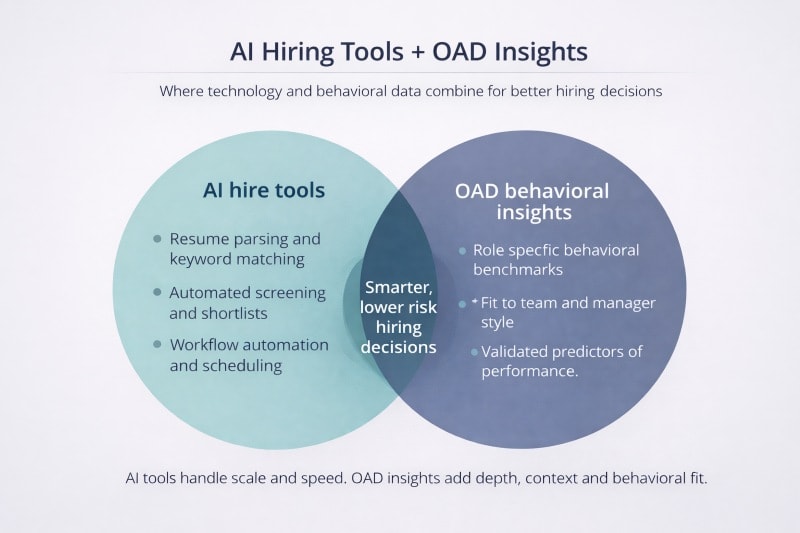
The Future of AI Hire for HR, Recruiters, and Business Leaders
What will change in the next three to five years
Analysts expect AI to become a core part of HR operating models, not a side experiment. Talent acquisition is often the first area to adopt AI, then internal mobility, workforce planning, and learning follow. CHROs are being asked to build an AI talent strategy that covers both AI tools and the skills needed to use them responsibly.
Building a balanced recruitment strategy that uses AI without losing judgment
High performing organizations will treat AI hire as a powerful assistant, not an oracle. They will combine automation, behavioral data, and strong governance so that recruiters and hiring managers can act with more confidence, not less responsibility. The result is a hiring process that is faster, fairer, and more connected to long term business success.
Conclusion
AI hire takes the repetitive work out of recruiting: screening, scheduling, and first-pass evaluation. Used well, it gives recruiters more time for the parts of hiring that need judgment and helps make decisions more consistent and fair.
It does not tell you who will thrive in your team. That still depends on how a person communicates, what motivates them, and how they lead, and those are the patterns of communication, motivation, and behavior that a behavioral diagnostic like OAD is built to show. Combining AI speed with behavioral data gives you a clearer view of each candidate than either one alone.
To see what that looks like with your own data, start with the person you already trust most in the role. Get your free Top Performer Profile: 7 minutes, results in 24 hours, no credit card.