You can name your top performer in three seconds.
Ask what makes them a top performer, and the answer goes vague. “Drive.” “Attitude.” “They just get it.”
That vagueness is expensive. It is why you cannot hire a second one on purpose, and why the wrong person gets promoted.
Performer skills are the observable work behaviors that separate high-performing employees from average ones: how they own outcomes, solve problems, communicate, adapt, and keep delivering under pressure. This guide breaks down the key traits, separates high performance from high potential, and shows how to measure the behavior behind the results instead of guessing at it.
Key takeaways
- A high performer is defined by consistent results in their current role, not by visibility, tenure, or how confident they sound in meetings.
- High performance and high potential are different things. Treating them as the same is how strong individual contributors become struggling managers.
- The traits that matter most (accountability, initiative, problem-solving, adaptability, communication) are behaviors, which means they can be observed, measured, and developed.
- Self-reported performance is unreliable. Employees and leaders routinely disagree about whether a team is high performing.
- Your current top performers are the benchmark. Measure what they actually do, and you have a hiring and development standard instead of a gut feel.
What Are Performer Skills?
Performer skills are the work behaviors that consistently produce above-average results in a specific role.
Not talents. Not credentials. Behaviors.
That distinction matters because behaviors are visible. You can watch someone flag a risk two weeks early. You can see who closes the loop after a meeting and who lets action items die. A resume shows none of this. Neither does a polished interview.
Performer skills are also role-specific. The behaviors that make a top account executive (persistence through rejection, comfort with ambiguity, speed) are not the ones that make a top operations lead (precision, process discipline, follow-through). A strong work ethic shows up in both, but it looks different in each job.
One more distinction before the list. Performance is about what someone delivers now. Potential is about what they could deliver in a bigger role later. Most organizations blur the two, and we will come back to why that is costly.
The traits covered below: accountability, initiative, problem-solving, adaptability, goal focus, communication and collaboration, leadership without authority, resilience and self-awareness, continuous learning, and the ability to use constructive criticism. Then we cover how to develop these skills, how organizations support them, and how to measure them.
What Is a High Performer?
A high performer is an employee who consistently meets or exceeds the key performance indicators of their role, over time and across changing conditions.
Three parts of that definition do the work.
Results, not activity. Busy is not the same as productive. The person who answers every message within five minutes and attends every meeting may be your most visible employee. They are not automatically your best one. High performers are judged by outcomes: revenue closed, projects shipped, errors prevented, customers kept.
Reliability, not spikes. One great quarter is a data point. Four in a row is a pattern. Reliability is what lets you plan around someone. It is the difference between a person you hope will deliver and a person you know will.
Team impact, not just individual output. Some top individual contributors quietly drain the people around them. They hoard information, skip handoffs, and win at the team’s expense. A true high performer raises the output of their colleagues, not just their own number. Individual contribution matters. So does what happens to the team when that person is in the room.
Why the gap between high and average performers is so large
Performance is not evenly spread. In a widely cited 2012 study of more than 600,000 people, O’Boyle and Aguinis found individual performance follows a power-law distribution, not a bell curve: the top 1% produced about 10% of output, and the top 5% produced about 26%.
One caveat: that sample was researchers, entertainers, politicians, and athletes, not corporate employees. McKinsey, citing the same study, puts the gap at roughly four times the productivity of average performers, and reports that in business settings the gap widens with job complexity, reaching 800% in highly complex roles such as managers and software developers.
The exact multiplier varies by role. The direction does not. Identifying high performers is a resource-allocation decision, because where they sit determines how much of your business results depend on a small number of people.
High Performer Versus High Potential: What Is the Difference?
High performance describes what someone delivers in their current role today. High potential describes what they could deliver in a larger, different role tomorrow.
They overlap. They are not the same thing.
Understanding High Performers
High performers are identified by evidence from the past and present. Their current performance shows up in measurable outcomes: targets hit, deadlines met, quality maintained.
The behaviors that signal consistent contribution are concrete:
- They deliver what they committed to, when they said they would.
- They raise problems early, before those problems become emergencies.
- They own their misses without being asked.
- Their work needs little rework from other employees.
Understanding High Potential
High potential is the capacity to grow into roles with more scope, complexity, and responsibility. High-potential employees may not currently perform at the highest level in their role. Some are early in tenure. Some are in the wrong seat.
Potential only turns into performance through employee development. A high-potential employee left in a role that never stretches them will plateau, disengage, and often leave for a new job somewhere that offers the right opportunities.
Comparing the two means comparing different kinds of evidence:
- Performance evidence: KPIs, delivery record, quality of output, peer input on reliability.
- Growth indicators: how fast they learn, how they handle ambiguity, whether they seek larger problems, whether others already follow their lead.
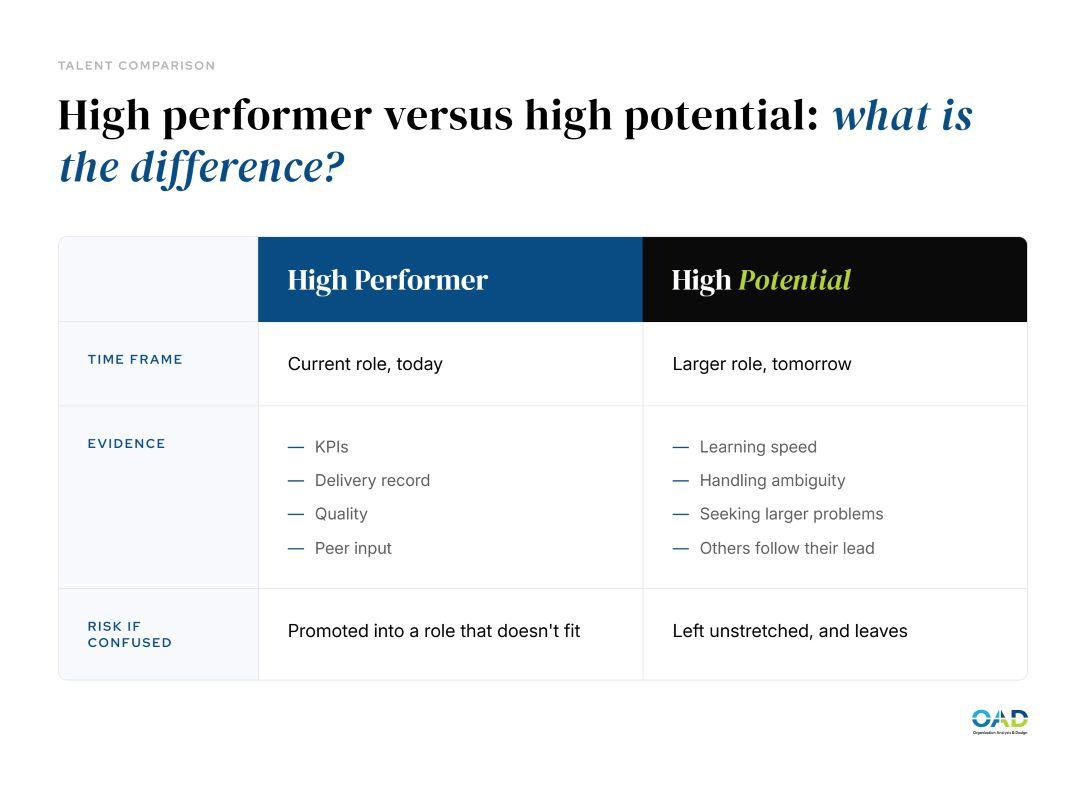
The cost of confusing them is real. Research from CEB(now part of Gartner) found that only about 15% of today’s high performers have what it takes to succeed in more senior roles.
Here’s what we see in practice: the best closer is not automatically the best manager. Promote on performance alone and you can lose a top performer and gain an underperforming manager in one move. We cover that trap in more depth in The Concept of Leadership: Why It Vanishes the Moment You Actually Need It.
Key Traits of High Performers
The key traits of high performers are accountability, initiative, problem-solving, and adaptability. Employer surveys consistently rank problem-solving and communication near the top of the list of traits they want. The four below are the foundation the rest are built on.
Accountability: they own the outcome, not just the task
Accountability is the foundational trait. A high performer treats the result as theirs, not just their assigned piece of it.
When a client deliverable slips because another team was late, the average employee reports that the other team was late. The high performer flagged the dependency a week earlier and had a backup plan ready.
Initiative: they act before being asked
Initiative means seeing what needs doing and doing it without waiting for permission. In practice, it looks like the analyst who notices a recurring error in a weekly report and fixes the source instead of correcting it by hand every Monday. Or the rep who builds a one-page objection guide because they kept hearing the same three objections.
Initiative is self-direction applied to the job. It is also one of the clearest separators between employees who need managing and employees who need resourcing.
Problem-solving: they find the actual problem first
High performers do not jump to the first fix. They ask what is actually broken, separate symptoms from causes, and then build innovative solutions that hold.
This is why problem-solving is so valuable: a strong problem-solver reduces the load on everyone above them. Fewer escalations reach senior leaders. Fewer decisions bounce back.
Adaptability: they adjust when the demands change
Adaptability is the capacity to adjust quickly to unexpected changes. High performers adapt quickly to changing demands and situations: a new priority, a lost client, a reorganized team. They recalibrate without losing output for a month.
We cover how they handle larger change in the Adapting to Change section below.
Goal Focus and Consistent Performance
High performers produce consistent performance because they focus on fewer, more meaningful goals and protect the routines that deliver them.
They prioritize ruthlessly. Most employees treat every task as equal. High performers know which three things move the number this quarter and spend their best hours there. Everything else gets done, but it gets done second.
They work to measurable objectives. “Improve client relationships” is a wish. “Raise renewal rate on my accounts from 80% to 90% by Q4” is an objective. If your team’s individual goals cannot be measured, you cannot tell your high performers apart from your hard workers. Hard work matters. It is not the same thing as results.
They run on routines, not motivation. Reliable delivery comes from structure: a weekly review of priorities, protected focus time, a consistent habit of closing open loops before the week ends. Like any discipline, it is a practice regimen, not a mood. The best employees do not rely on feeling self-motivated. They build systems that work on the days they do not.
Communication and Collaboration Skills
High performers communicate clearly, listen actively, and collaborate across roles in ways that prevent misunderstandings before they cost time.
Active listening
Active listening means understanding what the other person actually needs before responding. Picture a customer success manager on a call with an unhappy client. The average response is to defend the product. The high performer asks two clarifying questions, restates the problem, and discovers the real issue is an onboarding gap, not the software.
Clear communication prevents misunderstandings
Most rework in organizations starts as a communication failure. A vague request. An assumption nobody checked. High performers adapt their explanations to their audience: the technical version for engineers, the outcome version for the executive, the step-by-step version for the new hire. Effective communication prevents misunderstandings and resolves conflicts before they harden.
Collaboration across different roles
Strong interpersonal skills matter most at handoffs: sales to onboarding, product to support, finance to operations. High performers know what the next person in the chain needs and give it to them in a usable form.
Respectful communication during disagreements
High performers disagree openly and without making it personal. They argue the idea, not the person. They say “I see a risk in this timeline” instead of “this plan won’t work.” Then, once a decision is made, they commit to it.
Leadership and Accountability in High-Performing Teams
High-performing employees lead without needing a title, own their mistakes publicly, and share credit in ways that make the whole team stronger.
Leading without formal authority. In high-performing teams, leadership shows up before the promotion. It looks like the engineer who sets up the incident review nobody else organized, or the rep who mentors the new hire through their first month without being assigned to.
Accountability after mistakes. Everyone makes mistakes. High performers say “I missed that, here is what I am doing to fix it, and here is what I changed so it does not happen again.” No blame. No hiding. That behavior sets the standard for other employees faster than any policy.
Credit-sharing. When a project lands, high performers name the people who made it work. This is not modesty. It is how they build the trust that makes the next project easier.
Ownership connects to team outcomes. When enough individuals own their part fully, the team stops needing a manager to chase every thread. Individual ownership is what high team performance is made of.
Personality Traits That Support Performance
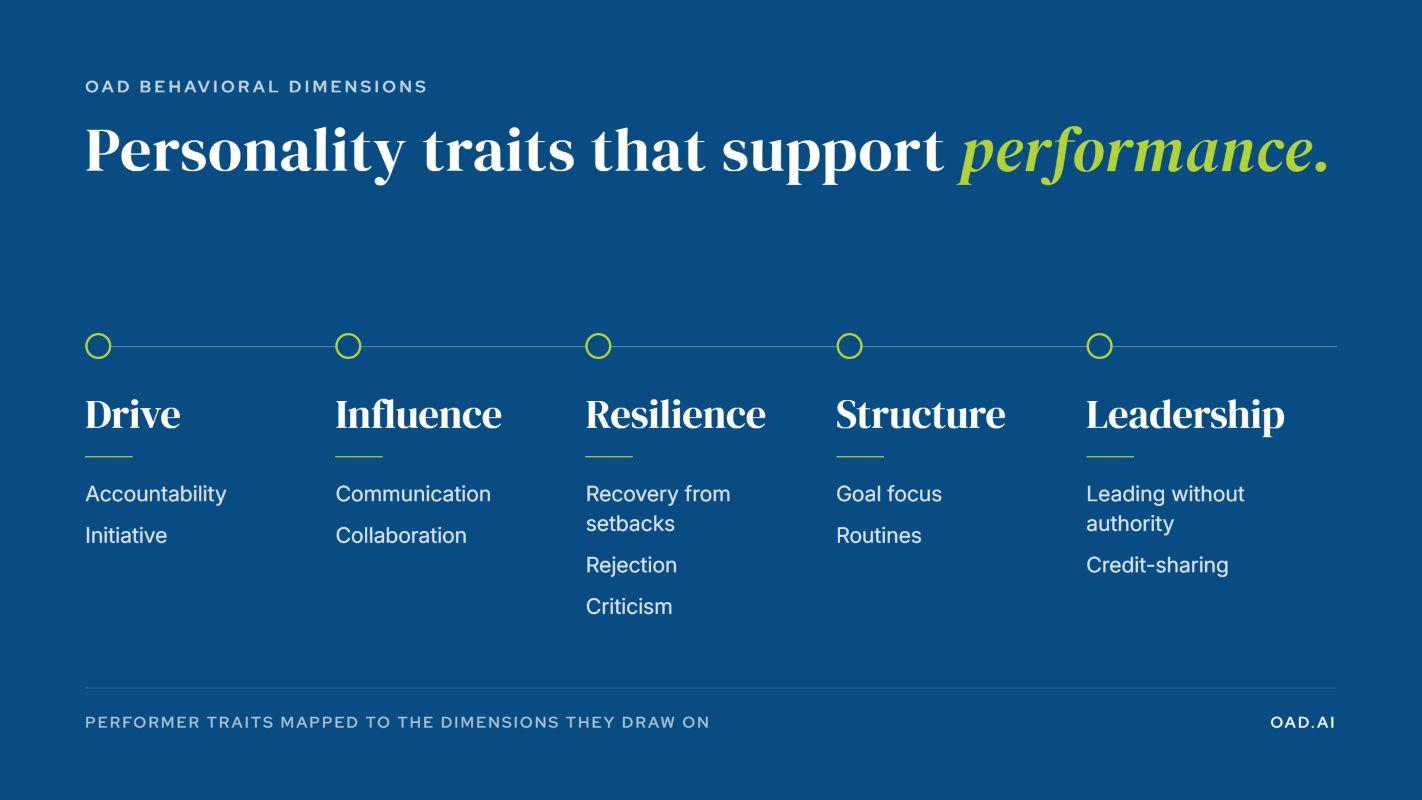
The personality traits most associated with performance are resilience, curiosity, emotional self-awareness, and realistic optimism. It helps to think of these as work behaviors rather than fixed personality: how someone operates under the specific pressures of their role.
That framing matters. “Personality” suggests something fixed and general. Behavioral drive is specific to the job. The same person can thrive in one role and stall in another.
Resilience during setbacks. Resilience is the capacity to absorb rejection, criticism, and failure without losing output. A salesperson hears no all day. A project lead watches a launch slip. Successful performers in any role develop resilience to handle both, and recover faster than their peers.
Curiosity as a driver of improvement. Curious employees ask why a process works the way it does, and then improve it. Curiosity is where new ideas come from.
Emotional self-awareness. Self-aware high performers know how they react under pressure and adjust before it affects others. They know when they are frustrated and do not let it leak into a client email.
Optimism without denial. The useful kind of optimism expects a good outcome and still names the real problems in the way. Blind optimism misses risks. Realistic optimism plans for them.
The point of measuring these traits is simple: you stop describing your top performers with adjectives and start describing them with evidence.
Adapting to Change
High performers respond to uncertainty by preparing for the likely scenarios instead of waiting for certainty that never arrives.
They respond to uncertainty with action. When a market shifts or a strategy changes, average performers wait for full instructions. High performers ask what is most likely to change and start adjusting the parts of their work that will be affected either way.
They prepare for shifting priorities. They keep their work in a state where it can be paused, handed off, or redirected without collapse. Clean notes. Documented status. No single points of failure that live only in their head.
They stay flexible during organizational change. Reorgs, new managers, new systems. High performers treat these as a new set of conditions, not a personal setback. That flexibility is also what makes them the people leaders lean on to make a change stick.
Continuous Learning and Employee Development
Continuous learning is a performance habit: high performers build skills before the role demands them, not after.
Learning as a habit. High performers read industry related books, study how their best colleagues work, and treat every project as a chance to learn something. Learning opportunities are not an annual training event for them. They are part of the job.
Challenging assignments. The fastest development happens through new assignments that stretch someone outside their comfort zone. A high performer who has mastered their role is a candidate for new projects with more scope: a cross-functional initiative, a larger account, a first team to lead.
Mentoring and coaching. Mentoring and coaching are among the most effective ways to develop top performers. A mentor shortens the learning curve. A coach helps someone see blind spots they cannot see alone.
Individual development plans. Creating individual development plans gives that growth structure. A good plan connects today’s skill development to tomorrow’s responsibilities, so the person and the business both know what they are building toward and why.
Accepting Constructive Criticism
High performers welcome constructive criticism because they care more about getting better than about being right.
They welcome it. For a high performer, constructive feedback is information. It shows them the gap between how they think they performed and how they actually did. That gap is where improvement lives.
They ask clarifying questions. “What specifically would have made that presentation stronger?” turns vague feedback into something usable. High performers ask until they understand what to change.
They apply it. The real measure of how someone handles feedback is not their reaction in the meeting. It is whether the behavior changes in the next two weeks.
They separate criticism from judgment. Feedback about a piece of work is not a verdict on the person. High performers keep those two things apart, which is what lets them hear hard feedback without getting defensive.
Performance Reviews and Regular Feedback
Performance reviews clarify expectations, but regular feedback between reviews is what actually changes performance.
Reviews set the standard. A good performance review makes expectations explicit: what success looks like in this role, how it is measured, and where the person stands against it. For high performers, clear expectations are motivating. Ambiguity is what frustrates them.
Regular feedback fills the gap. An annual review delivers news a year late. Short, regular feedback conversations, monthly or even weekly, let people correct course while it still matters.
Feedback should connect to measurable development goals. “Be more strategic” is not a development goal. “Lead the Q3 planning session and present three options with trade-offs” is. Tie feedback to goals you can identify progress against, and development stops being a vague promise.
Healthy Work-Life Balance
A healthy work-life balance protects sustainable performance. High performers set boundaries because they understand recovery is part of the job, not a break from it.
Boundaries protect performance. Top performers prioritize a healthy work-life balance not because they care less, but because they know output drops when they burn out. They set boundaries to protect personal time and hold them.
Recovery is a productivity practice. High performers take breaks to avoid burnout. Rest is how the next stretch of focused work becomes possible.
Workload conversations happen early. Here is the risk most managers miss: work flows to your most reliable people. Every urgent project lands on the same desk, because you know it will get done. Have the workload conversation before burnout develops, not after your best person resigns. If you want to retain high performers, protect their capacity as carefully as you protect your budget.
How to Develop Performer Skills
Performer skills can be developed by focusing on one behavior at a time, tracking progress weekly, practicing on real work, and reinforcing what works through recognition.
Set one improvement goal. Not five. Pick the single behavior that would make the biggest difference: raising issues earlier, delegating, running tighter meetings. Focus beats breadth.
Track progress through weekly reflections. Ten minutes at the end of each week: where did I practice this, what happened, what will I do differently? It turns a vague intention into a visible pattern.
Practice on real projects. Skills build through use, not workshops. Apply the new behavior on live work where the stakes are real and the feedback is immediate.
Recognition reinforces useful behaviors. For managers, this is the lever most often missed. When someone demonstrates the behavior you want, name it specifically. “The way you flagged that budget risk early saved us a week” teaches more than any training session.
How Organizations Support High-Performing Employees
Organizations support high-performing employees by giving them autonomy, clear growth paths, real learning resources, and consistent recognition.
Autonomy for capable employees. High performers want ownership. Micromanaging them signals distrust and is one of the fastest ways to lose top talent.
Pathways for employee development. Not every high performer wants to manage people. Build paths for deep expertise as well as leadership, so growth does not require leaving the work they are best at.
Resources for continuous learning. Budget, time, and access: courses, conferences, coaching, and time to apply what they learn.
Consistent recognition. Recognition that is specific and regular matters more than recognition that is large and rare. Tie it to the behaviors that drive business success, and you strengthen employee engagement and long-term success at the same time.
How Do You Measure High-Performing Behavior?
You measure high-performing behavior by pairing role-specific results with behavioral evidence, peer input, and regular review, instead of relying on impressions.
Identify role-specific performance indicators. Start with what success means in each job role. Revenue and retention for sales. Accuracy and cycle time for operations. Delivery and quality for project roles. Generic job descriptions produce generic measures.
Compare results with behavioral evidence. Results tell you what happened. Behavior tells you why, and whether it will happen again. A rep who hit target on one lucky deal and a rep who hit it through disciplined pipeline work look identical on a dashboard. They are not identical.
Use peer input to evaluate collaboration. Collaboration is hard to see from above. The colleagues who hand work to someone and receive work from them know whether that person makes the team better.
Review progress during regular feedback conversations. Measurement only matters if it feeds a conversation. Bring the data into the regular feedback rhythm, and use it to decide what to develop next.
Why self-assessment is not enough
People are poor judges of their own performance. In one 2025 study by MHR, 91% of employees said their team was high performing, while only 51% of the leaders running those functions agreed.
That gap is the case for structured measurement. A practical approach: start with the people you already know are your best employees. Document what they actually do, using results, peer input and, where useful, a validated assessment. That becomes your benchmark for hiring and development.
Design teams with data, not gut feel.
Most org-design decisions come down to role fit, leadership style, and team dynamics. OAD reads those signals from a 7-minute behavioral survey, so you can reconfigure roles and teams with evidence instead of guesswork.
A behavioral benchmark is one structured input into people decisions, alongside results, interviews, and manager judgment. Never the only one. For people leaders building this into their talent process, our CHRO page covers how the pieces fit together. If you want to see how the behavioral side compares with what predicts success at the hiring stage, read What Makes a Good Hire? 10 Traits That Actually Predict Success.
FAQs About Performer Skills
What skills define a high performer?
The skills that define a high performer are accountability, initiative, problem-solving, adaptability, clear communication, and collaboration, applied consistently enough to meet or exceed the key performance indicators of their role. Resilience and the ability to use constructive feedback support all of them. The exact mix varies by role, which is why the most accurate definition comes from studying your own top performers.
Can performer skills be learned?
Yes, most performer skills can be learned, because they are behaviors rather than fixed traits. Communication, goal focus, and handling feedback improve with deliberate practice, coaching, and regular feedback. Some underlying behavioral drives are more stable, which is why role fit matters: development works best when someone is already wired for the core demands of the job.
What is the difference between a high performer and a high-potential employee?
A high performer delivers strong results in their current role today. A high-potential employee has the capacity to grow into larger, more complex roles in the future. The two overlap, but many high performers are not suited to senior or managerial roles, so promotion decisions should assess potential separately rather than assume it from current performance.
How can managers develop performer skills in their team?
Managers develop performer skills by setting clear, measurable expectations, giving regular feedback between formal reviews, and assigning challenging projects that stretch people outside their comfort zones. Mentoring, coaching, and specific recognition of the behaviors they want to see reinforce progress. The most effective managers also measure what their current top performers do, so development targets real behavior instead of guesswork.
You already have a top performer. Find out exactly what makes them one, and use it to hire and develop the next. Get Your Free Top Performer Profile: 7 minutes, results in 24 hours, no credit card.