You already have a working theory of the concept of leadership. It’s built entirely backward. You define it by the promotion that failed: the closer who couldn’t coach, the loudest voice in the interview who went quiet under real pressure, the hire everyone liked who nobody trusted by month six. Leadership is not what you observe across a table. It is what a person does when the room gets hard, and the room does not get hard until the job already belongs to them.
Key takeaways
- The concept of leadership is best defined by what it produces, not who holds the title: direction, alignment, and commitment, a framework from peer-reviewed leadership research, not a personality read.
- Personality traits explain a real share of who emerges as a leader (a widely cited meta-analysis puts the combined effect at about 0.48), which still leaves most of what predicts leadership success invisible to a 45-minute interview.
- Twin studies estimate that roughly 30% of the variance in who occupies a leadership role is heritable. The other 70% is behavior, context, and development, which means leadership can be measured and built, not just guessed at.
- Promoting your top individual performer into a leadership role with no evidence they can lead is one of the most common, and most expensive, misreads in the concept of leadership.
- Interviews select for confidence and preparation, neither of which reliably predicts whether someone will actually create direction, alignment, and commitment once the role is real.
What Is the Definition of Leadership? Direction, Alignment, Commitment
Leadership is the process by which a person or group generates direction, alignment, and commitment toward a shared goal, not a trait someone is simply born with. That definition comes from research published in The Leadership Quarterly, and it reframes leadership as an outcome you can observe rather than a personality you have to take on faith.
Direction is whether a team can state the goal and why it matters. Alignment is whether roles, incentives, and process pull the same way instead of against each other. Commitment is whether people stay invested when the quarter gets hard. Leadership can be positional, tied to a title, or emergent, exercised by someone with no formal authority who still gets the room to move. Both count. The question is never whether this person seems like a leader. It’s whether this person’s team produces direction, alignment, and commitment, and that’s a question data answers better than a conversation does.
Leadership vs. Management: Different Skill, Different Failure Mode
Management keeps the machine running: budgets on track, deadlines held, process followed. Leadership sets where the machine is going and gets people to want to go there. Most leadership roles require both, and most mis-hires happen because an organization promoted someone for one and needed the other. A frontline manager can hit every operational metric and still fail as a leader if the team has no shared sense of direction. Day to day operations need management. Where the business is headed next year needs leadership. Evaluate them as two separate skills, not one job title.
The Core Leadership Concepts: Traits, Behavior, and Style
Leadership concepts break into a few durable ideas. Certain traits, extraversion, conscientiousness, emotional stability, correlate with who emerges as a leader, but traits were never the whole story: the Ohio State studies found that what leaders do (initiating structure, or task clarity, and consideration, or relationship quality) matters as much as who they are. Out of that research came a set of recognizable leadership styles, each with a real trade-off:
- Autocratic: centralized decisions, fast in a crisis, corrosive anywhere that needs new ideas.
- Democratic: distributed input, higher ownership, slower when the deadline is now.
- Laissez-faire: high autonomy, works only with an experienced team that already has clear goals.
- Transactional: reward tied tightly to metrics, strong in stable, process-driven work.
- Transformational: vision plus individualized attention, the style most meta-analyses link to the strongest performance gains.
- Servant: prioritizes the team’s growth first. One 2026 meta-analysis found it correlated with organizational commitment at r = 0.40
- Coaching: built around developing each person on the team.
- Authentic: consistency between what a leader says and what a leader does.
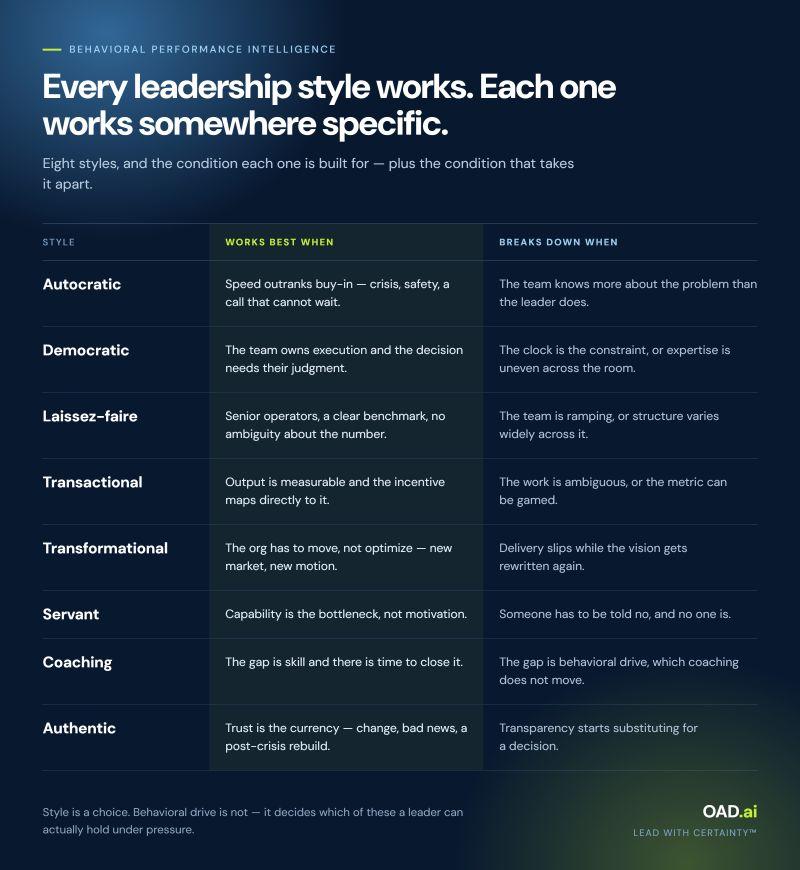
No single leadership style is correct everywhere. A task oriented approach wins in a crisis. A coaching approach wins when the team is capable and the problem is ambiguous. The mismatch, not the style itself, is usually what breaks a team. (More on how we score this: The Science.)
Why Interviews Miss Who Will Actually Lead
Leadership emergence, the process by which someone comes to be seen as a leader, has been studied for decades, and the findings are inconvenient for anyone hiring off a resume and a good conversation. A meta-analysis of personality and leadership found that Big Five traits, chiefly extraversion, predict who emerges as a leader and who is seen as effective, with a combined multiple correlation of about 0.48. That’s a real relationship, and it still leaves most of the variance unexplained by anything visible across a table.
Twin studies estimate that roughly 30% of the variance in who occupies a leadership role is genetic. Research on group dynamics has also found that people who simply talk more in a meeting are more likely to be perceived as leaders, whether or not what they said was any good. Confidence, articulateness, and preparation are exactly what an interview rewards, and none of the three reliably predict whether someone can produce direction, alignment, and commitment once the role is real.
Emotional Intelligence, Trust, and the Leader-Follower Relationship
Leadership is not a solo act. It’s a two-way relationship, and the leader’s side of it shows up in the data. A meta-analysis of 20 studies covering 4,665 subordinates found that a leader’s emotional intelligence, self-awareness, self-regulation, empathy, social skill, correlates with subordinate job satisfaction at ρ = 0.308. Separate research on leader-follower relationship quality found organizational commitment tracks with it at r = 0.32, and turnover intention drops with it at r = -0.37.
Trust, psychological safety, and perceived fairness are the mechanism behind both numbers. Team members who trust a leader’s competence and integrity take risks, surface bad news early, and stay committed when conditions change. None of that shows up in an interview. It shows up in behavioral data collected over time, which is exactly the gap a structured diagnostic is built to close.
Good Leadership vs. Great Leadership, and Where Mid-Sized Companies Feel the Gap First
Good leaders provide clear direction, follow through, and treat people fairly. Great leaders add something harder to fake: a vision the team can repeat back in its own words, the discipline to develop a successor instead of making themselves indispensable, and the willingness to make an unpopular, values-based call when the easy path is also the wrong one. Satya Nadella’s turnaround of Microsoft’s culture after 2014, replacing an internal stack-ranking system with what he called a “learn-it-all” mindset, is one of the most cited examples of a leadership style change preceding years of company growth. Steve Jobs built a different kind of great leadership on relentless product vision and exacting standards, a style not every organization could sustain.
Growing companies feel the gap between good and great first. Somewhere around the point where a team stops fitting comfortably in one room, informal alignment breaks and a founder’s gut stops scaling. That’s also where organizations tend to promote their best individual contributor into a leadership role with no evidence they can do it, because the alternative, an external hire with unproven fit, feels riskier. Both are guesses. One of them is just a guess you already made once before.
Ethical Leadership and Where Influence Goes Wrong
The same mechanisms that make leadership powerful, trust, authority, influence, become destructive when a leader manipulates information, plays favorites, or neglects the team during a stretch that matters. The cost isn’t abstract: one toxic leader inside a mid-sized team can drive out a meaningful share of that team within a year or two through disengagement and regretted attrition.
Ethical leadership is the strongest counter-signal in the data. The same 2026 meta-analysis found ethical leadership correlated with organizational commitment at r = 0.43, the strongest of any style measured. This is also where we’re direct about what OAD is and isn’t. We are not an opaque algorithm scoring a resume. We are a validated, structured behavioral diagnostic, EEOC compliant since 2001 with no adverse impact on any protected class, and independently reviewed against APA standards. We measure behavioral drive against a role benchmark. We do not replace judgment. OAD is one structured input into a leadership decision, never the sole basis for one.
Design teams with data, not gut feel.
Most org-design decisions come down to role fit, leadership style, and team dynamics. OAD reads those signals from a 7-minute behavioral survey, so you can reconfigure roles and teams with evidence instead of guesswork.
How to Actually Predict Leadership Before You Promote
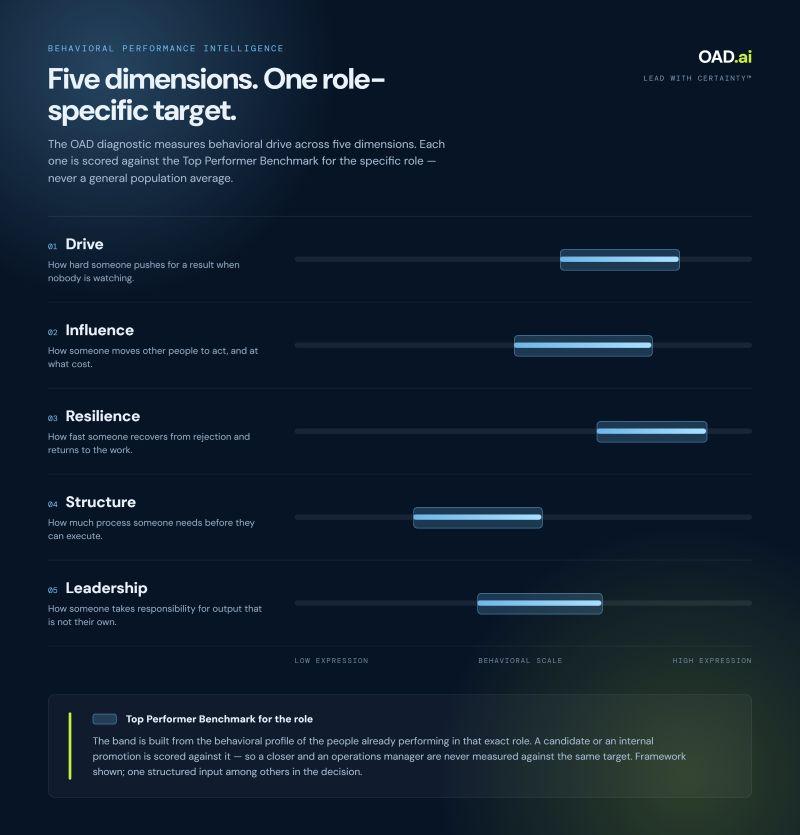
Here’s the mechanism. Every person you’ve ever promoted into a leadership role already had a behavioral pattern, whether or not anyone measured it. The diagnostic scores five dimensions, Drive, Influence, Resilience, Structure, and Leadership, against the Top Performer Benchmark set by whoever is already excelling in the role. A profile high in independence and pace maps onto fast execution with less need for consensus. A profile high in structured thinking and social orientation maps onto coaching a team through a stretch goal. Neither is better. The mismatch between the profile and the role is what costs you, and it’s the same mismatch behind why the best closer isn’t automatically the best sales manager.
On a 200-person operations org, the promotion mis-placement rate dropped from roughly 40% to roughly 12% after leaders were matched to roles using behavioral data instead of tenure or gut feel, one of three illustrative client scenarios behind OAD’s average 60% reduction in mis-hires across clients. That’s not a guarantee. It’s what happens when you stop guessing about the one decision you’ve never instrumented.
FAQ
What is the concept of leadership? The concept of leadership covers what leadership is, a process of generating direction, alignment, and commitment among a group, and its component parts: traits, behaviors, styles, and the situational factors that determine which approach works. A vague definition produces inconsistent hiring and promotion decisions; an operational one, built on outcomes, does not.
What’s the difference between leadership and management? Management focuses on planning, process, and keeping day to day operations on track. Leadership focuses on vision, direction, and getting a team to commit to it. Most leadership roles require both skills, evaluated separately, not folded into one job description.
Are leaders born or made? Neither claim holds alone. Twin studies put the heritable share of leadership role occupancy at roughly 30%. The remaining 70% comes from behavior, experience, and development, which is why leadership qualities can be built, and why a static personality read at hire time misses most of what will actually determine performance.
Can someone lead without a formal title? Yes. Leadership emergence research consistently shows individuals without assigned authority becoming leaders in group settings by providing direction, solving problems, and pulling the group toward a decision. Emergent leadership is often the clearest early signal of who is ready for a formal leadership role.
How long does it take to see results from a leadership change? Small shifts, a clearer weekly one-on-one, faster feedback, show up in team sentiment within weeks. Retention and performance gains from a leadership change typically take two to four quarters to show up cleanly in the data, which is why waiting for lagging metrics to flag a bad leadership fit is usually too slow.
None of this makes leadership less human. It makes it less of a guess. Start with the leader who already works: get your free Top Performer Profile, 7 minutes, results in 24 hours, no credit card, and turn the pattern that already succeeds on your team into the benchmark for who you promote next.