Most knowledge workers now spend the bulk of their week collaborating in some kind of team: a product squad, a cross-functional task force, a hybrid project team, a standing committee spanning departments and time zones. Effective teamwork has become a core career skill, not a soft bonus.
Working in a team means more than getting along. It means moving toward a shared goal, sharing accountability for the outcome, and adjusting how you communicate so the group moves faster than any one person could alone. The tips below are specific and practical, drawn from what actually separates teams that consistently deliver from teams that consistently don’t.
Key Takeaways
- Clear communication, active listening, and specific goals are the foundation every other teamwork practice builds on.
- High-performing teams combine human skills (trust, feedback, conflict resolution) with structural practices (defined roles, decision rights, shared metrics).
- Behavioral data can help leaders understand team dynamics, align people to the roles that fit them, and catch friction or disengagement early, but it works best as one input among several, not the whole picture.
- Hybrid and cross-functional teams need the same fundamentals as any other team, applied more deliberately because there’s less informal context to fall back on.
Start by Understanding Your Team Type
Before applying any teamwork tactic, understand what kind of team you’re actually in. A temporary project team shipping a single feature behaves differently from a standing team fielding support tickets every day. A cross-functional pricing committee blending finance, product, and sales runs on different rhythms than a hybrid product squad split across two offices.
Team dynamics who has influence, who initiates decisions, how conflict surfaces, how trust gets built vary with structure. A quick “team mapping” conversation helps: ask each person what they need to do their best work, who they rely on most, and where things feel unclear. That single conversation sets up nearly every tip that follows.
Set Goals That Are Actually Specific
High-performing teams share one trait almost without exception: clear goals and simple success metrics that every team member can repeat from memory without checking a doc.
Turn vague intentions into specific outcomes. “Improve onboarding” becomes “cut new-hire time to productivity from 90 days to 60.” A sales pod targets a quarterly number; an engineering team commits to a six-week deadline for a beta. The SMART framework (specific, measurable, achievable, relevant, time-bound) is a useful check, not a bureaucratic exercise to perform for its own sake.
It also helps to separate three layers: team goals (what the group delivers together), individual objectives (what each person owns), and organizational goals (where leadership is steering the company). When people can see the line from their own work to the team goal to the company goal, alignment tends to follow on its own.
Clarify Roles and Decision Rights Early
Even strong teams struggle when nobody’s sure who owns what: two people email the same client, nobody owns the documentation, everyone assumes someone else scheduled the stakeholder review. Ambiguity in roles is one of the most reliable ways to manufacture conflict that has nothing to do with anyone’s actual disagreement.
A simple RACI (Responsible, Accountable, Consulted, Informed) breakdown or a DRI (Directly Responsible Individual) model solves most of this. For a product launch, one person is the DRI for customer communications; a different person owns pricing approval. Naming this explicitly, even for a small team, removes a surprising amount of friction before it starts.
Communicate Clearly and Listen Actively
Good communication is the backbone of teamwork, and it matters more in hybrid teams that lean on async tools like Slack or email, where tone is easy to misread. Active listening is a set of observable behaviors, not a mindset: summarize what you heard before responding, ask a clarifying question when something’s ambiguous, pause before reacting to a terse message, and confirm understanding in writing after a verbal conversation.
For meetings, use a clear agenda and time-box the discussion. For async channels, keep one topic per thread and write subject lines someone can scan in two seconds. A misread message like “Why wasn’t this done?” can derail a week when it lands as an accusation instead of a genuine question. One clarifying reply (“Want to confirm the deadline, is it still Friday?”) usually heads off the unnecessary conflict entirely.
Build Trust Through Reliability
High-performing teams run on trust, and trust is built through small, consistent, unglamorous behaviors rather than one big gesture:
- Meet deadlines, or flag early when you won’t.
- Surface risks before they become surprises.
- Own mistakes publicly and focus on the fix, not the blame.
- Document decisions somewhere the whole team can see them.
- Give credit generously when someone else’s work moved things forward.
A shared status doc updated reliably every Friday builds more trust over months than a single well-delivered speech. Managers add to this by explaining the “why” behind decisions and being honest about real constraints like budget or headcount, rather than presenting decisions as fully settled from above.
Use Feedback That’s Actually Constructive
Constructive feedback is specific, behavior-focused, and tied to a clear outcome, not vague praise (“great job”) and not personal criticism (“you’re always late”). The Situation-Behavior-Impact (SBI) model is a reliable way to structure it:
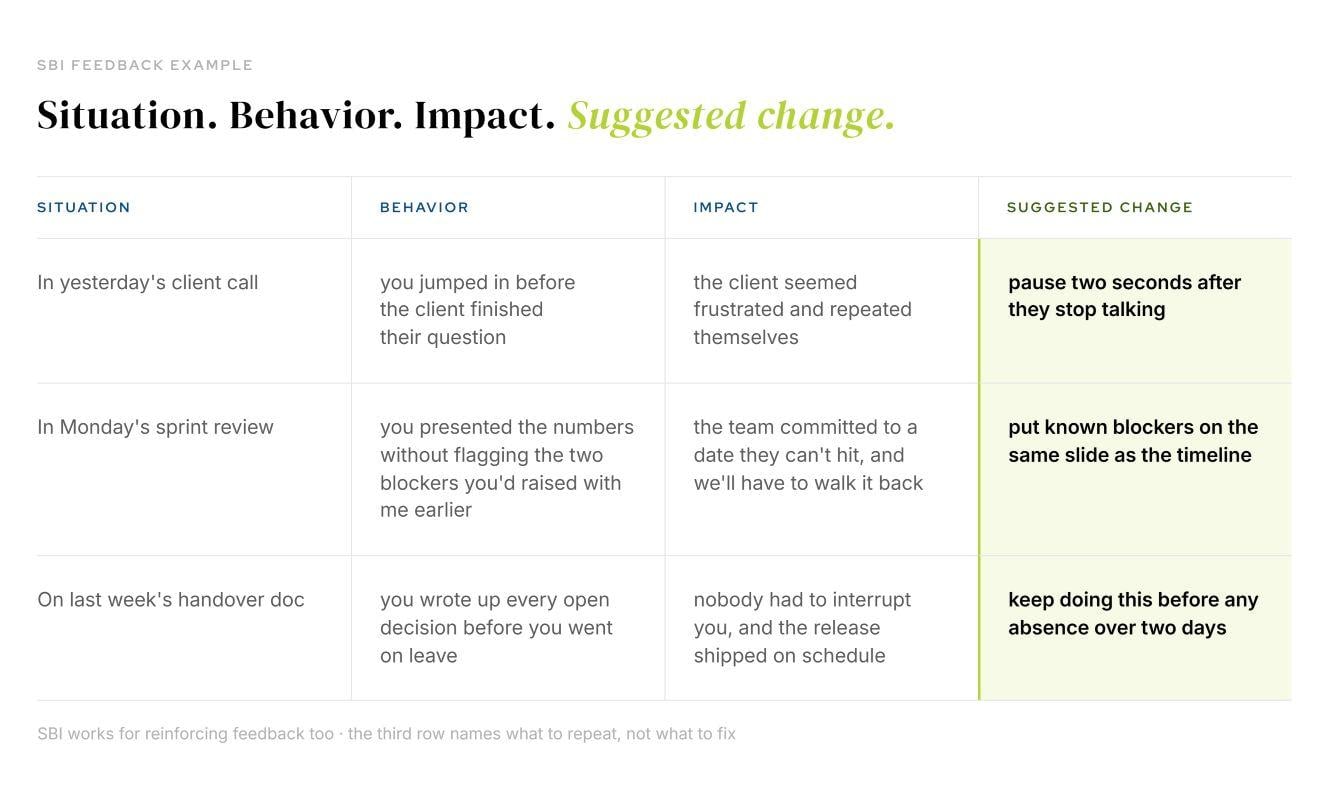
On the receiving end: listen fully before responding, ask a clarifying question if needed, resist the instinct to get defensive in the moment, and agree on one or two small changes to try over the next sprint. Regular retrospectives turn feedback into a habit instead of a once-a-year event people dread. Different people also take feedback differently: some want it direct and unadorned, others need more context first, and adjusting your delivery accordingly is part of giving feedback well.
Strengthen Collaboration and Knowledge Sharing
Collaboration means co-creating a solution together, not just splitting up tasks and reconvening at the end. A few practices that make this concrete: co-write documents instead of routing everything through one owner, run pair sessions for complex design or analysis work, rotate the note-taker role so ownership of meeting outcomes doesn’t sit with one person, and use a shared whiteboard when a problem genuinely benefits from more than one way of thinking about it.
Knowledge sharing matters just as much: document repeatable processes, keep an internal FAQ current, and record a short walkthrough when a process would otherwise live only in one person’s head. A cross-functional example: marketing builds a launch playbook so sales and customer success can reuse it instead of starting from scratch every time. This also surfaces where a team has a single point of failure, one person who holds all the context on something critical, so that expertise can be spread out before it becomes a problem.
Handle Conflict Before It Escalates
Conflict is inevitable in any real team, especially a diverse or cross-functional one. What separates a functional team from a dysfunctional one isn’t the absence of disagreement, it’s how the disagreement gets handled. A workable process:
- Surface the issue early, directly, and respectfully, rather than letting it build.
- Separate people from the problem. Use neutral, fact-based language: “We missed the last two deadlines because the spec changed mid-sprint.”
- Focus on interests, not positions: what outcome is each side actually trying to protect?
- Agree on a concrete next step, try it for one sprint, and reassess.
A practical example: product and sales disagree on a roadmap change. Instead of escalating through separate channels, they run a joint session, look at the same data together, agree to a two-week experiment, and revisit it on a set date. Some teams benefit from a named facilitator or an explicit escalation path so disagreements have a clear place to go instead of festering in side conversations.
Agree on How Decisions Actually Get Made
A lot of what looks like a personality conflict is really an unspoken disagreement about decision rights: who decides, how fast, and with how much input. Naming the model removes most of that friction.
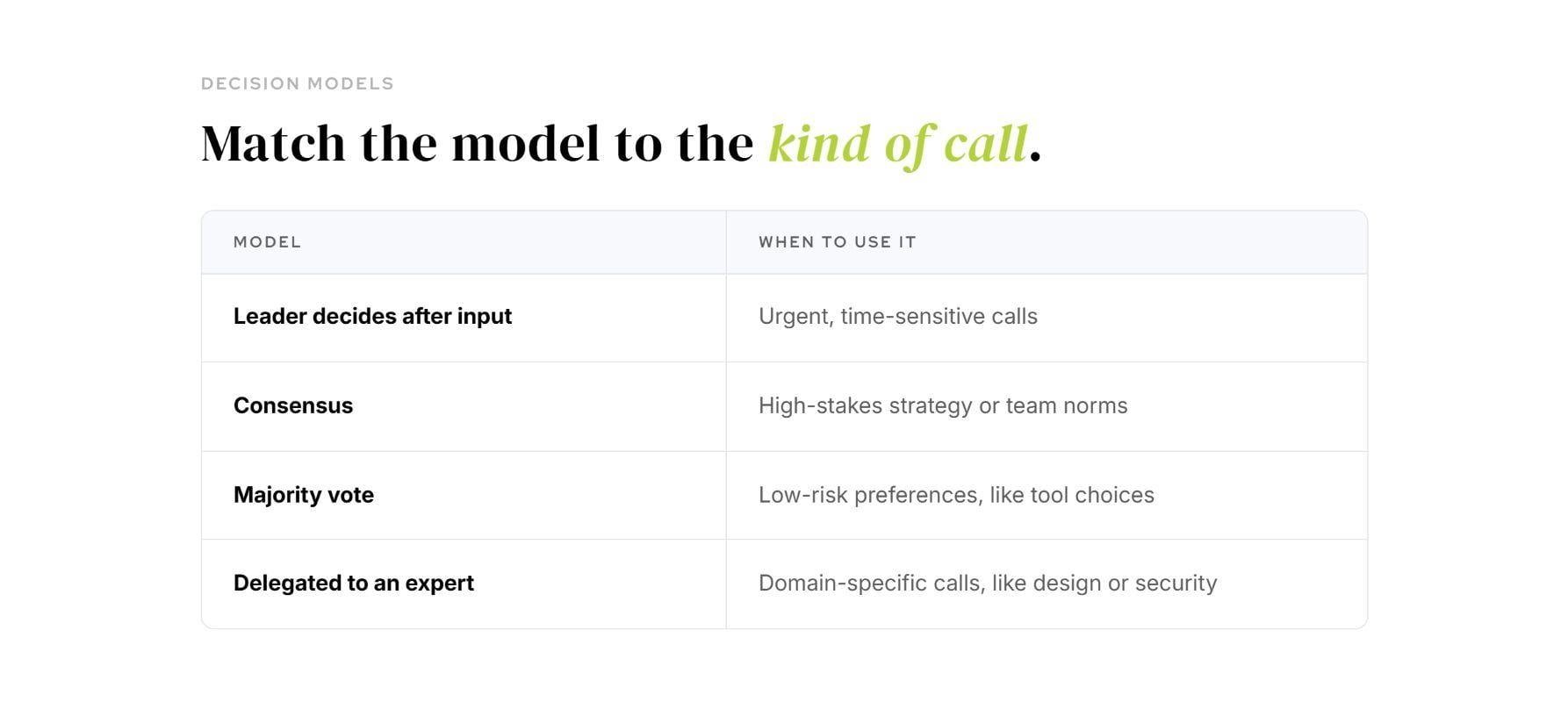
Stating it out loud in the moment (“the product lead is the decision owner today, using leader-decides-after-input”) prevents the same argument from resurfacing three separate times. Documenting the decision and the reasoning behind it in a shared space matters even more for distributed teams working across time zones, where there’s less shared context by default.
Make Hybrid and Distributed Teams Work
Hybrid and fully distributed teams face specific challenges that fully in-person teams don’t: informal decisions happen in a hallway or a side conversation that remote teammates never see, and a two-tier culture forms without anyone intending it.
A few practices help: shared “core hours” across time zones for real-time collaboration, written agendas and notes published somewhere everyone can find them, defaulting to video for anything sensitive or nuanced, and rotating meeting times so the same time zone doesn’t always absorb the inconvenience. One person per video frame also prevents side conversations that quietly exclude remote participants. The general rule: if a decision happened somewhere informal, write it down somewhere everyone can see it.
Use Cross-Functional Collaboration Intentionally
Cross-functional teams that blend product, engineering, sales, and operations can solve problems faster and spot risks earlier, but only when they’re managed deliberately. Left unmanaged, they tend toward silos and turf disputes instead.
What helps: a shared vocabulary everyone actually uses, joint retrospectives instead of separate ones per function, rotating meeting facilitation across departments, and agreeing on one definition of success before the work starts. None of this requires diversity of department to be treated as an abstract virtue, it’s a practical way to catch a downstream problem before it becomes a launch-week surprise.
Balance Accountability with Psychological Safety
Psychological safety means people feel safe to speak up, admit a mistake, or ask for help without fear of being punished or embarrassed for it. High-performing teams pair this safety with real accountability: commitments matter, goals are tracked, and performance issues get addressed promptly and respectfully, not avoided or ignored.
A few behaviors build this directly: leaders admitting when they’re wrong, explicitly inviting dissent (“what are we missing here?”), responding calmly to bad news instead of visibly reacting, and separating the person from the problem when something’s gone wrong. A monthly “risk we took, lesson we learned” conversation normalizes talking about failure openly, which is usually what makes people comfortable enough to actually hold each other to a high standard.
Where Behavioral Data Fits
Behavioral data is useful here, but it’s worth being precise about what it does and doesn’t do. A validated behavioral assessment can surface useful patterns, such as preferred pace, work style, and communication tendencies.
Tied to the tips above, that shows up a few concrete ways: matching people to the tasks that fit how they actually work, calibrating how feedback should be delivered so it actually lands, and spotting composition gaps, no strong finishers on a team, say, before a project launches rather than after it stalls.
The important caveat: behavioral data is one structured input into a team or staffing decision, not the sole basis for one. It works alongside direct observation, performance history, and manager judgment, not in place of them. Used that way, it is a starting point for understanding a team, not a verdict on it.
A Quick Checklist for Effective Teamwork
Shared direction: set goals with measurable outcomes and deadlines; clarify roles with RACI or DRI so every responsibility has one owner; agree on and document how decisions get made.
Daily behaviors: practice active listening (summarize, clarify, pause); give and receive feedback using Situation-Behavior-Impact; address conflict early with fact-based language.
Team design: adapt for hybrid and distributed work with core hours and written agendas; use cross-functional input intentionally; use behavioral data, where it’s useful, to align roles and spot gaps.
Culture: build trust through consistency and transparency; balance psychological safety with real accountability; make space to name what didn’t work, not just what did.
Pick one or two items to work on over the next 30 days rather than trying to fix everything at once, and revisit the list quarterly with your team.
FAQ: Common Questions About Working in a Team
How do I improve teamwork if my team is already tense or burned out? Stabilize workload and psychological safety before pushing for stretch goals. Gallup has found that 76% of employees experience burnout on the job at least sometimes, so a team feeling this isn’t unusual. Run a short retrospective on what’s draining the team versus what’s helping, delay non-critical work where you can, and agree on one or two norms to change, like no after-hours messages outside real incidents.
What if I’m the only one who seems to care about improving teamwork? Start by modeling the behaviors directly: clear communication, active listening, following through on what you said you’d do. Raise teamwork topics inside existing structures, one-on-ones, retros, performance check-ins, rather than proposing a separate “team building” meeting that’s likely to meet resistance.
How do I contribute if I’m quiet or introverted? Being quieter isn’t the same as being disengaged, and effective teams need both vocal brainstormers and people who think before they speak. Prepare thoughts in advance, use written channels to share ideas when that suits you better, request agendas ahead of time so you can contribute deliberately, and lean into roles that reward depth: research, analysis, documentation.
How can a manager tell a team is becoming less effective? Watch for missed or vague objectives, the same conflict resurfacing repeatedly, rising rework, fewer people speaking up in meetings, and late surprises on projects that should have been visible earlier. A simple monthly check on three things, clarity of goals, trust level, communication, tracked over time, catches most of this before it becomes a crisis.
How often should a team revisit its roles, goals, and norms? At least every quarter, and any time something changes materially: a new leader, a strategy shift, several new hires, or a reorg. Tying it to a natural point, a new quarter, right after a launch, works better than trying to schedule it in the abstract.
Build a Team That Actually Works Together
The teams that consistently perform well aren’t made up of unusually gifted people. They’re teams that got specific about goals, clear about roles, and honest about how they communicate and handle disagreement, and then kept doing it consistently.
If you want a starting point for understanding how your own team works, OAD’s free Top Performer Profile takes seven minutes and returns results in 24 hours, no credit card required.