You instrument pipeline, churn, and CAC to the decimal point. Then you promote your best performer into a leadership role and hope. That gap, the one place you still run on instinct, is where most leadership challenges in 2026 actually start.
Key takeaways
- Leadership challenges split into three types: external, internal, and role-based. Only two of the three are inside your control, and most leaders never separate them.
- Poor management is not a soft cost. Gallup puts the global price of low engagement at $8.8 trillion a year in lost productivity.
- Communication breakdowns, low morale, and burnout are not three separate fires. They are one drift pattern, and it usually starts with an unmeasured promotion.
- New managers promoted for individual performance, not behavioral fit, are a documented driver of the turnover that follows them.
- Behavioral data does not replace judgment. It gives you a benchmark to check judgment against, before the promotion, not after the resignation.
The Three Kinds of Leadership Challenges You’re Actually Facing
Every leadership challenge sorts into one of three buckets: external, internal, or role-based. Knowing which one you’re looking at changes what actually fixes it.
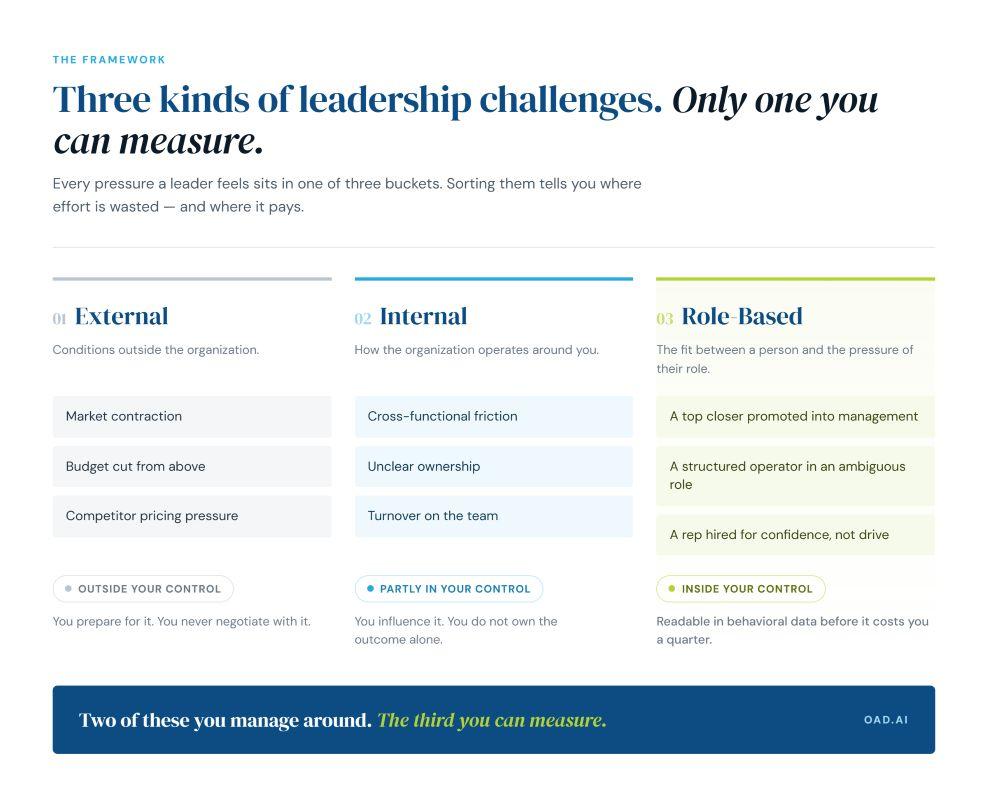
External challenges arrive from outside the org: market shifts, labor shortages, a client that walks. A leader cannot prevent these. They can only translate them into clarity fast enough that the team doesn’t write the story themselves, badly.
Internal challenges live inside the leader: conflict avoidance, a need for control, blindness to their own default setting under pressure. These are invisible in an interview and only surface once someone has real authority, which is exactly why interviews predict so little about who can handle it.
Role-based challenges come with the seat itself: constant decisions, constant visibility, the isolation of being the one everyone reads for the room’s mood. These exist even when the market is calm and the team is fully staffed.
Most leadership development spends its whole budget on the first bucket, skills training for external pressure, and almost nothing measuring the second: who this person actually is under pressure, and where their behavioral drive already breaks down.
Communication Breakdowns: When Messages Don’t Create Alignment
A communication breakdown is not a vocabulary problem. It’s what happens when a leader mistakes sending information for creating shared understanding.
One update, three interpretations, one missed deadline: that’s not a skills gap, it’s a failure of alignment. Hybrid work removed the hallway conversation that used to catch this in real time. Nothing replaced it.
The fix isn’t more meetings. It’s shorter huddles that surface priorities and blockers, an explicit line from every task back to the goal it serves, and a habit of checking for understanding instead of assuming it. Repetition isn’t redundancy here. It’s the only version of clarity that survives Slack threads, async updates, and a team that’s never fully in the same room.
Low Morale, Disengagement, and What It’s Actually Costing You
Low morale is a leadership signal, not an employee problem. It shows up as cameras off, minimum effort, and a slow bleed of the people you can least afford to lose.
iHire’s 2025 Talent Retention Report found the top three reasons people quit are a toxic environment (26.8%), poor company leadership (24.2%), and being unhappy with their direct manager (22.8%). None of that sits on the employee’s side of the desk.
The counter to low morale isn’t a bigger perk budget. It’s specific, visible recognition tied to a real outcome, and a one-on-one that talks about impact instead of a score.
Leading Through Constant Change Without Losing the Team
Leading through change means communicating before you have the full picture, not after.
Gallup surveyed 18,665 U.S. employees and found seven in ten had experienced disruptive organizational change in the past year. Among those who trusted their organization’s leadership through that disruption, the same research found they were 4.5 times as likely to stay engaged and 62% less likely to report burnout.
Silence during uncertainty doesn’t protect a team. It just hands the story to whoever’s loudest. Say what you know, say what you don’t know yet, and point at what the team can still control. Repeat weekly until the disruption passes.
Building Trust Across Hybrid and Remote Teams
Hybrid trust breaks down quietly, and the manager is usually the last one to notice.
Gallup found only 54% of managers who supervise remote employees strongly agree they trust their teams to be productive without being watched. Teams that build their own collaboration norms, instead of inheriting one from leadership, are 66% more likely to be highly engaged and 29% less likely to report burnout, per the same research.
Trust at a distance gets built the unglamorous way: personal check-ins that aren’t status updates, decisions explained instead of announced, and shared documentation so remote and in-office employees aren’t working off two different information sets.
Developing Managers Who Weren’t Ready for the Role
Most new managers were promoted for doing the individual job well, not for any behavioral evidence they could lead people doing it, including how they would demonstrate cultural fit in behavioral interviews.
They inherit former peers, an unfamiliar set of feedback conversations, and no training in either. Sink-or-swim is the default, and it’s predictably expensive: inconsistent performance and turnover that shows up months later and gets blamed on everything except the original promotion call.
Mentorship and real practice change this, not a one-day workshop. So does knowing where a candidate’s behavioral drive already sits before you hand them the title, not after their first team meeting goes sideways.
Driving Performance Without Burning Out the Team
Performance and burnout only trade off when workload management fails. They don’t have to.
“Do more with less” has been the default mode since 2021. It works for a quarter. By month twelve it shows up as sick days, cynicism in standups, and resignations that land right when someone finally ramps.
The fix isn’t urging people to work harder. It’s naming what’s non-negotiable this quarter versus what isn’t, capping concurrent projects to what the team can actually carry, and a leader who visibly takes their own recovery time instead of performing constant availability.
Why Leaders Avoid the Conversations That Matter Most
Avoiding a hard conversation feels safe in the moment and gets expensive fast.
Delayed feedback, an unaddressed toxic performer, a promotion conversation nobody starts: every one of these tells the rest of the team the standard is optional. A simple structure holds up here: name the specific behavior, state its impact, set the expectation, offer support, put a date on the follow-up. None of that requires charisma. It requires doing it on schedule instead of never.
What Changes by Level: Frontline, Mid, and Senior
The same leadership challenge lands differently depending on the seat.
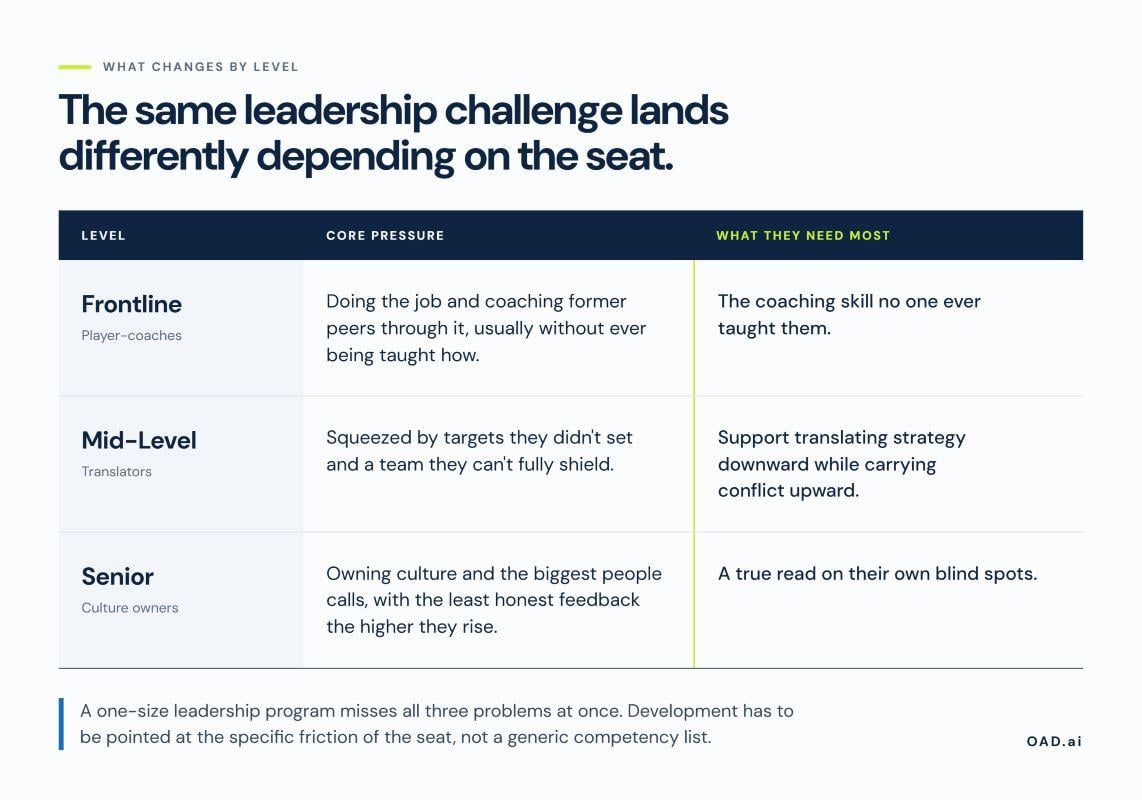
Frontline managers are player-coaches: doing the job and coaching former peers through it, usually without ever being taught how. Mid-level managers translate strategy downward and carry conflict upward, squeezed by targets they didn’t set and a team they can’t fully shield. Senior leaders own culture and the biggest people calls, and get the least honest feedback on their own blind spots the higher they rise.
A one-size leadership program misses all three problems at once. Development has to be pointed at the specific friction of the seat, not a generic competency list.
Turning Gut Feel Into Data: Where Behavioral Intelligence Fits
The challenges above aren’t new. What’s new is that you no longer have to manage them on instinct alone.
We built OAD on a simple bet: behavioral drive is invisible in an interview and only shows up in the data. OAD isn’t a personality quiz or a culture-fit questionnaire bolted onto your HR stack. It’s a validated behavioral diagnostic, built on 38 years of continuous validation, with more than 10 million assessments completed and zero successful legal challenges in that time. It measures how a leader is actually wired to operate under role-specific pressure, across five dimensions: Drive, Influence, Resilience, Structure, and Leadership.
That’s the difference between guessing which manager will burn out and knowing it 30 to 60 days early. OAD clients see a 60% average reduction in mis-hires by using that data before the promotion, not after it. And it’s one structured input into the decision, never the only one: OAD is EEOC compliant since 2001, with no adverse impact on any protected class: the opposite of a black-box screening tool.
Design teams with data, not gut feel.
Most org-design decisions come down to role fit, leadership style, and team dynamics. OAD reads those signals from a 7-minute behavioral survey, so you can reconfigure roles and teams with evidence instead of guesswork.
Structured leadership development isn’t an annual event. It’s assessment data, a coaching cadence, and real practice, repeated over six to twelve months, calibrated to the level: frontline, mid, or senior. That’s infrastructure, not a perk.
Every leadership challenge in this piece traces back to one unmeasured decision: who you promoted, and why. Get Your Free Top Performer Profile. Seven minutes, results in 24 hours, no credit card, and a benchmark for the next promotion call you have to make on more than gut feel.
Frequently Asked Questions
What are the most common leadership challenges leaders face in 2026? Communication breakdowns, low morale, constant change, unready new managers, and performance pressure that tips into burnout. Underneath most of these sits one internal challenge: a leader’s own self-awareness gap, which self-report surveys tend to miss.
How can senior leaders diagnose which leadership challenges are inside their organization? Pair qualitative signals (skip-levels, exit interviews) with quantitative ones (turnover by manager, engagement by team). Repeated attrition under one leader is a pattern, and a behavioral benchmark usually shows you why before the next resignation letter does.
What’s the real difference between internal and external leadership challenges? External challenges come from the market and sit outside a leader’s control. Internal challenges, avoidance, control issues, low self-awareness, sit inside the leader, and are exactly what a validated diagnostic surfaces early.
How can a smaller company build leadership development without a big HR budget? Start with the highest-leverage move: know who you’re promoting before you promote them. A free Top Performer Profile takes seven minutes and gives you a benchmark before building anything more expensive on top of it.
How long before leadership development shows results? Communication and recognition changes can shift morale within weeks. A pipeline built on assessment data instead of gut calls typically takes six to eighteen months to show up in turnover and engagement numbers. Track a few metrics quarterly rather than waiting for the annual review to tell you it was too late.