Every new team looks the same on day one. Cautious. Polite. Waiting for someone else to set the rules. What separates the teams that reach real performance from the ones that stall in quiet, unresolved conflict is not luck. It is whether the leader can read the team forming stages and act on what each one actually demands.
Key Takeaways
- Tuckman’s model names five stages of team development: forming, storming, norming, performing, and adjourning.
- Teams rarely move through the stages in a straight line. A new hire, a leadership change, or a shifted deadline can pull a team back into storming.
- Each stage calls for a different kind of leadership. Structure in forming. Disciplined conflict in storming. Shared ownership in norming. Delegation in performing.
- Behavioral data can show a leader where friction is likely before it shows up in a standup, not after it does.
- The goal is not to freeze a team in the performing stage. It is to move the team through the full cycle, adjourning included, so the lessons carry into the next project.
What Team Development Actually Is
Team development is the process by which a collection of individuals, each with separate habits and priorities, becomes a single unit that delivers on a shared goal, through evolving roles, negotiated norms, and trust built over repeated interactions, not through a kickoff meeting alone.
The model most leaders reach for comes from psychologist Bruce Tuckman, who published “Developmental Sequence in Small Groups” in Psychological Bulletin in 1965, synthesizing roughly 50 existing studies of small-group behavior into four stages: forming, storming, norming, and performing. In 1977, Tuckman and Mary Ann Jensen added a fifth stage, adjourning, for what happens when a team’s task ends and the group disbands.
The stages of group development apply whether you call the unit a “team” or a “group.” Some researchers reserve “group” for looser associations and “team” for interdependent, goal-focused units, but the developmental sequence holds either way.
The Five Stages, In Order
Forming, storming, norming, performing, adjourning. That is the order, always. (You may see “forming storming norming forming” referenced online. That is a typo. The fourth stage is performing.)
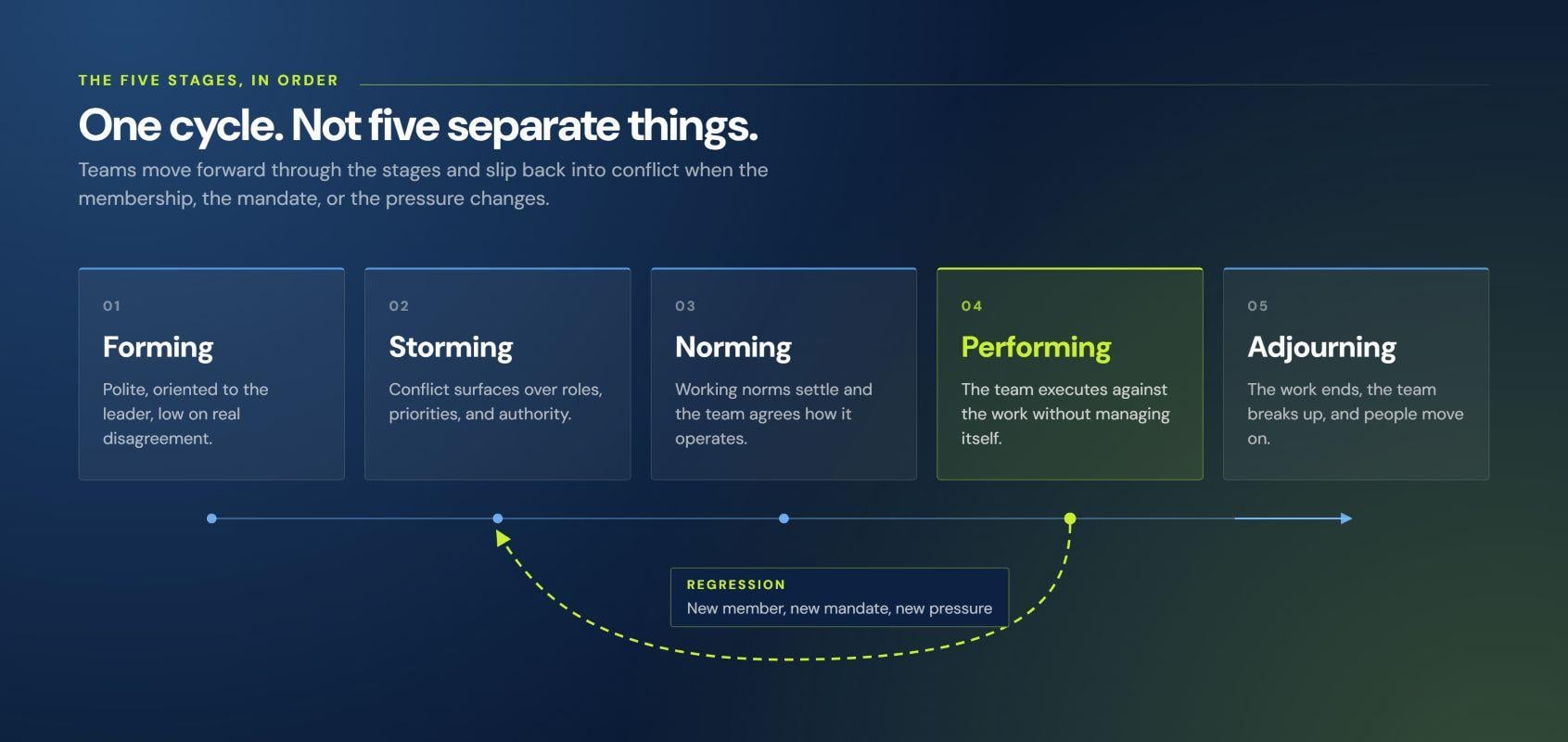
- Forming: the team meets, roles are unclear, everyone waits on the leader.
- Storming: conflict surfaces over priorities, roles, and authority.
- Norming: trust builds, norms solidify, work finds a rhythm.
- Performing: the team runs with high autonomy and reliable output.
- Adjourning: the task ends, the team disbands, and the lessons get captured or lost.
Forming: What Happens When a Team First Comes Together
In the forming stage, team members are polite, cautious, and dependent on the leader for direction, because no one yet knows how the group will actually work.
Conversation stays on safe ground: logistics, tools, schedules. Nobody wants to be the first to disagree. That caution is not a problem to fix, it is a normal, predictable first stage.
What a leader owes the team here is structure, not warmth: a clear purpose, defined roles, a written charter, a set cadence for meetings. Skip this and the team does not move faster, it moves into storming still arguing about basics.
This is also where a hiring mistake compounds. A team assembled on interview performance instead of fit against a working benchmark carries risk into every stage that follows. OAD clients see a 60% average reduction in mis-hires by anchoring hiring decisions to a validated behavioral benchmark instead of gut read, one structured input into a decision leaders were already making on incomplete information.
Design teams with data, not gut feel.
Most org-design decisions come down to role fit, leadership style, and team dynamics. OAD reads those signals from a 7-minute behavioral survey, so you can reconfigure roles and teams with evidence instead of guesswork.
Storming: Why Conflict Is the Sign a Team Is Actually Developing
The storming stage is where real differences in priorities, working style, and authority surface. Skipping it does not mean a team avoided conflict, it means the conflict went underground and resurfaces later as quiet resistance or sudden turnover.
Healthy storming and unhealthy storming look different in the room:
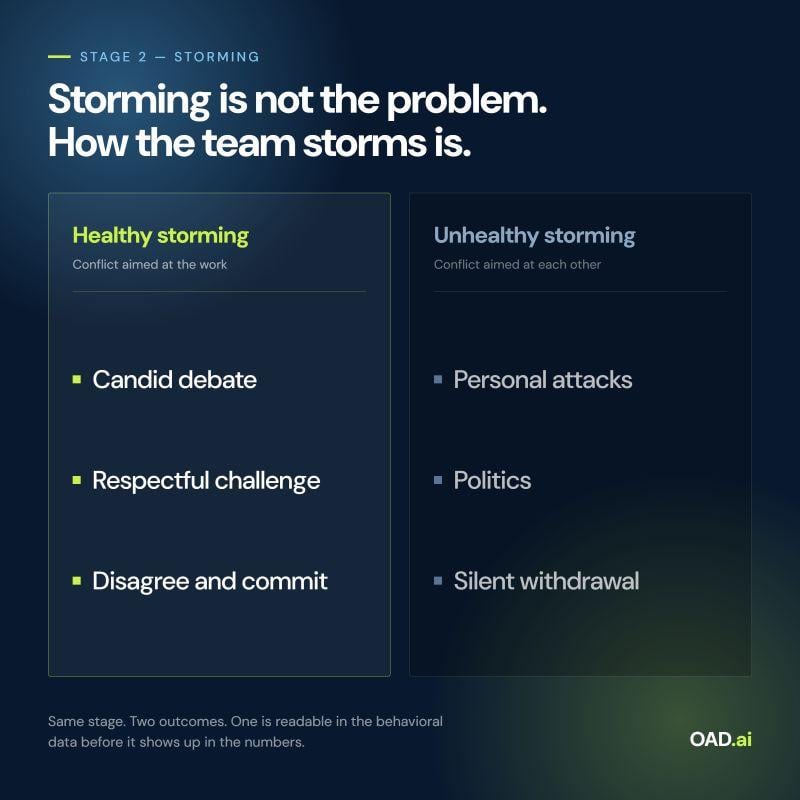
A leader’s job in storming is not to shut conflict down. It is to give it structure: a decision framework, a retrospective, a neutral facilitator for the highest-stakes calls. Behavioral data helps here too. A high-Drive profile paired with a high-Structure profile will read each other’s normal behavior as a personal attack unless someone names the pattern first.
Norming: How a Team Builds Trust and Working Rhythm
In the norming stage, the team develops a shared sense of “we,” roles clarify further, and work becomes more predictable because the group has agreed, explicitly or not, on how decisions get made.
Sprint ceremonies get smoother. People start anticipating each other’s needs. Norms lock in, some written (a communication cadence), some unwritten (how fast you are expected to reply).
The risk in norming is comfort: groupthink, or resistance to a new hire who might disrupt a rhythm the team just found. A leader should keep revisiting norms on purpose, rotate who runs the meeting, and protect space for a quieter team member to prepare before a decision meeting instead of being talked over by the loudest one in the room.
Performing: What High Performance Actually Looks Like
The performing stage is marked by high trust, flexible roles, and reliable output. The team handles conflict quickly and stays focused on the problem instead of the blame.
Leadership style has to shift here too. Directive management becomes a liability. The job becomes removing obstacles and protecting the team’s focus, not supervising it.
Performing is not a permanent state. It erodes before it collapses, and the early signal rarely shows up as a missed deadline first. It shows up in engagement, workload balance, and small shifts in how someone is operating relative to their own baseline. Watching for that drift, not just watching the calendar, is what keeps a performing team performing.
Adjourning: The Final Stage Most Teams Skip
Adjourning happens when a team’s task ends and the group disbands, bringing mixed emotions: pride, relief, sometimes anxiety about the next assignment.
A skipped adjourning stage does not save time, it costs the next team the lessons this one already paid for. A rushed close means undocumented decisions, uncelebrated work, and a team that resets to forming on its next project with none of the muscle memory it should have kept.
Do it well instead: run a real retrospective, document the decisions that mattered, recognize the work in public, and carry the behavioral data forward so the next team starts with information this one had to discover the hard way.
Teams Don’t Move in a Straight Line
Regression is common, not a failure. A new hire, a leadership change, or a goal that shifts mid-project can pull a performing team back into storming. Long-running teams can even slide through “decay stages,” denorming, de-storming, de-forming, without active maintenance.
Treat Tuckman’s stages as a diagnostic lens, not a one-way checklist. When you see regression, name it, then reapply forming-stage clarity and storming-stage structure instead of treating it as a personal failure.
A Leader’s Playbook by Stage
- Forming: set purpose, define roles, agree on communication rules before the work starts.
- Storming: normalize disagreement, use a decision framework, address conflict directly instead of letting it triangulate through a third person.
- Norming: involve the team in writing its own process, revisit norms on a schedule, shift ownership from you to the group.
- Performing: delegate real authority, protect focus time, keep checking for drift before it shows up in the numbers.
- Adjourning: run the retrospective, document what worked, say the recognition out loud.
Where Behavioral Data Fits in Team Development
OAD is not a personality test. It is a validated behavioral diagnostic, built on 38 years of continuous validation and more than 10M completed assessments, that measures behavioral drive across five dimensions: Drive, Influence, Resilience, Structure, and Leadership.
Applied to team development, that data does three things a standup cannot: it shows where two working styles are likely to clash before storming starts, it gives norming-stage teams a shared vocabulary for why someone works the way they do, and it flags drift in a performing team before it shows up in a missed number. None of it replaces judgment. It is one structured input alongside everything a leader already sees, not a substitute for it.
Design teams with data, not gut feel.
Most org-design decisions come down to role fit, leadership style, and team dynamics. OAD reads those signals from a 7-minute behavioral survey, so you can reconfigure roles and teams with evidence instead of guesswork.
The Team Variance Report turns that data into a team-level view instead of an individual one, and The Science covers the validation behind it, if you want the methodology before the summary.
Common Pitfalls Across the Stages of Team Development
| Stage | Common mistake | What it costs |
|---|---|---|
| Forming | Skipping structure, assuming the team will “figure it out” | Prolonged confusion, early disengagement |
| Storming | Avoiding conflict, or punishing it when it surfaces | The team never reaches norming |
| Norming | Groupthink, resisting new members or new ideas | Stagnation when conditions change |
| Performing | Complacency, skipping onboarding for new members | A relapse into storming |
| Adjourning | Skipping closure, not documenting what worked | Lost trust and lost lessons for the next team |
FAQ
Do all teams go through every stage of team development?
Most teams experience all five stages of team development, though the length and intensity of each one varies with team size, task complexity, and leadership. A team that appears to skip storming has usually just suppressed the conflict rather than avoided it, and it tends to resurface later as resistance or turnover.
How long does it take a new team to reach the performing stage?
There is no fixed timeline. Complex, cross-functional teams often take several months to move from forming to performing. Clear goals and behavioral data that surfaces friction early can shorten it. The more reliable signal is how consistently the team keeps its commitments, not the calendar alone.
Can a team move backward from performing to storming?
Yes, and it is common. Adding a member, changing a leader, or shifting the goal can all push a performing team back into storming. Leaders who catch the regression early can reapply forming and storming practices, clarifying roles and revisiting norms, instead of treating the setback as a failure.
What is the difference between team development and group development?
In most organizations the two terms are used interchangeably. Some researchers reserve “group” for looser associations and “team” for interdependent, goal-focused units, but Tuckman’s stages of group development apply to both.
How can I tell which stage my team is in right now?
Look at the level of conflict versus harmony, how clear the roles are, and how reliably the team keeps its commitments. High uncertainty points to forming. Frequent tension points to storming. Predictable routines point to norming. Autonomous, flexible collaboration points to performing.
You already have a top performer on the team you are building around. Start with a free Top Performer Profile. Seven minutes, results in 24 hours, no credit card, and a benchmark for every hire that comes after.