Ask five people on your team what the top priority is this quarter. Five different answers doesn’t mean you have a communication problem. It means you have a team alignment problem: the strategy in your deck and the work happening on Tuesday are not the same thing, and nobody has synced them.
Key takeaways
- Team alignment is a behavioral outcome, not a communication exercise: shared priorities, shared decision rights, and shared behavior under the same pressure.
- Duplicate projects and chronic disagreement about who decides are not communication failures. They are what unclear ownership looks like from the outside.
- Misalignment is diagnosable before it shows up in turnover: clashing communication styles, role mismatch, and pace conflicts surface long before anyone quits.
- Alignment breaks most often in the cascade from strategy to individual role, rarely in the strategy itself.
- People commit to goals they helped set. Handed goals get compliance. Co-owned goals get ownership.
Alignment Is Not a Slogan. It’s a Measurable State.
Team alignment is not a poster in the break room. Not an offsite. Not a values slide everyone nodded at once. It is the state where every person shares the same priorities, exhibits the same behaviors under pressure, and tracks against the same metrics as the person next to them.
Most teams have alignment on paper and drift in practice. Sales defines success as new logos. Ops defines it as cost per unit. Each function hits its own number, and the company still misses its number, because nobody’s incentive rewarded the handoff between them.
Real alignment survives contact with budgets, calendars, and hiring decisions, not just kickoff speeches. If you want to know whether your team is aligned, don’t ask what they believe. Look at where their calendars actually go.
Signs the alignment is surface-level only:
- Duplicate projects nobody owns
- Conflicting priorities across functions, each doing the math differently
- Chronic disagreement about who actually decides
- People who cannot connect their daily work to the company’s direction, and who are already looking
What the Org Chart Won’t Tell You
Most leaders sense misalignment and respond with a team-building exercise. That treats a data problem like a mood problem.
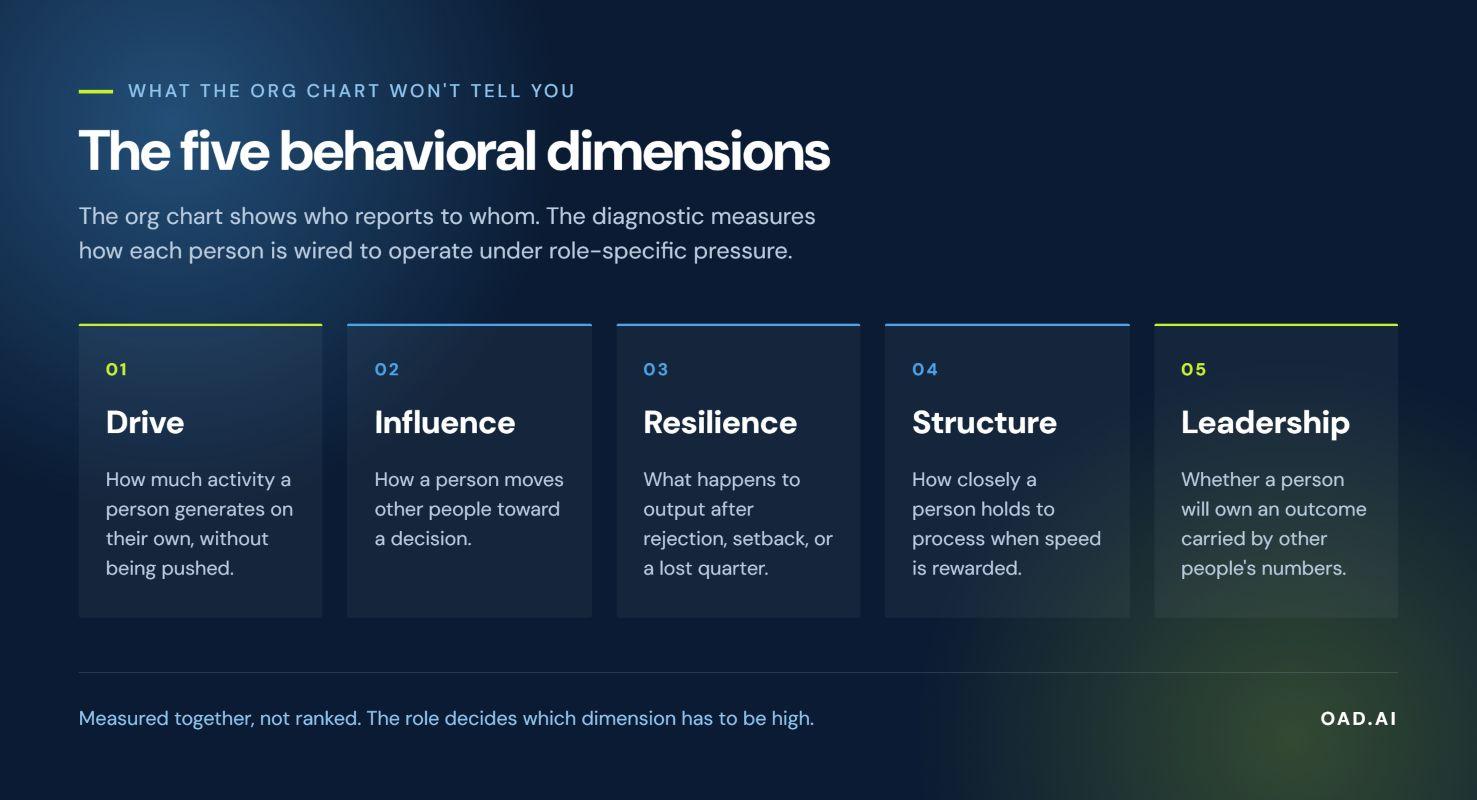
The friction is behavioral, and it is invisible in a conversation. Two people can agree on a strategy in a meeting and execute it in completely incompatible ways once they’re back at their desks. One moves fast and decides alone. The other needs consensus and structure before taking a single step. Neither is wrong. They are wired differently, and nobody measured that before putting them on the same deliverable.
OAD measures behavioral drive across five dimensions, always these five: Drive, Influence, Resilience, Structure, and Leadership. It is validated psychometric data, not a personality read, and it is how someone is wired to operate under role-specific pressure, not who they are as a person. Applied to a team, the same diagnostic that tells you whether a candidate fits a role tells you whether your current team’s behavioral composition matches what the strategy actually demands. A strategy team stacked with detail-focused executors and short on risk-tolerant Drive will stall on innovation every time, no matter how good the offsite was.
Design teams with data, not gut feel.
Most org-design decisions come down to role fit, leadership style, and team dynamics. OAD reads those signals from a 7-minute behavioral survey, so you can reconfigure roles and teams with evidence instead of guesswork.
Where Alignment Actually Breaks: The Cascade
Alignment fails less often at the top than in translation. The cascade looks simple on a slide:
- Company strategy: the direction and the multi-year bet.
- Department objectives: the measurable targets that ladder up to it.
- Team commitments: what ships this quarter, and who owns it.
- Individual role expectations: what this specific seat is accountable for, and which decisions it gets to make alone.
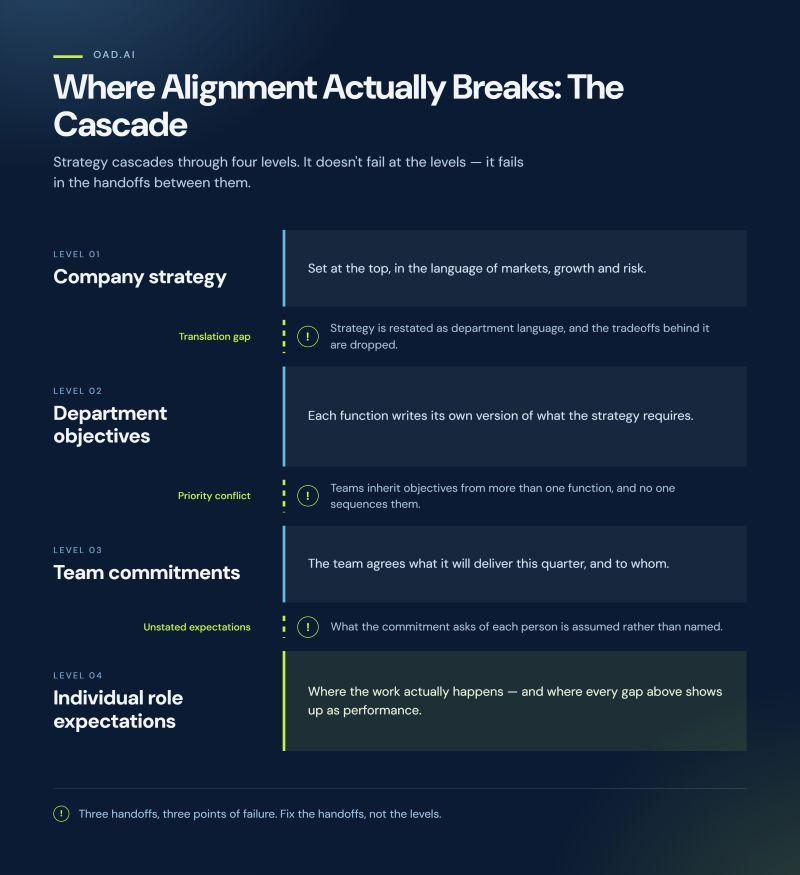
Break the chain anywhere and you get alignment on paper and confusion in practice. People who help set the goal at their level commit to it more than people who were simply handed it. That is not a motivational nicety. It is why goal cascades that skip the team-commitment step produce compliance instead of ownership, and why defined roles and clear decision rights eliminate the ambiguity that quietly kills execution.
A 200-Person Org, One Broken Handoff
Here is what this looks like at scale. On one illustrative 200-person operations org, promotions were decided on tenure and visibility, not on whether the behavioral profile that made someone a strong individual contributor also predicted leadership behavior. Roughly 40% of those promotions were behavioral mis-placements: strong performers moved into roles their behavioral drive did not support.
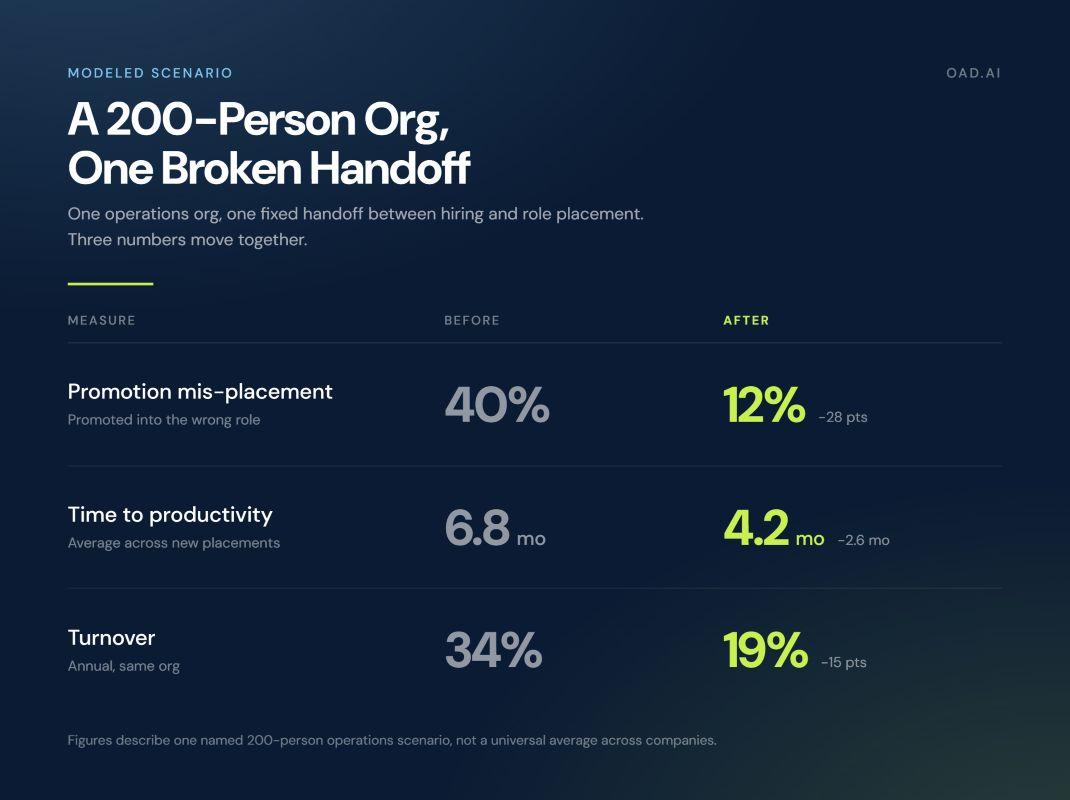
Using a validated behavioral benchmark to inform promotion decisions instead, that mis-placement rate came down to roughly 12%, time-to-productivity in the new role dropped from 6.8 to 4.2 months, and annual team turnover fell from 34% to 19%. These figures describe one illustrative operations scenario, not a guarantee for every org, but the direction holds wherever alignment breaks at the promotion decision instead of the hiring one.
The same logic shows up faster on commission-based sales teams, where role-fit errors hit the number immediately. On one illustrative 40-person sales team, quota attainment moved from 41% to 67% and ramp time dropped from 7.2 to 4.8 months once hiring matched behavioral drive to the role instead of matching résumés to a job description.
Building Alignment Into How the Team Operates, Not Just What It Says
Rituals help. Monthly cross-functional check-ins where teams commit to shared priorities out loud. Postmortems that examine collaboration, not just output. Role scorecards that state what winning actually looks like. None of it holds if you never check whether the team’s real behavioral makeup still matches what the strategy needs.
That is the gap a Team Variance Report is built to close: a standing read on where a team’s behavioral composition has drifted from the profile the role demands, before it shows up as a missed number. Performance drift is readable 30 to 60 days early. React to it after the quarter closes and you have already lost the quarter, and possibly the person. OAD’s Performance Drift Detection, coming to the platform, is built around exactly that window.
Design teams with data, not gut feel.
Most org-design decisions come down to role fit, leadership style, and team dynamics. OAD reads those signals from a 7-minute behavioral survey, so you can reconfigure roles and teams with evidence instead of guesswork.
None of this replaces judgment. Behavioral data is one structured input into a promotion or team-design decision, never the sole basis for one.
Start with one team, not the whole org. Pick the group with the most visible friction or the highest flight risk, and get a real read on it before you redesign anything.
FAQ
What does it mean for a team to be aligned? A team is aligned when its members share the same priorities, use the same definition of success, and behave consistently under the same kind of pressure, not simply when they can recite the same mission statement.
How do you know if a team is misaligned? Watch for duplicate projects with no clear owner, chronic disagreement about who decides, and people who cannot connect their daily work to the company’s direction. Turnover in that group is usually a lagging indicator, not the first sign.
What’s the difference between team alignment and team culture? Culture is what a team believes and how it generally behaves. Alignment is whether that behavior is currently pointed at the same goal. A team can have a strong, healthy culture and still be badly misaligned on priorities.
How long does it take to align a team? There is no fixed timeline, because most of the delay comes from skipping the diagnosis step, not the redesign step. Teams that start with a real read on where the behavioral mismatch sits move faster than teams that start with another offsite.
Get a Real Read on Your Team
Alignment starts with knowing what your team’s behavioral makeup actually is, not what the org chart assumes it is. Get Your Free Top Performer Profile: seven minutes, results in 24 hours, no credit card.