Your payroll runs through one vendor. Benefits through another. Compliance lives in whatever spreadsheet someone last remembered to update. You call this an HR function. It’s a patchwork, and patchworks fail exactly when you can least afford it: mid-audit, mid-growth-spurt, mid-lawsuit.
Managed HR replaces the patchwork with one accountable system. The best versions of it replace your gut with data, too.
Key takeaways
- Managed HR is a fully outsourced or hybrid HR function covering the full employee lifecycle: recruiting, onboarding, employee relations, compliance, payroll, and leadership development.
- It’s built for companies around 50 to 250 employees: past the point where one generalist can cover everything, not yet at the size that justifies a full internal HR department.
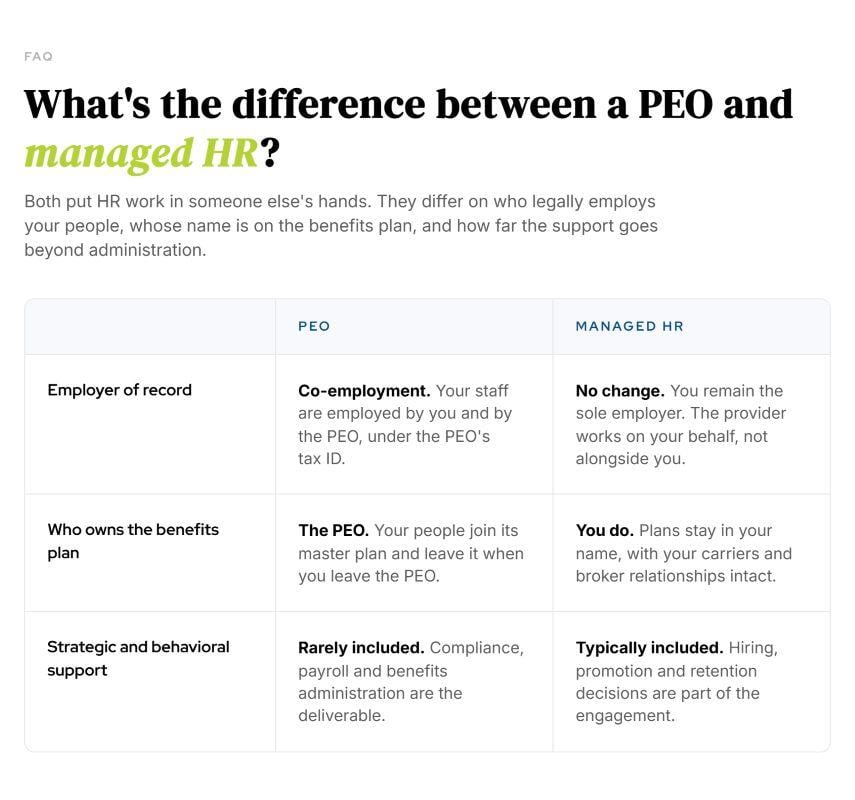
- A standard managed HR engagement is not a PEO. It typically keeps your company as the employer of record, so you retain your own benefits plans and your own identity while gaining outsourced expertise.
- Layered with validated behavioral data, such as OAD’s Top Performer Profile, managed HR stops reacting to turnover and starts predicting it.
- Most engagements move from signed agreement to full go-live in four to eight weeks, across three phases: assess, implement, then run.
What Is Managed HR?
Managed HR is a fully outsourced or hybrid human resources function. A dedicated partner runs your day-to-day HR administration and your strategic people operations under one accountable relationship, instead of both being scattered across vendors, part-time consultants, and whichever manager has bandwidth that week. It covers the full employee lifecycle: recruiting, onboarding, employee relations, compliance, payroll processing, and leadership development. The result is an always-on HR function without the cost and complexity of building one internally.
That’s a different model than hiring a single HR generalist, and a different model than a PEO (more on that distinction below). It’s also gaining real traction, for reasons that have nothing to do with fashion. Remote and hybrid work multiplied compliance complexity across state lines. Talent shortages make every mis-hire more expensive to absorb. Pay transparency rules and shifting overtime thresholds keep raising the stakes for getting employment law wrong. At the same time, behavioral analytics can now predict workforce risk and improve hiring accuracy in ways that weren’t accessible a few years ago. None of that has an internal fix that scales without headcount you don’t want to add yet.
The Cost of Outgrowing Ad Hoc HR
If your company has outgrown the stage where one HR generalist or office manager can juggle recruiting, onboarding, payroll, performance reviews, and employee relations at the same time, you already know the pattern. Reactive hiring fills seats and misses culture fit. Turnover creeps upward. Compliance anxiety sits in the back of your mind. Your systems are scattered: a payroll vendor here, a benefits broker there, a spreadsheet tracking who’s due for a review. There’s no time left for strategic workforce planning, because all your energy goes into putting out fires.
A modern managed HR partner fixes the underlying structure, not just the symptoms, by combining people, process, and technology into a single operating model. Instead of stitching together consultants, part-time help, and disconnected tools, you get one accountable team running your HR functions end to end. When that model also pulls in behavioral data, HR stops being reactive and starts being predictive: you can see role demands and team dynamics before you hire into them, not after the mis-hire has already cost you a quarter. This is not a co-employment PEO arrangement that pools your benefits with hundreds of other companies. It’s tailored support built for the specific size and stakes of a 50 to 250 employee organization.
Why Managed HR Beats Piecemeal Outsourcing
Most growing companies don’t have a single HR problem. They have a dozen, spread across different vendors, manual processes, and ad hoc workarounds. Managed HR centralizes what is usually fragmented, so compliance, hiring, employee development, and analytics reinforce each other instead of operating in isolation.
- Centralized HR ownership. One accountable partner manages policies, onboarding, offboarding, employee relations, and documentation across the full employee lifecycle. No chasing three vendors for one answer.
- Better hiring decisions. Behavioral assessments align candidates with role requirements, manager style, and organizational culture, which reduces mis-hires and shortens time-to-productivity. This is where a validated diagnostic, not a personality quiz, earns its keep.
- Lower compliance and legal risk. Ongoing monitoring of employment law changes, including state-level pay transparency rules, overtime thresholds, and leave requirements, keeps you ahead of costly mistakes.
- Predictable costs. You move from sporadic legal bills, ad hoc consultants, and emergency fixes to a model you can budget for quarterly and annually.
- Time back for leadership. Every hour a founder or manager spends untangling an HR fire is an hour not spent on the business. Centralizing HR under one accountable partner is what gets that time back, not a specific percentage claim we can stand behind, but the direction is consistent across every operator we talk to.
- Data-driven people decisions. Combining HR metrics (turnover, promotion velocity, absenteeism) with behavioral data informs talent strategy, succession planning, and engagement programs in a way spreadsheets alone can’t.
How Managed HR Actually Works
Most managed HR engagements follow a phased, repeatable process. Whether you’re starting from scratch or replacing a patchwork of vendors, the path runs through three stages.
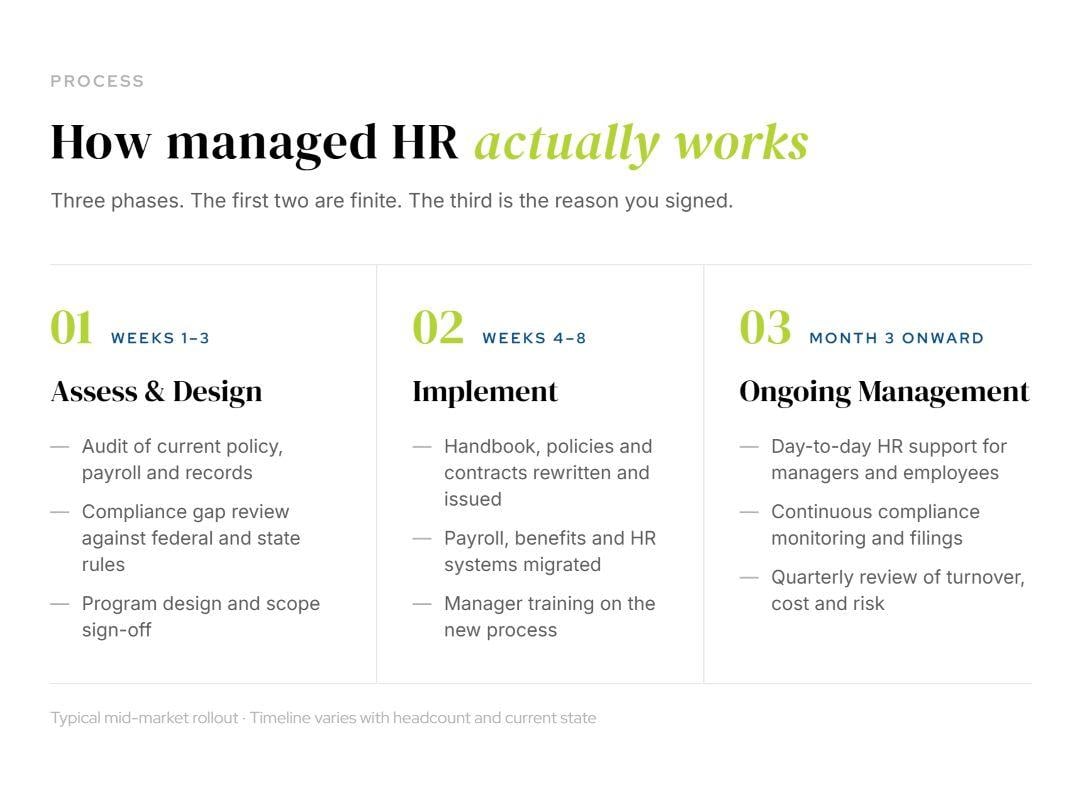
Step 1: Assess and design your HR operating model. The engagement opens with discovery, typically two to four weeks, where the provider reviews your current policies, org structure, tech stack, and pain points. That includes an HR audit of your documentation and workflows, a compliance gap check across tax, benefits, and state-specific regulations, and a workforce analytics baseline covering current turnover and available engagement data. This is also where behavioral data enters the picture: running OAD’s free Top Performer Profile, seven minutes, results in twenty-four hours, no credit card, on your leadership team and a slice of the broader team maps role demands and behavioral drive before you scale anything on top of it. The output is a clear six-to-twelve-month roadmap covering hiring priorities, policy updates, and the analytics foundation you need.
Design teams with data, not gut feel.
Most org-design decisions come down to role fit, leadership style, and team dynamics. OAD reads those signals from a 7-minute behavioral survey, so you can reconfigure roles and teams with evidence instead of guesswork.
Step 2: Implement core HR processes and technology. With the roadmap in hand, rollout covers onboarding, offboarding, documentation, an HR helpdesk, benefits coordination, and basic performance workflows. Data flows get established between your HRIS or payroll tool, your applicant tracking system, and any behavioral assessment platform in use. Standardized offer letters, e-signatures, automated 30/60/90-day review reminders, and compliance deadline alerts typically launch here. For clients, this step is usually light: two to three working sessions, with most configuration handled by the managed HR team.
Step 3: Ongoing management, analytics, and continuous improvement. Once live, the partner establishes a steady rhythm: monthly or quarterly strategy calls, regular ticket updates, and reporting on the metrics that matter to your business. This is where behavioral data compounds in value. Profiles inform hiring scorecards, promotion discussions, and team alignment reviews (what we build as a Team Variance Report), and combining people data, like absenteeism trends and skipped PTO, with behavioral results surfaces burnout and flight risk before they become resignations. We’re building automated Performance Drift Detection for exactly this pattern; it’s in development, not yet live.
What Separates a Real Managed HR Partner From a Payroll-and-Benefits Shop
Not all managed services are equal. Some providers handle basic administration, payroll processing, benefits, tax management, and stop there. Others operate as a genuine extension of your leadership team, bringing data and development capability that changes how you run the organization.
- Behavioral intelligence at the core. A partner that uses a validated diagnostic, not resumes and gut feel, to inform hiring, promotions, and team design is working from objective data about motivators, leadership potential, and risk signals.
- Strategic HR partnering, not process checklists. You want a senior partner who advises on org design, leadership development, and culture, not a junior generalist running through a workflow.
- Integrated people analytics. The ability to pull HRIS, ATS, engagement, and behavioral data into dashboards leaders actually use matters more than the number of point tools in the stack. ISO 30414,the first international standard for human capital reporting, is increasingly shaping how this kind of reporting gets structured.
- Playbooks built for your actual size. Career paths, performance cycles, manager training, and total rewards programs that work at 50 to 250 employees, not scaled-down versions of an enterprise framework.
- Flexible engagement models. Options from co-pilot support for an existing HR function to a fully outsourced department, with clear SLAs and response times.
Does It Actually Move the Numbers?
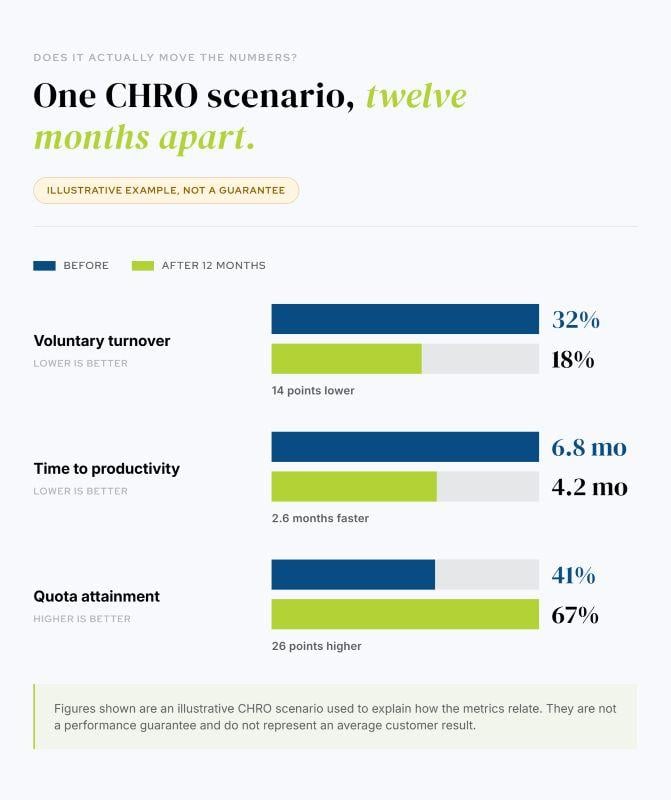
Leaders care about outcomes: lower turnover, better hires, fewer fires to put out. We won’t hand you invented case studies to make that point; every figure below is a named, illustrative scenario, not a guarantee, and not an average across all clients.
On a 200-person operations organization, layering behavioral benchmarking into hiring and promotion decisions took time-to-productivity from 6.8 to 4.2 months, annual turnover from 34% to 19%, and the promotion mis-placement rate from roughly 40% to roughly 12%. In one client’s Q2 people-function review, using a single validated behavioral standard in place of unvalidated tools tracked to an estimated $1.14M in avoided mis-hire cost, a 38% drop in time-to-productivity, a 26-point gain in quota attainment, and turnover down 14 points (from 32% to 18%). Across OAD’s client base broadly, the figure that holds up as a cross-audience number, the one we’ll actually put our name on outside a named scenario, is a 60% average reduction in mis-hires.
None of that is a promise for your organization specifically. It’s what happens when people decisions stop being the one thing you don’t measure.
Is Managed HR Right for Your Company?
Managed HR is powerful, but it isn’t for everyone. Where you fall on the spectrum tells you how much to invest.
Good fit:
- Companies between roughly 50 and 250 employees that have outgrown ad hoc HR but can’t yet justify a full internal HR leadership hire. The median annual pay for an HR manager was $149,280 in 2025, and demand for the role is projected to grow 6% through 2035, both of which make “build the internal team” a real cost comparison, not a hypothetical one.
- Organizations seeing rising turnover, hiring misses, employee relations strain, or headcount growth of 20 to 50% a year.
- Founders and CEOs spending more than 20% of their time on HR firefighting, compensation questions, or administrative duties.
- Businesses that want behavioral and analytics tools in their people decisions but don’t have the internal expertise to implement them.
Probably not yet:
- Very small teams, under roughly 25 to 30 employees, that a part-time HR consultant and simple payroll software can still cover. The complexity that justifies a full managed services engagement usually hasn’t accumulated at this stage.
- Large enterprises with an established HR center of excellence and an internal people analytics team. These organizations often need a targeted tool, like team-level behavioral benchmarking, more than a full managed HR buildout.
What Managed HR Costs
Pricing varies by headcount, geographic footprint, systems complexity, and how much strategic support you actually need, and it varies enough across providers that we’re not going to hand you a number we can’t stand behind. What’s consistent is the shape of the tiers.
Essential managed HR fits companies around 40 to 80 employees starting to feel compliance strain and administrative overload. Scope covers core HR administration: onboarding, offboarding, handbook and policy maintenance, basic employee relations support, and payroll coordination, usually with light reporting on headcount and turnover and behavioral assessments used selectively for critical hires.
Growth managed HR targets 80 to 200 employee companies focused on structured growth and retention. It adds performance cycles, manager coaching, more robust employee relations, onboarding design, and training programs, with behavioral data integrated into role design, internal mobility, and succession planning, not just used at the point of hire.
Strategic managed HR serves 150 to 250-plus employee organizations with multiple locations or complex regulatory environments. This tier functions as an outsourced HR department with senior leadership access: workforce planning, change management, advanced employee relations, full compliance oversight, and compensation design, with behavioral data used continuously to redesign org structures and flag burnout and flight risk across teams and locations.
The honest way to evaluate any of these tiers against a price tag is to compare it to the fully loaded cost of the internal team it replaces: a director, a generalist, a benefits coordinator, an HRIS, and compliance counsel, plus the tech stack underneath all of it.
Managed HR FAQ
Will I lose control of my culture if I outsource HR? No. Managed HR should operationalize your culture, not replace it. Your leadership team still sets values, direction, and expectations; the managed HR partner turns those values into hiring criteria, onboarding design, and management practices. Behavioral benchmarking against your own top performer, the kind OAD runs, turns “culture fit” into a measurable standard instead of a feeling someone in the interview room had.
Design teams with data, not gut feel.
Most org-design decisions come down to role fit, leadership style, and team dynamics. OAD reads those signals from a 7-minute behavioral survey, so you can reconfigure roles and teams with evidence instead of guesswork.
What’s the difference between a PEO and managed HR? A PEO uses a co-employment model and becomes the employer of record for tax, benefits, and compliance purposes, which means you share control over those functions. A managed HR service generally keeps your business as the employer entity: you retain your own benefits plans, your own brand, and your own employment relationships while gaining outsourced expertise. Many 50 to 250 employee companies prefer managed HR for exactly this reason, and it tends to include the strategic and behavioral layer that most PEOs don’t offer.
How long does it take to get up and running? Realistically, four to eight weeks from agreement to full go-live, depending on data migration, process complexity, and how many systems are involved: discovery (one to two weeks), design (one to two weeks), configuration and pilot (two to three weeks), then full rollout. Most companies feel relief on compliance and administrative load within the first month.
How do managed HR providers protect employee data? Reputable providers run on audited platforms with role-based access controls, encryption at rest and in transit, and clear data processing agreements. Behavioral assessment data is handled under the same standard, or a higher one, and used only for the HR purposes agreed to in the contract. Data ownership should be spelled out explicitly in your services agreement, so you retain access and control regardless of the provider relationship.
Can managed HR work with our existing tools? Yes. Modern providers integrate with or align to common HRIS, payroll, and ATS systems rather than forcing a rip-and-replace. Behavioral intelligence tools can typically sit alongside your existing stack through data exports or API integrations, so your team doesn’t take on unnecessary change management on top of everything else.
Get Strategic HR Support Without Building the Department
You don’t need to build a full internal HR function to get strategic support. You need one accountable partner, and if you want the people decisions inside that partnership to stop running on gut feel, you need behavioral data behind them. See the science behind that approach, or how it applies for CHROs specifically.
Start with the rep or leader you already trust. Get your free Top Performer Profile: seven minutes, results in 24 hours, no credit card.