You don’t have the title. You don’t have the budget. You have an idea that would save the company real money, and three failed pitches to show for it.
That’s not a charisma problem. It’s a framing problem, and framing is learnable. Influencing senior leaders has almost nothing to do with your job title. It has everything to do with how you frame the problem, and whether you’re speaking their language or yours.
Key takeaways
- Influencing senior leaders is about how you frame problems and decisions, not your job title or charisma. Tie every proposal to what they already measure: revenue, risk, strategy.
- Valuable insight beats a long slide deck. Data tied to a clear narrative cuts through competing priorities faster than opinion ever will.
- Behavioral data helps you tailor a message to different leadership styles, whether the leader in front of you is a visionary risk-taker or a detail-focused analyst.
- Credibility is built through consistent delivery, not grand promises. A small pilot with a measurable result earns more influence than any single presentation.
- Building a coalition among allies around the executive table meaningfully raises the odds that a proposal gets approved.
Why Influencing Senior Leaders Is Different
Picture a people operations manager at a 150-person company who has pitched the same retention initiative to the executive team three times. Each time, the conversation stalls. The idea is sound, a structured onboarding redesign to cut early attrition, but she’s been presenting it as an HR project: heavy on engagement theory, light on financial impact. On the fourth attempt, she changes one thing. She opens with a single sentence: “We’re losing 22% of new hires before month six, and it’s costing us $840,000 a year in replacement costs.” The room leans in. The initiative gets approved that quarter.
Nothing about her authority changed between pitch three and pitch four. What changed was the frame: from what matters to her, to what matters to them. That shift is the entire skill of influencing senior leaders. It sounds simple. It isn’t, because it requires you to think like the person across the table before you open your mouth.
Influencing senior leadership is fundamentally different from influencing peers. Executives operate under extreme time scarcity, a wider scope (enterprise, not function), and higher stakes. Every proposal gets filtered through revenue, cost, risk, and strategy. They juggle competing priorities across divisions and geographies, and they hear more pitches in a week than most managers deliver in a quarter.
This is for HR leaders, people managers, and functional leads who need buy-in from senior executives but don’t sit on the executive team themselves. Along the way, we’ll reference how behavioral data platforms like OAD can sharpen an influence strategy, one structured input among several, not a substitute for actually knowing the person you’re pitching.
Start With Their World: Map Senior Leaders’ Real Priorities
Before you try to influence anyone at the top, understand their context. Senior leaders think in enterprise value, not departmental projects, and their attention sits across five dimensions.
Revenue growth and profitability. Every proposal gets filtered through one question: does this grow the business or protect margin? A CFO cares about cash flow, margin, and compliance risk. Tie your idea to a business goal and the resource conversation gets easier by itself.
Risk and compliance. Senior leaders face constant pressure from digital disruption, regulatory shifts, and talent-market volatility. A proposal that names and mitigates a risk earns a faster decision than one that ignores it.
Talent and leadership pipeline. A CHRO thinks about retention, culture risk, and whether the organization has the bench to execute its strategy. Frame people topics as operational readiness, not as “engagement” in the abstract.
Strategic execution speed. This is a real, measurable gap: KPMG’s 2026 Adaptability Index found that 63% of executives report increased reliance on data and analytics for decisions, but only 43% say those decisions are actually happening faster or with more clarity. More data hasn’t bought most organizations more speed. A proposal that visibly closes that gap gets attention.
Cross-functional outcomes. Senior leaders prioritize initiatives that move the whole organization, not just one silo.
A simple exercise: list your company’s top three goals for this year. Then translate your proposal into measurable impact on those goals. If you can’t draw a direct line, the pitch isn’t ready yet. Track what leaders actually talk about in all-hands meetings, board updates, and earnings calls. The patterns in their language are your roadmap.
Decode Executive Styles With Behavioral Data
Understanding the business context isn’t enough if you misjudge the person receiving the message. Decision style matters as much as the content of the pitch, and different leaders process information, weigh risk, and commit to action in genuinely different ways.
This is where behavioral data earns its place. A diagnostic like OAD’s Top Performer Profile gives you an objective read on someone’s behavioral drive across five dimensions, Drive, Influence, Resilience, Structure, and Leadership, instead of leaving you to guess at a leader’s style from how they act in one meeting. It’s one structured input, not a substitute for paying attention to the person.
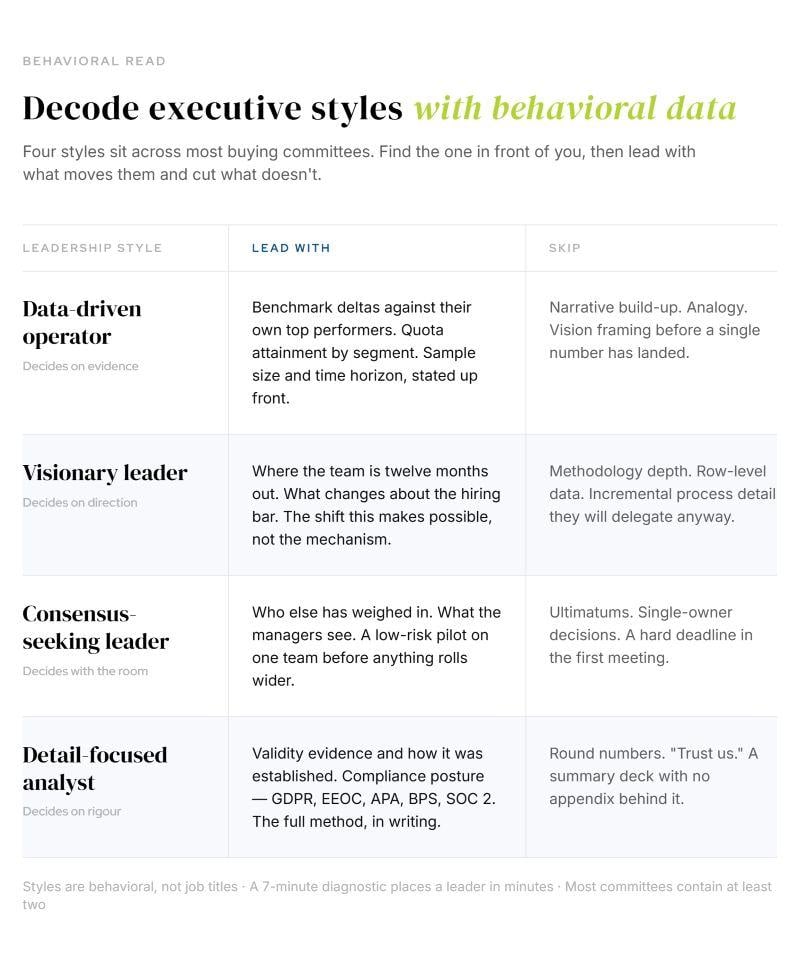
In practice, style shows up like this:
- Data-driven operator. Wants metrics, benchmarks, and operational detail. Lead with numbers and comparisons. Skip the narrative buildup.
- Visionary leader. Responds to bold framing, market positioning, and long-term stakes. Position your proposal as competitive advantage, not a line item.
- Consensus-seeking leader. Values inclusion and peer input. Propose to co-create the solution rather than present something finished.
- Detail-focused analyst. Precision wins. Skip the adjectives; lead with the number and the source behind it.
Use an if-then structure to tailor delivery: if the leader is highly decisive, lead with options and a recommendation, not a backstory. If they’re risk-averse, present the cost of inaction alongside the cost of action. If they value consensus, show who else already supports the idea before you make the ask. If they’re visionary, connect the proposal to where the company is headed, not just what it costs this quarter.
Gut feel about “how so-and-so likes to be pitched” is a heuristic, not a system, and heuristics have a mixed track record. Behavioral data replaces the guess with something you can actually check.
Craft a Compelling, Executive-Ready Message
Senior leaders scan for signal, not story. In a 30-minute slot, they’re deciding whether your point matters, what you need from them, and whether the risk-reward ratio justifies their attention. Lead with the point. Save the detail for when they ask.
Use one structure for every executive communication: Problem (what’s happening and why it matters now), Impact (the financial or strategic cost), Options (two or three paths, with tradeoffs), Recommendation (your best option and why), Ask (what you need from them: a decision, resources, support).
Before: “Our onboarding program has been the same for three years. We’ve looked at a few approaches, including peer mentoring, manager check-ins, and revised training modules. Engagement survey data from Q2 suggests new hires feel disconnected. We’d like to explore a pilot…”
After: “We’re losing 22% of new hires before month six, costing $840K a year. A 90-day structured onboarding redesign, piloted in engineering, can cut early attrition by 30% and save $250K in year one. I need approval for a $40K pilot budget and one HR resource for Q1.”
The second version speaks the language executives already use. In a one-on-one, open with the recommendation and let the conversation flow from there. In a formal presentation, use the full five-part structure on one slide, with backup data ready if someone asks for it.
Use Data to Stand Out
Senior leaders hear a lot of opinions. What cuts through is data tied to a clear narrative. The difference between raw data and a valuable insight is the difference between “turnover is 18%” and “our top engineers are leaving in year two, costing $1.2M a year in replacement and lost productivity.”
One real example makes the point well. McKinsey worked with a global quick-service restaurant chain that ran its people data against more than a hundred hypotheses about what actually drove store performance. The long-held assumption, that bigger and more frequent variable pay drove results, turned out to be wrong: career development and cultural norms correlated more strongly with performance than compensation did. In the pilot market, sales rose 5% after four months. That’s the pattern worth remembering: the insight that moves leadership isn’t the one that confirms what everyone already believed, it’s the one that corrects it.
Behavioral data from tools like OAD can surface the same kind of hidden pattern inside your own organization: burnout risk concentrated in one team, a misalignment between a leader and their direct reports, or flight risk sitting inside your highest performers. Those are the findings that make executives sit up, because they expose what isn’t visible from the top of the org chart.
Design teams with data, not gut feel.
Most org-design decisions come down to role fit, leadership style, and team dynamics. OAD reads those signals from a 7-minute behavioral survey, so you can reconfigure roles and teams with evidence instead of guesswork.
When you present, keep the visual simple: one trend line, one heat map, one dashboard that lets a leader find the story in seconds. A wall of charts asks them to do your analysis for you.
Build Credibility: Deliver, Then Ask for More
Trust is the currency that buys you time, attention, and eventually budget from people who don’t report to you. Credibility gets assessed on track record, not title, and it’s built the unglamorous way: hit deadlines without needing a reminder, close the loop on every commitment with a short follow-up naming decisions and owners, and surface problems early, with options attached, not bare complaints.
Here’s what that looks like end to end. A people manager launches a small 90-day retention pilot: targeted stay interviews for employees in their first year. She tracks the results, sees a 15% drop in early attrition inside the pilot group, and brings that data to the next budget review. The executive team approves scaling it company-wide. A small, measured win earns more influence than a grand promise ever does.
Avoid the credibility killers: promising an outcome you don’t control, escalating before you’ve tried to resolve something yourself, and bringing an opinion without evidence attached to it.
Before your next ask, run a quick check: Have you delivered on your last three commitments? Can you point to a measurable result from something recent? Have you been honest about what didn’t work and what you learned from it? If the answer to any of those is no, fix that before you fix your slide deck.
Frame Proposals in Terms of Enterprise Value, Not Function
There’s a real difference between “my department’s needs” and “an enterprise-level tradeoff.” Senior leaders think in the second frame. Talk only about your team, and you sound like a cost center. Talk about the organization, and you sound like a partner.
An HR leader pitching a behavioral assessment rollout shouldn’t say “we need a better hiring tool.” Try instead: “Cutting mis-hires across three divisions would save real money annually and cut time-to-productivity by weeks.” That’s an illustrative way to phrase it, not a specific promised number, but it puts the proposal in the language leadership already uses to evaluate everything else that crosses their desk.
Acknowledge constraints openly. If there’s a headcount freeze, say so. If the budget cycle is tight, propose a phased approach instead of pretending the constraint doesn’t exist. Showing you understand the broader picture builds trust faster than ignoring it does. Use language that signals an enterprise mindset: “for the company,” “across divisions,” “for the next 12 to 18 months,” not “for my team only.” Frame your own case this way and leaders hear a strategic partner, not a budget request.
Master Senior-Level Communication Habits
Influence isn’t only built in big presentations. It’s built in the small, day-to-day habits that compound into a reputation for clarity and respect for someone’s time.
Send a tight pre-read ahead of any meeting where you’ll ask for something, so the leader arrives already oriented. Put the ask in the first line of an email or the subject itself: “Decision needed: Q4 hiring plan” tells a leader exactly what you need before they open the message. Respect your time-box: if you have five minutes in a weekly huddle, rehearse until you can deliver it in four. And stay calm under a challenging question; listen, pause, answer directly, and resist the urge to over-explain.
Behavioral data can help here too, by telling you whether a given leader processes best in live discussion, a written memo, or a dashboard they’ll read before they talk. Matching their preferred format isn’t a trick. It’s a form of respect, and it’s why you get invited back.
Navigate Resistance and Tough Conversations
Resistance from a senior executive is normal. It’s a sign of engagement, not personal rejection, and when a leader pushes back, they’re telling you exactly what matters to them.
Anticipate the objections and prepare for them before you walk into the room. When pushback comes, use a simple sequence: pause and let the concern land, ask a clarifying question (“Can you help me understand which part of the risk concerns you most?”), restate the concern so they know you heard it, then reframe it through their lens, cost pushback becomes a risk-mitigation argument, for example.
Keep phrases ready that keep the dialogue open: “What would make this investable for you?” “Which risk worries you most here?” These signal that you’re solving, not selling. Calm consistency across several meetings usually builds more influence than trying to win one heated conversation, and sometimes the right move is adjusting your proposal between meetings based on what the pushback taught you.
Build Allies and Sponsors Around the Executive Table
Coalition-building is one of the most underused tools for influencing senior leadership inside a matrixed organization. A united front simply raises the odds that a proposal gets approved.
Start by identifying natural allies: leaders who feel the same pain, own a related metric, or have backed something similar before. Build the relationship before you need something from it, through regular, informal conversation, not a cold ask.
Here’s how that plays out. A people manager wants to pitch a talent analytics project. Before it goes to the full executive team, she has one-on-one conversations first: with the CFO, framing the value as reduced mis-hire cost, and with the CHRO, framing it as clearer leadership-pipeline visibility. By the time the proposal reaches the room, two members are already supportive before she’s said a word to the group.
Use coffee chats, hallway conversations, and a quick message to surface objections before the formal meeting, not during it. HR leaders can use OAD or other behavioral data to show the cross-functional benefit of an idea, which makes it easier for multiple executives to see their own stake in backing it.
A Simple Framework: From Idea to Executive Decision
Five steps carry this from a one-off conversation to a multi-quarter initiative.
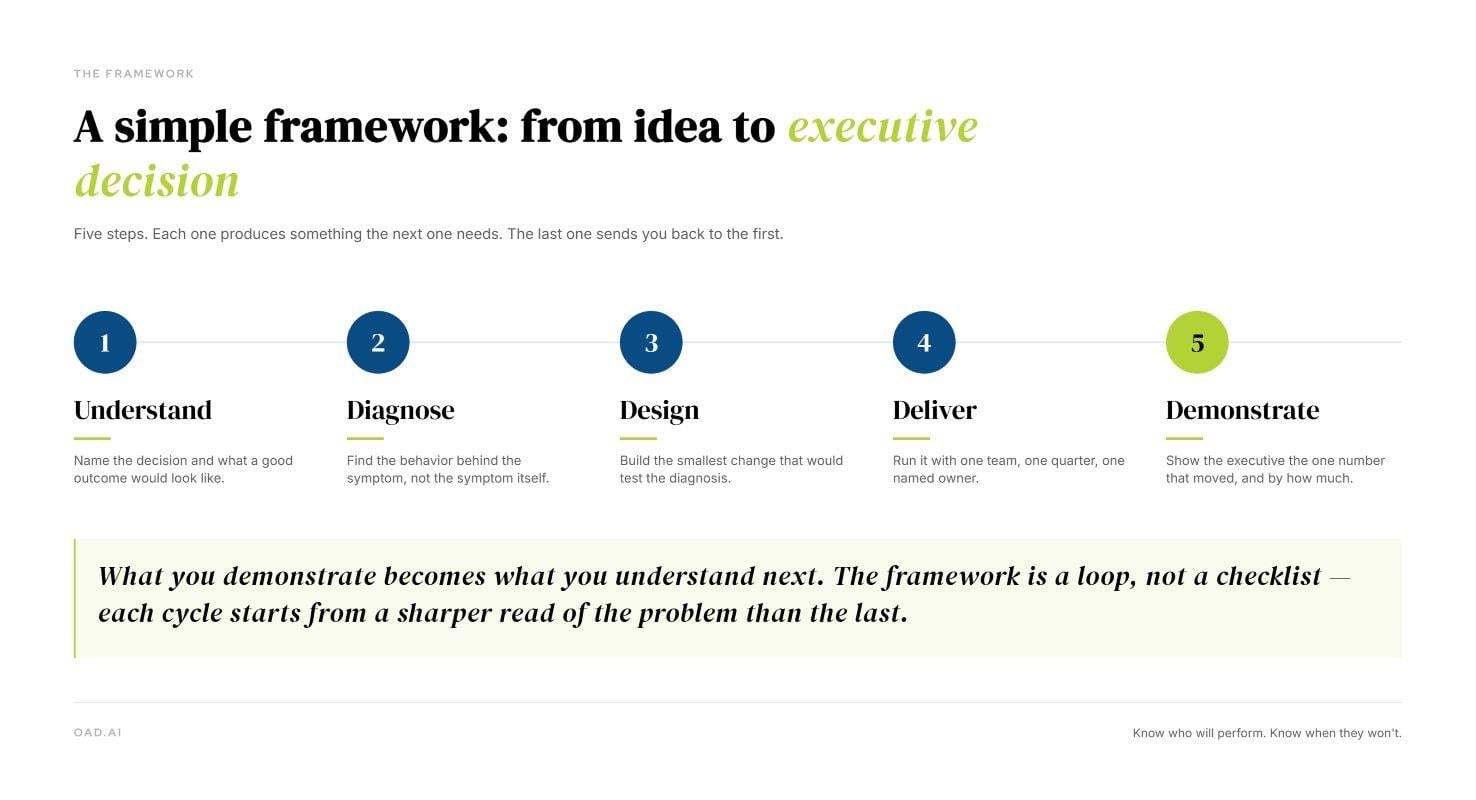
Understand. Map the senior team’s priorities. What’s on their scorecard, and what keeps them up at night?
Diagnose. Use people analytics and behavioral data to find out where the actual gap sits, not where you assume it sits. Behavioral data can show whether leadership potential exists where the organization needs it, or where engagement is quietly eroding in a critical team.
Design. Build the proposal in enterprise terms, using the Problem, Impact, Options, Recommendation, Ask structure, and tailor the language and format to the specific leader’s style.
Deliver. Present concisely, listen to the feedback, and adapt. Start with a small pilot where you can, rather than asking for a full commitment up front.
Demonstrate. Track the result, report back with data, and use that success as the foundation for the next ask.
Pick one decision coming up, next quarter’s budget round, a talent initiative you’ve been sitting on, and sketch how you’d run it through each step. The goal isn’t more process. It’s clearer thinking that leads to a faster, better outcome.
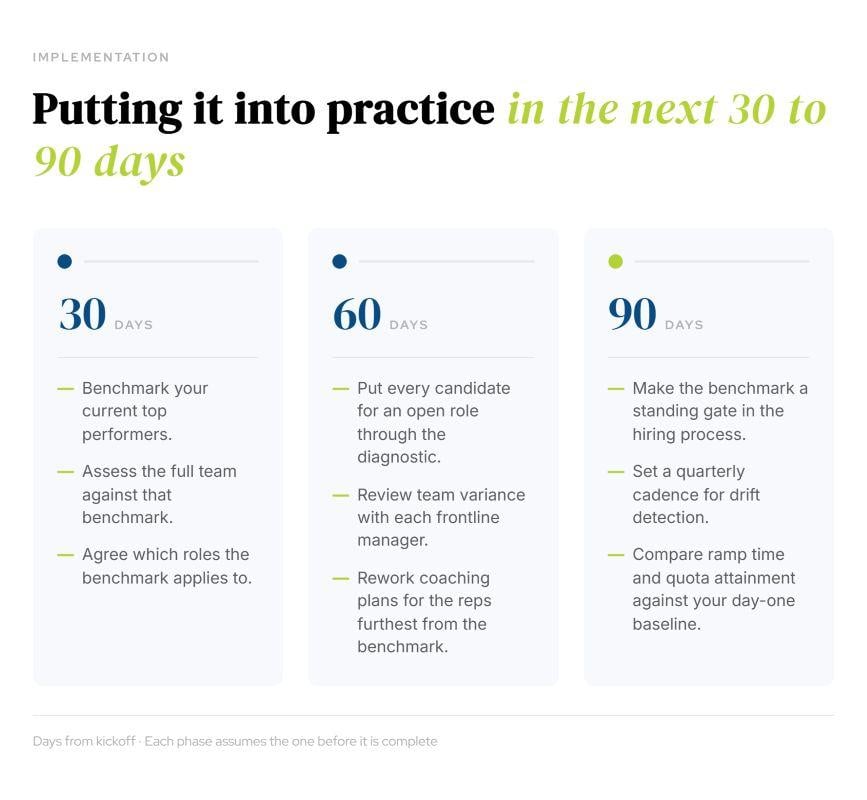
Putting It Into Practice in the Next 30 to 90 Days
Days 1 to 30: Listen and map. Schedule a 30-minute conversation with your manager’s boss to understand their top three priorities. Review recent all-hands materials, board summaries, or earnings call transcripts for patterns. Identify one initiative where your expertise adds value to an executive’s actual agenda.
Days 31 to 60: Pilot and learn. Launch one small, low-risk initiative tied to a senior leader’s stated priority, and track a measurable outcome. Use behavioral data to understand your own communication style and how it lands with executives; running OAD’s free Top Performer Profile, seven minutes, results in 24 hours, no credit card, is a fast way to get that read on yourself or a willing teammate.
Days 61 to 90: Present and build. Bring a data-backed story to the executive team, using the five-step framework and enterprise-value language. Follow up within 24 hours with a short summary of decisions, next steps, and owners.
Start with one leader, one initiative, one meeting. Influence isn’t about boiling the ocean. It’s about building a small, undeniable pile of evidence that your ideas move the business forward.
Influencing Senior Leaders in Practice: FAQ
How can I influence senior leaders if I’m relatively junior? Influence tracks less with your position than with how well you solve a real problem. Become the go-to person for one specific topic, retention trends, onboarding metrics, team dynamics, and prepare better than your peers: know the numbers, anticipate the questions, and always link the idea to an executive priority. Start with small, low-risk initiatives where a leader can safely say yes and see a quick win. Over time, that track record earns a seat your job title alone wouldn’t.
What if my senior leadership team seems uninterested in people topics? Reframe the issue in business language. Don’t say “engagement is dropping.” Say what it will cost: additional recruiting spend next year if voluntary turnover in a given function keeps climbing at its current rate. Behavioral and people-analytics data helps you quantify what can otherwise feel “soft” to a numbers-driven executive. Change the language, and the conversation tends to change with it.
How do I prepare for a high-stakes meeting with the executive team? Get clear on your single desired outcome first. Build a one-page summary using Problem, Impact, Options, Recommendation, Ask. Anticipate the top three questions you’ll face and rehearse a three-minute version of the pitch. Send the pre-read a day ahead and confirm how much time you actually have on the agenda. Afterward, send a follow-up within 24 hours summarizing the decisions, next steps, and owners.
What role can HR play in helping others influence senior leadership? HR can coach managers on how to frame a proposal, supply behavioral and people-analytics insight from tools like OAD, and coordinate the storyline before a big executive forum. Short “exec pitch” practice sessions, where a manager pressure-tests their message before the real meeting, catch problems early. Track which stories and metrics actually land with your leadership team and share those patterns across the organization.
How do I handle a senior leader who constantly cancels or shortens meetings? Move more of the substance into a tight written briefing that can be read asynchronously, and reserve live time exclusively for decisions and clarifying questions. Ask their assistant or chief of staff what format and cadence actually works for how that person operates. Keep every interaction short, clear, and outcome-focused. Leaders who see your meetings run efficiently are more likely to keep giving you the next one.
Start With the Data on Your Own Team
You already have a leader whose style you understand, and one you don’t. The second one is where the guessing costs you. See the science behind reading behavioral drive, or how it applies specifically for HR and people leaders.
Get your free Top Performer Profile: seven minutes, results in 24 hours, no credit card.