Every open role you fill is also a retention decision you don’t realize you’re making yet. Hire on gut feel and fill the seat fast, and you’ve also just decided how likely that person is to still be there in twelve months.
Job openings in the U.S. hit a record 11.4 million in December 2021, and monthly quits hit a record 4.5 million that November. The old playbook, post a job, fill the seat, hope people stick around, broke in plain view. For a company scaling from 50 to 250 employees, every departure ripples through a lean team in a way it never does at enterprise scale. Lose two or three people from a 12-person department and you don’t have vacancies. You have a culture problem.
Key takeaways
- Talent acquisition is a long-term strategy for hiring that goes far beyond filling open seats. It includes sourcing, assessing, hiring, and onboarding people who are likely to stay and thrive, and it’s fundamentally different from short-term, reactive recruiting.
- Employee retention isn’t separate from hiring. Decisions made during workforce planning, job postings, the interview process, and onboarding strongly predict morale, engagement, and tenure.
- A simple framework, workforce planning, sourcing, selection, onboarding, development, connects each stage to a concrete retention lever: culture fit, career paths, competitive compensation.
- Mid-sized companies (50 to 250 employees) can use behavioral assessments and people analytics to improve role fit, reduce early turnover, and spot flight risk early, even with a lean HR team.
- A focused 90-day plan can produce measurable improvement in both your acquisition strategy and your retention numbers, starting with auditing job postings, tightening onboarding, and piloting a behavioral assessment on one or two critical roles.
Why Talent Acquisition and Retention Are Now Inseparable
So what is talent acquisition and retention, exactly? Talent acquisition is the strategic, ongoing process of attracting, assessing, and selecting people aligned with your company’s long-term goals. Retention is the systematic effort to keep those people engaged, growing, and committed once they’re in the door. Treating them as two separate programs, one run by recruiting, one run by HR after the fact, is how companies end up solving a retention problem by hiring faster instead of hiring better.
Pay is consistently one of the biggest reasons people leave. Pew Research found that low pay was the single most commonly cited reason among workers who quit in 2021, ahead of feeling disrespected or lacking advancement. But pay alone doesn’t explain most of what happens in the first year of a bad hire. Role clarity, culture fit, and manager quality usually decide that long before the first compensation review. This article walks through a practical framework for building acquisition and retention as one connected system, sized for a company your size.
What Is Talent Acquisition? (And How It Differs From Recruitment)
Talent acquisition is a continuous, long-range function: workforce planning, employer brand, proactive sourcing of both active and passive candidates, structured selection, and measuring outcomes like quality of hire and new-hire retention. It includes building a candidate pipeline so you’re not starting from zero every time a role opens.
Recruitment, by contrast, is reactive. A customer support manager quits, you scramble to post a job, screen resumes, and fill the seat within three weeks: that’s recruitment. Building a leadership pipeline over the next 12 to 24 months by identifying potential candidates and mapping skill gaps before you need them: that’s talent acquisition. A real talent acquisition strategy is aligned with business strategy. It isn’t run as an isolated operational task that only activates when a req opens.
What Is Employee Retention? Connecting the Dots to Acquisition
Employee retention is your organization’s ability to keep valuable people over time. The core drivers are engagement, satisfaction, psychological safety, meaningful work, growth opportunity, manager quality, and alignment with the company’s stated values.
Retention gets measured through voluntary turnover, regretted versus non-regretted attrition, and average tenure by role, and those numbers should feed straight back into acquisition decisions. If hires from one sourcing channel consistently leave within nine months, that’s not a retention problem to solve later. It’s a sourcing signal to act on now.
Here’s what most companies miss: retention starts before day one. Hiring for behavioral and cultural fit, setting realistic expectations in the job posting itself, and building a real onboarding process all predict staying power more than anything that happens after month three.
How a Talent Acquisition Framework Drives Retention
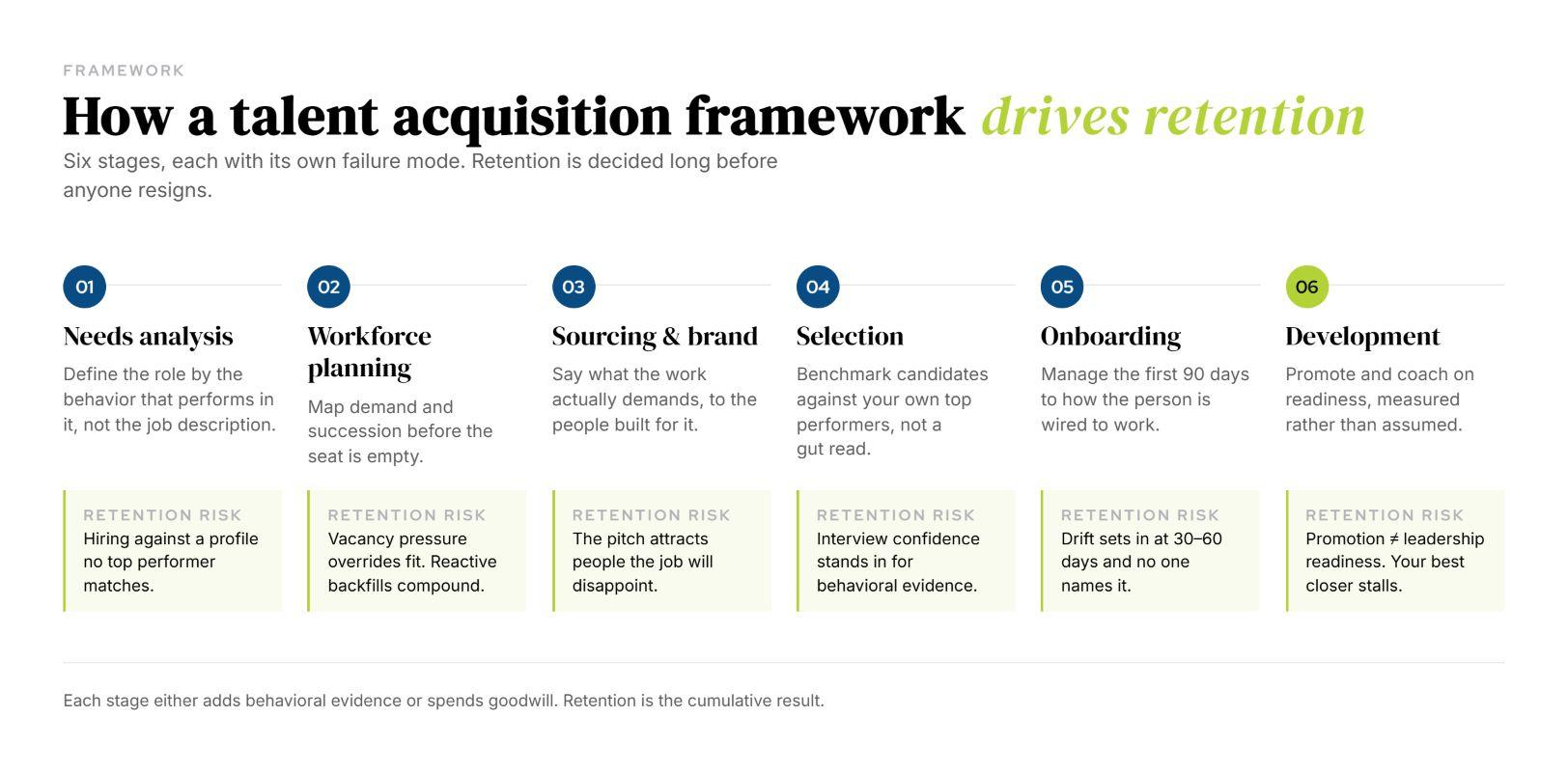
A simple framework connects the stages where you make hiring decisions to the retention outcomes they quietly determine.
- Organizational needs analysis. Get the role wrong here and you get overload and burnout later.
- Workforce planning. Poor forecasting forces reactive hiring, and reactive hiring lowers quality.
- Sourcing and employer brand. An inauthentic brand causes reality shock and early exits.
- Selection and assessment. Gut-feel hiring misses behavioral mismatches that don’t surface for months.
- Offer and onboarding. Weak onboarding is one of the single biggest drivers of first-year attrition.
- Development and feedback. No visible growth path, and your best people start looking elsewhere.
Comparing performance and tenure by sourcing channel, or by assessment result, shows you which parts of the engine are producing hires who last and which aren’t. Behavioral data can plug into this framework at several points at once, selection, team design, flight-risk monitoring, giving a mid-sized company the kind of insight that used to require an enterprise HR analytics team to build.
Step 1: Organizational Needs Analysis and Workforce Planning
Rigorous needs analysis is the foundation of both good hiring and strong retention. When roles are clearly defined, workloads are realistic, and expectations are aligned across the company, people know what success looks like. When they’re not, new hires walk into confusion and existing employees absorb the overflow.
Run a skill-gap analysis against your current team’s actual capability. Forecast headcount by quarter. Map roles to your 12 to 24 month business plan: if a product launches in Q3, engineers need to be hired and ramped by Q1. Poor workforce planning is especially damaging at your size. Hiring too fast without structure overloads managers, dilutes culture, and drives churn. Scaling from 50 to 250 employees means line managers and whoever owns talent acquisition need to sit in the same workforce planning review, not two separate conversations that never meet.
Step 2: Building an Employer Brand That Attracts and Keeps the Right People
Your employer brand isn’t a tagline on the careers page. It’s what current employees tell their friends over dinner, what shows up on a review site, and what a candidate senses in the interview room. A strong, honest brand sets accurate expectations about culture, leadership style, and flexibility, and when the brand is accurate, the “reality shock” that drives early exits mostly doesn’t happen.
Career pages, social presence, employee testimonials, review-site profiles, and job fairs all shape that perception, and consistent messaging across them supports both offer acceptance and retention. A company that visibly uses data, structured assessment, coaching, in its people decisions signals to a candidate that it takes fit seriously, not just headcount.
Step 3: Crafting Job Postings That Support Retention
A job posting is the first contract between your company and a future employee. Oversell it or leave it vague, and you attract someone who shows up to discover a different job than the one they accepted. That’s a retention problem wearing a hiring mask.
An effective posting includes a realistic snapshot of a typical week, not just a bullet list of duties; explicit performance expectations for the first 90 days; a transparent salary range; a sense of the manager’s style and the team’s working rhythm; and a real answer to where the role goes from here. Inclusive language broadens who applies and who refers others in, and an accurate posting simplifies onboarding later because expectations were set honestly from the start. Every posting you publish is a retention lever wearing a hiring hat.
Step 4: Sourcing Channels and Outreach That Predict Stickiness
Not every sourcing channel produces equally loyal hires. Referrals tend to run longer tenures and faster ramp-up. A generic job board casts a wide net but often produces higher early turnover. Niche communities, university partnerships, and alumni networks each carry their own retention pattern, and you won’t know which is which until you track it.
Proactive sourcing builds a relationship before a role becomes urgent, through a talent community, an industry event, or a longer-running outreach campaign, rather than a cold, one-off transaction the moment a req opens. Track tenure and performance by source and you’ll find the channels worth investing more in and the ones quietly costing you more than they save. Sourcing for values and behavioral alignment, not just technical skill, is what produces a hire who’s still there in two or three years, not just one who could technically do the job on day one.
Step 5: Assessment and Selection for Long-Term Fit
This is where most companies lose the retention game before it even starts. Leaning on resumes and unstructured interviews to find “the best candidate” is navigating by gut feel in a job that has real data available to it now.
Structured interviews, work samples, and a validated behavioral diagnostic each predict something resumes can’t: motivators, communication style, and how someone actually handles pressure, the things that determine engagement two years in, not just whether they can do the job on paper. OAD’s Top Performer Profile, seven minutes, results in 24 hours, no credit card, is built for exactly this: it turns those signals into something comparable across candidates instead of an interviewer’s gut call. Clients using OAD’s diagnostic see a 60% average reduction in mis-hires, the one figure that holds up as a fair comparison across industries rather than one company’s specific story.
Design teams with data, not gut feel.
Most org-design decisions come down to role fit, leadership style, and team dynamics. OAD reads those signals from a 7-minute behavioral survey, so you can reconfigure roles and teams with evidence instead of guesswork.
Interview questions should probe for culture add, resilience, and how someone actually handled conflict or ambiguity in the past, not “tell me about your strengths.” Consistently applied, data-informed selection criteria also reduce the kind of bias unstructured interviews quietly introduce, which supports both fairness and trust, both of which matter for retention long after the offer is signed.
Step 6: Designing Competitive Compensation and Total Rewards
Pay is consistently one of the top reasons people leave, and no amount of culture work fixes a compensation gap the market has already noticed. Benchmark pay both internally, so two people doing the same job aren’t quietly unequal, and externally, against market rate for your geography and industry.
Publishing salary ranges in job postings reduces negotiation friction and builds trust before a candidate even applies. Variable pay, equity, and bonuses tied to longer-term outcomes reward staying over job-hopping. And the definition of “benefits” has widened well past health insurance: mental health support, learning stipends, and real flexibility in how and where work gets done are now part of the same conversation as base pay, not a separate one. Compensation alone doesn’t guarantee retention. But misaligned or opaque pay reliably undermines it, especially for the roles where your best people have the most options.
Step 7: Building an Onboarding Process That Boosts Retention From Day One
Structured onboarding is one of the highest-return levers you have for first-year retention and speed to productivity. A new hire who feels lost or unclear about expectations in their first 90 days is far more likely to disengage, and far more likely to leave.
Build it in three checkpoints: 30 days (clear success metrics, introductions across the teams they’ll work with, an understanding of team norms), 60 days (independent contributions, regular manager check-ins, real feedback), and 90 days (a formal read on fit, a conversation about where this goes, and an honest look at any friction that’s shown up). Assign a named buddy. Put a weekly one-on-one with the manager on the calendar from week one. If you know from a behavioral assessment that a new hire is motivated by autonomy rather than close structure, build their ramp-up around that instead of a generic template. A short pulse check at the end of weeks one, four, and eight catches disengagement while it’s still fixable, well before a formal 90-day review would ever see it.
Talent Acquisition vs. Recruitment vs. Retention: How They Interlock
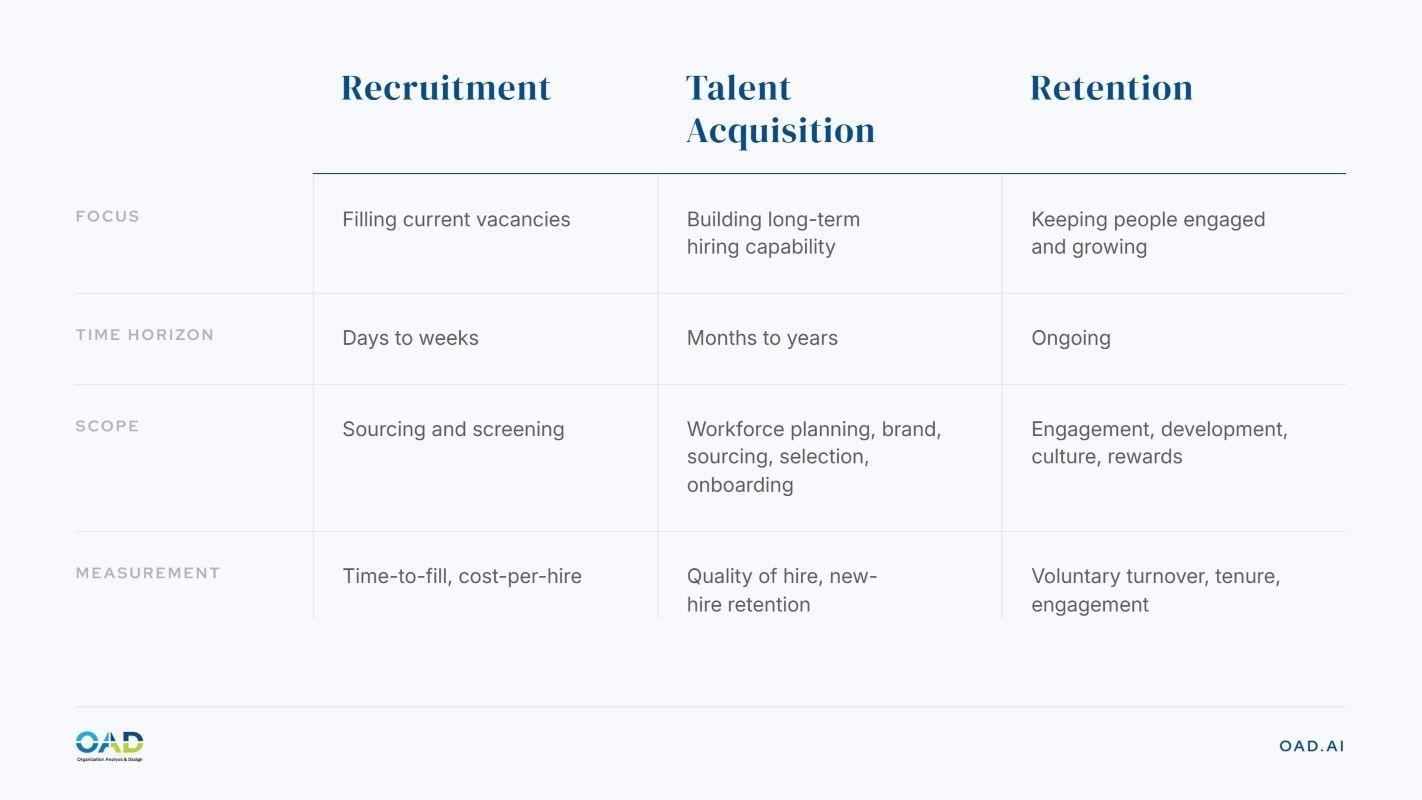
Recruitment is the operational act of filling a role. Talent acquisition is the strategic system behind it. Retention is the outcome, and the feedback loop that tells you whether the system is working. High turnover isn’t a retention team’s problem to fix alone. It’s a signal that the acquisition strategy needs adjusting, and the strongest HR teams treat retention metrics as a core KPI of talent acquisition itself, not a separate scoreboard managers own by themselves.
The Role of the Talent Acquisition Team in Retention Outcomes
At a 50 to 250 employee company, the team behind talent acquisition is often small: one to three recruiters, maybe a manager, shared HR support. But its impact on retention is out of proportion to its size, because every hire it makes either strengthens or weakens the culture the rest of the company has to work inside.
That team needs more than sourcing and scheduling skill. It needs enough data literacy to read what people analytics is actually telling it, comfort discussing culture and leadership expectations directly with a candidate, and a real partnership with hiring managers on defining success, not just taking headcount orders. Some companies now put a 12-month new-hire retention rate directly into the talent acquisition team’s own performance goals. That single change does more to align acquisition and retention than any process document could.
Using People Analytics to Link Hiring to Retention
People analytics turns talent acquisition from an art into something closer to a discipline. Time-to-hire and quality of hire matter, but the metrics that actually predict retention are first-year retention rate, performance by source, and engagement scores broken out by hiring cohort, not averaged across everyone.
Behavioral data that correlates with outcomes like performance, promotion likelihood, or burnout risk lets you see which behavioral profiles thrive in a given role and which tend to disengage, before you’ve made the hire rather than after. A practical way to start: compare retention and engagement for hires made with a behavioral assessment against hires made without one, on the same role, over the same period. Pair that number with the qualitative side, exit interviews, stay interviews, manager feedback, so you understand not just that people are leaving but why.
Designing a Talent Acquisition Strategy That Aligns With Business Strategy
A talent acquisition strategy doesn’t exist on its own. It flows from the company’s one-to-three-year plan: growth targets, product roadmap, geographic expansion, culture goals. Translating that into a hiring plan means naming priority roles, deciding the right seniority mix, making build-versus-buy calls, and timing hires to when the business actually needs them, not when a manager finally gets around to writing the req.
Ignoring that alignment produces two equally damaging outcomes. Over-hire and you get bloat, then layoffs, which do lasting damage to trust and morale. Under-hire and you get burnout, overwork, and the departure of the people carrying the heaviest load, usually your best ones. Revisit the plan at least annually, and always after a funding round, an acquisition, or a leadership change. A strategy that made sense at 80 employees is often wrong at 180, and the companies that get surprised by that are the ones that never scheduled the review.
Retention Fundamentals: What Keeps People After They’re Hired
The pillars here are well established, even if they’re easy to say and hard to actually build: competitive compensation and benefits (table stakes, not a differentiator on their own), meaningful work connected to visible impact, strong managers (people leave managers more often than they leave companies), real growth opportunity, a genuinely positive culture, and flexibility in how work gets done.
Each pillar traces back to a decision made earlier, at the acquisition stage. Hire managers with actual, demonstrated coaching ability, not just the best individual performance on the team. Be honest in the interview about workload and flexibility instead of hoping it works out. Build teams where people complement each other’s working style instead of duplicating it. Companies that invest consistently in one-on-ones, recognition, and a visible path forward keep people longer than companies that treat retention as an annual survey.
Retention Levers Closely Tied to How You Hire
Four acquisition-stage decisions carry outsized weight on whether someone stays.
Manager quality. Promote your top individual contributor into a people-manager role without ever evaluating their actual leadership potential, and you often lose a strong contributor and gain a struggling manager in the same move. Their direct reports absorb the cost, and turnover follows close behind.
Culture and values alignment. Hire someone whose motivators genuinely clash with how the team operates, and no amount of onboarding fixes that friction later. Using behavioral data to design complementary teams, not identical ones, reduces it before it starts.
Realistic previews. Day-in-the-life shadowing, a panel with future teammates, and an honest conversation about workload build trust before the offer letter is even signed. Behavioral insight helps a hiring manager anticipate coaching needs and communication style ahead of day one, instead of discovering them in the first bad week.
Team fit. Better alignment on autonomy versus structure, pace, and detail orientation reduces conflict and disengagement more reliably than a personality quiz ever could, because it’s measuring working style against the team’s actual demands, not against a generic type.
Common Talent Acquisition Mistakes That Undermine Retention
Most retention problems are hiring problems wearing a different name.
Rushing a requisition before the role is properly scoped sends new hires into confusion, and confusion breeds disengagement fast. Overselling the role or the culture in the interview creates a disappointment gap within the first six months that no amount of onboarding closes. Leaning on resumes and gut feel misses the behavioral signal that actually predicts fit, and introduces bias while it’s at it. Skipping structured onboarding to “let people figure it out” tells a new hire exactly how much they’re worth to you, and they hear it. Not collecting or acting on new-hire feedback lets a systemic problem repeat itself, quietly, every quarter. And promoting into management based on individual output alone, without ever assessing coaching ability or communication style, creates a turnover cascade below the person you just promoted.
Every one of these is fixable, and none of them require a bigger team. They require better collaboration between whoever owns hiring, HR, and the business leaders setting the priorities in the first place.
Embedding Behavioral Intelligence Into Talent Acquisition and Retention
Behavioral data gives a mid-sized company a systematic way to improve acquisition and retention at the same time, at several points in the framework:
Defining success profiles. Before posting a role, use behavioral data from your actual top performers to identify the motivators and risk signals that predict success in that specific seat.
Screening for behavioral fit. Add a short, validated diagnostic early in the process to surface an alignment gap before it becomes an expensive mismatch six months later.
Tailoring interview questions. Use what the assessment surfaces to design interview questions that probe the specific behavioral dimensions that actually matter for the role.
Personalizing onboarding. Share high-level profile insight with the hiring manager so they can adapt their coaching style to the person in front of them instead of a generic playbook.
Monitoring early warning signs. Track behavioral data alongside engagement and performance so you can catch burnout or flight risk while there’s still time to act, not after the resignation letter.
Picture a mid-sized company with real turnover in one function. Using behavioral data to define what its actual top performers look like, then screening new candidates against that profile, is how hiring for fit replaces hiring for résumé keywords. Managers get a team-level view that flags communication gaps before they turn into friction. Over time, that shows up as fewer early exits and a faster ramp to full productivity, the two numbers that actually move the P&L.
If you want to see this on one or two roles before committing further, start with OAD’s free Top Performer Profile, seven minutes, results in 24 hours, no credit card required.
Design teams with data, not gut feel.
Most org-design decisions come down to role fit, leadership style, and team dynamics. OAD reads those signals from a 7-minute behavioral survey, so you can reconfigure roles and teams with evidence instead of guesswork.
Building a 90-Day Action Plan for Talent Acquisition and Retention
Days 1 to 30: Audit and baseline. Review your last 12 months of hires and map each one to source, assessment (if any), manager, and current status. Audit your five most-used job postings for realism, do they name success metrics, a salary range, an honest description of the work, and rewrite the weakest ones. Identify the two or three roles with the worst turnover or the longest time-to-fill; these are your pilot roles. Run five to ten stay interviews with current employees to learn what’s actually keeping them, and what wouldn’t.
Days 31 to 60: Implement and test. Pilot a behavioral assessment on one or two critical roles and use the results to sharpen your success profiles and interview questions. Redesign onboarding for those same pilot roles: 30/60/90-day plans, an assigned buddy, scheduled manager check-ins. Sit down with hiring managers and document what “great” actually looks like for each open role, in writing, not just in someone’s head. Start tracking time-to-fill, source of hire, and an early engagement signal like a week-four pulse check.
Days 61 to 90: Measure and refine. Review what moved: offer acceptance, pulse-survey clarity and support scores. Compare retention and performance for hires made with an assessment against hires made without one. Bring the findings to business leaders and frame talent acquisition as an investment the numbers back up, not a cost center asking for more headcount. Set a quarterly check-in date to keep reviewing and adjusting as the data comes in.
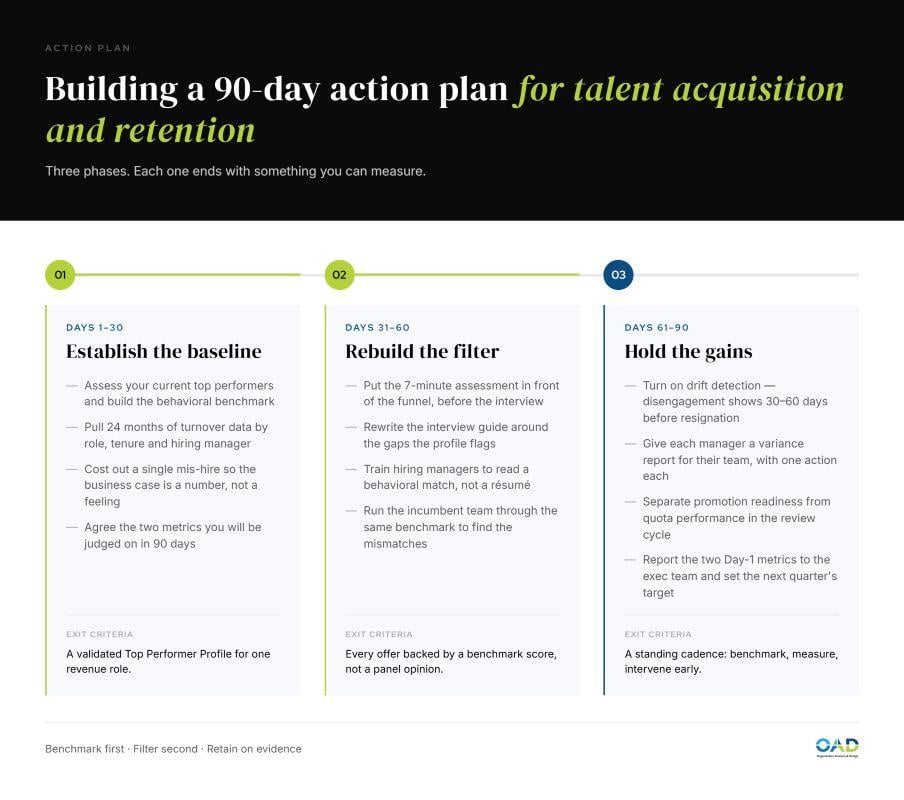
Small, disciplined changes in how you hire compound into real retention gains over a year. This doesn’t need a revolution. It needs consistent, measured improvement, applied to the two or three roles where it actually matters most right now.
Talent Acquisition and Retention: FAQ
How can a company with a very small HR or talent acquisition team get started? Start small. Pick one or two critical roles where a mis-hire or turnover actually hurts the business, and work with the hiring manager to define what success looks like there in behavioral terms, not just skills. Fix those job postings to be realistic and specific. Standardize three to five interview questions that probe behavioral fit alongside technical skill. Add structure with an affordable tool rather than a big platform: OAD’s free Top Performer Profile lets you pilot a behavioral assessment without an upfront commitment. Track source, performance, and 12-month retention in a plain spreadsheet. You don’t need an enterprise analytics stack to start. You need focus, a few consistent metrics, and the discipline to actually review them every quarter.
How do we measure whether our talent acquisition strategy is helping retention? Track a small, consistent set: voluntary turnover in the first 12 months, average tenure by role, offer acceptance rate, and engagement scores by new-hire cohort. Compare cohorts before and after a specific change, did early turnover move after you introduced structured onboarding or a behavioral assessment? Pair that with qualitative signal: exit interviews for why people leave, stay interviews for what’s working, manager feedback on new-hire readiness. Numbers tell you what happened. Conversations tell you why.
What’s the difference between hiring for “culture fit” and “culture add,” and why does it matter for retention? Culture fit means aligning with the core values and behaviors that define how your company actually operates. Culture add means someone who shares those values but also brings a perspective or strength the team is currently missing. Overweighting vague “fit” tends to narrow a team and invite groupthink, which quietly hurts both innovation and engagement over time. Structured criteria and a behavioral assessment help separate what’s genuinely job-relevant from what’s just “similar to the people already here,” which improves both inclusion and retention, because people stay when they feel valued for what they contribute, not just for how smoothly they blend in.
How often should we revisit our talent acquisition and retention strategy? At minimum, once a year, tied to business planning. Add a review after any major shift: a new product line, a funding round, a leadership change, or a sudden spike in turnover. Quarterly check-ins on time-to-fill, quality of hire, early turnover, and engagement let you make small corrections instead of a large, reactive overhaul later. A fast-growing mid-sized company should lean toward the more frequent end of that range; a strategy built at 80 employees is often the wrong one at 180, and the only way to catch that in time is to actually look.
Can behavioral assessments create bias or hurt candidate experience? A well-designed, validated assessment exists to reduce bias by adding an objective, structured input to what’s otherwise a subjective process, but it has to be used transparently to earn that. OAD’s diagnostic has been EEOC compliant since 2001, with no adverse impact demonstrated on any protected class, and it’s gone through three independent third-party validation cycles, most recently in 2023. Keep the assessment short (OAD’s Top Performer Profile takes seven minutes), tell candidates plainly how the results will be used, and never let a score be the sole hiring criterion; it’s one structured input alongside a real interview and work samples, not a replacement for either. Sharing high-level insight with the new hire’s manager, with the candidate’s knowledge, can actually improve the experience: a manager who understands someone’s communication style from day one starts the relationship on steadier ground than one working from a first impression alone.
Start With the Roles Where a Mis-Hire Hurts Most
You don’t need to redesign every hiring process this quarter. You need the two or three roles where getting it wrong costs you the most, fixed first. See the science behind how OAD builds that signal, or how it applies specifically for HR and people leaders.
Get your free Top Performer Profile: seven minutes, results in 24 hours, no credit card.