Every hiring trend in 2026 points the same direction: more automation, more applicants per opening, more competition for fewer roles. You have upgraded the sourcing. You have upgraded the screening. The part of the process that decides whether a hire actually performs once they start is still a gut call.
That is the gap this guide is about. Not another AI feature list. The one input every other function measures and hiring still does not.
Key takeaways
- Hiring has cooled, but competition per role has not. Postings are down while applications per opening have roughly doubled since spring 2022, which means selectivity, not speed, defines 2026 hiring.
- AI now touches most recruiting pipelines. The majority of hiring managers use it somewhere in the process, mostly for screening, which raises the stakes on what that screening actually measures.
- Skills based hiring keeps climbing. It answers can they do the job, never will they do it here, under your pressure, on your team.
- Employer brand is now a hard recruiting metric, not a goodwill line item. It shows up directly in cost per hire.
- Most new hire failures trace back to fit and behavior, not competence. That is the exact gap resumes, interviews, and skills tests all share.
The 2026 job market: fewer roles, more guessing per role
By mid-2026, the labor market has settled into something closer to precision hiring than a hiring boom. Job postings have cooled from the 2021 to 2022 frenzy, and employers are treating every opening as a strategic bet rather than a volume game.
The paradox is that applying got easier while filling a role got harder. Applications per open role have roughly doubled since spring 2022 [VERIFY: https://www.nu.edu/blog/67-hiring-statistics/]. More resumes land in the pipeline. Fewer of them tell you anything real about fit. Volume was never the bottleneck. Signal was.
AI now runs the pipeline. It still cannot tell you who will perform.
AI stopped being a recruiting feature somewhere around 2024 and became recruiting infrastructure. It sources candidates, drafts outreach, screens resumes, and schedules interviews before a human touches the requisition. The majority of hiring managers, roughly 87%, now use AI somewhere in the process [VERIFY: https://www.cpapracticeadvisor.com/2026/07/31/87-of-employers-use-ai-to-hire-but-82-are-wary-of-candidates-doing-the-same/187806/].
Here is what that adoption number does not tell you: AI can move a candidate through your funnel faster. It cannot tell you whether they will hit quota, hold up under a Q4 crunch, or manage a team the way your best performer does. Most AI hiring tools are pattern matching against a resume, which is exactly the artifact candidates now know how to optimize.
Not every AI-adjacent tool in this category is the same thing. Most of what gets called “AI hiring” is an opaque scoring model trained on historical resume data, with no audit trail and no way to prove it is not replicating whoever already got hired before. A validated behavioral diagnostic is a different instrument entirely. It measures behavioral drive against a role benchmark, not proxy features scraped from a resume, and it carries a compliance record the black-box tools do not: EEOC compliant since 2001, with no adverse impact recorded against any protected class, independently validated on a recurring cycle. See the methodology. That distinction matters more in 2026 than it did two years ago, because the AI-bias conversation is not going away, and “we used AI” is no longer a defense on its own.
Design teams with data, not gut feel.
Most org-design decisions come down to role fit, leadership style, and team dynamics. OAD reads those signals from a 7-minute behavioral survey, so you can reconfigure roles and teams with evidence instead of guesswork.
AI-generated resumes made verification the new baseline
Polished, AI-assisted resumes and cover letters are now the norm on both sides of the table. Keyword matching, the backbone of resume-first screening, breaks down fast when every applicant’s materials are optimized to pass it.
That is pushing recruiting teams toward layered verification: skills assessments and live work samples, structured behavioral interviewing, outcome-focused reference checks, identity verification for remote hires. A resume tells you what someone claims. A structured behavioral diagnostic tells you how someone is actually wired to operate under role-specific pressure, the part no amount of AI-assisted editing can fake, because it is not something a candidate is presenting. It is something you are measuring.
Skills based hiring answers “can they.” It was never built to answer “will they.”
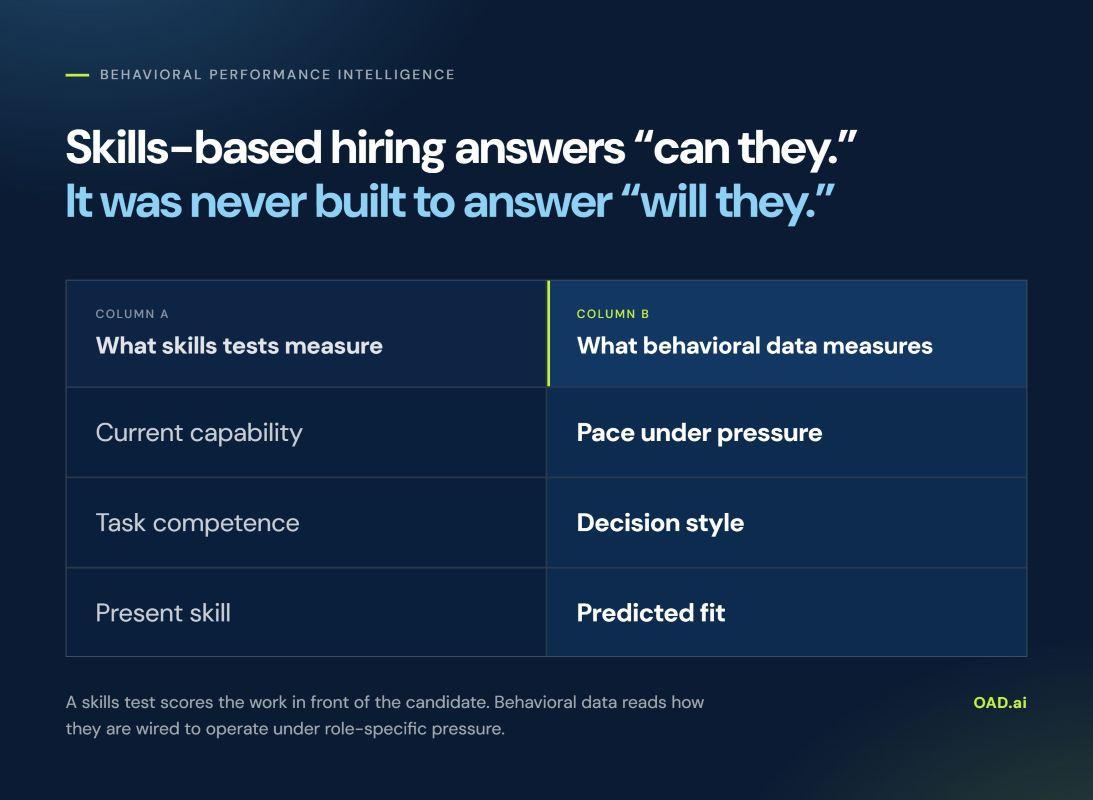
Skills based hiring kept climbing through 2026. Seventy percent of employers now use it, up from 65% the year before, and degree requirements keep dropping off job postings in favor of demonstrated capability.
This is a real improvement over pure credential screening. It is also, on its own, an incomplete filter. Interviews select for confidence, articulateness, and preparation, none of which predict performance. Skills tests select for current capability, which is closer, but still says nothing about pace, resilience under pressure, or how someone leads and communicates effectively under pressure once they are three months in. Your best performer and your worst performer can pass the same skills test. Skills verification and behavioral fit are two different questions, and most 2026 hiring stacks are still only answering one of them.
Employer brand and candidate experience became hard numbers
Employer branding used to live in the marketing budget. It now shows up in the recruiting P&L. Companies with a strong employer brand see roughly 50% lower cost per hire than those without one. A long, opaque process gets punished publicly and fast.
Sourcing has shifted alongside it. Job boards still matter for baseline visibility, but the active work has moved to social platforms, talent communities, and direct outreach. Candidates found proactively convert at a far higher rate than anonymous applicants. For a mid-sized firm without a large employer-brand budget, the practical lever is transparency: clear salary bands, tighter interview loops, and real feedback, not a bigger job board spend.
Referrals and internal mobility are outperforming the open market
Employee referrals remain the strongest source in the funnel by a wide margin.They typically account for 30% to 50% of all hires despite making up only 6% to 7% of applications. That gap is the whole argument for formalizing a referral program instead of treating it as an afterthought.
Internal mobility runs the same logic one layer deeper. Promoting from within reduces external hiring pressure and shortens the leadership pipeline, but only if you can actually see who is ready. That is where a behavioral benchmark earns its place outside of hiring: mapping current employees against the profile of your top performer surfaces leadership potential that a performance review alone will not show you, and turns succession planning into something closer to evidence than office politics.
Flexible work made cultural alignment a recurring cost, not a one-time one
Gig work, fractional leadership, and remote and hybrid arrangements are now standard parts of the workforce mix rather than exceptions. Companies are blending full-time staff, contractors, and part-time executives to manage cost and access specialized expertise.
The catch is that every one of those arrangements resets the fit question, on a shorter timeline, more often. A fractional CFO or a six-month contractor does not get the slow runway a full-time hire gets to figure out how the team communicates and decides. Alignment on pace and decision style has to be assessed upfront, because there is no year two to discover it in.
Executive hiring became leadership risk management
Executive search has moved from delivering a shortlist to functioning as leadership risk advisory. Boards and CEOs now expect search partners to flag change-leadership track record and team-fit risk before an offer goes out, not just technical pedigree.
That is where data-backed leadership assessment does its most expensive work. A senior mis-hire is not a bad-hire line item, it is a multi-year strategic bet gone wrong, and structured behavioral data can flag a likely derailer that a polished interview never will. Even firms without a large internal search function can borrow the principle: pair structured behavioral interviewing with a validated diagnostic before a senior offer, not after a senior regret.
The entry-level pipeline is thinning, and that is a five-year leadership problem
Entry-level hiring has flattened in a lot of sectors, as AI absorbs routine tasks once handed to junior generalists. The short-term logic is obvious. The long-term risk is that every senior leader you have today started as a junior hire, and a thinner entry-level pipeline now is a thinner leadership bench later.
Mid-sized employers can stay ahead of this by treating early-career hiring as a bet on learning agility and behavioral fit, not just current technical output, since technical output is exactly what’s shrinking as a job requirement at that level.
Behavioral data is the differentiator now that AI and skills got commoditized
Here is the pattern underneath all of the above: AI adoption and skills based screening are converging toward table stakes. Everyone is doing some version of both. The differentiator left standing is understanding how someone actually behaves, communicates, and leads, because that is the one input none of the above measures.
The scale of the miss is well documented outside of any single vendor’s data. One widely cited study found that when new hires fail within their first eighteen months, the overwhelming majority of those failures trace back to attitude, coachability, and cultural fit, not a shortage of technical skill. Technical competence is the easiest thing to screen for and one of the weakest predictors of whether someone succeeds.
This is the argument we built OAD around. We at OAD have run 10M+ assessments over 38 years of continuous behavioral science, and clients using OAD see a 60% average reduction in mis-hires. Not a promise, an average, tied to one structured input in a broader decision process, never the sole basis for one. For a lean recruiting team at a mid-sized firm, that is the practical case: a validated behavioral diagnostic does not replace your AI tools or your skills tests. It answers the one question they were never built to answer.
Design teams with data, not gut feel.
Most org-design decisions come down to role fit, leadership style, and team dynamics. OAD reads those signals from a 7-minute behavioral survey, so you can reconfigure roles and teams with evidence instead of guesswork.
What to change this quarter
You do not need to redesign your entire hiring process to act on this. Start narrower:
- Audit one role. Pick a single critical, recurring role and define success metrics and ideal behavioral traits before you post it again.
- Pair, don’t stack. Give every finalist for that role both a skills assessment and a behavioral diagnostic, not five more interview rounds.
- Compare against your last cohort. Track quality of hire and 6- and 12-month retention against the group you hired the old way.
- Build a living talent pool. Tag behavioral and skills data on strong candidates you didn’t hire, and revisit them before you re-source from scratch next time.
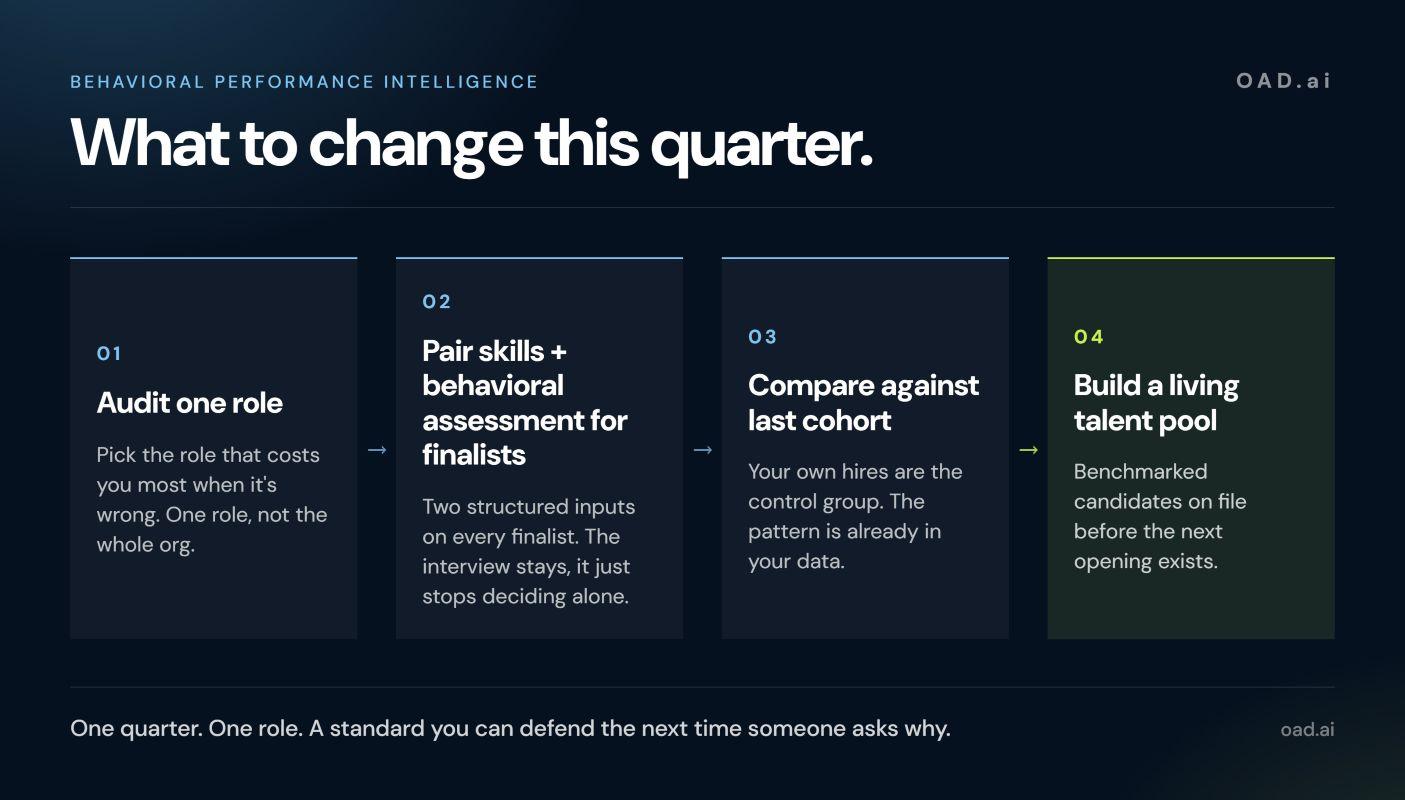
One calibrated role is usually enough to show the gap between guessing and measuring, and it is a lot easier to get internal buy-in for a broader rollout once you have your own before-and-after.
FAQ
How can a mid-sized company compete for talent in a cooler 2026 job market? Speed and directness beat brand recognition for most mid-sized firms. Clear salary ranges, a tight interview loop, and direct access to the actual hiring manager outperform a bigger recruiting budget. Behavioral data helps a lean team make confident calls without needing a large people analytics function to back them up, especially when it is paired with structured, behavioral interview questions to assess cultural fit.
How do we reduce bias when using AI in hiring? Treat AI as an assistant that surfaces a shortlist, never as the decision maker. Pair every AI recommendation with structured human review against job-relevant criteria, and audit outputs periodically for demographic patterns. A validated, independently reviewed behavioral diagnostic reduces bias more reliably than an unstructured interview, because it is measuring the same dimensions the same way for every candidate.
Where do behavioral assessments fit in a hiring process? They fit after basic qualifications and skills are confirmed, and before the final interview or offer. They sharpen interview focus and inform the decision. They should never be the only input; they are one structured signal alongside skills data and human judgment, not a replacement for either.
How should hiring practices adapt for remote and hybrid roles? Define remote, hybrid, and in-office expectations explicitly in the posting, including collaboration norms and time zones. Structured virtual interviews and behavioral data on self-management and comfort with autonomy matter more here than they do for an in-office role, because there is less day-to-day supervision to catch a mismatch early.
What is the single highest-leverage change to make this quarter? Calibrate one role. Define success metrics and ideal behavioral traits for a single recurring, critical position, pair a skills test with a behavioral diagnostic for every finalist, and compare the results against your last hiring cohort. That one experiment usually surfaces enough of a gap to justify the broader change.
Know who will perform. Know when they won’t. Get your free Top Performer Profile and start with the one role you’re most tired of guessing on. Seven minutes, results in 24 hours, no credit card.