Most companies respond to a distributed team by scheduling a bigger event. That’s the wrong lever. Global team building in 2026 means designing repeatable systems, rituals, and structures that let people scattered across countries, cultures, and time zones actually collaborate, not flying everyone to a resort once a year and calling it culture.
The shift already happened. Roughly 52% of U.S. remote-capable employees now work hybrid and another 26% work fully remote, a split that has held steady since 2022. Cross-border hiring is standard practice, asynchronous communication has to be the default rather than the exception, and Zoom, Slack, and Microsoft Teams are the connective tissue of daily work. Tools alone don’t build a team. Building trust across a distributed org requires intentional design, not a laissez-faire hope that people figure it out on their own.
Key takeaways
- Global team building is different from local team building because of three specific frictions: cultural norms shape how feedback and hierarchy are perceived, time zone gaps limit synchronous interaction, and legal and infrastructure constraints add friction local teams never face.
- Seven distinct strategies cover the space: behavior-based team design, async rituals, cross-cultural skill labs, global project challenges, structured mentoring, data-driven recognition, and hybrid offsites. Most companies need two to four of them, not all seven.
- The right combination depends on your team’s time zone spread, your actual engagement and turnover signals, and your budget and implementation capacity, not on which strategy sounds most impressive.
- Behavioral data can anchor the rest of the stack by surfacing where the real friction sits (communication gaps, conflict risk, leadership ambiguity, or burnout risk) before you commit budget to an activity.
- A lean HR team can start with the two lowest-cost, highest-leverage moves, behavioral assessment and async rituals, and add project challenges, mentoring, recognition, and offsites as the foundation proves out.
How We Chose These Global Team Building Strategies
This isn’t a list of one-off games. The “strategies” below are program types, enabling systems, and repeatable structures, evaluated against criteria that actually matter for a distributed org rather than what photographs well:
- Impact on cross-cultural collaboration. How well it bridges cultural norms, communication styles, and work expectations across regions.
- Scalability for a 50 to 250 person organization. Whether it works at the team level and the whole-company level without breaking.
- Suitability across fully remote, hybrid, and multi-office setups. No strategy earns a spot here if it only works in one modality.
- Time zone friendliness. Whether it’s async-native, rotates fairly across regions, or is at least designed to avoid punishing the same time zone every time.
- Integration with existing workflows. Slack, Teams, Google Workspace, and the HRIS platforms teams already use.
- Use of data and people analytics. Whether it can be personalized and measured, instead of run on gut feel.
- Accessibility and inclusion. Language simplicity, neurodiversity considerations, and bandwidth constraints.
- Cost and ease of implementation. A strategy only helps if a lean HR or people-ops team can actually run it and keep running it.
We excluded pure one-off event vendors and in-person-only retreat providers that don’t support global participation, since neither holds up against a distributed team’s actual constraints.
The 7 Best Global Team Building Strategies for Distributed Teams
Below are seven distinct, complementary strategies. Combine two to four of them into a stack that matches your footprint; none of them is meant to be run alone.
1. Behavior-Based Global Team Design
This strategy uses behavioral data to understand how people from different backgrounds prefer to communicate, decide, and collaborate, then shapes global teams and rituals around that data instead of hoping a distributed team “figures it out.”
Why it stands out. It addresses the root cause of friction in international teams, misaligned expectations and clashing work styles, not just scheduling conflicts. Organizational design meaningfully influences how effective a global team becomes, and cultural difference is something to design around, not something to ignore and hope averages out. A validated behavioral assessment gives a team a shared, neutral vocabulary for how each person prefers to communicate and decide. Used as one input, it can inform team norms, role clarity, and conflict-prevention rituals in a multinational team.
Design teams with data, not gut feel.
Most org-design decisions come down to role fit, leadership style, and team dynamics. OAD reads those signals from a 7-minute behavioral survey, so you can reconfigure roles and teams with evidence instead of guesswork.
Best for: mid-sized companies scaling into new hubs in Eastern Europe, Latin America, or Southeast Asia; HR leaders trying to reduce turnover, burnout, and mis-hires in newly formed global teams; leaders standing up cross-border product teams that have to align fast under pressure.
Key strengths: enables data-driven composition of cross-country teams, pairing visionary profiles with detail-oriented implementers across regions rather than by accident; improves 1:1 and team coaching by giving managers concrete insight into each person’s motivators and stressors; makes it easier for managers to start conversations about workload and engagement with remote employees who might otherwise stay invisible until they resign.
Limitations: requires upfront investment in the assessment and in training managers to interpret results responsibly, not just glance at a score; may face skepticism in cultures unfamiliar with behavioral psychometrics, so HR needs to communicate the science and the privacy safeguards clearly rather than roll it out silently.
2. Always-On, Async Global Rituals
Recurring, lightweight rituals, weekly written wins, short video snippets, a standing virtual watercooler channel, that work across time zones without requiring the whole team online at once. They build persistent connection without adding another meeting.
Why it stands out. Remote workdays measurably reduce the spontaneous small talk and relational energy that build a sense of belonging, and structured social rituals appear to buffer that effect. Prioritizing asynchronous communication reduces the number of calls that fall at 6 a.m. for one region and 10 p.m. for another, and these rituals are easy to automate through a Slack bot or a Teams integration rather than something a person has to manually run every week. A quick written win-of-the-week or an emoji check-in takes a couple of minutes and still gives people a relaxed way to connect beyond the day’s task list. A rotating virtual coffee pairing does the same thing on a slower cadence, replacing the spontaneous hallway conversation a distributed team never gets by default.
Best for: teams stretched across six or more time zones where synchronous games and offsites are hard to schedule fairly; engineering, product, and support teams already comfortable working async and in writing; organizations that want a consistent, low-friction global connection point every week rather than a big splashy event twice a year.
Key strengths: scales from a 10-person team to a 300-person org without heavy facilitation, since most of these rituals run in two minutes or less; inclusive by design for caregivers and people on nontraditional schedules, since participation happens whenever it suits the person; compounds over time into a searchable record of wins and stories that doubles as a lightweight culture archive.
Limitations: can feel shallow fast if the prompts repeat or aren’t thoughtfully curated; needs an owner, usually HR or a culture champion, to keep it from fading out after the first few months of novelty wear off.
3. Cross-Cultural Skill Labs
Structured, recurring workshops that teach concrete skills: communicating across high- and low-context cultures, giving feedback across regions, running an inclusive virtual meeting. This goes further than a generic diversity training module.
Why it stands out. Research on cultural intelligence, the ability to function effectively across cultural contexts, shows it predicts task performance in virtual, cross-cultural interactions. Establishing cross-cultural awareness early, before a team hits its first real misunderstanding, keeps friction from calcifying into resentment later. The strongest version of this strategy uses real scenarios pulled from the company’s own Slack threads and meeting transcripts as case studies, then connects the pattern back to behavioral data to show how culture and individual working style interact, rather than treating “culture” as one flat variable. A simple team agreement, response windows, escalation protocols, and feedback formats spelled out in writing, gives every team something concrete to actually adopt afterward.
Best for: companies with hubs in three or more regions seeing recurring communication friction; newly acquired teams or post-merger integrations spanning multiple countries; leaders and managers running global project teams or client-facing roles where a misread cue is expensive.
Key strengths: produces a practical communication agreement teams can adopt immediately, not just a training certificate; gives introverts and non-native English speakers a structured, lower-pressure way to speak up, which improves participation for the whole team, not just the people the format was designed for; signals real organizational commitment to inclusion instead of a one-off diversity module.
Limitations: needs professional facilitation with genuine cross-cultural expertise; a generic training deck doesn’t do the job. Impact fades without follow-up sessions or reinforcement from managers and the systems around them.
4. Global Project-Based Challenges
Time-bound, cross-border projects, a four to six week innovation sprint, an internal hackathon, a customer-experience challenge, where mixed-country teams solve a real business problem together. Bonding happens through the work itself, not an artificial exercise bolted on top of it.
Why it stands out. This builds working relationships through substance instead of contrived team-building games, and structured challenges under realistic constraints tend to sharpen problem-solving skills in a way an abstract icebreaker can’t. Postman, a software company with more than 400 employees across 20-plus countries, brought its distributed team together for a two-day conference in Barcelona in 2024 after years of largely virtual interaction, mixing people across offices for shared sessions rather than segregating by region. A project-based challenge gets a lighter-weight version of that same cross-border mixing spread across several weeks instead of a single flight, and it produces tangible outputs, a process improvement, a prototype, a playbook, alongside the connection. Keep the output in a centralized, accessible repository so it doesn’t end up concentrated with whichever office happened to host the final readout.
Best for: product, growth, and operations teams already running sprints or quarterly OKRs; companies wanting to tap local-market insight from teammates actually based in a target market; high-growth firms looking to spot future leaders in emerging offices before a formal promotion cycle forces the question.
Key strengths: reveals real leadership, collaboration, and problem-solving style under realistic time pressure, which a contrived exercise can’t replicate; spans several weeks, which avoids the scheduling problem of a single long, multi-time-zone live event; creates a shared story across locations that a slide deck about “our global culture” never does on its own.
Limitations: can overload teams already at capacity if it’s not aligned with existing priorities; needs clear scoping and facilitation, or the loudest or best-resourced region ends up dominating while quieter hubs disengage.
5. Structured Global Mentoring and Buddy Systems
Pairing employees across countries and functions for a three to six month mentoring or buddy program with clear goals, prompts, and check-ins built in from the start.
Why it stands out. Deliberate personal connection builds relational closeness in a remote team, especially for someone joining from an office far from headquarters, and a structured buddy program gives that connection a reason to exist beyond an awkward first Slack message. These programs work best when paired with a short, behavior-informed playbook, built from assessment data on what actually motivates the new hire, rather than a generic “ask them about their weekend” prompt sheet. Mentoring is also one of the more cost-effective retention levers available: it mainly requires thoughtful matching and light ongoing program management, not a budget line.
Best for: rapidly scaling companies onboarding cohorts of new hires worldwide every quarter; organizations with junior talent concentrated in emerging markets and senior leadership concentrated in one country; employees who want a real growth path without relocating to headquarters.
Key strengths: low cost, high impact, since it mainly needs good matching and light management rather than a platform purchase; improves retention among global employees who might otherwise feel invisible or stuck, since the first person a new hire connects with outside their immediate team often shapes their entire early experience; generates a steady stream of field-level feedback back to HR and leadership that a survey alone won’t surface.
Limitations: pairs lose momentum without clear expectations and periodic nudges from a program owner; can reinforce existing silos if matching isn’t deliberately cross-functional and cross-cultural rather than convenient.
6. Data-Driven Global Recognition and Celebrations
Using performance data and manager input to spotlight contributions from every location, not just headquarters, through a global all-hands, a newsletter, or a dedicated recognition channel. This is the most visible form of global team building on this list.
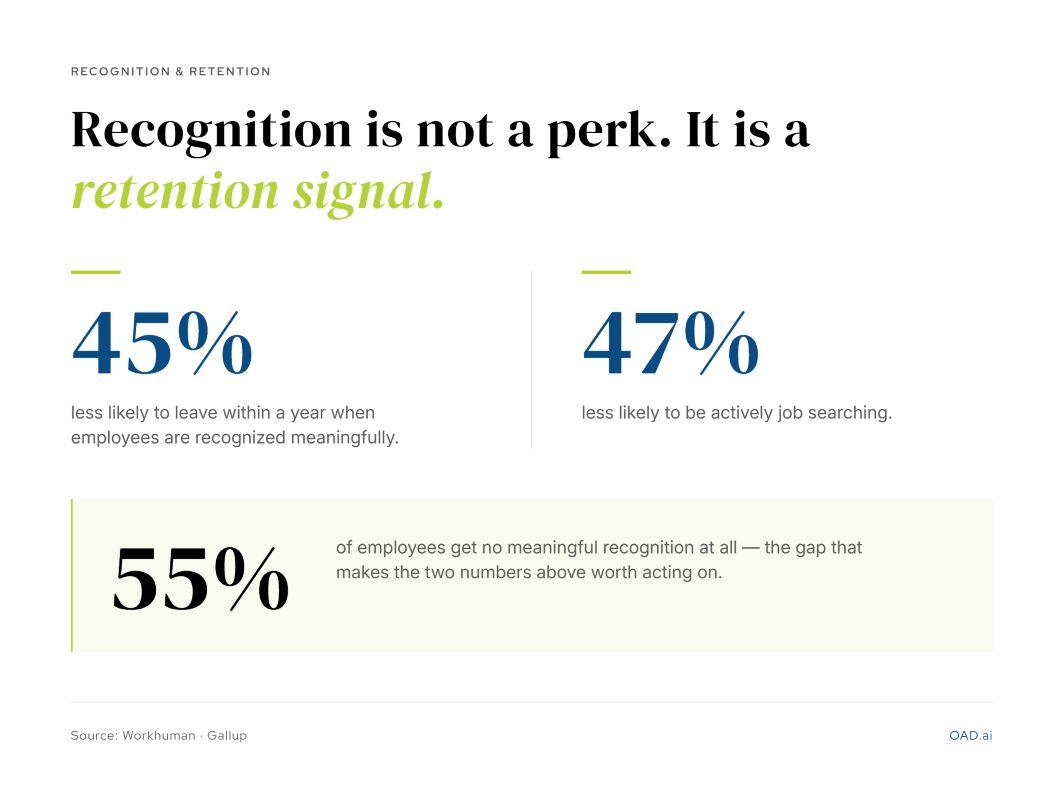
Why it stands out. A Workhuman and Gallup study tracking more than 3,400 employees from 2022 to 2024 found that employees who received high-quality recognition in 2022 were 45% less likely to have left their job by 2024, and those whose recognition met four or more of five quality pillars were 47% less likely to be actively job searching. The same research found more than half of U.S. employees receive no recognition at all, or recognition that doesn’t meet any of those quality pillars, which is the gap a global recognition program is built to close. Centralized documentation and regular retrospectives reveal whether a specific region feels excluded from decisions or visibility before it shows up as a resignation. This counters the “center and periphery” dynamic where headquarters gets the credit by default, and it reinforces the exact behaviors you want repeated by naming them, specifically, in public.
Best for: organizations with multiple offices or entities across countries; teams running quarterly all-hands where recognition already exists but skews to one region; HR leaders building or refreshing a company-wide recognition program from scratch.
Key strengths: strengthens psychological safety by showing that a contribution from any location can actually be career-advancing; simple to run using the HRIS, project tools, and feedback surveys already in place; makes room to highlight global holidays and cultural milestones respectfully, rather than only through a headquarters-centric calendar.
Limitations: risks looking like favoritism if the recognition criteria aren’t clearly defined and communicated; needs discipline on frequency, too rare reads as tokenistic, too frequent reads as noise that people stop paying attention to.
7. Hybrid Global Offsites With Virtual-First Design
Carefully planned annual or biannual global gatherings that mix regional in-person hubs with a genuinely rich virtual experience for people who can’t travel. This is the flagship event that anchors everything else on this list.
Why it stands out. In-person time still strengthens trust and rapport built online in a way a video call can’t fully replicate, which is why Postman’s 400-plus-person, 20-plus-country team flew in for that Barcelona conference after years of primarily virtual work. But the differentiator that actually matters is virtual-first design, not the size of the venue. Encouraging camera use during any hybrid session helps capture the cultural cues a purely audio call misses, and breakout rooms let both large and small groups engage meaningfully whether they’re in the room or joining remotely. A short, well-run icebreaker, something like Two Truths and a Lie, works as well over video as it does in person, and running it that way from the start prevents remote attendees from becoming second-class participants in their own company’s offsite.
Best for: companies with travel budgets that support at least a regional meetup once a year; teams coming out of a major reorg, funding round, or strategic pivot that need real shared alignment, not just a status update; organizations with employees spread across continents but with existing regional clusters to build around.
Key strengths: creates emotionally memorable experiences that sustain day-to-day remote collaboration long after the event ends; opens the door to deeper strategy, culture, and leadership workshops that are genuinely hard to run well purely online; virtual-first design prevents the “second-class citizen” dynamic regardless of whether the org is 50 people or 250.
Limitations: significant logistical and budget planning required, and economic conditions can constrain how often you can actually run it; risk of over-indexing on spectacle instead of building the systems, rituals, mentoring, recognition, that carry the culture between offsites.
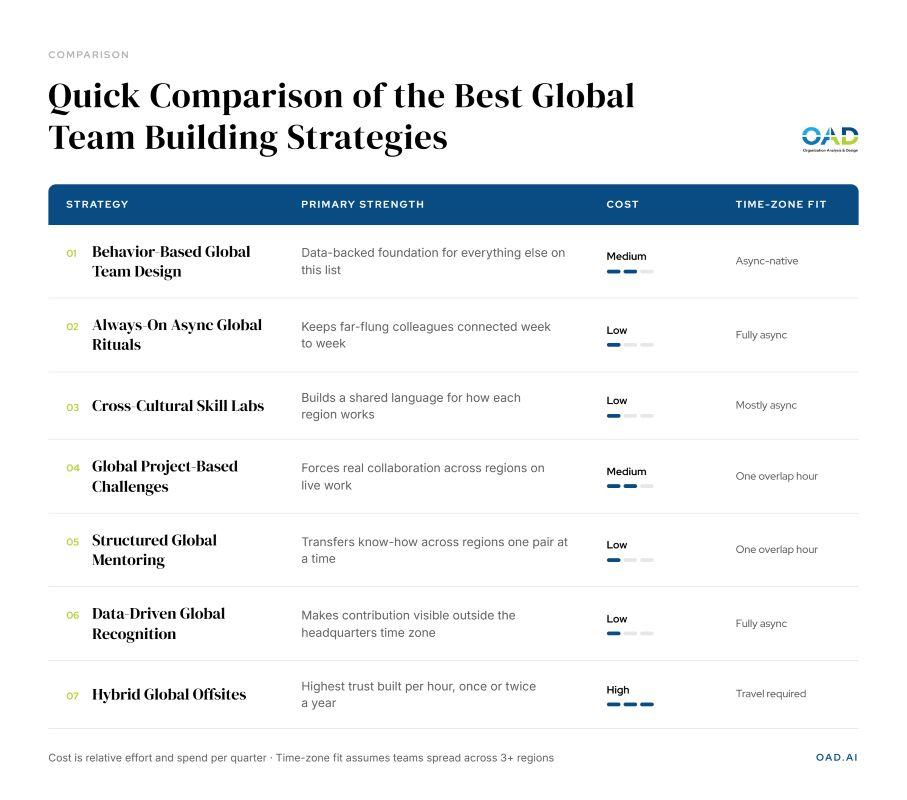
Quick Comparison of the Best Global Team Building Strategies
How to Choose the Right Global Team Building Approach
Most organizations combine two to four of these strategies. Choice and sequencing should follow your actual maturity and pain points, not which strategy sounds most impressive in a planning meeting.
Choose based on your team’s global footprint and time zones. How many regions you span determines what’s realistic at scale. Heavily overlapping time zones, Americas plus Western Europe, can lean more on live workshops, project challenges, and meetings with real synchronous components. Widely dispersed time zones, Americas plus EMEA plus APAC, should prioritize async rituals, mentoring, and behavior-based design, and rotate any live events so the inconvenient hour moves around instead of always landing on the same region. Map your current time zone clusters and overlap hours before you pick a program; if the whole team shares only a two-hour daily overlap, building the strategy around live exercises sets it up to fail.
Choose based on culture, engagement, and turnover signals. Let the data set the priority, not a hunch. High turnover concentrated in one region points toward mentoring, recognition, and a behavioral read to diagnose the actual cause, since stay interviews and engagement data broken out by location can show where people are struggling before an exit interview confirms it. A low engagement score on “I feel understood by my manager” points toward cross-cultural skill labs and manager training. Low team cohesion scores point toward behavior-based design and async rituals first, before any investment in a large event. Track engagement and performance metrics systematically rather than reacting to whichever complaint reached HR most recently.
Choose based on budget, capacity, and implementation ownership. A lean HR team should start with the low-cost, high-leverage options, behavioral assessment and async rituals, before committing to a large offsite. Split ownership deliberately: HR or people ops owns the design, policy, and facilitation; managers own day-to-day adoption and reinforcement inside their own teams; executives role-model participation and fund the bigger initiatives once the foundation is working. Pilot with one or two teams first, then scale based on what the feedback and the numbers actually show, not on a rollout date picked in advance.
Which Global Team Building Strategy Is Best for You?
There’s no single right path, and sequence matters more than trying to run all seven at once.
- Choose Behavior-Based Global Team Design if you want a scalable, data-backed foundation for hiring, promotion, and team formation across countries.
- Choose Always-On, Async Global Rituals if your top priority is keeping far-flung colleagues connected week to week without adding another meeting.
- Choose Cross-Cultural Skill Labs if miscommunication, conflict avoidance, or feedback gaps are actively slowing down global projects.
- Choose Global Project-Based Challenges if you want to combine team bonding with real innovation, process improvement, or customer-facing work.
- Choose Structured Global Mentoring if you’re onboarding many new hires and want to speed up their integration and growth.
- Choose Data-Driven Recognition if visibility and appreciation currently skew toward headquarters and everywhere else feels like an afterthought.
- Choose Hybrid Global Offsites if you’re ready to invest in a flagship annual event that reinforces everything else you’re already doing.
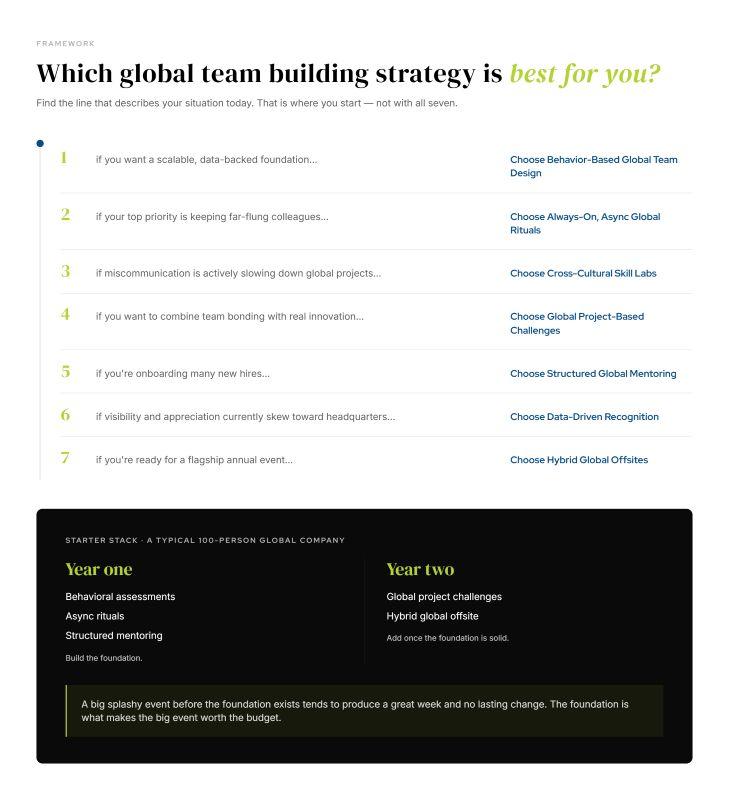
A reasonable starter stack for a typical 100-person global company: behavioral assessments plus async rituals plus mentoring in year one, then add project challenges and a hybrid offsite in year two once the foundation is solid. A big splashy event before the foundation exists tends to produce a great week and no lasting change; the foundation is what makes the big event worth the budget.
Global Team Building: FAQ
What actually makes global team building different from regular team building? Three things a single-office team never has to deal with. Cultural norms shape how feedback, recognition, and hierarchy get perceived, so an activity that reads as direct and helpful in one office can read as blunt or disrespectful in another. Time zone gaps limit how much synchronous interaction is even possible, which forces a heavier reliance on async design than most single-location teams ever need. And legal, visa, and infrastructure constraints, from labor law differences to internet reliability, add friction a co-located team simply doesn’t encounter.
How many of these seven strategies should we actually run? Most organizations land on two to four, not all seven at once. Start with whichever strategy addresses your most urgent signal, usually behavioral assessment plus async rituals for a team that’s just gone distributed, and add the others as that foundation proves out. Running all seven simultaneously with a lean team usually means none of them get the ownership and follow-through they need to actually work.
Do async rituals really work as well as live events for a distributed team? For weekly connection, often better, because they don’t force anyone into a call at an unreasonable hour. Async rituals aren’t a full substitute for the trust that in-person time builds, but they’re the strategy most likely to actually sustain itself week over week across a wide time zone spread, where a live event can only happen occasionally. The two are complementary, not competing: async rituals carry the weekly cadence, and an occasional hybrid offsite carries the deeper relationship-building an app can’t replicate.
How do we know if our global team building strategy is actually working? Watch the same signals you’d track for any people investment: engagement scores broken out by region rather than averaged across the whole company, voluntary turnover by location, and whether a behavioral read shows improving communication or leadership patterns on a team over successive cycles. If engagement or turnover in one region stays flat despite the program running there, that’s a signal to change the approach in that region specifically, not to run the same event again and hope for a different result.
What’s the most common mistake companies make with global team building? Treating it as a single flagship event instead of a system. A well-produced annual offsite generates real energy for a few weeks and then fades if nothing sustains it between events. The strategies that actually change how a distributed team works day to day, behavior-based design, async rituals, recognition, mentoring, are the ones running every week, not once a year.
Start With the Behavioral Read, Then Build the Stack Around It
You don’t need all seven strategies running by next quarter. You need to know where your global team’s actual friction sits before you decide which two or three to build first.
Get your free Top Performer Profile: seven minutes, results in 24 hours, no credit card.