You can name your best performer in one second. You cannot say why the other six do not perform the same way, and neither can they.
That gap, not effort or attitude, is what turns a promising team into six people who share a calendar. Teamwork success is not a mood you cultivate at an offsite. It is a design problem, and most leaders are solving it blind.
Key takeaways
- Teamwork success is a team’s repeatable ability to hit its goals. A single project that went well is a moment, not a system.
- High-functioning teams report meaningfully higher engagement, performance, and retention than teams that do not collaborate well, per Gallup’s teamwork research.
- Role clarity, psychological safety, and matching people to the work they are actually wired for are the three levers a leader can pull directly.
- A 90-day, structured cadence builds these traits into habit. A single offsite does not.
- Behavioral data replaces guesswork about who should own what, the same way pipeline data already replaced guesswork about revenue.
Teamwork Success Is a System, Not a Moment
Teamwork success is a team’s repeatable capacity to hit shared outcomes through collaboration, not a lucky project that went well once. A team that ships one feature on time and cannot repeat the result has had a moment, not a system.
The difference shows up in the numbers you already track: revenue hit on schedule, cycle time, retention. It does not show up in whether people get along. Getting along is not the goal. Repeating the result is.
Why Effective Teamwork Shows Up in Your Retention Numbers
Weak teamwork has a second, quieter cost: dependency on one person. When knowledge and ownership live in a single head, that person’s vacation becomes a risk, not a Tuesday. Effective teamwork spreads the load so the team survives an absence, a departure, or a bad quarter without losing the work.
The Traits That Actually Predict a High-Performing Team
A Shared Goal Everyone Can State Without a Slide Deck
If a team member cannot say the team’s top priority this quarter without checking a document, the goal is not shared. It is filed. Translate company targets into one or two measurable team goals, not five aspirational ones, and tie individual objectives to that same number.
Open Communication and Psychological Safety, Not Just an Open Door
Psychological safety means a team member raises a risk or admits a mistake without waiting to see how it lands. A randomized study across more than 500 teams found that building this into how managers run one-on-ones improved innovation, performance, and team stability. Reserved and outspoken team members do not participate equally by default. Structure for it: round-robins, written pre-reads, explicit norms for feedback.
Roles Built Around What People Are Actually Wired to Do
Effective teamwork does not mean everyone thinks alike. It means the analytical problem solver owns the data, the relationship builder owns the client, and the detail-focused executor owns the checklist, because that is where each one is strongest. Put a highly creative, low-detail person in a compliance-heavy role and you have degraded both the person and the team.
Decision Rights That Are Assigned, Not Assumed
Every decision needs an owner and a method: the leader decides after input, the group reaches consensus, or the call is delegated to whoever has the expertise. Time-box the discussion, name the owner, log the trade-off. Teams that skip this step do not avoid conflict. They just have it later, with less information.
Knowledge That Lives in a System, Not in One Person’s Head
Documented processes, shared drives, and short recorded walkthroughs turn a team’s know-how into something that survives turnover. This matters most for distributed and hybrid teams, where time zones already work against informal knowledge transfer.
A 90-Day Way to Build a High-Performing Team
Foster teamwork the way you foster pipeline: on a cadence, not a hope.
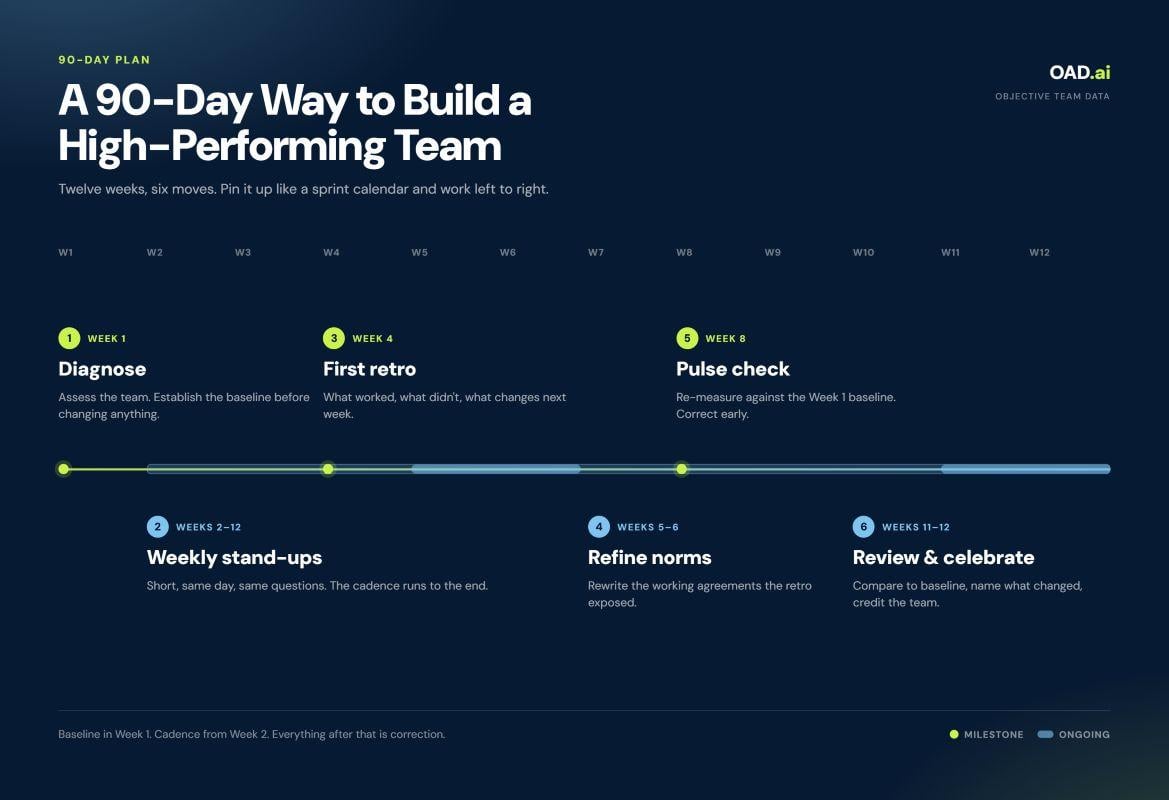
Treat it as a living system. The rituals stay. The specifics adapt to your team.
Where Behavioral Data Fits
Technology does not create teamwork. It makes teamwork easier to build on purpose. A calendar tool tells you when a meeting is. It cannot tell you who should own client relationships or who is about to burn out under ambiguity.
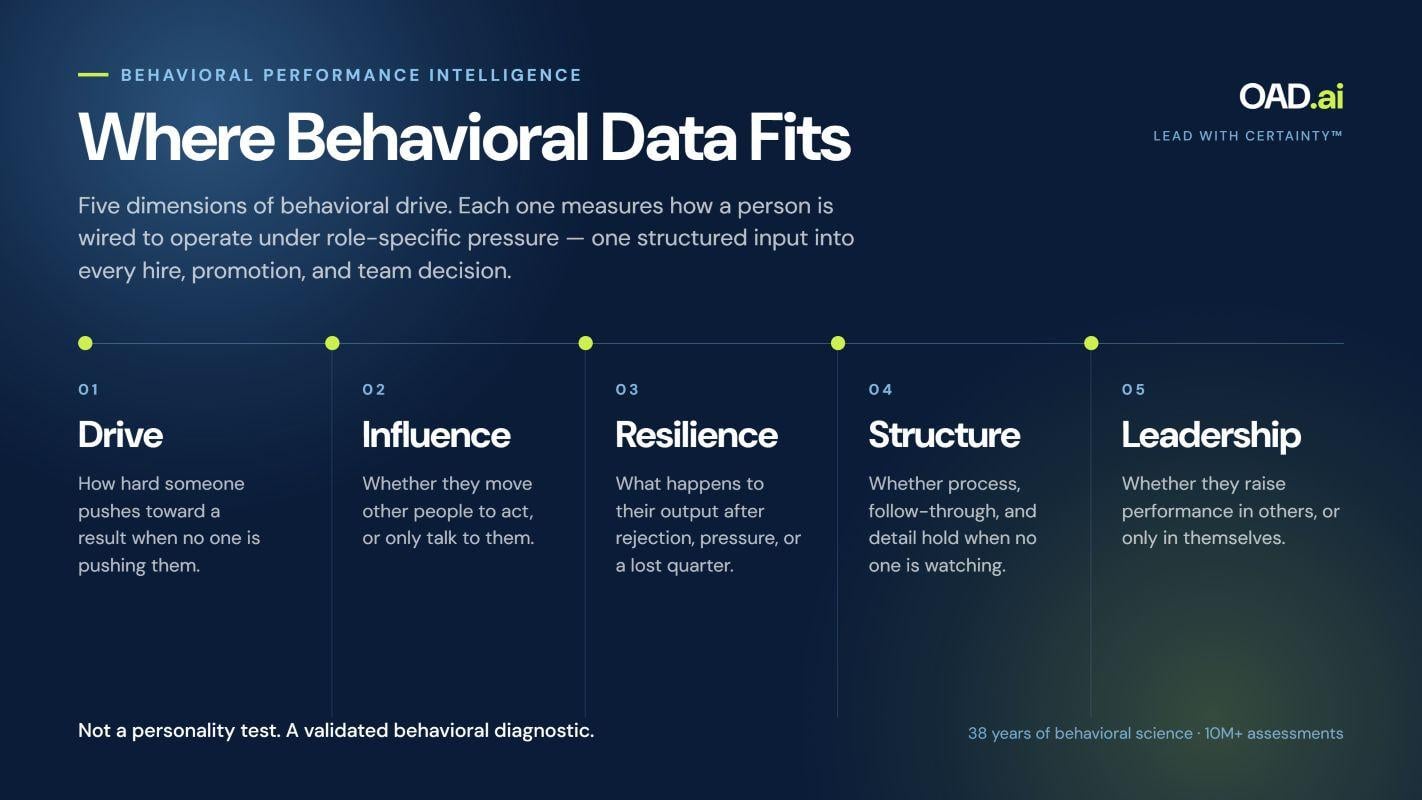
That is where behavioral data comes in. We at OAD measure behavioral drive, how someone is wired to operate under role-specific pressure, across five dimensions: Drive, Influence, Resilience, Structure, and Leadership. It is not a personality read. It is a diagnostic, built on 38 years of continuous validation and more than 10M completed assessments, and it is EEOC compliant since 2001 with no adverse impact on any protected class.
We built OAD to answer the two questions a leader actually has: who should own this, and who is showing early signs of drift before performance collapses. On a 200-person operations org, this kind of role realignment has moved time-to-productivity from 6.8 to 4.2 months and cut promotion mis-placement from roughly 40% to 12%. On a 40-rep sales team, the same discipline has taken quota attainment from 41% to 67%. Results like these vary by team; treat them as illustrative, not a guarantee.
OAD clients see an average 60% reduction in mis-hires. That number holds up because it is one structured input into a decision, never the whole decision.
FAQ: Teamwork Success and Behavioral Data
How long does it take to see results from working on teamwork?
Small changes, better meetings, clearer roles, show up in four to six weeks. Deeper shifts in mutual accountability take three to six months, and only happen if leaders change how work gets assigned and how conflict gets resolved. Pairing team-level rituals with a shared behavioral read on the team tends to compress that timeline.
Can teamwork be measured, or is it just a feeling?
It can and should be measured with hard numbers: on-time delivery, error rates, customer satisfaction, and voluntary turnover. Pair those with engagement scores and internal mobility. The point is to move the conversation from a feeling in the room to evidence you can act on.
What is the ideal team size?
Four to seven core members is the range that shows up most often in practice: enough for real diversity of thought, small enough to decide quickly. A tight core of five people who complement each other on strengths will beat a larger, more uniform group nearly every time.
How do I improve teamwork if I am not the manager?
Start inside what you control. Document what you know, invite people into decisions instead of announcing them, and propose one small ritual, a 15-minute weekly retro, and ask your manager to back it. Naming your own working style, and asking others to name theirs, does more to open communication than any policy.
How often should roles get revisited?
A light check every quarter, a deeper reset annually or after a strategy shift. Persistent confusion about ownership, duplicated work, or a new hire whose behavioral profile does not match the role they landed in are all signals to move that check up. Do not wait for the calendar.
You already know your best performer. Get your free Top Performer Profile and turn that person into your hiring and team-design benchmark: 7 minutes to complete, results in 24 hours, no credit card required.