Most team builders fail for the same reason most hires fail: nobody defined what “working” would look like before the event happened. A trust fall in a hotel ballroom with no debrief and no follow-up doesn’t build anything. It just uses a Tuesday.
Team builders are the structured activities, games, and facilitated events companies run to strengthen collaboration, trust, communication, and performance on a team. Done well, they target a real gap and produce a measurable shift in how people work together afterward. Done badly, they’re a line item that photographs well and changes nothing.
Key takeaways
- Team builders are deliberate, structured activities used to strengthen collaboration, trust, communication, and performance, not casual happy hours. The difference is a measurable goal behind the activity.
- Effective team building activities share the same traits regardless of format: a clear objective, psychological safety, structured reflection afterward, and a link to real workflows, not abstract games with no transfer to daily work.
- The right activity depends on team size, goal, time and budget, and format (in-person, remote, or hybrid). A scavenger hunt that energizes a 12-person sales team can fall flat with a 40-person team mid-launch.
- Behavioral data can sharpen team builder design before you pick an activity by surfacing where the real friction sits: communication gaps, conflict risk, leadership ambiguity, or burnout risk.
- Team building only shows ROI when someone measures it. Pre- and post-event pulse surveys, engagement scores, turnover, and operational metrics (cycle time, error rate) turn “everyone had fun” into an actual answer.
What a Team Builder Actually Is (And When You Actually Need One)
A team builder is a deliberate, structured team building activity used in a corporate setting to strengthen collaboration, trust, communication, and performance. It differs from a casual happy hour or pizza lunch because it’s designed around a measurable goal, not just a break in the routine. Team building improves communication and collaboration when the activity maps to a real gap on the team. It boosts productivity and morale when participants walk away with a shared experience they can actually reference in future work, not just a memory of a good afternoon.
Here’s when to actually schedule one, rather than defaulting to an annual calendar slot:
- After rapid hiring, when a team has grown fast and its norms and culture are still thin.
- Post-merger or acquisition, where two legacy cultures now have to operate as one team.
- When a new manager or leadership team takes over an existing group.
- When engagement survey scores drop, specifically when trust or communication scores fall noticeably.
- When turnover or flight-risk signals spike and exit interviews point to role mismatch or burnout rather than pay.
An effective team builder is more than a fun game. It has to connect to a business outcome, and ideally, it’s informed by behavioral data rather than a guess about what the team “probably needs.” OAD’s free Top Performer Profile, seven minutes to complete with results in 24 hours, can surface a communication gap, leadership friction, or burnout risk before you pick a single activity.
Design teams with data, not gut feel.
Most org-design decisions come down to role fit, leadership style, and team dynamics. OAD reads those signals from a 7-minute behavioral survey, so you can reconfigure roles and teams with evidence instead of guesswork.
What Separates an Effective Team Builder From a Cringe One
A trust fall with no debrief and no behavior change afterward is a waste of budget, not a team building win. An outcomes-driven activity targets a specific friction point instead: miscommunication between two functions, low mutual accountability on a team, or conflict avoidance among new managers. Effective activities let people practice real workplace behaviors and problem solving, not perform an abstract game that never transfers back to daily work.
Here’s what separates a useful team builder from a cringe one:
- A one-sentence objective. If you can’t state the purpose of the activity in one sentence, the activity isn’t ready to run.
- Psychological safety. Activities that create psychological safety produce better team performance, because participants have to feel safe enough to speak, make mistakes, and disagree for anything real to surface.
- Inclusivity. Not everyone thrives in the same format. Design for a range of physical ability, personality style, and cultural background, not for the loudest extrovert in the room.
- Structured reflection. Without a debrief, insight from the activity evaporates within days. The debrief is where the activity actually becomes a team builder instead of just an event.
- A link to real workflows. Scenarios that mirror actual project deadlines, customer conflicts, or resource constraints transfer back to daily work. Abstract games don’t.
- Measurable outcomes. Pre- and post-event surveys, project cycle times, or error rates tell you whether anything changed, not just whether people smiled in the photos.
- Timing inside the workday. After-hours mandatory events tend to breed resentment, not trust.
Activities should also reflect the company’s actual culture and values, not a generic template pulled off a vendor’s site. A workshop where teams identify real communication blockers from prior projects, practice new norms in small challenges, and commit to specific process changes is the kind of design that shows up in sprint velocity and escalation counts 90 days later. A generic offsite with no follow-up rarely moves either number. Behavioral assessment data can flag where a team builder should actually focus: whether conflict style mismatches, communication gaps, or leadership friction dominate the team you’re designing for.
Types of Team Builders: From Five-Minute Icebreakers to Full Offsites
Team builders span from a five-minute warm-up before a Monday standup to a multi-hour program built for a quarterly offsite. They can run in-person, virtual, or hybrid, and they can last anywhere from a few minutes to a full day depending on the goal’s complexity. Interactive team activities strengthen communication and collaboration regardless of format. The work is matching the type to the actual need.
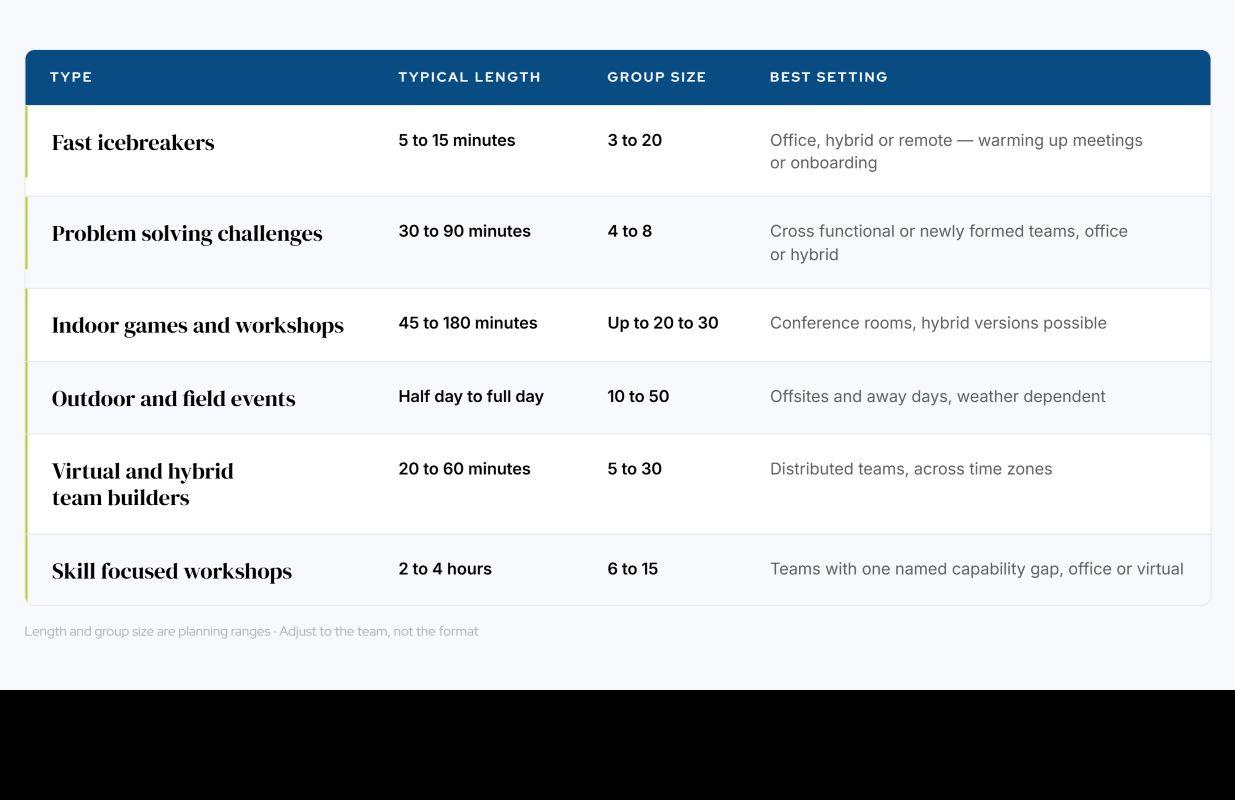
Each type gets concrete examples in the sections below.
Team Icebreaker Games That Don’t Waste Time
Icebreaker games are short, low-stakes activities that warm up energy, lower social distance, and help a team connect before diving into the agenda. They should be light, structured, and time-boxed, not an open-ended detour. Shared experiences build trust, and even five minutes of structured personal sharing shifts the tone of a meeting.
- Three Snapshots. Each person shares three photos from different years that represent something about them. Works in person with printouts or virtually over screen share. Time: 10 minutes.
- One Win, One Worry. Each participant shares one success from the current quarter and one concern. Virtual or in person. Time: 5 to 10 minutes. Builds psychological safety and surfaces shared concerns early.
- Object Story. Everyone grabs an object from their desk and tells a 60-second story about it. Works well over webcam. Time: 5 minutes.
- Two Truths and a Wish. A variation on the classic format where participants share two truths and one aspiration. It helps teammates understand each other’s motivations, not just trivia about their past.
- Pictionary round. A quick 5-minute drawing game using a whiteboard or a digital tool. It breaks communication barriers fast, especially in a group where not everyone knows each other well.
Assign a facilitator to manage transitions and hold the stated time. If the meeting is already agenda-heavy, one icebreaker is enough.
Remote and Virtual Team Building Activities for Hybrid Teams
Hybrid and remote work is standard now, and distributed teams lose the hallway conversations and lunch-table moments that build informal norms without anyone trying. Without deliberate effort, remote teams risk isolation, miscommunication, and uneven belonging. Team building activities should be inclusive and engaging regardless of location, and individuals benefit from formats that suit their own preferences rather than a one-size-fits-all event.
- Show and Share Desk Tour. Each person gives a brief virtual desk or office tour on video. Time: 10 to 15 minutes. Good for onboarding weeks.
- Virtual Coffee Roulette. Randomly pair colleagues across locations for a 15-minute chat, scheduled weekly or biweekly. Builds informal connection across geography.
- Lunch and Learn Lightning Talks. Internal speakers present for 10 minutes each on non-work or lightly work-adjacent topics. Hybrid-friendly and builds knowledge sharing.
- Online Group Game Night. Platforms like Jackbox or browser-based quizzes, 60 to 90 minutes, opt-in. Friendly competition without pressure.
- Quarterly Challenge. Step goals, reading groups, or journaling tracked in Slack or Teams over a full quarter. Builds shared, sustained purpose rather than a single event’s worth of connection.
Match time zones, make accessibility explicit (captions, no sensory overload), and state clearly whether participation is opt-in or expected. Behavioral profiles can also group people with complementary strengths in breakout rooms, so a high-structure thinker ends up working alongside a high-influence communicator instead of three of the same profile in one room, which tends to produce a stronger session than a random draw.
Problem Solving Games That Mirror Real Work Challenges
Problem solving games bridge the gap between a fun team building experience and the decisions teams actually face at work. They create a safe simulation space to practice prioritization, negotiation, and clarity under pressure, where the stakes feel real without the real consequences.
- Deadline Rescue. Hand teams a failing project plan. Under a 25-minute cap, they redesign the timeline, reallocate resources, and decide trade-offs. Group size: 4 to 8. Debrief on who led when and where communication broke down.
- Resource Swap. Teams receive incomplete but overlapping resource sets and negotiate trades to hit shared goals. Group size: 3 to 5. Debrief on conflict style, leadership emergence, and fairness.
- Customer Inbox. Simulate a shared inbox of conflicting customer emails: urgent versus important, unclear versus angry. Group size: 4 to 6. Debrief on triage patterns and who took which role.
- Silent Strategy. Teams plan a strategy without speaking, using only written notes or a shared tool. Group size: 3 to 6. Debrief on where misunderstandings happened without a verbal channel.
- Retrospective Remix. Teams analyze a fictionalized version of a prior internal incident, with the constraints changed, and solve it under the new conditions. Group size: 5 to 8.
Beyond custom activities, a handful of classic formats deliver consistent results: the Marshmallow Challenge for collaboration under pressure, Worst Idea Brainstorming to lower pressure by inverting the usual “best idea” dynamic, a blindfolded obstacle exercise to force reliance on clear verbal communication, and a resource-constrained consensus exercise to practice weighing diverse perspectives fairly. Improv exercises teach active listening and “yes, and” collaborative momentum, useful for teams that tend to shut ideas down reflexively.
Behavioral data on a team’s Influence and Structure profiles can predict who naturally takes charge in an exercise like Deadline Rescue or who manages conflict in Silent Strategy. Use those insights for role assignment going in, and for the debrief coming out.
Indoor Team Building Games for Offices and Conference Rooms
Indoor team building suits offsites, quarterly meetings, or training days when weather, travel, or logistics make an outdoor event impractical. A conference room and basic supplies are enough to run a full program.
- Office Scavenger Hunt. Clues tied to company history or values, hidden around the office. Works for 8 or more participants. Time: 30 to 45 minutes.
- Tower Sprint. Using paper, tape, and other inexpensive supplies, teams build the tallest stable tower in 20 to 30 minutes. Group size: 4 to 6. Builds problem solving under time pressure. An Egg Drop Challenge follows the same format with a fragility constraint added.
- Memory Wall. A sticky-note or digital board capturing company wins, milestones, and challenges over the years. Time: 45 minutes. Builds shared history and identity.
- Flip the Script. Cross-functional pairs swap tasks or roles for 15 minutes and share what they learned. Time: 30 to 45 minutes. Builds empathy for other people’s work and understanding of dependencies.
- Persona Marketplace. Teams build personas of internal stakeholders (marketing, support, operations) and pitch solutions as if selling to those personas. Time: 45 minutes.
HR or team leads can weave three of these into a single half-day event, with 10-minute breaks and a 15-minute reflection period between each. The debrief is where behavior change actually takes root: ask what challenges emerged, which behaviors are worth carrying back into daily work, and what specific commitments people are willing to make.
Outdoor Team Building Exercises and Scavenger Hunts
Movement, fresh air, and a break from a conference room reset energy in a way an indoor session usually can’t. Outdoor exercises work best for annual offsites or company gatherings where the whole team is in one place at one time.
- City Scavenger Hunt. Teams navigate a local downtown using a smartphone app or QR codes. Time: 1 to 2 hours. Groups of 4 to 8.
- Campus Quest. Clues tied to company milestones, scattered around a business park. Time: 1 hour. Groups of 5 to 10.
- Egg Drop Challenge (outdoor version). Using eco-friendly materials and clear safety rules, teams design a container to protect an egg from a drop. Time: 45 to 60 minutes.
- Charity Walk Challenge. Mixed teams walk to meet step goals tied to fundraising for a cause. Duration: half day. Builds wellbeing and a shared sense of purpose beyond the quarter’s targets.
Run a logistics checklist before you commit to a date: permissions for any public space, the weather forecast, an indoor contingency plan, physical accessibility so no one is excluded on mobility grounds, and reasonable physical expectations for the group you actually have.
Kindness Workshops and Purpose-Driven Team Bonding
A kindness workshop is a structured team building activity centered on empathy, giving, and community impact. These events connect a team’s day-to-day work to something beyond the quarterly number, and a well-run one takes roughly 1.5 hours, whether run in person or as a hybrid session.
- Care kits for shelters or first responders. Teams assemble kits with assigned roles (planners, packers, communicators). Time: half day.
- Comfort items for children’s hospitals. Crafting blankets or stuffed animals allows for tactile work, storytelling, and empathy. Time: 2 to 3 hours.
- Nonprofit volunteer partnership. A half-day project like a community garden build or a resource drive. Outcome: external alignment, brand purpose, and team pride.
- Peer Skill-Share Workshops. Teammates teach each other a skill they already have. This one requires zero budget and still builds mutual respect and open communication.
These events support psychological safety and values alignment, and they integrate naturally into an existing ESG or CSR program. Use behavioral insight to choose roles inside the event rather than assigning them at random: someone with a high Influence profile can coordinate external partners, someone with high Structure can plan logistics, and someone with high Resilience can lead unpredictable on-site interactions. That’s the difference between a forced assignment and one where people are doing what they’re actually wired to do well.
Design teams with data, not gut feel.
Most org-design decisions come down to role fit, leadership style, and team dynamics. OAD reads those signals from a 7-minute behavioral survey, so you can reconfigure roles and teams with evidence instead of guesswork.
Designing a Corporate Team Building Event With Behavioral Data
Mid-sized companies, roughly 50 to 250 employees, face a specific version of this problem. Culture and norms are still forming, but role mismatch, communication breakdown, and leadership gaps show up fast, and a one-size-fits-all team building program wastes the budget it was supposed to protect. Data-driven design fixes that before you pick an activity, not after the event underdelivers.
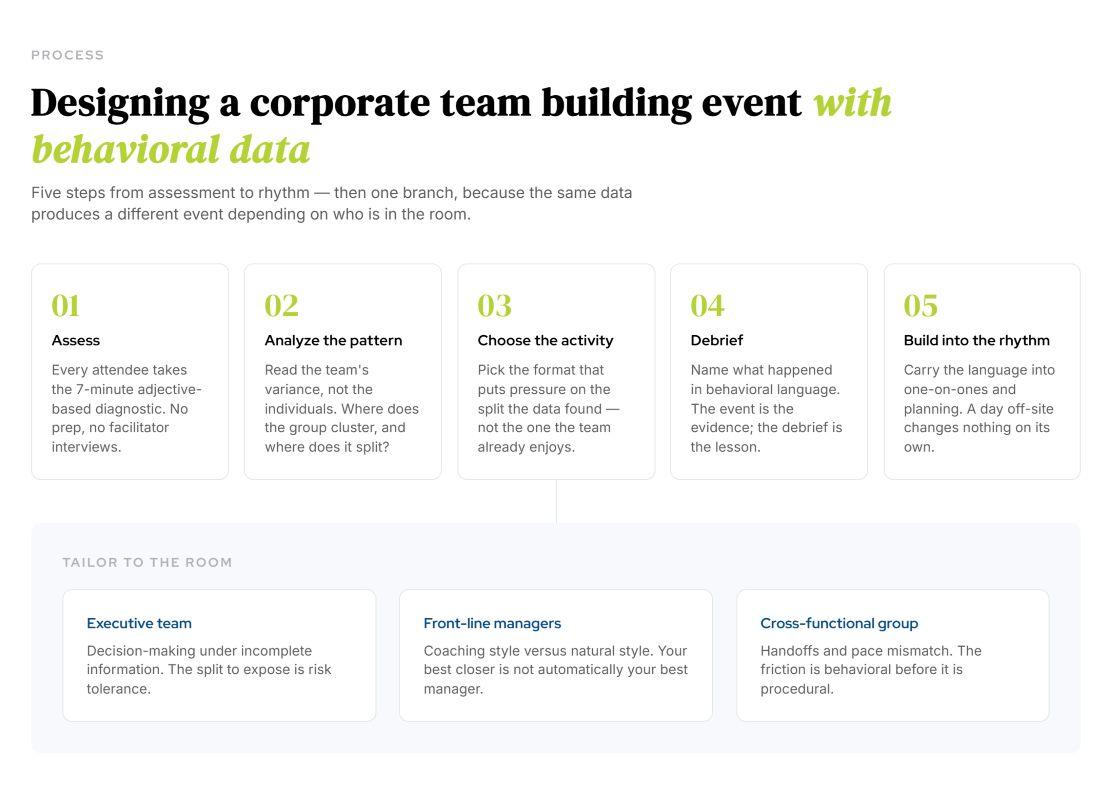
Here’s the process:
- Run a behavioral assessment before the event. OAD’s Top Performer Profile takes seven minutes and returns results in 24 hours, drawing on a benchmark built from over 10 million assessments and 38 years of continuous validation.
- Analyze the team-level pattern. Look for a communication gap (many low-Influence profiles clustered together), conflict risk (mismatched stress-response profiles), a leadership gap (few high-Leadership scores on the team), or burnout risk (high Drive paired with low Resilience).
- Choose the activity that targets the actual pattern. Low communication clarity points toward a problem solving challenge. Weak trust points toward a kindness workshop or an empathy exercise. Leadership ambiguity points toward a workshop that clarifies decision rights directly.
- Run a facilitated debrief that surfaces the pattern out loud. Show the team’s aggregate behavioral profile, ask which behaviors helped or hurt during the activity, and agree on shared norms coming out of it.
- Build the practice into the team’s ongoing rhythm. Rotating meeting facilitators, for instance, promotes inclusive participation and shared leadership well past the event itself.
Tailor the design by audience:
- Executive teams: focus on the leadership dimension, high-stakes problem solving, and decision-making norms.
- Front-line managers: prioritize conflict resolution, communication style, and delegation practice.
- Cross-functional project teams: emphasize role clarity, dependency mapping, and aligning goals across silos.
Team building activities improve communication and collaboration skills most reliably when the activity is selected based on actual behavioral data, not a guess about what the team probably needs.
How to Choose the Right Team Builder for Your Team
Not every activity suits every team, culture, or growth phase. A scavenger hunt that energizes a 12-person sales team may fall flat with a 40-person engineering org in the middle of a product launch. Fit is what determines whether the event works.
- Team size and composition. A team of five needs a different activity than a group of fifty. Factor in the mix of new hires versus long-tenured employees, and whether people are remote or in-office.
- Goal. Onboarding needs a different activity than conflict repair. Innovation sprints need something different than leadership development or burnout relief. Match the activity to the actual goal, not the calendar slot.
- Time and budget. A 15-minute icebreaker costs nothing. A full-day offsite with facilitation, travel, and materials needs planning and approval. Know the real constraint before you design around it.
- Location and format. Virtual, hybrid, on-site, or off-site, and for remote teams, account for time zones and travel time in the plan itself.
- Data inputs. Engagement survey results, exit interviews, and a behavioral assessment reveal where the real gaps and risks sit, rather than where you assume they sit. If your data shows low psychological safety, prioritize a trust-building format over a generic energy-booster.
- A standing menu. Build a set of team builders categorized by goal (trust restoration, leadership clarity, energy boost) and effort level (low, medium, high), so managers can self-serve an option instead of starting from a blank page every time.
Making Team Building Inclusive, Safe, and Psychologically Smart
Modern teams include neurodiverse individuals, multicultural members, introverts and extroverts, and people with varying physical abilities. A poorly designed activity risks alienating some of them. A well-designed one strengthens the whole team instead.
- Avoid heavily physical or sensory-intensive activities unless they’re clearly optional, with a parallel alternative offered up front.
- Offer alternatives to spotlighted participation: smaller groups, pair reflections, or written input for people who communicate better in those formats.
- Respect cultural and generational differences. No forced oversharing, and no alcohol-centric event as the only option.
- Set a clear consent norm: participants can opt out of a specific task without judgment or explanation.
- Design for hybrid accessibility. Remote participants need a parallel experience, not a passive view of a camera pointed at the room.
- Use behavioral data on communication and stress-response style to structure mixed groups that feel balanced, so no single style dominates the room.
- Make sure facilitation always includes a debrief, that communication norms are set in advance, and that no one feels pressured to share private information.
A quick pre-approval check before any activity ships: every task is optional, remote access is equal, roles allow for varied participation, cultural differences are respected, facilitation includes a debrief, and behavior norms are set in advance.
Measuring the Impact of Team Builders on Performance and Retention
Photos from the event are not a metric. Showing real ROI on a team building program requires measurement tied to a business outcome over 3, 6, and 12 months, the same discipline you’d apply to any other spend.
- Pre- and post-event pulse surveys. Measure trust, communication clarity, and psychological safety before and after the event, and track the change again at 30, 90, and 180 days.
- Engagement scores and eNPS. Watch belonging, manager behavior, and recognition scores over the following three to six months, not just the week after the event.
- Turnover and flight-risk signals. Track whether targeted team building actually reduces attrition among people already flagged as disengaged or mismatched.
- Operational metrics. Cross-functional project cycle time, error rate, and customer satisfaction scores, wherever teamwork is the input that actually moves the number.
A widely cited meta-analysis published in Small Group Research (Klein, DiazGranados, Salas, et al., 2009) found that team building has a positive, moderate effect across team outcomes overall, and that it’s most strongly related to affective outcomes like trust and process outcomes like communication, ahead of hard performance metrics. That distinction matters for how you set expectations: team building moves how people work together first, and performance numbers follow from that, not the other way around.
Platforms that track behavioral data can surface early warning signs, burnout risk, role misfit, communication clashes, before they show up in a resignation letter. When a team builder targets one of those specific patterns, you can track whether the underlying data actually shifts across a later assessment cycle, not just whether the survey scores went up for a month.
Team building isn’t a once-a-year calendar item. It’s a rhythm: short icebreakers woven into regular meetings, periodic coaching, quarterly events, and an annual offsite that actually builds on what came before it. Organizations that commit to that cadence build stronger working relationships and keep the people who make the team worth building in the first place.
Team Builders: FAQ
What’s the actual difference between an icebreaker and a team builder? An icebreaker is a short, low-stakes activity, usually five to fifteen minutes, meant to warm up a meeting or a new group before real work starts. A team builder is a more deliberate intervention, sized from thirty minutes to a full day, designed around a specific objective like conflict resolution, trust repair, or leadership clarity, with a debrief built in. An icebreaker opens a room. A team builder is meant to change something about how the team operates afterward.
How long should a team building activity actually run? It depends entirely on the goal, not a rule of thumb. A quick icebreaker needs five to fifteen minutes. A problem solving challenge that mirrors a real work scenario typically needs thirty to ninety minutes to land. A full offsite built around several activities and a real debrief usually needs a half day to a full day. Running an activity longer than its goal requires doesn’t make it more effective, it just uses more of the day’s budget.
Do virtual team building activities work as well as in-person ones? They can, but they need deliberate design, not a video-call version of an in-person format. Match activities across time zones, keep sessions shorter than their in-person equivalent, make accessibility explicit (captions, no sensory overload), and be clear about whether participation is opt-in or expected. Remote teams lose the informal hallway moments that build norms passively, so virtual team builders need to do more of that work on purpose.
How much should a company budget for team building? There’s no fixed number, because a five-minute icebreaker costs nothing and a full-day offsite with facilitation, travel, and materials can run into real budget approval. The better question is whether the spend maps to an actual goal: a low-cost, frequent cadence of icebreakers and short problem solving challenges often does more for day-to-day collaboration than one expensive annual offsite with no follow-up.
How do you know if a team building program is actually working? Track it the way you’d track any other investment. Run pre- and post-event pulse surveys on trust, communication, and psychological safety, then check them again at 30, 90, and 180 days. Watch engagement scores and turnover among people already flagged as at-risk. Where teamwork is the direct input, watch operational numbers like cycle time and error rate. If none of those move over two or three cycles, the activity, not the team, is the thing that needs to change.
Start With the Data, Then Pick the Activity
You don’t need a bigger team building budget. You need to know what your team’s actual gap is before you spend the budget you already have. See how OAD builds that signal, or how it applies specifically for HR and people leaders.
Get your free Top Performer Profile: seven minutes, results in 24 hours, no credit card.