Most executive directors learn the job by accident. They were promoted from a program role because they knew the mission, not because anyone taught them how to read a board dynamic, design a team, or catch a flight risk before the resignation letter. Then they inherit fundraising targets, staffing decisions, compliance, and a board with its own competing priorities, usually with no dedicated HR function to lean on.
Executive director training that actually works isn’t a generic leadership seminar with a nonprofit label stuck on it. It’s built around what the job specifically demands: strategic leadership, people analytics, culture, fundraising, and governance, taught in a way a leader can use the same week they learn it, on a budget that assumes a lean team, not a corporate L&D department.
Key takeaways
- Executive director training only works when it’s built around the specific pressures of the role, governing boards, shifting fundraising targets, thin staffing, and dual accountability to mission and finances, not generic management theory borrowed from the corporate world.
- In a 50 to 250 employee nonprofit, those HR functions usually don’t exist as a separate team. They land on the executive director’s desk, which is exactly why the training has to be practical enough to use without an HR department behind it.
- A five-stage framework, baseline assessment, governance training, people and culture, fundraising and external leadership, then implementation and coaching, gives a development program structure without turning it into an abstract course.
- Validated behavioral data, not personality labels, helps executive directors make sharper hiring, promotion, and team-design decisions, and it works alongside skills and experience rather than replacing them.
- Nonprofit executive director turnover is a real, documented problem: average ED tenure runs 5 to 7 years sector-wide, and roughly a third of nonprofit chief executives report they intend to leave their role within two years. Training that surfaces risk early is one of the few levers that actually addresses the cause, not just the symptom.
Why Generic Leadership Training Fails Nonprofit Executive Directors
Most leadership courses teach the same generic material: strategic planning frameworks, communication theory, financial management basics. They rarely address what an executive director actually deals with day to day: a governing board with its own competing priorities, fundraising targets that move with the economy, staff stretched across multiple roles, and the constant pressure to do more with less.
Executive directors carry outsized responsibility across mission delivery, staffing, donor relationships, and compliance, on top of fundraising and financial management. In an organization with 50 to 250 employees, there is often no dedicated HR team. Those functions get split across finance and operations, or land squarely on the ED’s own desk. The predictable result is reactive hiring, reactive turnover management, a misaligned board, and a leader who burns out before they’ve had time to build the systems that would have prevented it.
Training built around those realities looks different from a generic leadership course. It covers strategic leadership, people analytics, culture, fundraising, and governance, and it gives a nonprofit leader tools usable the same week, with a limited budget and a lean team in mind.
What Effective Executive Director Development Actually Delivers
Development built around the realities above, not abstract theory, tends to produce a specific set of outcomes:
- Stronger hiring and promotion decisions. A short, validated behavioral assessment helps an ED match applicants and current staff to roles based on evidence rather than gut instinct. OAD’s Top Performer Profile, for example, takes seven minutes and returns results in 24 hours, surfacing communication style, motivators, and behavioral risk signals that a resume alone won’t show.
- Sharper board and leadership alignment. Governance training that covers how to build a real partnership with the board, not just how to survive board meetings, gives directors and board members a shared language around motivators, communication preferences, and risk tolerance. That shared language reduces conflict and speeds up strategic decisions that would otherwise stall in disagreement.
- Reduced burnout and turnover. Roughly a third of nonprofit chief executives say they intend to leave their role within two years, and average ED tenure runs 5 to 7 years sector-wide. Training that surfaces behavioral risk signals early, so a leader can adjust a workload or a role before someone burns out, addresses the pattern instead of just documenting it after the fact.
- More predictable fundraising and program delivery. Mapping donor-portfolio ownership to actual behavioral strengths, storytelling and relationship tasks to influence-oriented team members, detail-heavy grant work to analytical profiles, tends to produce steadier fundraising performance than assigning work by whoever happens to be available.
- Faster ramp-up for new executive directors. Repeatable templates and a simple people-analytics routine let a new ED assess an organization’s people health and set immediate priorities within weeks rather than months of guessing.
Design teams with data, not gut feel.
Most org-design decisions come down to role fit, leadership style, and team dynamics. OAD reads those signals from a 7-minute behavioral survey, so you can reconfigure roles and teams with evidence instead of guesswork.
The common thread is evidence over instinct at every stage, not instinct replaced by a black box.
A Five-Stage Framework for Executive Director Development
A structured development track doesn’t need to be complicated to be effective. Five stages cover the ground that matters, whether it’s run as an 8 to 12 week cohort or an ongoing development track.
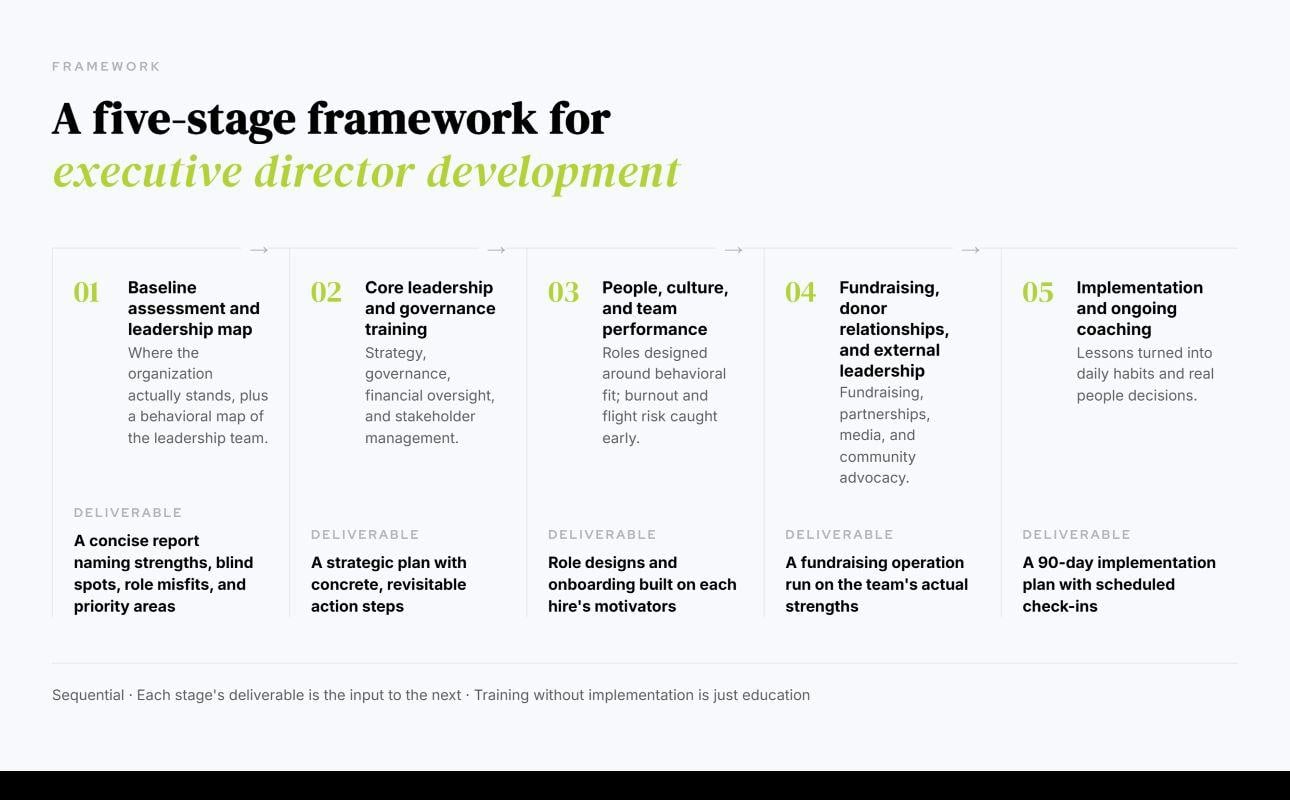
Stage 1: Baseline assessment and leadership map. Start with a clear picture of where the organization actually stands: turnover rates, fundraising stability, staff engagement indicators, and board satisfaction. Having the ED and their leadership team complete a short behavioral assessment at this stage builds a behavioral map of the organization, who thrives in which role, where communication styles clash, and where the real risk sits, before a single training module begins. The deliverable should be a concise report naming leadership strengths, blind spots, role misfits, and priority areas, read with the same rigor a leader already applies to a financial statement.
Stage 2: Core leadership and governance training. This stage covers the ED’s core responsibilities: strategy, governance, financial oversight, and stakeholder management. Participants should come out able to clarify the division of responsibility between the ED and the board, work effectively with a board chair to set strategic KPIs, read financial statements and manage a budget with real confidence, and maintain compliance with regulatory and funder requirements. Strategic planning that produces concrete, revisitable action steps, not a static document filed away after the retreat, is the actual goal here.
Stage 3: People, culture, and team performance. Most executive directors were promoted from program roles. They know the mission deeply and often lack structured practice in building and managing a high-performing team. This stage covers designing roles around behavioral fit, hiring for culture add rather than culture fit, and building onboarding around each new hire’s actual motivators and communication style. It should also cover the early identification of burnout, conflict patterns, and flight risk using behavioral signals, so a leader adjusts a workload or a role proactively instead of reacting to a resignation letter.
Stage 4: Fundraising, donor relationships, and external leadership. This stage covers the outward-facing responsibilities: fundraising, partnerships, media presence, and community advocacy, including the storytelling and advocacy skills an ED needs to represent the mission credibly to donors, volunteers, and the public. Behavioral insight helps determine who should lead major gift conversations, who manages grant details, and who owns the storytelling, so a fundraising operation runs on the team’s actual strengths instead of falling entirely on the ED’s own shoulders.
Stage 5: Implementation and ongoing coaching. Training without implementation is just education. This stage turns lessons into daily habits: a 90-day implementation plan tied to specific people decisions (hires, promotions, role changes, board committee assignments), scheduled check-ins that refine the plan against real outcomes, and behavioral data used routinely in weekly meetings and board reports rather than pulled out once and filed away.
What Separates Effective Executive Director Development From a Generic Course
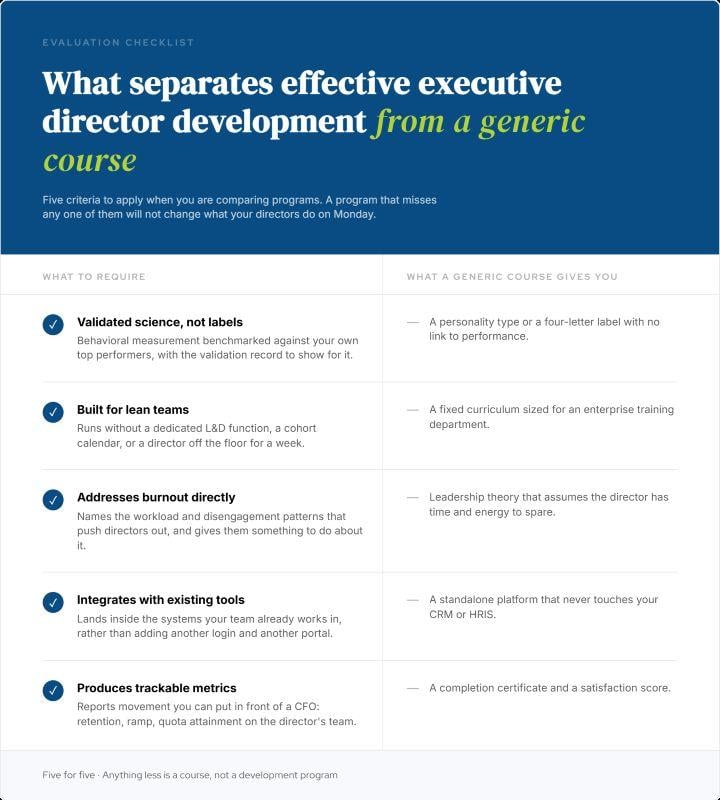
A handful of things distinguish development that actually changes how a leader operates from a course that produces a certificate and not much else:
- Validated behavioral science, not personality labels. The difference between a generic “soft skills” workshop and something that actually informs staffing, promotion, and succession decisions is validation. A tool used this way should be EEOC compliant, show no adverse impact on any protected class, and be independently validated on a real schedule, not just branded with a typology.
- Built for lean organizations. The curriculum has to assume thin margins and a small or nonexistent HR team, not a full technology overhaul. If a tool or process needs a dedicated administrator to run it, it’s the wrong tool for a 50 to 250 employee nonprofit.
- Addresses burnout and isolation directly, not just performance. Systematizing decision-making and building a data-backed support structure reduces the cognitive load that drives ED burnout. The goal is sharing the weight of the job, not just teaching a leader to carry the same weight differently.
- Integrates with what already exists. Whether the organization runs on an HRIS, an ATS, or a set of spreadsheets, any behavioral tool or dashboard should plug into that, not require replacing it.
- Produces metrics you can actually track. Turnover rate, time-to-fill, fundraising renewal rate, staff engagement score. If a program can’t point to what moves after it, it’s a seminar, not development.
Behavioral data belongs in this picture as one structured input among several, alongside skills, experience, and judgment, never as the sole basis for a staffing or promotion decision.
Who Should Pursue Executive Director Training
This kind of development tends to matter most at a handful of specific inflection points:
- New executive directors in their first one to three years, who need a clear roadmap, a shared language with their board, and confidence making early staffing calls. An intensive, boot-camp-style track can compress this learning curve for leaders with under three years in the seat.
- Seasoned EDs leading a growing organization, moving from 20 to 100-plus employees, who are finding that the people systems that worked at a smaller size no longer scale.
- Aspiring executive directors, deputy directors, COOs, and program directors preparing to step into the top role within 12 to 24 months, who want the expertise in place before the pressure hits, not after.
- HR or people-focused staff supporting the ED, who want a shared behavioral framework for hiring, development, and identifying high-potential talent across the organization.
An organization that sends its full leadership team through the same development approach gets a compounding benefit: a shared vocabulary for talking about people decisions that survives past any one training session.
Choosing a Format: Cohort, In-House, or Self-Paced
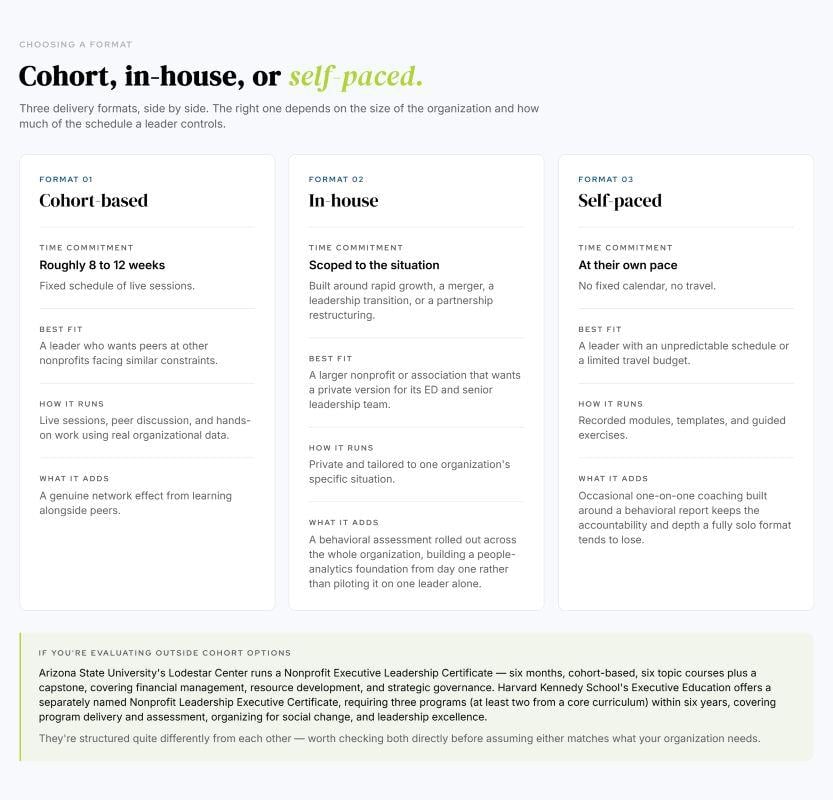
There’s no single right delivery format; the right one depends on schedule, budget, and how many leaders need to go through it at once.
Cohort-based programs run over roughly 8 to 12 weeks with live sessions, peer discussion, and hands-on work using real organizational data. Participants get a genuine network effect from learning alongside peers at other nonprofits facing similar constraints. Two established examples worth knowing about if you’re evaluating outside options: Arizona State University’s Lodestar Center runs a Nonprofit Executive Leadership Certificate, a six-month, cohort-based program built around six topic courses plus a capstone project, covering financial management, resource development, and strategic governance. Harvard Kennedy School’s Executive Education offers a separately named Nonprofit Leadership Executive Certificate, which requires completing three programs (at least two from a core curriculum) within six years, covering program delivery and assessment, organizing for social change, and leadership excellence. They’re structured quite differently from each other, worth checking both directly before assuming either matches what your organization needs.
In-house development works better for a larger nonprofit or association that wants a private version for its ED and senior leadership team, tailored to a specific situation: rapid growth, a merger, a leadership transition, a partnership restructuring. A behavioral assessment can be rolled out across the whole organization as part of this format, building a people-analytics foundation from day one rather than piloting it on one leader alone.
Self-paced tracks suit a leader with an unpredictable schedule or a limited travel budget: recorded modules, templates, and guided exercises completed at their own pace. Pairing self-paced content with occasional one-on-one coaching sessions built around a behavioral report keeps the accountability and depth that a fully solo format tends to lose.
What Determines the Real Cost of Executive Director Development
Exact cost varies widely by format, provider, and organization size, so treat any single number you see quoted with some skepticism. A few factors consistently drive the real cost:
- Format. Self-paced content is generally the least expensive; an in-house program tailored to one organization’s specific situation tends to run highest, since it’s built rather than bought off a shelf.
- Scale. Training one ED costs less than sponsoring an entire leadership team through the same curriculum, but the per-person value usually goes up when a whole team shares the same vocabulary and tools.
- What’s included. A program limited to live sessions costs less than one that bundles ongoing coaching, dashboards, and ongoing behavioral-data access; decide which of those your organization will actually use before paying for all of them.
- Existing infrastructure. An organization with no HRIS or ATS may need a simpler starting point than one that already has systems a new tool needs to integrate with.
The honest starting point for a budget-constrained organization is usually the least expensive layer that still produces a real behavioral baseline, a validated assessment across the leadership team, paired with the governance and people-management training a lean team can act on immediately, rather than a large bundled program that assumes staff and budget most 50 to 250 employee nonprofits don’t have.
Executive Director Training: FAQ
How long does executive director training typically take? A cohort program typically runs 8 to 12 weeks with a few hours of weekly commitment. Full adoption of new behavioral tools and practices usually takes 3 to 6 months to become routine. A deeper cultural shift, where the whole organization operates from a shared behavioral language, more often takes 12 to 18 months. Treat any faster timeline with skepticism; real behavior change in an organization doesn’t happen on a training schedule alone.
Can a seasoned executive director still benefit from this kind of training? Yes, and often more than a first-time ED expects going in. Experienced leaders use structured development to modernize their people practices, introduce behavioral analytics they never had access to earlier in their career, and prepare for succession. A leader with years of experience can still carry blind spots that experience alone never surfaced.
Do we need an HR department to benefit from a program like this? No, and that’s the point. The most useful version of this kind of development is built for organizations with lean or nonexistent HR functions: plug-and-play hiring scorecards, role-fit benchmarks, and behavioral dashboards that don’t require HR expertise to use well.
How does a behavioral assessment actually fit into the training? It shows up at multiple points rather than as a one-time event: leadership mapping during the baseline stage, hiring scorecards when a role opens, team-composition analysis during the people and culture stage, and ongoing risk monitoring during implementation. OAD’s Top Performer Profile is built for exactly this kind of repeated use: seven minutes to complete, results in 24 hours, and never the sole input in a staffing decision.
Is this kind of training only useful for nonprofit organizations? The curriculum described here is built around nonprofit-specific realities, board governance, fundraising, thin HR support, but the underlying principle, using validated behavioral data to make better people decisions instead of relying on instinct alone, applies to any mission-driven organization serving multiple stakeholders with limited resources.
What results should a nonprofit realistically expect? Noticeable improvement in hiring decisions and team alignment typically shows up within 3 to 6 months. Measurable outcomes like reduced turnover, faster time-to-fill, and steadier fundraising metrics tend to develop over 6 to 12 months, not immediately after the first training session.
Start With a Real Read on Your Leadership Team
You don’t need a full training overhaul to start making better people decisions this quarter. You need an honest baseline for your leadership team, then a plan built around what it actually shows. See how OAD builds that baseline, or how it applies specifically for HR and people leaders.
Get your free Top Performer Profile: seven minutes, results in 24 hours, no credit card required.