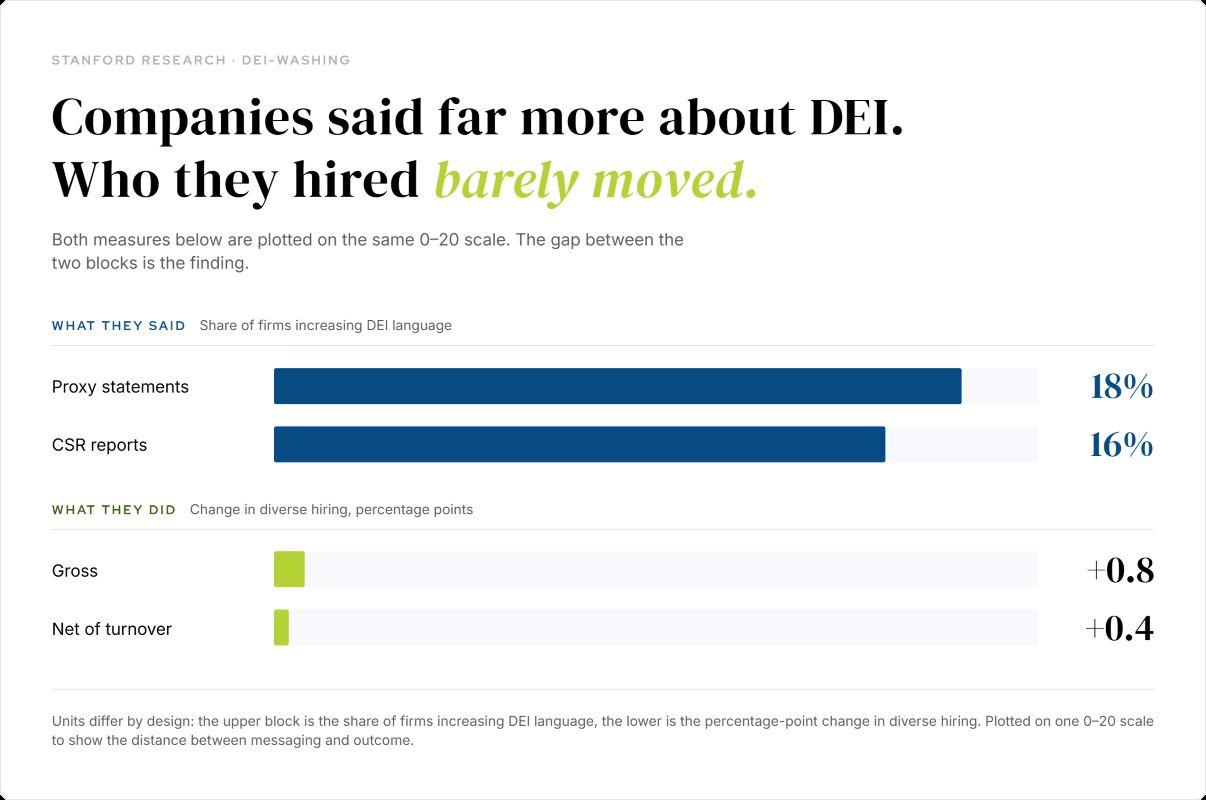
Companies increased DEI language in their proxy statements by 18% after a public DEI controversy.Their actual hiring of women and people of color moved by 0.8 percentage points, mostly in junior and back-office roles, while turnover among the same groups increased. Talk is cheap. Fairness in hiring doesn’t happen by accident, and it doesn’t happen by press release either. It’s built through deliberate systems, validated tools, and a commitment to evaluating every candidate on what actually predicts success in the role.
In 2026, DEI hiring has moved past slogans and into the domain of evidence, structure, and accountability, or it hasn’t moved at all. This guide walks through what it actually takes to embed diversity, equity, and inclusion into every stage of the hiring process, with practical steps sized for mid-sized companies that want the substance, not the disclosure.
Key takeaways
- DEI hiring means embedding diversity, equity, and inclusion into every step of the process, sourcing, screening, interviewing, selection, and onboarding, not setting a headcount target and calling it done.
- Structured hiring practices, inclusive job descriptions, and validated behavioral data reduce bias without lowering the bar; the evidence shows they raise the quality of the pool you’re actually evaluating.
- DEI efforts have to tie to measurable outcomes, representation by level, pass-through rates, quality of hire, retention, or they’re indistinguishable from the “DEI washing” the data shows investors and employees are catching onto.
- Systemic interventions, structured interviews, rubric-based scoring, standardized criteria, consistently outperform individual-level bias training alone, by a wide and now well-documented margin.
- Legal scrutiny of DEI programs increased sharply after 2023. The safest and most effective path is the same one: broaden who you reach, standardize how you evaluate everyone, and never make a decision based on a protected characteristic.
What Is DEI Hiring in 2026?
DEI hiring is the practice of embedding diversity, equity, and inclusion into sourcing, screening, interviewing, selection, and onboarding, not a single initiative bolted onto an existing process. It’s the operating system underneath every talent decision an organization makes, not a checkbox next to it.
It is not quotas, and it is not lowering the bar. It’s widening equal access and applying the same evaluation criteria to everyone, so the candidate who’s actually best for the role is the one who gets it. Diversity means candidates with varied characteristics and experience across race, gender, national origin, disability, age, and other dimensions of identity. Equity means fairness in process and access to opportunity for every qualified candidate. Inclusion means a workplace where people feel valued and respected once they’re in the door, not just recruited into it.
The landscape shifted hard between 2020 and 2026. The post-2020 surge in corporate DEI investment collided with legal challenges, most notably the Supreme Court’s 2023 ruling in Students for Fair Admissions v. Harvard, which struck down race-conscious college admissions and prompted law firms across the country to warn corporate clients about a new era of scrutiny on their own DEI programs, even though the ruling itself addressed higher education admissions under Title VI, not employment under Title VII. Political scrutiny from the federal government intensified alongside it.
Against that backdrop, a Stanford Graduate School of Business study examined nearly 1,300 diversity-related controversies at 315 U.S. public companies from 2008 to 2022 and found what researchers termed “diversity washing”: DEI messaging in proxy statements and CSR reports rose sharply after a controversy, but hiring of women and people of color moved just 0.8 percentage points above baseline, concentrated in junior and non-core roles, while diversity in senior roles actually declined and turnover among women and people of color increased. Net workforce diversity, accounting for both hires and departures, rose only 0.4 points. For a company with 50 to 250 employees, this is exactly the size where culture either becomes genuinely inclusive or DEI stays surface-level messaging with nothing behind it. You don’t have the scale to hide the gap between what you say and what your funnel data actually shows.
DEI vs. “DEI Hire”: Clearing Up a Costly Misconception
The phrase “DEI hire” gets used as a weapon against employees and against inclusive hiring itself. When someone is labeled that way, their actual qualifications get erased and a false premise gets reinforced: that diversity and merit are somehow in conflict.
They aren’t, structurally. DEI initiatives target systemic issues in the hiring process itself, who gets sourced, how resumes get screened, how interviews get run. They don’t and shouldn’t evaluate whether one specific person “deserved” their role after the fact. Effective DEI hiring practices support merit-based evaluation by standardizing how every candidate is assessed, not by selecting a less qualified applicant over a more qualified one.
The antidote to the label is transparent hiring criteria, clear role expectations, and evidence-based selection, documented well enough that any hire’s legitimacy is visible to the whole hiring team, not just asserted after someone raises a question.
Core Principles Behind Effective DEI Hiring Practices
Successful DEI hiring rests on a small number of non-negotiable principles. A written DEI hiring policy is the framework; these are what the strongest ones actually commit to.
- Fairness and consistency. Every candidate goes through the same structured steps, questions, and scoring. Diverse teams tend to outperform homogeneous ones on innovation and problem-solving, but only when the process that builds the team is itself fair. A biased process produces a biased team regardless of intent.
- Transparency. A hiring manager should be able to explain why a candidate advanced or was declined using documented criteria, not gut feel. A policy that lives in a drawer isn’t a policy; it has to be visible to the people running the process day to day.
- Accountability. Leaders and HR own representation and equity goals together, not just recruiters. Measurable goals for representation should tie into the same performance reviews and business planning as any other people metric, not sit in a separate DEI report nobody reads.
- Adaptability. Review the policy at least annually against updated legal guidance, talent-market shifts, and employee feedback. What worked in 2024 may not hold up under 2026 legal or market conditions, and treating the policy as finished is how it goes stale.
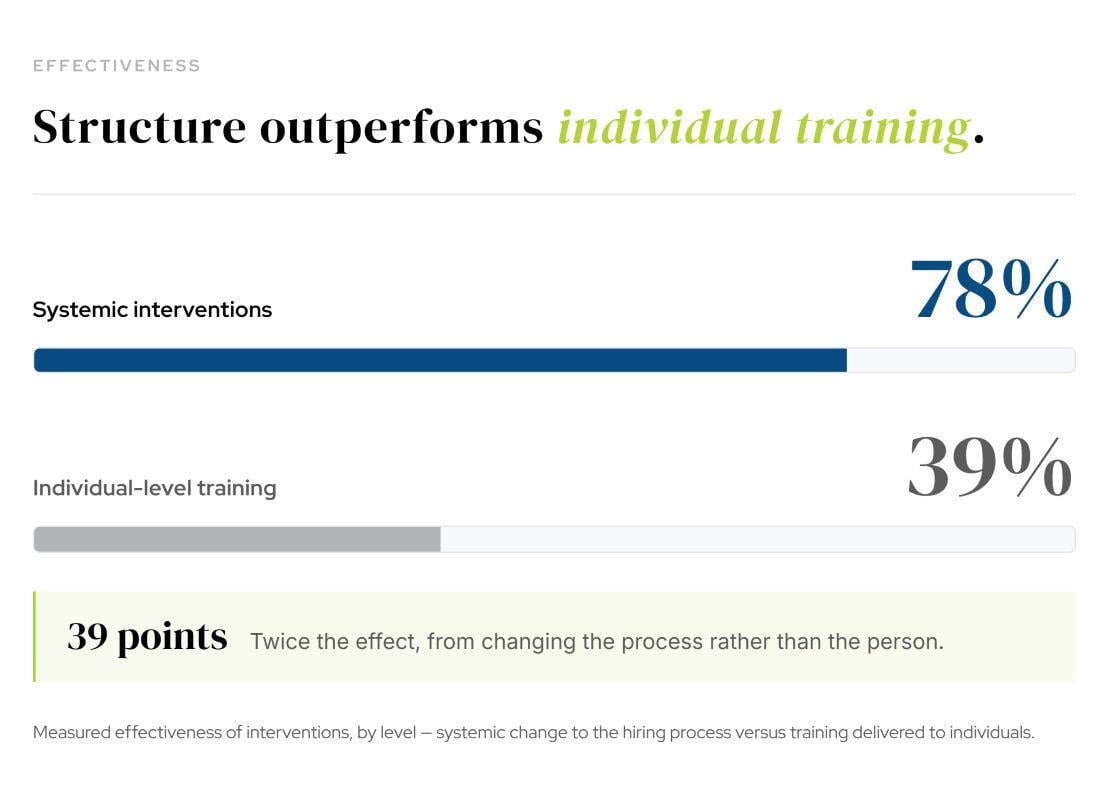
Bias-awareness training can help hiring managers recognize decision-making errors like confirmation bias and racial bias, and it’s worth running. But it isn’t sufficient on its own. A 2025 systematic review of interventions to reduce implicit bias in high-stakes professional judgment, covering hiring and selection decisions specifically among other domains, found that systemic strategies, structured interviews, rubric-based evaluation, changes to the decision environment itself, produced strong effects in roughly 78% of the studies reviewed, compared to about 39% for individual-level approaches like bias-awareness workshops alone. Changing the process outperforms changing the person almost two to one. Build the training, but build the structure first.
Designing Inclusive Job Descriptions and Role Requirements
Inclusive job descriptions are the easiest DEI win available, and they remain underused. Clear, consistent job descriptions attract a broader range of applicants; a poorly written one silently narrows the candidate pool before a single resume arrives.
Gender-coded or exclusionary language, “rockstar,” “aggressive,” “native English speaker,” deters qualified applicants who read it and self-select out. Run a practical audit against every open role:
- Cut unnecessary degree requirements. Focus the posting on demonstrated skills and qualifications, not pedigree that doesn’t actually predict performance.
- Separate must-haves from trainable nice-to-haves. A long laundry list of requirements discourages women and candidates from underrepresented groups disproportionately, research on job-posting language consistently shows this, even when they’d be strong hires.
- Replace vague “culture fit” language with specifics. Describe the actual work environment, team dynamics, and support systems instead of a phrase that too often just means “reminds me of myself.”
How you communicate DEI commitments in the posting itself shapes how candidates perceive you before the first interview. A concise, honest statement, support for employee resource groups, transparent pay bands, a real equitable-promotion process, helps candidates self-select into an environment where they believe they’ll actually be valued, not just recruited.
Review historic job descriptions against application and hiring data periodically to see which specific changes actually moved the diversity of who applied. That turns the job description from a static document into a tool you keep improving, not a template you wrote once in 2023.
Structuring the Hiring Process to Reduce Bias
Unstructured interviews and ad-hoc assessments are one of the largest sources of unconscious bias and inconsistent hiring decisions, and the evidence on this is now unusually strong.That same 2025 systematic review found structured interview protocols and rubric-based scoring among the most consistently effective systemic interventions in hiring contexts specifically.
Standardize the interview process with three concrete steps:
- Same core questions for every candidate. Use behavioral interview questions tied to role-relevant competencies, scored against a predefined rating scale, not improvised in the room.
- Pre-agreed weighting. Decide which competencies matter most before you meet a single candidate, not after you’ve already formed an impression of one.
- Job-relevant exercises. Standardize work samples, a sales role-play, a coding task reviewed anonymized, that assess actual skill instead of likeability or pedigree.
The strongest documented example of this working comes from Yale School of Medicine’s pediatric emergency medicine fellowship: standardized assessment scores showed a statistically significant racial disparity, while scores from a structured, behavior-based interview format did not, on the same applicant pool. Structure didn’t just reduce the gap. It removed it, in a setting where the unstructured format had one.
Reinforce this operationally: use scorecards inside your ATS, run debrief meetings around documented evidence, and rule out off-the-record “vibes only” feedback as a basis for a decision. Structured interviews also make hiring faster, because they cut the circular debate that happens when nobody wrote down why they liked a candidate.
Using Behavioral Data and People Analytics to Support DEI Hiring
Behavioral assessment and people analytics make DEI hiring more objective, more scalable, and more defensible when a decision gets questioned later. When a hiring decision rests on validated, job-related data instead of one manager’s gut, the whole process gains credibility, not just the outcome.
This is also where the line matters most. A validated behavioral diagnostic is not a resume-screening algorithm making an opaque call based on proxy features scraped off a CV. OAD’s Top Performer Profile, seven minutes to complete with results in 24 hours, measures behavioral drive against a specific role benchmark across five dimensions, Drive, Influence, Resilience, Structure, and Leadership, not “culture fit” measured as similarity to whoever’s already in the room. Behavioral data complements skills and experience; it never replaces them, and it is never the sole basis for a hiring decision. Any tool used this way has to be validated and job-related to hold up under federal discrimination law, and OAD’s diagnostic has been EEOC compliant since 2001 with no adverse impact demonstrated on any protected class, independently validated across three third-party cycles, most recently in 2023. That compliance record is the actual differentiator between a tool that reduces bias and one that just launders it behind a dashboard.
Design teams with data, not gut feel.
Most org-design decisions come down to role fit, leadership style, and team dynamics. OAD reads those signals from a 7-minute behavioral survey, so you can reconfigure roles and teams with evidence instead of guesswork.
Track a small set of people analytics metrics to know whether your process is actually working, not just running:
| Metric | What it reveals |
|---|---|
| Pass-through rates by demographic group | Where diverse candidates are dropping out of the funnel |
| Assessment score distributions | Whether scoring patterns differ meaningfully across groups |
| Time-to-offer | Whether some groups experience a slower process than others |
| 12-month retention by hire source | Quality of hire, and whether new hires actually stay |
| Candidate experience surveys | Perceived fairness and inclusion during the process itself |
Start small. Pilot a behavioral assessment in one department, watch what the fairness and performance data actually show, and expand from there rather than rolling out a company-wide mandate on day one.
Embedding DEI Initiatives Across the Hiring Funnel
A one-off training or a diversity statement on the careers page doesn’t move anything by itself. DEI has to be embedded at every stage of the funnel to produce a change that shows up in the numbers.
Sourcing. Diversify channels beyond referrals and the same two job boards. Partner with professional associations, community colleges, returnship programs, and agencies that serve underrepresented communities. This expands the pool and creates access to roles many qualified candidates simply never see under a referral-only pipeline.
Screening. Blind resume screening, hiding names, addresses, and schools during the initial pass where feasible, can reduce unconscious demographic bias before a human even forms an impression. Apply knock-out criteria that map directly to the job description, nothing more.
Interviewing. A diverse interview panel brings multiple perspectives to the room and signals an inclusive culture to the candidate sitting across from it. Include at least one trained, DEI-aware interviewer on every panel, someone positioned to catch a pattern the rest of the panel might miss.
Offer and onboarding. Publish transparent salary ranges consistent with equal-pay principles, and build in equitable negotiation guardrails so the outcome doesn’t depend on who negotiated harder. Connect new hires to employee resource groups early; this is where inclusion stops being a policy and starts being an actual experience. Belonging from day one predicts stronger retention and engagement across every demographic group, not just the ones DEI programs are usually built to serve.
The Role of Leaders, Hiring Managers, and Employee Resource Groups
Ownership of DEI hiring has to be shared across the organization. When only recruiters carry it, DEI turns into a bureaucratic add-on instead of something the culture actually runs on.
Leaders set the tone: clear DEI hiring goals, inclusive behavior modeled in their own hiring decisions, and progress tied to business strategy rather than a separate slide in the all-hands deck. That kind of visible commitment reads as genuine to both candidates and current employees, in a way a values statement alone doesn’t.
Hiring managers are the front line. They follow the structured process, attend regular (not one-time) bias-awareness training, and document the evidence behind every decision they make.
Employee resource groups can support hiring directly: participating in interview panels, advising on inclusive job description language, and helping assess whether a candidate would actually thrive in the existing culture. Give ERG involvement clear, time-bound scope, quarterly job-description review, occasional panel participation, periodic input on candidate-experience feedback, rather than an open-ended expectation that they solve DEI for the whole organization on top of their day jobs. Compensate or formally recognize that work; it’s real labor, not a volunteer extra.
Measuring DEI Hiring Outcomes and Avoiding “DEI Washing”
The Stanford research is the cautionary case study here: DEI messaging can rise sharply while actual hiring outcomes barely move, and turnover among the groups the messaging claims to support can get worse, not better. Avoiding that gap means tracking the outcomes that are hard to fake, not the ones that are easy to publish.
Track these, consistently, over time:
- Representation at every level: applicant, interviewer, new hire, leadership, and promotion.
- Pass-through rates by stage and by demographic group, so you can see exactly where the funnel narrows.
- Offer-acceptance rates across groups.
- Early tenure turnover, within the first 12 months of hire specifically.
- Candidate experience feedback on whether the process actually felt fair and transparent.
Demographic data tracked across hiring stages surfaces bottlenecks a single aggregate number hides, for example, underrepresented candidates consistently dropping out after the panel-interview stage specifically, which points to a fixable problem in that one stage rather than the process broadly. Ask candidates and new hires directly whether the process felt fair, rather than relying only on internal dashboards. Skip vanity metrics like counting DEI-related social posts, and report the real numbers to employees and leadership, and to your board where relevant, even when they’re not flattering yet.
Legal and Ethical Guardrails for DEI Hiring
The years since 2023 brought real legal scrutiny to DEI programs. It’s more complex to navigate than it was five years ago, but it’s entirely manageable when practices are grounded in the actual law rather than in slogans on either side of the debate.
Title VII of the Civil Rights Act prohibits employment decisions based on race, color, religion, sex, or national origin, and the Equal Employment Opportunity Commission enforces it alongside applicable state and local law. The distinction that matters in practice: it’s illegal to give preferential treatment based on a protected characteristic, and it’s lawful, and encouraged, to broaden recruiting, remove unnecessary barriers, and apply the same evaluation criteria to every candidate.
Run regular audits to identify disparities in hiring outcomes across demographic groups. Validate every assessment and selection tool for job-relatedness and predictive validity, document why each criterion was chosen, and monitor statistically for adverse impact on an ongoing basis, not as a one-time check when a tool is first adopted.
Ethical practice runs alongside the legal minimum. Respect candidate privacy, use any AI or assessment tool transparently, and give candidates a real explanation of how the process works, including a development-oriented note to candidates who weren’t selected where you can. Most employment discrimination claims trace back to an opaque process, not a fair one that happened to produce a result someone disagreed with. Transparency is a legal shield and an ethical commitment at the same time, and it’s the thing that actually separates a responsible employer from one running a performative version of the same program.
Putting It All Together: A Practical DEI Hiring Roadmap
A phased roadmap for a mid-sized company that wants real progress, not another proxy-statement paragraph, between now and the end of 2026.
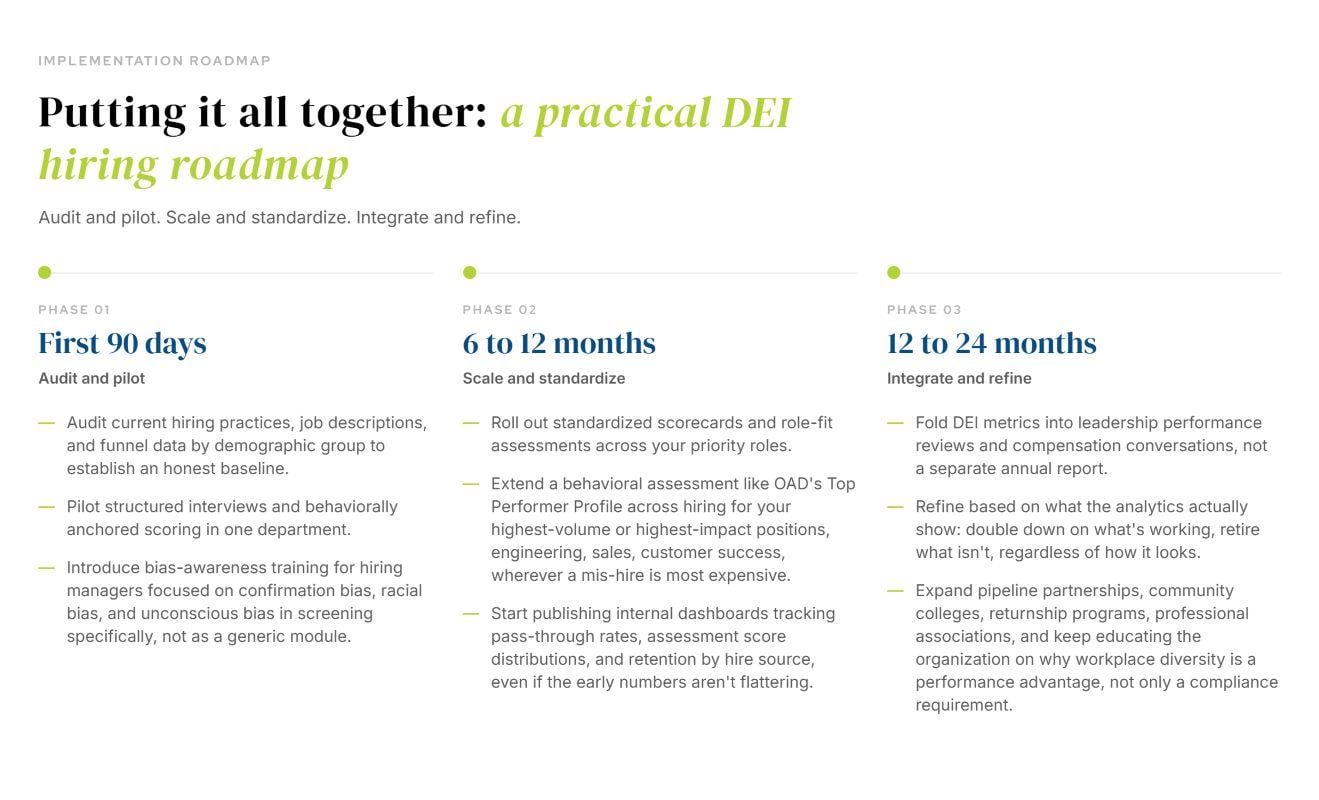
First 90 days: audit and pilot. Audit current hiring practices, job descriptions, and funnel data by demographic group to establish an honest baseline. Pilot structured interviews and behaviorally anchored scoring in one department. Introduce bias-awareness training for hiring managers focused on confirmation bias, racial bias, and unconscious bias in screening specifically, not as a generic module.
Next 6 to 12 months: scale and standardize. Roll out standardized scorecards and role-fit assessments across your priority roles. Extend a behavioral assessment like OAD’s Top Performer Profile across hiring for your highest-volume or highest-impact positions, engineering, sales, customer success, wherever a mis-hire is most expensive. Start publishing internal dashboards tracking pass-through rates, assessment score distributions, and retention by hire source, even if the early numbers aren’t flattering.
Design teams with data, not gut feel.
Most org-design decisions come down to role fit, leadership style, and team dynamics. OAD reads those signals from a 7-minute behavioral survey, so you can reconfigure roles and teams with evidence instead of guesswork.
12 to 24 months: integrate and refine. Fold DEI metrics into leadership performance reviews and compensation conversations, not a separate annual report. Refine based on what the analytics actually show: double down on what’s working, retire what isn’t, regardless of how it looks. Expand pipeline partnerships, community colleges, returnship programs, professional associations, and keep educating the organization on why workplace diversity is a performance advantage, not only a compliance requirement.
OAD supports each phase with fast, validated behavioral data and people analytics that are straightforward for a lean team to actually run. If you want a fairer, more measurable hiring process, start with OAD’s free Top Performer Profile: seven minutes, results in 24 hours, no credit card required.
DEI Hiring: FAQ
How do we improve DEI hiring without slowing down our process? Standardizing the process, templates, structured questions, reusable scorecards, tends to make hiring faster, not slower, because it cuts the circular debate that happens when nobody documented why they liked a candidate. Use a short, validated tool like OAD’s Top Performer Profile (seven minutes, results in 24 hours) alongside clear decision thresholds to speed up screening. Set a simple service-level agreement, feedback within 48 hours of each interview, so a structured process doesn’t quietly turn into more bureaucracy than the one it replaced.
Does DEI hiring mean we can’t prioritize the most qualified candidate? No, and this is the misconception worth killing directly. DEI hiring is about making sure every qualified candidate gets an equitable shot at being evaluated accurately, not about choosing someone less qualified. Clearly defined, job-related criteria and objective tools, behavioral assessment, work samples, structured interviews, make it easier to actually see who’s most qualified, not harder. Done correctly, it raises quality of hire by widening and more fairly comparing the pool, not by adding a constraint on top of it.
What’s a realistic first step for a 50 to 200 person company just starting? Start narrow. Rewrite two or three job descriptions for inclusive language and build structured interview guides for the next roles you open. Pilot a behavioral assessment like OAD’s on one critical role to get a fast, concrete read on fit and bias in that specific process. Pick one or two metrics to track from day one, pass-through rate by gender or race is a good starting point, rather than trying to stand up a full analytics program before you’ve run a single hire through the new process.
How do we involve employee resource groups without overburdening them? Give ERGs clear, bounded roles: quarterly job-description review, occasional interview-panel participation, periodic input on candidate-experience feedback. Compensate or formally recognize that work through performance reviews or a stipend, since it’s real labor on top of someone’s actual job. ERGs can help interpret candidate feedback and flag where the hiring experience doesn’t match your stated values, but they shouldn’t be the ones expected to solve DEI hiring for the whole organization.
Can AI and assessment tools used in hiring be compatible with DEI and legal compliance? Yes, when the tool is scientifically validated, job-related, and audited for bias on an ongoing basis, not a black box making decisions off proxy signals nobody can explain. Be transparent with candidates about what a tool like OAD’s diagnostic measures and how the results are used; involve legal counsel and industrial-organizational psychology expertise to confirm any tool meets regulatory expectations before it’s rolled out broadly. And never let any single assessment, OAD’s included, be the sole basis for a hiring decision. The right question for any tool is whether it measures what it claims to measure, and whether it does that fairly across every candidate group, not whether it produces a faster answer.
Start With a Process That Can Actually Show Its Work
You don’t need a bigger DEI statement. You need a hiring process that produces evidence you’d be comfortable defending, to a candidate, a board, or a regulator, without hedging. See how OAD builds that evidence, or how it applies specifically for HR and people leaders.
Get your free Top Performer Profile: seven minutes, results in 24 hours, no credit card required.