Most employee engagement strategies treat the survey score as the problem. It isn’t. By the time a pulse survey flags a disengaged team, the decision that created the disengagement already happened, usually in the interview room, months earlier, when you may have missed signs of cultural fit in the hiring process. Fix the role-fit decision and a lot of the “engagement problem” stops needing to exist.
Key takeaways
- Employee engagement is the emotional commitment employees bring to their work. It’s a different thing than job satisfaction or wellbeing, and it moves different numbers.
- Gallup’s meta-analysis of business units worldwide found that teams in the top quartile of engagement are 23% more profitable than teams in the bottom quartile.
- Managers account for at least 70% of the variance in team engagement scores, more than any perk, policy, or all-hands meeting.
- A credible engagement strategy pairs consistent listening (surveys, pulse checks) with visible manager action, not a single annual survey.
- Most engagement programs treat the symptom. Whether someone was ever right for the role they were hired into is the root cause survey scores rarely reach.
What Employee Engagement Actually Means
Employee engagement is the emotional commitment an employee has to their work and their organization’s goals. Not whether they like their benefits. Not whether they’re satisfied with their pay. Whether they bring energy, ownership, and discretionary effort to work most people would do the bare minimum on.
Job satisfaction and employee engagement get used interchangeably, and they shouldn’t be. A satisfied employee can enjoy their schedule, their coworkers, and their benefits without ever going out of their way. An engaged employee solves problems before they escalate, flags what’s broken, and covers for a struggling teammate without being asked. Employee wellbeing is a third, related idea: it measures stress and health, not commitment. All three can move independently of each other, and a strategy that only tracks one of them is flying with two instruments out.
The Business Case for Employee Engagement
Engagement isn’t a morale metric. It’s a performance metric with a dollar figure attached.
Gallup’s meta-analysis of more than 180,000 business units across dozens of countries found that teams in the top quartile of engagement post 23% higher profitability than teams in the bottom quartile. The same body of research is the source of the most-cited number in this space: managers account for at least 70% of the variance in team engagement scores. Not compensation. Not the mission statement on the wall. The manager.
U.S. engagement itself is not trending the right direction. Gallup’s most recent annual read put U.S. employee engagement at 31%, the lowest level in a decade. That’s the backdrop every engagement strategy is now built against: a workforce that is, on average, not bringing its full effort, and a shrinking margin for organizations that get it wrong.
The mechanism is straightforward. Engaged employees take initiative, catch problems early, and stay. Disengaged employees do the job description and nothing past it. At scale, that gap shows up in retention, in customer experience, and eventually on the P&L.
The Four Levels of Employee Engagement
Not every employee experiences engagement the same way, and lumping them into one “engaged / not engaged” bucket hides where the real risk sits.
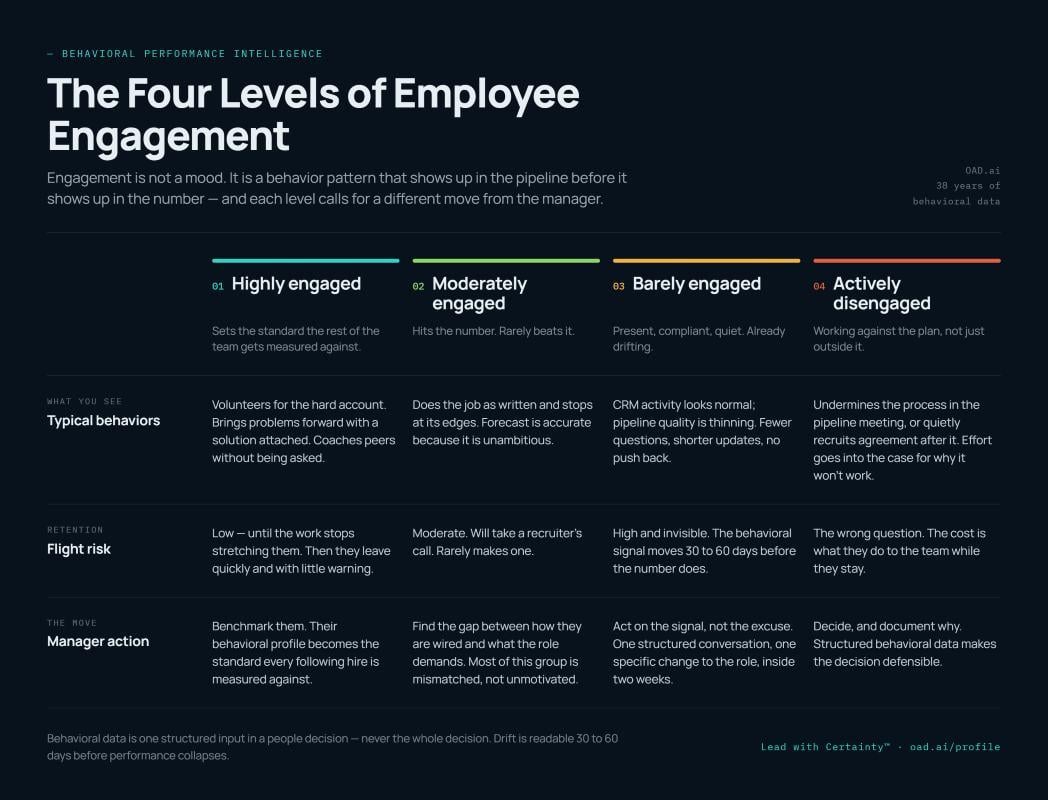
Highly engaged employees take on stretch work without being asked, propose fixes, and advocate for the company outside of it. They’re your lowest flight risk.
Moderately engaged employees meet expectations reliably and hold a positive attitude, but they rarely go past the job description. With the right recognition or growth path, they move up fast.
Barely engaged employees deliver the minimum. They’re reactive, risk-averse, and quietly checked out: the “quiet quitting” profile that survey data alone often misses because they still show up and hit their numbers.
Actively disengaged employees are vocal about their dissatisfaction and can pull a team down with them. They’re the smallest group and the most expensive one to leave unaddressed.
The hard part isn’t defining these levels. It’s telling them apart. A quiet employee can be deeply engaged and simply introverted, or quietly checked out and drifting, and a survey response can look identical either way. That’s a behavioral question, not a satisfaction question, and it’s exactly where survey data alone runs out of resolution.
The Drivers That Actually Move Engagement
A short list of drivers shows up across nearly every study on this topic, and all of them are measurable:
- Role clarity. Employees who know exactly what’s expected of them operate with more autonomy and less anxiety.
- Meaningful work. People need to see how their work connects to something real, not just to a mission statement.
- Growth and development. Visible paths and skill-building keep commitment alive past year one.
- Recognition. Specific, timely, two-way feedback, not generic praise.
- Psychological safety. The ability to raise a problem or ask a question without fear.
- Manager quality. The single biggest lever, by a wide margin. See the 70% variance stat above.
- Fairness. Transparent promotions and consistent standards. Perceived unfairness erodes trust fast and doesn’t rebuild at the same rate it was lost.
- Sustainable workload. Enough resource to meet the demand placed on someone. Without it, engagement burns down into burnout.
Manager quality carries more weight than the other seven combined, which is why engagement programs built around perks, all-hands meetings, or one annual survey are usually solving for the wrong 30%.
Employee Engagement vs. Employee Experience
Employee engagement measures how someone feels and behaves. Employee experience is the whole system that produces that feeling: recruiting, onboarding, day-to-day work, development, advancement, and exit. Every stage of that experience either builds engagement or erodes it, long before an employee fills out a survey.
Chaotic onboarding leaves new hires unclear on their role. Opaque promotions make tenured employees feel overlooked. A mis-hire, someone placed in a role that never fit how they’re wired to work, often starts with an interview process that never deeply assessed communication skills and behavioral signals, arrives disengaged before day one and tends to stay that way regardless of what the engagement program does afterward.
Building an Employee Engagement Strategy
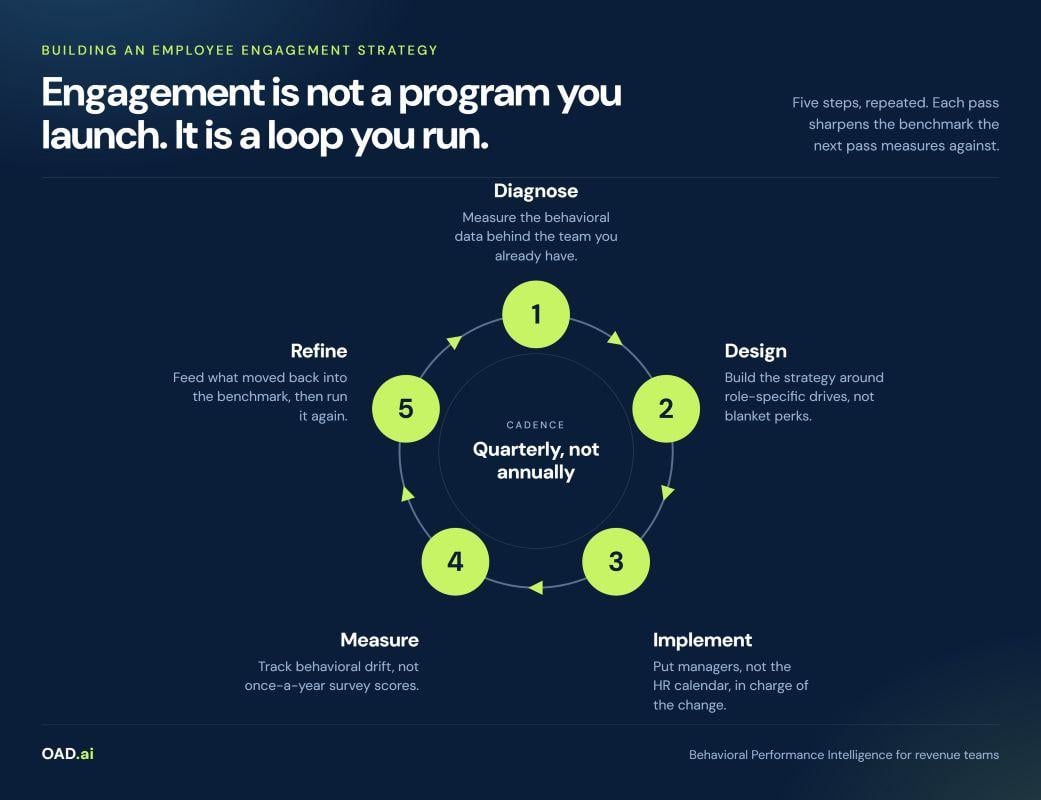
A real engagement strategy is an operating system, not a pizza party or an annual survey. It runs on a five-step loop:
- Diagnose. Establish a baseline with a real employee engagement survey, not a satisfaction poll. Gallup’s Q12 is the most widely used validated instrument for this; build your own core questions around the same drivers it measures: clarity, recognition, development, and trust.
- Design. Turn the data into two or three priorities tied to specific drivers, not a 40-index dashboard nobody will act on.
- Implement. Fold changes into meetings that already exist: one-on-ones, standups, performance reviews. A separate “engagement meeting” signals it isn’t real work.
- Measure. Track with pulse surveys two to four times a year, not just the annual instrument.
- Refine. Adjust as context shifts. An engagement strategy is never finished.
Keep the survey itself short: 15 to 20 items, a consistent rating scale so you can trend it over time, one or two open-text questions, and no double-barreled items asking about two things at once. “I know what is expected of me at work” is a good clarity question. “I am satisfied with my manager and my compensation” is two questions wearing one sentence.
Why Most Employee Engagement Efforts Fail
The same handful of mistakes show up almost everywhere:
- Treating engagement as an HR-only project, so no one with budget authority owns it.
- Running the annual survey and going silent afterward. Feedback with no visible follow-up trains people to stop giving it.
- Reporting a single favorability score with no segmentation, which hides pockets of disengagement under a flattering average.
- Leaving frontline managers without the time or training to act on results, even when the strategy above them is sound.
Every one of these traces back to the same root: engagement work that stays at the survey level and never reaches the decisions that created the disengagement in the first place.
Turning Engagement Data Into Daily Practice
Data without follow-through is worse than not asking. The loop that works: share results transparently, hold team-level conversations that are a dialogue rather than a readout, co-create one or two priorities per team so people actually own them, and track progress on a 90-day cycle.
Day to day, that shows up as weekly check-ins about workload and capacity, individual goals tied visibly to the organization’s goals, recognition that’s specific rather than generic, and quarterly growth conversations instead of once-a-year ones. None of it requires new software. It requires managers who have the bandwidth and the skill to run it, which loops back to the driver that mattered most: manager quality.
The Variable Most Engagement Strategies Skip
Here’s what most engagement strategies never touch: whether the person was right for the role to begin with.
Two people in the same job, with the same manager, can land at completely different engagement levels because their behavioral drive, how they’re wired to operate under pressure, doesn’t match the role the same way. Surveys measure how someone currently feels. They don’t measure whether the role was ever going to fit them.
This is where we at OAD sit. Our scalable OAD pricing plans make it straightforward to deploy the platform across teams as you grow. We built the Top Performer Profile to answer a question engagement surveys can’t: is this person’s behavioral drive aligned with what the role actually demands? It takes seven minutes, results come back in 24 hours, no credit card required, and it maps against the same five dimensions we use across the platform: Drive, Influence, Resilience, Structure, and Leadership. Clients using OAD’s diagnostic to hire and place people against a role benchmark see a 60% average reduction in mis-hires. In one client’s Q2 review, their People team documented $1.14M in avoided mis-hire cost, a single illustrative example, not a universal outcome.
None of that replaces a manager, a fair promotion process, or a good survey. It’s one structured input into decisions that used to run on gut feel alone, the same way your best hire already showed you what “good” looks like before anyone built a system to measure it. Used alongside honest survey data and manager coaching built specifically around the manager-variance finding above, role fit closes a gap that perks and pulse surveys can’t reach on their own.
FAQ
How often should we run an employee engagement survey?
Once a year or every 18 months for the full instrument, supplemented by pulse surveys two to four times a year on specific issues like hybrid work or manager effectiveness. The right cadence is the one your organization can actually act on. It’s better to survey less often and follow through visibly than to survey constantly and go silent every time.
What makes a good employee engagement survey question?
Short, specific, and about one thing at a time. “I know what is expected of me at work” and “I receive recognition when I do good work” both work because they map to a single driver. Avoid double-barreled questions, and include at least one open-text item to catch what a rating scale misses.
How do you re-engage an actively disengaged employee?
Start with an honest one-on-one to find the root cause: role misfit, a broken relationship with a manager, workload, or a fairness issue. Build a time-bound plan with clear support and, if the mismatch is structural, an honest conversation about whether the role is right at all. Catching this early, with behavioral data alongside the conversation, makes it far less common to reach this point in the first place.
What’s a realistic timeline for engagement improvements?
Local wins, clearer goals, more consistent recognition, are visible within 60 to 90 days when a manager acts on results. Organization-wide movement in engagement and retention typically takes 12 to 24 months, especially when it’s tied to real changes in how managers operate, not just a new perk.
Most of what erodes employee engagement was decided before the employee’s first day. See how your current team’s behavioral drive maps against your top performer with a free Top Performer Profile: 7 minutes, results in 24 hours, no credit card. Get Your Free Top Performer Profile → oad.ai/profile