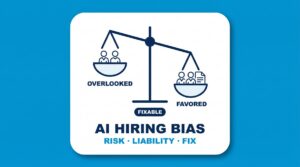
Your screening tool rejects candidates in milliseconds. It also discriminates in milliseconds. AI hiring bias does not announce itself in an interview room. It compounds silently across thousands of applications before anyone notices the pattern, and by then the exposure is already regulatory, reputational, and structural.
This guide is built for the people who now own that exposure: HR leaders, people analytics teams, and hiring managers deciding whether an AI hiring tool goes live, and how to defend it if it gets challenged. Structured, validated behavioral assessment, the category OAD operates in, is one of the few technical answers to a technical problem. The rest of this guide covers where bias comes from, what the law requires, and how to build a defensible process around it.
Key takeaways
- AI hiring bias is systematic distortion in a model’s outputs that disadvantages a legally protected group, and it scales faster than human bias ever could.
- Bias enters at multiple points across the funnel: training data, proxy variables, deployment, and feedback loops, not just the final scoring step.
- Federal law already applies to AI hiring tools, and a growing list of state and local laws add specific audit and disclosure requirements.
- Structured, skills-first assessment is the most defensible technical fix available, because it measures behavior against a validated benchmark instead of resume proxies.
- OAD is built as one structured input in the hiring decision: EEOC compliant since 2001, no adverse impact on any protected class, zero successful legal challenges in 38 years, and never the sole basis for a hire.
Why AI Hiring Bias Matters Now
A biased interviewer affects one candidate at a time. A biased algorithm affects every candidate who touches that stage of your pipeline, at the speed and volume of automated screening. That shift is already the default: industry surveys report that 93% of Fortune 500 CHROs now use AI somewhere in their hiring process. Hiring bias used to be a training problem. Now it is an infrastructure problem, and it moves at infrastructure speed.
The stakes compound in both directions. Get it wrong loudly and you carry litigation risk, regulatory exposure, and a public record every applicant can see before your next req even opens. Get it wrong quietly, with no one noticing, and you are also filtering out qualified candidates your people analytics function will spend the next two years explaining away in retention and performance data. Bias in sourcing shows up as attrition eighteen months later, filed under a different problem entirely.
What Is AI Hiring Bias?
AI hiring bias is a systematic pattern in a model’s selection outputs that disadvantages candidates based on a protected characteristic, produced by the data, design, or deployment of the system rather than any single decision.
Human hiring bias and algorithmic hiring bias share a source. Bias in the training data was human bias first. They do not share a scale. A biased recruiter is inconsistent, prone to confirmation bias or affinity bias, an unconscious preference for candidates who remind them of themselves. A biased model is consistent, at scale, and defensible-looking, because it produces a number instead of a gut feeling.
Algorithmic discrimination in hiring typically takes one of a few shapes:
- Proxy discrimination: a neutral-looking variable (zip code, college name, employment gap) stands in for a protected class.
- Historical bias replication: the model learns who a company already hired, not who performs.
- Feedback loop bias: biased outputs become the next round’s training data, and the pattern hardens.
- Measurement bias: the outcome being optimized (resume keyword match, interview score) was never actually a good predictor of performance.
Where AI Bias Enters Your Hiring Pipeline
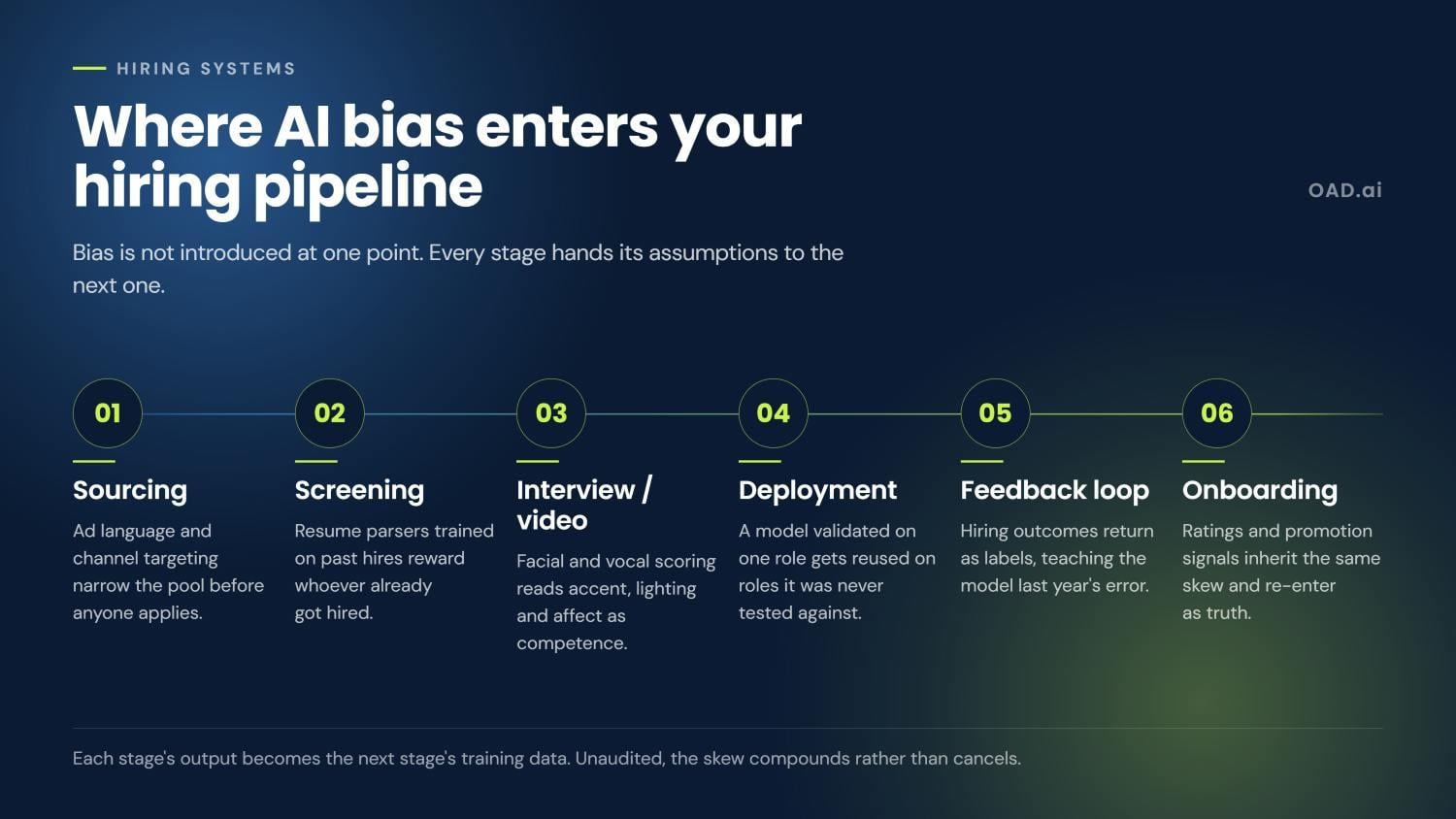
Bias does not wait for the final scoring model. It enters at sourcing, when job ad language or platform targeting skews the applicant pool before a single resume is reviewed. It enters at screening, when resume parsers weight proxy features like graduation year, employment gaps, or extracurricular language that correlates with race, gender, or age. It enters at interview scheduling and video assessment, when tone, accent, or facial expression become inputs a model was never designed to fairly judge, a risk that also disadvantages neurodivergent applicants and non-native English speakers whose communication patterns simply differ from whatever the model was calibrated on. It enters at deployment, every time a tool is used outside the population and role it was validated on. It enters at the feedback loop, when this year’s hiring outcomes silently become next year’s training data. And it can enter as late as onboarding, when predictive attrition-risk scoring flags certain new hires for extra scrutiny based on the same proxy patterns that biased the screen in the first place.
How AI Models Introduce Racial and Intersectional Bias
Most hiring AI in production today falls into three buckets: resume-parsing and ranking models, often built on natural language processing and, increasingly, large language models; video or audio interview scoring tools; and game-based or predictive assessments built on more traditional machine learning trained on past-hire outcome data. Each learns from historical hiring decisions, and historical hiring decisions carry the racial and gender composition of whoever was hired before the model existed. Train a model on twenty years of a homogenous workforce, and it will learn to reproduce that workforce, not to find the best candidate in it.
Intersectional bias compounds this. A model can show no measurable disparity against women overall and no measurable disparity against Black applicants overall, and still systematically disadvantage Black women specifically, because the intersection was never tested as its own subgroup. Bias audits that only check single-axis demographic categories miss it entirely.
The Real World Cost: Discrimination Risk and Team Performance
Adverse impact from a hiring algorithm shows up as a measurable pass-through gap between groups. One widely cited 2024 study found AI-driven hiring bias affected 26% of Black applicants, and estimated that removing the bias would let roughly 40,000 more Black and Asian applications advance per hiring cycle. Separate survey research suggests as many as 1 in 10 applicants are auto-rejected from four positions they apply to because of automated screening, never reaching a human reviewer at all. Some tested screening tools showed a consistent bias specifically against Black male candidates, distinct from the broader gender or race gaps measured in aggregate.
The exposure is not theoretical. A discriminatory algorithm may create liability exposure under Title VII and a growing set of state disclosure and audit laws, independent of whether the discrimination was intentional. Beyond litigation, the downstream cost is a workforce built on the wrong signal: teams that look consistent on paper and underperform in the field, because the tool was optimized for resume similarity, not behavioral fit.
The Legal Landscape: Federal, State, and Local Rules
Title VII of the Civil Rights Act already applies to hiring algorithms the same way it applies to a human interviewer: disparate impact on a protected class is the standard, regardless of intent. The same disparate-impact standard extends to sex, national origin, age under a separate federal statute, and, per subsequent EEOC guidance, sexual orientation and gender identity. The EEOC has signaled it is prepared to enforce this against AI tools specifically, including an early AI hiring discrimination settlement reported in 2023.
State and municipal law is moving faster than federal guidance. New York City’s Local Law 144 requires an independent bias audit before certain automated employment decision tools can be used. Illinois’ AI Video Interview Act requires applicant notice and consent before AI-scored video interviews. More states are drafting similar rules every year. Audit your state and local requirements before deployment, not after a complaint, and route any AI hiring tool contract through legal review before it touches a live applicant.
Five Strategies to Reduce AI Hiring Bias
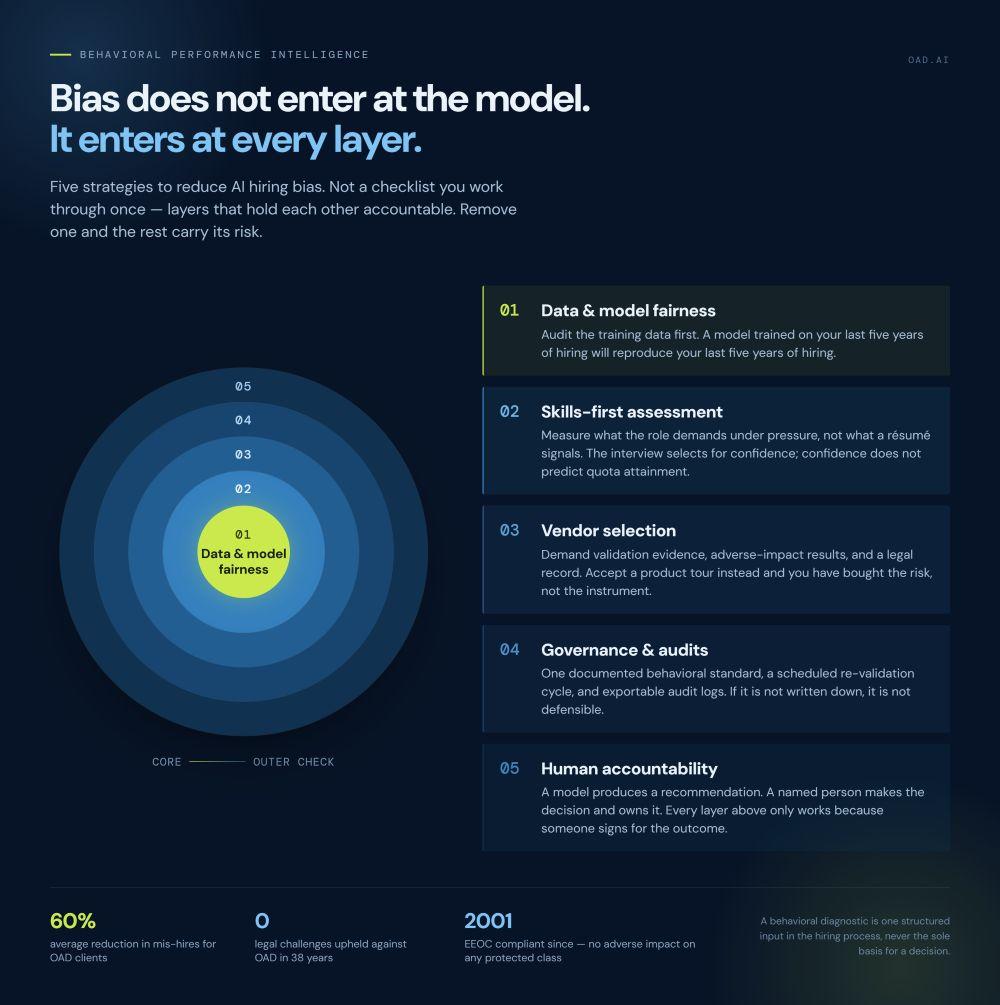
These five strategies work as a system, not a checklist you complete once. Skills-first, measurement-driven fixes carry the most weight. Governance and human accountability are what make the fix durable.
1. Design Data and Models for Fairness
Mask or remove variables that function as demographic proxies, not just the demographic fields themselves. Run counterfactual tests: change only a candidate’s name or zip code and see if the score moves. Document where every training record came from and what was cleaned out, because an unauditable dataset is not a defensible one.
2. Use Structured, Skills-First Assessments Early
Replace resume-keyword screening with short, job-relevant work samples as early in the funnel as possible. Blind identifying information during that first screen. Score against behavioral anchors tied to what the role actually requires, not to what past hires happened to look like on paper, and use structured strategies to assess communication skills in interviews so that evaluation is consistent across candidates.
3. Choose Responsible AI Hiring Tools and Vendors
Require documented fairness testing from any vendor before signing, not a marketing claim. Ask for explainability examples: can the vendor show why a specific candidate scored the way they did? Put audit rights and liability allocation in the contract itself, not a verbal assurance.
4. Build Governance, Monitoring, and Audits Into the Workflow
Bias detection is not a one-time launch check. Run adverse-impact audits by role on a fixed cadence, log every automated decision for traceability, and assign an owner who is accountable for reviewing the results, not just generating them.
5. Keep Humans Accountable With Structured Decision Rules
Give interviewers a rubric, not a gut check. Require a human sign-off before any automated rejection becomes final. Train hiring teams on how the tools they use can fail, because a team that trusts a black box uncritically is the last line of defense that already gave up.
Measuring Outcomes: Metrics for Bias Detection
Track pass-through rate by demographic group at every stage of the funnel, not just at final offer. Watch score distributions for unexplained clustering. Watch override rates: a human reviewer overturning the model constantly is a signal the model is miscalibrated, not that the human is being difficult. Set a remediation trigger before you need one, a defined disparity threshold that automatically pauses a stage for review, and a fixed audit cadence, quarterly at minimum for any tool touching a protected-class-relevant decision.
Case Snapshots: Detecting and Fixing Hiring Bias Patterns
One of the most cited bias patterns in this space traces back to classic resume-audit research: identical resumes sent out under different name conventions, some coded as white-sounding, some as Black-sounding, received measurably different callback rates, even though nothing but the name changed. More recent audits applying the same method to AI-driven resume screening and large language model ranking tools found the pattern persisted in some tested tools, with white-associated names favored over identical resumes carrying Black-associated names.
A separately documented case involved a resume-ranking tool that learned to downgrade any resume containing the word “women’s,” as in a women’s college or a women’s chess club, after training on a company’s historically male-skewed hiring pattern. The tool was scrapped entirely once the pattern was found, a far costlier remediation than catching it before deployment through the subgroup testing described in Strategy 1.
The lesson generalizes: any model trained on historical hiring data, or on text patterns correlated with it, will find and reproduce whatever bias already existed, even when no one told it to look for race or gender at all. The fix is not a patch to the model. It is moving the first-mile decision to an instrument that was never trained on a company’s own historical hiring pattern, or anyone else’s, in the first place.
Algorithmic Monocultures and Vendor Concentration Risk
When most companies in an industry converge on the same handful of screening vendors, they also converge on the same blind spots. A candidate rejected by one tool’s bias pattern is likely to be rejected by every company using that same tool, turning one vendor’s flaw into an industry-wide filter. Diversify screening methods rather than routing every decision through a single automated tool, and treat any vendor with outsized market share as a concentration risk to evaluate, not a safe default because everyone uses it.
The OAD Playbook: Structured Assessment in the First Mile
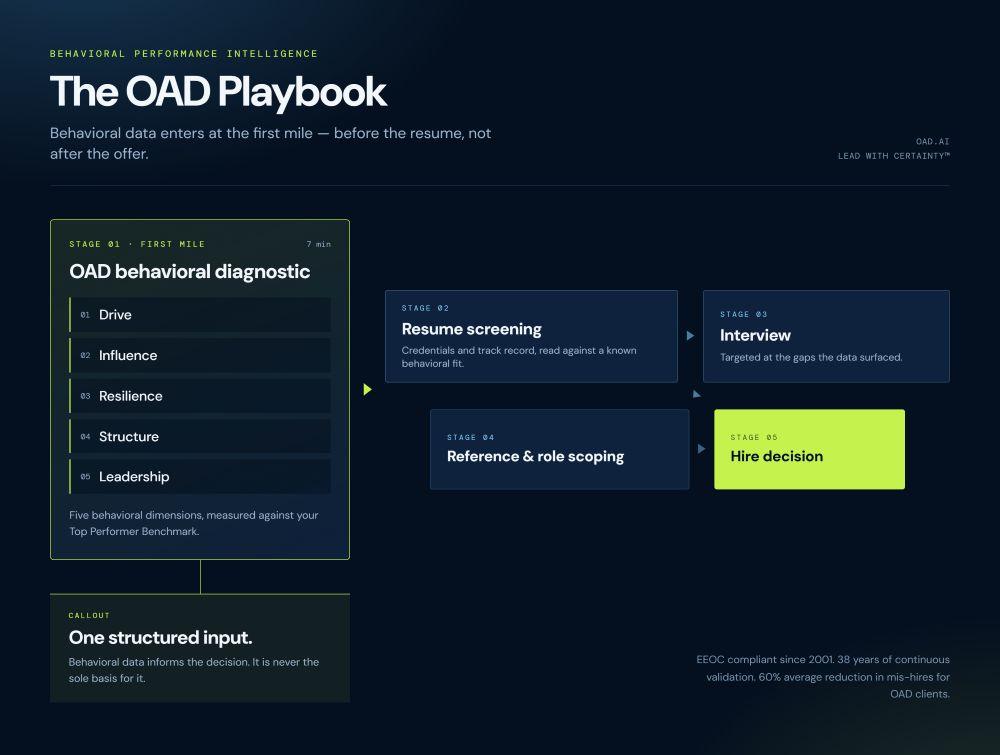
We built OAD as the opposite of the black-box screener this guide has been describing. OAD is a validated structured behavioral diagnostic, not a resume-ranking algorithm. It measures behavioral drive, how someone is wired to operate under role-specific pressure, against a Top Performer Benchmark built from your own best performer, not from a decade of a company’s historical hiring pattern, and fits into a broader set of data-driven human resource solutions and behavioral assessment use cases.
Placed in the first mile of the funnel, before resume screening narrows the pool on proxy signals, OAD scores every candidate against the same five dimensions: Drive, Influence, Resilience, Structure, Leadership. That is one structured, consistent, auditable input, not the whole decision. EEOC compliant since 2001, with no adverse impact on any protected class and zero successful legal challenges in 38 years.
If you are piloting a new use of the assessment, a new role type, a new region, run it as an A/B test against your current process and measure pass-through rate by group before rolling it out fully. This is the kind of program a compliance-first People function builds once and defends indefinitely. Certainty comes from data, not from switching tools on faith, and scalable OAD pricing plans for different team sizes let you expand that program as adoption grows.
Choosing AI Hiring Tools: Vendor Questions That Matter
Before you sign with any AI hiring vendor, ask where the training data came from and whether it reflects your labor market or a different one entirely. Ask for group-level fairness metrics, not an aggregate accuracy score that can hide a subgroup gap inside a good-looking average. Ask what integration and audit support the vendor provides when a regulator or an internal audit asks for a decision trail. Compare explainability across every vendor on your shortlist: if a company cannot say why a specific candidate scored the way they did, that is the answer to whether you should sign.
Compliance Checklist and Implementation Steps
Update your internal hiring policy to name which tools are approved, who owns their audit cadence, and what triggers a pause. Schedule a cross-functional review with legal before any new AI hiring tool touches a live applicant, not after the first complaint.
Set monitoring KPIs, pass-through rate by group, override rate, audit cadence, and assign a named owner for each, because a metric with no owner does not get reviewed.
FAQ
What causes AI hiring bias?
AI hiring bias comes from three main sources: training data that reflects a company’s past hiring pattern, proxy variables that correlate with a protected class even when the class itself is removed, and feedback loops where biased outputs become tomorrow’s training data. The bias is rarely coded in on purpose. It is inherited.
Does AI increase discrimination risk compared to a human recruiter?
AI can increase discrimination risk because it operates at far greater speed and scale than a single recruiter, turning one biased pattern into a filter applied to every applicant who touches that stage. It can also reduce risk when it replaces inconsistent human judgment with a structured, validated, auditable process. The outcome depends entirely on how the tool was built and deployed.
How do you measure fairness in a hiring algorithm practically?
Track pass-through rate by demographic group at every funnel stage, monitor score distributions for unexplained clustering, and run adverse-impact audits by role on a fixed cadence. A fair-looking aggregate score is not enough. The subgroup and intersectional numbers are where the real signal lives.
Is a company liable if an AI hiring tool discriminates?
Employers may carry liability exposure under Title VII and applicable state or local law when an AI hiring tool produces a disparate impact on a protected class, regardless of whether the discrimination was intentional. Confirm specific exposure with legal counsel; this is not legal advice.
What is the fastest way to reduce AI hiring bias right now?
Run a rapid audit of pass-through rates by group on current tools, and move to a structured, skills-first assessment as early in the funnel as possible. Early-funnel structure prevents more downstream bias than any patch applied after the fact.
Next Steps
None of this makes AI hiring tools disposable. It makes them something to instrument the same way a pipeline already gets instrumented, with a validated benchmark instead of a black box. Start where the bias enters first: the screen before the interview. Get Your Free Top Performer Profile, 7 minutes, results in 24 hours, no credit card, and see what a validated structured input looks like next to what is running today.