Technology in recruitment has shifted from a niche add-on to a core part of how organizations compete for talent. Most teams didn’t ‘shift.’ They were forced into tech adoption the moment application volume outpaced human review. The right mix of recruitment software, AI-powered tools, and data analytics can improve hiring quality and speed, but it also risks eroding the human judgment and candidate experience that make great hires stay. This article shows how to use technology to support better decisions without losing the relationships and insight that drive long-term performance. OAD teams see this shift every week when executives ask not for ‘more candidates,’ but for tools that remove noise and expose who will actually perform.
The New Role of Technology in Recruitment
Hiring used to be a largely manual craft: CV stacks, email threads, and interview notes scattered across inboxes and spreadsheets. Today, technology in recruitment is central to how organizations compete for talent. Applicant tracking systems, software systems, AI-powered tools, and data analytics shape who even gets seen, how quickly decisions are made, and how fair those decisions are.
Organizations are increasingly leveraging technology to strategically enhance recruitment outcomes, using advanced tools to improve efficiency, candidate assessment, and overall hiring success.
The ‘manual craft’ era wasn’t charming. It hid bias, lost notes, and produced random outcomes disguised as intuition.candidate
A hiring manager recently told us she once lost a finalist’s interview notes in a six-person email chain. The candidate never heard back. The team hired no one that quarter.
At the same time, the recruitment landscape has become more complex. Remote and hybrid work have expanded the talent pool, but they’ve also increased application volume. Generative AI has made it trivial for job seekers to fire off dozens of tailored applications in minutes, which leaves hiring teams filtering far more noise for the same number of roles.
McKinsey data shows remote work expanded some talent pools by more than 4x. What we’ve seen at OAD is a different side effect: teams drown in applicants but still can’t find the right ones.
Surveys show that a growing majority of organizations either already use AI in their recruitment process or plan to increase investment in AI-driven tools, mainly to handle volume and speed up decision making. Technology employers are often at the forefront of adopting these solutions, integrating AI and software systems to streamline and enhance their hiring processes.
Leaders like Satya Nadella call AI ‘the next transformational layer.’ In hiring, that’s true, but only if teams understand where the technology’s limits actually are.
The question is no longer whether to use recruitment technology, but how to use it without losing the human judgment and nuance that distinguish high-quality, long-term hires from short-term fixes.

Key Benefits of Embracing Technology in Recruitment
Recruitment tools are essential for streamlining and improving the hiring process, helping organizations stay competitive in talent acquisition.
Used well, recruitment technology is not just about saving time; it changes the quality and consistency of hiring decisions.
At OAD, we watch teams misuse tech when they chase speed instead of signal. The goal isn’t faster screening. It’s fewer hiring mistakes.
First, technology in recruitment improves the candidate experience. Automated updates, clear timelines, and streamlined interview scheduling remove friction that often frustrates job seekers. Leveraging recruitment tools and AI-driven systems creates an efficient candidate experience, ensuring top talent is attracted and engaged throughout the process. Candidate experience isn’t a soft metric: multiple studies show that how people are treated during the process directly influences whether they accept offers and how they talk about your brand.
IBM found that candidates who feel respected during hiring are 38 percent more likely to accept offers. We see the same pattern in OAD data: candidates who understand the role expectations upfront stay longer and perform better.
Design teams with data, not gut feel.
Most org-design decisions come down to role fit, leadership style, and team dynamics. OAD reads those signals from a 7-minute behavioral survey, so you can reconfigure roles and teams with evidence instead of guesswork.
Second, recruitment technology enables more data-driven decisions. When your recruitment software captures consistent recruitment data at each stage of the recruitment process, hiring managers can see which channels actually bring in qualified candidates, where strong candidates drop out, and how long it really takes each team to move from application to offer.
Third, embracing technology shifts HR professionals toward more strategic aspects of talent acquisition. Automating repetitive tasks like basic resume screening, interview scheduling, and routine candidate queries frees time for advising hiring managers, refining recruitment strategies, and strengthening the employer brand instead of just moving candidates from one stage to the next.
Map Your Current Hiring Process Before Adding More Tools
Before adding another piece of recruitment software, you need a clear view of your existing hiring process. Otherwise, you risk automating a flawed system and locking in bad habits at scale.
Start by mapping the recruitment process from end to end:
- How do you handle candidate sourcing today (online job boards, social media platforms, referrals, agencies), and are you leveraging technology or AI tools to automate and improve this step?
- How are candidates screened, shortlisted, and handed over to hiring managers? Are you using technology or AI-driven candidate screening tools to filter and evaluate applicants efficiently?
- Where do human recruiters add real judgment, and where are they doing repetitive tasks any software could handle?
Most teams only discover the real bottleneck when they map the process. One client found that 40 percent of delays came from a single hiring manager who only reviewed candidates on Fridays.
This exercise usually surfaces gaps: inconsistent requirements between hiring managers, unclear decision criteria, or bottlenecks where candidates sit for weeks without feedback. Once your current hiring process is visible, you can decide where technology can enhance efficiency and where you must preserve or even deepen human involvement.
Core Recruitment Technology You Actually Need
Many organizations are sold on impressive feature lists. In practice, most need a disciplined core stack that does a few things extremely well.
Applicant Tracking Systems as Your System of Record
An applicant tracking system (ATS) should function as the backbone of your recruiting process. It stores candidate data, centralizes job openings and job listings, tracks where candidates are in the hiring process, and supports scheduling interviews and recording outcomes.
OAD regularly audits team workflows and sees ATS tools collecting dust simply because no one agreed on how to use them.
A good ATS gives hiring teams a consistent way to document feedback and hiring decisions. It makes recruitment data queryable: time-to-hire by role, conversion rates by stage, and performance of different sourcing channels. Without this system of record, even the most advanced AI-powered tools have nothing reliable to work with.

Candidate Relationship Management for Long-Term Hiring
Where the ATS tracks active applications, candidate relationship management (CRM) tools help you nurture your wider talent pool. This includes silver-medalist candidates, passive candidates who weren’t ready to move last year, and even existing employees who might be ready for internal moves.
A recruitment CRM helps you maintain engagement with potential candidates through targeted content, check-ins, and tailored outreach. Over time, this builds a talent pipeline that reduces your reliance on reactive, last-minute sourcing whenever a new job requirement appears.
One tech company we worked with filled a senior engineer role in two days by pulling from its CRM. That candidate had been a runner-up nine months earlier.
Sourcing Qualified Candidates in a Tech-Driven Market
Online Job Boards and Social Media Platforms
Online job boards and social media platforms remain core channels, but the way you use them matters more than the volume of job listings. Treat them as part of a coherent employer brand strategy rather than simple advertising space.
Job boards inflate activity metrics, not accuracy. Most teams mistake movement for selection.
Clear job descriptions, realistic job requirements, and consistent messaging across platforms help you attract qualified candidates instead of a flood of mismatched applications. Recruitment software can track which channels supply candidates who progress farthest in the hiring process, so you can invest in what actually works rather than what just creates activity.
LinkedIn’s global talent report shows unclear job requirements are the second leading cause of early turnover. OAD data reinforces this: mismatch begins before the first interview.arti
Building a Sustainable Talent Pool of Qualified Candidates
Recruitment technology tools can help you track both the candidates who apply today and those who might be a better fit for future roles. Tagging candidates by skills, experience level, and potential future fit lets hiring managers search the existing talent pool before launching a new campaign. Gamified assessment tools can also be used to evaluate a candidate’s skills, such as problem-solving, creativity, and teamwork, in an engaging and unbiased way.
This approach improves candidate engagement. Instead of treating people as “rejected,” you position them as part of your wider talent pipeline, reducing time-to-hire and demonstrating that you value long-term relationships, not just immediate vacancies.
Recruitment Marketing and Strategy in the Digital Age
Modern recruitment rises or fall on one factor: how strategically organizations attract talent before they even start looking. Job postings may catch attention, but it’s proactive recruitment marketing that drives sustainable hiring success. True talent attraction isn’t accidental — it’s engineered through compelling messaging, strategic presence, and authentic engagement.
High-performing recruitment strategies operate with a sophisticated understanding of candidate behavior. Applicant tracking systems and candidate relationship management software don’t just organize workflows — they transform how employers connect with potential hires across social media platforms, job boards, and career sites. In these digital environments, personalized communication flows freely, authentic employer branding emerges naturally, and candidates feel connected to opportunities that align with their values and aspirations.
At the heart of breakthrough recruitment marketing lies data-driven insight. Analytics reveal which channels generate the most qualified applicants, which engagement tactics resonate deepest, and how recruitment efforts align with broader business objectives. Forward-thinking hiring managers use this intelligence to refine their approach in real time — transforming everyday talent acquisition into measurable competitive advantage.
Because effective recruitment marketing isn’t just about better job postings — it’s about understanding the candidates who power organizational growth. And when companies achieve that strategic alignment, they don’t just fill positions faster. They build stronger talent pipelines, adapt to market changes more effectively, and unlock sustainable access to the exceptional people who drive their success.
Using AI-Powered Tools Without Losing Control
Resume Screening and Candidate Matching with AI
Artificial intelligence and machine learning are most visible in resume screening and candidate matching. AI-powered tools can scan large volumes of candidate data, interpret CVs using natural language processing, and highlight the most suitable candidates based on predefined criteria.
Used carefully, these tools help hiring teams handle volume and avoid missing strong candidates simply because they applied at a busy moment. The risk comes when organizations treat AI rankings as unquestionable truth instead of decision support. Research continues to show that AI systems can amplify bias if trained on incomplete or skewed data sets.
Conversational AI: Chatbots and Candidate Queries
Chatbots and virtual assistants now handle basic candidate queries, schedule interviews, and provide real-time updates on application status. This can dramatically improve response times and reduce the administrative burden on human recruiters, especially in high-volume hiring environments.
One candidate recently told us a chatbot asked three follow-up questions in a row that didn’t fit her background. She left the process the same day.
To protect the candidate experience, you should be explicit about where automated interactions end and where human recruiters take over. Candidates expect quick answers to simple questions, but they also expect thoughtful, human responses when it comes to feedback, complex questions, and offer discussions.
Predictive Analytics and Data-Driven Recruitment
Predictive analytics uses patterns in recruitment data and candidate behavior to forecast outcomes such as likelihood of accepting an offer, risk of early turnover, or potential performance in the role. Done well, predictive models help hiring managers focus their time on candidates with the highest probability of success and design more targeted recruitment strategies.
Data-driven recruitment is not about replacing human recruiters with algorithms. It is about giving hiring teams better information so they can make more consistent, transparent decisions, and explain those decisions to both candidates and business leaders.
Designing a Better Candidate Experience with Technology
Communication, Scheduling, and Feedback Loops
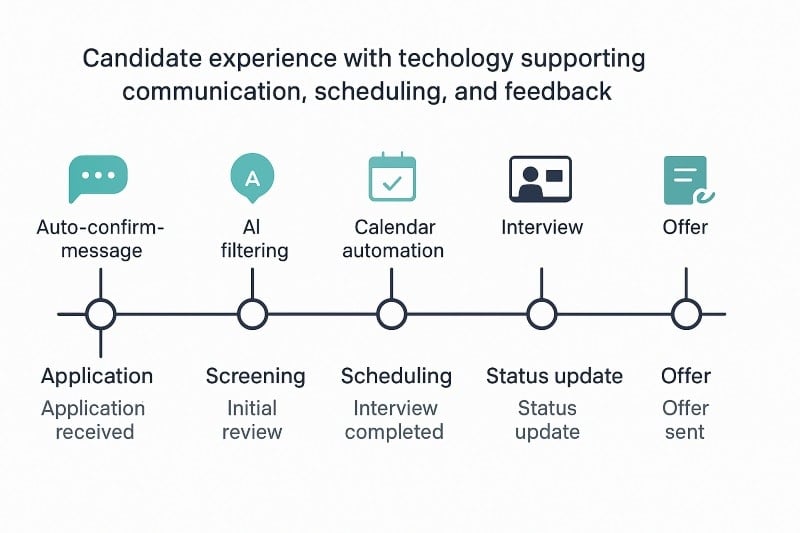
Candidate experience often breaks down in boring, operational places: confusing job descriptions, slow responses, and interviews that are rescheduled multiple times. Recruitment technology directly addresses these friction points.
A hiring process with gaps is like a relay race where one runner just sits down.
Integrated scheduling tools allow candidates to choose interview slots that work for them, while automated reminders reduce no-shows. Centralized communication through your ATS or CRM keeps messages consistent and ensures both the candidate and the hiring team know what happens next.
Studies consistently link positive candidate experience to higher offer acceptance rates and stronger employer reputation.
Even candidates who don’t receive an offer are more likely to re-apply or recommend your company when the process feels efficient, respectful, and transparent.
Video Interviews and Virtual Hiring
Virtual interviews and structured video interviews are now common parts of modern recruitment practices. Video interview technology enables organizations to conduct interviews remotely or globally, facilitating both live and recorded interviews regardless of candidate location. They expand your reach, reduce travel logistics, and often speed up hiring decisions. Recent data suggests that a large majority of hiring managers now use some form of virtual interviewing as part of their
The key is to design video interviews so they still feel human. Provide candidates with clear instructions, expectations, and technology checks in advance. Encourage hiring managers to build rapport instead of treating the session as a rigid interrogation simply because it happens on screen.
Teams that script video interviews too rigidly forget that rapport predicts performance far better than perfect audio.
Freeing HR Professionals for More Strategic Aspects
Automating repetitive tasks is not about reducing headcount; it is about raising the value of each HR professional. When recruitment software handles repetitive onboarding tasks, standard communication templates, and basic resume screening, HR teams can spend more time on the strategic aspects of talent acquisition.
If HR is buried in scheduling, they can’t influence hiring quality. That’s not efficiency. That’s misallocation.
Jeff Bezos often says leaders should focus on decisions that compound. Offloading administrative tasks gives HR room to make those compounding decisions.
Those strategic aspects include:
- Advising hiring managers on realistic job requirements and market conditions
- Identifying internal mobility opportunities for existing employees
- Designing more inclusive recruitment strategies and assessment models
- Using recruitment data to inform workforce planning and budget decisions
In this model, human recruiters focus on judgment, relationship-building, and coaching rather than manual process administration.
Turning Recruitment Data into Better Hiring Decisions
Many organizations collect recruitment data, but far fewer use it effectively. A data-driven approach starts by deciding which questions matter:
- Which sources yield candidates who become high performers, not just fast hires?
- Where in the recruitment process do strong candidates drop out?
- How does time-to-hire vary by team, role, or region, and why?
Modern recruitment technology tools and data analytics can answer these questions with far greater precision than anecdotal experience alone.
The output of data analytics should be action: refining recruitment strategies, adjusting interview stages, changing job requirements, or investing in different channels. Dashboards that don’t influence behavior are decoration, not strategy.
Measuring Recruitment Effectiveness with Technology
Organizations transform or stagnate on one critical factor: how effectively they measure and optimize their talent acquisition. Recruitment success isn’t accidental—it’s engineered through precise measurement, strategic insight, and continuous refinement. Understanding what drives results in your recruitment process becomes the foundation upon which sustainable hiring excellence is built.
Modern recruitment technology unleashes the power of deep analytics, revealing the hidden patterns within every stage of your talent funnel. Performance indicators like time-to-hire, cost-per-hire, and source-of-hire emerge as strategic compass points, illuminating which channels attract exceptional talent and where friction disrupts the flow. Machine learning algorithms and predictive analytics elevate this intelligence further, transforming raw recruitment data into powerful forecasts that anticipate hiring needs, decode the DNA of high-performing hires, and optimize marketing campaigns with surgical precision.
Organizations that harness these technologies don’t just improve their hiring—they revolutionize their entire approach to talent acquisition. Data replaces intuition, clarity emerges from complexity, and strategic decisions flow from evidence rather than assumption. This transformation doesn’t simply attract and retain superior candidates; it ensures your recruitment process remains dynamic and competitive in an ever-evolving landscape. Because exceptional hiring isn’t just about better systems—it’s about understanding the data that powers them, and when organizations achieve that mastery, they don’t just hire better talent. They build stronger teams, adapt faster to market demands, and unlock the full potential of their workforce.
Common Pitfalls When Embracing Technology in Recruitment
Technology in recruitment fails most often when it is used as a shortcut instead of an amplifier for good practice.
Most failures aren’t technical. They’re cognitive. Teams stop thinking the moment automation looks competent.
We’ve seen teams spend six figures on a new ATS only to recreate the same chaotic decision-making because no one fixed the role expectations.
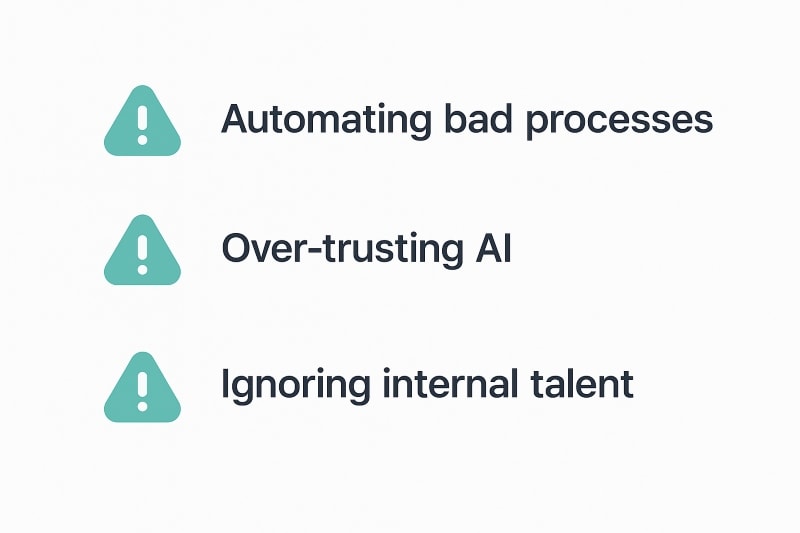
One pitfall is automating bad processes inherited from traditional recruitment channels. If job requirements are vague, interview feedback inconsistent, or decision criteria unclear, adding an ATS or AI tool simply makes the inconsistency faster and more opaque.
A second pitfall is over-trusting AI tools without validation. If your team treats AI rankings as infallible, you risk introducing or reinforcing bias, especially against candidates from under-represented backgrounds or with non-traditional career paths.
New York City’s AI hiring audit laws surfaced multiple documented cases of bias amplification. Tools don’t fix bias; governance does.
A third pitfall is ignoring internal and passive candidates because online job boards produce a constant stream of new applicants. Recruitment technology should make it easier, not harder, to identify and engage existing employees and long-term passive candidates who may be strong fits for upcoming roles.
The Future of Technology in Recruitment
The future of recruitment will not be defined by a single tool, but by the integration of several trends:
- Wider use of artificial intelligence and machine learning to match candidates, predict performance, and personalize candidate journeys at scale
- Increased reliance on virtual interviews and assessments as global and hybrid teams become the norm
- Stronger regulation and ethical frameworks around AI-powered tools, especially in heavily regulated markets
Research on AI in recruitment is increasingly clear on the trade-offs: AI can bring efficiency and innovation, but it requires transparent, responsible use of data to maintain candidate trust and avoid unintended discrimination. AI screening works until it decides ‘operations’ means ‘logistics’ and buries your best candidates on page six.
Organizations that treat AI as a partner, not a black box, will build more resilient and adaptable recruitment strategies.
Where OAD Fits in a Modern Recruitment Tech Stack
It’s the same principle Warren Buffett uses for investments: make decisions based on fundamentals, not surface signals. OAD gives teams those fundamentals.
Applicant tracking systems, recruitment software, and AI-powered tools are essential, but they mostly describe what candidates have done. To make better hiring decisions, you also need a structured way to understand how people are likely to behave and where they will thrive.
OAD adds this layer. As a scientifically validated personality and talent assessment, OAD helps hiring teams understand a candidate’s skills, work style, and role fit beyond the CV and the interview impression. Integrated into your recruitment technology stack, OAD:
- Provides objective data to support hiring decisions
- Helps match candidates to roles where they are more likely to perform and stay
- Gives hiring managers a shared language for discussing fit and potential; learn how to assess communication skills in an interview
Used alongside your ATS, CRM, and AI-enabled tools, OAD connects recruitment decisions to downstream performance and job satisfaction, which is ultimately what high-quality hiring should optimize for.
Design teams with data, not gut feel.
Most org-design decisions come down to role fit, leadership style, and team dynamics. OAD reads those signals from a 7-minute behavioral survey, so you can reconfigure roles and teams with evidence instead of guesswork.
Best Practices for Implementing Recruitment Technology
Forward-thinking organizations rise or fall on one crucial factor: how strategically they harness recruitment technology. Success isn’t accidental—it emerges when tools align seamlessly with organizational vision and human experience. True recruitment transformation begins with defining clear objectives and pinpointing the precise challenges technology must solve, whether streamlining applicant flows, strengthening candidate relationships, or engineering exceptional hiring experiences.
Smart recruitment technology choices flow naturally from strategic integration with existing HR ecosystems—applicant tracking systems and candidate relationship management platforms working in perfect harmony. This isn’t just about purchasing software; it’s about creating a unified digital foundation that empowers your entire talent acquisition engine. Forward-thinking leaders understand that technology alone doesn’t drive results—comprehensive training and ongoing support transform hiring managers and HR professionals into confident, consistent practitioners of innovation.
The candidate experience isn’t just a priority—it’s the heartbeat of recruitment success. Every touchpoint, from initial application to final onboarding, must reflect your organization’s commitment to transparency, timely communication, and unwavering data privacy. This human-centered approach doesn’t happen by chance; it’s engineered through thoughtful technology deployment that serves people, not just processes.
Measurable transformation emerges when organizations monitor and evaluate their recruitment technology with scientific precision—gathering feedback from candidates and internal users, tracking key performance indicators, and identifying opportunities for continuous improvement. When companies achieve this alignment between human insight and technological capability, they don’t just attract better candidates. They unlock the full potential of their hiring teams, building recruitment processes that grow stronger, adapt faster, and deliver sustainable competitive advantage in the war for talent.
Action Checklist: Using Technology in Recruitment the Smart Way
To align technology in recruitment with better outcomes, not just faster processes, use this checklist:
- Map your current hiring process from sourcing to onboarding before adding new tools.
- Decide where human recruiters and hiring managers must stay in the loop and where automation genuinely adds value.
- Use an ATS as your system of record so recruitment data is consistent and usable.
- Build and maintain a talent pool through candidate relationship management, not just one-off campaigns.
- Introduce AI-powered tools carefully, validate their outputs, and monitor them for fairness and bias.
- Use data analytics and predictive analytics to refine recruitment strategies, not just to generate reports.
- Protect and continually improve candidate experience across all touchpoints, especially communication and feedback.
- Add scientifically validated assessments like OAD to connect hiring decisions with on-the-job performance and retention.
If you want to see how OAD integrates with your existing recruitment technology and supports more data-driven, human-centred hiring decisions, you can start with the free Top Performer Profile: 7 minutes, results in 24 hours, no credit card.