Talent acquisition is more than filling open roles. Picture a fast-growing tech team scrambling every quarter because no one anticipated the skills they’d need next. That scramble disappears once talent acquisition becomes proactive instead of reactive. It is a strategic, ongoing process that connects your hiring decisions to long-term business goals. Instead of reacting to every vacancy, effective talent acquisition builds pipelines, plans for future skills, and aligns hiring needs with where the organization is heading.
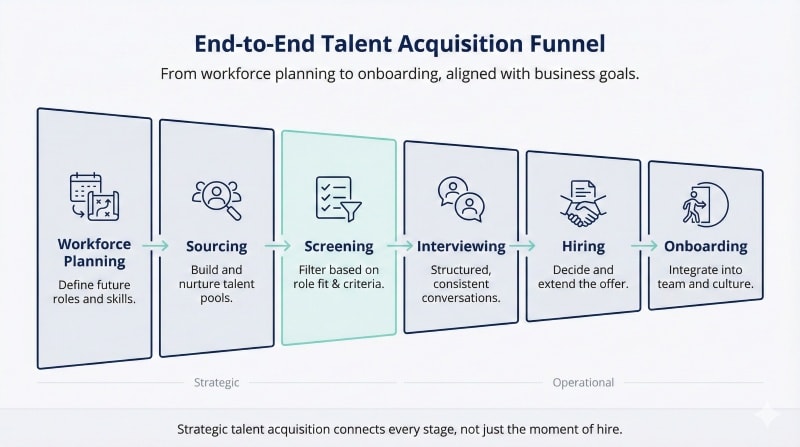
This process typically involves workforce planning, sourcing, recruiting, assessing, and integrating new hires into the organization. While HR often owns the talent acquisition process, it only works when talent acquisition teams, hiring managers, and senior leadership are aligned on what “top talent” actually looks like.
In reality, this neat five-stage model collapses the moment a hiring manager bypasses sourcing and drags in a ‘friend of the team’ as a shortcut.
At OAD, we frequently see companies trip at this exact point: everyone assumes they share a definition of ‘top talent,’ until a hire goes sideways and the misalignment becomes painfully clear.
Modern talent acquisition increasingly relies on recruitment software and talent acquisition technology to manage complexity. Without the right tools, even the best strategies are slowed down by manual work, inconsistent communication, and fragmented candidate data.
Deloitte’s Human Capital Trends report notes that organizations waste hundreds of hours a year on manual hiring tasks. Paired with OAD-level insights, automation actually accelerates decision quality instead of just speeding up admin work.tr
From Recruitment Process to Strategic Talent Acquisition Using Talent Acquisition Software
Traditional recruitment focuses on filling jobs. Strategic talent acquisition looks at long-term capability: which skills, behaviors, and leadership potential will your organization need in 12–36 months?
Think of it like sports scouting: signing a striker because you need one today is recruitment. Building a roster that can still win two seasons from now is talent acquisition.
It’s the same mindset shift Jeff Bezos talks about: decisions shouldn’t be made for the next quarter, but for the next decade. Strategic talent acquisition follows that logic.
Talent acquisition software helps bridge that gap by giving HR and recruiting teams visibility across the entire recruitment process: where qualified candidates come from, where they drop out, and which hiring decisions translate into strong performance and retention. As organizations grow, it becomes essential to make candidate management scalable to efficiently handle increasing volumes and complexity in the hiring process.
Introduction to Talent Acquisition
Organizations succeed or struggle based on one critical capability: how strategically they acquire talent. Filling positions isn’t enough — talent acquisition demands a systematic approach that weaves hiring directly into long-term business strategy. True talent acquisition doesn’t react to openings. It engineers sustainable growth through precise identification, strategic attraction, and seamless integration of candidates who will drive tomorrow’s success. This methodology transcends traditional recruitment by building robust talent pipelines and anticipating workforce evolution before it arrives.
Smart organizations deploy recruitment software and hiring tools like precision instruments — applicant tracking systems streamline every hiring stage, transforming complexity into clarity. These systems orchestrate job postings across multiple boards, coordinate seamlessly with staffing agencies, and centralize candidate intelligence for faster, sharper decisions. Advanced talent acquisition technology doesn’t just improve efficiency — it revolutionizes effectiveness, ensuring exceptional candidates are discovered, engaged, and secured before competitors even recognize the opportunity.
Collaboration drives results: HR leaders, hiring managers, and talent acquisition experts unite to define requirements, source exceptional talent, and craft candidate experiences that resonate. The right fusion of technology and strategy transforms talent acquisition from a support function into a competitive weapon — helping companies dominate talent markets while others struggle to keep pace. When organizations master this alignment, they don’t just fill roles. They build unstoppable teams.
Why Talent Acquisition Software Matters Once You Pass 50 Employees
A hiring manager in a 60-person company might still juggle candidates in their inbox. By 80 employees, that same system becomes chaos: missed messages, duplicate interviews, and lost candidates. For strategies on how to hire your first employee, consider this comprehensive guide.
Manual hiring processes can work in small organizations. Once you cross 50 employees and start handling multiple job postings, hiring managers, and locations, spreadsheets and inboxes become a liability.
We see this tipping point constantly. Leaders assume hiring ‘worked fine’ until one growth spurt exposes every hidden inefficiency.
At this stage, you typically face:
- Overlapping recruiting efforts and duplicated candidate outreach
- Inconsistent interview experiences across hiring teams
- Little visibility into recruitment goals, funnel metrics, or hiring challenges
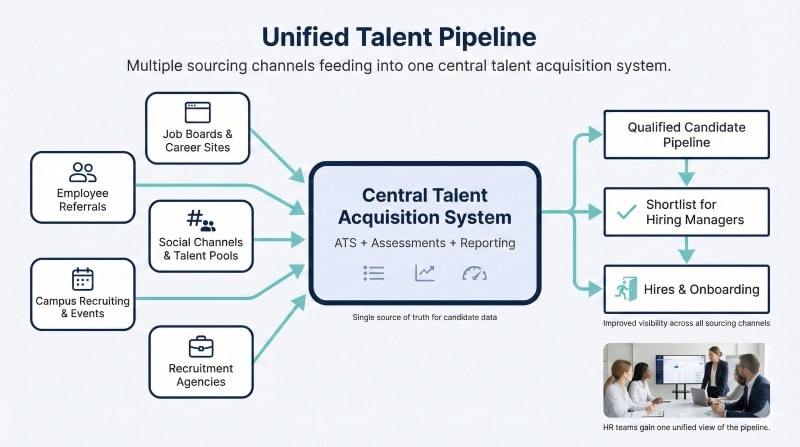
Talent acquisition software gives HR leaders and recruiting teams a single source of truth: one place to manage candidate data, track the hiring process, and standardize how decisions are made.
McKinsey calls this unified visibility ‘organizational clarity.’ OAD’s data layer pushes that clarity further by showing not just who applied, but who is wired to excel.
Outcomes You Should Expect
From a business perspective, investing in powerful talent acquisition software should help you:
- Hire smarter through data-driven decisions, not just intuition
- Reduce time-to-fill without sacrificing candidate quality
- Improve candidate experience and employer branding
- Build a fair interview process that is defensible and consistent
- Support flexible hiring for small teams, mid sized companies, and high growth organizations
What Is Talent Acquisition Software, Really?
Talent Acquisition vs Traditional Recruitment
Recruitment is often transactional: open role, job posting, interviews, offer. Talent acquisition is broader and more strategic: it includes workforce planning, employer branding, campus recruiting, talent pools, and internal mobility.
It mirrors the difference between how Warren Buffett invests versus how day traders operate: one chases events, the other builds value over time.
Talent acquisition software reflects this shift. It is not just hiring software; it is a combination of systems that support the full talent acquisition process, from first touch to acceptance.
Talent Acquisition Software vs Recruiting Software vs Hiring Software
You will see vendors use terms like “talent acquisition software,” “recruitment software,” “recruiting tools,” or “hiring software” almost interchangeably. In practice:
- Applicant tracking system (ATS): The core system used to manage applications, interviews, and offers.
- Recruiting software / recruitment solution: Often used as umbrella terms covering ATS plus extra features.
- Talent acquisition software: Typically refers to a broader suite that includes applicant tracking, built in recruitment marketing, employer branding, and analytics tools.
For HR leaders, labels matter less than capabilities. The key is to understand how each talent acquisition tool fits into your hiring ecosystem.
When a Simple ATS Is Not Enough
This is the stage where leaders realize the ATS isn’t the problem. Their hiring complexity outgrew the tool months ago.
An entry-level all in one ATS or free plan can be enough for small businesses hiring a few roles per year. Once you deal with complex hiring needs (multiple locations, specialized roles, high volume recruiters, or a large talent acquisition team), you need:
- Configurable workflows for different business units
- Scalable candidate management and reporting
- Deeper integrations with HRIS, payroll, and assessment platforms
At this point, “just an ATS” starts to show its limits.
Mapping Talent Acquisition Software to the Hiring Process
The Modern Hiring Process
A modern hiring process usually includes:
- Defining role requirements and success criteria
- Posting jobs and promoting job ads across multiple job boards
- Sourcing candidates proactively from talent pools or job boards
- Initial candidate screening and assessments
- Interviews and evaluations
- Video interviews for streamlining candidate assessment, offering greater scheduling flexibility and improved evaluation of communication skills
- Offer, acceptance, and onboarding
Talent acquisition software supports each stage so that recruiting teams and hiring managers share the same information, not their own private spreadsheets.
From Process to Outcomes
The goal is not just to digitize the recruitment process. Google’s Project Oxygen showed that structured, consistent hiring predicts far better outcomes. OAD’s behavioral layer pushes that structure into how decisions are actually made. an The goal is to:
- Improve quality of hire
- Tackle hiring challenges (e.g., talent shortages, niche roles, high turnover)
- Reduce bias and support blind hiring where appropriate
- Align hiring decisions with broader recruitment goals and business strategy
Key Features of Talent Acquisition Software
Applicant Tracking System as the Core
An applicant tracking system (ATS) is the backbone of most talent acquisition software. It centralizes:
- Applications from job boards, career page, and staffing agencies
- Interview scheduling and feedback
- Candidate communications and hiring decisions
Effective applicant tracking helps you avoid lost CVs, duplicate candidate records, and inconsistent data.

Candidate Relationship Management (CRM) and Talent Pools
Beyond the ATS, many talent acquisition tools include CRM capabilities. It’s the same strategy Tim Cook uses in supply chain planning: build early, nurture long-term sources, and avoid scrambling later. These help you manage existing talent pool investments:
- Tagging and segmenting candidates based on skills, seniority, or location
- Nurturing silver-medalist candidates for future roles
- Reactivating past applicants when relevant roles reopen
This is where recruiting software moves from reactive to proactive.
Built-In Recruitment Marketing & Employer Branding
Strong employer branding is often the deciding factor when top talent chooses between offers. LinkedIn’s Talent Trends report shows that 75 percent of candidates research a company’s brand before applying. OAD’s assessments help ensure the brand aligns with the actual employee experience. Many platforms now include built in recruitment marketing features:
- Career page builders
- Employer branding content templates
- Automated job postings to multiple job boards and social channels
These tools help you maintain consistent messaging while reaching a broader audience.
Integrations & Analytics Tools
Modern talent acquisition technology rarely stands alone. Integrations with HRIS, payroll, assessment platforms (such as OAD), and communication tools ensure that candidate data flows across systems.
Analytics tools then help you turn that data into insight: where top talent comes from, which job ads convert, and which hiring teams run a streamlined interview process versus those that stall.
Sourcing: From Job Postings to Talent Pipelines
Job Ads, Job Boards, and Posting Jobs at Scale
Most talent acquisition software simplifies posting jobs to:
- Multiple job boards
- Your own career page
- Social media channels
- Recruitment agencies and staffing firms
Instead of logging into each platform separately, hiring teams can post, update, and close roles centrally, keeping candidate data in one place.
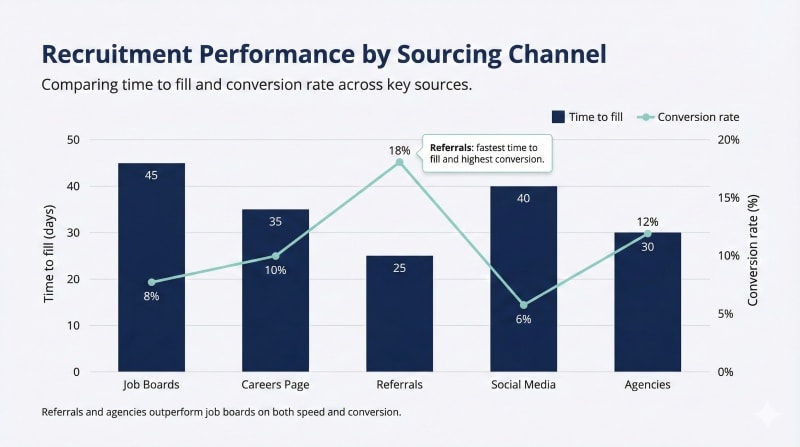
When to Use Staffing Agencies and Recruitment Agencies
Staffing firms and recruitment agencies can be critical partners for niche roles, short timelines, or markets where you lack internal reach. We often see organizations overspend on agencies simply because no one is tracking whether they out-perform internal sourcing. Talent acquisition software should support:
- Tracking agency performance
- Measuring cost per hire and time to fill
- Consolidating agency-submitted candidates with direct applicants
Campus Recruiting and Early Talent
For organizations investing in campus recruiting and internships, talent acquisition tools help:
- Capture candidate data at events
- Build early-career talent pools
- Track candidate progress across multiple recruitment cycles
Over time, these pipelines become a strategic asset, not just one-off campaigns.
Screening: From Initial Candidate Screening to Shortlists
Designing Scalable Initial Candidate Screening
Initial candidate screening can involve:
- Knock-out questions within application forms
- Screening questions aligned to role requirements
- Basic eligibility checks
Talent acquisition software automates much of this, allowing recruiting teams to focus on qualified candidates rather than sifting through noise.
Companion Skills-Based Assessments
Many platforms integrate companion skills based assessment tools to evaluate technical or role-specific abilities. These can sit alongside:
- Work samples
- Coding challenges
- Simulations or case studies
Used correctly, they support data driven decisions rather than relying solely on interviews.
Behavioral & Personality Assessment: Where OAD Fits
Skills alone rarely predict long-term success. Behavioral style, decision-making preferences, and working pace all influence performance, especially in leadership or team-based roles.
Harvard’s research shows that technical skills explain a fraction of long-term performance. This is exactly why OAD’s behavioral science is so crucial.
This is where science-based assessment platforms like OAD complement talent acquisition software. Integrated into your recruiting process, OAD helps:
- Match candidates to role demands
- Evaluate team fit and communication styles
- Reduce the risk of placing someone in the wrong environment
Design teams with data, not gut feel.
Most org-design decisions come down to role fit, leadership style, and team dynamics. OAD reads those signals from a 7-minute behavioral survey, so you can reconfigure roles and teams with evidence instead of guesswork.
Interview Management, Candidate Engagement & Experience
Streamlined Interview Process
A streamlined interview process improves both candidate experience and internal efficiency. Elon Musk famously asks candidates to explain their biggest technical challenges in detail. Structured processes ensure every hiring manager pulls that level of clarity consistently. Talent acquisition software supports:
- Coordinated interview scheduling across busy calendars
- Structured interview guides for hiring managers
- Standardized scorecards and evaluation criteria
This reduces friction and makes it easier to run a fair interview process at scale.
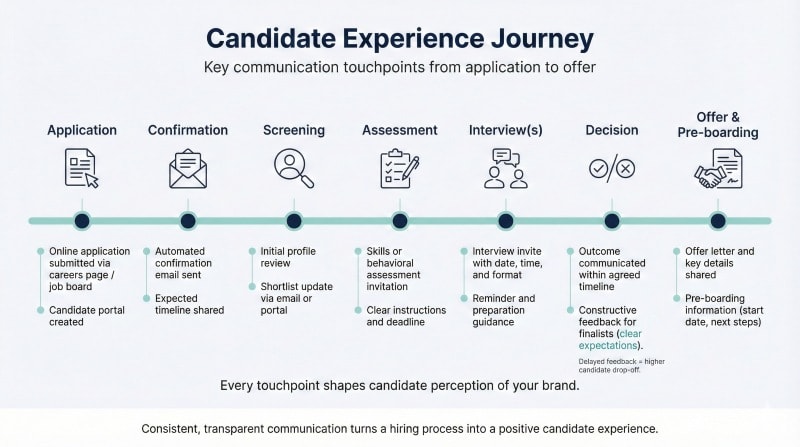
Candidate Communications & Engagement
Candidate engagement is critical, especially in competitive markets. Candidates ghost when they feel ghosted. A single delayed update can signal disorganization and push top applicants toward more responsive competitors. Talent acquisition software typically includes:
- Automated status updates
- Personalized email or SMS templates
- Reminder workflows for interviews and assessments with a behavioral assessment platform
Strong candidate communications prevent drop-offs and signal that your organization respects candidates’ time.
Candidate Experience Optimization
Candidate experience is no longer a “nice to have.” It is central to employer branding and long-term talent acquisition strategy. With the right tools, you can:
- Measure candidate satisfaction via surveys
- Identify bottlenecks where candidates are left waiting
- Adjust your recruiting process to reduce frustrations
AI-Powered Recruiting Tools: Hype vs Real Value
AI Sourcing & Screening
Many platforms now offer AI-powered recruiting tools, including AI sourcing companion intelligence features that suggest candidates based on role criteria and past hiring patterns.
This is where many HR teams hand too much power to a black-box algorithm and only realize the problem once candidates demand transparency.h
Used carefully, these AI companions increase efficiency by:
- Prioritizing promising profiles
- Highlighting patterns in candidate data
- Reducing manual screening time
AI Interview Companions
Some vendors offer AI interview companion tools, including AI interview companion checks and AI interview scoring. These tools can:
- Suggest follow-up questions based on candidate responses
- Generate summaries of interviews
- Flag potential issues based on predefined criteria
However, you must treat AI interview tools as input, not decision-makers. Automation employ’s approach of trusting the algorithm blindly is a fast way to damage fairness and trust.
Regulators are already fining companies for opaque AI use. OAD takes the opposite approach: every insight is explainable and traceable.
Explainability and Risk Management
Everything explainable AI in hiring comes down to one principle: if you cannot explain why a candidate was rejected, you have a problem.
HR leaders should be wary of vague phrases like “al powered tools built for smarter hiring” or “al powered tools” that cannot clearly show:
- Which candidate data is used
- How decisions or rankings are produced
- How bias is monitored and mitigated
AI should support human judgment, not replace accountability.
Employer Branding & Built-In Recruitment Marketing
Employer Branding Inside Your TA Stack
A polished career page can’t compensate for a confusing hiring process. Candidates subconsciously treat friction in your hiring process as a proxy for internal chaos. Behavioral economists call it effort signaling. Talent acquisition software can support employer branding by:
- Ensuring job ads match your tone of voice and values
- Providing consistent templates for job postings
- Helping you maintain a modern, informative career page
A strong employer brand makes your recruitment software more effective by improving conversion at the top of the funnel.
Built-In Recruitment Marketing
Built in recruitment marketing capabilities typically include:
- Campaigns to re-engage past candidates
- Talent newsletters and content sequences
- Remarketing audiences based on candidate data
Combined with high-quality content, these features help you stay visible to top talent, even before a specific role opens.
Recruitment Analytics: Hiring With Data, Not Anecdotes
Core Metrics and Analytics Tools
Recruitment analytics should give clear answers to questions like:
- Which job boards deliver the most qualified candidates?
- Where do candidates drop out of the recruiting process?
- Which hiring manager or hiring teams move fastest or slowest?
Analytics tools within talent acquisition software help convert raw candidate data into actionable insight.
High-Volume vs Complex Hiring
High volume recruiters often focus on speed, cost per hire, and pipeline throughput. Complex hiring for senior or niche roles in mid sized companies may focus more on quality of hire, retention, and culture fit.
Your talent acquisition software should support both types of hiring challenges with configurable dashboards.
Solutions for Complex Hiring
Modern organizations rise or fall on one decisive factor: how effectively they identify and attract exceptional talent. Complex hiring needs may challenge even seasoned leaders, but it’s sophisticated talent acquisition that drives sustainable growth. True recruitment excellence isn’t accidental — it’s engineered through intelligent systems, seamless workflows, and deep understanding of human potential.
The most forward-thinking platforms operate with a shared vision of what great hiring looks like. Solutions like Recruit CRM, Zoho Recruit, and Lever don’t just automate processes — they elevate them. AI-powered job postings emerge naturally from data-driven insights, targeting precisely the right candidates. Built-in recruitment marketing flows freely through every touchpoint, strengthening employer brands while analytics tools reveal the patterns that transform hiring from guesswork into strategic advantage. Advanced interview management and blind hiring capabilities ensure fairness doesn’t just exist in policy — it lives in practice.
Every staffing firm and recruiting team that embraces this evolution discovers something profound: when technology aligns with human insight, extraordinary results emerge. High-volume applicant management becomes effortless. Stakeholder coordination strengthens rather than strains relationships. Candidate experiences transform from transactional to memorable. Because exceptional hiring isn’t just about better software — it’s about understanding the people who power organizational success. And when companies achieve that alignment, they don’t just fill positions faster. They unlock talent potential, attract the extraordinary, and build teams that drive long-term triumph.
Talent Acquisition Strategies for Different Company Types
Small Businesses
Small businesses may start with a free plan or lightweight all in one ATS. A 10-person startup might get by with templates and spreadsheets. Add a second location and that same system collapses in weeks. The focus is often:
- Straightforward hiring workflows
- Basic reporting
- Affordable pricing
Even at this stage, setting up structured processes and simple recruitment analytics pays off later.
Mid-Sized and High-Growth Organizations
Mid sized companies and high growth organizations typically face complex hiring needs:
- Multiple locations and business units
- Non-stop requisitions
- Mixed volume and niche hiring
They require talent acquisition software that supports flexible hiring, role-specific workflows, and advanced collaboration for cutting edge hiring teams.
Large Talent Acquisition Teams & High-Volume Recruiting
For large talent acquisition teams and high volume recruiters, scalability is critical. The system must handle:
- Thousands of applicants
- Multiple hiring teams working concurrently
- Consistent standards across the organization
Here, automation is essential, but it must remain explainable and auditable.
Top Talent Acquisition Software Solutions & Best Recruiting Software
Evaluating Talent Acquisition Software
Evaluating talent acquisition software involves more than feature checklists. Analyst reviews provide surface-level comparisons. OAD-level behavioral data reveals how well the tool actually supports decision-making. You should consider:
- Scalability and performance
- User experience for recruiters and hiring managers
- Integration with existing talent acquisition technology
- Implementation support and long-term partnership
Third-party reviews, “biz applauded” case studies, and analyst reports can provide useful signals, but they are not a substitute for hands-on testing.
Examples of Recruiting Software
The market includes a wide range of best recruiting software platforms. Examples include:
- Zoho Recruit: Widely used for its ATS and CRM combination
- Recruit CRM: Focused on agencies and staffing firms
- Workable, JazzHR, and similar platforms: Popular ATS options for growing companies
These tools can serve as standalone recruitment solutions or as part of a broader stack.

Interpreting Vendor Claims
Vendor marketing often promises an “employ advantage” with claims like “how Employ’s ATS choices transform hiring” or references to “automation that will hire for you.”
These claims sound impressive until you test them. Most ‘AI-powered’ features break down the moment you introduce real-world hiring complexity.
Treat these as starting points, not conclusions. Always verify:
- How features work in real workflows
- How easy it is for hiring manager and recruiting teams to adopt the tool
- How transparent AI companions and automation really are
Key Selection Criteria for Talent Acquisition Software
Scalability & Candidate Management
Candidate management must be scalable. As volumes grow, the system should still feel manageable and intuitive. Look for:
- Clear pipeline views
- Fast search across candidate data
- Robust filters and tags
Fairness, Compliance & Governance
A modern system should support:
- Structured evaluation forms and scorecards
- Blind hiring options where appropriate
- Audit trails that show who changed what, when
This protects both candidates and your organization.
User Experience & Adoption
If a recruiter can’t move a candidate through stages in under 30 seconds, adoption will fail. Time pressure is relentless. No matter how powerful the platform, adoption will fail if day-to-day users dislike it. Make sure recruiters, recruiting teams, and hiring managers can perform core tasks quickly:
- Posting jobs
- Moving candidates through stages
- Providing feedback and making decisions
Implementation & Optimization
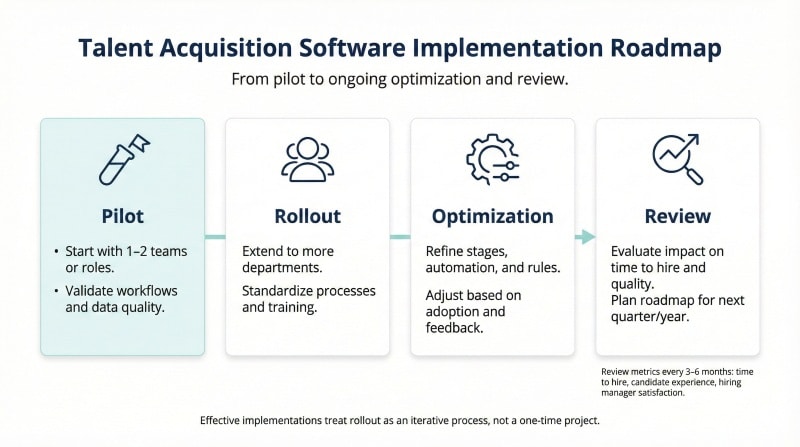
From Pilot to Rollout
Successful implementations usually start with a focused pilot:
- One region, department, or business unit
- Clear recruitment goals and success metrics
- Tight feedback loop between vendor, recruiters, and HR leadership
Only after the pilot proves value should you roll the system out broadly.
Continuous Improvement
This is where companies quietly stall. They implement the tool, celebrate, then forget to optimize it for the next three years. Implementation is not the end. To get the full benefit of talent acquisition software, you need ongoing optimization:
- Regular reviews of recruitment analytics
- Adjustments to workflows and stages
- Training refreshers for existing and new hiring teams
This is where many organizations go wrong: they automate old, flawed processes instead of redesigning them.
Compliance, Fairness, Blind Hiring & AI
Legal & Ethical Considerations
Whether you hire in one country or many, your talent acquisition process must comply with relevant labor, data protection, and anti-discrimination laws. Talent acquisition software should:
- Support consent management and data retention policies
- Provide clear logs of hiring decisions
- Allow you to export data for audits or investigations
Blind Hiring & Explainable AI
Blind hiring techniques, such as masking names or certain demographic information, can reduce bias, but they are not a cure-all. The combination of structured evaluation, training, and explainable AI is more powerful than any single tactic.
AI companions should never be a black box. You should know exactly how they influence rankings, suggestions, or interview prompts.
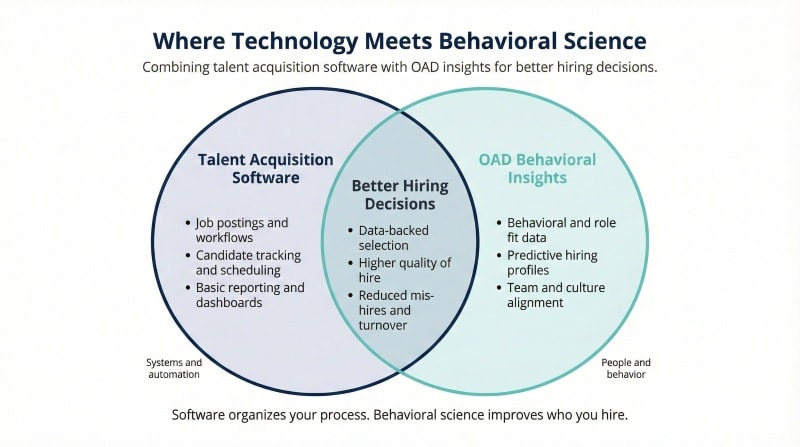
Where Talent Acquisition Software Ends – And Where OAD Begins
The Limits of Software-Only Approaches
Even the best talent acquisition software cannot tell you whether a candidate’s behavioral profile fits a specific role, team, or leadership culture. Research from the Society for Industrial and Organizational Psychology reinforces this gap: software tracks steps, but only behavioral science predicts performance. this It can track, automate, and surface data, but it cannot replace deep psychological insight.
How OAD Complements Talent Acquisition Software
This is where OAD’s science-based assessments add a layer traditional recruiting software does not provide. Integrated into your existing talent acquisition tools, OAD helps you:
- Align candidates with role requirements beyond the job description
- Understand how a candidate will communicate, decide, and respond to pressure
- Build teams with complementary profiles rather than accidental overlaps
Software organizes the recruiting process. OAD helps clarify who will thrive in the roles you are hiring for.
Conclusion and Next Steps
Summary of Key Takeaways
Talent acquisition software has moved from optional tool to critical infrastructure for any organization that wants to hire smarter and build long-term capability. The combination of:
- Robust applicant tracking
- Thoughtful candidate engagement
- Strong employer branding
- Clear recruitment analytics
- Responsible, explainable AI
allows HR leaders to hire top talent more consistently and transparently.
Testing OAD Alongside Your Talent Acquisition Software
If you already have a talent acquisition system in place, the next step is not replacing everything. The next step is enhancing your stack with better insight.
A live, no-risk trial allows your team to evaluate how OAD integrates into your current recruitment process and how it supports your hiring managers in making more confident, data-driven decisions.