Hiring manager software has moved from a “nice-to-have” tool to critical infrastructure for any organization that hires at scale. With rising talent shortages, complex hiring funnels, and pressure to reduce time to hire without sacrificing quality, the systems you choose directly shape how consistently your teams bring in the right people. This guide walks you through what hiring manager software actually does, how it fits into your tech stack, and how to choose a solution that supports high-quality, data-driven hiring decisions.
The Ultimate Guide to Hiring Manager Software
What Is Hiring Manager Software, Really?
Hiring manager software is the operational layer that helps hiring managers, HR, and recruiters coordinate everything between “We need someone” and “Here is your first day.” It brings applicant tracking, interview coordination, communication, and decision-making into one platform so you are not relying on spreadsheets, inboxes, and memory to run a complex hiring process. Hiring manager software covers all aspects of the hiring process, from sourcing candidates to onboarding new hires. Unlike generic recruiting software or a core HR system, hiring manager software is designed around the daily workflows of managers who own headcount and decisions, not just HR administrators who maintain records.
Most ‘recruiting systems’ are built for compliance and record-keeping. Hiring manager software is built for the moment a manager says, ‘I need someone in this seat in 6 weeks or we’ll miss our targets.’ Businesses of all sizes, from startups to large enterprises, rely on hiring manager software to streamline their hiring operations.
In practice, most organizations experience the limits of manual hiring sooner than they expect. Once you have multiple roles open at once, several hiring managers, and candidates moving through different stages, it becomes very easy to lose track of who is where in the funnel. Companies across various industries have adopted hiring manager software to address these challenges. That is where hiring manager software becomes less of a “nice upgrade” and more of a basic requirement for staying organized, responsive, and fair.
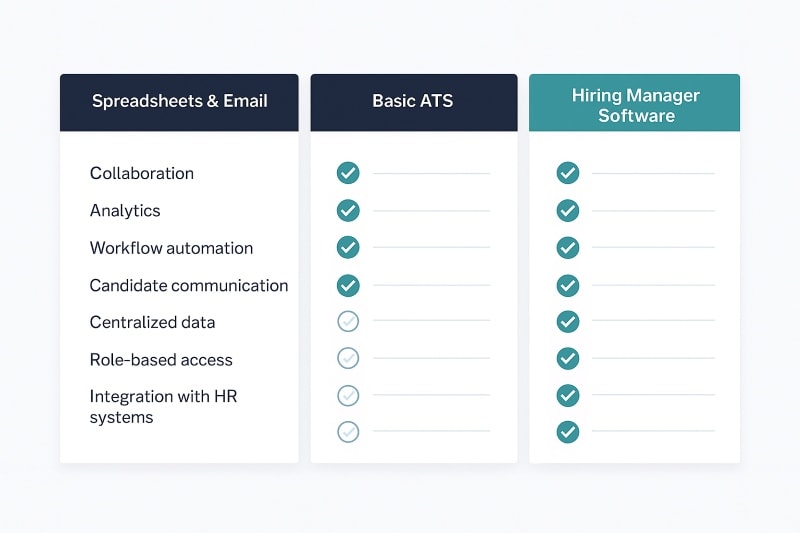
Compared to traditional HR systems, hiring manager software complements broader human resources functions by focusing on the specific needs of hiring teams and integrating seamlessly with existing HR workflows. As a solution designed to address the unique challenges faced by hiring managers, it streamlines the entire recruitment process and enhances collaboration between HR and hiring teams.
The Outcomes You Should Expect from Hiring Manager Software
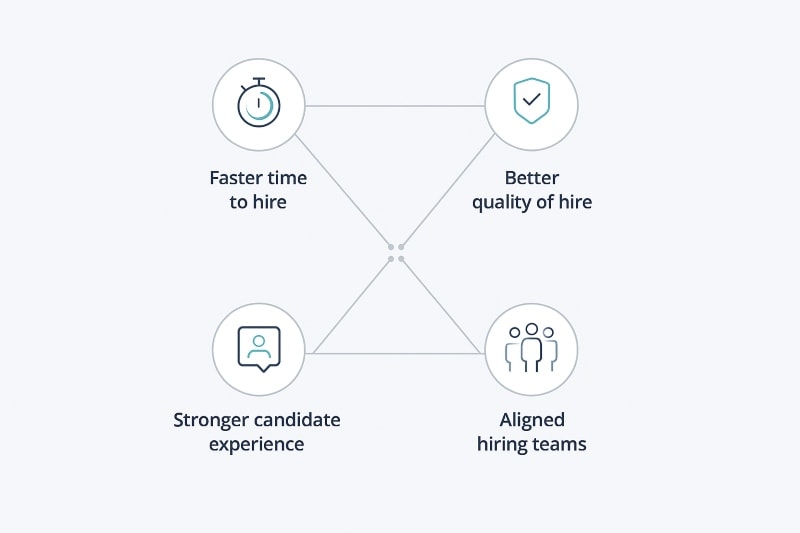
Before you compare features, it is worth getting clear on the outcomes you should expect from any serious hiring manager platform. Software is only worth the investment if it improves specific metrics and experiences that matter to your business. The right hiring manager software helps organizations save time and money by streamlining the hiring process and reducing manual work.
First, you should see a faster and more predictable time to hire. A structured platform removes bottlenecks like lost resumes, delayed feedback, and endless scheduling emails. When stages are clear and every stakeholder knows what they need to do next, roles move from “open” to “accepted offer” more consistently.
Second, hiring quality should improve. Good hiring manager software does not simply push more candidates through the pipeline. It makes it easier to apply structured criteria, compare candidates side by side, and document why a decision was made. Combined with a validated assessment like OAD, this structure supports more objective, repeatable hiring decisions.
Design teams with data, not gut feel.
Most org-design decisions come down to role fit, leadership style, and team dynamics. OAD reads those signals from a 7-minute behavioral survey, so you can reconfigure roles and teams with evidence instead of guesswork.
Third, the candidate experience should feel more professional. Candidates should receive timely updates, clear next steps, and consistent communication, whether they are ultimately hired or not. The right platform helps you create that experience at scale, rather than depending on each individual manager’s communication habits. Employees also benefit from smoother, more engaging onboarding, which helps them feel empowered and supported from day one.
Finally, your hiring teams should collaborate more effectively. Recruiters, hiring managers, and HR should be able to see the same information, comment in context, and move decisions forward inside the platform. When the software becomes the single source of truth for hiring, you reduce misalignment and unnecessary meetings.
Core Features of Modern Hiring Manager Software
Applicant Tracking and Hiring Funnel Management
At the center of any hiring manager platform is an applicant tracking system (ATS). This is where you manage all open positions, store candidate information, and track where each applicant is in the hiring funnel. A strong ATS gives you a clear view of stages such as application, screening, interviews, offer, and onboarding, with the ability to see how many candidates sit in each stage at any time.
Basic systems will allow you to move candidates between stages and attach notes. More advanced platforms give you configurable workflows, automatic reminders, templates, and guardrails that keep hiring managers from skipping critical steps. For example, you can require interview scorecards before a candidate can move to the next stage, or enforce that certain compliance checks are completed before an offer is approved.
The value here is visibility and consistency. Instead of each hiring manager running their own version of a process in their inbox, the ATS becomes the shared operating system for hiring. That is essential when you are hiring across multiple teams, sites, or countries.
Job Posting and Recruitment Marketing
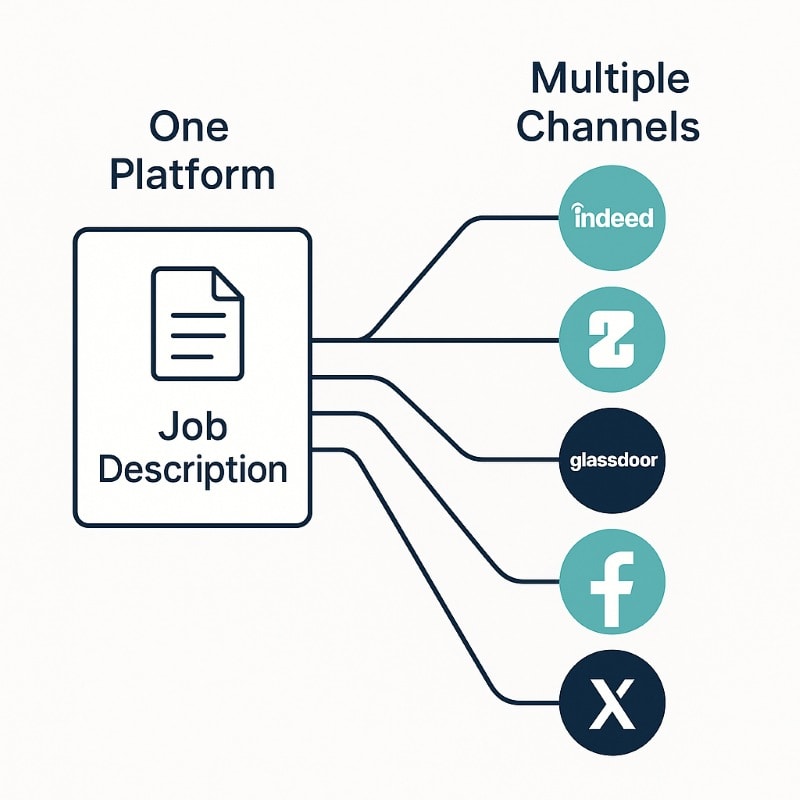
Most hiring manager software now includes tools for posting jobs to multiple job boards and channels in just a few clicks. This can include major job boards, niche industry sites, and your own careers page, as well as social networks where your employer brand is active. With integrated sourcing features, candidates can be efficiently sourced from multiple channels, allowing the software to automatically identify and pre-select suitable talent from a wide range of sources.
Centralizing job postings solves two problems. It saves time, since your team does not need to copy and paste descriptions across many platforms. It also gives you a single view of which channels actually deliver qualified candidates. Over time, you can see which job boards generate top talent, which only bring in volume, and where you may be overspending.
For teams focused on recruitment marketing, some platforms add branded landing pages, talent pool nurturing, and simple campaigns to keep past candidates engaged. Even if your strategy is not sophisticated yet, having job posting and sourcing data in one system gives you a foundation to improve.
Interview Scheduling and Coordination
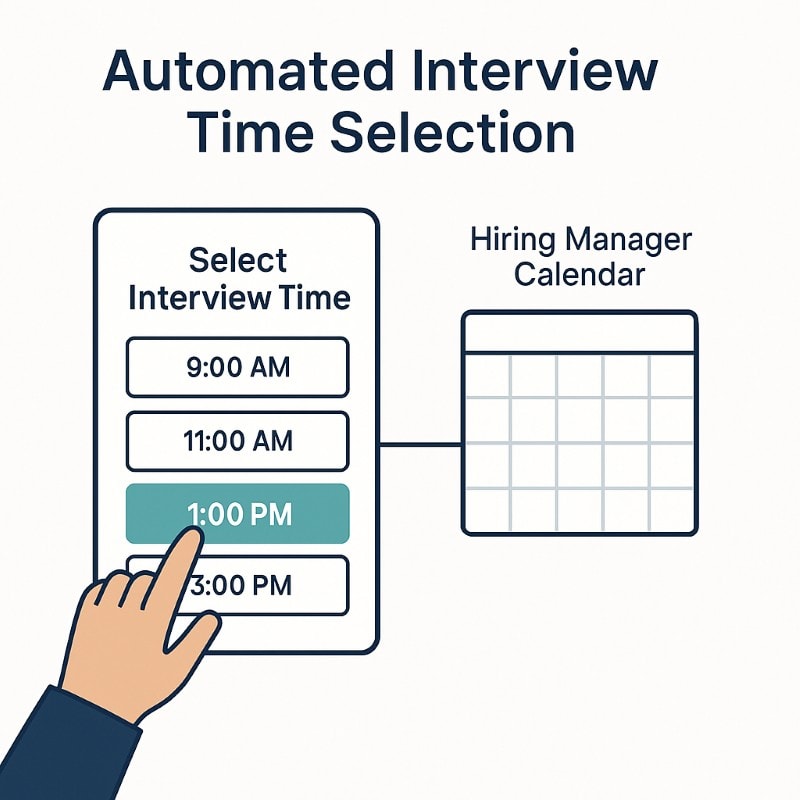
Interview scheduling is one of the most common sources of delay in the hiring process. When each interview requires multiple back-and-forth emails between candidates, recruiters, and managers, days are lost with every round. Modern hiring manager software automates much of this coordination, allowing users to manage schedules and schedule interviews with just one click, streamlining the process for all parties involved.
Typical capabilities include calendar integration, automatic time-slot suggestions, and self-scheduling links that allow candidates to pick available times. For global teams, time zone awareness becomes essential. More advanced tools can handle multi-step interview sequences and panel interviews, ensuring that everyone who needs to be present is available.
The goal is not just convenience, but reliability. When interviews are easy to schedule, they happen sooner and are less likely to be rescheduled. That keeps candidates engaged and reduces the risk that strong applicants accept another offer during delays.
Collaboration and Feedback Tools for Hiring Teams
Hiring is rarely a solo decision. Most roles require input from the hiring manager, one or more interviewers, HR, and often a senior leader. Without a shared platform, that collaboration tends to happen in long email threads, private notes, or informal conversations, which makes decisions opaque and hard to audit.
Effective hiring manager software provides structured ways to capture feedback and make decisions. This includes standardized interview scorecards, predefined competencies, rating scales, and comment fields that keep opinions anchored to observable evidence instead of impressions. It can also include @mentions, task assignments, and notifications so that the right people are prompted to review candidates at the right time.
Over time, these tools help you move from unstructured “gut feel” hiring to a more consistent, criteria-based process. When you combine structured feedback with OAD assessment data, hiring teams can discuss candidates using a shared language about traits, behaviors, and role fit instead of abstract impressions.

Analytics, Reporting, and Compliance
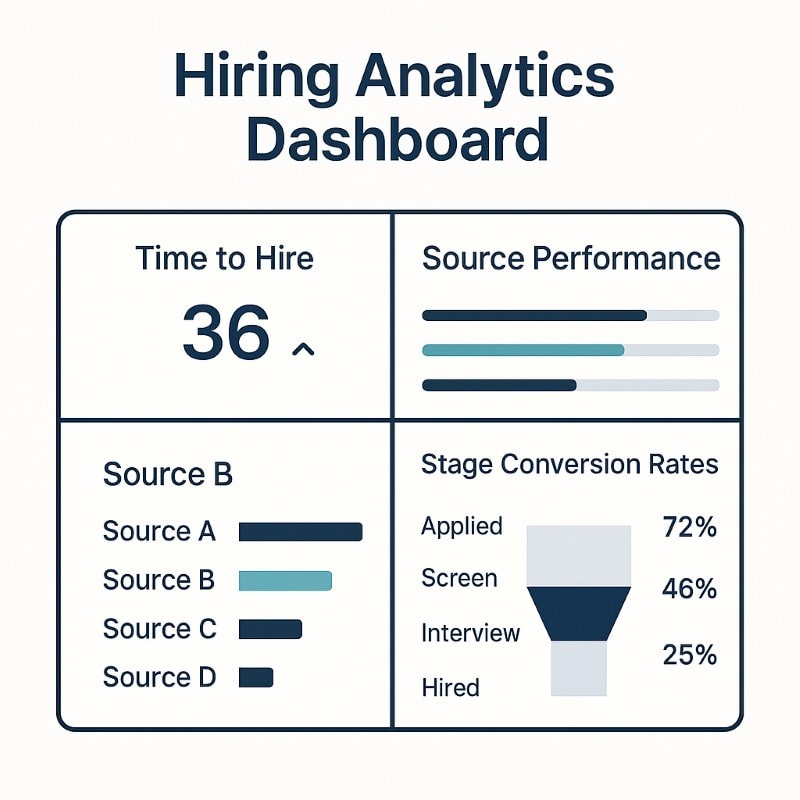
One of the strongest arguments for serious hiring manager software is the ability to measure the hiring process with more than anecdotes. Robust platforms provide analytics on time to hire, conversion rates between stages, source effectiveness, and offer acceptance rates, among other metrics.
These reports are not simply for HR dashboards. They inform real operational decisions. If you see that a particular stage consistently adds weeks to the process, you can redesign that step or add support. If certain job boards rarely lead to offers, you can reallocate budget. If a particular team has significantly longer time to hire than others, you can dig into whether the bottleneck is scheduling, feedback, or role design.
Compliance is another critical dimension. In many regions, organizations must be able to demonstrate fair, consistent processes and keep records for specified time periods. Centralized software helps you maintain that documentation without manual effort. The platform also enables organizations to stay compliant with industry regulations and standards such as GDPR, EEO, and CCPA by automating compliance processes and providing certification-backed trust. When questions arise, you can see who made which decision, when, and based on what information.
Integrations with HR and Core Systems
Finally, hiring manager software rarely stands alone. It should connect cleanly with your HRIS, payroll, onboarding tools, and any assessments you rely on. Integrations reduce manual data entry, prevent errors, and ensure that once a candidate becomes an employee, their information flows through correctly.
From an architectural standpoint, it is better to think in terms of an ecosystem than a single all-in-one platform. Your hiring manager software should be excellent at running the hiring process, while your HRIS should be excellent at managing the employee lifecycle. Assessment tools like OAD add depth by providing validated psychological insights that inform both selection and development.
When systems talk to each other, you gain both efficiency and insight. For example, you can compare OAD results and hiring data to performance and retention outcomes over time, building an internal evidence base for what “good” truly looks like in your environment.

How AI-Powered Hiring Tools Fit into Hiring Manager Software
Common AI Use Cases in Hiring Platforms
Many modern hiring manager tools now market AI capabilities as key differentiators. The most frequent use cases are AI-assisted sourcing, resume screening, candidate matching, chatbots for candidate communication, and automated scheduling.
AI sourcing tools scan external profiles or talent pools to identify candidates who appear to match your job requirements. Screening models can rank applicants based on predefined criteria, reducing the manual review load on recruiters and hiring managers. AI chatbots can answer candidate questions, guide them through application steps, and gather basic information without human intervention.
These features can be valuable, especially in high-volume environments. However, their effectiveness depends heavily on the quality of the data they are trained on and the clarity of the criteria you use to define success in a given role.
Predictive Analytics and “Top Talent” Scoring
Some platforms go further and offer predictive analytics that score candidates based on their estimated likelihood of success or retention. In theory, this can help prioritize interviews and focus manager time on the most promising profiles.
In practice, predictive models are only as good as the data they learn from. If historical hiring decisions were biased or inconsistent, an AI trained on that data can easily replicate and amplify those patterns. That is why organizations should treat predictive scores as one input among many, not as an automatic decision rule.
Tools like OAD complement predictive analytics by grounding decisions in validated measures of traits and behaviors. Instead of relying solely on opaque scores, you can evaluate candidates against role-specific profiles that have been tested and refined across many organizations and roles.
Design teams with data, not gut feel.
Most org-design decisions come down to role fit, leadership style, and team dynamics. OAD reads those signals from a 7-minute behavioral survey, so you can reconfigure roles and teams with evidence instead of guesswork.
Bias, Fairness, and Compliance Considerations
Regulators and courts are increasingly focused on how AI is used in hiring. Organizations that deploy AI-powered hiring tools need to understand not only what the models do, but how they are trained and monitored. You should be able to ask vendors for documentation on bias testing, model governance, and auditability.
From a practical standpoint, HR and legal teams should define clear guidelines for where AI is allowed to make recommendations and where human review is required. Automated screening may be acceptable as a first pass, but final decisions should always be traceable to documented criteria, structured interviews, and defensible assessments.

AI as Support, Not a Replacement for Judgment
The most effective organizations treat AI in hiring as decision support rather than decision replacement. AI can handle repetitive tasks, surface patterns in large datasets, and highlight candidates who might otherwise be overlooked. It cannot understand the strategic nuances of a role, the culture of a specific team, or the long-term trade-offs between different profiles.
That is why combining AI-enabled software with structured human tools is so powerful. Hiring manager software orchestrates the process. AI tools help with scale and speed. OAD assessments add validated insight into how a person is likely to behave and perform in a given context. Human leaders then make decisions based on a clearer, more complete picture.
Managing the Hiring Funnel with Data, Not Guesswork
Visualizing the Hiring Funnel
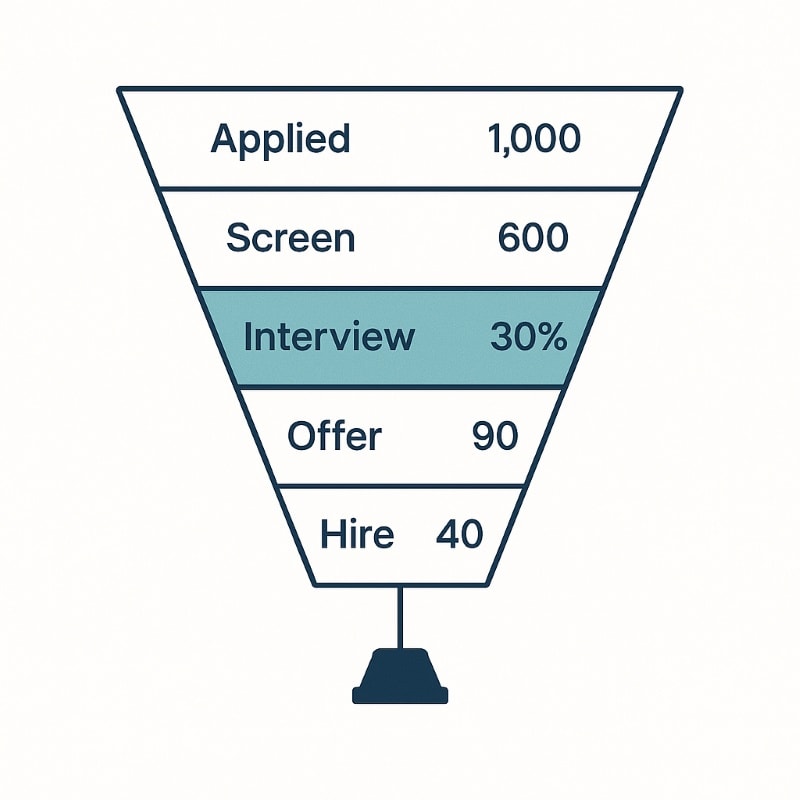
A core advantage of centralized hiring manager software is the ability to visualize your hiring funnel in real time. Instead of guessing how many candidates are in process for each role, you can see exactly how many applicants sit at each stage and how long they have been there.
This visibility is especially important for organizations with multiple locations, business units, or global teams. Leaders can spot where the funnel is healthy and where it is constricted. Roles with plenty of applicants but low progression may indicate screening or role clarity problems. Roles with strong progression but slow offers may point to approval bottlenecks or compensation misalignment.
Benchmarks and Service Levels for Hiring
Once your data is reliable, you can establish internal benchmarks and service level agreements (SLAs) for the hiring process. For example, you might define that all new applicants should be reviewed within a set number of days, or that feedback after interviews should be entered within 24 or 48 hours. Some organizations use the software to review applicants or update statuses once or twice a week to maintain momentum and ensure timely progress.
These benchmarks are not just operational niceties. They directly impact candidate experience and your ability to compete for top talent. When hiring managers consistently take weeks to respond, strong candidates move on. When recruiters have to chase feedback repeatedly, they spend less time on strategic sourcing and relationship-building.
Hiring manager software makes these patterns visible. You can see which teams consistently meet SLAs and which do not, then provide targeted support or adjust expectations accordingly.
Turning Data into Action
Collecting data is not the hard part anymore; acting on it is. The real value comes when HR and business leaders use hiring analytics to redesign processes, refine role requirements, or revisit decision criteria.
For example, if you see that a particular interview stage has a very low pass-through rate and disproportionately affects certain candidate groups, you may need to review the questions, scoring, or panel composition. If a specific sourcing channel yields many candidates but very few hires, you can either refine the messaging for that audience or redirect investment elsewhere.
When you layer OAD data on top of process analytics, you can go further. Over time, you can see which profiles tend to succeed in specific roles or teams, which helps you refine both your job design and your hiring criteria.
Designing a High-Quality Candidate Experience with Software
Communication Basics that Still Differentiate You
Despite all the technology available, many candidates still report being “ghosted” or left in the dark for long stretches. Simple, consistent communication remains one of the clearest ways to stand out as an employer.
Hiring manager software can automate status updates, interview confirmations, and rejections, but the tone and timing still matter. Templates should be clear, respectful, and realistic about timelines. Candidates should know what will happen next and when they can expect to hear from you.
Even when the answer is “no,” a timely, considerate response signals professionalism. Over time, that builds a stronger employer reputation and keeps your talent pool warmer, even among those who were not selected.
Feedback and Transparency
Not every candidate can receive detailed feedback at every stage, but your process should include clear points where more insight is given. Structured notes and scorecards in your software make it easier for hiring managers to provide specific, actionable feedback without starting from scratch each time.
Transparency also means setting expectations early. If your process includes multiple interviews, assessments, or case studies, candidates should know that upfront. When the software supports a clear process map and standardized messages, candidates are less likely to feel that requirements are changing arbitrarily.
Measuring Candidate Experience
If you want to improve candidate experience, you need to measure it. Many hiring platforms now include basic survey tools that can trigger feedback requests after certain stages, such as after an interview or after a decision is communicated.
Short, targeted surveys can provide useful insight without overwhelming candidates. Questions might cover clarity of communication, perceived fairness, and overall impression of the process. Over time, you can identify patterns: particular roles, teams, or stages where candidate satisfaction dips.
The point is not to chase a perfect score, but to understand where the experience you believe you are delivering diverges from what candidates actually perceive.
Protecting Your Talent Pool
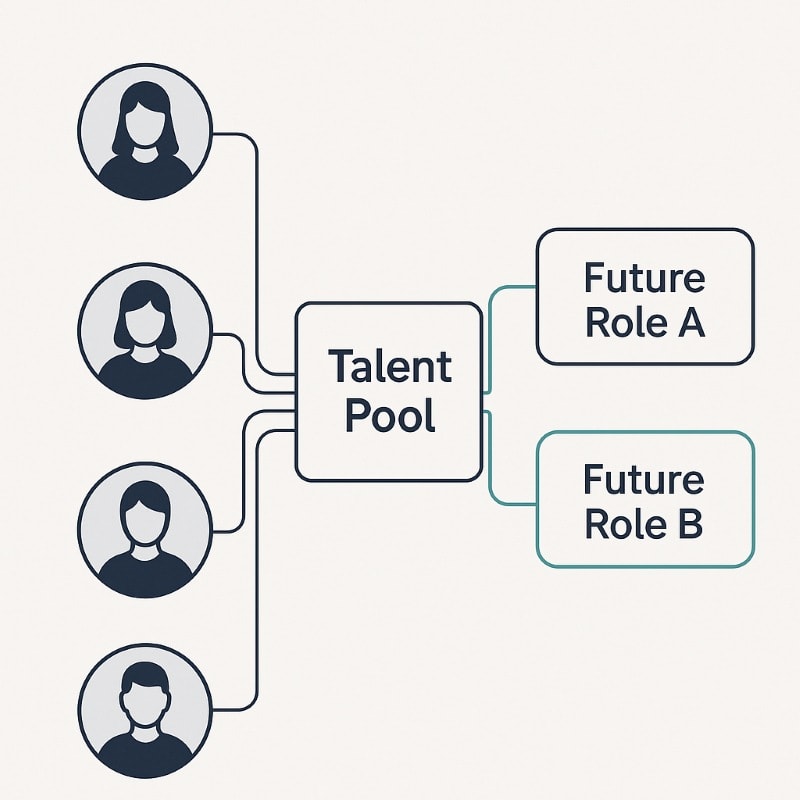
Every candidate interaction is part of your long-term talent strategy. Candidates you reject today may be a strong fit for a future role, or they may become customers, partners, or advocates. Poor communication or disorganized processes do not just cost you an immediate hire; they erode your future talent pool.
Hiring manager software helps you maintain a structured, searchable database of candidates who have already engaged with your company. With the right tagging and notes, you can identify promising candidates for future roles and re-engage them with tailored outreach. That is almost impossible to do reliably if candidate history is scattered across inboxes and spreadsheets.
Aligning Hiring Teams Around Better Decisions
Clarifying Roles in the Hiring Process
Misalignment in hiring often stems from unclear roles. Who is responsible for defining the role profile? Who owns sourcing? Who makes the final hiring decision? Who is accountable for time to hire? Without clear answers, delays and frustration are inevitable.
Hiring manager software does not solve role clarity by itself, but it provides a framework to implement it. Workflows can specify who needs to approve each step, who is assigned to interviews, and who is responsible for entering feedback. When responsibilities are embedded in the system, expectations become much easier to set and enforce.
Using the Platform to Reduce Noise
When feedback lives in long email chains or informal messages, it becomes difficult to reconstruct why a decision was made. It also opens the door for louder voices to dominate decisions, even if their input is not based on well-defined criteria.
Centralized platforms reduce that noise. Each interviewer completes a scorecard. Comments are logged in one place. Hiring managers can compare perspectives without trying to reconcile conflicting stories from different channels. HR can review decisions for consistency and fairness.
This structure is particularly valuable when combined with OAD’s framework for role fit. Instead of arguing about vague terms like “culture fit,” teams can discuss specific behavioral traits and job demands using shared language and evidence.
Collaboration Metrics and Coaching Opportunities
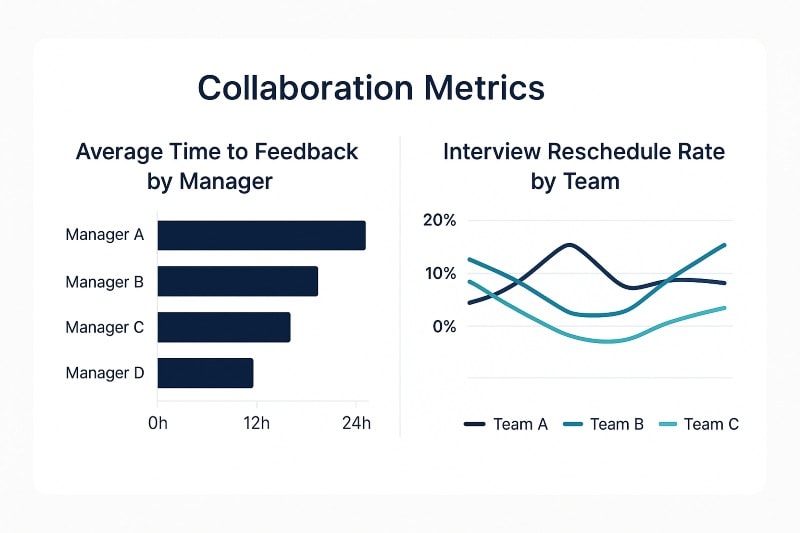
If you track who submits feedback when, how long decisions take, and how often interviews are rescheduled, you gain a clearer picture of how effectively your hiring teams are collaborating. These are not metrics to punish people with, but tools to identify where support or coaching is needed.
For example, if a manager consistently delays feedback, you can explore whether they are overloaded, unclear on expectations, or unconvinced of the process value. If a team frequently changes requirements mid-search, you may need to improve upfront role definition and stakeholder alignment.
Evaluating Hiring Manager Software: A Practical Framework
Clarify Your Hiring Needs First
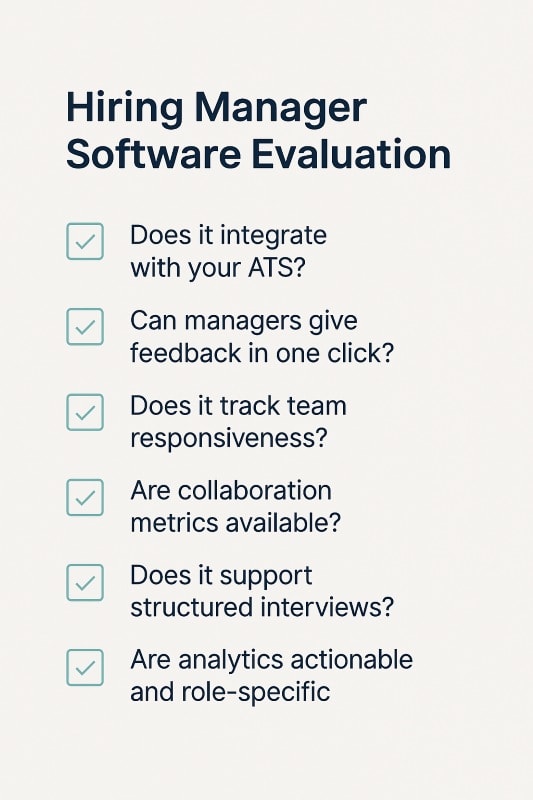
Before you look at feature matrices, you need a clear picture of what you are hiring for and at what scale. A company making a handful of senior hires per year has different needs than one filling dozens of operational roles each month.
Consider factors like volume of hires, role complexity, geographic spread, and the mix between internal recruiters and external agencies. Clarify whether your main challenges are sourcing, screening, scheduling, decision-making, or onboarding. This prevents you from being seduced by impressive features that will not meaningfully change your outcomes.
Know Your Non-Negotiables
Some requirements should be non-negotiable: data security standards, integration with your core HR systems, basic analytics, and the ability to configure workflows without constant vendor intervention. Compliance requirements in your jurisdictions may also dictate minimum capabilities around documentation and record retention.
Beyond that, you can group features into “must-have,” “nice-to-have,” and “future phase.” AI chatbots, advanced recruitment marketing tools, or highly customized career sites might belong in later phases for many organizations. Starting with a realistic, prioritized list keeps the selection process grounded.
Understand Total Cost of Ownership
Licensing fees are only part of the cost. Implementation, training, change management, and ongoing administration all consume time and budget. A platform that looks affordable on paper can become expensive if it requires constant specialist support to make basic changes.
During evaluation, ask vendors for clear examples of typical implementation timelines, the level of internal resources required, and what is included in standard support versus premium services. Consider how easily your team can adapt and configure the platform after the initial project is complete.
Questions to Ask Vendors
To move beyond marketing claims, ask concrete questions:
- How do you support hiring managers specifically, beyond recruiter workflows?
- What reporting do HR leaders and executives actually use most in your system?
- How transparent are your AI models, if you offer them?
- What integrations are live and maintained, not just “on the roadmap”?
- How do you train and support customers during the first 6–12 months?
The goal is not to find a perfect system, but to find one that aligns with your hiring needs, culture, and existing tech stack.
Where Hiring Manager Software Ends – and Where OAD Begins
Efficiency vs. Accuracy in Hiring
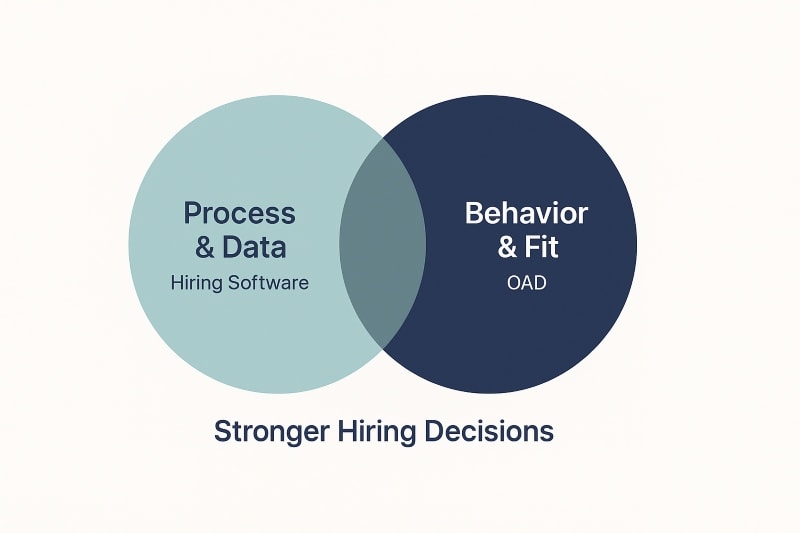
Hiring manager software is excellent at orchestrating the process: posting jobs, moving candidates through stages, coordinating interviews, and recording decisions. What it does not inherently provide is a scientifically grounded way to determine whether a candidate truly fits the role, team, and culture.
That is where OAD comes in. OAD focuses on the accuracy of hiring decisions by measuring the underlying traits and behaviors that drive performance. When you combine efficient process software with a validated assessment, you reduce both mis-hire risk and time spent debating subjective impressions.
Defining “What Good Looks Like” for Each Role
A common challenge in hiring is that stakeholders hold different mental models of an “ideal” candidate. Some prioritize experience, others communication style, others problem-solving or resilience. Without a shared definition, interviews become inconsistent and decisions become harder to explain.
OAD helps you define what success in a specific role actually looks like, in terms of measurable traits and behavioral tendencies. Those role profiles give hiring managers a clearer target and turn vague requirements into something concrete. Hiring manager software can then operationalize those profiles by attaching them to requisitions, interviews, and evaluation forms.
Combining OAD Insights with Platform Data
When your hiring manager software integrates with OAD, you gain a richer picture of what is working. You can compare assessment results, process data, and long-term outcomes like performance and retention. Over time, your organization builds its own evidence base for which profiles thrive in which roles and environments.
This is where hiring becomes truly strategic. Instead of treating each hire as an isolated decision, you learn from patterns and refine both process and profiles. OAD and your software together turn hiring from a reactive activity into a continuous learning system.
Implementing Hiring Manager Software So People Actually Use It
Start with a Focused Pilot
Rolling out a new hiring platform across the entire organization in one step often creates confusion and resistance. A focused pilot with a few business units, role types, or regions lets you test workflows, gather feedback, and adjust before scaling.
Define clear success criteria for the pilot: time to hire improvements, adoption rates, candidate satisfaction, or manager satisfaction. Use the pilot to identify what training and support people actually need, rather than guessing.
Invest in Training for Hiring Managers
Recruiters and HR professionals are used to learning new tools. Many hiring managers are not. If you want managers to engage with the platform consistently, training must be simple, relevant, and tied to their real work.
Short, scenario-based sessions often work better than long generic trainings. Show managers how the software saves them time, reduces duplicate conversations, and improves their ability to hire the right people. Provide job aids and short videos they can refer back to when needed.
Treat Change Management as Part of the Project
Technology alone does not change behavior. Communicate clearly why you are implementing the software, how it will help the business, and what you expect from different stakeholders. Make it easy for people to raise issues and questions early, before frustration builds.
Leadership support matters here. When senior leaders use reports from the new system in their discussions and hold teams accountable for data quality and process adherence, adoption increases. When they ignore the system and continue to rely on informal updates, people quickly learn that the platform is optional.
Measure Impact in the First Year
From the first months, monitor key indicators: adoption rates, time to hire, candidate experience scores, and manager satisfaction. Expect some disruption as people adjust, but look for steady improvement over the first year.
If certain parts of the process are not working, adjust workflows, templates, or training rather than abandoning the system. Hiring manager software is most effective when it is continuously tuned to your organization, not treated as a one-time installation.

Common Traps to Avoid with Hiring Manager Software
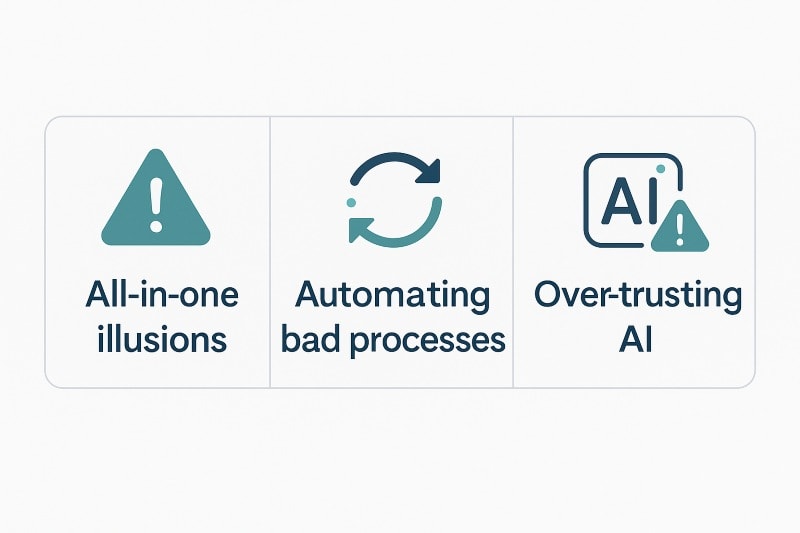
Even well-chosen platforms can underperform if they are misused or poorly implemented. Some traps show up repeatedly across organizations.
One trap is buying an “all-in-one” platform that promises to solve every HR problem, then discovering that adoption is low because the system is complex and unintuitive. Depth in the hiring workflow matters more than having every conceivable feature in one place.
Another trap is automating a broken process. If your role definitions are unclear, interviewers are untrained, or decision criteria are inconsistent, software will simply make those problems more efficient. It is worth investing time in designing a good process before you automate it.
A third trap is over-relying on AI scores or automation and underinvesting in human judgment and structured assessment. AI can help handle volume, but it cannot replace the work of understanding what your specific organization needs in a role and how a person is likely to behave once hired.
Finally, some organizations underestimate the cultural side of hiring tools. When hiring is seen as an administrative chore rather than a core leadership responsibility, no platform will fully fix the problem. The most effective software implementations happen where leaders already care deeply about who they hire and see the platform as a way to support that responsibility.
Conclusion: Turning Hiring Manager Software into a Real Advantage
Hiring manager software is no longer just about digitizing paperwork or moving away from spreadsheets. Used well, it becomes the operating system for how your organization attracts, evaluates, and selects talent. The right platform helps you shorten time to hire, improve candidate experience, and align hiring teams around consistent, data-driven decisions.
Yet process efficiency is only half of the equation. The other half is the accuracy of those decisions. That is where combining your software with a scientifically validated assessment like OAD creates a meaningful edge. You gain both the structure to run a reliable process and the insight to understand who is most likely to succeed in each role and team.
If you are reviewing your hiring stack or considering a new platform, it is an ideal moment to rethink how you define and measure “fit.” Instead of relying on intuition alone, you can test OAD and see how data-backed insights into behavior and motivation sharpen your hiring decisions, reduce mis-hires, and support long-term growth.