Welcome to the show. Edwin, I want to start with a line that shows up in hiring meetings constantly: “I just don’t think they’re a fit.” Fourteen words—and somehow that can outweigh a CV, a work sample, even a strong panel interview.
Yes, and those fourteen words are doing far more work than people realize. “Not a fit” can mean the candidate challenged me, or they were nervous, or they didn’t communicate the way I prefer. And sometimes, if we’re being honest, it simply means they didn’t feel familiar in a way that makes us comfortable.
So when people say they’re testing fit… they might actually be testing familiarity. Or just… confidence theater.
Exactly. Interview polish is not the same as future performance. Some of the most polished candidates I’ve seen struggled once hired. And some of the quieter ones—the ones who needed a moment to think—ended up being steady, collaborative, and highly effective.
Then how do you stop “fit” from becoming this catch-all excuse? Because I get why teams care about it. If someone genuinely clashes with the way the team works, that’s a real problem.
It is, and that’s the tension worth preserving. Culture fit is not meaningless. Teams tend to perform better when people understand the mission, operate within shared norms, and want to contribute. That can improve engagement, reduce friction, even support retention. The problem starts when fit quietly becomes sameness.
Sameness—that’s the word. Not shared values. Sameness. Those are not the same thing.
Very different. Shared values sound like: we give direct feedback, we take ownership, we collaborate across teams. Sameness sounds like: this person feels easy to me, I’d enjoy spending time with them. That’s not a hiring standard. It’s a preference.
“Would I grab a drink with them” is probably the most expensive question nobody admits they’re asking.
And it leads to homogeneity. You hire people who feel familiar, and then you wonder why the team thinks the same way and misses the same blind spots. A better approach is to break the interview into categories: behavioral, technical, and values alignment. Not chemistry—categories.
Okay, make that practical. If I’m a manager listening to this on my commute, what do those three buckets actually give me?
Each one answers a different risk. Behavioral questions show patterns from real experience. Technical questions test whether the person can actually do the work. Values or culture questions examine how they operate with others and relate to the mission. When you separate those, you reduce the chance that charm fills the gaps.
“Charm fills the gaps.” That’s… painfully accurate. So instead of one vague impression, you’re asking: have they done similar work, can they do this job, and will they operate in a way that supports the team without needing everyone to be identical.
That’s the goal. The strongest hiring processes don’t chase a feeling. They collect enough comparable evidence that the decision can be explained afterward. If you can’t explain why Candidate A was chosen over Candidate B without using words like “energy” or “presence,” the process is weak.
And probably biased, even if nobody intended it.
Yes. Bias tends to enter through ambiguity. The less defined your criteria, the easier it is for preference to present itself as judgment.
Okay, so let’s tighten the system. Behavioral questions first. I hear “Tell me about a challenge” all the time, and then… nothing. No follow-up, no depth.
That’s a missed opportunity. Behavioral questions only work if they produce specific evidence. Instead of “Tell me about a challenge,” ask, “Tell me about a time you made a mistake that affected other people. What happened, what did you do next, and what changed afterward?” Now you’re testing accountability, not just storytelling.
The “affected other people” part really changes it. That forces them to go beyond a safe answer.
Exactly. And the follow-up is where the real signal appears. What was your role? What feedback did you receive? What would your manager say you learned? Candidates can rehearse a summary. It’s much harder to construct detailed, consistent answers under follow-up.
So the clever question isn’t the advantage. It’s the discipline afterward.
Usually, yes. The same applies to conflict. Don’t ask, “Are you good with conflict?” Everyone will say yes. Ask for a specific disagreement, how they handled it, and what the outcome was. Then listen for ownership, respect, and whether they can reflect without deflecting.
What about stress? Every role is “fast-paced” now. Apparently every company is dynamic and every team wears multiple hats.
Yes, the universal description. A stronger approach is to ask about a period where priorities shifted quickly. How did they decide what to do first, and what did they communicate to others? That reveals judgment, not just resilience language.
Now technical interviews—this is where things can get… theatrical. Puzzles, trick questions, things that feel impressive but not relevant.
And those should be avoided. Technical questions should reflect the actual work. If the role involves troubleshooting, give a realistic scenario. If it involves analysis, present real data. If it involves writing, ask for a short writing sample. The closer the task is to the job, the more useful the signal.
And for culture questions, we’re not asking if we’d enjoy spending time with them. We’re asking how they work.
Correct. Questions like: what kind of environment helps you perform best, how do you handle expectations outside standard hours, what does effective collaboration look like to you. These surface alignment without requiring similarity.
The after-hours question is a good one. That’s the kind of mismatch you want to catch early, not after someone’s already joined.
Exactly. And then comes the part many teams skip: consistency. Ask the same core questions, use a defined scorecard, and evaluate independently before discussing as a group. You’re building multiple points of evidence around the same decision.
Multiple points of evidence. Not one impressive conversation.
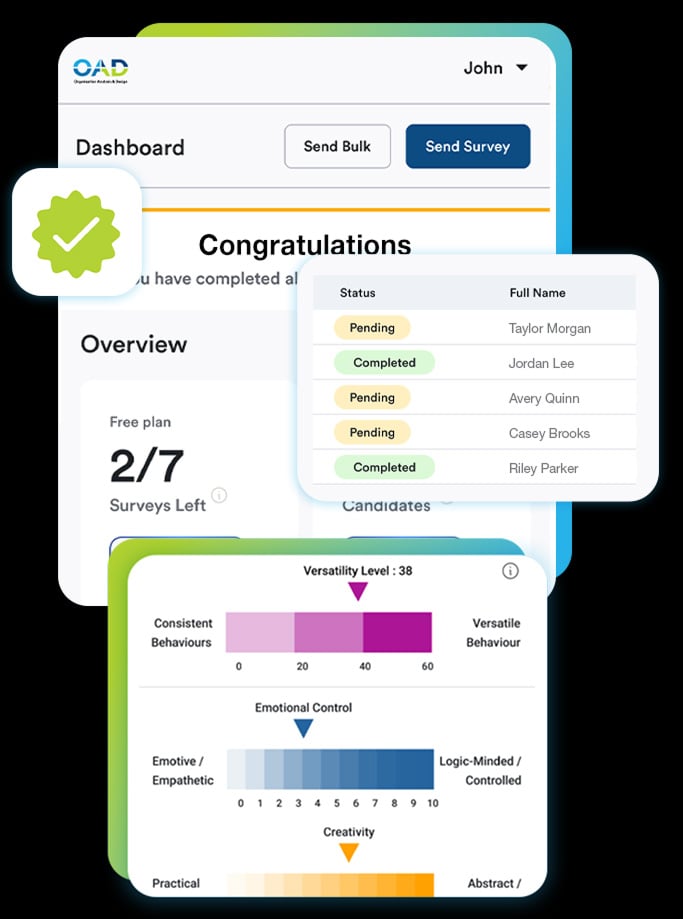
Yes. Hiring should reward evidence, not charisma. And if you’re trying to make that shift—toward a more structured, consistent process—tools like OAD can help. You can test their approach, including behavioral assessments, for free at o-a-d-dot-a-i and start reducing some of that guesswork.
It really comes back to respect, doesn’t it? Respect for the role, for the candidate, and for the cost of getting it wrong.
It does. Every hiring decision shapes the future of the team. If you choose based on evidence, you build capability. If you choose based on comfort, you build an echo.
That’s a sharp way to put it. Thanks for listening to The Science of Leading.
We’ll see you next time.