Hiring is a prediction task. You are trying to predict how someone will behave when the work is real: under deadlines, with unclear priorities, around conflict, and inside your company’s constraints.
Most hiring processes are not built for prediction. They are built for presentation. Resumes reward storytelling. Interviews reward confidence. References often reward politeness. Then hiring managers act surprised when “great in interviews” becomes “unreliable in execution.”
This article shows how to predict candidate behavior with evidence you can actually use. The core shift is simple: stop treating hiring like a one-time performance review, and start treating it like an evidence process. The FBI comparison matters for one reason only: they separate claims from proof, look for patterns across incidents, and document decisions in a way that holds up when outcomes are audited.
We can borrow that mindset ethically for hiring. No theatrics. No “lie detection.” Just better evidence, better structure, and more informed hiring decisions.
Why Hiring Struggles to Predict Candidate Behavior
Resume screening overweights the wrong signals
Most recruitment process steps begin with resume screening. Resumes help confirm baseline requirements: relevant experience, technical skills, and career progression. They are weak at showing how someone behaves at work.
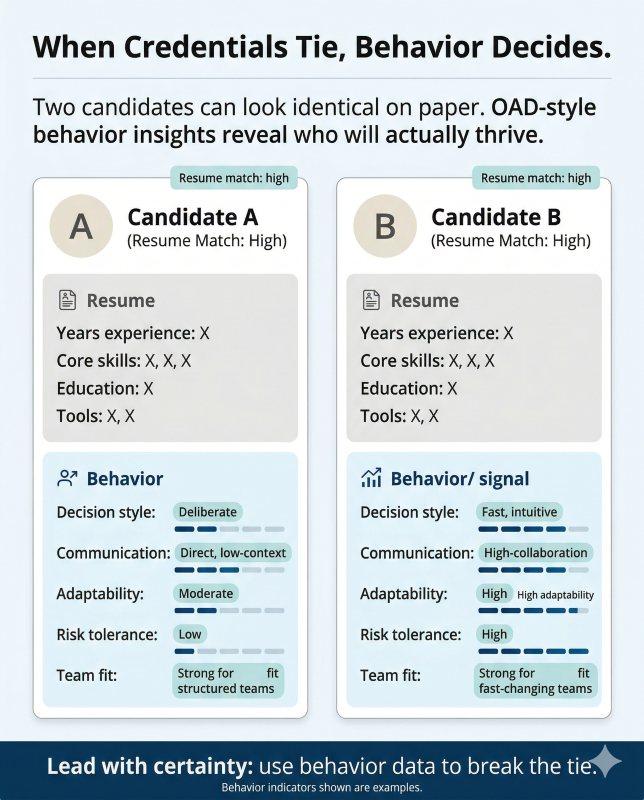
Two candidates can list the same outcomes while getting there in completely different ways:
- One is consistent, coachable, and accountable.
- The other is reactive, hard to work with, and unreliable under pressure.
Both can look identical on paper because resumes are optimized for presentation, not behavior frequency or behavior under constraints.
If your early filtering is built on credentials alone, you do not “identify candidates” who will succeed. You identify candidates who can package their past well instead of assessing behavioral fit for the role.
Interviews reward confidence, not future performance
Unstructured interviews are especially bad at predicting future job performance because they amplify subjective impressions and make it harder to assess real-world communication skills. The most polished communicator often sounds like the safest hire, even when their real-world follow-through is inconsistent.
This is where gut feelings quietly take over:
- “They seem sharp.”
- “I like their energy.”
- “They would fit our company culture.”
None of that is inherently useless. The problem is that it becomes the decision system. You end up selecting for interview performance rather than work behavior.
If your goal is to predict future behavior, you need more than “seems competent.” You need observable data points: what they did, how they decided, what happened next, and what changed after feedback.
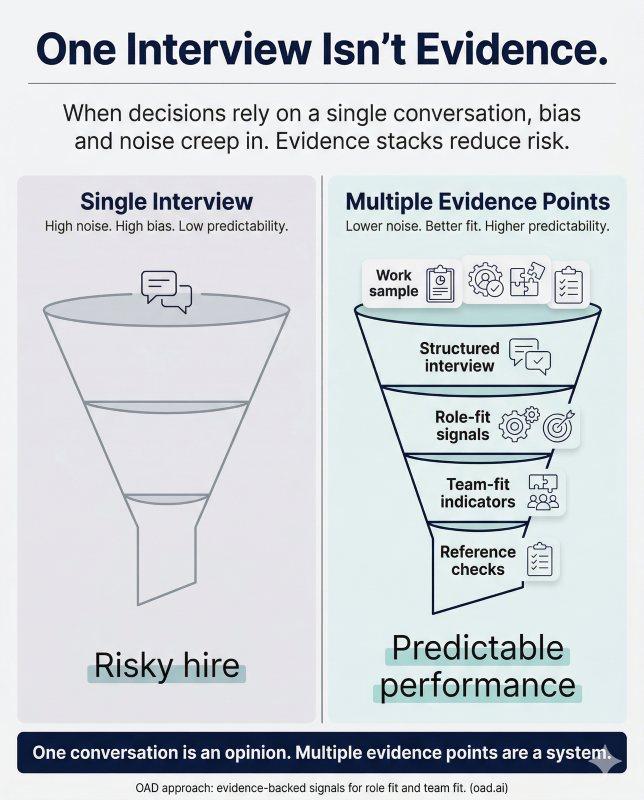
One-off interviews create false certainty from thin evidence
A single interview is a snapshot. Candidate behavior is a pattern.
One good conversation does not tell you how someone behaves:
- when priorities conflict,
- when they disagree with a manager,
- when they fail,
- when they need to learn fast,
- when the work is boring and repetitive.
Prediction requires repeatable evidence across more than one moment. Without that, hiring decisions become a confidence contest, not an assessment.
That is why many organizations end up with “surprising” hiring outcomes. The process did not fail because the candidate tricked anyone. It failed because the process did not collect enough objective data to justify the prediction.
Why Interview Performance Isn’t Candidate Behavior
Coached answers are not the same as real actions
Behavioral interviews are supposed to reveal past behavior. In practice, they often reveal how well someone prepared.
The best candidates do prepare. That’s normal. The problem is that preparation can turn into performance: polished STAR stories, clean lessons learned, perfect conflict resolution arcs. These stories can be real and still be strategically edited to hide the messy parts that matter for prediction.
If you want to predict candidate behavior, you need detail that is hard to fake at speed:
- sequence of actions (what happened first, then what),
- constraints (time, resources, unclear ownership),
- tradeoffs (what they chose not to do),
- consequences (what broke, who disagreed, what they learned).
When answers stay high-level, you are evaluating storytelling ability, not behavior.
Context shifts change behavior, even for strong people
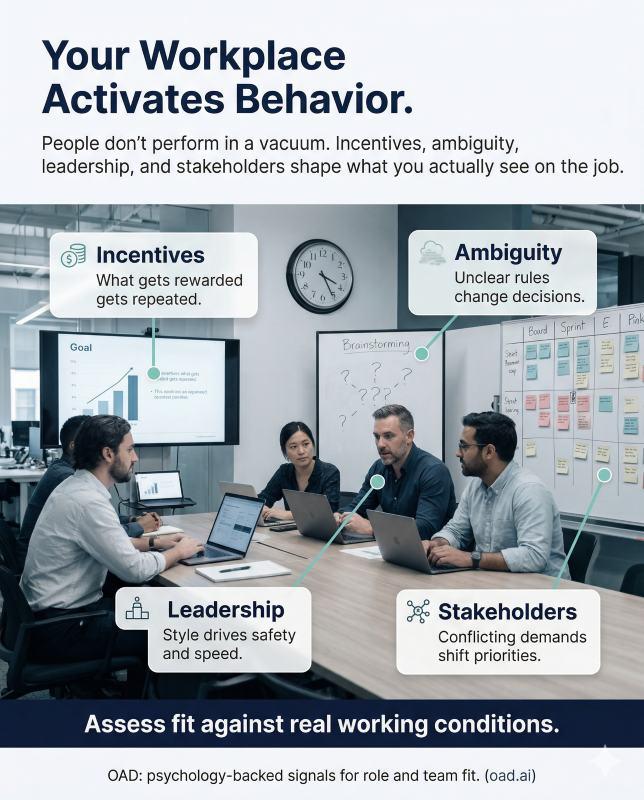
Candidate behavior is not a fixed personality trait. It is behavior in context, including how well someone aligns with and adds to your existing culture through behavioral fit.
A person can look outstanding in one environment and struggle in another because:
- incentives change (speed vs quality),
- ambiguity changes (clear tasks vs messy problems),
- team dynamics change (high trust vs political friction),
- leadership changes (hands-on vs hands-off),
- role scope changes (individual execution vs cross-functional influence).
This is why relying on generic “strengths” is risky. You need role-specific behaviors tied to your success indicators and a clear view of what truly motivates and drives your hires. If you do not define the behaviors the role requires, you will overvalue personal characteristics that look impressive but do not translate into performance in your environment.
“Can do” vs “will do”
Technical ability matters. But “can do” is capacity. “Will do” is consistency under real constraints.
Many hiring failures are not because someone lacked skill. They are because they did not:
- communicate early when blocked,
- prioritize intelligently,
- recover after mistakes,
- manage stakeholder expectations,
- sustain effort on unglamorous tasks.
Those are behavioral patterns. If you do not measure them, you are guessing.
Design teams with data, not gut feel.
Most org-design decisions come down to role fit, leadership style, and team dynamics. OAD reads those signals from a 7-minute behavioral survey, so you can reconfigure roles and teams with evidence instead of guesswork.
Where Behavioral Interviews Go Wrong
Predictable questions invite predictable answers
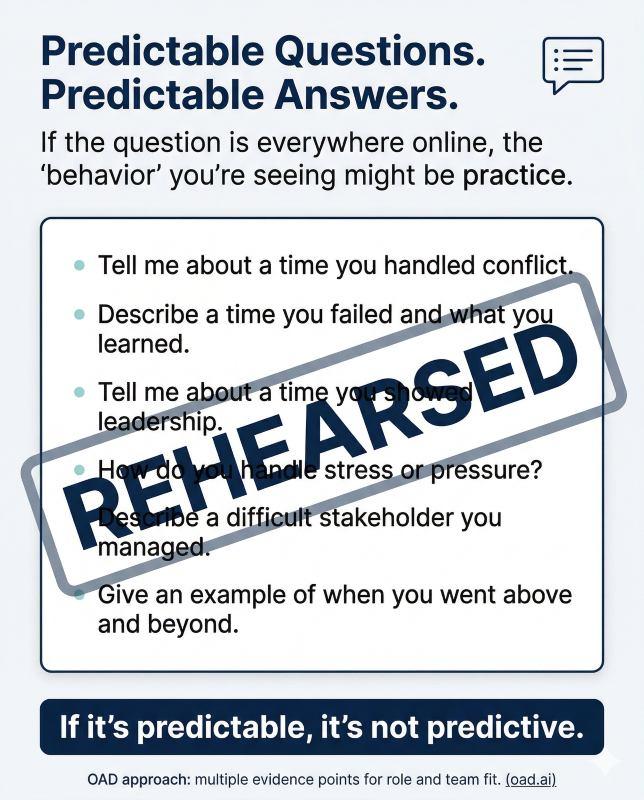
Most behavioral interviews use the same few prompts instead of drawing on broader data-driven hiring and talent insights:
- “Tell me about a time you handled conflict.”
- “Tell me about a time you showed leadership.”
- “Tell me about a time you failed.”
Candidates can rehearse these. Coaching markets exist specifically to teach “correct” responses. The more predictable the interview, the less it differentiates real patterns.
This does not mean behavioral interviews are useless. It means the design is often too easy to game.
Weak probing produces vague answers and weak scoring
Even when candidates share real examples, interviewers often do not probe. They accept the narrative at face value. Then they score based on vibes.
This creates two problems:
- The interview lacks objective data.
- The scoring is not repeatable across hiring managers.
If two interviewers cannot reliably score the same answer the same way, you do not have a hiring practice. You have opinions.
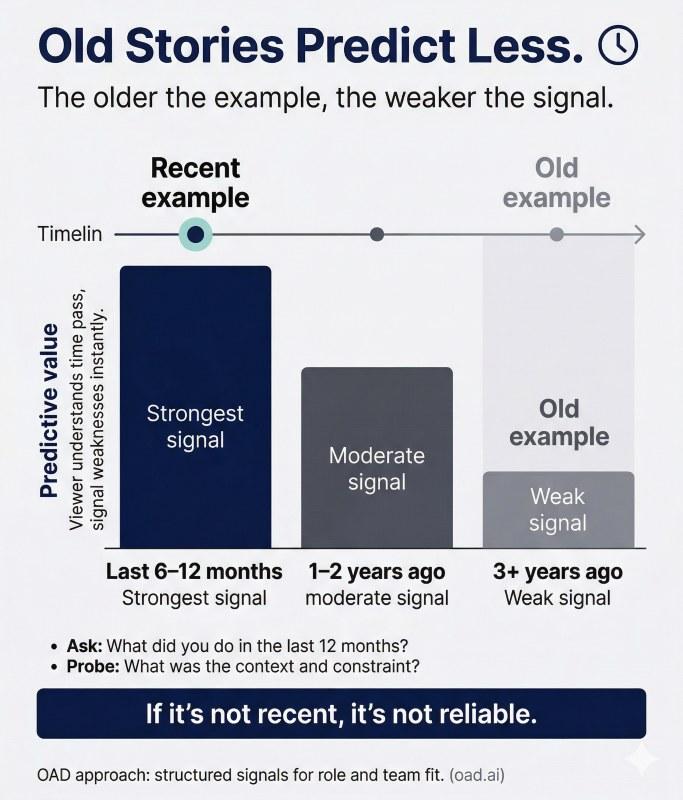
Old stories are weaker predictors
The farther an example is from today, the weaker it is for prediction. People change. Roles change. Context changes.
If your best evidence is from five years ago, you are forecasting future behavior using expired data points. Strong interviews prioritize recent, comparable incidents tied to the role you are hiring for.
Upgrade Your Behavioral Interviews (Without Adding Hours)
The goal is not “more interviews.” The goal is better evidence per minute.
Require two recent examples per competency
Pick 4–6 key competencies for the role. For each one, require two examples from the last 12–18 months when possible.
Two examples do three things, especially when paired with a quick, validated behavioral survey completed before interviews:
- reduces one-off story bias,
- reveals whether behavior is consistent or situational,
- makes it harder to rely on a single curated success story.

Use follow-up probes that force observable detail
A strong behavioral interview sounds less like Q&A and more like incident reconstruction, which is critical when you are trying to build consistently high-performing sales teams.
Core probe set (use consistently):
- “What did you do first?”
- “What options did you consider?”
- “What tradeoff did you accept?”
- “Who disagreed and what happened?”
- “What was the measurable outcome?”
- “What changed in your approach afterward?”
These prompts elicit detailed responses and reduce narrative control.
Add one deviance probe per competency
One deviance probe surfaces edge cases where scripted answers break:
- “Tell me about a time this approach did not work.”
- “When did you miss a deadline, and what happened next?”
- “When did you get feedback you did not agree with?”
People who have real experience can answer with specificity. People running a polished script often struggle here.
Anchor scoring so it’s repeatable
Use a structured format with anchored definitions, not abstract labels like “strong communicator.”
Example anchor (for “ownership”):
- 1 = blames context, avoids accountability, no corrective action
- 3 = owns the issue, explains actions, partial corrective learning
- 5 = owns the issue, prevents recurrence, communicates early, improves systems
Anchors turn subjective impressions into usable, comparable data that can flag turnover risk and team fit issues early.
Design teams with data, not gut feel.
Most org-design decisions come down to role fit, leadership style, and team dynamics. OAD reads those signals from a 7-minute behavioral survey, so you can reconfigure roles and teams with evidence instead of guesswork.
What the FBI Gets Right (And How Hiring Can Borrow It Ethically)
This is the part where people get weird and start thinking about “spotting liars.” Don’t. That’s not the lesson.
The useful lesson is procedural: evidence, patterns, corroboration, documentation.
Incident-based evidence beats general claims
When someone says, “I’m highly accountable,” that is a claim. The FBI mindset would ask: show the incident.
In hiring, the equivalent is structured incident analysis:
- situation and constraints,
- actions taken,
- decisions and tradeoffs,
- results and consequences,
- learning and change.
This converts soft statements into evaluable data points, which is the same shift private equity firms need when they evaluate leadership teams and culture risk.
Pattern recognition across episodes
One incident can be a fluke. Patterns are predictive.
Across two examples, you can see:
- how they handle ambiguity,
- how they respond to feedback,
- whether they escalate issues early,
- whether they prioritize based on outcomes.
That’s how you predict future behavior without pretending you have magical insight.
Corroboration and documentation
Hiring teams often treat interviews as primary truth. Corroboration means validating key claims through additional data sources:
- structured references (focused on role-critical behaviors),
- work samples (where relevant),
- assessment outputs aligned to success indicators.
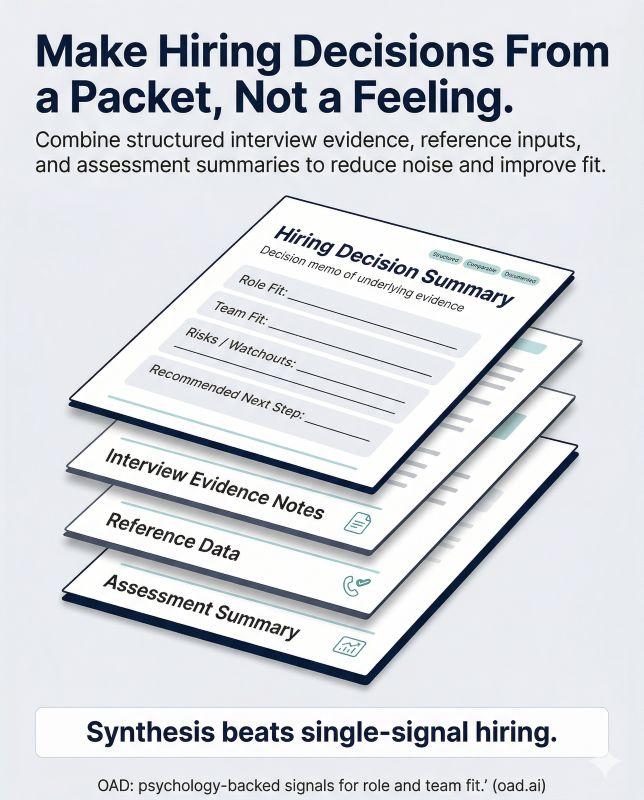
Documentation means writing down evidence in a consistent format so decisions can be reviewed later, especially when outcomes differ from expectations. That is how a recruitment process improves instead of repeating the same hiring mistakes forever and gives leaders better inputs for data-informed coaching and development.
Add a Short, Scientifically Validated Assessment to Improve Prediction
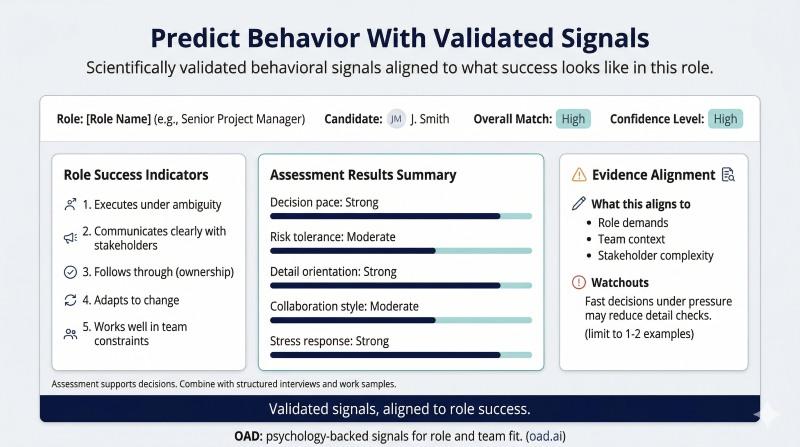
Interviews are human judgment under time pressure. That’s where bias and noise thrive. A validated assessment adds structure, consistency, and objective data.
The key is using assessments correctly:
- short enough to be practical,
- validated (scientifically validated, not marketing claims),
- job-relevant (linked to role success indicators),
- interpreted with care (not treated as destiny).
A good behavioral assessment does not replace human judgment. It improves it by giving hiring managers data-driven insights that are harder to “talk your way around” in an interview.
This is where tools like OAD’s scientifically validated assessment fit: structured, evidence-informed measurement of personality traits and behavior-relevant tendencies, used alongside interviews to improve candidate success and long-term performance.
Start with the free Top Performer Profile: 7 minutes, results in 24 hours, no credit card.
Implementation Checklist for Hiring Managers
Keep this simple. Prediction improves when you add structure and remove noise.
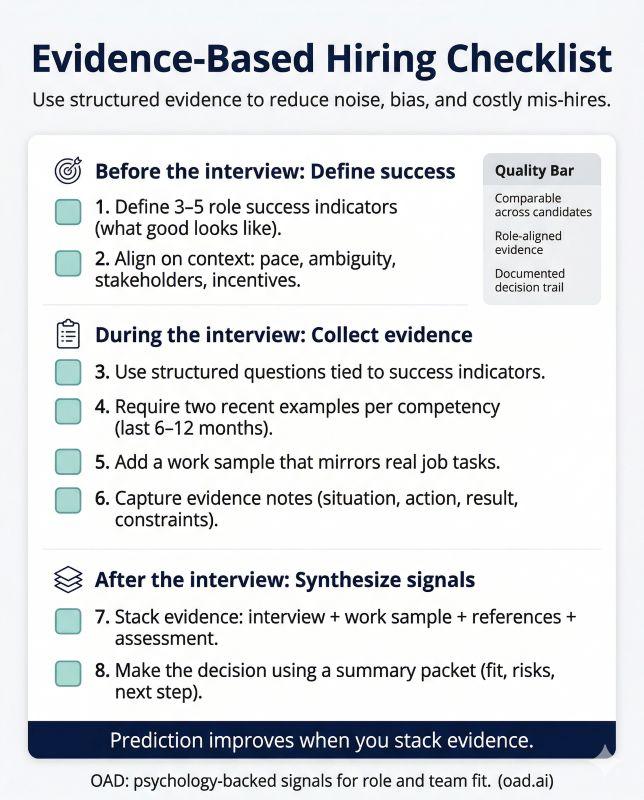
- Audit your current hiring process for prediction gaps
Identify where decisions rely on resumes, unstructured interviews, or subjective impressions. - Define 4–6 role-critical behaviors
Focus on observable actions tied to performance, not vague trait labels. - Build a behavioral interview template
Two recent examples per competency, one deviance probe, consistent follow-up questions. - Train interviewers on elicitation and coding
Train them to capture evidence, not narratives. Use anchored scoring. - Pilot a short assessment for one role family
Add one validated tool, align outputs with success indicators, keep candidate experience clear, and make sure your platform supports individual employee access to assessment results, scalable pricing for growing teams, and founder- and CEO-level visibility into long-term fit. - Validate against outcomes
Track early indicators (ramp time, quality, stakeholder feedback) and later indicators (performance ratings, retention, manager satisfaction). - Review quarterly and recalibrate
Hiring outcomes change with teams, strategies, and labor markets. Your process should adapt.
FAQ: Predicting Candidate Behavior
How do you predict candidate behavior in a job interview?
Use incident-based questions tied to role-critical behaviors, require two recent examples per competency, and score with anchored definitions. The goal is evidence you can compare across candidates.
Are behavioral interviews good predictors of future performance?
They can be, but only when structured. Predictive power drops when questions are predictable, probing is weak, and scoring relies on subjective impressions.
What assessments help predict candidate success without bias?
Short, scientifically validated assessments that are job-relevant and interpreted consistently. They should be used alongside structured interviews, not as a standalone gate.
How many interviews do you need to make an informed hiring decision?
There is no magic number. Fewer high-quality, structured interviews with corroborating data sources usually outperform more unstructured conversations.
Conclusion: Hire for Future Behavior, Not Past Presentation
If you want to predict candidate behavior, stop rewarding presentation and start collecting evidence. Resumes and one-off interviews create confidence without proof. Structured incident analysis, consistent probing, anchored scoring, and corroborating data points create decisions you can stand behind.
If your team wants to move from gut feelings to evidence-driven hiring, start with the free Top Performer Profile: 7 minutes, results in 24 hours, no credit card.