Most organizations have a formal hiring process on paper, yet crucial decisions still lean heavily on intuition and first impressions. This article breaks down which selection techniques for hiring actually predict high performance, how to combine them into a practical, candidate-friendly selection process, and where scientifically validated tools like OAD’s behavioral assessments can significantly improve the accuracy of your hiring decisions.
Hiring has never been more data-driven on paper and more improvisational in practice. Many organizations invest in applicant tracking systems, online job boards, and polished employer branding, yet still rely on gut feeling once candidates reach the interview stage. The result is familiar: inconsistent hires, avoidable turnover, and teams that never reach the performance level leadership expects—a poor hiring decision can lead to decreased productivity, increased costs, and missed opportunities that impact both financial and operational outcomes.
Think of the hiring manager who insists on reviewing dashboards for hours, then picks the finalist because they ‘seemed sharp on the call.’ At OAD, we see this contradiction every week.
This article walks through the selection techniques for hiring that actually predict job performance, not just make the process look sophisticated. We connect research-backed methods with practical steps that HR leaders, hiring managers, and recruitment teams can apply in day-to-day hiring.
Introduction to Hiring: Why Selection Techniques Matter
Hiring is more than filling a vacancy. Each decision reshapes your culture, affects team performance, and influences your ability to execute strategy. A process that overweights impressions and underweights data creates a slow leak of performance across the organization.
The ‘slow leak’ shows up as loss aversion in disguise: managers cling to mediocre hires because the cost of admitting the mistake feels higher than the cost of living with it.
Every hire changes the physics of a team. One strategically wrong hire can reroute how managers spend their week: more conflict resolution, less execution. Making informed hiring decisions, supported by comprehensive assessment methods, helps organizations avoid these negative outcomes and ensures better alignment with team and culture.
Overview of the Hiring Process and Employee Selection
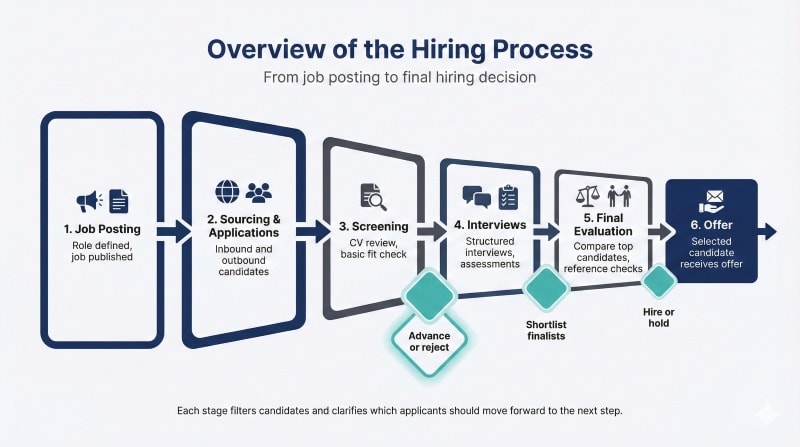
A typical hiring process moves through a familiar sequence: define the job opening and success criteria, attract potential candidates, screen for minimum qualifications, evaluate short-listed candidates, then select the final candidate and extend an offer. Some steps may require candidates to create profiles or fill out extensive forms, which can negatively affect the overall recruitment experience and reduce the likelihood of attracting suitable applicants.
The steps look universal. The failure points aren’t. Most teams collapse at the moment criteria drift or interviewers go off-script.a
Within that sequence, the employee selection process is the subset of steps where you compare candidates and decide who moves forward. This is where selection techniques for hiring matter most: resume screening, interviews, assessments, reference checks, and the way your hiring team interprets the data.
How Poor Hiring Decisions Drag Down Business Success and Team Performance
Research on personnel selection shows substantial variability in individual performance and large economic gains when better selection methods improve the average quality of hire. A single poor hire in a key role can create months of lost productivity, rework, and damage to team morale. McKinsey estimates low performers drain managerial time by up to 40 percent, and we’ve seen similar patterns: one misaligned hire often forces high performers into permanent cleanup mode. When selection is unstructured, hiring managers tend to:
- Overweight likability and similarity to themselves
- Underestimate cognitive ability and problem-solving
- Ignore early red flags in favor of a strong final impression
Over time, this erodes overall job performance and makes it harder for high performers to do their best work.
When Your Hiring Process Looks Busy but Doesn’t Predict Job Performance
Many organizations have hiring processes that feel rigorous – multiple interviews, elaborate scorecards, complex approval flows – but still do not predict who will succeed in the role. The issue is not the amount of activity, but the predictive power of the selection methods you use and how consistently they are applied.
It’s the classic mid-sized-company trap: five interview rounds and a 40-minute scorecard, yet the final decision hinges on whichever VP spoke last in the debrief.
Even Jeff Bezos openly warns against ‘hiring as convenience,’ yet many companies still mistake a busy process for a predictive one. Companies looking to hire smarter can benefit from behavioral assessment platforms that prioritize team fit and ROI.
What Is the Employee Selection Process, Really?
The employee selection process is the controlled part of hiring where you evaluate candidates against a defined role and decide who to hire. It is distinct from sourcing and employer branding, even though all three are connected. Choosing the right employee selection methods is crucial to ensure effective hiring outcomes and identify the best candidates for your organization.
From Job Opening to Job Offer: Mapping the Employee Selection Process
Once a job opening is approved, the selection process usually consists of:
- Defining job success and hiring criteria
- Screening applications for minimum requirements
- Conducting initial interviews or phone screens
- Running structured interviews, tests, or work samples
- Performing reference and background checks to verify the candidate’s qualifications, such as education and employment history
- Making a final decision and offer
Each step is an opportunity either to improve prediction of job performance or to introduce bias and noise.
Key Players: Hiring Managers, Recruiters, and the Hiring Team
In mid-sized and larger organizations, selection decisions rarely belong to a single person. Recruiters, hiring managers, HR business partners, and sometimes peers all contribute data and opinions. Without a clear structure, this becomes a negotiation based on impressions instead of a disciplined evaluation of evidence.
Selection Process vs. Recruitment Process: Where Most Companies Get Confused
Recruitment is about attracting potential candidates and building a pipeline. The selection process is about choosing among those candidates. Many organizations invest heavily in recruitment (employer brand, online job boards, recruitment agencies) but treat selection as a generic series of interviews. High-performing companies deliberately design their employee selection process with the same care they apply to customer acquisition or product quality. The purpose of the selection process is to identify and choose the most suitable candidates for the role.
Defining Job Success Before You Select Candidates
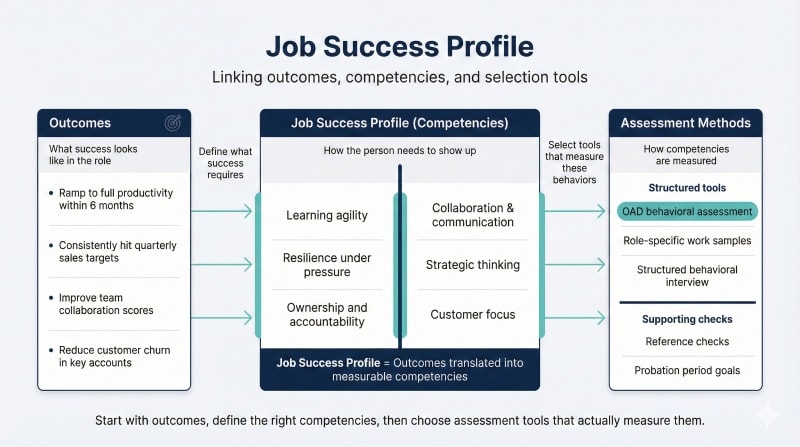
Strong selection techniques for hiring start before the first resume arrives. If “job success” is vague, your criteria will drift and your hiring team will default to intuition. Clearly defining job success ensures you are evaluating candidate skills, experience, and potential—assessing a candidate’s skills is crucial for predicting job success and making informed hiring decisions.
Translating the Job Description into Measurable Job Performance
Most job descriptions list responsibilities and requirements, but they rarely define what “good” looks like 6–12 months after hire. Before opening a role, clarify:
- What specific outcomes the role must deliver
- How performance will be measured
- Which behaviors distinguish top performers from average ones
This gives you a benchmark for evaluating candidate skills, experience, and potential.
Identifying Skills, Behaviors, and Cognitive Ability That Actually Matter
Decades of research in industrial-organizational psychology show that general mental ability (GMA) is one of the strongest predictors of job performance across roles and industries, particularly in complex jobs. That does not mean you should ignore technical skills or experience. Instead, define:
- Required technical skills and qualifications
- Critical soft skills and behavioral traits
- The level of cognitive ability needed to learn quickly and solve novel problems
When these elements are explicit, you can select appropriate assessments instead of guessing during interviews. It’s also important to use assessments that measure a candidate’s ability to perform job-related tasks and handle real-world scenarios.
Aligning Hiring Criteria with Future Job Performance and Business Goals
Selection criteria should reflect both the role today and where the business is heading. For example, a sales position in a new market may require more resilience and learning agility than a mature territory. Connecting hiring criteria to strategic goals keeps your process relevant over time.
Overview: The Main Types of Employee Selection Methods
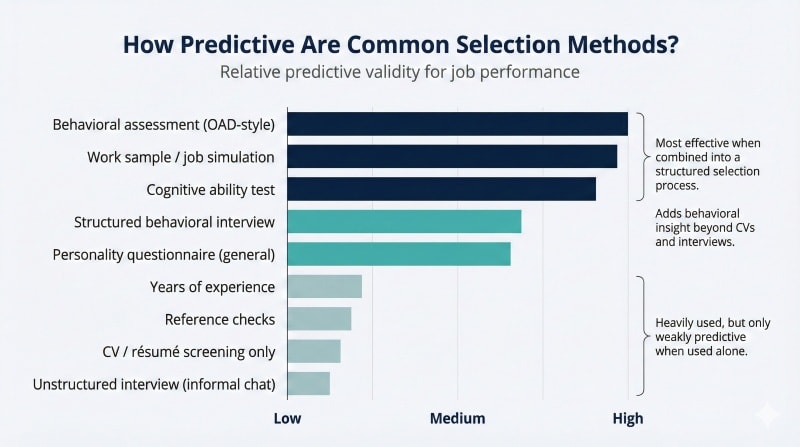
There is no single perfect selection method. Each has strengths, limitations, and costs. Most teams mistake ‘method comfort’ for method validity. Unstructured interviews comfort hiring managers. Cognitive tests predict performance. The goal is to combine methods that predict job performance while maintaining a reasonable candidate experience. Some selection methods, such as group interviews, are designed to assess multiple candidates simultaneously to evaluate teamwork and collaboration skills.
Types of Employee Selection Methods Used in Modern Hiring
Common employee selection methods include:
- Resume and application screening
- Structured and unstructured interviews
- Group interviews, where multiple candidates are assessed simultaneously through group tasks or discussions to evaluate teamwork, communication, and collaboration skills
- Cognitive ability tests
- Skills and work sample assessments
- Personality and behavioral assessments
- Reference and background checks
- Assessment centers or job auditions
The challenge is not access to tools, but choosing the right mix for each role.
CV and Resume Screening, Online Job Boards, and Recruitment Agencies
Resume screening and online job boards help filter out clearly unqualified candidates and identify potential matches at scale. Recruitment agencies extend reach into passive talent pools. However, CVs primarily reflect past roles and self-reported achievements. They rarely capture how a candidate thinks, learns, or behaves under pressure, so used alone they are weak predictors of future performance.
Resume screening is notorious for false negatives. Some of your best future performers simply don’t write strong resumes.
Interviews, Tests, and Assessments as Core Selection Methods
Beyond the CV, interviews, tests, and assessments form the backbone of modern selection processes. Research consistently shows that structured interviews, cognitive ability tests, and work-sample style assessments provide some of the highest predictive validity for job performance when implemented well. These methods also allow you to observe and evaluate present candidates’ skills, decision-making, and overall suitability for the role.
Which Selection Methods Actually Predict Job Performance?
Not all selection techniques for hiring are equal. Some are popular because they feel intuitive or easy, not because they work.
Cognitive Ability Tests and General Mental Ability as Predictors of Job Success
Meta-analyses over many decades show that general mental ability is strongly related to job performance in a wide range of roles. Validity coefficients around .5 are common, meaning that higher GMA scores reliably predict better job performance and training success, especially in more complex jobs. Cognitive ability tests help you assess how quickly a candidate can learn new information, solve problems, and handle complexity.
Structured Interviews vs. Unstructured Conversations
Unstructured interviews – informal conversations that follow the interviewer’s intuition – are widespread but inefficient. They often duplicate questions, drift into small talk, and introduce avoidable bias. Structured interviews, in contrast, use job-related questions linked to defined competencies, standardized rating scales, and the same questions across candidates for a given role. Recent meta-analyses show structured interviews achieving some of the highest mean validities among selection methods.
Work Samples, Job Auditions, and Assessment Centers
Work sample tests and job auditions ask candidates to perform tasks that closely mirror real work: building a small feature, analyzing data, running a simulated sales call, or leading a mock team meeting. These methods objectively assess a candidate’s ability to perform specific job duties, providing both content validity (tasks match the job) and strong criterion-related validity (performance correlates with later job performance). Assessment centers extend this concept with a series of exercises and group tasks and are especially useful for leadership and complex roles.
Designing a High-Quality Candidate Selection Process
The most effective selection processes combine complementary tools while keeping the process lean enough that candidates stay engaged. Certain selection techniques also make it possible to compare how different candidates approach problem-solving, teamwork, and other critical skills, providing valuable insights into candidate compatibility and overall fit.
Building a Clear Funnel from Potential Candidates to Final Offer
A practical funnel might look like this:
- Wide top: applicants sourced via job boards, referrals, and agencies
- Initial screen: minimum qualifications and basic fit
- Structured interview and/or cognitive ability test
- Role-specific skills or work sample assessment
- Final structured interviews and reference checks
Each step needs clear entry and exit criteria so your hiring team knows exactly why candidates advance or exit.
Screening Out Unqualified Candidates Without Losing Top Talent
Automated resume screening and pre-screen questions can save time, but rigid filters can also eliminate unconventional but high-potential candidates. These tools can help identify the most promising candidates by analyzing responses and traits based on predefined criteria, improving the efficiency and effectiveness of the hiring process. Use minimum requirements sparingly, offer alternative ways to demonstrate potential (for example, work samples), and periodically review borderline cases to calibrate filters.
Combining Multiple Selection Techniques Without Overloading Candidates
It is possible to design a process that is both rigorous and respectful of candidate time. Combine methods that add unique information instead of repeating the same signal, such as cognitive ability tests plus structured interviews plus a concise work sample. This layered approach strengthens prediction without turning your process into a marathon.
Step 1: Finding Qualified Candidates and Attracting Top Talent
Even the best selection techniques fail if the right people never enter the pipeline.
Using Online Job Boards, Social Media, and Recruitment Agencies Effectively
Online job boards remain a core channel for active job seekers, while social media and recruitment agencies help you reach passive candidates. Use these channels to target relevant talent pools, communicate a clear value proposition for the role, and set realistic expectations about responsibilities and performance standards.
Writing Job Descriptions That Filter for Suitable Candidates and Cultural Fit
A strong job description functions as a filter, not a wish list. It should clearly describe key outcomes, distinguish must-have from nice-to-have requirements, and reflect your culture and working style honestly. This attracts candidates whose skills and expectations match the role.
Leveraging Internal Talent, Referrals, and Current Employees
Internal mobility and employee referrals are often among the most effective sources of qualified candidates. They provide better information about how candidates actually work and fit within the culture and typically reduce time-to-hire.

Step 2: Resume Screening and Early Candidate Evaluation
Early screening should quickly separate clearly unqualified candidates from those worth a deeper look, without introducing unnecessary bias.
What to Look for in Candidate Qualifications Beyond Buzzwords
Rather than scanning for specific job titles or employer names, focus on evidence of learning and progression, concrete achievements linked to measurable outcomes, and experience with similar challenges, scale, or complexity. This improves your chances of identifying candidates whose past work aligns with the job’s real demands.
Spotting Red Flags Without Letting Hiring Biases Take Over
Gaps in employment, short tenures, or career changes can be relevant, but they are not automatic disqualifiers. Treat them as prompts for structured follow-up questions rather than reasons to discard a candidate.
Automating Resume Screening Without Destroying Candidate Experience
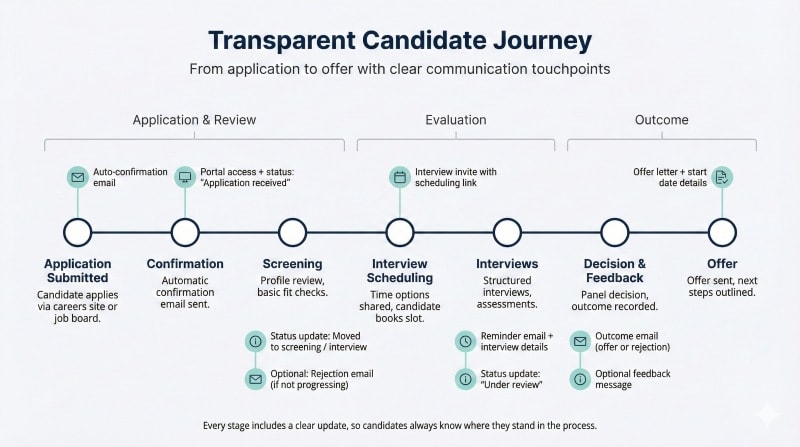
Automation can prioritize applications and surface top candidates, but poorly tuned filters can also eliminate strong profiles or create a cold, opaque experience. Keep screening rules simple and transparent, provide timely acknowledgments and status updates, and offer candidates a clear timeline for next steps.
Step 3: Structured Interviews: The Most Reliable Interview Technique
Structured interviews sit at the core of high-quality employee selection methods. They translate job requirements into observable candidate behaviors.
Building Structured Interview Questions Around Job Success Criteria
Start with your job success profile and translate key competencies into behavioral, situational, and job-knowledge questions. Each question should have predefined indicators of strong, average, and weak responses.
Most teams obsess over the perfect questions when the real risk is untrained interviewers improvising halfway through.
Evaluating Candidate Responses for Problem-Solving and Communication Skills
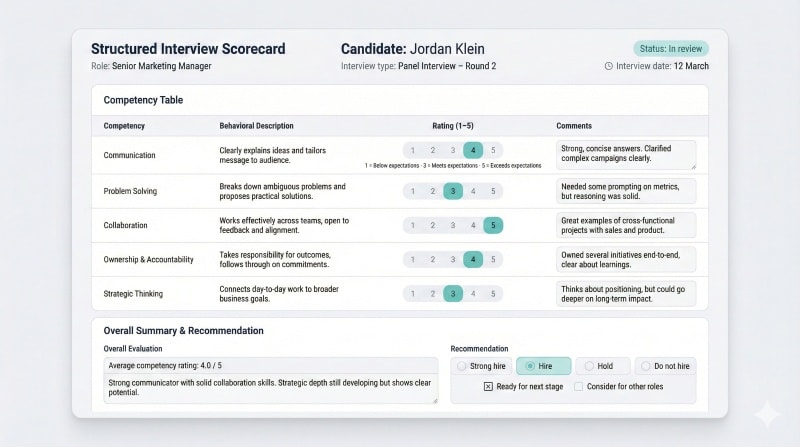
During the interview, evaluators should take structured notes based on specific behaviors, ask follow-up questions to clarify vague answers, and rate responses using numeric scales tied to your criteria. This ensures that problem-solving abilities, communication skills, and other key competencies are evaluated consistently.
Using a Common Rating System So the Hiring Team Makes Informed Decisions
After interviews, the hiring team should compare anchored ratings, not just impressions. This makes it easier to see where candidates genuinely differ and reduces the influence of the most senior or outspoken person in the room.
Step 4: Cognitive Ability Tests, Skills Assessments, and Work Samples
Tests and simulations extend what you learn from interviews by observing how candidates think and work.
When to Use Cognitive Ability Tests vs. Role-Specific Skills Assessments
Cognitive ability tests are especially valuable when the role requires learning complex information quickly, the environment changes frequently, or there is limited time to train new hires. Skills assessments and work samples are ideal when tasks can be realistically simulated and you need objective evidence of technical proficiency. Combining both types of assessments often yields the strongest prediction of job performance.
Designing Work Samples and Job Auditions That Mirror Real Tasks
Effective work samples reflect critical, frequently performed tasks, are time-bounded and clearly explained, and use standardized scoring rubrics. This reduces subjectivity and gives candidates a realistic preview of the job.
Balancing Predictive Power with Fairness and Candidate Experience
Be transparent about why you use each assessment and how results feed into the decision. Keep assessments as short as possible while still predictive, and avoid unpaid assignments that mimic full workdays.
Step 5: Personality Assessments and Cultural Alignment
Personality and behavioral assessments help answer how a candidate is likely to behave over time, especially under stress or change.
Personality Assessments vs. Popular but Unvalidated Personality Tests
Not all personality tools are created equal. Many popular tests lack robust validation and provide limited predictive power for job performance. Evidence-based tools, in contrast, are rigorously validated and designed for workplace decisions. For example, OAD’s behavioral assessments are built to clinical-level standards of accuracy and used by organizations to align people with roles and teams more effectively.
Design teams with data, not gut feel.
Most org-design decisions come down to role fit, leadership style, and team dynamics. OAD reads those signals from a 7-minute behavioral survey, so you can reconfigure roles and teams with evidence instead of guesswork.
Matching Personality Profiles to Roles (e.g., Sales Positions vs. Analytical Roles)
Different roles demand different behavioral patterns. A sales position may benefit from higher levels of assertiveness and social energy, while analytical roles may require greater patience and detail orientation. Personality data helps you identify candidates whose natural style fits role demands and avoid overemphasizing surface charisma.
Using Personality Data to Predict How Candidates Work with Existing Teams
When integrated into your selection process, personality insights can reduce friction and mis-hires by helping managers understand how new hires will interact with current team members, respond to feedback, and handle pressure.
Step 6: Reference Checks, Background Checks, and Final Validation
Once you have strong interview and assessment data, reference and background checks provide final risk control and context.
What to Ask Previous Employers to Validate a Candidate’s Ability to Perform
Rather than generic questions about strengths and weaknesses, ask previous supervisors about specific responsibilities the candidate handled, concrete results they delivered, and how they responded to setbacks or feedback. Align questions with your job success criteria to verify key assumptions.
Using Background Checks to Reduce Risk Without Slowing Down Hiring Decisions
Background checks should be proportionate to the role’s risk profile and local legal requirements. Keep them focused on information that is genuinely relevant to job performance and safety.
Turning Final Candidate Evaluation into a Structured Decision, Not a Gut Call
At the decision stage, bring together interview ratings, assessment scores, and reference and background information. Use a simple decision framework so the hiring team can weigh each factor consistently rather than arguing from isolated anecdotes.
Reducing Hiring Biases in the Candidate Selection Process
Bias is most harmful when it is invisible. A deliberate structure helps contain it.
Where Bias Creeps In: From Resume Screening to In-Person Interview
Bias can appear when screening for school names or employers instead of capabilities, making early judgments based on accent or appearance, or overvaluing confidence or extroversion in roles that do not require them. Simply being aware of bias is not enough; processes must be designed to limit its impact.
Structured Interviews, Scoring Rubrics, and Blind Screening Techniques
Evidence-based ways to reduce bias include blind or semi-blind resume review for early stages, structured interview guides and rating scales, and calibration sessions where interviewers compare how they score sample responses. These techniques do not eliminate bias, but they make hiring decisions more defensible and fair.
How Data from Assessments Can Counter “Similar-to-Me” Bias
Objective assessment data gives the hiring team a shared reference point beyond personal preference. When a candidate who “feels” like a great fit scores poorly on key predictors of performance, it prompts more disciplined discussion.
Candidate Experience: Protecting It While You Assess Rigorously
Candidate experience directly influences your ability to attract and close top talent and shapes your employer brand. Studies show that a strong candidate experience improves offer acceptance rates, expands your pool of qualified applicants, and strengthens employer reputation in the market.
Candidate experience rarely fails at the application stage. It fails when companies turn the mid-process into a black box.
Communicating Expectations Clearly During Each Interview Stage
Candidates should always know where they are in the process, what the next step looks like, and how long it will take to receive a decision. Simple, transparent communication significantly improves perceived fairness.
Avoiding Overlong Processes That Lose the Best Candidates
Top candidates often exit processes that require too many interview rounds with no new information, demand excessive unpaid work, or provide little feedback or clarity. A well-designed process gathers enough evidence quickly and respects candidate time.
Designing a Candidate Journey That Reflects Your Culture and Employer Brand
Every interaction – from the job ad to the final conversation – sends a message about how your organization treats people. A structured, respectful selection process communicates that you make decisions based on clear expectations and data, not politics and improvisation.
Assessment and Evaluation: From Data Points to Hiring Decisions
Collecting data is the easy part. Turning it into a clear hiring decision is where many teams struggle.
Combining Cognitive Ability, Skills, Personality, and Interview Data
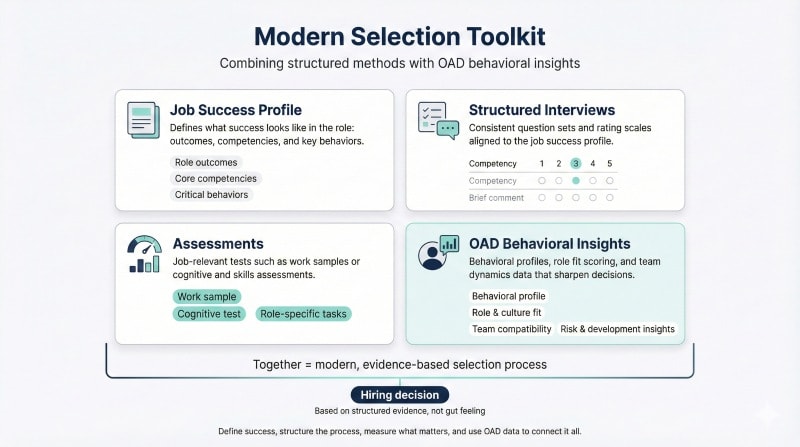
Define a simple model for how your methods work together. For example, cognitive ability and work samples indicate capacity to perform, skills tests and experience confirm readiness to start, and personality and behavioral data show role and team fit. Structured interviews then integrate and validate the story.
Running Effective Hiring Team Debriefs Without Groupthink
In debrief meetings, review structured scores before open discussion, invite each interviewer to share observations before debating, and focus on behaviors and evidence, not labels. This makes it easier to challenge assumptions and raise concerns early.
Documenting Why You Selected the Right Candidate (and Not the Runner-Up)
Brief documentation of why a candidate was selected – tied to your defined criteria – supports compliance, future reviews, and internal learning. It also helps you refine your selection methods over time.
Case Example: Selection Techniques for Hiring in a Sales Position
Sales roles highlight the difference between selecting for charisma and selecting for performance.
Defining Job Success for Sales Roles (Targets, Behaviors, Ramp-Up Time)
Before hiring, define revenue or quota expectations, expected ramp-up time, and key sales activities and behaviors (prospecting, discovery, negotiation). This anchors every subsequent selection decision.
Which Selection Methods Best Predict Sales Performance
For sales roles, a robust process often combines cognitive ability tests to gauge learning speed, work samples or role-plays (for example, mock sales calls), structured interviews focused on resilience and customer orientation, and personality assessments that highlight drive, persistence, and social energy. These techniques help separate candidates who can talk convincingly from those who can sell consistently.
Avoiding Common Traps: Charisma Over Skill and “Good Talkers”
Many poor sales hires looked excellent in unstructured interviews. A structured, evidence-based process reduces the risk of over-indexing on first impressions or storytelling ability.
Common Pitfalls When Choosing Employee Selection Methods
Even with strong tools available, several predictable mistakes keep selection processes from reaching their potential.
Automating Bad Processes Instead of Fixing Them
Technology can make a weak process faster, not better. Before adding more tools, ensure your underlying selection criteria, interview guides, and assessment choices are sound.
Over-Trusting Gut Feel and Charismatic Candidates
Intuition has a role, especially for final tie-breakers, but should not replace evidence. Train hiring managers to treat gut feel as one data point, not the decision driver.
Relying on One Common Employee Selection Method and Ignoring the Rest
No single method – not interviews, not CVs, not tests – can capture the full picture. Overreliance on one technique leaves you exposed to its blind spots.
Measuring the Impact of Your Selection Techniques on Business Success
Selection methods should be managed like any other strategic investment: with clear metrics and feedback loops.
Tracking Performance, Turnover, and Time-to-Productivity
Link hiring decisions to downstream metrics such as first-year performance ratings, time-to-productivity, and early turnover. Patterns in these data help you see which selection techniques correlate with real-world success.
As Jack Welch often said, the only real metric is performance over time. Track whether top scorers become your top 25 percent within a year.
Running Simple Validity Checks on Your Selection Process
You do not need a full research team to evaluate validity. Start by comparing average performance of hires who scored high versus low on key assessments and reviewing whether structured interviews predict later success better than unstructured ones.
Using Data to Refine Your Hiring Process Over Time
Treat your selection system as an evolving product. Remove steps that do not add predictive value, strengthen those that do, and continuously update job success profiles as roles change.
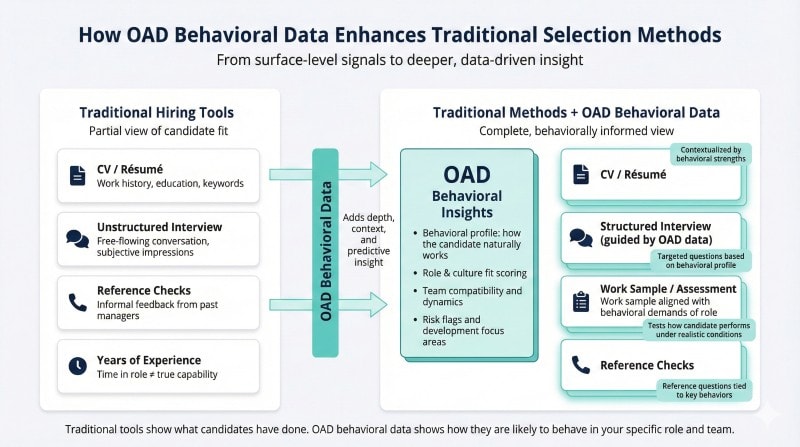
Where Traditional Selection Techniques End – and Where OAD Begins
Traditional methods – CVs, unstructured interviews, ad-hoc reference checks – were never designed to provide deep insight into how people will behave in specific roles and teams. They leave too much to chance.
OAD’s scientifically validated behavioral assessments give hiring teams a data-rich view of a candidate’s natural strengths, learning style, and fit with role demands and existing teams. Validated by independent institutes and benchmarked against complex clinical instruments, OAD brings clinical-level precision into practical hiring decisions.
Design teams with data, not gut feel.
Most org-design decisions come down to role fit, leadership style, and team dynamics. OAD reads those signals from a 7-minute behavioral survey, so you can reconfigure roles and teams with evidence instead of guesswork.
When a CFO hires a VP of Sales who looks perfect on paper but burns the team out in six months, the pattern is predictable. Leaders like Warren Buffett often emphasize temperament over talent, and OAD’s data makes that temperament measurable.
By integrating OAD into your selection process, you can move beyond gut feel and surface-level impressions, align candidates with the behavioral demands of the role, and reduce mis-hires while strengthening long-term performance.
Implementation Roadmap: Upgrading Your Employee Selection Process
Improving selection techniques for hiring does not require a complete rebuild. It does require focus and consistency.
Start with One Role and One Hiring Team
Choose a role with significant business impact and enough hiring volume to see patterns. Align one hiring team around clear job success criteria, structured interview guides, and a small set of validated assessments.
Standardize Selection Methods Before Scaling Across the Organization
Once the process works for one role, standardize the playbook, document steps, tools, and decision rules, train additional hiring managers and recruiters, and integrate templates into your hiring systems.
Training Hiring Managers to Use Structured Interviews and Assessment Data
Hiring managers often receive little training in selection, despite making some of the organization’s most important decisions. Short, focused training on structured interviewing and interpreting assessment data pays for itself quickly in better hiring outcomes.
Conclusion: Turning Selection Techniques for Hiring into a Competitive Advantage
Selection techniques for hiring are one of the most powerful levers you have to improve job performance, reduce turnover, and build resilient teams.
Organizations that win in talent markets tend to define job success clearly and early, combine high-validity methods such as structured interviews, cognitive ability tests, and work samples, use personality and behavioral data to align people, roles, and teams, protect candidate experience while maintaining rigor, and continuously measure and refine their selection process.