AI sourcing is moving from buzzword to baseline infrastructure in modern recruitment. As competition for top talent intensifies, talent teams are using AI to find, screen, and engage qualified candidates faster while reducing repetitive manual work. This article explains what AI sourcing is, how it fits into your hiring process, and how to combine it with behavioral data to make better hiring decisions.
AI sourcing is quickly shifting from “nice to have” to core infrastructure for modern talent acquisition. Instead of recruiters spending hours combing through job boards, copying profiles, and chasing cold outreach, AI systems can search, match, and initiate contact at a scale no human team can match alone.
Done well, AI sourcing is not about replacing recruiters. It is about removing the time consuming manual work so your people can spend their time where they create the most value: building relationships, qualifying fit, and aligning hiring decisions with strategy.
Introduction: Why AI Sourcing Is Reshaping Recruitment
From manual sourcing to AI supported recruiting
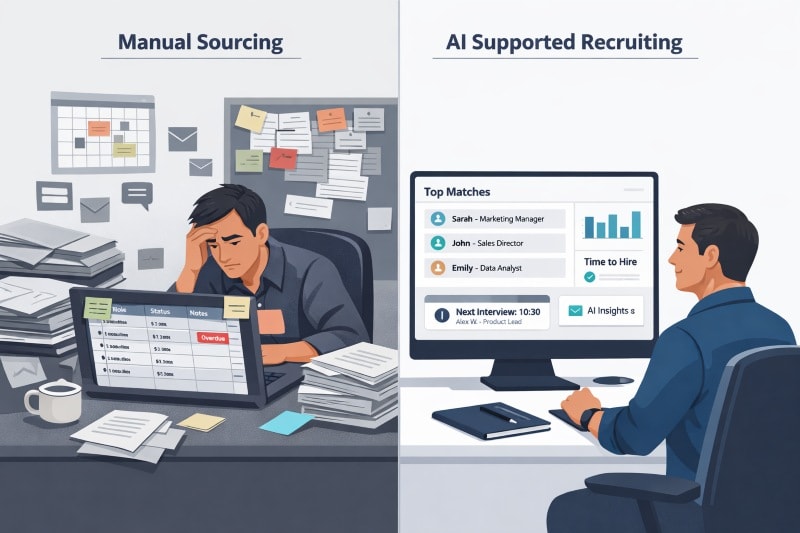
Traditional sourcing relies on human researchers running keyword searches, scanning profiles, and sending large volumes of semi generic outreach. In most companies, this still means spreadsheets, multiple browser tabs, and a heavy reliance on job boards or inbound applications. The result is slow time to shortlist, inconsistent follow up, and a constant feeling of chasing the market rather than shaping it.
AI sourcing changes the equation by using models that understand job titles, skills, and experience patterns at scale. Instead of manually scanning hundreds of profiles, recruiters set parameters and let AI surface qualified candidates and suggest outreach. The recruiter still decides who to approach, but the heavy lifting of search and first contact becomes dramatically faster.
The limits of manual sourcing in a tight talent market
In competitive talent markets, manual sourcing simply cannot keep up. By the time a recruiter has built a list, many of the best candidates are already in process elsewhere. Manual processes also encourage recruiters to circle around the same channels and candidate pools, reinforcing existing biases and blind spots.
Because manual sourcing is so time consuming, recruiters often default to urgent requisitions and let long term pipeline building fall behind. This reactive pattern increases time to hire, inflates agency spend, and makes strategic workforce planning more difficult. AI sourcing helps talent teams escape that cycle by automating repetitive tasks and giving them more breathing room to think ahead.
Why AI sourcing is called a game changer
AI sourcing is often called a game changer for a simple reason: it shifts recruiter time from search to decision. Instead of spending hours pulling lists and tracking responses, recruiters can review ranked candidates, refine criteria, and focus on high quality conversations with potential hires.
Framed correctly, AI acts as an exoskeleton for recruiters, amplifying their reach rather than replacing their judgment. It allows talent teams to handle higher requisition volumes, explore new markets, and respond faster to hiring needs while maintaining a more consistent candidate experience across the funnel.
What Is AI Sourcing and How Does It Work?
Core definition and scope
AI sourcing uses artificial intelligence to find, screen, and engage potential candidates based on criteria such as job titles, skills, experience, and location. Unlike simple keyword search, AI sourcing tools can interpret context, infer related skills, and recognize patterns across large volumes of data from job boards, social profiles, internal databases, and other sources.
The scope usually includes identifying prospective candidates, enriching profiles with additional information, ranking their potential fit, and preparing outreach that can be customized by recruiters. In short, AI sourcing moves from static search results to an ongoing, dynamic flow of candidate suggestions and engagement options.
How AI sourcing works in practice
Under the hood, AI sourcing tools rely on large language models and other machine learning techniques to interpret both candidate data and job requirements. Recruiters provide inputs such as a job description, ideal candidate profile, or example employees, and the system uses these signals to search across large datasets for similar profiles.
Modern tools use natural language interfaces, so recruiters can refine searches with plain language prompts rather than complex Boolean strings. The AI can also support contact information discovery, basic screening questions, and automated follow up sequences, which would be tedious to manage manually at scale.
AI agents and specialized tools across the funnel
In practice, AI sourcing rarely exists as a single monolithic system. Instead, teams use a mix of AI agents and specialized tools that handle different stages of the recruiting process. Some tools focus on search and matching, others on candidate engagement and outreach, and others on pipeline management or scheduling.
The most effective setups combine these components into guided workflows and automated workflows that are tailored to each organization. Recruiters still control the critical decisions, but AI agents perform the repetitive tasks in the background: updating statuses, logging communications, and surfacing next best actions.
Benefits of AI Sourcing for Recruiting Teams
Automating tedious tasks and saving hours
AI sourcing is especially strong at removing low value, repetitive work that drains recruiter capacity. Tasks such as scanning profiles, copying data into an applicant tracking system, sending follow up reminders, or running the same search across several job boards can be automated or semi automated.
When these tasks are handled by AI, recruiters can spend more time partnering with hiring managers, clarifying job requirements, and assessing candidates in depth. Over a year, this shift can free hundreds of hours, reduce burnout, and create space for more strategic recruiting initiatives that often get postponed.
Scaling reach without scaling headcount
There is a hard limit to how many profiles a human can review and how many candidates they can contact in a given week. AI sourcing tools effectively raise that ceiling by continuously scanning the market and refreshing lists of potential candidates in the background.
This capacity to scale reach without proportional increases in headcount is particularly valuable for lean talent teams that support fast growing businesses. Instead of adding more recruiters for every growth wave, organizations can use AI to keep their candidate pipeline full and their recruitment efforts focused on the roles where human judgment is most critical.
AI as an exoskeleton, not a replacement
One of the most important mindset shifts is to treat AI sourcing as an exoskeleton, not a replacement for recruiters. The technology is powerful at pattern recognition and repetitive execution but still limited in understanding nuance, culture, and human motivation.
Recruiters remain responsible for interpreting the signals AI provides, challenging its recommendations when needed, and ensuring that high touch candidate interactions reflect the organization’s values. When this balance is maintained, AI sourcing strengthens the credibility of the talent function instead of threatening it.
How AI Sourcing Fits into the Hiring Process
From job requirements and job description to search criteria
AI sourcing begins with clarity. If job requirements and the job description are vague, inconsistent, or misaligned across stakeholders, AI will simply scale that confusion. The best practice is to define must have skills, nice to have skills, and clear outcome expectations before turning on any AI sourcing tool.
Once the profile is clear, AI can help translate it into search criteria and related skills the team might otherwise miss. For example, it can suggest adjacent experience, certifications, or tool familiarity that correlate with strong performance in similar roles, expanding the pool beyond obvious keywords.
Handover from sourcing to hiring managers
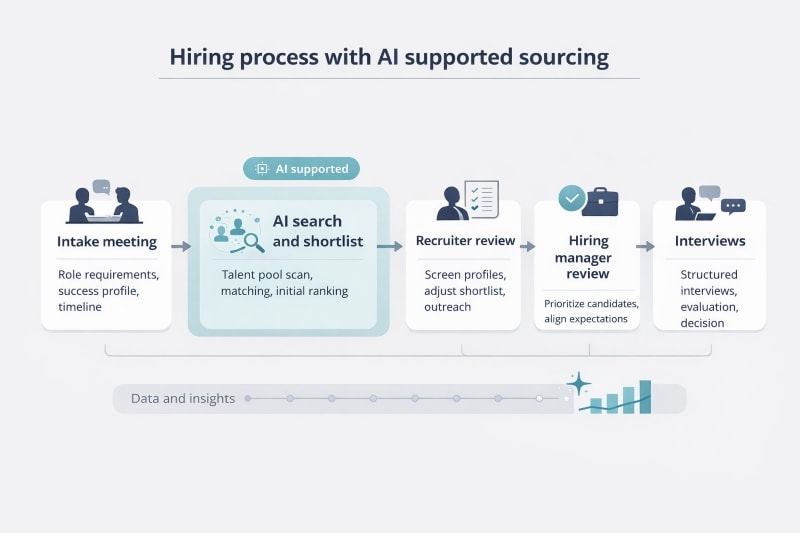
AI sourcing does not remove the need for structured collaboration between recruiters and hiring managers. Instead, it changes the nature of that collaboration. Rather than debating whether the talent pool exists, managers and recruiters can review AI generated shortlists together and refine the criteria based on real market feedback.
This joint review is also the moment to calibrate expectations about seniority, compensation, and trade offs between different candidate profiles. AI can surface more options, but human stakeholders must still decide which profiles are realistic and aligned with the organization’s strategy and budget.
Aligning AI sourcing with existing recruiting process and team roles
For AI sourcing to deliver value, it needs to fit into the existing recruiting process rather than sit on the side as an experiment. That means mapping out who owns each step, where AI can automate or augment, and how data flows into the applicant tracking system.
Some teams redesign recruiter roles to include more stakeholder management, market insights, and candidate coaching, while AI takes over the most repetitive elements of candidate search and outreach. Clear ownership, consistent workflows, and simple operating guidelines help avoid confusion and ensure adoption.
The AI Sourcing Tech Stack and Tool Types
Applicant tracking system vs dedicated sourcing tool
Many organizations start with an applicant tracking system that manages job posts, applications, and interview workflows. These systems sometimes offer basic sourcing features, but they are not always optimized for proactive outbound talent sourcing across the open market.
Dedicated AI sourcing tools focus more heavily on search, candidate rediscovery, and outreach. They integrate with the applicant tracking system so that candidate data and status updates stay in one place, while the sourcing layer does the heavy lifting in terms of market scanning and engagement.
Key capabilities to look for
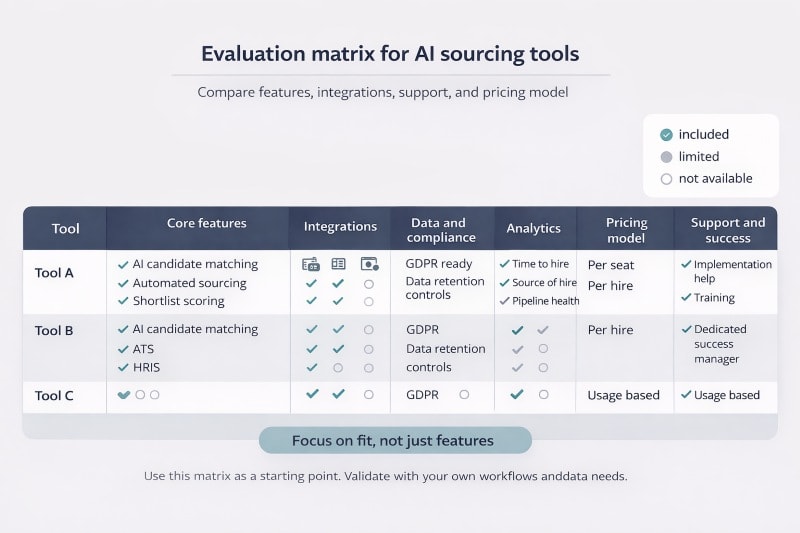
When evaluating AI sourcing tools, recruiting leaders should focus less on buzzwords and more on practical capabilities. Useful features include guided workflows that help recruiters follow best practices, automated workflows for repetitive tasks such as follow up reminders, and multi step sequences for outbound outreach.
Conversational AI and voice input can further reduce administrative friction by allowing recruiters to log notes, trigger actions, or adjust campaigns through natural language. The goal is not to buy the tool with the longest feature list, but the one that cleanly supports how your team already works or wants to work.
Pricing models and cost control
AI sourcing tools are commonly priced per user seat, per job requisition, or based on candidate contact credits. Each model has trade offs. High per seat pricing can become expensive for large teams, while volume based pricing may favor organizations with more predictable hiring patterns.
Before signing contracts, recruiting leaders should model different hiring scenarios and ensure the chosen pricing structure aligns with projected usage and budget constraints. Negotiating flexibility to scale seats up and down, or to adjust credit levels, can prevent cost surprises later.
Core AI Sourcing Strategies to Find Qualified Candidates
Outbound talent sourcing at scale
Outbound talent sourcing remains one of the most effective ways to reach passive candidates, but it is resource intensive when handled manually. AI sourcing lets teams run ongoing outbound campaigns that constantly surface new candidates and keep talent pools warm without requiring recruiters to trigger every single outreach manually.
By combining AI driven search with sequenced outreach, organizations can build brand presence in specific talent segments, such as niche engineering roles or regional leadership profiles, and respond to new hiring needs more quickly when they arise.
Using AI to interpret job requirements and ideal profiles
One powerful but underutilized aspect of AI sourcing is its ability to generalize from examples. Instead of only matching keywords, AI can look at your best performing employees in a given role and identify shared patterns of skills and experience. It can then search for candidates with similar profiles, even if their titles and resumes use different language.
This approach reduces over reliance on narrow title based searches and helps talent teams discover candidates who might otherwise be overlooked. It also improves alignment between hiring needs and the actual work being done by high performers in the role.
Targeting specific talent markets and roles
Different roles operate in different talent markets. Sourcing software engineers, for example, requires different channels, messaging, and expectations compared to sourcing sales leaders or HR professionals. AI sourcing can help by surfacing regional and sector specific insights so recruiters are not working in the dark.
By tailoring search parameters and outreach strategies to each segment, AI sourcing tools help recruiters focus on the right candidates rather than simply more candidates. This specificity is crucial to maintaining quality while increasing volume.
Talent Acquisition With AI Sourcing
Assessing hiring needs with AI insights
AI sourcing tools can support hiring needs assessment by providing real time signals about talent availability, common skill combinations, and likely trade offs between experience level and compensation. Instead of relying purely on anecdotal feedback from the market, leaders can see data on how many profiles match their criteria and how quickly those candidates tend to move.
This information helps talent acquisition leaders challenge unrealistic expectations early, refine role definitions, and prioritize requisitions based on where the organization can realistically compete for talent.
Using AI sourcing to understand the talent market
Because AI sourcing tools scan large datasets, they can reveal patterns that would otherwise be invisible. For example, they can highlight which regions have growing clusters of specific skills, which industries are hiring for similar roles, and which skills often appear together in the best candidate matches.
These insights support strategic workforce planning and employer branding efforts. Talent leaders can decide where to focus outreach, which talent communities to invest in, and how to position their roles in a way that resonates with the market.
Strategic uses for talent leaders and recruiting leaders
For senior talent leaders, the real value of AI sourcing is not just faster hiring, but better decision making. With clearer data on candidate supply, engagement rates, and pipeline health, leaders can forecast hiring timelines more accurately and align recruiting resources with business priorities.
They can also use AI sourcing metrics to inform build versus buy decisions, internal mobility strategies, and long term investments in training or reskilling programs when external talent is scarce or expensive.
Personalization at Scale: Outreach and Candidate Engagement
From generic templates to personalized messages
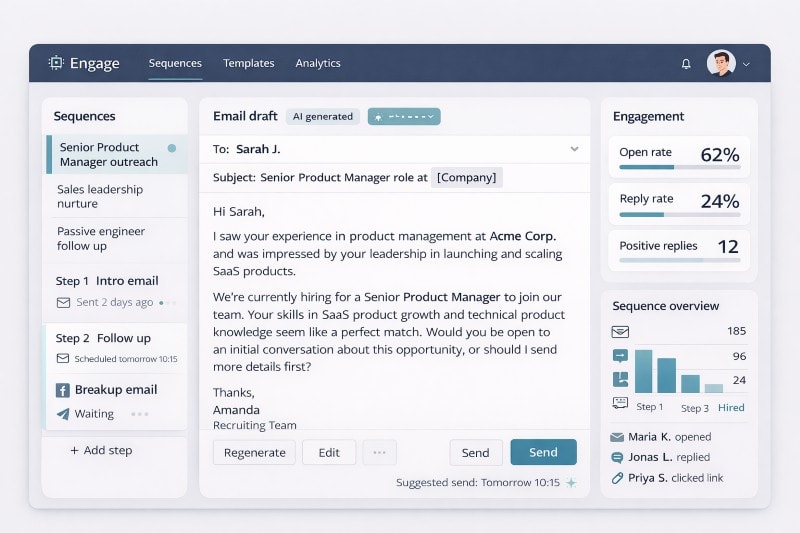
Candidates quickly recognize generic outreach and ignore it. AI sourcing tools help recruiters move beyond copy pasted templates by suggesting personalized messages that reference a candidate’s background, skills, or public projects. When recruiters review and refine these drafts, the result is higher engagement for less manual writing.
The key is to use AI as a starting point, not an autopilot. Recruiters still need to check tone, verify details, and ensure the message feels authentic and aligned with the employer brand.
Multi step sequences and continuous sourcing
One message rarely secures a candidate’s attention. Multi step sequences that include follow ups, gentle check ins, and value based messages are far more effective, but hard to manage by hand across hundreds of prospects. AI sourcing tools can schedule and execute these sequences at scale, while giving recruiters visibility into who is engaging and why.
This continuous sourcing and nurturing means talent teams have warm relationships to tap into when a new role opens, rather than starting from zero each time.
Using conversational AI and voice input to streamline workflows
Conversational AI interfaces and voice input features allow recruiters to interact with their tools in more natural ways. Instead of navigating multiple menus, they can ask the system to “show me new candidates who match this job in the last seven days” or “create a follow up sequence for everyone who opened but did not reply.”
These small usability improvements compound over time, reducing friction and making it easier for recruiters to adopt and consistently use AI sourcing functionality.
Candidate Experience: Using AI Without Losing the Human Touch
Where AI improves candidate experience
Used thoughtfully, AI can significantly improve candidate experience. Automated status updates, scheduling tools that respect candidate time zones, and quick responses to basic questions reduce uncertainty and show respect for candidates’ time. Candidates appreciate clarity more than perfectly crafted messages.
When AI sourcing feeds accurate information into downstream systems, it also reduces the likelihood of miscommunication between recruiters, coordinators, and hiring managers, which further improves the overall candidate journey.
Risks of over automation and how to avoid them
The main risk is treating candidates as data points instead of people. Over automation can flood candidates with messages that sound repetitive or impersonal. It can also create awkward situations if AI driven outreach does not reflect prior interactions or context, such as reaching out about a role that is clearly a poor fit.
Organizations can mitigate these risks by setting clear rules for when human review is required, limiting fully automated messaging, and regularly sampling candidate communications for quality and relevance.
Balancing AI efficiency with human interaction
The healthiest approach is to let AI handle scale and logistics, while humans own high stakes conversations and decision moments. This includes initial qualification calls, detailed role discussions, feedback on assessments, and offer negotiations. Those interactions shape the employer brand more than any automated sequence.
By making deliberate choices about where to insert human touchpoints, talent teams can preserve empathy and connection while still benefiting from AI driven efficiency.
Candidate Pipeline Management and Rediscovery
Building and maintaining a healthy candidate pipeline
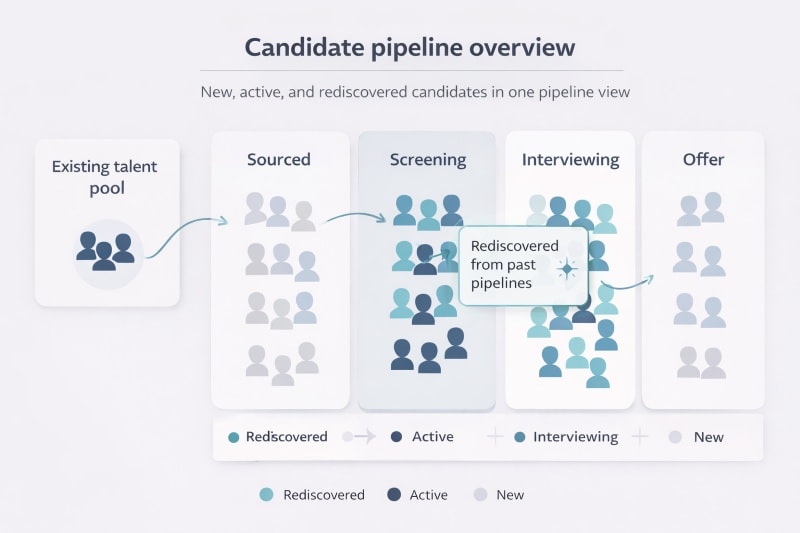
A strong candidate pipeline is not just a long list of names. It is an organized view of who is in process, who might be ready for future roles, and which segments need more attention. AI sourcing tools help maintain this structure by tagging candidates, tracking engagement, and surfacing those who are likely to be open to new conversations.
This structure allows talent teams to move from reactive scrambling to proactive planning, especially for roles that recur frequently or have long ramp up times.
AI powered candidate rediscovery in your ATS
Most organizations already have a large number of past applicants and silver medalists stored in their applicant tracking system. Manually reviewing those profiles when a new role appears is rarely feasible, so those candidates are often forgotten.
AI powered candidate rediscovery changes that. By matching new job requirements to historical profiles, it can surface potential candidates who already know your brand and have shown interest. This reduces sourcing time and leverages the investment made in previous recruitment efforts.
Nurturing a long term talent pool
Beyond specific requisitions, AI sourcing can support long term relationship building through periodic, relevant outreach. For example, talent communities can receive tailored content, event invitations, or short updates about new initiatives that align with their interests.
This approach keeps your organization top of mind for potential candidates without requiring recruiters to manually manage every interaction. When a suitable role opens, outreach feels like a continuation of an existing relationship rather than an out of the blue message.
Evaluating Fit: Skills, Soft Skills and Behavioral Data
Screening for hard skills and experience
AI sourcing is well suited to identifying hard skills and experience markers, such as specific technologies, years in role, or exposure to certain industries. It can quickly filter out candidates who do not meet essential criteria and prioritize those who do, especially in high volume hiring scenarios.
However, organizations should be careful not to treat these hard filters as a complete picture of potential. Overly rigid criteria can exclude high potential candidates whose capabilities are not fully captured on paper.
Why soft skills remain difficult for AI to judge alone
Soft skills such as communication, resilience, learning agility, and leadership potential are more complex to infer from surface level data. While AI can pick up some signals from language patterns or career trajectories, it cannot reliably understand deeper behavioral traits without structured input.
This limitation is crucial in leadership roles or team sensitive environments, where mismatches in style and expectations can create costly friction. Relying solely on AI sourced signals here is risky.
Where science backed assessments complete the picture
This is where behavioral and personality assessments, such as those provided by OAD, play a critical role. By measuring underlying traits and work preferences with scientifically validated tools, organizations can go beyond the resume and understand how a person is likely to behave in a specific role and team context.
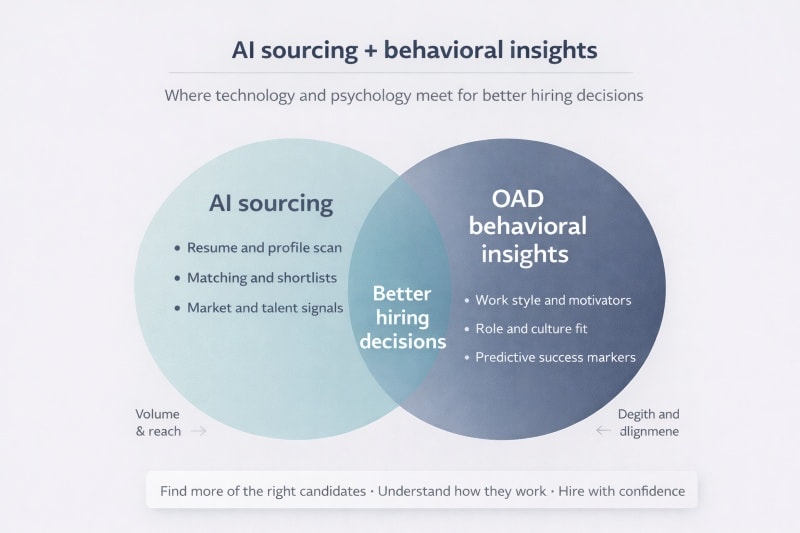
When AI sourcing is combined with assessments, the result is a richer, more reliable view of fit that includes both skills and behavior. You find the right candidates faster and make more confident hiring decisions.
Design teams with data, not gut feel.
Most org-design decisions come down to role fit, leadership style, and team dynamics. OAD reads those signals from a 7-minute behavioral survey, so you can reconfigure roles and teams with evidence instead of guesswork.
ROI and Business Case for AI Sourcing
Measuring time to fill, cost per hire and sourcing time
The simplest way to evaluate AI sourcing is to track its impact on time to fill, cost per hire, and recruiter hours spent on sourcing. If AI tools reduce the number of days it takes to move from approved requisition to signed offer, or meaningfully cut agency spend, they are creating tangible value.
Measuring these metrics before and after implementation helps build a grounded business case and informs future investment decisions.
Linking AI sourcing to quality of hire
Speed and cost are important, but they are not the whole story. If AI sourcing accelerates hiring but degrades quality of hire, long term business impact will suffer. Talent leaders should therefore track downstream metrics such as ramp up time, performance, and retention for hires influenced by AI sourcing.
Over time, these signals reveal whether AI sourcing is simply filling seats faster or truly improving the match between candidates and roles.
Building a business case talent leaders can defend
A defensible business case for AI sourcing combines efficiency gains with evidence of improved hiring outcomes. It also acknowledges limitations and specifies how human oversight mitigates risks. When talent leaders can clearly explain where AI helps, where it does not, and how it integrates with existing governance, executive support is much easier to secure and maintain.
Implementation Best Practices for AI Sourcing
Start with one pressing use case
Rather than attempting a full transformation overnight, effective teams begin with one high impact use case such as sourcing for a specific role family, automating scheduling, or rediscovering candidates in the ATS. This focused approach allows for faster learning and reduces change fatigue.
Once value is proven in one area, it becomes easier to extend AI sourcing to other parts of the recruiting process with less resistance.
Integrate AI sourcing into existing workflows
AI sourcing works best when it is integrated into tools and workflows recruiters already use. That means ensuring smooth connections between the sourcing tool, the applicant tracking system, and communication channels, so recruiters do not have to duplicate work across systems.
Practical documentation, simple playbooks, and visible champions inside the team help new habits stick and prevent the technology from becoming another underused platform.
Training recruiters and hiring managers to use AI effectively
Training should go beyond technical demos. Recruiters and hiring managers need to understand not only how to operate the tools, but how to interpret AI outputs, when to override them, and how to communicate about AI usage with candidates and stakeholders.
The goal is to create informed users who trust the tools without outsourcing judgment to them.
Questions to Ask AI Recruiting Vendors
Capabilities and limitations
During vendor evaluations, vague promises are not enough. Ask concrete questions about how the tool sources candidates, how it ranks them, and what data it relies on. Clarify whether it supports sourcing, screening, candidate engagement, and reporting, or only one piece of the puzzle.
Equally important, ask where the tool does not perform well or requires human intervention. Realistic vendors will acknowledge limitations rather than claiming to do everything.
Integration, scalability and support
Strong AI sourcing tools should integrate cleanly with your applicant tracking system and existing communication platforms. Confirm how data flows between systems, how duplicates are handled, and how permissions are managed.
Also clarify how the platform scales as your hiring volume changes and what support is available during implementation and ongoing use. Poor support can turn even a technically strong tool into a daily frustration.
Pricing, data security and bias safeguards
Pricing discussions should include not just headline costs but also any hidden fees related to integrations, data exports, or additional features. On the data side, talent leaders should ask how candidate data is stored, who owns it, and how long it is retained.
Bias safeguards deserve focused attention. Ask vendors how they detect and mitigate bias in their models, what audits they run, and how they support customers in meeting ethical and regulatory expectations.
Common Mistakes and Risks in AI Sourcing
Treating AI as a replacement for recruiters
One common mistake is viewing AI sourcing as a way to reduce recruiter headcount rather than to elevate the role. This mindset often leads to underinvestment in training and governance, and to disappointing outcomes, because the human elements of recruiting are underestimated.
Recruiters who feel threatened by the technology are also less likely to adopt it in a thoughtful, experimental way.
Ignoring potential bias and data quality issues
AI systems learn from historical data. If that data reflects biased hiring practices or incomplete records, the AI can replicate and even amplify those patterns. Ignoring this risk can undermine diversity, equity, and inclusion goals and create reputational and legal exposure.
Organizations should set clear expectations about data quality, regularly review AI outcomes for patterns, and pair AI sourcing with deliberate strategies to broaden the talent pool.
Failing to monitor candidate experience and outcomes
It is not enough to track clicks and response rates. Talent teams need to monitor how candidates experience AI driven outreach and processes. Feedback from candidates, recruiters, and hiring managers should be used to adjust campaigns, messaging, and automation boundaries.
When issues are caught early, they are easy to correct. If left unattended, they can quietly erode employer brand over time.
Governance, Ethics and Compliance
Fairness, explainability and transparency
Governance around AI sourcing should include clear principles about fairness and explainability. Leaders should decide what level of algorithmic decision making is acceptable, how explanations will be communicated internally, and how candidates can raise concerns if they feel they have been treated unfairly.
Even when AI is only used for sourcing suggestions, it is worth documenting how recommendations are generated and how they are used.
Handling reference checks and sensitive data responsibly
As AI systems become more capable of ingesting and analyzing different data types, it is vital to set boundaries around what data is appropriate to use. Reference checks, for example, should still follow structured, transparent processes rather than opaque automated scraping of public information.
Data minimization, consent, and clear retention policies remain important anchors even as tooling evolves.
Keeping humans accountable for final hiring decisions
The final hiring decision should always rest with accountable humans. AI can support that decision, but it cannot be responsible for it. Defining who signs off at each stage, and how AI inputs are considered, helps maintain clarity and accountability.
This principle also reinforces trust internally, signaling that AI is a tool used by professionals, not a black box deciding people’s careers.
Measuring Success in AI Sourcing
Outreach and engagement metrics
On the tactical level, success can be measured through outreach metrics such as open rates, reply rates, conversion to screening calls, and meeting acceptance rates. A B testing subject lines, message content, and timing helps optimize sequences over time.
These metrics should be tracked by segment, role type, and geography to reveal where AI driven outreach is performing well and where adjustments are needed.
Funnel and diversity analytics
Beyond outreach, talent teams should look at how AI sourced candidates move through the funnel. Are they more likely to reach later stages, receive offers, or accept them compared to other candidates? How do these patterns differ across demographic groups?
Regularly reviewing these analytics supports both performance optimization and diversity monitoring, ensuring AI sourcing supports broader organizational goals.
Continuous improvement loops with AI insights
Because AI systems can learn from new data, they are well suited to continuous improvement cycles. Recruiters can provide feedback on candidate matches, label strong and weak fits, and refine success criteria. Over time, the system becomes better at surfacing candidates who match your specific definitions of success.
The critical step is designing feedback loops that are simple enough for recruiters to use consistently in their daily work.
Where AI Sourcing Ends and Where OAD Begins
Why finding candidates is only half the problem
Even the best AI sourcing setup solves only one part of the hiring equation: finding and engaging potential candidates. It does not automatically tell you which person will thrive in your specific culture, team, and role. Many expensive mis hires happen not because the talent market was weak, but because the evaluation of fit was incomplete.
Once you have a strong slate of candidates, the question shifts from “who can do the job” to “who will do the job well here.”
Using OAD to understand behavior, motivation and role fit
OAD provides science backed behavioral assessments that help organizations understand how individuals prefer to work, communicate, and make decisions. This data goes beyond resumes and interviews, which are often influenced by preparation and self presentation, and reveals stable tendencies that matter for long term success.
By combining AI sourcing with OAD assessments, hiring managers can compare candidates not only on skills, but on how well their natural tendencies align with the demands of the role and the dynamics of the existing team.
Combining AI sourcing with OAD for better hiring decisions
The most effective organizations use AI sourcing to build a strong, diverse pipeline and OAD assessments to make higher quality decisions within that pipeline. AI ensures that you see enough of the market and do not waste time on repetitive tasks. OAD ensures that decisions are grounded in objective, validated behavioral data rather than intuition alone.
Together, they help talent leaders hire faster, reduce costly turnover, and build teams that perform better over time.
Conclusion and Next Steps
The future of AI sourcing in recruitment
AI sourcing will continue to evolve, with more natural language interfaces, better integrations, and smarter recommendations. As the technology matures, the gap will widen between organizations that use AI thoughtfully and those that rely solely on manual processes.
For talent acquisition leaders, the choice is no longer whether AI sourcing matters, but how to implement it in a way that strengthens both performance and integrity.
Why human judgment still decides who you hire
Despite advances in artificial intelligence, recruiting remains a fundamentally human discipline. Culture, values, and long term potential cannot be outsourced to algorithms. AI sourcing can inform decisions, but it cannot replace the responsibility leaders carry for the people they bring into their organizations.
Keeping this perspective at the center helps ensure that AI is used as a tool in service of human judgment, not the other way around.
How to test OAD alongside your AI sourcing stack
If you already use AI sourcing tools, the fastest way to improve your hiring outcomes is to strengthen how you assess fit. OAD integrates alongside your existing systems to provide clear, data driven insight into each candidate’s behavioral profile and likely performance in role.
If you want to see what that looks like in practice, you can start with the free Top Performer Profile with a live demo and assessment trial, and evaluate how behavioral data enhances the decisions you are already making with AI sourcing.