Change management is the difference between “we rolled it out” and “it actually changed how people work.”
For HR and leaders in mid-sized companies, that difference is not abstract. A change initiative that drifts or stalls shows up as avoidable turnover, manager frustration, uneven adoption, and a slow slide back to the status quo. McKinsey has long cited that large transformation efforts fail at high rates, often around 70%. Not because leaders lack vision, but because execution breaks when people do not change day-to-day behavior.
This article lays out five elements you can use as a practical checklist, whether you’re implementing new technology, restructuring processes, changing business processes, or running a broader organizational change management program.
What Are The 5 Key Elements Of Successful Change Management: Why This Topic Matters for HR Teams in Mid-Sized Companies
Mid-sized organizations are large enough to feel “enterprise complexity” but small enough that change load hits harder. You do not have endless project teams, internal comms staff, and training capacity. The same managers and high performers get pulled into every change effort, and momentum dies quietly when they hit overload. This is why structured change management strategies—addressing both technical and human aspects—are essential to guide organizations through successful transitions.
Change fatigue is real, measurable, and tied to management behaviors. Gartner has reported that when managers create a psychologically safe environment, it can significantly reduce change fatigue. That matters because change fatigue turns into passive resistance: slower adoption, more errors, less engagement, and eventually flight risk. Company culture also plays a critical role in embedding change and ensuring it becomes part of the organization’s core values, helping prevent regression to old habits.
For HR, the job is not “get people to like the change.” It is to reduce the operational damage during the transition and increase the odds that the new behaviors stick.
Common reasons for change in organizations include revenue growth, better product or service quality, enhanced customer satisfaction, and reduced risk exposure, especially in high-stakes contexts like private equity integrations where you must mitigate people and culture risks post-acquisition.

What “successful change management” actually means in practice
Successful change management is not a slide deck, a launch email, or a training completion rate.
To effectively manage change, organizations must apply key principles that address both operational and human factors, ensuring that the people side of change is properly supported to realize benefits.
It is when:
- People understand the desired future state and what changes in their job.
- Managers reinforce the new behaviors consistently.
- The implementation process is measurable, and problems are surfaced early.
- Existing processes, incentives, and performance metrics stop rewarding the old way.
Research shows that effective change management increases the likelihood of exceeding objectives by sevenfold, underscoring the critical importance of managing the people side of change to achieve desired outcomes.
The hidden costs HR ends up owning
When change initiatives fail, the symptoms usually land in HR’s lap:
- Role confusion and duplicated work as teams improvise around unclear processes
- “Shadow processes” that bypass new systems
- Manager burnout from constant escalation and rework
- Employee engagement drops and preventable attrition
Harvard Business Review has also highlighted that employee willingness to support enterprise change has dropped sharply in recent years, citing a Gartner survey that showed willingness at 43% in 2022 versus 74% in 2016.
That is why change management has to be treated as a structured approach, not a communications exercise.
Why These Five Elements Were Selected
There are dozens of change management models and best practices. Most fail in the same predictable ways: too much theory, not enough operational clarity, and no measurement beyond vanity metrics. A successful change initiative requires integrating project management with change management and proactively addressing common failure factors through a systematic, structured approach.
These five elements were selected because they cover what actually drives outcomes in organizational change management:
- leadership and sponsorship
- clarity and measurable outcomes
- a structured strategy and model
- engagement and stakeholder activation
- governance and sustainment
Successful change management relies on these five key elements—clear leadership sponsorship, structured planning, effective communication, robust training/engagement, and reinforcement—which are essential for achieving a successful transformation.
Prosci’s research repeatedly identifies sponsorship as the top contributor to success in change management. That is not “nice to have.” It is the foundation that makes the other elements work, especially for founders and CEOs who must make precise, long-term leadership and hiring decisions.
Selection criteria: people + process + measurement
Each element had to meet three criteria:
- People: It directly affects behavior change, not just awareness.
- Process: It can be operationalized into roles, decisions, and routines.
- Measurement: It produces signals you can track to catch failure early.
Effective management strategies are structured approaches that help organizations facilitate and support change, guiding transitions, addressing resistance, and ensuring successful adoption of new systems or processes.
This matters in mid-market environments where HR is expected to drive organizational success without an army of program managers.
Where behavioral data supports change planning
Most change plans assume a generic employee and a generic manager. Real organizations do not have those.
Behavioral data helps you:
- identify who is likely to lead well under uncertainty
- spot teams where resistance risk is higher due to misalignment or stress load
- tailor enablement for different learning styles and working patterns
Leveraging behavioral data provides valuable insights into employee motivators and potential sources of resistance, enabling organizations to make more informed decisions that enhance the success of change initiatives.
OAD’s quick, clinically validated personality assessment fits here as a behavioral, data-driven layer that helps reduce guesswork in selecting change leaders, building effective change management teams, and anticipating adoption risk across key stakeholders.
Design teams with data, not gut feel.
Most org-design decisions come down to role fit, leadership style, and team dynamics. OAD reads those signals from a 7-minute behavioral survey, so you can reconfigure roles and teams with evidence instead of guesswork.

The 5 Key Elements of a Successful Change Management Process
1) Strong Change Leadership and Sponsorship
If sponsorship is weak, everything else becomes performative. People watch what leaders do, not what they announce.
Organizations with dedicated resources and structured methodologies tend to achieve excellent change management effectiveness, as these factors enable smoother execution and higher success rates in transformational initiatives.
Strong sponsorship has three visible traits:
- Consistency: the message does not change every two weeks.
- Presence: sponsors show up in the moments that feel risky (pushback, tradeoffs, missed targets).
- Resourcing: time, budget, and priority are protected when conflict shows up.
Prosci research shows a direct correlation between sponsor effectiveness and meeting project objectives, with 79% of participants with extremely effective sponsors meeting their goals compared to just 27% of those with extremely ineffective sponsors.
In addition to strong sponsorship, assembling an effective change management team with the right roles, responsibilities, and skills is critical. Selecting individuals for strategic, tactical, and operational roles ensures smooth implementation and communication throughout the change process.
What executive sponsorship looks like (in real life)
Practical expectations you can set for executive leadership:
- Name the reason for change in plain language.
- Define what “done” looks like in measurable terms.
- Make tradeoffs explicit (what stops, what deprioritizes).
- Hold leaders accountable for reinforcing new behaviors.
If you cannot get these commitments, call it what it is: a communication campaign, not a change initiative.
Middle managers: the real adoption bottleneck
Executives can open the door, but middle managers determine whether anyone walks through it.
They translate the change into daily work:
- what changes in team meetings
- what “good” looks like now
- what gets escalated vs handled locally
- what stops being tolerated (unacceptable behavior often spikes under stress)
If middle managers are confused, the entire organization will be confused.

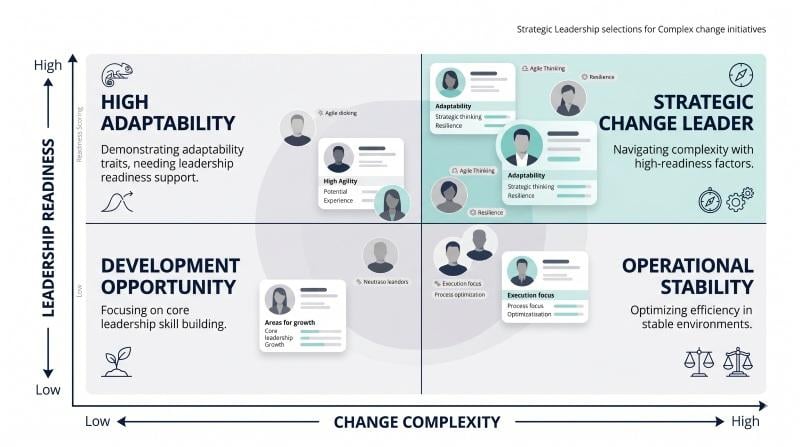
Selecting and supporting change leaders with behavioral data
Most companies pick change leaders based on availability, job title, or who speaks confidently in meetings, rather than using behavioral data to coach leaders more effectively. That’s how you end up with visible leadership and invisible follow-through.
To ensure effective collaboration and successful change initiatives, it’s also crucial to assemble a project team with clearly defined roles—including project managers, team members, mid-level managers, and supervisors—so everyone understands their responsibilities and can work together efficiently.
Better selection criteria:
- Can they stay calm under ambiguity?
- Do they drive decisions, or seek consensus forever?
- Do they handle conflict directly without blowing up trust?
- Do they reliably follow through on routines?
Behavioral assessment data, including deeper motivation insights into what drives each leader, can help HR and the management team select leaders who are more likely to maintain momentum and model the required behaviors.
Design teams with data, not gut feel.
Most org-design decisions come down to role fit, leadership style, and team dynamics. OAD reads those signals from a 7-minute behavioral survey, so you can reconfigure roles and teams with evidence instead of guesswork.
Selecting change leaders with behavioral data
Use OAD’s job behavior insights to support three decisions:
- Shortlist change leaders: identify people with the behavioral profile that fits this change initiative (high uncertainty, high stakeholder negotiation, high execution discipline).
- Coach manager gaps: where a leader’s style creates predictable adoption risk (too blunt, too passive, too detached).
- Build balanced leadership pairs: match a “vision driver” with an “operator” so the change process stays both credible and executable.
2) Clear Vision, Objectives, and Measurable Outcomes
Most change programs fail slowly because “success” never gets defined. Everyone agrees in theory, then argues in execution.
A strong change management plan defines:
- the desired future state
- the project objectives
- the key metrics that indicate progress
- what employees must do differently
Defining the desired future state without vague language
Avoid these phrases unless you attach specifics:
- “improve collaboration”
- “increase accountability”
- “drive transformation”
- “be more agile”
Replace with observable outcomes:
- “handoffs happen within 24 hours”
- “status updates happen weekly, in the platform, not in inboxes”
- “managers use the same scorecard for performance check-ins”
- “training is applied in role workflows within 30 days”
That is where organizational change becomes operational. A detailed project plan is essential during the implementation phase to guide these changes, support stakeholders, and proactively address potential obstacles.
Turning goals into key metrics people understand
Use two metric sets:
- Project metrics: timeline, scope, system stability, process completion
- People metrics: adoption, capability, engagement, retention risk, compliance to new process, and whether employees understand the reasons for change, the benefits it brings, and how to implement new processes effectively.
If you only track project metrics, you can “finish” and still fail.
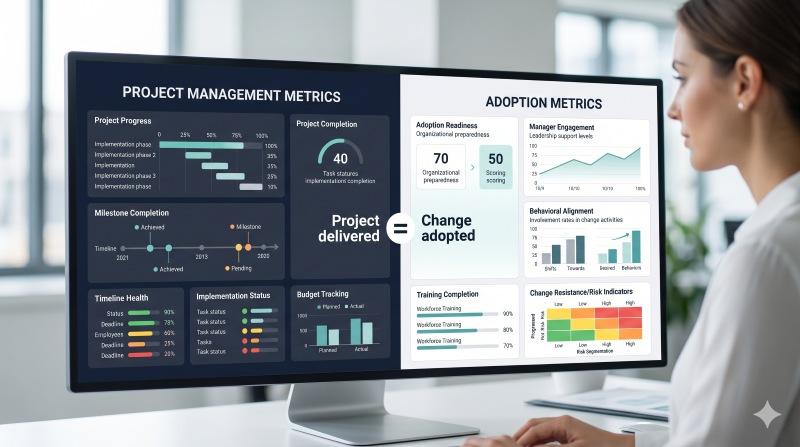
People metrics vs. project metrics
A clean, practical measurement set for managing change:
- Adoption: who is using the new process or new systems, and how often
- Capability: can they do it correctly (quality measures, error rates, rework)
- Engagement: do they believe it helps, and do they feel supported
- Sustainment: does it persist past the initial push (60–90 days post-launch)
Tracking these people metrics not only provides actionable insights but also drives positive outcomes by ensuring that individual adoption and behavior change collectively contribute to the overall success of the change initiative.
Tie each metric to a person who owns it. Otherwise it becomes trivia.
Set adoption and people-focused KPIs
Examples of KPIs that actually predict whether change initiatives fail:
- training completion paired with a real-world task validation (not just “watched video”)
- manager reinforcement cadence (weekly check-ins for first month)
- process compliance rate (tracked in the project management platform)
- role fit and risk and readiness alerts around retention post-launch (watch for spikes in manager escalations, absenteeism, internal conflict)
Achieving and celebrating short term wins is also crucial—these quick, visible successes help build momentum, boost confidence, and reinforce commitment to ongoing change initiatives.
3) A Structured Change Management Strategy and Model
A model is not there to sound smart. It’s there to prevent predictable failure.
A structured approach is especially critical during digital transformation, where organizations face significant, transformational change that requires restructuring processes and retraining staff.
A structured approach forces decisions you would otherwise avoid:
- sequencing and phasing
- stakeholder engagement depth
- reinforcement routines
- what gets measured and when
- how feedback changes the plan
Research shows that organizations applying a structured approach to change management are 33% more likely to experience good or excellent change management effectiveness than those without a methodology.
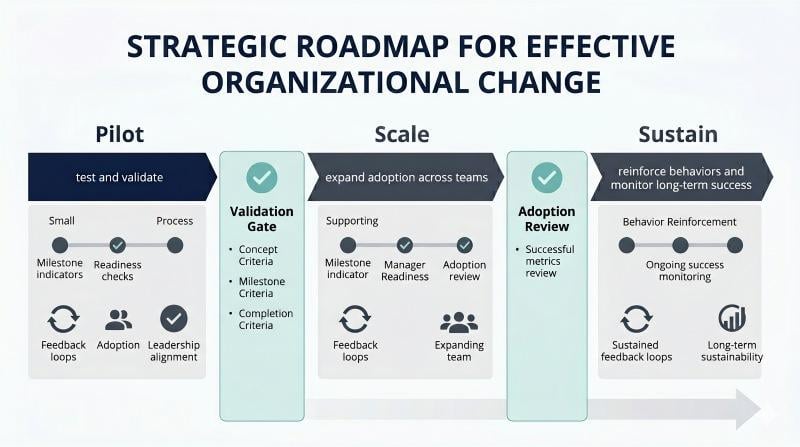
Choosing a change management model based on change scale and risk
Use models as tools, not ideology.
- If the change is mostly about individual adoption and behavior shifts, you need something like ADKAR logic (awareness → desire → knowledge → ability → reinforcement).
- If it’s an organization-wide transformation that requires coordination across key stakeholders and executive leadership, Kotter-style steps can help keep urgency and governance visible.
- If it’s an iterative improvement to business processes, Lean/PDCA thinking keeps the loop tight: test, learn, standardize.
Change management strategies and management workshops can be tailored to support these different types of change—whether transformational, adaptive, or individual—by addressing both technical and human factors, engaging stakeholders, and maintaining momentum throughout the initiative.
The wrong model usually shows up as either:
- too much talk and no execution, or
- too much execution with no adoption.
Phasing: pilots, waves, and how to maintain momentum
A pilot is not a “soft launch.” It’s a controlled learning cycle.
A good pilot has:
- a defined group and timeframe
- clear success criteria (define success before you start)
- a feedback cadence (weekly minimum)
- a decision gate: scale, revise, or stop
It’s essential to involve stakeholders throughout the change process, from planning to feedback collection, to gain support and identify resistance points. Engaging employees early in the change process increases their buy-in and reduces resistance, as they feel more involved and empowered in shaping the change.
This is how you avoid the classic mid-sized failure pattern: launching company-wide before you know what breaks.
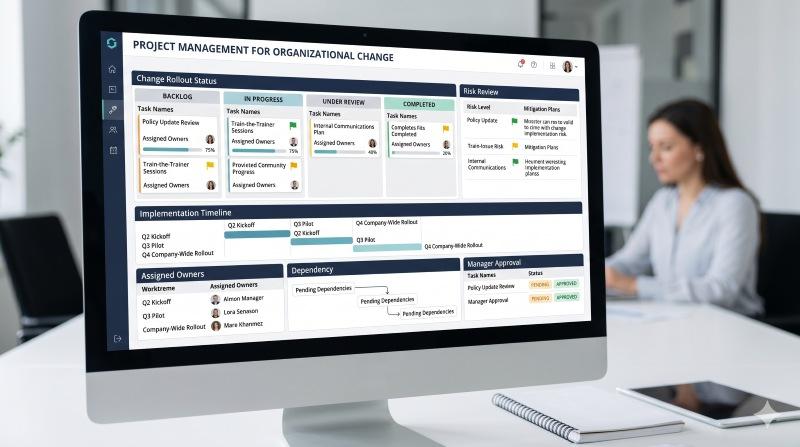
Where project management platforms help
A project management platform helps when it is used to create visibility, not bureaucracy.
Use it to:
- track change initiatives by team and milestone
- document decisions and owners
- surface blockers early
- keep a single source of truth (reduces poor communication and rumor spread)
Avoid turning it into a second job. If updating the tool becomes the work, adoption will drop.
4) Engagement, Communication, and Change Champions
Most change communication fails because it answers the wrong question.
Leadership tends to communicate the what and why. Employees are silently asking: “What changes in my day, and what happens if I don’t get it right?”
Engagement is not about making people enthusiastic. It’s about reducing uncertainty, preventing misinformation, and giving employees enough clarity to act. Raising awareness among stakeholders and employees is a critical first step to foster buy-in and facilitate smoother implementation of change initiatives. Open communication and active employee engagement help organizations embrace change and reduce resistance, making transitions more successful.
Effective communication helps build awareness and desire, bridging the gap between individual beliefs and organizational goals.
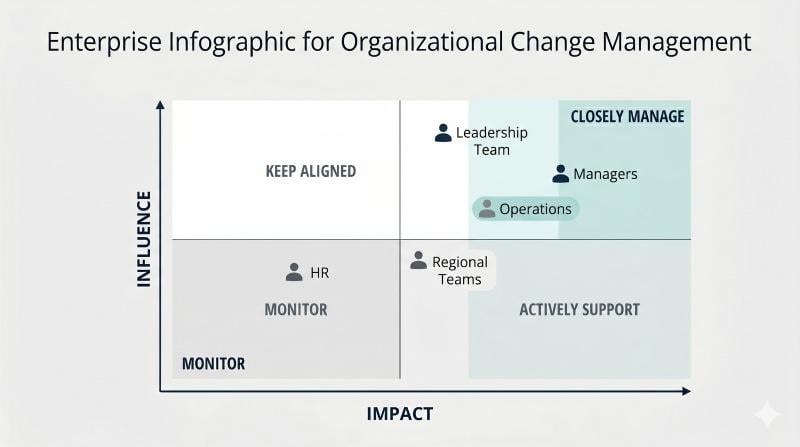
Stakeholder mapping: identify key stakeholders by influence and impact
Do not treat stakeholders as one blob.
Segment them by two factors:
- Influence: Can they accelerate or block adoption for others?
- Impact: How much does their work change?
This helps you decide where to spend attention. Your change management team should focus deep engagement on high-influence, high-impact groups first, then expand.
Practical output from stakeholder mapping:
- who needs direct sponsor time
- who needs manager enablement
- who needs training and job aids
- who needs a “watchlist” because resistance risk is high
Communication that reduces uncertainty
Effective change communication is repetitive, specific, and role-based.
Use a simple communication spine:
- What’s changing and when
- What stays the same
- What I need you to do next
- Where to get help
- How we’ll measure progress
Then tailor it by audience. Finance needs different detail than frontline ops. Managers need reinforcement scripts, not inspirational messages.
Also: do not confuse frequency with clarity. More messages can increase anxiety if they are vague.
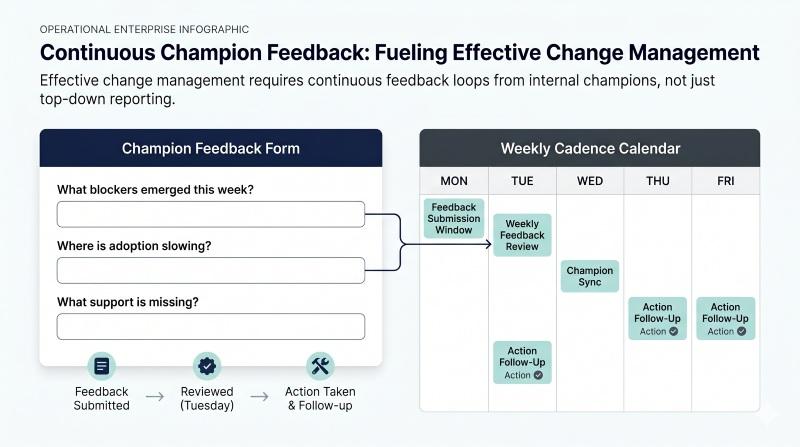
Build a change champion network across teams
Change champions are not cheerleaders. They are distributed operators who:
- translate the change into local context
- surface real blockers early
- reinforce new behaviors peer-to-peer
- provide feedback without filtering everything through management
Recruit champions deliberately. Look for people who are trusted, steady under stress, and willing to be direct.
Build and sustain a champion network
Make the network operational:
- short enablement sessions (30–45 minutes)
- weekly feedback pulse: what’s confusing, what’s breaking, what’s improving
- quick resources: scripts, mini job aids, escalation paths
- public recognition tied to outcomes (not popularity)
If you do this well, champions become your early warning system. That is how you maintain momentum without overloading HR.
5) Governance, Capability, and Sustainment
This is where “successful change” either becomes normal work or dies quietly after launch.
Governance is not bureaucracy. It’s decision clarity:
- who decides what
- how tradeoffs get made
- how issues get escalated
- what gets measured and how often
Equally important is aligning change management strategies with the organization’s culture. Embedding new processes and ensuring the sustainability of organizational transformations depend on understanding and integrating the organization’s culture into every stage of the change initiative.
Research shows that effective change management programs require broad committed engagement, with 67% of respondents citing clear organization-wide ownership of and commitment to change across all levels of the organization as the key factor in a successful change initiative.
Build the change management team (roles, decision rights, cadence)
A practical team structure for mid-sized companies:
- Executive sponsor: owns priority and resourcing
- Change lead: owns the change process end-to-end
- Functional owners: own adoption in their areas
- HR partner: owns role impact, enablement, manager support, engagement signals
- Project lead / PM: owns plan, timeline, dependencies, risk tracking
- Comms and training owners: can be part-time roles, but must be named
Set a cadence:
- weekly execution meeting (tight, decision-focused)
- biweekly sponsor check-in (resourcing and tradeoffs)
- monthly review of key metrics and sustainment risks
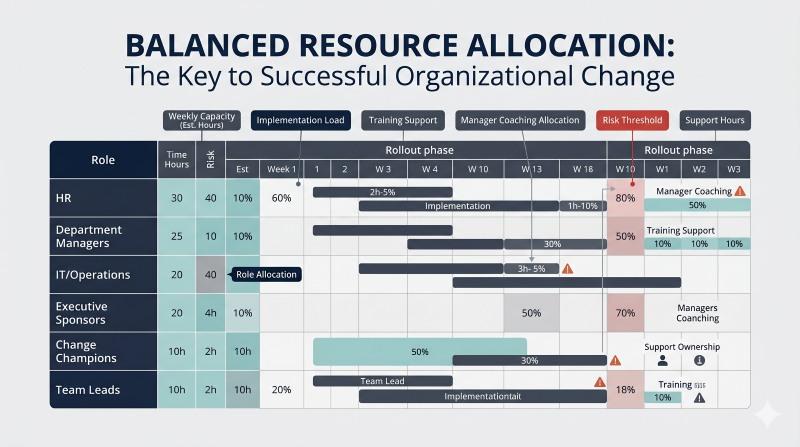
Sufficient resources: time, budget, training, manager capacity
This is where a lot of change initiatives fail for boring reasons. Leaders approve the change, but not the capacity required to implement it.
Resource questions to answer upfront:
- What work stops or slows to make room for this?
- How many manager hours per week are required during rollout?
- What training is needed, and how will it be validated?
- What support coverage exists during the implementation process?
If the answer is “people will figure it out,” you are scheduling failure.
Capability building: new skills, new behaviors, different learning styles
Change often requires capability, not compliance.
Plan for:
- skill gaps (new software, new systems, new technology)
- behavior shifts (handoff discipline, documentation habits, decision speed)
- manager coaching (reinforcing new behaviors without micromanaging)
Different learning styles are real in practice, even if you keep the terminology simple. Some employees need a quick demo, others need job aids, others need coached repetition. Build a mixed enablement package.
Sustainment best practices: align systems, job design, and rewards
Sustainment means aligning the organization so the old way stops being rewarded.
Actions that lock change in place:
- update job descriptions to reflect new processes
- update performance metrics to match the new expectations
- remove workarounds that keep the old process alive
- reinforce manager routines (team meetings, check-ins, escalation rules)
If you do not align systems, you are asking people to swim upstream permanently.
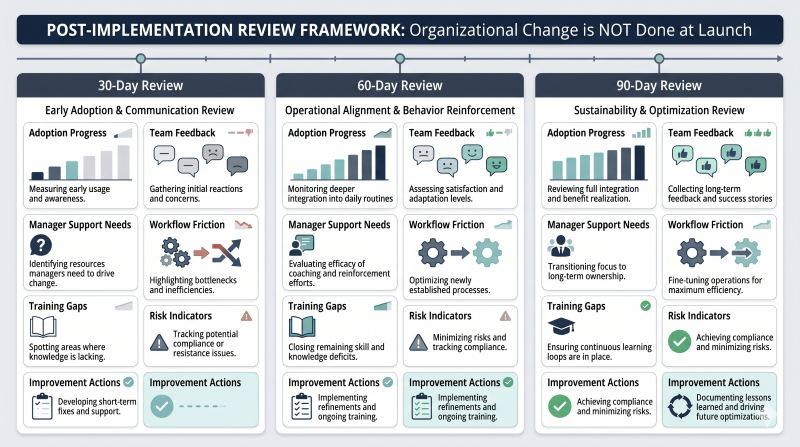
Continuous improvement: track progress, adjust, and standardize
Treat change like a learning loop, not a launch event.
Minimum sustainment measurement:
- adoption and quality after 30/60/90 days
- manager reinforcement cadence
- escalation volume and root causes
- engagement signals and attrition risk markers
Then adjust: simplify steps, clarify responsibilities, fix tool friction, retrain where needed.
Why Change Initiatives Fail (and How the 5 Elements Prevent It)
Most failures are not mysterious. They are predictable, repeatable, and preventable.
Poor communication creates rumor-driven resistance
When people do not get clear answers, they invent them. That is when resistance becomes emotional and hard to unwind.
Prevention:
- Element 4 (communication and champions) reduces uncertainty fast.
- Element 2 (measurable outcomes) makes success concrete, not political.
No measurable objectives causes drift
If you cannot define success, the initiative becomes opinion. Teams argue, momentum collapses, and the status quo wins.
Prevention:
- Element 2 forces defined KPIs and ownership.
- Element 3 creates a structured approach with gates.
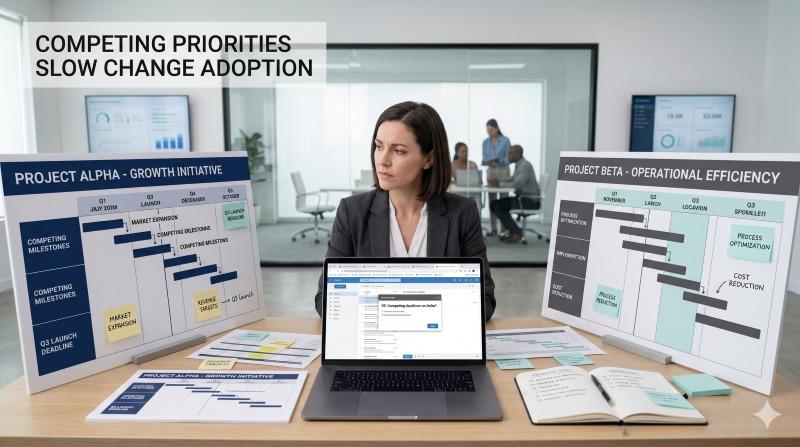
Overloaded teams and competing change demands
Mid-sized companies get crushed here. Multiple initiatives stack, and managers silently ration attention.
Prevention:
- Element 5 (governance and resourcing) forces sequencing and tradeoffs.
- Element 1 (sponsorship) protects priority when conflict hits.
Role misfit and unmanaged behavior under stress
During change, people’s default patterns intensify. Avoidance becomes more avoidant. Aggression becomes more aggressive. Accountability gaps widen.
Prevention:
- Element 1 uses better leader selection and manager coaching.
- Element 5 institutionalizes expectations and consequences.
- Behavioral data can help anticipate where adoption friction is likely, so HR can intervene earlier (OAD angle).
[Image: Manager coaching conversation with a clear “expected behaviors” checklist. Alt: “”]
Quick Comparison of Common Change Management Models
Change management models are decision aids. They help you choose what to emphasize, what to sequence, and what to measure. They do not replace leadership, resourcing, or a workable change management plan.

ADKAR (best for individual adoption)
Use ADKAR when: the success of the change hinges on individual behavior change, capability, and reinforcement (new software, new systems, new skills, new workflows).
Strengths:
- keeps focus on employee adoption and ability, not just rollout
- makes gaps obvious (people can have awareness but no ability)
Watch-outs:
- can feel too “person-by-person” if you need organization-wide coordination
- needs strong manager routines to reinforce new behaviors
Kotter (best for organization-wide transformation)
Use Kotter-style sequencing when: you need cross-functional alignment, strong executive leadership visibility, and sustained momentum across the entire organization.
Strengths:
- creates urgency and governance structure so the change does not drift
- emphasizes communication and reinforcement at scale
Watch-outs:
- can become overly programmatic if teams treat it like a checklist
- fails fast if sponsorship is weak (and sponsorship is consistently a top success factor in Prosci research)
Lewin (useful when you need a simple stability shift)
Use Lewin’s “unfreeze-change-refreeze” logic when: you need to intentionally break existing processes, reset norms, and then stabilize the new way of working.
Strengths:
- clear mental model for removing old habits and locking in new ones
- useful for culture and behavior resets
Watch-outs:
- real organizations rarely “refreeze” permanently; most operate in continuous change
Lean / PDCA (best for iterative process improvement)
Use PDCA when: you are improving business processes, restructuring processes, or optimizing workflows where learning-by-doing beats top-down design.
Strengths:
- tight learning loop: test, learn, standardize
- reduces risk by validating changes in real-world scenarios
Watch-outs:
- can under-communicate the “why” if you treat it like pure operations
- can stall without decision rights and clear metrics
How to Choose the Right Change Management Strategy
The right strategy is the one that matches your change scale, people impact, and organizational capacity. Most failures come from mismatch, not effort. “Seventy percent of transformations fail” is a common benchmark for a reason. Execution breaks when engagement and capability do not keep pace with the plan.
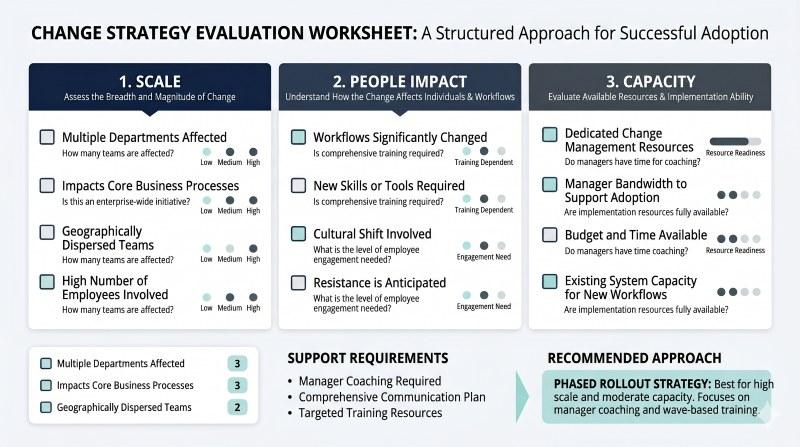
Choose based on change scale
- Team or function-level change: Start with pilot waves, tight feedback loops, and manager enablement.
- Multi-function change: Emphasize governance, stakeholder mapping, and cross-team dependencies.
- Entire organization transformation: Prioritize sponsorship, sequencing, and a communications spine that stays consistent.
Choose based on people impact
If many roles change, people need clarity and reinforcement, not optimism.
Questions that determine people impact:
- Are job responsibilities changing, or just tools?
- Are performance metrics changing?
- Are managers expected to coach new behaviors?
- Will the change create temporary workload spikes?
If the answer is “yes” across multiple areas, the change management team should allocate more time to manager coaching, champions, and reinforcement routines.
Choose based on organizational capacity
Capacity is the part everyone pretends is infinite, right up until the change initiatives fail.
Do a simple change-load check:
- How many major change efforts are active right now?
- Which teams are already at saturation?
- What work stops or slows to make room?
- Do managers have time for enablement and support?
If you cannot create space, your “structured approach” becomes a structured failure.
Which Element Should Mid-Sized HR Teams Prioritize First?
Prioritization is situational. Use this as a decision rule.
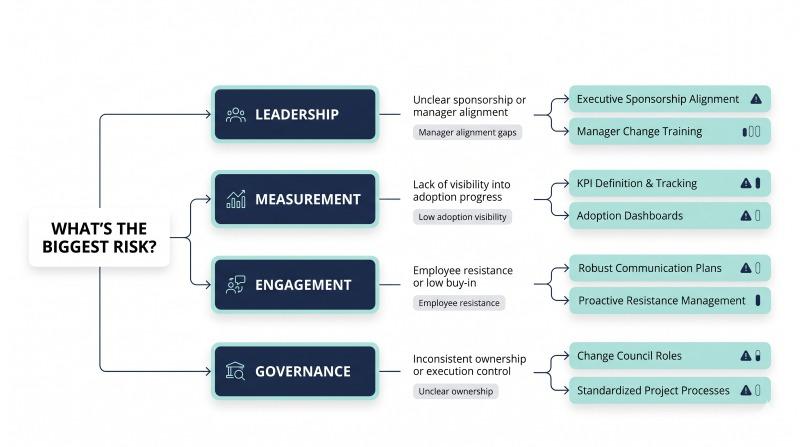
If executive sponsorship is weak: start with leadership alignment
Prosci’s research has identified sponsorship as the greatest contributor to change management success across its studies since 1998.
If sponsorship is not visible and resourced, fix that before you build anything else.
If adoption risk is high: start with engagement and champions
When employee willingness to support enterprise change drops, adoption becomes fragile. A Gartner survey cited by HBR reported willingness at 43% in 2022 vs 74% in 2016.
That is your cue to invest in role-based communication, manager toolkits, and a champion network early.
If multiple initiatives compete: start with governance and sequencing
If teams are overloaded, you will not “inspire” your way out of it. You need decision rights, tradeoffs, and a plan that protects focus.
If leaders are aligned but execution is sloppy: start with measurable outcomes
Define success, pick 5–10 key metrics, and assign owners. Drift dies when measurement is real.
FAQ: Successful Change Management
How do you measure change management success?
Use both project and people measures:
- adoption and usage (are people actually using the new process)
- quality and rework (are they doing it correctly)
- manager reinforcement (are new behaviors being coached)
- sustainment at 30/60/90 days (does it stick after the initial push)
Define success before rollout. Otherwise you will measure whatever is easiest, not what matters.
Why do change initiatives fail?
Common failure patterns:
- weak sponsorship or inconsistent leadership support
- unclear objectives and no measurable outcomes
- poor communication that increases uncertainty
- overloaded teams and competing change efforts
- capability gaps (new skills required, insufficient enablement)
The “70% fail” benchmark shows up repeatedly in transformation research for a reason: execution and adoption break more often than strategy.
How do you manage resistance to change from employees?
Treat resistance as information.
- clarify what changes in day-to-day work
- address concerns early with managers and champions
- remove practical blockers (time, tools, training)
- reinforce new behaviors with routines and clear expectations
Also: psychological safety matters. Gartner reported that when managers create a psychologically safe environment, it can reduce change fatigue by up to 46%.
How long does a change management process take?
It depends on scope, not ambition.
- process changes can stabilize in weeks if enablement and reinforcement are strong
- organization-wide transformations often take months and require staged rollout waves
The key is not the calendar. It’s whether sustainment mechanisms exist after launch.
What is the change management process?
At a practical level, a change management process means:
- align leaders and sponsorship
- define measurable outcomes
- choose a model and phased strategy
- engage stakeholders through communication and champions
- govern, enable, and sustain until the new way becomes normal work
Final Recommendations and Next Steps
This is the part where most teams either act or go back to meetings about meetings.

- Run a readiness and role-impact scan
Map which roles change, where adoption risk is highest, and which managers need extra coaching. - Pick your model, then design the rollout in phases
Define pilot scope, success criteria, feedback cadence, and the scale decision gate. - Build your champion network early
Champions reduce noise, surface blockers, and help maintain momentum without overloading HR. - Measure what matters, not what’s convenient
Track adoption, quality, reinforcement, and sustainment. Assign owners. - Operationalize sustainment
Update job expectations, align performance metrics, and remove incentives that reward the old way.
If you want to see how OAD performs on your own roles and teams, you can test the free Top Performer Profile and explore scalable pricing plans for different team sizes, and compare your next change leaders and key roles using data instead of gut feel. As adoption grows, giving individuals their own secure access to survey results and development insights helps sustain engagement. For revenue-critical roles, you can also use OAD to build and coach high-performing sales teams with better role fit.