Leaders shape results, team morale, and how work gets done. So a leadership evaluation sample should do more than “rate performance.” It should make expectations measurable, feedback usable, and development concrete.
This guide gives you a copy-paste leadership performance review template, plus leadership performance review examples and performance review phrases you can use immediately. It’s written for HR teams and executives who want consistent, fair reviews across managers, team leaders, and senior leaders, without vague language or personality contests.
What is a leadership evaluation sample (and when should you use one)?
A leadership evaluation sample is a structured template for assessing a leader’s outcomes and behaviors. It helps reviewers write performance review comments that are specific, consistent, and tied to business goals.
The point is simple: better inputs create better decisions. When reviews are unstructured, two leaders can deliver the same results and get completely different feedback based on the reviewer’s style. A template reduces that noise.
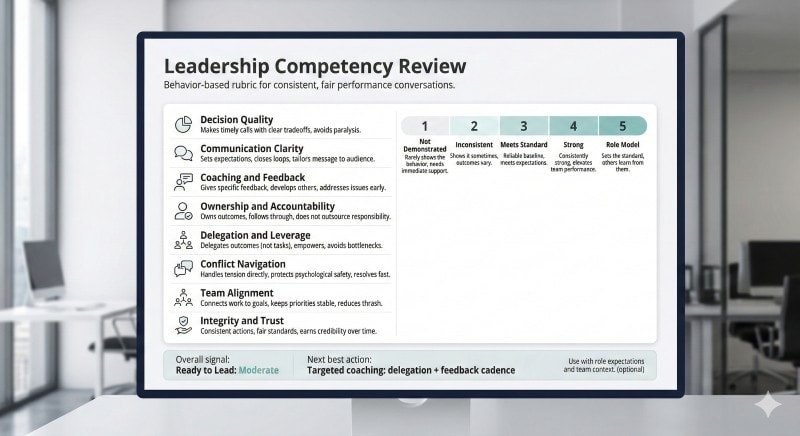
The purpose: clearer expectations, better feedback, stronger leadership skills
A strong leadership performance review does three jobs:
- Clarifies what “effective leadership” means in this role
- Creates constructive feedback that can be acted on
- Builds a development path that improves team performance over time
If the review can’t produce a clear next step, it’s not a review. It’s a recap.
Who this template is for (HR, hiring managers, executives, team leaders)
This template is designed for:
- HR professionals running performance management across teams
- Hiring managers assessing team leaders and people managers
- Executives calibrating leadership standards across functions
- Team leaders completing self-reviews or peer feedback
It also works when you need consistent language for performance review phrases, especially across multiple reviewers.
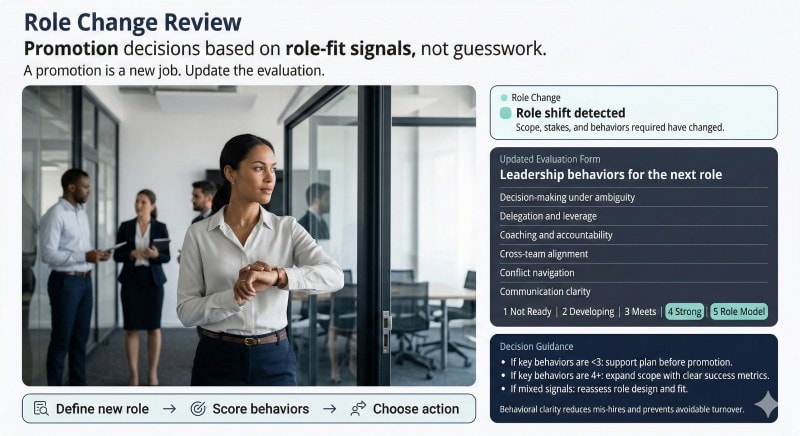
When to use it (annual performance review, promotions, role changes, performance issues)
Use a leadership evaluation sample when decisions matter:
- Annual performance review cycles
- Promotion readiness and succession planning
- Role changes (new scope, new team, new business goals)
- Performance concerns where you need clear documentation
- Post-project reviews for project team leads
If the leader’s scope changed during the year, call that out upfront. Otherwise, reviewers will judge based on outdated expectations.
Leadership performance review overview
A leadership performance review should assess two things:
- What results the leader produced (team outcomes)
- How the leader produced them (management skills and behaviors)
Results without leadership skill can burn teams out. Great leadership without outcomes is still a problem. The review needs both.
Scope: what the review covers (results, behaviors, people leadership, execution)
Most leadership reviews should include:
- Results: delivery, business impact, team’s success
- Execution: prioritization, time management, follow-through
- People leadership: delegation skills, coaching, team building
- Collaboration: team collaboration, cross-functional work, conflict resolution strategies
- Decision quality: decision making under uncertainty, risk assessment
- Communication: clarity, listening, handling complex ideas
The scope should match the role. A project team lead is not graded like a VP with budget ownership.
How leadership reviews connect to employee performance and team performance
Leaders influence:
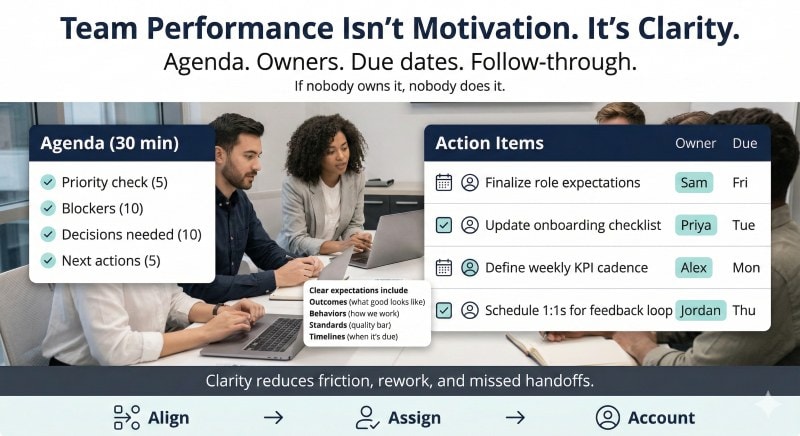
- Clarity of expectations
- Speed and quality of decisions
- Psychological safety and team input
- Accountability and follow-through
- Team efficiency and collaboration patterns
That is why leadership reviews are not “soft.” They are upstream performance drivers.
Cadence: annual reviews vs regular feedback cycles (and why most teams need both)
Annual performance reviews are common because they align with compensation and planning cycles. They are also too infrequent to fix problems early.
The practical setup:
- Use regular feedback (monthly or quarterly) for course correction
- Use the annual performance review to summarize and decide (pay, promotion, scope)
That keeps the annual review from turning into a surprise audit.
Context that affected performance (constraints, dependencies, major shifts):
Outcomes and impact (team outcomes, team efficiency, project delivery)
Key results delivered (what happened):
- Result 1 (include metric or milestone if available):
- Result 2:
- Result 3:
Impact on team performance:
- Team efficiency (speed, throughput, rework, handoffs):
- Team outcomes (quality, customer impact, internal impact):
- Team morale and retention signals (if relevant):
Execution strength:
- What the leader consistently delivered well:
- Where delivery slipped and why (root causes, not excuses):
Competencies (communication, decision making, emotional intelligence, delegation, strategic thinking)
Rate each competency based on observable behavior. Add specific examples. No examples = weak review.
Communication skills
- What they did well:
- What to improve:
- Specific examples:
Decision making
- What they did well:
- What to improve (speed, quality, risk assessment):
- Specific examples:
Emotional intelligence
- What they did well (active listening, empathy, conflict handling):
- What to improve:
- Specific examples:
Delegation and time management
- What they did well (ownership, clarity, follow-up):
- What to improve:
- Specific examples:
Strategic thinking and problem solving
- What they did well (priorities, trade-offs, long-term impact):
- What to improve:
- Specific examples:
Optional add-ons depending on role:
- Technical skills (if hands-on leadership role)
- Team building and collaboration (if cross-functional heavy)
- Change leadership (if transformation work)

Values and culture (team morale, positive work environment, collaboration)
This section prevents “results at any cost” leadership.
What this leader reinforces (positive work environment):
How they support team collaboration and psychological safety:
Where their leadership style creates friction (if applicable):
Development plan (professional development, milestones, support, follow-ups)
Keep it measurable. “Get better at leadership” is not a plan.
Top development goals (1–3):
- Goal:
- Why it matters:
- What “good” looks like:
- Actions (training, coaching, new challenges):
- Milestone by date:
- Goal:
- Why it matters:
- What “good” looks like:
- Actions:
- Milestone by date:
Follow-up cadence (regular feedback):
- Next check-in date:
- Review again in: 30 / 60 / 90 days
Overall performance summary + rating (optional)
Use ratings only if your company already has a system. If you don’t, skip it. Forced ratings without definitions create noise.
Overall summary (3–6 sentences):
- What they achieved
- How they led
- Biggest strength to keep
- Biggest gap to close
- The one priority for the next cycle
Overall performance (optional):
- Rating:
- Rationale (must include examples):
Leadership performance review examples
Examples help reviewers stop writing vague feedback like “strong leader” or “needs to improve communication.” Below are leadership performance review examples across roles, performance levels, and reviewer perspectives.
Examples by role (people manager, functional leader, project team lead, senior leader)
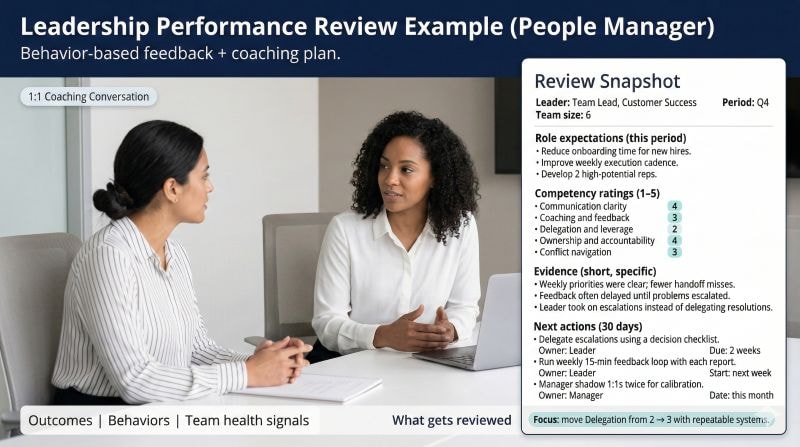
People manager (team lead with direct reports)
“Over the past quarter, you improved team execution by clarifying priorities and assigning clear owners. Team members report fewer last-minute changes, and delivery has become more predictable. Your 1:1s are consistent, and you follow through on development commitments. The biggest improvement area is delegation. You still take on work that should be owned by senior team members, which slows decisions and limits growth opportunities.”
Functional leader (department head)
“You delivered key outcomes against business goals while maintaining stability during competing priorities. Cross-functional partners describe your communication as clear and proactive, especially when timelines shift. You also strengthened team collaboration by aligning stakeholders early. The main gap is decision speed in ambiguous situations. You tend to seek additional validation before committing, which delays execution when the team needs direction.”
Project team lead (matrix leadership, limited formal authority)
“You coordinated a multi-team project effectively and kept stakeholders aligned through regular updates. When dependencies blocked progress, you escalated quickly and proposed alternative paths. Team outcomes improved because you documented decisions and clarified handoffs. The improvement area is conflict resolution. When priorities clashed between teams, you avoided direct conversations and issues resurfaced later.”
Senior leader (exec-level scope)
“You delivered impact at the organizational level and built alignment on priorities. Your strategic thinking is strong, especially in identifying which initiatives to stop. You improved team capability by developing leaders beneath you and delegating meaningful ownership. The gap is consistency in feedback delivery. Some team leaders report they only get direct feedback during high-pressure moments, which reduces clarity and trust.”
Examples by performance level (outstanding, solid track record, needs improvement)
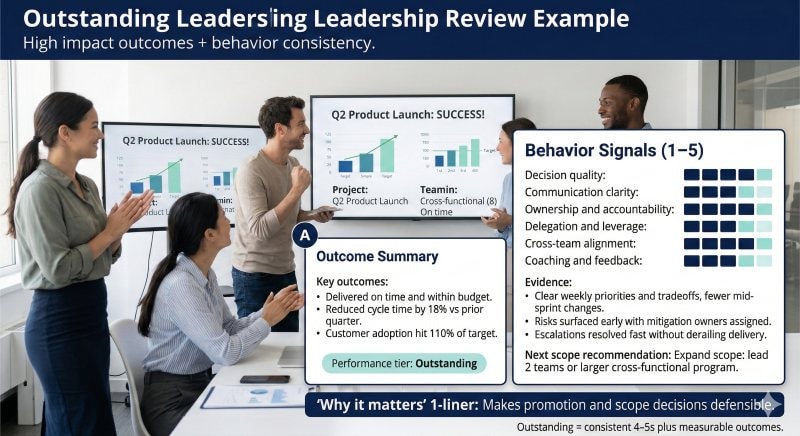
Outstanding leadership (high impact, strong behaviors)
“You consistently delivered results while improving team performance. You communicate effectively, set clear expectations, and use regular feedback to keep execution on track. You also built a positive work environment where team members raise issues early. You should now focus on scaling your leadership by delegating more strategic ownership and coaching others to make decisions without you in the loop.”
Solid track record (meets expectations with clear improvement targets)
“You met expectations on delivery and kept the team aligned. Your decision making is generally sound, and you collaborate well with stakeholders. The next step is improving the quality of your performance review comments and coaching conversations. Several opportunities for development were identified during the year, but they were not translated into measurable goals and follow-ups.”
Needs improvement (performance gaps tied to specific examples)
“You missed key deadlines and the root cause was not workload alone. Priorities were unclear, tasks were not delegated effectively, and decisions were delayed. Team members often lacked context and had to rework outputs due to shifting direction. The immediate focus is establishing a consistent review process: weekly priority setting, clearer ownership, and documented decisions. Progress should be reviewed in 30 to 60 days with specific examples.”
Examples by reviewer perspective (manager, peer, skip-level, self-review)
Manager perspective
“You improved team efficiency by setting clear weekly priorities and removing blockers faster. Your leadership skills are trending upward, especially in coaching and delegation. The next improvement area is communication in high-pressure situations. In two escalations this quarter, messages became reactive and created confusion. The expectation is calm, direct updates with clear decisions and owners.”

Peer perspective
“You collaborate well and keep cross-functional work moving. You communicate effectively when timelines shift and you flag risks early. A growth area is involving partners sooner. On two projects, requirements were shared late, which forced last-minute trade-offs.”
Skip-level perspective
“Your team’s work quality is strong and outcomes are clear. The main opportunity is developing your next layer of leadership. Your direct reports rely on you for decisions that could be made at their level. Shifting those decisions down will strengthen team capability and reduce bottlenecks.”
Self-review perspective
“This review period, I improved communication by documenting decisions and clarifying priorities. My strongest leadership skill was building alignment across stakeholders. My key improvement area is decision speed when information is incomplete. Next cycle, I will define decision thresholds, involve relevant input early, and commit to clearer timelines for trade-offs.”
Performance review phrases for leaders (strengths and improvement)
Most leadership reviews fail for one boring reason: reviewers write soft, unspecific sentences that cannot be acted on. The fix is not “more feedback.” It’s clearer feedback.
Use the phrases below as a starting point, then add specific examples from the review period.
How to write strong leadership performance review comments (specific examples, outcomes, context)
A useful leadership comment has three parts:
- Behavior (what the leader did)
- Impact (what changed for the team or business)
- Context (when it showed up, what situation)
Weak: “Strong communicator.”
Better: “Communicates priorities clearly in weekly planning, which reduced rework and improved delivery.”
If you want calibration across reviewers, insist on that structure. Otherwise, you get opinions dressed up as evaluation.

Leadership strengths: ready-to-use phrases (positive feedback)
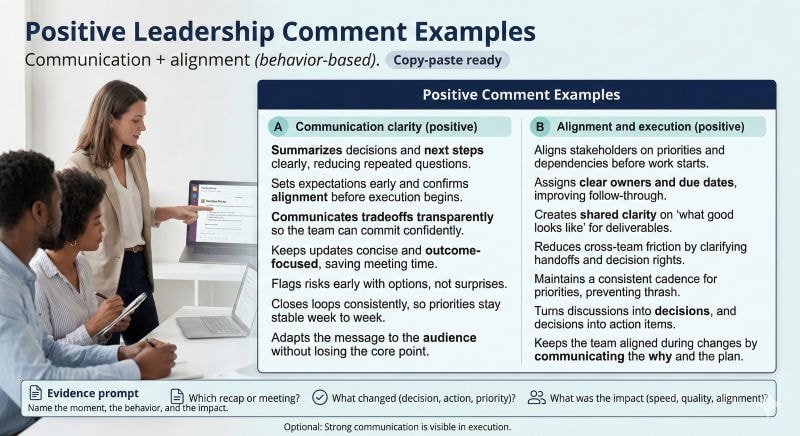
- “Sets clear expectations and aligns the team on priorities early.”
- “Communicates effectively with stakeholders, especially when timelines shift.”
- “Removes blockers quickly and keeps team efforts focused on outcomes.”
- “Builds a positive work environment where team members raise concerns early.”
- “Delegates tasks appropriately and supports ownership without micromanaging.”
- “Uses active listening skills and reflects back key points before deciding.”
- “Makes timely decisions when information is incomplete and explains trade-offs.”
- “Recognizes strong work and reinforces behaviors that improve team performance.”
- “Encourages professional growth by assigning stretch work with clear support.”
- “Keeps the team aligned during change and maintains team morale.”
Leadership improvement: ready-to-use phrases (constructive feedback, constructive criticism)
These are direct without being messy. They focus on what to change.
- “Needs to clarify priorities earlier to reduce last-minute changes and rework.”
- “Decision making is sometimes slow when ambiguity is high; the team needs faster direction.”
- “Communication becomes reactive under pressure; updates should be calmer and more structured.”
- “Delegation is inconsistent; too much work stays with the leader instead of being assigned clearly.”
- “Should document decisions more consistently so teams don’t re-litigate the same topics.”
- “Needs to involve partners earlier to prevent avoidable scope changes later.”
- “Feedback is too general; team members need specific examples and clear next steps.”
- “Conflict resolution strategies should be more direct; unresolved issues resurface and slow execution.”
- “Should create clearer development milestones instead of broad professional development goals.”
- “Needs to improve follow-through on commitments to maintain trust with the team.”
Quick formatting rules for copy-paste comments (keep it usable, not poetic)
- Start with the core behavior in the first sentence.
- Add impact in the second sentence.
- Add one example, date, project, or stakeholder context.
- End with the expectation for next cycle.
Template you can reuse:
“[Behavior]. This [impact] for [team/business]. Example: [specific example]. Next cycle, the expectation is [clear change].”
Example phrases by competency
This section is the quick-grab bank. Each competency includes positive phrases, constructive phrases, and a few self-review prompts so leaders can assess their own performance without writing a novel.
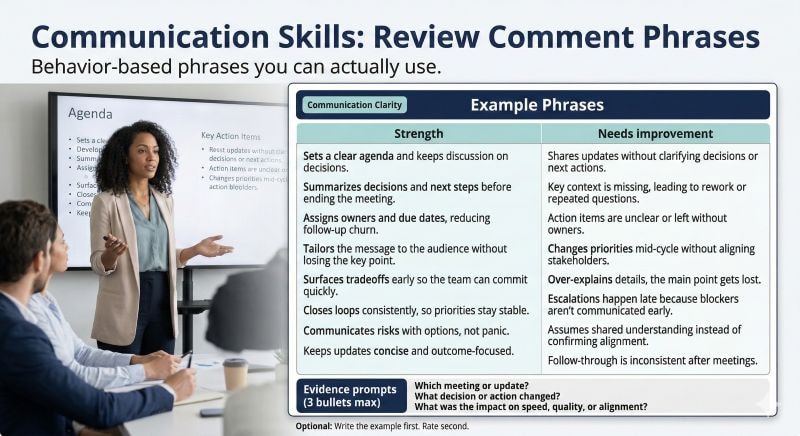
Communication skills (positive, constructive, self-review prompts)
Positive communication skills phrases
- “Communicates priorities clearly and repeats them often enough to stick.”
- “Explains complex ideas in plain language so team members can act quickly.”
- “Sets clear expectations on what ‘done’ looks like and what success means.”
- “Keeps stakeholders informed with structured updates and clear next steps.”
- “Uses active listening skills and confirms understanding before responding.”
Constructive communication skills phrases
- “Messages can be unclear when priorities change; the team needs explicit direction.”
- “Often assumes context that others do not have; needs to reset the ‘why’ more often.”
- “Updates are sometimes too broad; stakeholders need specifics on decisions, owners, and timing.”
- “Should address issues earlier instead of waiting until deadlines force escalation.”
Self-review prompts (communication)
- “Where did I communicate clearly enough that rework went down?”
- “Where did I create confusion by not documenting decisions?”
- “Did I give clear expectations or just outcomes?”
Decision making (outcome-focused, risk assessment, timely decisions)
Outcome-focused decision making phrases
- “Makes decisions that balance speed, quality, and business goals.”
- “Clarifies trade-offs early and commits to a direction.”
- “Uses data where available and avoids analysis paralysis.”
Risk-assessment decision making phrases
- “Identifies risks early and plans mitigations with owners and timelines.”
- “Escalates appropriately when risk exceeds the team’s control.”
- “Separates reversible decisions from high-impact, one-way decisions.”
Timely decision making phrases
- “Makes timely decisions in ambiguous situations and explains the rationale.”
- “Avoids delaying execution by seeking unnecessary consensus.”
- “Sets decision deadlines when the team is stuck.”
Emotional intelligence (active listening, conflict resolution, team input)
Empathy-focused phrases
- “Shows empathy without lowering standards or avoiding accountability.”
- “Notices team stress signals and adjusts workload and expectations early.”
- “Maintains a calm tone under pressure, which stabilizes team morale.”
Active listening phrases
- “Seeks team input before deciding, then closes the loop on what changed.”
- “Reflects back concerns accurately and asks clarifying questions.”
- “Creates space for quieter team members to contribute.”
Conflict-resolution example phrases
- “Addresses conflict directly and early, before it becomes a team dynamics issue.”
- “Separates the people from the problem and focuses on solutions.”
- “Handles disagreements fairly and prevents blame cycles.”
Growth mindset (learning, resilience, continuous improvement)
Learning-oriented phrases
- “Seeks feedback proactively and applies it in visible ways.”
- “Treats mistakes as signals for process improvements, not personal failures.”
- “Builds new skills through deliberate practice, not just exposure.”
Resilience-focused phrases
- “Stays effective during setbacks and keeps the team focused on solutions.”
- “Adapts quickly to new challenges without shifting priorities daily.”
- “Maintains consistent standards even under pressure.”
Encouraging development phrases
- “Encourages professional development by creating time for learning and experimentation.”
- “Uses retrospectives to drive continuous improvement in how the team works.”
- “Turns lessons learned into repeatable processes.”
Delegation and time management (clear expectations, ownership, prioritization)
Positive phrases
- “Effectively delegates tasks with clear ownership, deadlines, and success criteria.”
- “Prioritizes work based on impact and keeps the team aligned to business goals.”
- “Protects focus time and reduces noise for the team.”
- “Uses a consistent review process to track progress without micromanaging.”
Constructive phrases
- “Keeps too many decisions and tasks at their level, creating bottlenecks.”
- “Needs to set clearer expectations on timelines and quality standards.”
- “Should reduce context-switching and protect time for high-impact work.”
- “Follow-through on delegated work needs to be more consistent.”
Strategic thinking and problem solving (trade-offs, complex ideas, innovative solutions)
Positive phrases
- “Shows strong strategic thinking by focusing on the few priorities that drive outcomes.”
- “Connects day-to-day execution to longer-term business principles.”
- “Solves problems quickly by defining the root cause before proposing solutions.”
- “Generates creative solutions without losing practicality.”
Constructive phrases
- “Needs to make trade-offs clearer so the team understands what is not being done.”
- “Sometimes jumps to solutions before defining the problem.”
- “Should communicate strategy in a way that translates into weekly execution.”
Team building and collaboration (team efforts, improve team dynamics, team aligned)
Positive phrases
- “Builds team collaboration through clear roles, shared goals, and open communication.”
- “Improves team dynamics by addressing issues early and fairly.”
- “Recognizes team efforts and reinforces behaviors that raise the team’s success.”
- “Creates a positive work environment with high standards and psychological safety.”
Constructive phrases
- “Needs to address misalignment earlier to prevent friction and delays.”
- “Should involve cross-functional partners sooner to reduce handoff issues.”
- “Team morale dips during high-pressure periods; needs more consistent communication and support.”
Best practices for effective leadership performance reviews
If you want reviews that improve team performance instead of just documenting opinions, the process has to be structured. Otherwise, you get inconsistent standards, soft language, and ratings that cannot be defended, especially when founders and CEOs are making high-stakes leadership and promotion decisions for a scaling organization.
Align leadership skills to business outcomes (what “good” looks like in this role)
Start with outcomes, then define the leadership behaviors that produce them.
Example: If the business goal is faster delivery, the relevant leadership skills are usually prioritization, delegation, decision making, and communication. If the goal is retention, you look harder at coaching, feedback delivery, conflict resolution, and team morale.
Write role-specific definitions so “strong leadership skills” means the same thing across teams.
Use multi-rater feedback where it makes sense (and where it backfires)
Multi-rater feedback can improve accuracy because leaders affect people in different directions: down, sideways, and up.
Use it when:
- The leader’s work is cross-functional (many stakeholders)
- You need visibility into collaboration and communication skills
- You suspect a gap between perception and impact
Avoid it when:
- The team is in active conflict and feedback will become political
- Reviewers do not have enough exposure to the leader’s work
- The organization cannot protect confidentiality appropriately
If you do use it, standardize prompts so you get comparable inputs, not random essays.
Bias mitigation basics (training, structured criteria, consistent language)
Bias mitigation is not solved by telling reviewers to “be objective.” It’s solved by designing the review to require evidence.
Practical moves that work:
- Use the same competency definitions across teams
- Require at least one specific example per major rating area
- Ban vague labels without evidence (“not leadership material,” “too soft,” “too aggressive”)
- Separate personality from behavior (what happened, what impact, what expectation)
Where possible, use structured tools and consistent criteria to reduce variation between reviewers. That is one reason psychometrically validated assessment data can help in hiring and development: it adds a repeatable lens instead of relying on gut feel.
Design teams with data, not gut feel.
Most org-design decisions come down to role fit, leadership style, and team dynamics. OAD reads those signals from a 7-minute behavioral survey, so you can reconfigure roles and teams with evidence instead of guesswork.
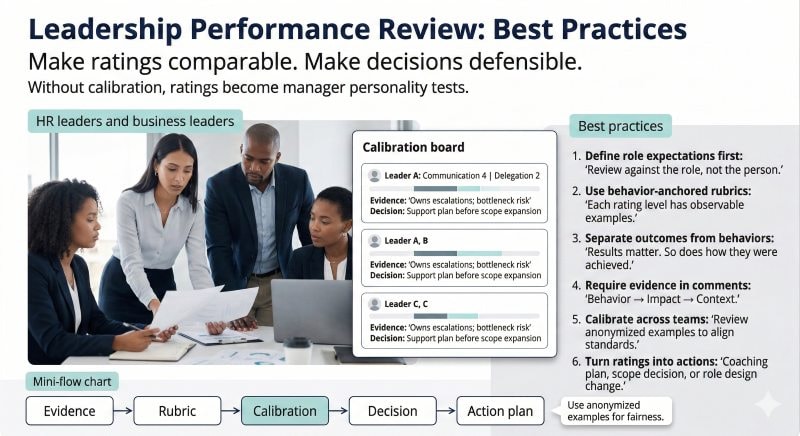
Calibration sessions: why “document examples” matters
Calibration is how you prevent one department from being “easy graders” while another is harsh.
Calibration works best when:
- Leaders bring 2 to 3 concrete examples per competency
- Review comments are written before the session
- HR moderates language consistency and standards
- Decisions are recorded, not “agreed verbally”
If you cannot explain a rating with examples, it’s not a rating. It’s a mood.
Tools and systems: keeping the process consistent across teams
Consistency requires a system, even if it’s simple.
Minimum viable setup:
- A template (like the one above)
- A shared competency rubric
- A place to store performance review comments and examples
- A regular feedback cadence so the annual performance review is not a surprise
If you want to strengthen consistency further, structured assessment data like behavior fit reports that match roles to personality can support both leadership development and selection decisions by giving you comparable inputs across candidates and leaders.
Design teams with data, not gut feel.
Most org-design decisions come down to role fit, leadership style, and team dynamics. OAD reads those signals from a 7-minute behavioral survey, so you can reconfigure roles and teams with evidence instead of guesswork.
Annual performance review process checklist
This is the checklist that prevents the annual review from turning into a stressful memory test and pairs well with scalable, science-based leadership assessment plans that keep data organized across teams and cycles.
Prepare performance data (goals, metrics, stakeholder input, specific examples)
Before the meeting, gather:
- Goals and outcomes for the review period
- Key metrics where relevant (delivery, quality, retention, engagement, cost)
- Stakeholder input (peers, partners, skip-level feedback if used), plus any structured evaluations of critical skills such as communication capabilities assessed during the hiring process
- Specific examples tied to leadership skills (good and bad)
Write comments before the meeting. If you improvise in the room, you will drift into vague language.
Share self-assessment instructions (own performance, wins, gaps, support needed)
Ask the leader to submit a short self-review that covers, and consider supplementing it with behavioral coaching insights grounded in assessment data that reveal how they respond under stress and in different leadership situations:
- Key wins and outcomes
- Where they fell short and why
- What they learned and what they changed
- Professional growth goals for next cycle
- Support needed (resources, training, stakeholder alignment)
This improves accuracy and reduces defensiveness because the leader is not hearing everything for the first time.
Run the review meeting (agenda, feedback delivery, next steps)
Simple agenda that works:
- Context and scope for the period
- Outcomes and impact
- Competencies and specific examples
- Development plan and milestones
- Summary and next steps
Deliver feedback clearly. Use constructive feedback language that targets behavior and expectations, not identity.
Document decisions and follow-ups (performance management hygiene)
After the meeting:
- Finalize the written review within 24 to 72 hours
- Record development milestones and dates
- Schedule follow-up check-ins
- Capture any compensation or scope decisions separately if needed
The goal is continuity. The review should feed the next cycle, not disappear into a system until next year.
Linking leadership reviews to employee development
A leadership performance review is only useful if it changes what happens next. The fastest way to waste a review is to end it with “keep doing what you’re doing” and no plan.
Turn feedback into a development plan (career development, new skills, training)
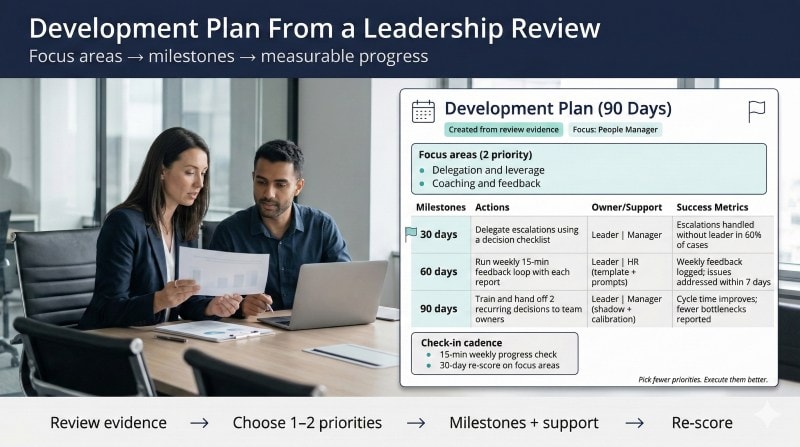
Translate review outcomes into 1 to 3 development priorities. Keep them specific and role-relevant.
Examples of good development priorities that are informed by insights into a leader’s core motivators and behavioral needs:
- “Improve delegation so decisions move faster without escalations.”
- “Strengthen conflict resolution to reduce recurring team friction.”
- “Improve communication in high-pressure situations to keep stakeholders aligned.”
Avoid generic goals like “be more strategic” unless you define the behaviors you want to see.
Define milestones and measurement (measurable development milestones)
Development needs measurement, even if it’s simple. Pick indicators that match the skill.
Examples:
- Delegation: “X decisions per month made at the team lead level without escalation.”
- Communication: “Weekly updates include decisions, owners, and timelines every time.”
- Coaching: “Monthly documented development conversations with each direct report,” which is especially important when you’re developing leaders in critical roles such as high-performing sales reps moving into sales leadership positions.
- Decision making: “Decision deadlines set for ambiguous topics, with trade-offs documented.”
Milestones should be time-bound and visible. Otherwise, “professional growth” becomes a yearly fiction everyone politely agrees to.
Track progress with regular feedback and check-ins
If you only talk about development once a year, you’re not developing anyone. You’re filing paperwork.
Use a consistent cadence:
- 30-day check-in: confirm actions started
- 60-day check-in: review early evidence and adjust
- 90-day check-in: evaluate progress with examples
Keep notes brief and tied to the same competencies used in the annual performance review. That creates continuity and reduces opinion drift.
Sample leadership performance review comments (templates)
These are ready-to-use leadership performance review comments. They’re written to be copy-paste friendly, but still structured enough to support calibration.
Positive comment templates (by theme and performance level)
Communication and alignment (strong performance)
“Communicates priorities clearly and consistently, which kept team members aligned and reduced rework. In [project/period], you documented key decisions and clarified ownership, which improved delivery speed. Next cycle, continue scaling this by setting clearer decision deadlines for ambiguous topics.”
Execution and outcomes (strong performance)
“Delivered key outcomes against business goals and kept the team focused on high-impact work. You effectively managed competing priorities and removed blockers early. Example: [specific milestone]. Next cycle, maintain this level of execution while delegating more operational work to develop team capability.”
People leadership and coaching (strong performance)
“Creates a positive work environment with high standards and consistent support. You give constructive feedback early and coach team members toward better performance. Example: [specific development outcome]. Next cycle, expand this by building stronger leadership skills in your direct reports through intentional delegation.”
Corrective comment templates (clear, fair, action-focused)
Decision making (needs improvement)
“Decision making is too slow in ambiguous situations, which delays execution and creates confusion for the team. In [example], the team waited for direction and priorities shifted multiple times. Next cycle, the expectation is to set decision deadlines, document trade-offs, and communicate the decision with owners and timelines.”
Delegation and bottlenecks (needs improvement)
“Delegation is inconsistent and too many tasks remain with you, creating avoidable bottlenecks. In [project], work stalled because ownership was unclear and decisions escalated unnecessarily. Next cycle, delegate tasks with clear success criteria, assign ownership explicitly, and review progress weekly without taking back the work.”
Communication under pressure (needs improvement)
“Communication becomes reactive under pressure, which reduces clarity and increases stakeholder noise. In [incident], updates lacked clear decisions and next steps. Next cycle, the expectation is structured updates: what changed, what decision was made, who owns what, and when the next update will happen.”
Comment variations for common leadership gaps (communication, delegation, decision making)
Use these shorter variants when you already have examples documented elsewhere.
Communication
- “Needs to provide clearer expectations and reduce assumptions about context.”
- “Should document decisions to prevent repeated debates and rework.”
- “Updates must include owners and timelines, not just general status.”
Delegation
- “Needs to delegate more ownership to strengthen team capability and reduce bottlenecks.”
- “Should stop re-taking delegated work when execution is imperfect. Coach instead.”
- “Set clearer success criteria before delegating tasks.”
Decision making
- “Needs faster decisions when information is incomplete, with explicit trade-offs.”
- “Should separate reversible decisions from high-impact decisions to move faster.”
- “Set decision deadlines to avoid slow drift and repeated stakeholder loops.”
FAQ: leadership performance reviews
These answers are written to be short, practical, and easy to reuse later for FAQ schema.
What should I write in a leadership performance review?
Write comments that include:
- The leadership behavior you observed
- The impact on team performance or business outcomes
- One specific example
- The expectation for next cycle
If you cannot point to an example, the comment is too vague to be useful.
What are positive leadership comments examples?
Examples that work because they are specific:
- “Sets clear expectations and keeps the team aligned on priorities.”
- “Removes blockers quickly and improves team efficiency.”
- “Communicates effectively with stakeholders and documents decisions.”
- “Coaches team members consistently and supports professional growth.”
- “Creates a positive work environment while holding high standards.”
Add one concrete example to make any of these review-ready.
What are 5 important leadership skills?
Five leadership skills that show up in most roles:
- Communication skills
- Decision making
- Delegation and time management
- Emotional intelligence (active listening, conflict handling)
- Strategic thinking and problem solving
The right emphasis depends on the leader’s scope and business goals.
What are the 7 qualities of a good leader?
Common qualities that matter in performance reviews:
- Clarity (clear expectations)
- Accountability (follows through)
- Sound judgment (decision quality)
- Communication (keeps people aligned)
- People development (coaching and growth)
- Resilience (stays effective under pressure)
- Integrity (trust and consistency)
A review template helps you evaluate these through observable behaviors, not impressions.
How do you give constructive feedback to a leader without damaging team morale?
Keep it behavior-based and forward-looking:
- Describe what happened, not what you think it “means” about them
- Explain the impact on the team’s work
- Set a clear expectation for what changes
- Agree on a check-in date to review progress
If the leader is surprised in the annual review, the process failed earlier. Use regular feedback so morale is not hostage to one meeting.
What should be included in a leadership development plan after a review?
Include:
- 1 to 3 priorities tied to the role
- Clear behaviors to start and stop
- Milestones with dates
- Support needed (training, coaching, stakeholder alignment)
- A follow-up cadence (30/60/90 days)
If the plan is not measurable, it will not survive the next busy quarter.
Conclusion: use a structured template to improve leadership and team performance
A leadership evaluation sample is not about making reviews longer. It’s about making them consistent, specific, and useful. The template, examples, and performance review phrases above are designed to reduce vague feedback and make leadership standards comparable across teams.
When leadership performance reviews are structured, you get clearer expectations, better development outcomes, and fewer performance surprises. That is what strengthens team performance over time.
If your leadership performance reviews still depend on who writes the best narrative, you are leaving critical decisions to inconsistency. Start with the free Top Performer Profile: 7 minutes, results in 24 hours, no credit card.