Most teams think they have a “teamwork problem.” What they usually have is a visibility problem. People experience the same team dynamics differently, and those gaps show up later as missed deadlines, messy team discussions, uneven contributions, and slow decisions.
A teamwork self assessment questionnaire turns those vague impressions into structured input you can actually use. Done well, it helps HR and people leaders spot patterns, give constructive feedback, and improve how team members collaborate, communicate, and solve problems without turning the process into a blame game.
What a Teamwork Self Assessment Questionnaire Measures
A teamwork self assessment is a structured set of questions that helps each team member rate behaviors that shape team effectiveness. The goal is not to label someone an “effective team player” forever. The goal is to identify what helps the team succeed and what quietly blocks progress.
Most questionnaires focus on a few repeat drivers of team performance:
- Communication: clarity, responsiveness, and whether team discussions lead to decisions.
- Listening: whether people understand each other’s points before reacting.
- Collaboration: how well colleagues coordinate work, share knowledge, and support shared responsibilities.
- Flexibility: adaptability when priorities shift or obstacles show up.
- Decision making: whether the team makes informed decisions and follows through.
- Leadership behaviors: role-modeling, coaching, and how people lead without formal authority.
These dimensions map directly to common business outcomes. When teamwork skills are strong, teams align faster on a common goal, handle conflict with less drama, and keep momentum. When they are weak, the team might look “busy” while results stall.
For HR, hiring managers, and executives in 50+ employee companies, the questionnaire is useful because it creates a repeatable baseline. It gives you a clear starting point for development, onboarding, team interventions, and performance conversations that focus on behaviors, not personalities, which is critical for founders and CEOs scaling teams with long-term fit.
Design teams with data, not gut feel.
Most org-design decisions come down to role fit, leadership style, and team dynamics. OAD reads those signals from a 7-minute behavioral survey, so you can reconfigure roles and teams with evidence instead of guesswork.
If you want to compare how different roles and teams behave under pressure using structured data, tools like the OAD Survey personality assessment can add an objective layer to what is otherwise guesswork.
How to Use This Self Assessment (Instructions, Time, Confidentiality)
Respondent instructions
This self assessment works best when people answer based on what actually happens, not what they wish happened.
- Think about the last 4–8 weeks of real work.
- Answer each item based on observable behavior in team discussions, meetings, and daily collaboration.
- If you are unsure, choose the response that fits most of the time.
- Do not overthink individual incidents. Look for patterns.
For consistent results, every team member should complete the questionnaire under the same conditions (same time window, same instructions, same scale).
Estimated completion time
Most versions take 8–12 minutes depending on item count and whether you include scenarios. Put the estimate at the top of the questionnaire and repeat it right before the first question.
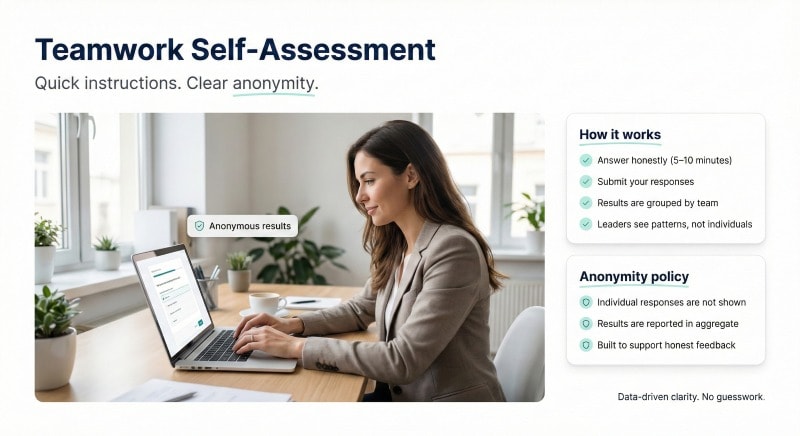
Anonymity and data-use policy (plain language)
Decide this before you distribute anything. Teams answer more honestly when the rules are clear.
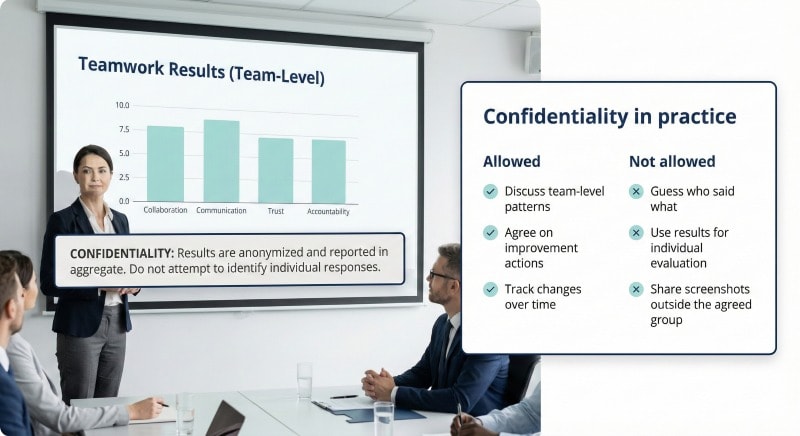
- Anonymous (recommended for development): Results are aggregated at team level. Individual responses are not shared. This is best when your goal is improving team dynamics and psychological safety.
- Identified (only when necessary): Individual results may be used for coaching or performance development. If you do this, say exactly who can see the results, how they will be used, and what they will not be used for.
Keep the policy short. People do not trust long policies. They trust clarity.
Questionnaire Structure (Sections, Scale, Item Counts)
A teamwork self assessment questionnaire should be easy to answer and easy to score. If it feels like homework, completion drops and the data turns into noise, which is why giving each person secure application access to their own assessment profile matters.
Competency sections
Use 5–7 themed sections so the questionnaire stays scannable and the results are interpretable. A practical structure looks like this:
- Communication
- Listening
- Collaboration
- Flexibility and adaptability
- Decision making
- Leadership and coaching (optional, depending on role mix)
- Problem solving and innovation (optional but useful)
Response scale type
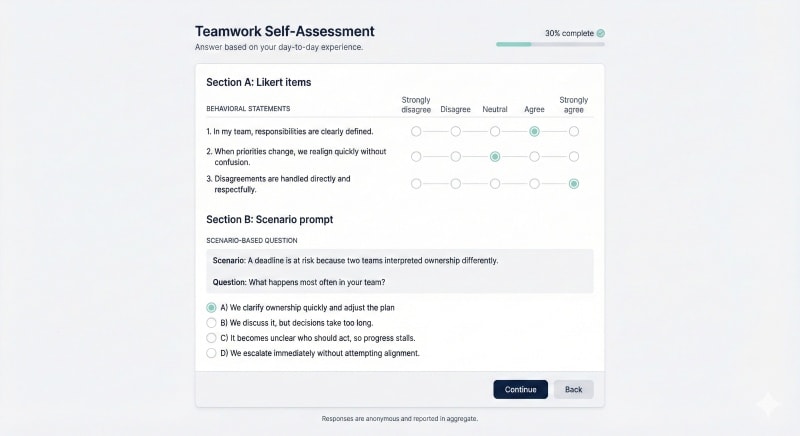
A standard 5-point Likert scale is the simplest for most teams:
1 = Strongly disagree
2 = Disagree
3 = Neither agree nor disagree
4 = Agree
5 = Strongly agree
If you want more nuance, use 7 points. If you want higher completion and less confusion, use 5.
Total item count per section
To stay inside your total word and time constraints, keep it tight:
- 4–6 items per section for core dimensions
- 2–4 scenario prompts total if you include scenarios
This usually lands you around 25–40 items, which is enough to see patterns without exhausting people.
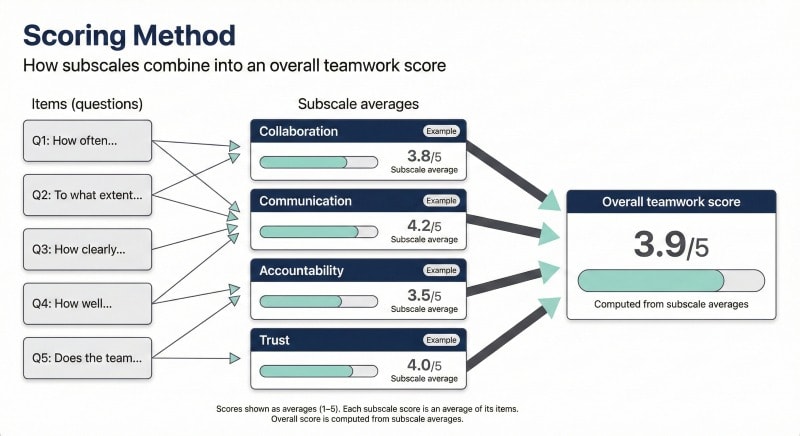
Scoring aggregation method
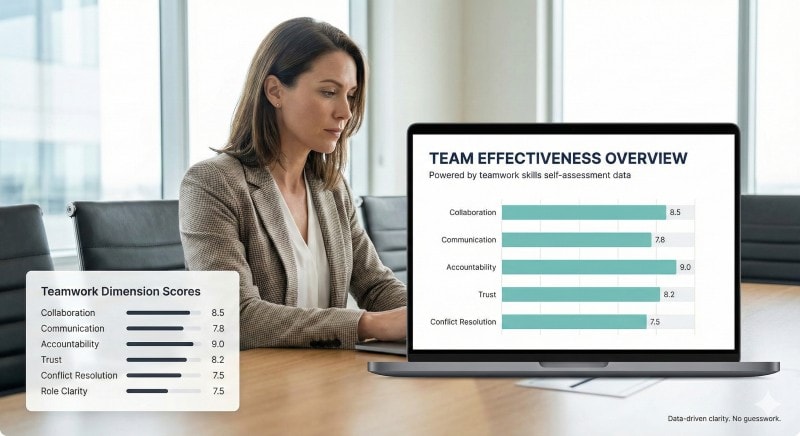
Use subscale scoring first, then an overall roll-up:
- Average each section to produce a subscale score (communication, collaboration, etc.).
- Average the subscales for an overall teamwork score.
- Report both. The overall score is a headline. The subscales tell you what to do next.
Teamwork Skills Covered (Core Dimensions)
A teamwork self assessment questionnaire is only useful if it measures behaviors that actually drive team effectiveness. These are the dimensions that typically predict whether a team hits team goals or gets stuck in endless coordination.
Communication (and how team discussions actually go)
Communication is not “sharing updates.” It’s whether the team exchanges information in a way that leads to action.
Strong patterns include clear expectations, timely responses, and decisions that are documented. Weak patterns look like vague ownership, missed handoffs, and repeated meetings that solve nothing.
Listening (respect for ideas, not just politeness)
Listening shows up in whether team members understand each other’s point before pushing their own. It also shows up in how disagreement is handled. If the team treats questions as attacks, people stop contributing, and collaboration becomes theater.
Collaboration (coordination, contributions, shared responsibilities)
Collaboration is the daily ability to work interdependently without constant escalation. This includes follow-through, sharing knowledge, and adjusting when someone is blocked.
A practical way to frame it is: does the team behave like a group of individuals, or like a unit committed to a common goal?
Flexibility and adaptability (responsiveness when priorities shift)
Every team faces obstacles. High-functioning teams adjust roles, timelines, and approaches without turning it into a drama festival. Low-functioning teams treat change as chaos and lose weeks to friction.
This dimension captures responsiveness, openness to new approaches, and willingness to re-plan.
Decision making (informed decisions and execution)
Decision quality is not just intelligence. It’s process. Do teams gather the right input, make informed decisions, and commit? Or do they stall, revisit decisions endlessly, and leave responsibilities unclear?
This is one of the fastest ways to see why team performance lags even when the team has “strong talent,” and it pairs well with behavior fit reports that match roles to personality.
Leadership, role-modeling, coaching (formal or informal)
Leadership behaviors show up in every team, even without managers. It includes accountability, setting standards, and helping colleagues improve through coaching and constructive feedback.
This dimension matters most when the questionnaire is used across mixed seniority levels or when the team relies heavily on peer leadership, especially when you also understand what truly motivates each person on the team.
Problem Solving and Innovation Items
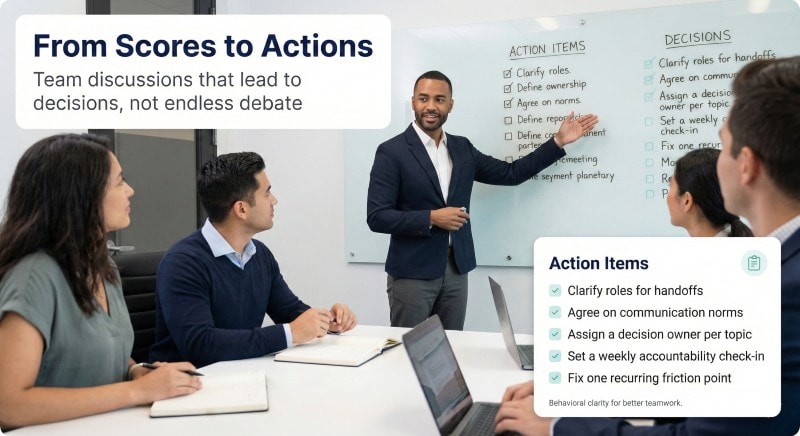
Teams do not fail because they lack “ideas.” They fail because they cannot turn problems into workable solutions without blame, avoidance, or chaos. This section measures how the team handles obstacles and whether it can innovate under real constraints.
Behavioral problem solving items
Behavioral items work when they focus on what people actually do when something breaks:
- Do team members surface problems early or hide them until the last minute?
- Does the team separate facts from opinions during discussions?
- Do people propose solutions or only point out what is wrong?
- Does the team learn from mistakes or repeat them?
These behaviors connect directly to team performance because they determine speed, quality, and rework.
Scenario-based prompts (higher signal)
Scenarios are useful because they reduce “self-image” answering. Instead of asking what someone believes about themselves, you force a choice under pressure.
Keep scenarios short and realistic. Two to four prompts total is enough. Examples of scenario angles:
- A deadline is at risk because one dependency is late. What happens next?
- Two colleagues disagree on approach and both have valid points. How does the team decide?
- A customer issue appears and the cause is unclear. How does the team investigate?
- A process is clearly inefficient. Who drives improvement, and how?
If you include innovation, define it in plain business terms: proposing practical improvements that benefit the team, the customer, or the organization, and support it with behavioral coaching tools that help leaders act on the data.
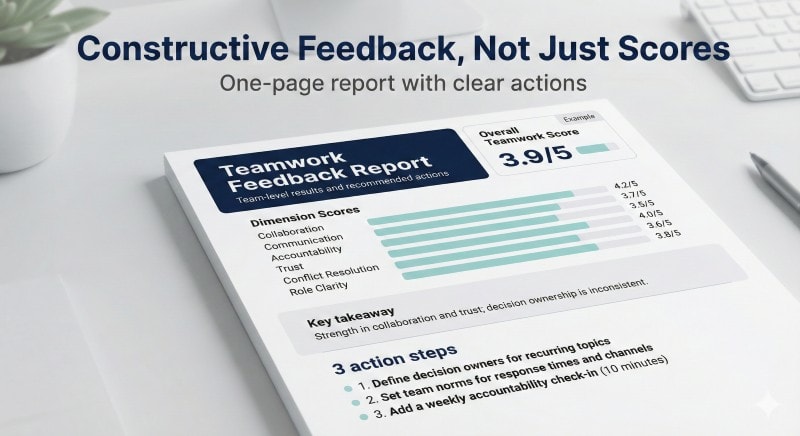
Scoring and Interpretation (From Scores to Constructive Feedback)
Scoring should be boring. Boring is good. The moment scoring feels “creative,” people stop trusting it.
Scoring rubric
Use the same scale across sections and interpret it consistently.
- Compute the average score per dimension (communication, listening, collaboration, etc.).
- Compute an overall teamwork score as the average of dimension scores (optional, but useful for a headline).
Design teams with data, not gut feel.
Most org-design decisions come down to role fit, leadership style, and team dynamics. OAD reads those signals from a 7-minute behavioral survey, so you can reconfigure roles and teams with evidence instead of guesswork.
Interpretation labels (simple, not moralizing)
Avoid labels that sound like a personality verdict. Use performance language:
- 4.1–5.0: Strong and consistent
- 3.1–4.0: Solid, with clear improvement areas
- 2.1–3.0: Inconsistent, likely affecting team effectiveness
- 1.0–2.0: High risk, actively harming team dynamics
If you want fewer buckets, collapse to three ranges. More ranges adds fake precision without better decisions.
Feedback message templates (per range)
Each dimension should output feedback that answers three questions:
- What this score typically means in day-to-day teamwork
- What the team should keep doing or stop doing
- One practical action for the next 2–4 weeks
Example format for a low collaboration score:
- Meaning: coordination breaks down, responsibilities are unclear, contributions are uneven
- Risk: missed handoffs, slower progress, frustration between colleagues
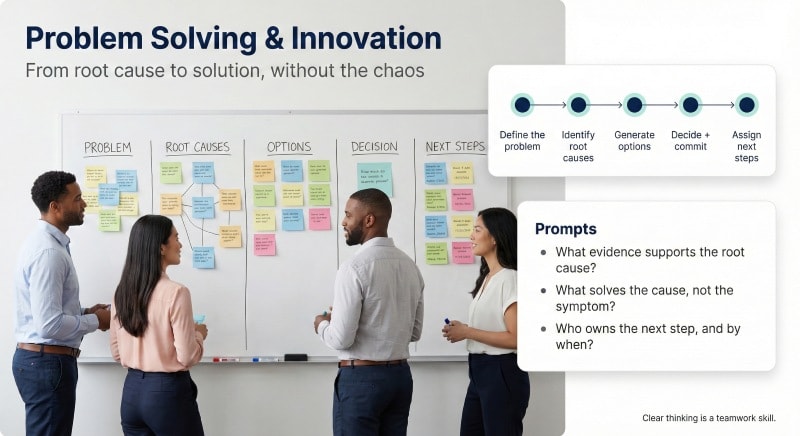
- Action: set explicit owners and next steps in every meeting, then review weekly
This turns the questionnaire into development, not just measurement.
If you need more than self-report data, pairing this with a structured assessment approach like the OAD Survey for psychometric precision can help reduce bias and make team development decisions more objective.
Linking Results to Team Performance and Team Goals
A teamwork self assessment questionnaire is not a personality quiz for entertainment. Its only job is to improve outcomes. That means translating scores into team performance indicators leaders care about.
Map each dimension to observable team performance indicators
Use a simple mapping so results lead to informed decisions:
- Communication: fewer misunderstandings, faster handoffs, cleaner project execution
- Listening: less conflict drag, better meeting quality, more balanced participation
- Collaboration: smoother coordination across departments, fewer “dropped balls,” higher follow-through
- Flexibility: faster recovery from obstacles, less disruption when priorities shift
- Decision making: reduced rework, fewer stalled initiatives, clearer ownership
- Leadership/coaching: improved engagement, clearer standards, faster skill development
This is where “team dynamics” becomes operational. You stop arguing about who is “difficult” and start fixing what is broken.
Include objective metrics where you can
If you have access to data, add one or two objective measures that match the team’s work, and consider whether you also need risk and readiness alerts for burnout and turnover:
- Cycle time (how long work takes from start to finish)
- Rework rate (how often work gets redone)
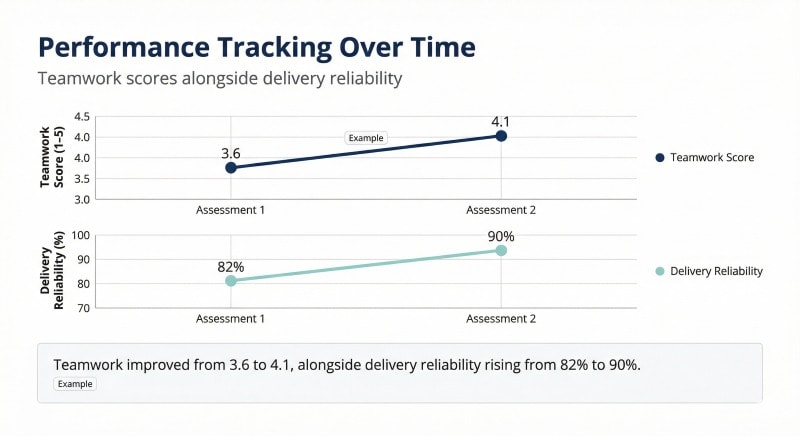
- Delivery reliability (how often commitments are met)
- Customer outcomes (complaints, escalations, satisfaction)
- Internal outcomes (handoff failures, incident volume)
Do not pretend there is a universal metric for every team. Choose what fits the business and the team’s common goal, particularly in high-stakes contexts like private equity hiring and post-acquisition team fit.
Benchmarks without fake precision
You can benchmark in two practical ways without inventing industry numbers:
- Internal benchmark: compare the team to itself over time (baseline, then reassess).
- Cross-team benchmark: compare similar teams inside the same organization, using the same questionnaire and conditions.
This matters because “good” depends on context. A product team and a compliance team can both be high-performing while behaving differently.
Sample Teamwork Self-Assessment Questionnaire Items
These examples use clear, affirmative statements that are easier to answer and easier to score. Use a consistent time anchor like “in the last month” to improve reliability, just as you would when using behavioral interview questions to assess cultural fit.
Communication (Likert statements)
- “In team discussions, expectations and next steps are stated clearly,” which is the same communication clarity you should look for when assessing communication skills in interviews.
- “I share relevant updates early enough for others to act.”
- “When priorities change, the team communicates what changes and why.”
Listening (observable behavior)
- “Team members ask clarifying questions before disagreeing.”
- “Different opinions are acknowledged and summarized accurately.”
- “People avoid interrupting or talking over colleagues in meetings.”
Collaboration (contributions and shared responsibilities)
- “Work is coordinated so handoffs are clear and deadlines are realistic.”
- “Team members support colleagues when obstacles threaten progress.”
- “Responsibilities are assigned, and follow-through is consistent.”
Flexibility and adaptability
- “When plans change, I adjust quickly without blaming others.”
- “The team revisits roles and responsibilities when workload shifts.”
- “We experiment with better processes instead of repeating what is not working.”
Decision making (informed decisions)
- “Decisions are made with the right input, not just the loudest opinion.”
- “Once a decision is made, the team commits and executes.”
- “When decisions are unclear, someone takes responsibility to clarify.”
Leadership and coaching
- “I model the behaviors I expect from others on the team.”
- “Constructive feedback is given in a way that improves performance.”
- “People help colleagues build skills instead of doing the work for them.”
Scenario prompts (problem solving and innovation)
- “A deadline is at risk because a dependency is late. What happens next in your team?”
- “Two team members disagree on approach. How does the team reach a decision?”
- “A recurring issue keeps appearing. How does the team identify the cause and prevent it?”
Feedback and Development Planning (Constructive Feedback that Changes Behavior)
If the questionnaire ends with a score, it becomes office trivia. The value comes from turning results into specific actions that improve teamwork skills and team effectiveness.
Individual feedback (short, practical)
For each team member, generate a brief summary that includes:
- Top 2 strengths (dimensions with highest scores)
- Top 1–2 improvement areas (lowest dimensions)
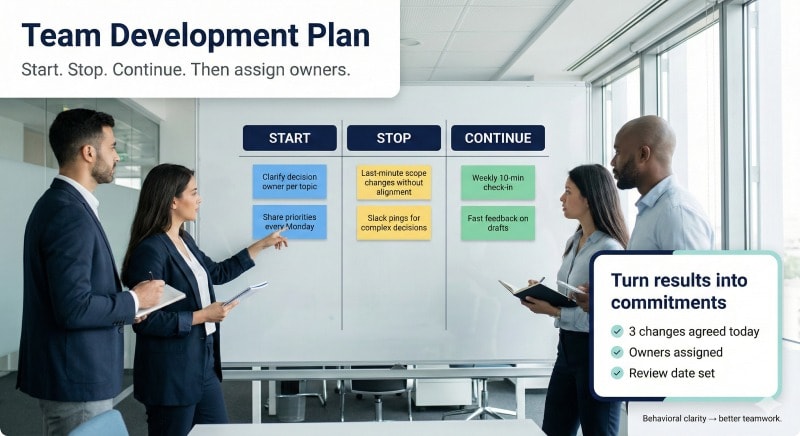
- One behavior to start this week
- One behavior to stop this week
Keep it behavioral, not psychological. “Improve collaboration by confirming owners and deadlines at the end of meetings” beats “be more collaborative.”
Team-level improvement actions
Team dynamics are usually a system problem. Your results should lead to two team actions, not ten, especially in functions like sales where you may also be using data to build and coach winning sales teams.
Examples tied to common low-score patterns:
- Low communication: end every meeting with written next steps, owners, and due dates.
- Low listening: adopt a rule that someone must restate the other view before disagreeing.
- Low collaboration: set explicit handoff rules and define what “done” means for shared work.
- Low flexibility: pre-agree on a fast re-planning process when obstacles appear.
- Low decision making: clarify who decides, who advises, and how decisions are documented.
Make the actions small enough to execute. Progress beats ambition.
Follow-up reassessment timeline
Reassess too fast and nothing changes. Reassess too late and nobody remembers what they tried.
A practical cadence:
- Baseline assessment
- 4–6 weeks of focused improvement actions
- Reassessment
- Repeat with one new focus area
This makes development measurable without turning it into surveillance.
Implementation and Performance Review Integration
This section is where teams usually sabotage themselves. They mix “development” and “evaluation,” then act surprised when honesty disappears, especially if they have not been transparent about how OAD pricing and plans scale across teams.
Implementation checklist (pilot to rollout)
- Pilot with a small group (one team or a subset).
- Collect feedback on clarity, time to complete, and confusing items.
- Revise items that cause repeated misunderstandings.
- Decide distribution method (form tool, HR system, internal survey platform).
- Decide how results will be stored and who can access them.
- Roll out with consistent instructions and a clear purpose statement.
Optional manager review steps (use cautiously)
If results will be discussed with a manager:
- Share aggregated team results first.
- Use individual results only for coaching unless the policy explicitly states otherwise.
- Focus on behaviors linked to team performance, not vague “attitude” judgments.
Confidentiality rules for shared results
Write the rules in plain language:
- Who sees individual results (if anyone)
- Who sees team-level summaries
- What the results will be used for (development, team planning)
- What they will not be used for (punishment, ranking people, hidden performance scoring)
If you cannot commit to those boundaries, do not pretend you can. Run it anonymous and development-only.
Conclusion
A teamwork self assessment questionnaire gives you a structured way to understand how your team actually operates. It makes teamwork skills visible, links them to team performance, and creates a clear path for development.
Used consistently, it improves team discussions, reduces friction in collaboration, and helps teams achieve goals with fewer preventable obstacles.
If you want to see how a structured, science-based assessment approach can complement self-report and help you compare candidates or teams with more objectivity, you can start with the free Top Performer Profile and evaluate roles and people using data instead of gut feel.