A team growth plan is not “more training.” It’s a system that turns business objectives into development goals, then turns those goals into new skills, better performance, and stronger retention. The difference between a plan that works and a plan that collects dust is measurement, manager behavior, and personalization.
OAD’s angle is simple: development works better when it’s based on behavioral data, not vibes. You still need judgment. You just stop pretending gut feel is a strategy, which is especially critical in high-stakes contexts like PE hiring and post-acquisition team fit.
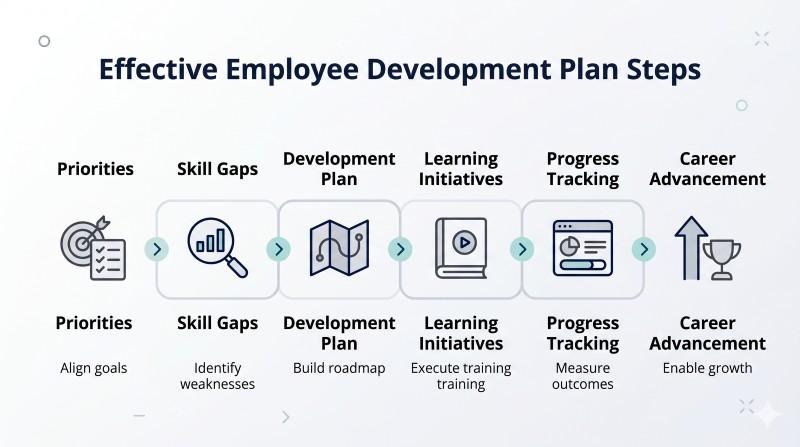
If you want an effective employee development plan without making HR teams hate their own calendar, do this:
- Define organizational priorities and critical skills.
Start with business goals and identify what “good” looks like in each role. - Assess skills gaps and role fit using data.
Use performance review inputs, project outcomes, and behavioral assessment to see what’s actually blocking results. - Write development plans with measurable goals.
Each plan needs development goals, timelines, success metrics, and the experiences required to build competence. - Pick development initiatives that create real behavior change.
Mentorship programs, cross functional projects, leadership training, and targeted training resources. - Monitor progress and make necessary adjustments.
Regular check ins, continuous feedback, and a short quarterly review to evaluate progress and reset priorities. - Connect development to career advancement and succession planning.
Make career path expectations explicit. Tie promotion criteria to observable behaviors and outcomes.
This is the whole point: growth plans should improve employee performance and team’s performance, not just “encourage team members.”
Why Team Growth Plan Matters for Business Objectives: The Importance of Employee Development Plans
At 50+ employees, growth becomes coordination. Coordination creates bottlenecks. Bottlenecks create frustration. Frustration creates attrition. Then you get to re-hire the same role twice, which is an expensive hobby. A team growth plan is a strategic, documented roadmap designed to improve the overall performance, skills, and structure of a team.
Employee development is how you protect business success while scaling:
- Retention: professional growth reduces “I’m stuck” churn, especially for high performers.
- Capacity: development programs expand what your team can take on without constant headcount pressure.
- Consistency: a shared development plan framework keeps teams work aligned and on the same page.
- Internal mobility: you build employee growth plans that create career opportunities instead of external job hunting.
- Actionable steps: effective employee development plans include actionable steps that guide skill-building and help employees achieve career objectives.
Teams excel when they understand not just what to do, but why it matters, grounding work in a Wildly Important Goal (WIG) to empower focus and execution momentum.
Managers and team leaders play a crucial role in guiding the development plan, facilitating ongoing conversations, and ensuring alignment with business objectives.
Global, US-leaning reality check
If you operate across regions, “career advancement” and compensation norms differ. But the fundamentals do not:
- People want clarity on expectations.
- Managers must coach, not just evaluate.
- Progress must be measured in outcomes, not intentions.
Your development plan should be stable globally, with local adaptations for leveling, compensation bands, and documentation standards. Career development is essential—organizations should ensure employees have access to the support, resources, and opportunities needed for growth. It’s also important to equip employees with the skills and knowledge required to succeed in different regions and roles.

Benefits of Development Plans
Employee development plans don’t just organize growth — they ignite it. True professional advancement isn’t wishful thinking; it’s systematic design that transforms potential into performance. For employees, a strategic development plan becomes the compass that guides career navigation, helping them chart ambitious goals, pinpoint growth opportunities, and master skills that elevate their impact. This clarity doesn’t just motivate — it energizes, creating deep engagement as team members discover their path forward isn’t just possible, it’s planned.
For organizations, development plans represent the bridge between individual ambition and business transformation. Smart companies don’t wait for skills gaps to appear — they anticipate, invest, and align talent development with strategic priorities. This forward-thinking approach generates powerful returns: teams that perform at higher levels, talent that stays engaged and committed, and leadership pipelines that flow with ready-to-advance professionals. When development plans work, they create something remarkable: teams aligned around shared growth, cultures built on possibility, and businesses positioned to turn human potential into competitive advantage.
Step 1: Define Organizational Priorities and Critical Skills
A team growth plan starts with organizational needs, not personal wishes. Career aspirations matter, but they need to connect to business goals. Team development and team building are essential parts of this process, ensuring that teams are systematically aligned, trust is fostered, and communication is transparent across the organization, especially for founders and CEOs scaling their teams.
For example, if your company is launching a new product, critical skills might include project management, customer research, and cross-functional collaboration. Technical skills such as data analysis, coding, or marketing automation are also vital to address specific organizational needs and drive growth.
Effective team development strengthens a team’s capacity to adapt how work gets done, exercise sound judgment, and integrate new tools and expectations without losing focus on outcomes. Planning hires based on skills gaps rather than reactive needs improves staffing models and supports long-term success by enabling behavior fit reports that match roles to personality.
Translate business goals into role outcomes
Do this per function, then per role:
- What are the business objectives for the next 2–4 quarters?
- What outcomes must each team deliver to support them?
- What are the critical skills that predict those outcomes?
Example: if market competitiveness depends on faster launches, critical skills might include cross-team execution, problem solving skills, and improve communication across stakeholders. Not “take a course on productivity.”
Identify skills gaps using existing data
Before you invent new processes, use what you already have:
- performance review themes (especially repeated ones)
- missed deadlines, rework loops, quality issues
- stakeholder feedback and customer escalations
- engagement signals (drop in initiative, conflict patterns, withdrawal)
Gather insights from this existing data to inform development plans and ensure your team growth plan is tailored to real needs.
This is where most companies skip discipline. They jump straight to “development initiatives” without diagnosing the problem, instead of using a quick, clinically validated behavioral assessment to understand what’s really going on. That’s how you get training with no impact.
Design teams with data, not gut feel.
Most org-design decisions come down to role fit, leadership style, and team dynamics. OAD reads those signals from a 7-minute behavioral survey, so you can reconfigure roles and teams with evidence instead of guesswork.

Step 2: Assess Team Members to Personalize Development
Generic development plans fail because they assume everyone needs the same thing. They don’t. Individual development and career growth are essential for both employees and organizations, and team leaders and managers play a crucial role in supporting these through personalized strategies and ongoing feedback.
Behavioral differences change how people learn, lead, handle pressure, and solve problems. That’s why a scientifically validated assessment is useful: it helps you stop guessing and makes it easier to choose scalable OAD plans for every team size. Assessing soft skills alongside technical abilities is also vital for team development, ensuring long-term success and cultural fit, and can be reinforced with behavioral interview questions that assess culture add.
Effective leaders who engage their teams around both individual and shared purpose can increase motivation, innovation, and retention while ensuring personal effectiveness and team achievement. Fostering psychological safety allows team members to take risks and voice opinions freely, encouraging critical thinking and problem-solving.
Use behavioral assessment (OAD) to target coaching
Use assessment data to answer practical questions:
- Who needs structure vs autonomy to perform?
- Who thrives in ambiguity vs needs clearer constraints?
- Who is energized by cross functional projects vs drained by them?
- Who is ready for leadership training vs still stabilizing core execution?
Then connect those patterns to development goals. Not personality labels. Real behaviors, grounded in motivation insights that reveal what truly drives people.
Continuous feedback and monitoring progress are essential to ensure development goals are met and to support ongoing personal and team growth, especially when coaches use behavioral tools that power data-driven coaching. Implementing regular performance evaluations creates structured feedback loops that foster a growth mindset and can be enhanced by risk alerts that flag burnout and flight risk early. Encourage team members to develop expertise in key areas relevant to your team’s objectives, such as employee engagement and retention strategies, to drive meaningful improvement.
Avoid one-size-fits-all growth plans
Common failure patterns:
- “Everyone should improve communication” (translation: nobody defined what good looks like)
- “More training resources” (translation: no accountability or measurement)
- “Mentorship programs for everyone” (translation: mismatched mentors and low follow-through)
A strong focus on employee engagement can significantly enhance the effectiveness of culture development initiatives. Using employee development plan examples and real world examples helps guide managers and HR professionals in designing effective, tailored plans for employees at different career stages. It’s essential to measure progress and track progress with clear benchmarks and regular check-ins to ensure development goals are met and maintain accountability. High-trust teams give and receive feedback often and constructively, while effective teams communicate early, honestly, and with consistency—both are crucial for building trust and amplifying developmental momentum. Implementing regular pulse surveys, monthly one-on-ones focused on values alignment, and peer feedback systems can significantly enhance feedback culture within organizations. Defining core values through specific behaviors and intentionally building culture through rituals, such as weekly demos or monthly recognition programs, further strengthens team dynamics. When teams are intentionally developed, they operate with greater clarity around priorities and responsibilities, reducing friction and limiting rework in fast-changing environments. Creating tailored learning opportunities that address skill gaps supports ongoing professional development and is easier when each employee has individual application access to their own insights.
An effective employee development plan is tailored, short, and measurable. You can still use a standardized template. The content inside the template should differ.

If you want to baseline development needs with less guesswork, you can test the OAD Survey and use the results to map coaching priorities to role expectations instead of relying on manager intuition alone.
Development Initiatives
Development initiatives are where growth plans transform from vision into reality. These power moves — structured training programs, leadership development, mentorship opportunities, cross-functional projects — become the engines that drive real change. The initiatives that truly move the needle? Those engineered with precision, aligned to organizational objectives and tailored to unlock each employee’s unique potential.
When organizations invest in targeted development programs, they’re not just filling skills gaps — they’re building tomorrow’s leaders today. This commitment accelerates performance, strengthens capabilities, and cultivates the next generation of organizational talent. Picture this: a marketing manager diving into cross-functional projects, sharpening critical thinking and problem-solving prowess, while entry-level employees tap into mentorship programs that compress their learning curve dramatically, and sales leaders use behavioral insights to build winning sales teams. When these initiatives flow seamlessly through thoughtful design and consistent delivery, something powerful emerges — a culture where continuous learning thrives and high performance becomes the new standard across every team.
Evaluating Development Progress
Development plans succeed or fail on one critical factor: execution. Talent development isn’t wishful thinking — it’s engineered through consistent follow-through and strategic monitoring. Regular check-ins become the heartbeat of meaningful growth, whether delivered through focused one-on-ones, structured performance reviews, or those powerful informal moments when feedback flows naturally. These touchpoints don’t just track progress — they create space for reflection, celebration, and the kind of honest assessment that identifies exactly where additional support can make the difference.
Smart organizations measure development impact against real business objectives. This isn’t just good practice — it’s competitive advantage. Data-driven evaluation reveals patterns that matter, guides necessary course corrections, and ensures development initiatives stay aligned with evolving organizational priorities. When tracking and evaluation become embedded in the development process, something remarkable happens: both employees and organizations unlock their adaptive capacity, stay responsive to change, and build the momentum that transforms good intentions into measurable performance gains.
Succession Planning
Organizations thrive or stagnate on one critical factor: how well they prepare tomorrow’s leaders today. Succession planning isn’t just talent management — it’s strategic future-proofing engineered through deliberate action. True leadership continuity emerges when organizations actively cultivate high-potential talent through targeted initiatives: mentorship programs that transfer wisdom, leadership training that builds capability, and cross-functional projects that expand perspective.
This intentional approach drives measurable impact across multiple dimensions. When team members witness clear advancement pathways and experience genuine investment in their growth, engagement soars and retention strengthens. But succession planning delivers something deeper — it transforms organizational culture itself. Internal mobility flows naturally, continuous learning becomes embedded, and teams develop the agility to tackle emerging challenges with confidence. The result isn’t just better prepared leaders. It’s a high-performing organization that grows stronger, adapts faster, and unlocks the full potential of its people.