Performance tracking is a simple idea. You measure employee performance over time. You use that data to improve results. The goal is not control. The goal is clarity.
Most companies track performance in some way. The problem is timing. If feedback comes once a year, it is too late to help. It becomes a record of the past, not a tool for improvement.
What performance tracking means at work
Performance tracking means you collect a small set of signals on a regular schedule. You review them with the employee. You use them to decide what to keep, what to change, and what support is needed.
A basic tracking system includes:
- Clear goals (what success looks like)
- Key performance indicators (how you measure progress)
- A check-in rhythm (weekly, biweekly, or monthly)
- Short notes on outcomes and feedback
Good tracking makes work visible. That makes improvement possible.
Performance tracking vs. performance reviews vs. performance management
These terms sound similar, but they are not the same.
- Performance tracking is the measurement layer. It covers goals, KPIs, and check-ins.
- Performance reviews are the formal summary. They are often tied to pay or promotion.
- Performance management is the full system. It includes tracking, coaching, growth, and decisions.
Strong teams use tracking to support fair reviews. Weak teams use reviews to fill gaps in tracking.
What changes when you track progress consistently
When tracking is consistent, managers do not have to guess. Employees know what matters. They also know where they stand.
Three things tend to improve:
- Faster fixes. Small issues get handled early.
- Better growth. Coaching targets real skill gaps.
- Fairer decisions. Reviews rely less on memory and mood.
If you want to improve employee performance, start here. Make progress easy to see. Make it easy to discuss. Keep it consistent.
Why Performance Tracking Matters
Performance tracking matters because it turns “I think” into “I know.” Managers get a clearer view of team member performance. Employees get fewer surprises. The business gets fewer expensive mistakes.
It also fixes a common problem in growing companies: work moves fast, but feedback moves slow. When you track employee performance in real time, you can correct course while it still matters.

Better decisions on training, promotions, and resource allocation
Without performance data, decisions often fall back on confidence, visibility, or who speaks the loudest in meetings. That is not a system. It is a bias factory.
With a performance tracking system, you can make informed decisions such as:
- Who needs skill-building vs. role changes
- Where training budget will have the highest impact
- Which teams are overloaded and need support
- Who is ready for more scope or leadership
This is also where HR gains leverage. Instead of arguing opinions, you can point to patterns.
Accountability without micromanagement
Accountability does not require surveillance. It requires clear expectations and a consistent way to review progress.
When goals and KPIs are agreed upfront, tracking becomes a shared tool. Employees can track progress themselves. Managers can coach instead of chase. The focus stays on outcomes, not activity.
A good rule: track what you would discuss in a one-on-one anyway. If the metric would never come up in a real performance conversation, it probably does not belong.
Earlier detection of skill gaps and performance issues
Most “performance problems” are not sudden. They build over time. Tracking makes the early signals easier to spot.
Examples of early signals:
- Missed deadlines that become a trend
- Quality issues that repeat in the same type of task
- Slow ramp-up on a skill that the role depends on
- Low follow-through after feedback
When you see these patterns early, you can respond with coaching, training, clearer goals, or workload changes. That is cheaper and kinder than waiting for failure.
How tracking supports employee development and retention
Employees stay longer when they can grow and when expectations feel fair. Performance tracking supports both.
It helps employees understand:
- What “good” looks like in their role
- What to improve next
- How their work connects to team and business objectives
It also helps managers recognize improvement, not just results. That matters for motivation and engagement. People do not quit because of one bad week. They quit after months of unclear standards and random feedback.
What to Measure: Metrics and KPIs That Actually Help
Performance tracking fails when you measure the wrong things. It also fails when you measure everything. More metrics do not create clarity. They create noise.
Choose a small set of key performance indicators (KPIs) that match the role and the business goal. Then track them the same way every time.
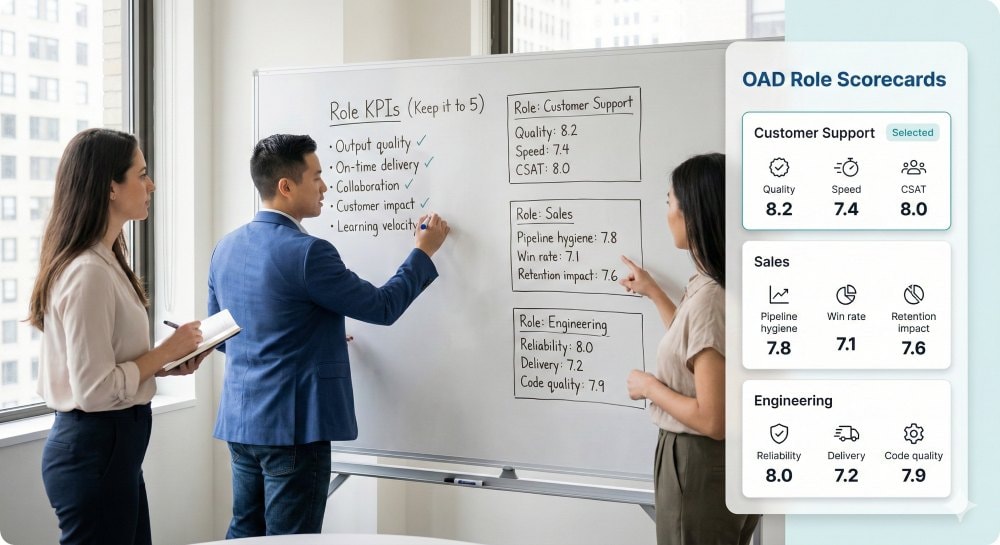
Key performance indicators: output, quality, timeliness, reliability
Most roles can be tracked with four core buckets. The KPIs will differ by job, but the buckets stay stable.
Output
- Volume of work completed (tickets closed, cases handled, clients served)
- Throughput over time (per week, per sprint, per month)
Quality
- Error rate, rework rate, customer complaints
- QA scores or audit results (if you have a consistent rubric)
Timeliness
- On-time delivery rate
- Cycle time (how long work takes from start to finish)
Reliability
- Follow-through on commitments
- Consistency across weeks, not just peak weeks
Keep KPIs concrete. If two managers can read a KPI and argue about what it means, it is not ready.
Leading vs. lagging indicators
Lagging indicators tell you what happened. Leading indicators tell you what is likely to happen next.
Lagging examples
- Revenue closed
- Project delivered
- Customer satisfaction score after delivery
Leading examples
- Pipeline coverage for sales
- Milestone completion rate for projects
- First-pass quality on early deliverables
Use both. Lagging indicators keep you honest. Leading indicators help you coach earlier.
Individual vs. team performance metrics
Some work is owned by one person. Some work is shared. If you only track individual metrics in team-based roles, you create blame and competition.
Use this split:
- Individual KPIs for role ownership and skill growth
- Team KPIs for shared outcomes (delivery, quality, customer impact)
Make team metrics visible to the team. Keep individual metrics private by default, unless there is a clear reason to share.
Avoiding vanity metrics and “busywork” tracking
Vanity metrics look useful, but they do not change decisions. Activity tracking often falls into this trap.
Common examples:
- Hours online
- Messages sent
- Meetings attended
- “Touches” with no link to outcomes
If a metric does not lead to a better decision, drop it. Tracking employee performance should help you answer simple questions:
- Are we getting the right outcomes?
- If not, why not?
- What support or change fixes it?
Goal Setting and Alignment
Tracking is pointless without goals. Metrics tell you what happened. Goals tell you what “good” looks like. When goals are vague, performance tracking turns into opinion fights.
Good goal setting does three things. It sets direction, it sets priorities, and it sets the standard for performance evaluation.
Clear and measurable goals (SMART, without the corporate theater)
SMART goals are fine. People just use them badly. The goal is not to sound polished. The goal is to make the target clear enough to track progress.
A measurable goal usually includes:
- A result (what changes)
- A metric (how you measure it)
- A deadline (when it should be true)
- A scope (what is included and what is not)
Examples that work:
- “Reduce customer onboarding time from X to Y by end of Q2.”
- “Improve first-pass QA from X% to Y% over the next 8 weeks.”
- “Deliver project milestones A, B, and C on time this quarter.”
If a goal can be met by “trying hard,” it is not a goal. It is a vibe.
Aligning individual goals with organizational objectives
Employees disengage when goals feel random. Alignment solves that. It links day-to-day work to business objectives.
A simple alignment method:
- Start with the company goal (growth, retention, quality, speed, cost control).
- Translate it into a team outcome (what the team must deliver).
- Define the individual’s contribution (what this role owns).
- Set KPIs that show progress.
This also prevents the classic mistake: people hitting their personal targets while the business misses its targets.
How to track employee progress across quarters and projects
Goals should not live in a slide deck. They should show up in the workflow.
Practical ways to track progress:
- Tie goals to project milestones and deliverables
- Review KPIs in regular one-on-ones (weekly or biweekly for most roles)
- Use a simple status system: on track, at risk, off track
- Capture short notes on what changed and why
Keep the tracking lightweight. The goal is consistent signal, not paperwork.
When to adjust goals and how to document changes
Goals should change when business needs change. That is normal. What ruins trust is changing goals without saying so, then leading with “you missed.”
Adjust goals when:
- Scope changes (more work, fewer resources, new priorities)
- The baseline was wrong (bad data, unclear process)
- External factors shift (market changes, regulatory constraints, major client loss)
When you adjust, document it in one line:
- What changed
- When it changed
- What success now means
That protects both managers and employees. It also keeps performance tracking honest.
How to Track Performance Effectively
The best performance tracking system is boring. It runs on a schedule. It uses the same inputs each time. It produces clear next steps. If it needs a heroic manager to function, it will fail.
This section is the “how.” Cadence, check-ins, feedback, and how to keep tracking useful instead of invasive.

The basics: cadence, owners, and data collection
Start with three decisions:
- Cadence: weekly, biweekly, or monthly check-ins, plus a quarterly summary
- Owners: who updates what (employee, manager, HR, or shared)
- Data sources: which systems feed performance data (project tools, CRM, QA audits, customer feedback)
Keep data collection consistent. If you change the rules midstream, comparisons become meaningless. Your “trend” becomes a mood.
A practical default for many roles:
- Biweekly one-on-ones
- Monthly KPI snapshot
- Quarterly performance review cycle
One-on-one meetings and regular check-ins
One-on-ones are where tracking becomes coaching.
A simple structure:
- Progress since last check-in (wins, misses, blockers)
- KPI and goal status (on track, at risk, off track)
- What support is needed (training, priorities, resources)
- Next actions (two or three concrete steps)
Document the outcomes in short notes. Not essays. Notes should capture decisions, not feelings.
Performance review cycles: what to keep, what to replace
Annual reviews are not evil. They are just too slow on their own.
Keep the formal review if it is needed for behavioral assessment tools for executive coaches:
- Compensation
- Promotion decisions
- Role changes
- Compliance and documentation
Replace the “surprise verdict” style review with a summary of what was already tracked. If the quarterly rhythm is real, the annual review should feel obvious.
If it does not, your tracking is not working. Or your manager is not using it.
Ongoing feedback, peer feedback, and self-assessment
Feedback works best when it is close to the work.
Ongoing feedback
- Use it for specific behaviors and outcomes
- Tie it to goals and KPIs, not personality
Peer feedback
- Use it when work is cross-functional or collaborative
- Ask for examples, not ratings
- Limit it to a few focused prompts, not open-ended chaos
Self-assessment
- Useful when it asks: what worked, what didn’t, what you’ll do next
- Less useful when it becomes a self-marketing exercise
The goal is signal. If feedback is vague, it is noise.
How to track productivity without breaking trust
Productivity tracking goes wrong when it becomes surveillance. People change behavior to satisfy the metric, not the mission.
Guidelines that keep it sane:
- Track outcomes first, activity second
- Be transparent about what you track and why
- Use the data for coaching, not punishment
- Avoid “always-on” monitoring unless you have a legal, role-specific reason
If employees feel watched instead of supported, performance drops. Engagement drops. And your tracking system becomes the enemy, which is a weird choice for a management tool.
Tools and Performance Tracking Systems
Tools do not fix weak management. They do make it easier to collect data, track progress, and run consistent performance conversations. The best tools remove friction. They do not add admin work.
If your performance tracking system needs six tabs, three exports, and a manager who enjoys spreadsheets, it’s not a system. It’s a warning sign.
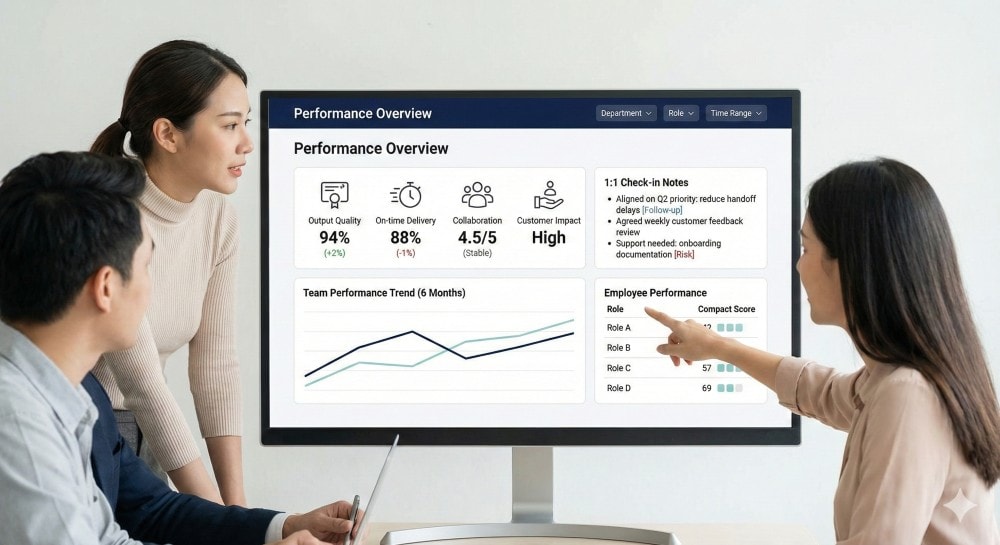
What a performance tracking system should do (minimum viable features)
A useful system does five things well:
- Goal tracking: store goals, owners, deadlines, and status
- KPI tracking: capture key metrics with clear definitions
- Check-in notes: document one-on-ones and action items
- Feedback capture: allow timely feedback tied to work
- Reporting: show trends at employee and team level
Keep it simple. If your “tracking” requires people to translate reality into five dropdowns, data quality will collapse.
Performance management software: what to look for
Most tools promise the same outcomes. Focus on fit.
Look for:
- Easy setup for goals, KPIs, and review cycles
- Flexible templates by role type (sales, support, engineering, ops)
- Clear permissions (privacy matters)
- Strong manager workflow for check-ins and coaching
- Reporting that shows trends, not just snapshots
Avoid tools that push you into one rigid process. Different teams need different tracking rhythms. Global companies also need flexible settings for time zones, role families, and privacy rules.
Connecting performance tracking with project management platforms
If your work already lives in tools like Jira, Asana, Monday, or similar, do not duplicate it by hand.
Good integrations help you:
- Pull delivery and cycle time data automatically
- Track milestones and project progress against goals
- Reduce manual data collection and reporting
The rule: pull signals from existing systems when possible. Ask humans for judgment and context, not for copying numbers.
Real-time dashboards vs. periodic reporting
Real-time data sounds impressive. It is not always useful.
Real-time dashboards
- Best for operational roles with fast feedback loops
- Useful when work has clear throughput and quality signals
- Risk: people start “working the dashboard”
Periodic reporting
- Best for complex roles where outcomes take time
- Helps managers focus on trends, not daily noise
- Easier to pair with coaching and development
Most teams need both. Use real-time views for execution and weekly or monthly summaries for decision-making.
Turning Performance Data Into Better Decisions
Performance data is only useful if it changes what you do next. Otherwise, you’re just collecting numbers to feel organized.
This section is about moving from tracking to action: how to get actionable insights, reduce bias, and avoid the most common data traps.
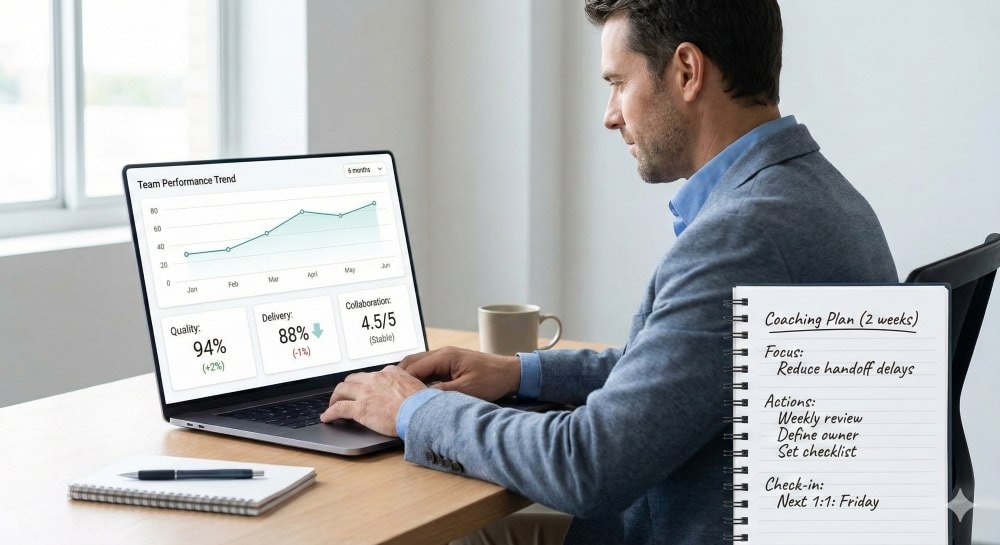
From performance data to actionable insights
Raw data answers “what happened.” Actionable insights answer “what should we do now.”
A simple decision flow:
- Confirm the pattern. Is this a one-off or a trend?
- Find the cause. Skill gap, unclear goals, workload, process, or role fit?
- Choose the intervention. Coaching, training, clearer priorities, or system fixes.
- Set a short follow-up window. Track progress in 2–4 weeks.
Keep the intervention small and specific. “Do better” is not a plan. “Reduce rework by tightening the review checklist” is.
Using data to reduce bias and improve fairness
Tracking can reduce bias, but only if your inputs are consistent.
Bias tends to creep in through:
- Recency (overweighting the last two weeks)
- Visibility (rewarding the loudest or most present)
- Similarity (favoring people who “feel like a fit”)
- Narrative (one story outweighing months of results)
Performance tracking helps when it forces clarity:
- Same KPI definitions for the same role
- Same review cadence across employees
- Same documentation standard for feedback
Data does not remove judgment. It makes judgment easier to defend.
Common data problems: inconsistent inputs and weak baselines
Most performance data issues are boring and preventable.
Inconsistent inputs
- Different managers rate the same behavior differently
- KPIs mean different things across teams
- People “round” numbers or skip updates
Fix: define KPIs in plain language and train managers on the same rubric.
Weak baselines
- No starting point, so “improvement” is guesswork
- Goals set without historical context
- Targets copied from another team with different constraints
Fix: set baselines before you set targets. If you do not have baseline data, start with a short tracking period first, then set goals.
What to do when roles are hard to quantify
Some roles do not have clean output metrics. Think: leadership, strategy, creative work, complex problem solving.
You can still track performance. You just track different signals:
- Quality of decisions (measured through outcomes and post-mortems)
- Stakeholder satisfaction (with structured questions, not vibes)
- Delivery on commitments (milestones, timelines, clarity of output)
- Error prevention (risk reduction, fewer escalations, fewer surprises)
Use a mix of:
- A few measurable goals
- A simple rubric for quality
- Regular performance conversations with documented examples
If a role is impossible to measure, it usually means the role is unclear. Tracking exposes that fast, which is uncomfortable, but useful.
Coaching and Continuous Development
Tracking shows you the gap. Coaching closes it. Without coaching, performance tracking becomes a scorecard that makes people defensive. With coaching, it becomes a tool for employee growth.
The best system is steady. It focuses on small improvements, not big speeches.

Continuous feedback that actually improves performance
Feedback works when it is timely and specific. That means close to the work, not weeks later.
Keep it simple:
- Name the outcome you saw.
- Name the impact.
- Agree on the next step.
- Set a short follow-up date.
Avoid vague labels like “more proactive” or “better communication.” If you cannot point to a real example, it is not feedback. It is a personality opinion.
Development plans tied to observed performance
Development plans should come from patterns in performance data, not from generic training menus.
A useful plan includes:
- The skill to build (one or two, not ten)
- What “good” looks like in the role
- A practice method (projects, shadowing, role-play, repetition)
- A measure of progress (quality, speed, fewer errors, stronger outcomes)
- A timeline (usually 30–90 days)
If the plan does not change day-to-day behavior, it is just paperwork.
Training managers to run strong performance conversations
Most performance systems fail because managers are not trained to use them. Tools do not teach judgment. They do not teach coaching. You have to.
Manager basics that matter:
- Ask clear questions. Listen more than you talk.
- Separate facts from interpretations.
- Give one priority at a time.
- Agree on next actions and write them down.
- Follow up on the date you said you would.
Consistency builds trust. Surprise coaching does not.
Recognition and rewards that reinforce the right behaviors
Recognition works best when it points to a repeatable behavior, not just a result.
Good recognition answers:
- What did the person do?
- Why did it matter?
- What should we repeat?
This is also where performance tracking helps. You can recognize improvement, reliability, and quality, not just the biggest visible win.
Where structured assessment data strengthens development plans
Performance tracking tells you what happened. It does not always tell you why it happened.
When patterns keep repeating, you often need role-fit data. That includes strengths, working style, and predictable risk areas under pressure. A validated assessment can add that missing layer.
This is where OAD fits the system:
- Use tracking data to spot a pattern (missed deadlines, conflict, quality drops).
- Use assessment data to understand likely drivers (attention to detail, tolerance for ambiguity, pace, social approach).
- Build a development plan that matches the person and the role, not a generic “improve performance” plan.
It is not about labeling people. It is about choosing the right coaching approach, earlier, with less guesswork.
Risks and Pitfalls of Performance Tracking
Performance tracking can improve team performance. It can also poison culture if it’s done with the subtlety of a surveillance drone. The difference is intent, design, and manager behavior.
This section covers the common ways performance tracking breaks trust, creates KPI gaming, or produces bad decisions with a confident tone.
Surveillance culture and the trust breakdown
The fastest way to kill performance is to make people feel watched. When tracking feels like monitoring, employees change behavior to protect themselves. They stop taking risks. They stop being honest. They start managing optics.
Warning signs you’re drifting into surveillance:
- Tracking hours, clicks, or “online status” as a primary measure
- Hidden metrics that employees do not understand
- “Gotcha” conversations based on dashboards
- No clear link between tracking and support
A simple safeguard: if you can’t explain how a metric helps an employee improve, don’t track it.
KPI gaming and perverse incentives
People optimize what you measure. If you measure the wrong thing, they will still optimize it. They’ll just do it in a way that hurts outcomes.
Common examples:
- Measuring speed, then quality collapses
- Measuring volume, then cherry-picking easy work
- Measuring individual output, then collaboration drops
- Measuring “activity,” then meetings multiply
Reduce gaming by:
- Using a balanced KPI set (output plus quality plus timeliness)
- Reviewing trends, not single spikes
- Pairing metrics with real work examples
- Keeping space for manager judgment, documented clearly
Over-relying on tools and under-investing in manager skill
A tool can store goals and collect performance data. It can’t do coaching. It can’t handle conflict. It can’t tell when someone is struggling because of workload, not effort.
When companies skip manager training, performance tracking becomes:
- More admin
- More resentment
- More shallow feedback
- More bias, not less
If you want the system to work, train managers on:
- Running effective one-on-ones
- Giving specific feedback
- Setting measurable goals
- Using KPIs without losing context
Privacy and compliance considerations (global view, slight US tilt)
Performance tracking touches personal data. That creates legal and ethical obligations. Rules vary by country, and even by state.
Global basics that usually keep you on the safe side:
- Track only what you need for performance evaluation and development
- Be transparent about what you collect and why
- Limit access to performance data based on role
- Set retention rules (don’t store everything forever)
- Avoid collecting sensitive personal data unless you have a clear legal basis
With a US tilt, the practical takeaway is the same: treat performance data like HR data, not like “random analytics.” If your tracking approach would look bad on the front page of a newspaper, it’s probably not compliant, even if no one has sued you yet.
FAQ: Performance Tracking Questions People Ask
This is the part where we answer what people actually type into Google at 2 a.m. while trying to fix their performance review process.
What is the meaning of performance tracking?
Performance tracking means measuring employee performance over time using clear goals and a small set of metrics. The purpose is to track progress, identify areas for improvement, and support better decisions.
It is not the same as a performance review. Tracking happens continuously. Reviews summarize what tracking already showed.
How to do performance tracking?
A practical performance tracking system has five parts:
- Set clear, measurable goals for the role
- Choose a few KPIs that match those goals
- Review progress on a regular schedule (weekly, biweekly, or monthly)
- Document outcomes and feedback in short notes
- Use the data to coach, support development, and adjust priorities
Start small. If the system is heavy, people will stop using it. Then you’ll be back to guessing.
What does a performance tracker do?
A performance tracker is a tool or process that helps managers and employees track employee progress. It usually helps with:
- Recording goals and status updates
- Tracking key metrics over time
- Capturing one-on-one notes and feedback
- Supporting performance review cycles
- Showing trends for team performance
The best trackers reduce admin work. The worst ones create it.
What are the best KPIs for tracking employee performance?
The best KPIs depend on the role, but they usually fit into four buckets:
- Output (how much work gets done)
- Quality (how often work needs rework, errors, or corrections)
- Timeliness (on-time delivery, cycle time)
- Reliability (follow-through, consistency)
Pick KPIs you can measure consistently. If the data is messy, the decisions will be messy too.
How often should you track performance without micromanaging?
Most teams do well with:
- Weekly or biweekly one-on-ones
- Monthly KPI summaries
- Quarterly review cycles
Micromanagement is not about frequency. It is about intent. If tracking is used to support progress and remove blockers, it builds trust. If it’s used to catch mistakes, it destroys it.
How do you track performance fairly across different roles?
Fair tracking starts with role clarity. You need clear expectations for each role and KPI definitions that fit the work.
Practical steps:
- Use role-based scorecards (different roles, different KPIs)
- Standardize how managers rate quality and performance behaviors
- Compare people within similar roles, not across unrelated roles
- Document examples, not just ratings
- Review trends over time, not single moments
Conclusion: A Practical Performance Tracking System You Can Run This Quarter
Performance tracking works when it’s simple, consistent, and tied to real decisions. Pick a few goals, measure a few KPIs, run regular check-ins, and document what changed. That’s enough to improve employee performance without turning work into a monitoring exercise.
If your current process is mostly annual reviews, fix cadence first. Add biweekly one-on-ones and a monthly KPI snapshot. Most “performance problems” shrink when expectations and feedback stop arriving six months late.
If you want to strengthen accuracy even more, add structured role-fit data alongside performance data. If you want to see how that looks in practice, you can start with the free Top Performer Profile: 7 minutes, results in 24 hours, no credit card.