Motivation in the workplace is the difference between employees doing the minimum and employees doing work they are proud to attach their name to.
When employee motivation is high, you typically see stronger employee engagement, better employee performance, and fewer “quiet quitting” behaviors. When it’s low, the signs show up fast: missed deadlines, lower quality work, higher employee turnover risk, and managers spending their week chasing basics.
This guide breaks motivation down into practical drivers you can influence, and motivation strategies you can apply without guessing. It also covers how to measure employee motivation so you can spot problems early and fix the right thing, not just “add perks.”

What Is Motivation in the Workplace?
Motivation in the workplace is the set of forces that shapes how much effort someone is willing to put into their work, how long they sustain that effort, and how they behave when things get difficult.
It is not the same as mood. It is also not the same as talent. A capable person can still be unmotivated if the environment, role, or leadership signals push them into disengagement.
A useful way to think about motivation is this: employees feel motivated when the work feels worth doing, and the path to doing it well feels realistic.
Employee motivation refers to what, exactly?
In practice, employee motivation shows up as:
- Effort: how hard someone tries
- Persistence: how long they keep going
- Direction: what they choose to spend energy on
- Initiative: whether they act without being pushed
- Resilience: how they respond to setbacks
This matters because two employees can look “busy” but be motivated by different things. One is driven by mastery and purpose. The other is driven by fear of consequences. The output may look similar for a while, but retention and long-term performance usually won’t.

Intrinsic motivation vs. extrinsic motivation
Most workplace motivation fits into two buckets:
Intrinsic motivation is driven by the work itself. People are motivated because they find the work meaningful, enjoy solving the problem, or want to improve their skills.
Extrinsic motivation comes from outcomes outside the work. People are motivated by pay, bonuses, promotions, public recognition, or avoiding negative consequences.
Both matter. Intrinsic motivation is usually stronger for sustained performance and learning. Extrinsic motivation can be useful for clear, short-term goals. The problem starts when a company relies on extrinsic motivators to fix issues that are actually caused by poor role fit, weak leadership, or unclear expectations.

Why motivation in the workplace is hard to “force”
Motivation is partly personal and partly structural.
You cannot force employees motivated through slogans, posters, or one-off incentives. People notice when the daily reality contradicts the message. What you can do is design the conditions that make motivation more likely:
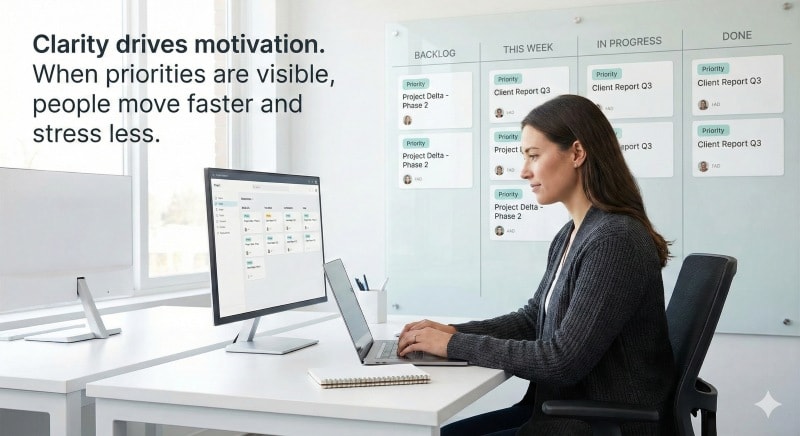
- clear priorities
- fair expectations
- autonomy with support
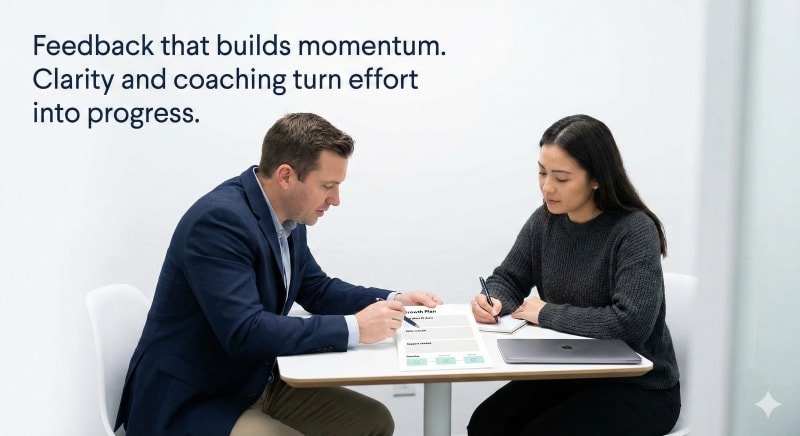
- feedback that helps people improve
- career growth that is real, not promised
When those conditions are missing, even highly motivated employees tend to burn out or leave.
Why Is Motivation in a Workplace Important?
Because a motivated workforce doesn’t just “feel better.” It behaves differently.
Motivated employees tend to put in more discretionary effort, solve problems earlier, collaborate more, and recover faster after setbacks. When motivation drops, you often see the opposite: avoidance, blame-shifting, low energy meetings, and managers doing more firefighting than leading.
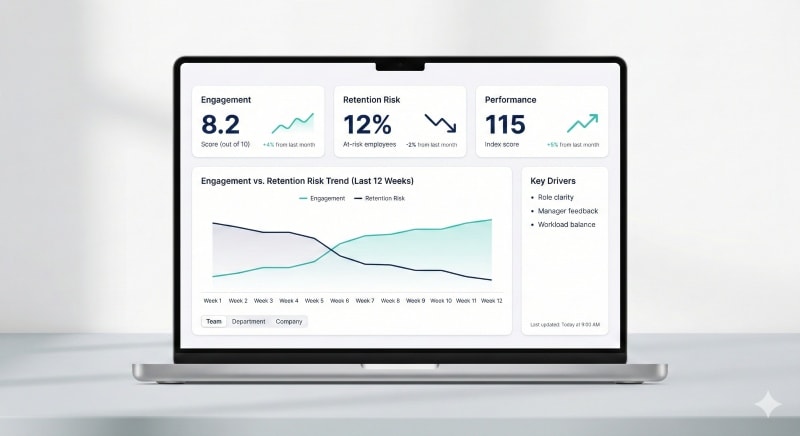
Motivation is also one of the cleanest leading indicators you have. If motivation is declining, employee retention risk usually follows.
Employee engagement, job satisfaction, and employee performance
Employee engagement is what you can observe day-to-day. Job satisfaction is what people report. Motivation is the engine behind both.
When employees feel motivated, you typically get:
- stronger focus and follow-through
- higher quality work
- better team coordination
- fewer avoidable errors
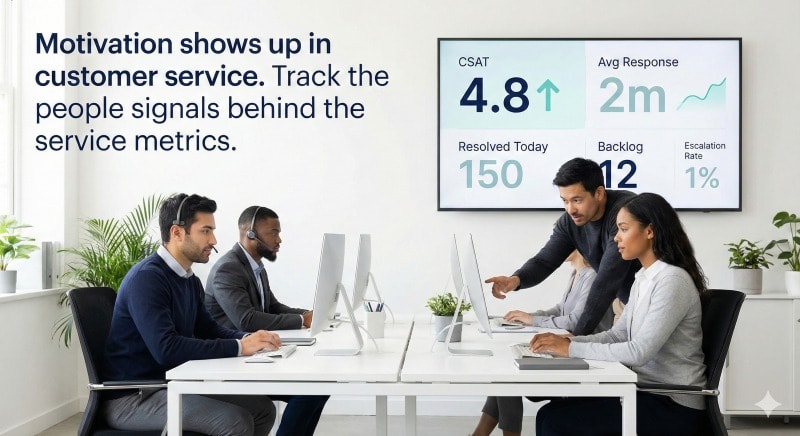
This shows up in customer-facing roles as better customer service and, over time, higher customer satisfaction.
The catch: engagement can look “fine” on the surface when people are compliant but emotionally checked out. That’s why you need both measurement and manager-level observation, not just vibes.
Motivation, employee retention, and employee morale
Low motivation rarely stays private. It spreads.
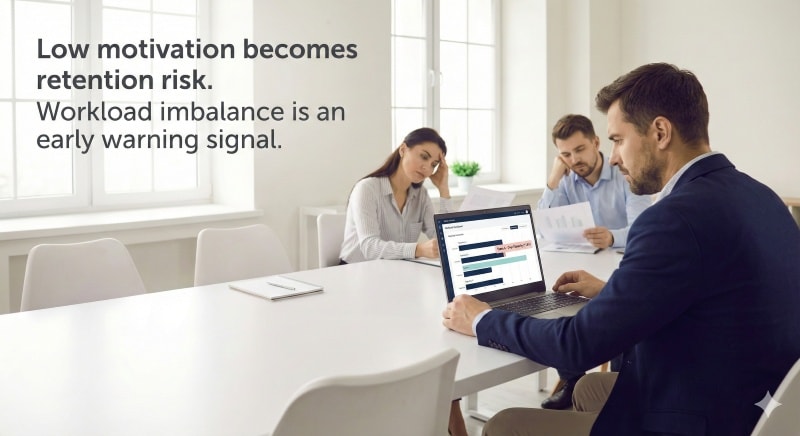
When a team’s employee morale declines, high performers notice first. They usually have options. If they leave, your remaining team members absorb the workload, stress rises, and motivation drops further.
Retention is expensive to ignore, even when hiring is “easy.” It is not just replacement cost. It’s lost context, slower execution, and managers spending months rebuilding trust and performance.
If you want to increase employee retention, you do not start with perks. You start with the drivers of motivation: role clarity, growth, recognition, and a supportive work environment.
Business success outcomes leaders actually care about
Executives usually want motivation improvements because they want business success outcomes like:
- higher productivity without burnout
- more consistent performance across teams
- faster execution on priorities
- fewer costly mistakes
- stronger customer loyalty
Motivation is not a “soft” topic. It is a performance lever. It just happens to involve human behavior, which is inconvenient because humans are inconsistent.

What Makes Employees Feel Motivated? The Core Drivers
Employees feel motivated when their daily work lines up with three things:
- They know what good looks like.
- They believe effort leads to progress.
- The environment feels fair and supportive.
Different people weight the drivers differently. Some care most about autonomy. Others care most about stability, recognition, or career growth. That is why one-size motivation strategies fail.

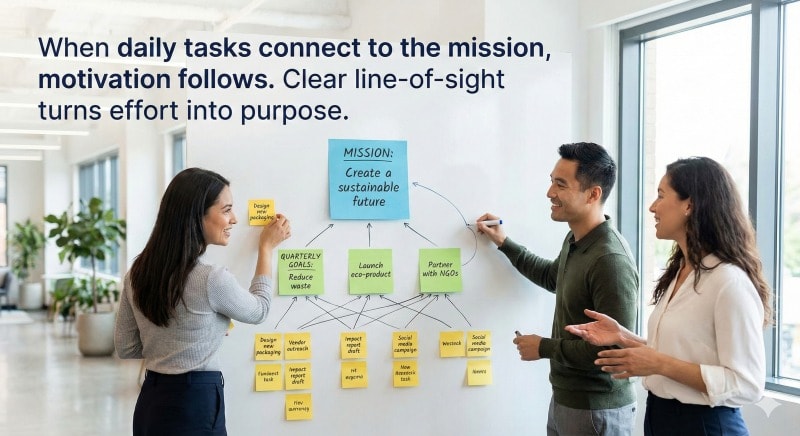
Company’s mission and purpose (without the corporate theater)
A company’s mission can motivate, but only when it connects to real decisions.
If leaders talk about “values” while rewarding the opposite behavior, employees stop listening. Purpose works when:
- goals are clear
- priorities are consistent
- leaders follow the same rules
- people can see how their work contributes
Purpose is not about speeches. It’s about alignment.
Autonomy, ownership, and decision-making
Autonomy is not “do whatever you want.” It is control over how you do the work, within clear constraints.
People feel motivated when they can:
- make decisions at their level
- solve problems without constant approvals
- shape their workflow
- own outcomes, not just tasks
When autonomy is missing, employees often stop thinking ahead. They wait for instructions. That looks like low initiative, but it is often a rational response to being micromanaged.

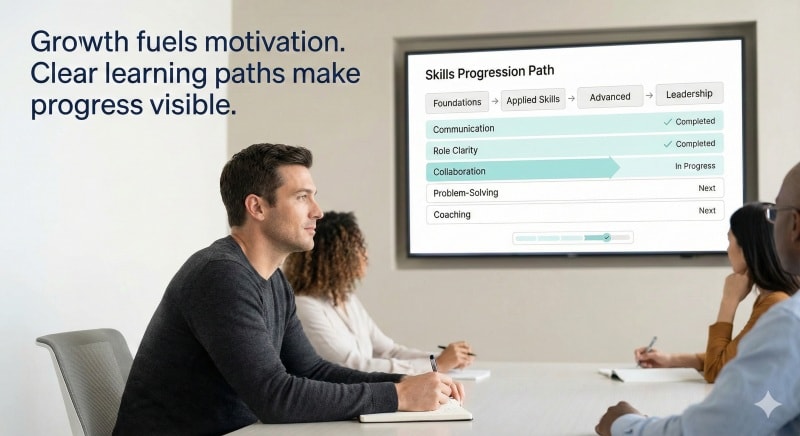
Career growth and professional development
Career growth is a major driver of employee motivation, especially for high performers.
Professional development opportunities work best when they are:
- connected to real skills the role needs
- paired with time to apply learning
- linked to career advancement pathways
- supported by manager coaching
Training programs that are disconnected from the job often feel like busywork. People can tell when development is a checkbox.
Recognition, fairness, and “employees feel valued” moments
Recognition matters because it signals what the organization values.
To motivate employees, recognition has to be:
- specific (what they did and why it mattered)
- timely (close to the behavior)
- fair (not only for the loudest people)
- consistent (not random bursts)
When recognition is uneven, people do not just feel ignored. They feel the system is rigged. That is a fast path to disengagement.

External factors and personal life pressures
Motivation is also shaped by what employees carry into work:
- caregiving responsibilities
- financial stress
- health issues
- chronic overload
- burnout
You cannot manage someone’s personal life, but you can design work so it does not crush them. Flexible work arrangements, realistic deadlines, and supportive managers are not “nice.” They protect performance.

Intrinsic Motivation: How to Build It (and Not Accidentally Kill It)
Intrinsic motivation is what you get when employees want to do the work well, even when nobody is watching. It is the most stable fuel you have. It is also the easiest to destroy with sloppy leadership.
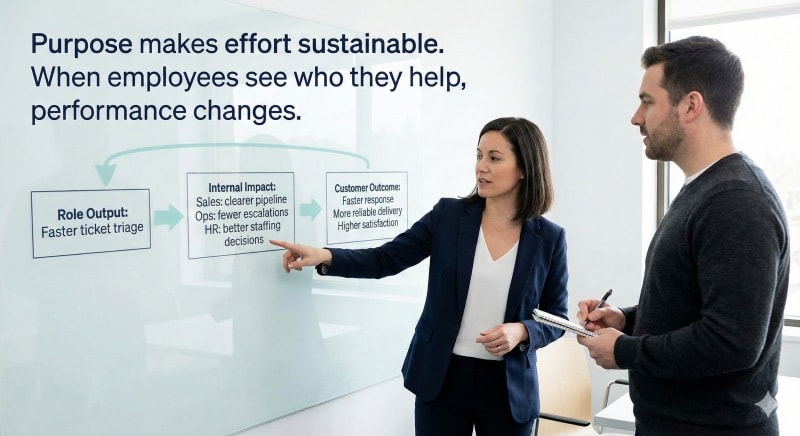
Meaningful work and a strong sense of contribution
Meaningful work does not require saving lives. It requires clarity.
Employees are more likely to feel motivated when they can answer:
- What problem am I solving?
- Who benefits from my work?
- What does “good” look like here?
When people cannot see impact, work turns into task completion. That is where motivation fades, even for competent team members.
Mastery: new skills, training programs, personal growth
Mastery is a powerful intrinsic motivator because it creates progress people can feel.
To make mastery real:
- define the few skills that matter most for the role
- give employees time to practice, not just learn
- build feedback into the workflow
- celebrate improvement, not just outcomes
If training programs are generic, they do not increase motivation. They increase cynicism.
Autonomy with clear organizational goals
Autonomy works when it comes with guardrails.
Give employees:
- the goal and success criteria
- the constraints (budget, timeline, compliance)
- freedom on the approach
Remove autonomy and you get compliance. Remove clarity and you get chaos. Neither improves employee performance.
Extrinsic Motivation: Rewards That Work Without Backfiring
Extrinsic motivation is useful. It is just easy to misuse.
Rewards can boost effort short-term. They can also create entitlement, internal competition, and a “pay me or I won’t” mindset if you lean on them for everything.
Financial incentives and tangible rewards
Use financial incentives when:
- performance is measurable and within employee control
- the goal is short-term and specific
- the incentive rules are simple and trusted
Avoid incentives when:
- outcomes depend heavily on other teams or systems
- measurement is messy or political
- quality matters more than speed and volume
Incentives that feel unfair do more damage than no incentives at all.

Non-financial rewards: recognition, flexibility, visibility
Non-financial rewards often matter more than leaders expect, especially when they improve daily life.
Examples:
- public recognition that is specific
- flexible work arrangements for high-trust performers
- ownership of a visible project
- access to mentoring or stretch work
These rewards support both extrinsic motivation and intrinsic motivation because they reinforce status, trust, and progress.
Common reward traps that reduce intrinsic motivation
Three common traps:
- rewarding the wrong behavior (speed over quality, loudness over results)
- rewarding inconsistently (favorites, politics, randomness)
- over-rewarding basic expectations (turning normal work into a bargaining chip)
If you want a motivated workforce, rewards must reinforce the culture you claim to want.
Create a Positive Work Environment That Sustains Motivation
A positive work environment is not “fun.” It is stable, fair, and workable.
People can handle pressure. They cannot handle pointless pressure.
Supportive work environment: psychological safety and respect
Employees contribute more when they feel respected and safe to speak up.
Practical signs of a supportive work environment:
- managers listen without punishing bad news
- mistakes are handled as learning, not public shaming
- expectations are consistent across team members
- decisions are explained, not hidden
Psychological safety is not softness. It is operational efficiency.
Healthy work-life balance and flexible work arrangements
Work-life balance is not a perk. It is a performance control.
If the workload is permanently unrealistic, motivation will collapse. Flexible work arrangements help when they are paired with:
- clear output expectations
- reliable communication norms
- boundaries that prevent always-on work

Wellness programs and employee well being
Wellness programs only help if they reduce friction in real life.
Good examples:
- workload reviews and capacity planning
- manager training to prevent burnout patterns
- benefits employees can actually use
- process fixes that remove repetitive stress
Bad examples:
- offering meditation apps while ignoring chronic overload
Employees notice the difference immediately.
Workplace culture norms that shape motivated teams
Culture is what gets rewarded and tolerated.
If you tolerate:
- poor performers who create chaos
- managers who micromanage
- unclear priorities
then motivation strategies will fail no matter how polished your internal comms are.
Motivated teams usually have:
- clear ownership
- fast conflict resolution
- fairness in workload
- consistent standards
Leadership and Motivation: What Managers Must Do Weekly
Leadership is where motivation lives or dies. Not in HR documents. Not in posters. In weekly behavior.
Communicate effectively and provide constructive feedback
Motivation drops when people do not know where they stand.
Strong managers:
- set priorities in plain language
- give feedback quickly and calmly
- separate behavior from identity
- make next steps clear
Constructive feedback should reduce confusion, not increase anxiety.
Empower employees without dumping responsibilities
Empowerment fails when leaders offload problems without support, often due to a lack of strong communication skills.
Empowerment works when you give:
- decision rights
- the resources to execute
- access to context
- accountability that is fair
That is how employees feel motivated instead of set up to fail.
Emotional intelligence and leading different personality types
People respond differently to the same environment.
One employee wants autonomy and stretch work. Another wants structure and certainty. If you manage both the same way, one will disengage.
This is where organizational psychology matters. Motivation improves when leaders understand:
- what energizes each person
- what stresses them
- how they prefer feedback
- how they approach risk and change
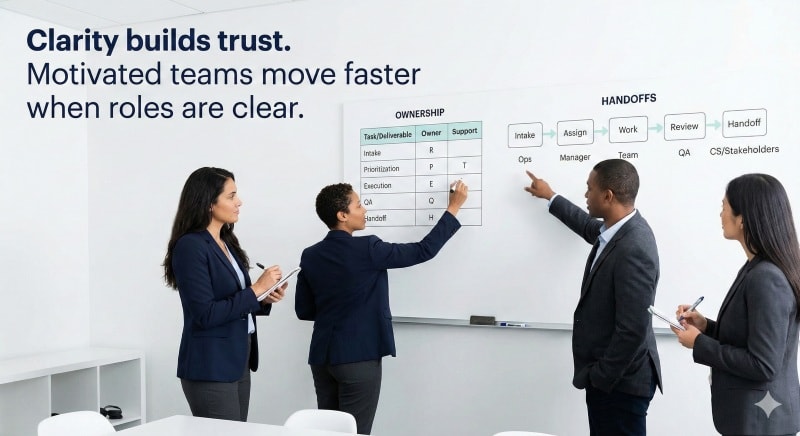
Team members, trust, and team building that is not cringe
Team building only matters when it builds trust that improves execution.
Good team building:
- clarifies roles and responsibilities
- fixes communication breakdowns
- improves handoffs and accountability
- reduces conflict avoidance
Social events are optional. Trust is not—and understanding team motivations and drivers is a key foundation.
Employee Motivation Strategies by Situation
Most motivation strategies fail because they treat motivation like a single problem. It isn’t.
A motivated employee can lose drive for one specific reason: unclear expectations, poor manager signals, role mismatch, overload, unfair rewards, or no path forward. The fix depends on the cause.
How to improve employee motivation when performance slips
When employee performance drops, don’t start with a pep talk. Start with a clean diagnosis.
Check these in order:
- Role clarity
Does the employee know exactly what “good” looks like this week? - Skill and support
Do they have the capability and tools to hit the standard? - Workload and constraints
Is the workload realistic, or are they constantly behind? - Friction and blockers
Are other teams, approvals, or broken processes slowing them down? - Manager behavior
Are you giving feedback, priorities, and autonomy consistently?
Then apply the simplest intervention:
- clarify priorities
- remove blockers
- reset expectations
- add coaching or training
- adjust responsibilities
If you skip diagnosis, you risk punishing an employee for a system problem.
Motivation strategies for high performers
Highly motivated employees don’t need “motivation.” They need protection.
If you want to keep them, focus on:
- stretch work that builds mastery
- recognition that is specific and fair
- autonomy with trust
- career growth that is visible and realistic
- workload boundaries so they don’t become the default problem-solver for everything
High performers leave when they feel taken for granted or trapped. They stay when progress is real.
Hard-to-motivate roles: repetition, burnout, and overload
Some roles make motivation harder: repetitive tasks, high emotional load, constant interruptions, or heavy compliance constraints.
In these roles, focus on:
- micro-autonomy (choice in sequencing, breaks, approach)
- job crafting (small changes to add variety and ownership)
- process improvement (remove pointless steps)
- rotation and learning (new skills over time)
- recognition that acknowledges the real difficulty of the work
If a role is designed like a treadmill, don’t blame employees for feeling tired.

Remote and hybrid teams: sustaining engagement
Remote work can increase motivation for some people and drain it for others.
Common motivation killers in hybrid settings:
- unclear response expectations
- meeting overload
- isolation and weak feedback loops
- “invisible work” not being recognized
- uneven flexibility across team members
Fixes that work:
- clear norms for communication and handoffs
- fewer, better meetings
- structured 1:1s focused on progress and blockers
- recognition that includes remote employees
- explicit priorities so people don’t guess
Training and Development That Actually Increases Motivation
Training only boosts motivation when employees can see a path: learn, apply, progress.
If training is random, generic, or disconnected from daily work, it doesn’t motivate. It distracts.
[Image: Employee development plan showing skills, projects, and timeline. Alt: “Professional development opportunities linked to career advancement”]
Professional development opportunities tied to career advancement
Professional development should answer one question: “What does this unlock?”
Make development concrete:
- identify the skills required for the next level
- connect training to real projects
- give time and support to practice
- track progress in simple terms
Employees feel motivated when development leads to momentum, not more tasks.
Mentoring, coaching, and role clarity
Mentoring helps with perspective. Coaching helps with performance.
Use mentoring for:
- navigating organizational culture
- building confidence and long-term direction
- career decision support
Use coaching for:
- improving specific skills
- feedback on real work
- building consistency and resilience
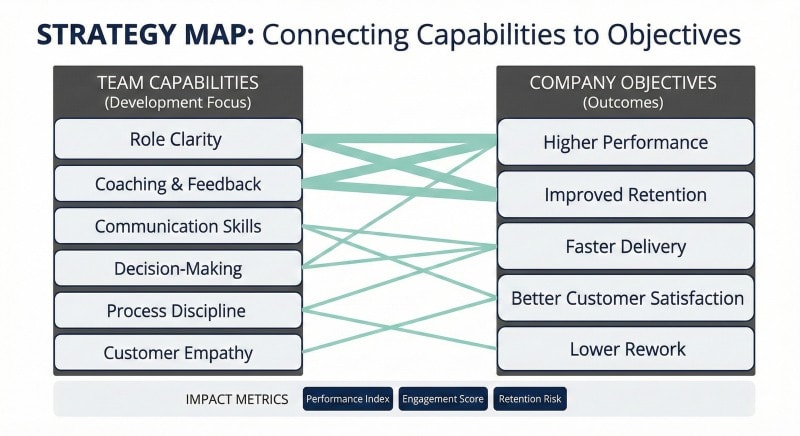
Role clarity is the multiplier. Without it, even great coaching feels random.
Align development with organization’s objectives
Development should support both the person and the business.
When aligned well:
- employees see meaning and direction
- leaders see stronger capability over time
- teams execute faster with less rework
This is where motivation in the workplace ties directly to organizational success.
Measuring Employee Motivation Without Guesswork
If you don’t measure employee motivation, you’re stuck reacting after the damage is done.
Measurement does not mean over-surveying people. It means using a few reliable signals and tracking them consistently.
How to measure employee motivation: leading vs. lagging indicators
Lagging indicators tell you what already happened:
- turnover
- absenteeism
- performance decline
- customer complaints
- missed deadlines
Leading indicators help you act earlier:
- pulse survey trends
- employee feedback themes
- participation in development
- manager 1:1 consistency
- internal mobility interest
A smart approach uses both.
Employee surveys: what to ask, how often, how to interpret
Employee surveys work when they are short, regular, and acted on.
Good survey rules:
- keep it brief (a few consistent items over time)
- measure drivers, not just feelings
- segment by team, role, and tenure where possible
- protect anonymity so answers are honest
- close the loop with visible action
Ask about:
- clarity of expectations
- fairness and recognition
- workload and support
- growth opportunities
- trust in leadership
If you run surveys and do nothing, you train people to stop telling you the truth.
Employee feedback loops and “you said, we did” credibility
The fastest way to boost motivation is to fix one annoying, real problem and tell people what changed.
Examples:
- simplify approvals
- remove a broken workflow step
- improve staffing for a bottleneck role
- clarify priorities and stop last-minute churn
When employees see action, employee feedback increases, and motivation rises because effort feels worthwhile.

Linking motivation to customer satisfaction and customer loyalty
Motivation affects how people treat customers and how often they fix problems before they escalate.
You can often see motivation shifts in:
- response quality
- error rates
- follow-through
- customer satisfaction scores
- repeat business patterns
This is one reason motivated employees tend to deliver better customer service. Not because they’re nicer people. Because they have the energy to care.
Using Personality and Role Fit to Improve Employee Motivation
Here’s the part many companies avoid because it requires more effort than buying another “engagement platform.”
Motivation is not only about perks, pay, and culture. It is also about fit.
Two employees can have the same job title and very different motivation levels because the role demands match one person’s natural strengths and stress profile and clash with the other’s.
If you want proper motivation, you have to treat employees like individuals, not interchangeable “resources.”
Why “proper motivation” depends on human behavior differences
Human behavior isn’t uniform. Some people are energized by change and ambiguity. Others are drained by it. Some thrive with social interaction. Others do their best work with uninterrupted focus.
This matters because motivation drops when work constantly pushes against someone’s core preferences. Over time, that looks like:
- lower employee engagement
- more friction with team members
- avoidance of responsibility
- burnout patterns
- rising retention risk
Managers often label this as “attitude.” It is frequently mismatch.
Matching work to strengths to prevent disengagement
A simple rule: people stay motivated when they can win.
That doesn’t mean work should be easy. It means the work should be aligned enough that effort produces progress.
Practical examples:
- A highly analytical employee may feel motivated by problem-solving and clear metrics, but drained by constant unstructured stakeholder work.
- A highly social employee may feel motivated by collaboration and customer interaction, but disengaged in isolated deep-work roles.
- A detail-focused employee may excel in compliance-heavy work, while a big-picture employee burns out in repetitive precision tasks.
When strengths and responsibilities align, employee performance improves and employee satisfaction rises. When they don’t, you can throw rewards at the problem forever and still lose.
Design teams with data, not gut feel.
Most org-design decisions come down to role fit, leadership style, and team dynamics. OAD reads those signals from a 7-minute behavioral survey, so you can reconfigure roles and teams with evidence instead of guesswork.
How structured assessments reduce bias in motivation decisions
Many “motivation” decisions are actually guesses:
- who gets promoted
- who gets stretch projects
- who gets labeled as “low potential”
- who gets coached vs managed out
Without structure, bias sneaks in through confidence, communication style, and manager preference.
A scientifically validated assessment helps because it creates a shared language for:
- preferred working style
- stress triggers
- communication patterns
- leadership potential signals
- team fit risks
It doesn’t replace manager judgment. It improves it by giving better inputs.
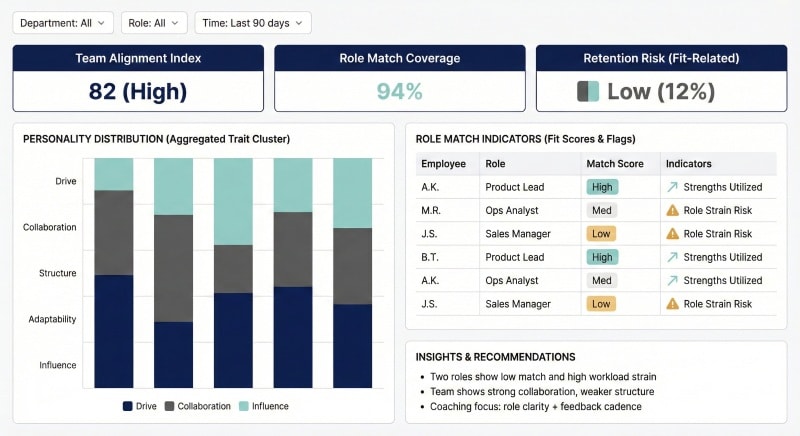
OAD angle: using data to support employees and improve retention
This is where OAD fits naturally.
If your goal is to improve employee motivation, you need to know:
- what the role truly requires
- what motivates different people in that role
- where mismatches create disengagement and turnover
OAD’s approach is built for that. It helps you compare candidates and employees with structured, science-based data rather than gut feel, so your motivation strategies target the right lever.
Start with the free Top Performer Profile: 7 minutes, results in 24 hours, no credit card.
FAQ: Motivation in the Workplace (People Also Ask)
What is the best motivation for work?
The best motivation for work is the one that lasts.
For most roles, intrinsic motivation drives the most consistent results over time because it comes from purpose, autonomy, and mastery. Extrinsic motivation can help in short bursts, especially for clear targets, but it tends to be weaker as a long-term strategy if the work itself feels misaligned or unfair.
In practice, the “best” motivator is a combination:
- meaningful goals
- control over how work is done
- growth and career progress
- recognition that feels fair
- rewards that reinforce the right behaviors
Why is motivation in a workplace important?
Motivation in the workplace matters because it predicts behavior before results decline.
When motivation drops, you typically see lower employee engagement, weaker performance, higher absenteeism, and increasing employee retention risk. When motivation is strong, employees tend to show more initiative, better collaboration, and higher-quality output, which supports business success.
How do you motivate employees without money?
You motivate employees without money by improving the conditions that drive intrinsic motivation and everyday fairness.
High-impact levers:
- clearer goals and fewer shifting priorities
- autonomy and trust
- recognition that is specific and consistent
- career growth through real development opportunities
- better workload design and fewer blockers
- managers who communicate effectively and give constructive feedback
These factors often matter more than leaders expect, especially for experienced team members.
What are the biggest causes of low employee motivation?
Common causes include:
- unclear expectations and constant priority changes
- lack of recognition or unfair rewards
- weak manager communication and inconsistent feedback
- limited career growth or stalled development
- role mismatch (the work fights the person)
- chronic overload and burnout
- toxic norms in workplace culture
Most “motivation problems” are system problems that show up in people.
How do you measure employee motivation accurately?
Use a mix of:
- short pulse surveys (track trends, not perfection)
- manager 1:1 notes on blockers and energy
- behavioral indicators (initiative, participation, follow-through)
- retention risk signals (internal mobility, disengagement patterns)
- performance consistency over time
Accuracy comes from consistency and action. If measurement never leads to change, responses become unreliable.
Conclusion: Build a Motivated Workforce That Drives Business Success
If you want to improve motivation in the workplace, don’t default to perks.
Start with the drivers that reliably change outcomes:
- clarify priorities and expectations
- design autonomy with support
- build mastery through real development
- recognize performance fairly
- fix workload and process friction
- align roles with human behavior differences
This is how you build motivated employees, not just temporarily energized ones. It also improves employee retention, employee satisfaction, and employee performance without relying on constant external pressure.
If you want to see how OAD performs on your own roles and candidates, start with the free Top Performer Profile: 7 minutes, results in 24 hours, no credit card.