Hiring gets expensive when you treat “fit” like a gut feeling. This guide is for HR teams, hiring managers, and executives in 50+ employee companies who want a repeatable way to assess job fit and predict job performance using structured, defensible methods.
What is job fit and what is a job fit assessment?
Job fit is the match between a person and the reality of the role: the tasks, the performance standards, the work environment, and the team context.
A job fit assessment is the system you use to measure that match. It typically combines multiple inputs, like skills assessments, cognitive ability measures, personality traits, and structured interviews.
Job fit matters because it predicts what you actually care about: job performance over time, not “interview performance for 45 minutes.” Research-backed selection methods consistently show that more structured approaches predict performance better than loose, intuition-led methods. For example, classic meta-analytic work reports higher validity for structured interviews than unstructured interviews (about .51 vs .38).
Why assess job fit
Poor job fit increases turnover risk
When a hire leaves early, you pay twice: replacement costs plus lost output. SHRM provides tools for calculating turnover cost because the impact is material and often underestimated in budgeting.
If you need a conservative anchor for business discussions, one analysis of studies and case examples estimated replacement costs around one-fifth of annual salary for many roles (and it can be higher for complex roles).
Fit influences employee engagement and day-to-day behavior
Engagement is not a vibes metric. Fit affects whether people can sustain effort in your environment: workload, autonomy, team norms, manager style, and role clarity. When fit is poor, “performance problems” often show up as inconsistent execution, friction with existing teams, and avoidable attrition.
Fit improves time-to-productivity
Time-to-productivity depends on learning speed (cognitive ability and prior experience), role clarity (job responsibilities and job requirements), and whether the person’s work style matches how the team actually operates. A fit assessment helps you stop hiring people who only look good on paper but struggle in the real workflow.
Job fit measures and assessments
A thorough job fit assessment uses multiple measures because performance is multi-causal.
Skills assessments
Use skills tests to evaluate technical skills, hard skills, and job-relevant communication skills. Keep them close to real tasks, not trivia.
Cognitive ability tests
Cognitive ability is one of the most consistent predictors of learning and job performance across roles, especially when work is complex.
Personality traits and psychometric tests
Personality is useful when you are clear about what you are measuring. Meta-analytic evidence has long shown conscientiousness relates to job performance across occupational groups.
Use personality measures such as the OAD Survey, a quick, validated personality assessment to predict typical behavior under pressure: follow-through, detail orientation, steadiness, social assertiveness, and risk tolerance.
Design teams with data, not gut feel.
Most org-design decisions come down to role fit, leadership style, and team dynamics. OAD reads those signals from a 7-minute behavioral survey, so you can reconfigure roles and teams with evidence instead of guesswork.
Work-style surveys
Work-style tools help you understand daily preferences: collaboration cadence, time management approach, structure vs autonomy, and pace tolerance. This is where “work life balance” expectations and work environment reality can be made explicit early, and where motivation insights into what truly drives employees give you another lens on long-term fit.
Culture and team alignment measures
Assess alignment to the company’s culture carefully. “Cultural fit” can become code for sameness if you are sloppy. Done properly, it is about values and working norms that affect team dynamics and execution, and you can deepen this with behavioral interview questions to assess cultural fit.
How to assess job fit (step-by-step)
A job fit system should be designed like a process, not a collection of random tests.
- Define the role (outcomes first)
- Choose measures that match the role’s demands
- Administer assessments in a candidate-friendly sequence
- Use structured interviews to validate behavior and motivation
- Score consistently and compare candidates against the same rubric
- Validate predictive power against real job performance, then improve
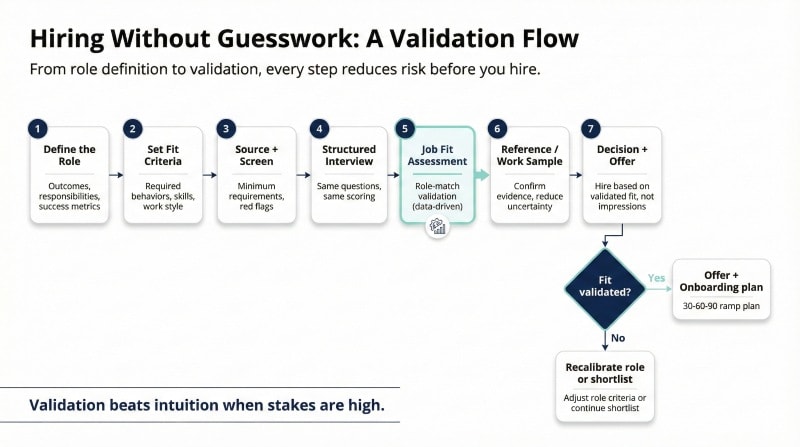
Step 1: Define the role and write a performance-based job description
Start with job analysis. Document:
- The outcomes that define success in the first 6 to 12 months
- The non-negotiable job requirements
- The key factors that make someone succeed or fail in this particular role
- The work environment realities (pace, ambiguity, stakeholder load)
Then translate that into job fit criteria and core competencies. Write a job description that prioritizes performance outcomes over generic lists. “Own X outcome” beats “responsible for Y tasks” every time, and pair that with a psychometrically precise hiring tool like the OAD Survey so your assessment model matches the role definition.
Step 2: Select job fit measures (including cognitive ability)
Match the method to what you need to predict.
- Use cognitive ability tests when the role requires continuous learning, complex judgment, or heavy problem-solving. Evidence supports cognitive ability as a strong predictor of performance, and recent meta-analytic work continues to reinforce its importance.
- Use skills assessments to simulate job tasks. For a technical role, that might be debugging, analysis, or building a small feature. For a managerial position, use scenario work that tests prioritization and decision quality, including structured ways to assess communication skills in interviews.
- Use personality traits measures to predict typical behavior patterns, especially conscientiousness and role-relevant traits tied to the job’s success profile, and incorporate behavior fit reports that match roles to personality for higher confidence.
Design teams with data, not gut feel.
Most org-design decisions come down to role fit, leadership style, and team dynamics. OAD reads those signals from a 7-minute behavioral survey, so you can reconfigure roles and teams with evidence instead of guesswork.
Step 3: Administer assessments and job simulations
Place assessments where they help decision-making without wrecking candidate experience.
Practical sequencing that works for many roles:
- Short screen (role basics, motivation, constraints)
- One core assessment (skills or cognitive ability, depending on role) delivered through individual, secure application access for each candidate
- Structured interview
- Job simulation or work sample (if not already done)
- Final decision interview (only if needed)
Set fair time limits and ensure mobile access where possible. Communicate what the assessment is measuring and why. Candidates tolerate structure when it is transparent and relevant.
Step 4: Use structured behavioral interviews to assess job fit
Unstructured interviews reward confidence and storytelling. Structured interviews reward evidence.
Meta-analytic findings commonly show structured interviews outperform unstructured ones in predicting job performance.
Build the interview around competencies and job fit criteria:
- Behavioral questions: “Tell me about a time you did X. What did you do, and what happened?”
- Situational questions: “If X happens here, what do you do first, second, third?”
- Follow-ups that force specifics: “What did you measure?” “What trade-off did you make?” “What feedback did you get?”
If you want an extra edge: decide whether you are assessing typical performance (day-to-day tendencies) or maximal performance (best-case capability). Interview structure and wording should align to that choice, and post-hire you can use behavioral coaching tools for leaders to reinforce the same model in development.
Step 5: Score, compare, and make confident hiring decisions
This is where most teams quietly fail: they gather data, then ignore it.
Use:
- A standardized scoring rubric per competency
- A candidate comparison matrix (same criteria, same weights)
- Decision rules (what is required vs trainable)
Avoid “averaging away” a red flag that matters. If a role requires high reliability and execution, low conscientiousness signals should not be treated as a minor preference.
Step 6: Validate predictive power against job performance
Validation is what separates a real assessment program from corporate theater.
Pilot in one role:
- Run the assessment on candidates and, where appropriate, incumbents
- Track performance outcomes (quality, output, ramp time, manager ratings)
- Compare assessment scores to outcomes
- Adjust benchmarks and cutoffs based on what predicts success
This is also how you keep the system fair. If a measure is not helping prediction, remove it.
Post-hire fit: measuring employee engagement and early warning signs
Fit is not “set and forget.” Track early signals:
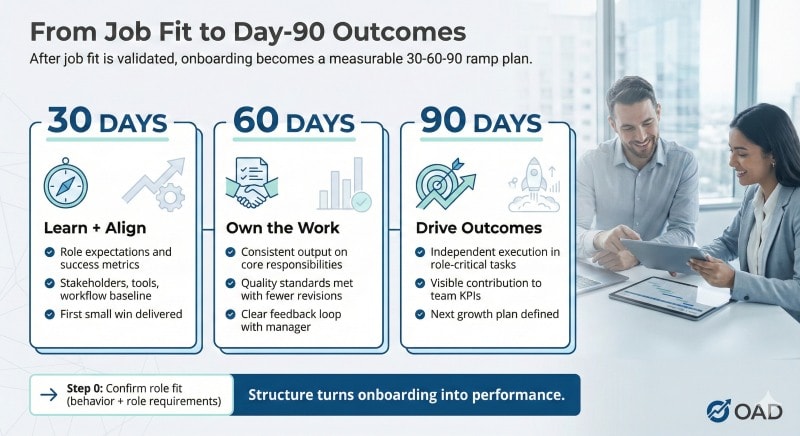
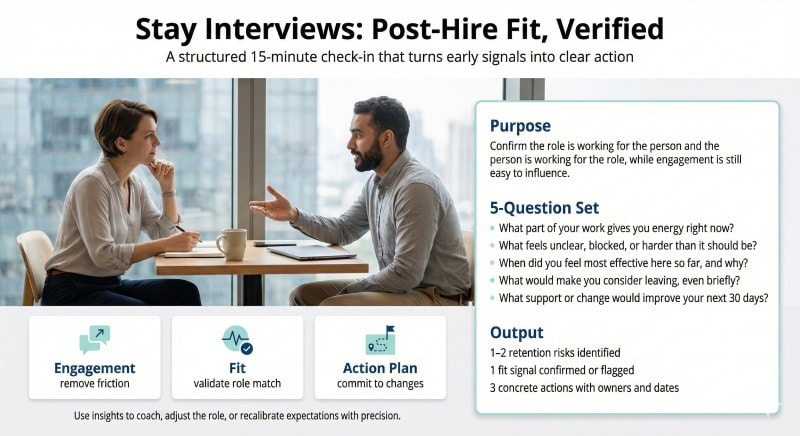
- Engagement check-ins at 30, 60, 90 days
- Stay interviews to surface mismatch early
- Manager notes tied to job fit criteria, not personality judgments
Then loop that back into your job fit measures. If hires who score well still struggle, your role definition or simulation is probably wrong.
Implementation tips for a thorough job fit assessment program
- Pilot on one role first. Prove it works before scaling.
- Train interviewers on scoring, evidence standards, and bias controls.
- Document decisions and results. Auditability matters in modern hiring.
- Keep the system simple enough to run every time.
Common pitfalls and best practices
- Do not use “cultural fit” to screen for sameness. Define the actual working norms you need.
- Avoid unvalidated tests. If it does not predict job performance, it is noise.
- Do not over-weight one measure. Use cognitive ability, skills, and structured interviews as a system.
Templates, tools, and sample interview questions
Job description template (outcomes-focused)
Include:
- Success outcomes (6–12 months)
- Top responsibilities tied to outcomes
- Required competencies and behaviors
- Work environment realities
- How success is measured
Sample behavioral interview questions
- “Tell me about a time you had too many priorities. How did you decide what mattered?”
- “Describe a time you made a mistake that affected others. What did you do next?”
- “Tell me about a time you had to influence a skeptical stakeholder.”
Candidate comparison spreadsheet template
Columns:
- Competency scores (with definitions)
- Skills assessment score
- Cognitive ability score (if used)
- Motivation and constraints
- Overall fit-to-role score
- Notes grounded in evidence
FAQ (People Also Ask)
What is a job fit assessment?
A job fit assessment is a structured way to measure how well someone matches a particular role’s requirements, work environment, and team context using tools like skills assessments, cognitive ability measures, personality traits, and structured interviews.
Can you still get hired if you fail an assessment test?
Sometimes, yes. It depends on what the test measures and how you weight it. Employers may treat some results as coachable (certain technical gaps) and others as higher risk (core cognitive demands or role-critical behaviors). The right approach is transparency and consistent decision rules, especially for founders and CEOs who are hiring with long-term fit in mind or private equity leaders managing post-acquisition team risk.
How do I pass a job assessment test?
From an employer perspective, this is a design problem. Make assessments job-relevant, explain what is being tested, set fair time limits, and avoid trick formats. When the assessment mirrors real tasks, “prepping” becomes less of a factor.
What is a JOFI assessment?
JOFI is a branded “job fit” style assessment term used by specific providers. Treat it like any third-party tool: evaluate what it measures, whether it predicts performance for your roles, and whether it holds up under validation in your hiring context.
Conclusion: build a scalable job fit system that predicts performance
Job fit is not a soft concept. It is a measurable match between a person and the role’s real demands. When you define success outcomes, use job-relevant measures, interview with structure, and validate against performance, you stop guessing.
If you want to see what a structured, science-based fit model looks like in practice, you can start with the free Top Performer Profile: 7 minutes, results in 24 hours, no credit card.