Scaling is not “grow faster.” Scaling is building a business model and operating system that can absorb more customers, more revenue, and more complexity without breaking your customer experience or your team.
This scale up strategy playbook is written for business owners, founders, and leadership teams in growth-stage B2B SaaS, with a slight US lens but globally applicable benchmarks and decision rules.
What a scale-up strategy is (and why most companies get it wrong)
A scale-up strategy is a set of choices that make growth repeatable. Scaling refers to the process of rapidly growing and expanding a business, typically in terms of revenue, customer base, and employee headcount, without proportional increases in resources.
- A clear target market
- A defensible competitive advantage
- A repeatable acquisition motion
- A scalable business model that can be replicated easily without proportionally higher costs
- Business operations that do not rely on heroics
- A talent system that puts the right people in the right roles
Essential tools, such as project management software and operational efficiency frameworks like The Rockefeller Habits, are critical for supporting scale-up execution.
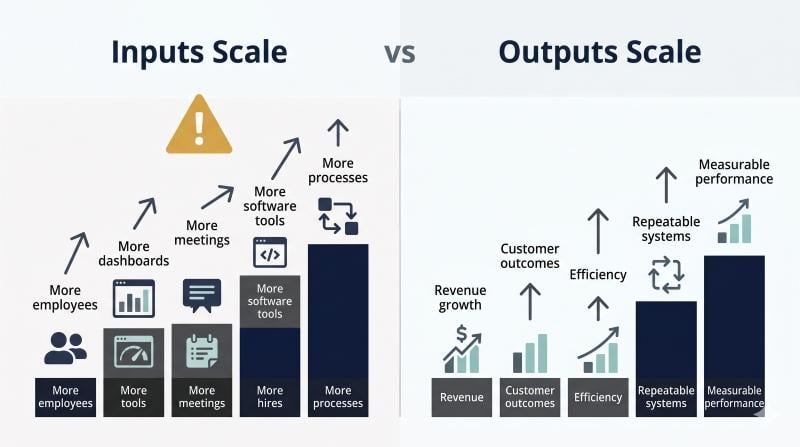
Most companies fail because they scale inputs (headcount, spend, features) before they can scale outputs (consistent delivery, retention, predictable revenue). Securing additional funding is also crucial to cover expansion costs, technology upgrades, and hiring outsourced expertise during growth.
Startup Genome’s research on 3,200+ startups flagged premature scaling as a dominant failure pattern, including the widely cited “74%” figure and the “93% never break $100k/month” claim for startups that scale prematurely.
Establishing a loyal customer base is fundamental to scaling, as loyal customers provide stability and generate positive word-of-mouth endorsements.
When to start scaling (signals you’re ready)
Product-market fit signals you can trust
Look for proof in behavior, not opinions:
- Retention that holds by cohort
- Expansion or increased usage without constant intervention
- Customer feedback that repeats the same “why we bought” story
Before pursuing new markets, it’s crucial to optimize revenue from existing products by focusing on current offerings and maximizing value from your existing customer base.
If churn is volatile, or customers only succeed with founder-led rescue missions, you are not in a growth stage. You are in a fragile stage with a marketing budget.

Acquisition signals that indicate repeatability
You are ready to start scaling when:
- Your pipeline behaves predictably by channel
- Your messaging converts the same target market repeatedly
- Your sales process has clear stages, exit criteria, and forecast integrity
- Your core services are robust and scalable, ensuring they can support acquisition growth as you expand
“More leads” is not a strategy. A clear strategy is knowing which leads become customers at a cost that still leaves margin for support growth.
Unit economics signals (CAC, LTV, payback)
A common benchmark discussed in SaaS is LTV:CAC around 3:1 as a baseline and using CAC payback to sanity-check speed to recovery, but treat benchmarks as context, not commandments. Remember, a key goal during scaling is increasing revenue without proportional increases in resources, which makes optimizing these metrics even more critical for sustainable growth.
Build a one page strategic plan that drives revenue growth
A one page strategic plan is not a cute document. It’s a constraint system. It forces the leadership team to stop pretending everything is a priority. When developing your scale up strategy, it’s essential to integrate a growth strategy that anticipates the need for more resources—such as additional personnel, budget, and infrastructure—to support expansion and operational growth.
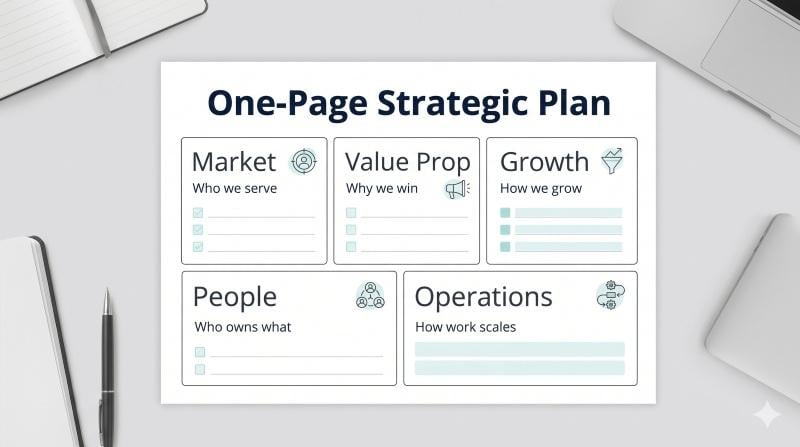
Before you start filling in the boxes, remember that the key components of a scale-up strategy include building a scalable business model, fostering a growth culture, securing funding, and implementing rigorous performance metrics.
At the end of the day, aligning the key pillars—people, strategy, execution, and cash—is critical for an effective scale-up strategy.
One page plan objectives
Your one page plan should answer, in plain English:
- Who is the target market?
- What is the business model (pricing, packaging, retention path)?
- What is the competitive advantage (why you win)?
- What are the key pillars for the next 90 days?
As part of your scale up strategy, ensure you evaluate and upgrade existing ones—systems, personnel, and infrastructure—to support operational capacity and sustainable growth.
If you cannot fit it on one page, you do not have a strategy. You have a wishlist.
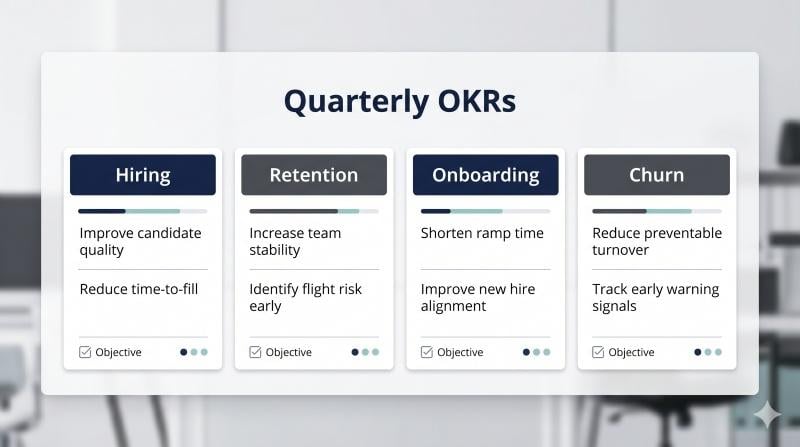
Quarterly OKRs tied to people and execution
Tie OKRs to outcomes the business actually feels:
- Time-to-productivity for new hires
- Retention for key roles
- Support load per customer segment
- Cycle time for shipping and onboarding
This is where people-first stops being a slogan and becomes business operations. Developing scalable talent systems and organizational capabilities is essential to ensure your scale up strategy supports both immediate growth and long-term success.
Budget allocation: invest, delay, or kill
In scaling, “significant investment” is usually required. The only question is whether you spend it deliberately or accidentally. Securing additional funding—such as venture capital, loans, or grants—may be necessary to cover expansion costs and support your scale up strategy.
Allocate budget to:
- The parts of your system that reduce rework (process, onboarding, QA)
- The parts that improve decision quality (data, structured hiring, analytics)
- The parts that protect customer experience (support capacity planning)
Delay anything that grows complexity without improving repeatability.
Managing cash flow and creating a detailed financial plan to forecast expenses and revenue are crucial steps during this period of scaling.
Align the management team (decision rights and cadence)
Scaling punishes ambiguity.
- Define who decides, who inputs, who executes
- Run a monthly operating review and a quarterly planning reset
Market conditions and competitive advantage (choosing where to scale)
Assess market conditions without delusion
Market conditions matter, but most teams use them as excuses.
Assess:
- Demand stability in your segment
- Sales cycle realities
- Switching costs and implementation friction
- Whether the “larger market” is actually reachable with your current motion
A startup’s ability to scale also depends on its readiness—having the right resources, infrastructure, and strategic planning in place is essential to support growth when market conditions are favorable.
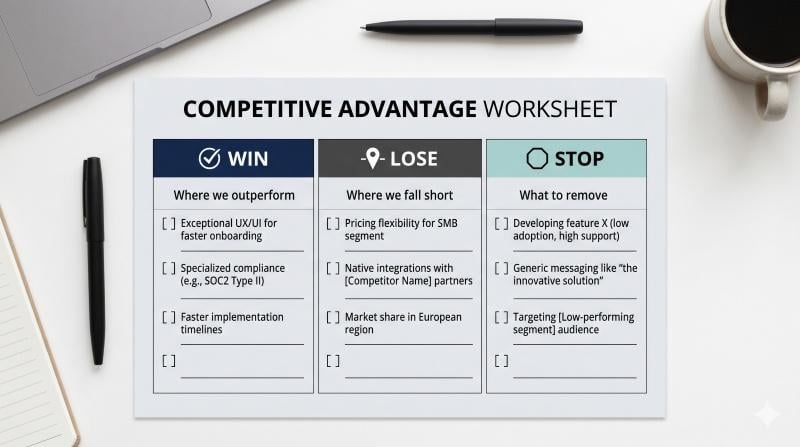
Define competitive advantage in operational terms
Competitive advantage is not “better features.”
It is a repeatable reason customers choose you and stay.
Write it as:
- “We win because…”
- “We lose when…”
- “We will stop doing…”
If you cannot articulate this, you will bleed money trying to buy market share.
Customer base playbook (retention before new customers)
Segment your customer base by value and use case
Not all customers deserve equal attention.
Segment by:
- Industry and workflow fit
- Expansion potential
- Support burden
- Implementation complexity
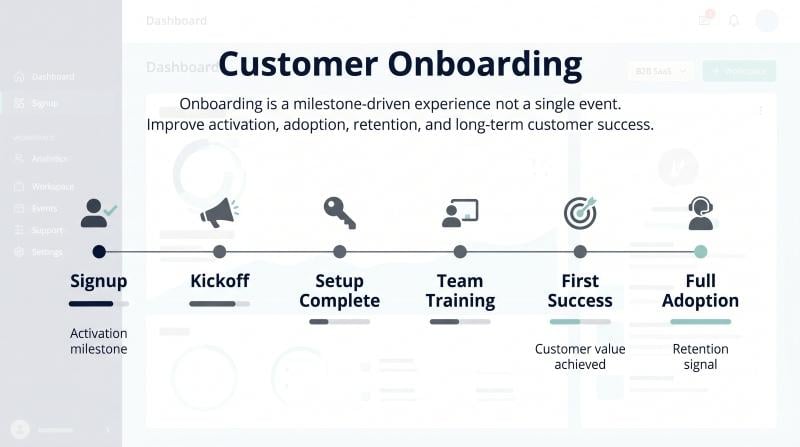
Build customer experience systems that support growth
Scaling fails when customer experience becomes inconsistent.
Systematize:
- Onboarding steps with clear milestones
- Hand-offs between sales, CS, support
- Escalation paths
This reduces costs and protects trust.
Loyal customer base mechanics: expansion and referrals
Referrals happen when outcomes are obvious.
Operationalize:
- Case studies tied to measurable outcomes
- Referral prompts at the right success moment
- Light incentives that do not cheapen the brand
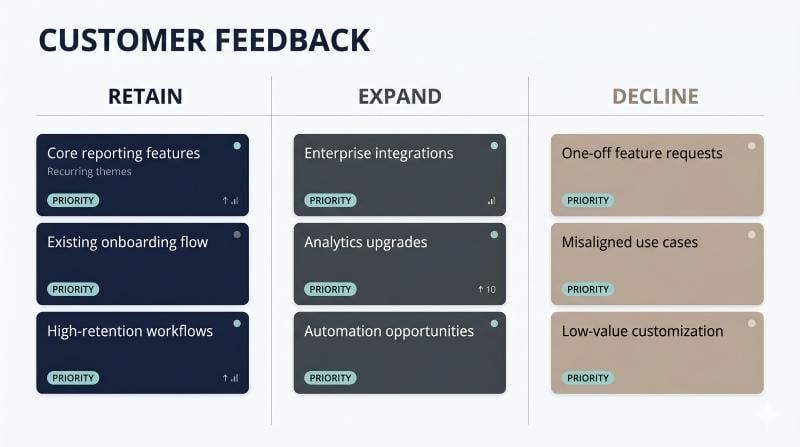
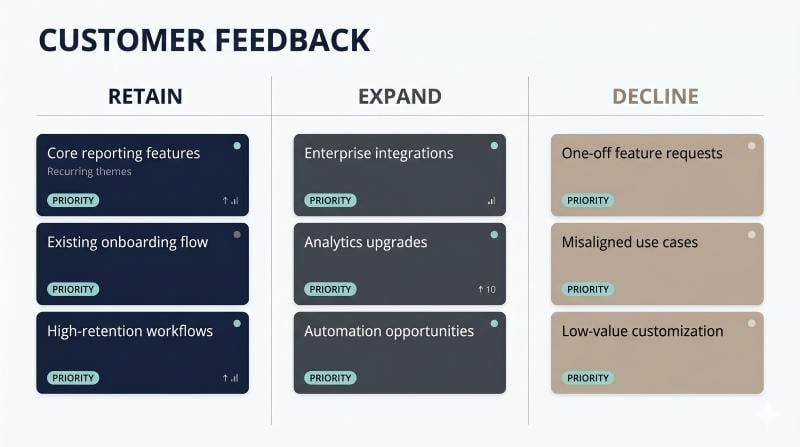
Use feedback like an adult
Customer feedback is only useful when it changes decisions.
Track:
- Churn reasons by segment
- Onboarding drop-off points
- Requests that map to your core use cases
Ignore loud outliers that pull you away from product market fit.
Metrics that decide if you scale or stall
LTV to CAC: track weekly, interpret carefully
LTV:CAC is only meaningful when:
- LTV is cohort-based (not blended fantasy)
- CAC is fully loaded (not “just ads”)
- Payback period is tracked alongside it
A commonly used benchmark is 3:1 as a baseline, but treat it as a starting question, not a finish line.
Churn, expansion revenue, and net revenue retention
NRR is where B2B SaaS companies prove they have a business, not a leaky bucket.
McKinsey has highlighted NRR as a critical metric for B2B tech growth and investor confidence.
Rule of 40 (use it to force tradeoffs)
Rule of 40 is a heuristic: growth rate + profit margin should be around 40% for a “healthy balance” in SaaS, commonly used by investors and operators.
It’s useful because it forces clarity:
- If you want faster growth, accept lower margins knowingly
- If funding is tight, push efficiency without killing the product
Cashflow and runway stress-tests
If you cannot describe what happens to runway under:
- slower pipeline
- increased demand (support load spikes)
- hiring delays
then you are not scaling. You are gambling with payroll.
Business operations to support startup scaling
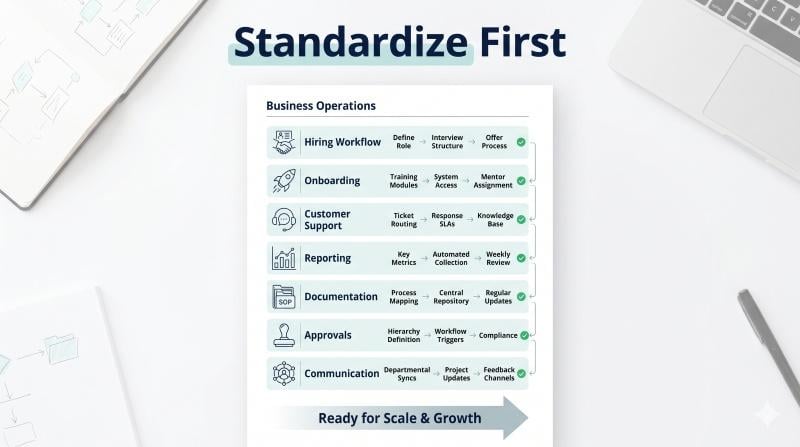
Standardize what breaks first
Early stages survive on improvisation. Growth breaks it.
Standardize:
- onboarding workflows
- support triage
- release QA and incident response
- hiring and promotion decisions
Reduce costs without damaging the product
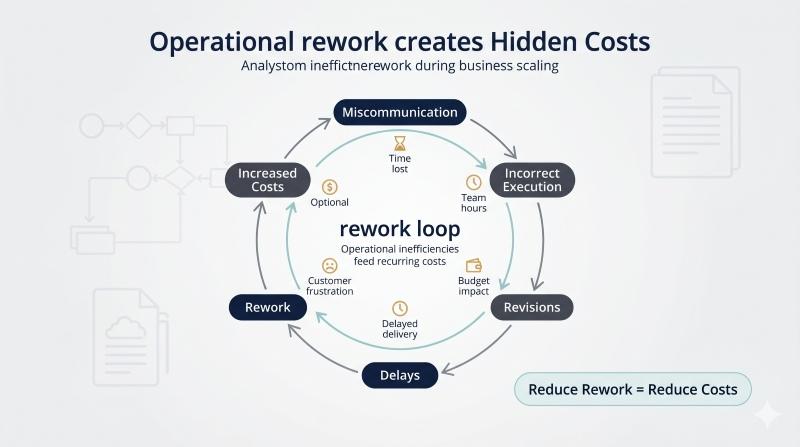
Cost reduction works when it removes rework:
- fewer bad hires
- fewer escalations
- fewer failed implementations
- fewer “urgent” interrupts
Cutting costs by starving customer experience creates churn that murders revenue growth later.
Talent and leadership team scaling
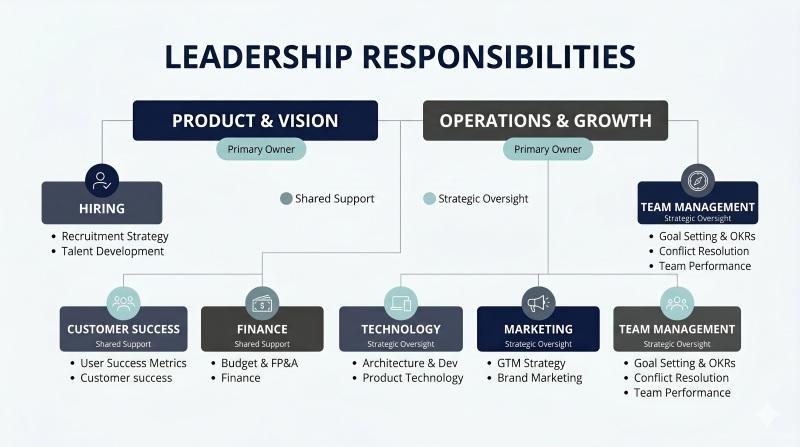
Clarify co founder roles before the org forces it
Scaling amplifies conflict.
Partnering with data-driven coaching tools for leaders can make those tensions productive rather than destructive. Define:
- who owns product decisions
- who owns go-to-market
- who owns people and operations
If nobody owns it, everyone fights about it.
Hire right talent with role-fit criteria
Leverage behavior fit reports to match roles to personality.
“Strong team” is not a vibe. It’s selection.
Use:
- scorecards tied to outcomes
- structured interviews
- role-fit signals that predict performance with a quick OAD survey tool
This is where OAD’s behavioral team software fits naturally: structured behavioral intelligence reduces the guesswork that makes growth chaotic.
If you want to see how structured behavioral data changes hiring quality, start with Top Performer Profile on one role and compare signal vs gut feel.
Leadership development changes in the growth stage
The leadership team’s job shifts from doing to designing:
- clearer delegation
- cleaner decision-making
- stronger manager enablement
The cost of weak managers rises sharply when headcount rises.
People analytics for scaling hiring and retention (the OAD angle)
Map role-fit vs performance with behavioral data
Most companies measure performance after the damage is done.
Providing individual application access so every employee can manage their own insights accelerates learning and course correction. Role-fit analytics let you:
- predict friction points
- tailor onboarding
- improve team composition

Audit the hiring funnel (conversion and quality)
Track:
- conversion rates by stage
- time-to-fill for critical roles
- quality signals post-hire (30/60/90-day outcomes)
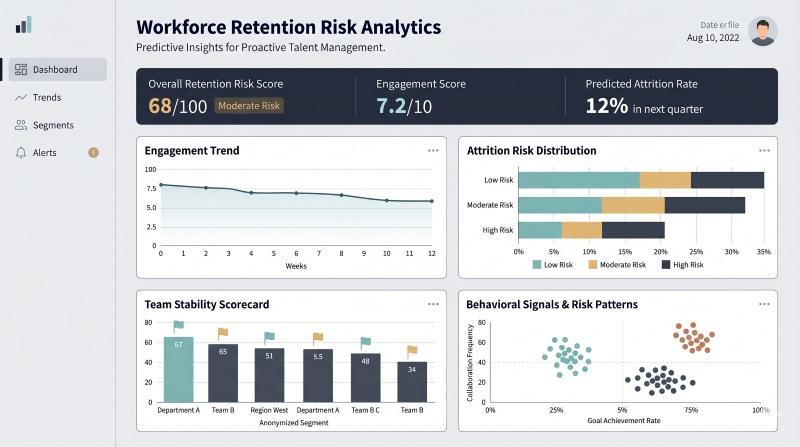
Retention diagnostics and flight-risk patterns
Use risk and readiness alerts to predict turnover.
Retention isn’t random.
Patterns emerge by:
- manager behavior
- role mismatch
- team dynamics
- expectation gaps in onboarding
Behavioral signals, including motivation insights into what truly drives your hires, help you move from “exit interview theater” to earlier intervention.
Design teams with data, not gut feel.
Most org-design decisions come down to role fit, leadership style, and team dynamics. OAD reads those signals from a 7-minute behavioral survey, so you can reconfigure roles and teams with evidence instead of guesswork.
Light AI use-cases that improve consistency
Support these workflows with validated psychometric assessments like the OAD Survey.
Artificial intelligence is useful when it:
- standardizes evaluation
- flags anomalies
- reduces manual sorting
AI is not useful when it replaces judgment without accountability.
Investing in automation and technology to unlock scale
Modern startups rise or fall on one decisive factor: how intelligently they amplify their impact through technology. Growth may seduce with promises of expansion, but it’s strategic automation — not mere headcount or capital injection — that drives sustainable scale. True operational leverage isn’t accidental; it’s engineered through deliberate investments in artificial intelligence and process optimization.
Exceptional scaling organizations operate with automated systems that handle the repetitive while humans focus on the transformative. They deploy AI-driven solutions that surface customer insights faster than manual analysis ever could, implement workflows that ensure consistency flows naturally across growing teams, and create technological foundations where innovation emerges organically. Even strategic planning benefits from this approach — the right tools don’t just track progress, they create alignment that adapts fluidly as market dynamics shift and opportunities surface.
Because sustainable growth isn’t just about building better systems — it’s about multiplying human potential through intelligent automation. When startups achieve this technological alignment, they don’t just expand their operations. They transcend traditional scaling limitations, outpace competitors trapped in manual processes, and unlock revenue streams that flow efficiently while costs remain controlled. The organizations that master this transformation don’t simply grow — they establish competitive advantages that compound over time.
Maintaining a strong company culture during rapid growth
Growth accelerates momentum, yet it threatens to erode the foundational culture that catalyzed your startup’s initial breakthrough. During rapid scaling, core values and mission dissolve beneath the relentless pressure to recruit, deploy, and penetrate new markets. Yet robust organizational culture transcends mere workplace amenity — it functions as a sophisticated growth mechanism. It magnetizes exceptional talent, maintains strategic alignment across teams, and generates the innovation cycles that sustain competitive advantage.
Preserving culture throughout aggressive expansion demands systematic visibility and operational integration. Establish transparent communication architectures — structured organizational forums, real-time strategic updates, and bidirectional feedback ecosystems. Recognize and incentivize behaviors that exemplify foundational values, not merely quantitative performance indicators. Invest deliberately in human development: structured mentorship frameworks, continuous learning pathways, and clearly defined advancement trajectories ensure your workforce remains emotionally invested in collective success.
The outcome? An organization that expands in harmony with leadership vision, not in opposition to it. When culture operates as engineered infrastructure rather than accidental byproduct, your startup achieves rapid scaling without sacrificing the distinctive elements that generated its original competitive edge.
Ensuring effective communication as teams expand
Organizations rise or fall on a fundamental truth: communication complexity doesn’t simply grow with team size — it evolves exponentially, transforming manageable coordination into organizational entropy. What flows naturally among ten individuals fractures at fifty, and without intentional adaptation, chaos becomes inevitable at 200. Effective communication isn’t merely helpful — it’s the foundational architecture that transforms scaling ventures into sustainable enterprises, preventing misalignment, eliminating wasteful effort, and averting costly miscalculations.
Forward-thinking startups don’t simply manage communication — they engineer it into their operational DNA. Establish rhythmic touchpoints that create organizational heartbeat: daily standups that pulse with energy, weekly syncs that maintain momentum, monthly all-hands that reinforce vision. Deploy collaboration platforms that amplify your workflow’s natural cadence, whether through Slack’s real-time connectivity, Trello’s visual clarity, or purpose-built solutions that serve your unique ecosystem, and apply structured strategies to assess communication skills when hiring into these teams. Document your objectives, responsibilities, and critical metrics within shared knowledge spaces, ensuring no team member navigates organizational ambiguity.
Most critically, architect transparent pathways for feedback and intelligence flow. As organizations evolve, ambiguity doesn’t just slow progress — it suffocates innovation entirely. By elevating communication from afterthought to strategic priority, scaling ventures transcend departmental silos, maintain unwavering alignment, and cultivate cultures where breakthrough thinking and flawless execution don’t just coexist — they fuel one another’s emergence.
Execution roadmap and strategic planning cadence
Run three loops:
- Monthly: operating review (metrics, hiring, churn, capacity)
- Quarterly: one page plan refresh (priorities, resourcing, sequencing)
- Quarterly: talent + product sync (roles, org design, roadmap realism)
Publish the one page plan company-wide. Scaling fails when only the founders know what matters.

Risks and pitfalls (avoid premature scaling)
Premature scaling is predictable:
- hiring ahead of repeatability
- entering new markets before retention stabilizes
- expanding product scope to chase every customer
Startup Genome’s premature scaling analysis is blunt about the consequences, which is why this topic keeps resurfacing in the startup world.

FAQ
What is a scale-up strategy?
A scale-up strategy is a set of choices and operating systems that make growth repeatable: clear target market, consistent acquisition, healthy unit economics, scalable operations, and a strong talent system.
When should a startup start scaling?
When product-market fit holds by cohort, acquisition is predictable, and unit economics are stable enough that increasing spend and hiring will not amplify losses.
What metrics matter most for startup scaling?
At minimum: churn, expansion revenue, net revenue retention, CAC, LTV, payback period, and a profitability-vs-growth view like the Rule of 40.
How do you reduce customer acquisition cost without killing growth?
Reduce CAC by improving conversion and targeting, not by starving acquisition. Segment by channel and cohort, fix drop-off points, and double down on the target market that retains best.
Conclusion: scale without burning the team
Scaling does not reward ambition. It rewards repeatability.
If you want to see how behavioral intelligence changes hiring and retention decisions in a 50–250 employee company, test the Top Performer Profile and compare your next hires with structured data instead of gut feel.