Hiring or promoting a manager is one of the highest-leverage decisions in a 50+ employee company. It changes execution speed, retention, team morale, and whether problems surface early or rot quietly.
This guide is built for HR leaders, hiring managers, and executives who want a manager interview that produces usable evidence, not confident storytelling. You will get a structured question set, a simple scoring approach, and a practical way to reduce bias.
OAD fits here as an added layer of behavioral data. Used correctly, it helps you test for role fit and leadership patterns that interviews often miss, especially under pressure, conflict, and competing priorities.
This article covers two common scenarios: hiring into a management role and promoting someone into their first manager position. The questions overlap, but the risk profile is different, so the scoring and follow-ups matter.
What Makes a Great Manager Interview (And What Usually Goes Wrong)
A strong manager interview does three things:
It isolates the competencies that predict performance in your context.
It forces specific examples, not opinions.
It produces comparable data across candidates.
Most manager interviews fail because they do the opposite. They rely on “common interview questions” asked casually, scored mentally, and remembered selectively. Candidates who are articulate and confident get rewarded. Candidates who are precise and effective but less polished get overlooked.
Why “common management interview questions” fail without scoring
Questions like “What is your management style?” or “Tell me about yourself” are not useless. They are just easy to game.
Without a scoring framework, interviewers tend to grade based on familiarity. If the candidate sounds like the last high performer, they feel “right.” If they sound different, they feel “risky.” That is not evaluation. That is pattern matching with a job title slapped on top.
The fix is not more questions. It’s better questions with consistent scoring and follow-ups that force evidence.

The minimum structure: competencies, anchors, and evidence
To keep the process tight and comparable, you need three elements.
1) Competencies
Pick 4–6 competencies that match the role. A team leader running a stable function needs different strengths than a turnaround manager inheriting a broken team.
2) Anchors
Define what “strong,” “acceptable,” and “weak” look like for each competency. This prevents one interviewer from rating “confident” as strong while another rates “specific and accountable” as strong.
3) Evidence
For each competency, you need at least one behavioral example and one scenario-based question. Behavioral examples test what they have done. Scenarios test how they think when the context changes.
If you want to add OAD, use it to sharpen what you probe. Do not use it as a shortcut decision. The interview still needs to confirm real behavior, judgment, and how the person shows up with direct reports, even when you use a psychometrically precise OAD Survey.
Core Competencies to Evaluate for Management Roles
If you only do one thing, stop interviewing “manager” as a vague identity. Interview the actual demands of the management role you are hiring for.
Below are the competency areas that show up across management positions globally, with a slight US-lean in language and common HR usage. You do not need all of them. Pick 4–6 and weight them based on the job description and the team’s current reality, then use behavior fit reports to match role to personality.
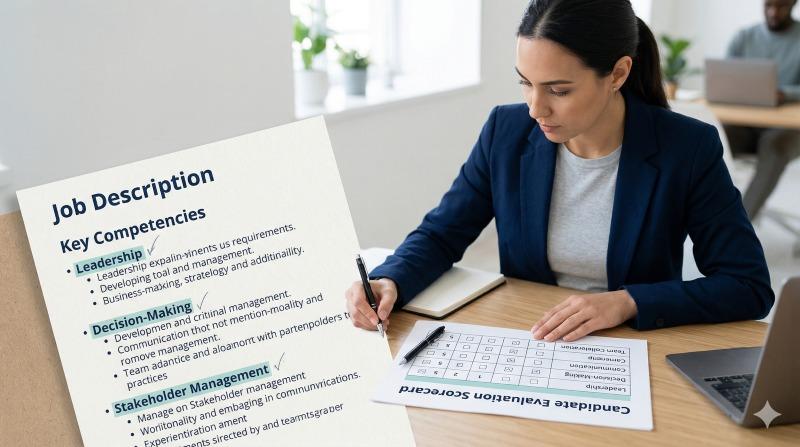
People leadership (coaching, feedback, underperformance)
This is where most new managers fail. Not because they are “bad people,” but because they avoid discomfort, delay feedback, and confuse being liked with leading.
What you are really testing:
- Can they set clear expectations early?
- Can they give direct feedback without drama?
- Can they manage a personnel situation without punting it to HR?
- Can they support team member growth and the team’s professional development, including using individual application access for each employee’s insights?
If you use OAD here, the value is in spotting patterns like avoidance, overly high harmony-seeking, or low assertiveness under stress, then asking targeted follow-ups to confirm how that plays out in real work.
Execution (priorities, delegation, accountability)
A manager’s job is not to do everything. It is to get the right work done through the team, consistently.
What you are really testing:
- How they establish priorities when everything is urgent
- Whether they can delegate tasks with clarity, not vague handoffs
- How they track progress without micromanaging
- Whether they can build systems that survive beyond their personal heroics
This is where “project management” skills matter even outside formal project roles. Execution is a repeatable process, not a personality trait.

Decision making (trade-offs, risk, judgment)
Strong managers can explain their thought process. Weak managers defend outcomes and skip the reasoning.
What you are really testing:
- Do they define the decision clearly, including constraints?
- Do they seek input from the right people, not the loudest people?
- Do they handle uncertainty without freezing or gambling?
- Can they own consequences without blaming “the business” or “leadership”?
A tough decision example should reveal how they balance speed, quality, people impact, and risk.
Conflict management (tension, mediation, directness)
Conflict does not disappear because you hire “culture fit.” It just goes quiet and expensive.
What you are really testing:
- Can they address tension early, before it becomes personal?
- Can they give difficult news without escalating emotions?
- Can they mediate interpersonal disputes without playing referee forever?
- Can they protect standards while staying fair?
This is closely tied to emotional regulation and clarity. You do not need therapy language. You need observable behavior: what they said, what they did, and what changed.
Culture and values (fit vs add)
Culture “fit” is often a polite way to hire the most similar person in the room. That gets you harmony and stagnation, instead of using behavioral interview questions to assess culture fit and culture add.
What you are really testing:
- Do they align with company values in behavior, not slogans?
- Do they strengthen the work environment, especially under stress?
- Can they lead a diverse group without defaulting to one style for everyone?
- Will they raise standards without turning into a compliance cop?
If OAD includes a culture-fit report or values alignment view, use it to create better questions, not to outsource judgment.

Behavioral Questions That Actually Predict Performance (“Tell Me About a Time”)
Behavioral interviewing works because it forces candidates to talk about real constraints, real trade-offs, and real consequences. It also reduces the “I would” answers that sound smart but prove nothing.
The mistake is letting behavioral questions become open-ended storytelling competitions.
How to use STAR without letting candidates ramble
STAR is useful when it stays tight:
- Situation: What was happening, and what were the stakes?
- Task: What responsibility did you own?
- Action: What did you do, specifically?
- Result: What changed, and how do you know?
Keep control with constraints:
- Ask for a single example from their past experience, not a “pattern.”
- Time-box the first answer: 2–3 minutes.
- Interrupt politely if they float: “What did you do next?” or “What was your decision in that moment?”
If a candidate cannot land a specific example, that is not a communication style quirk. It is often a signal that they did not own the work at the level the role needs.
Scoring criteria for “about a time” answers (signals + red flags)
Use a simple 1–5 scale per answer, anchored to evidence.
Strong signals (4–5):
- Clear ownership: “I decided,” “I changed,” “I coached,” not “we kind of”
- Specific actions and sequencing, not general principles
- Measurable outcomes when reasonable (time saved, attrition reduced, cycle time improved)
- Balanced accountability: owns mistakes without self-punishment or excuses
- Learning loop: shows how they improved their preferred method over time
Red flags (1–2):
- Vague narratives with no decisions, no constraints, no outcomes
- Blame-heavy framing: “They were incompetent,” “Leadership blocked me”
- Hero stories where the team is passive and they “saved everything”
- Avoidance disguised as kindness: delayed feedback, unresolved conflict
- No evidence of coaching or developing team member capability

8 high-yield “about a time” prompts
These are designed to surface management skills that matter across industries, including promotions into a new manager role.
- Underperformance
“Tell me about a time a direct report was underperforming. What did you do in the first two weeks?” - Team conflict
“Tell me about a time two team members were in conflict. How did you handle conflict, and what changed afterward?” - Difficult conversations
“Tell me about a time you had to deliver difficult news to your team. What did you say, and how did you handle reactions?” - Delegation under pressure
“Tell me about a time you had too much on your plate and had to successfully delegated tasks. How did you decide what to delegate?” - A tough decision
“Tell me about a tough decision you made with incomplete information. What was your thought process?” - Priorities shifting
“Tell me about a time priorities changed mid-project. How did you reset expectations and keep execution moving?” - Developing someone
“Tell me about a time you coached someone who was struggling but had potential. What did you change in how you provided support?” - Leading change
“Tell me about a time you introduced a new process or standard that people resisted. How did you get adoption without forcing it?”
Interview Questions for Managers by Theme (Curated Set)
This is the part everyone turns into a 70-question dump because restraint is painful. Don’t. You want a tight set that covers the hiring process and still leaves time for follow-ups.
Use 2–3 themes for a first-round management interview. Use the remaining themes for later rounds or panel interviews. Keep the interview process consistent across candidates while deliberately assessing communication skills in the interview.
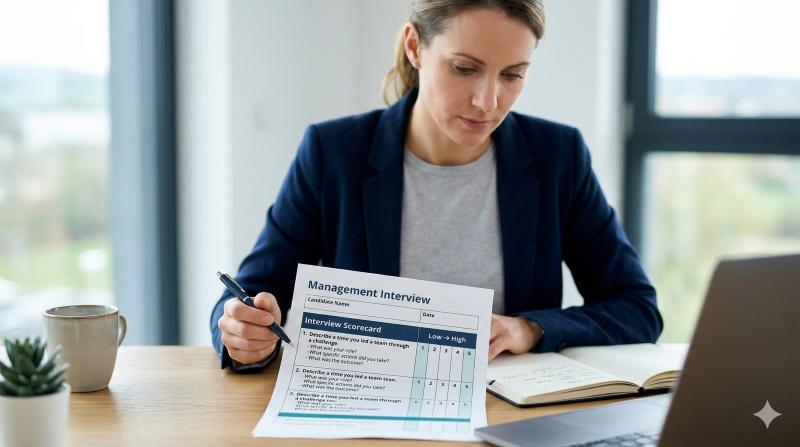
Management style and leadership style
Use these to understand how the candidate leads day-to-day, not their philosophy-of-leadership speech.
Questions
- “How would your direct reports describe your management style?”
- “What do you do in the first 30 days when you join an existing team?”
- “What expectations do you set for your team member communication and availability?”
- “How do you balance autonomy and accountability?”
- “What does ‘high performance’ mean to you in a manager position?”
- “What is a leadership style you used in a previous role that you would not use again?”
Follow-ups that force evidence
- “Give me an example from your previous position where you changed your approach.”
- “What did you track weekly to know your team was healthy and performing?”
Direct reports, coaching, and performance reviews
These questions surface whether the candidate can build capability, not just demand output.
Questions
- “How do you run 1:1s, and what do you document?”
- “Tell me about a time you gave feedback that was hard to hear. What was the outcome?”
- “How do you handle a team member who is consistently late or misses deadlines?”
- “What is your approach to professional development for your team’s professional development?”
- “How do you calibrate performance reviews so they stay fair across a diverse group?”
- “When do you involve human resources, and when do you handle it directly?”
Follow-ups
- “What did you say in the moment? Use your actual words.”
- “What changed in behavior, not attitude?”
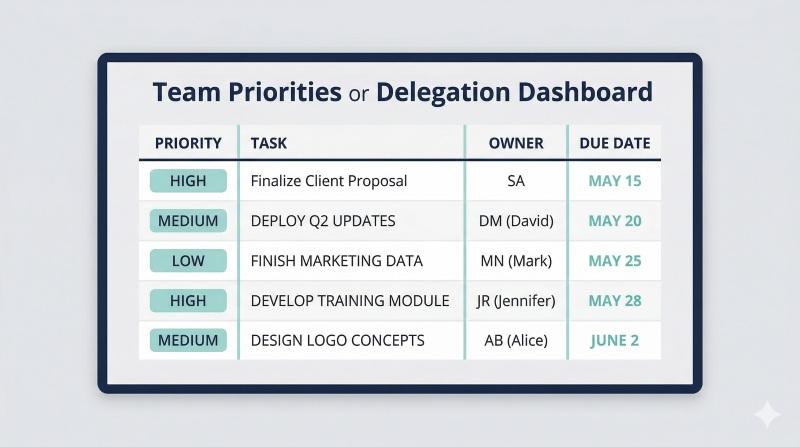
Establish priorities and successfully delegated tasks
Delegation is where weak managers become bottlenecks and strong managers become multipliers.
Questions
- “How do you establish priorities when senior management gives conflicting inputs?”
- “Tell me about a time you had to delegate work you normally would have done yourself.”
- “How do you assign work so ownership is clear and follow-up is predictable?”
- “What do you do when a delegated task is going off-track?”
- “What is your preferred method for tracking work: meetings, dashboards, written updates, or something else?”
- “Describe a time you had to cut scope or say no. How did you communicate it?”
Follow-ups
- “What did you keep, what did you cut, and why?”
- “How did you confirm the person understood expectations?”
Tough decision and thought process
You are testing judgment under pressure, not perfect outcomes.
Questions
- “Walk me through a tough decision you made recently. What options did you consider?”
- “Who did you consult, and why those people?”
- “How do you assess risk when the data is incomplete?”
- “Tell me about a time your decision was wrong. What did you do next?”
- “How do you balance speed vs accuracy in decision making?”
- “Describe a time you had to choose between hitting a goal and protecting team well being.”
Follow-ups
- “What trade-off did you accept consciously?”
- “What did you learn that changed how you make decisions now?”
Handle conflict and conflict resolution
These questions reveal whether the candidate can face tension, not avoid it.
Questions
- “Tell me about a conflict with a peer or stakeholder. How did you resolve it?”
- “How do you handle conflict between two direct reports when both think they are right?”
- “Describe a personnel situation where emotions were high. What did you do first?”
- “When someone pushes back on feedback, what do you do in the moment?”
- “How do you set clear expectations for respectful disagreement on your team?”
- “Tell me about a time you had to deliver difficult conversations to protect standards.”
Follow-ups
- “What did you say verbatim in the first conversation?”
- “What did you do to prevent the same conflict from repeating?”
Company culture, company values, and culture add
Keep this section evidence-based. If it turns into “do I like them,” it’s useless.
Questions
- “Which company values do you find easiest to model? Which are hardest?”
- “Tell me about a time you protected culture under pressure, even when it cost you speed.”
- “Describe a time you joined a team with an existing culture you did not like. What did you change, and what did you leave alone?”
- “How do you build psychological safety without lowering standards?”
- “What does culture add mean to you in a hiring manager context?”
- “How do you make sure your leadership does not unintentionally exclude a diverse group?”
Follow-ups
- “What behavior did you reward, and what behavior did you correct?”
- “What did you change in the work environment that people could actually feel?”
How to Spot Red Flags Without Vibe-Based Hiring
Red flags are rarely single answers. They are patterns across answers. The goal is to detect risk early, then test it with follow-ups.

Patterns that show up across answers
Watch for these repeated signals:
- Low ownership: The candidate describes problems but not decisions.
- Chronic blame: Every failure is someone else, every success is self.
- Vague leadership: They talk about “empowering people” with no examples.
- Avoidance: Underperformance, conflict, and feedback get delayed or outsourced.
- Ego-first framing: The team is background. They are always the hero.
- No calibration: They cannot explain what “good” looks like in measurable or observable terms.
One bad story does not disqualify someone. A consistent pattern usually should.
Follow-up prompts that force evidence
Use short prompts that remove escape routes:
- “What did you do in the first 48 hours?”
- “What did you say, exactly?”
- “What changed, and how do you know?”
- “What would your team say you got wrong?”
- “If I asked your last hiring manager, what would they warn me about?”
- “What was the measurable outcome?”
If you’re using OAD, this is where it shines. Behavioral data can highlight tendencies (for example, risk tolerance, assertiveness, detail orientation). Your job is to test whether those tendencies match the management role and the team’s needs, not to label them as “good” or “bad.”
Interview Design: Structure, Timing, and Scoring
A manager interview should feel simple to run and hard to fake. That only happens when you design it like an evaluation, not a conversation.
This section gives you a lightweight structure you can apply globally, with hiring-manager-friendly language and minimal bureaucracy.
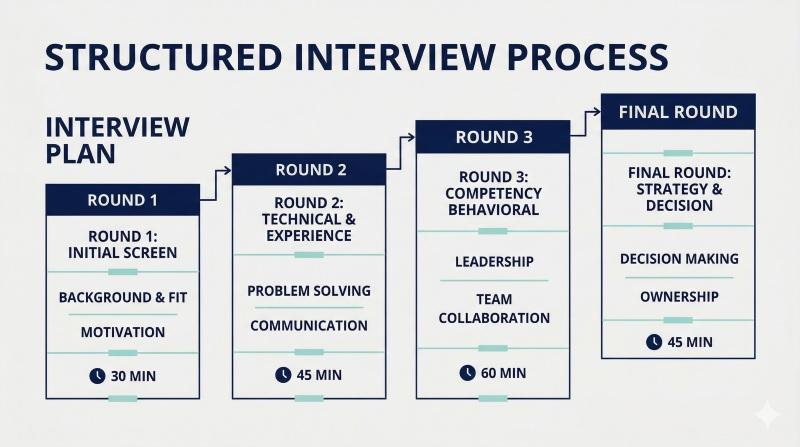
Simple scorecard template (competencies + weights)
Start with 4–6 competencies and weight them based on the role. Example weights for a typical people manager role:
- People leadership: 25%
- Execution and delegation: 25%
- Decision making: 20%
- Conflict management: 15%
- Culture and values: 15%
If you are hiring for a turnaround or high-change environment, increase execution and decision making. If you are inheriting a fragile team, increase people leadership and conflict management; founders and CEOs making these calls benefit from a system for long-term leadership fit.
Score each competency separately using a 1–5 scale:
- 1 = clear risk (weak evidence, red flags, no ownership)
- 3 = acceptable (some evidence, limited depth, inconsistent)
- 5 = strong (specific examples, clear judgment, repeatable approach)
Add one line that forces discipline:
Evidence notes: “What did they do?” “What changed?” “What proof did they give?”
No adjectives. No “seems confident.” Treat it like a case file.
Timing per question (avoid the “we ran out of time” failure)
A clean structure for a 45–60 minute interview:
- 5 minutes: role context and expectations (from the interviewer, not the candidate)
- 30–40 minutes: questions (behavioral + scenario), with follow-ups
- 5–10 minutes: candidate questions
- 2 minutes: close and next steps
Timing rule that protects quality:
Ask fewer questions, follow up harder.
For most management interviews, you want:
- 6–8 core questions total
- 1–2 follow-ups per question
- At least 2 “about a time” prompts
If the candidate is long-winded, cut politely: “I’m going to pause you. What was your decision in that moment?”

Sample interviewer notes that stay factual
Bad notes are impressions. Good notes are observable actions.
Weak notes
- “Good communicator”
- “Seems like a team leader”
- “Nice personality”
- “Strong leadership style”
Useful notes
- “Underperformance example: set 2-week plan, documented expectations, weekly check-ins, escalated only after missed milestones.”
- “Delegation example: defined owner, success metric, checkpoint schedule. Corrected scope creep early.”
- “Conflict example: addressed directly within 24 hours, used shared goals, set behavior boundaries.”
If your team uses OAD, add a small prompt at the bottom of the scorecard:
Behavioral data follow-up: “Which trait pattern might create risk in this role, and what question will confirm it?”
Using OAD to Improve Role Fit and Team Alignment
Interviews measure what candidates can explain. Behavioral tools help you see what candidates tend to do, especially when the situation is messy.
That’s the gap OAD helps close.
Use OAD to improve two things:
- Role fit: whether the person’s natural patterns align with the management role
- Team alignment: how their style will land with the existing team
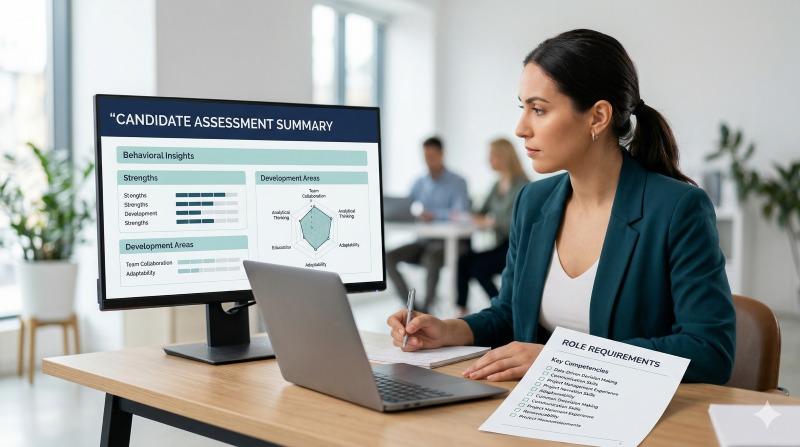
Map candidate motivators to the management role
Manager roles come with built-in friction: competing priorities, emotional labor, accountability, and ambiguity, which makes it critical to understand motivation insights and what truly drives your hires.
A candidate can have strong management skills but still be a poor fit if the role constantly clashes with their motivators. That mismatch often looks like burnout, avoidance, micromanagement, or unnecessary conflict.
Practical application:
- Clarify the top stressors in the job description (pace, change, autonomy, stakeholder load).
- Use OAD results to spot likely pressure points.
- Ask targeted questions that test behavior under those stressors.
Example follow-up prompts:
- “When priorities shift weekly, what system keeps you steady?”
- “When a stakeholder pushes you hard, how do you respond without escalating?”
- “When you don’t have full authority, how do you still get results?”
Design teams with data, not gut feel.
Most org-design decisions come down to role fit, leadership style, and team dynamics. OAD reads those signals from a 7-minute behavioral survey, so you can reconfigure roles and teams with evidence instead of guesswork.
Use OAD data to sharpen follow-ups (not to replace the interview)
The correct workflow is:
Interview first. OAD sharpens follow-ups.
If the interview suggests a pattern (avoidance, rigidity, impulsiveness, low accountability), OAD can help you test whether it is situational or consistent.
If OAD flags a pattern (for example, strong independence or low patience), the interview is where you confirm how that plays out with direct reports and cross-functional work, ideally informed by a fast, validated OAD Survey tool that reveals fit before the interview.
This protects you from two common errors, and it also mirrors how coaches use behavioral data to improve leadership coaching:
- Over-trusting the interview: hiring the best storyteller
- Over-trusting the assessment: forgetting context and growth
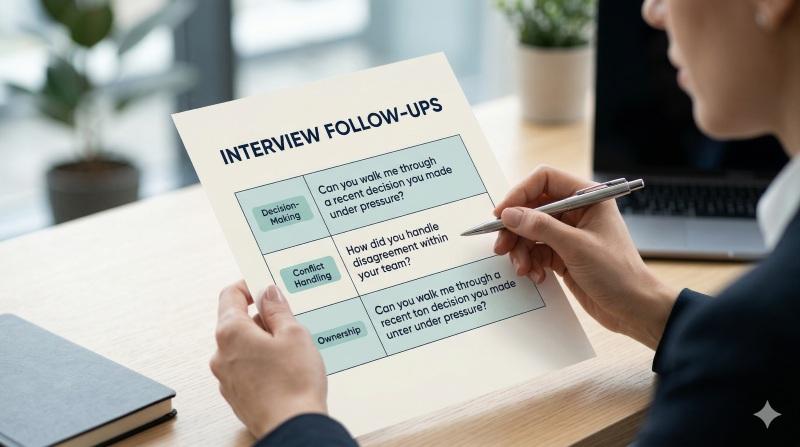
Team alignment: how a manager’s profile affects the existing team
Managers don’t operate in isolation. They amplify or destabilize the team they inherit.
Team alignment questions to ask internally before you hire:
- What does the existing team need more of: clarity, speed, support, structure, autonomy?
- What are the current failure points: conflict avoidance, unclear priorities, weak accountability?
- What management style has worked here, and what has failed?
Then, test the candidate against that reality, keeping an eye on patterns that may trigger risk alerts for turnover and team fit issues:
- “Tell me about a time you inherited an existing team with low trust. What did you do first?”
- “Tell me about a time your leadership style did not work with a team. What did you change?”
Design teams with data, not gut feel.
Most org-design decisions come down to role fit, leadership style, and team dynamics. OAD reads those signals from a 7-minute behavioral survey, so you can reconfigure roles and teams with evidence instead of guesswork.
This is where OAD can help you avoid repeating mismatches, especially when you are hiring a new manager into a fragile work environment, similar to how behavioral insight reduces post-acquisition risk in PE hiring strategy and team fit.
FAQ: Interview Questions for Managers
Place this section near the end so it serves search intent and can be used for FAQ schema later.
What are the best interview questions for managers?
The best interview questions for managers force specific examples about delegation, feedback, decision making, and conflict management, then score the answers against clear criteria. Prioritize “about a time” questions and follow-ups that require evidence.
What are good behavioral interview questions for managers?
Good behavioral questions ask for one specific situation and what the candidate did. Examples include handling underperformance, resolving team conflict, delivering difficult news, and making a tough decision with incomplete information.
How do you interview a first-time manager?
For a first-time manager, focus on how they influence without authority, how they give feedback, how they handle accountability, and how they plan to support team member growth. Use promotion-focused prompts like: “Tell me about a time you coached a peer” and “How do you set clear expectations when you are not the boss yet?”
How do you evaluate management style in an interview?
Ask how their direct reports would describe them, then require examples that show how they run 1:1s, delegate tasks, handle conflict, and manage performance reviews. Score what they did, not how confident they sound.
What are red flags in a management interview?
Common red flags include vague answers, blame-heavy stories, avoidance of difficult conversations, and “hero” narratives where the team has no ownership. Red flags are patterns across answers, not one awkward moment.
How many interview questions should you ask for a manager position?
In a 45–60 minute interview, aim for 6–8 core questions with 1–2 strong follow-ups each. Fewer questions with deeper probing produces better signal than rushing through a long list.
Conclusion: Make the Interview Predictive, Not Performative
Manager interviews fail when they reward confidence over competence. A structured interview fixes that by creating comparable evidence across candidates, anchored to the real demands of the management role.
Use a curated set of interview questions for managers, score against defined competencies, and validate claims with follow-ups that force specifics. If you add behavioral data, use it to sharpen your evaluation, not to outsource judgment.
If you want to see how OAD performs on your own roles and candidates, start with the free Top Performer Profile: 7 minutes, results in 24 hours, no credit card.