Hiring the wrong person isn’t just inconvenient it’s expensive. Research shows a bad hire can cost up to 30% of the employee’s annual salary, not to mention lost productivity and team morale. If your interview process relies on gut instinct and generic questions, it’s timeto fix that.
How to Interview Someone for a Job: Why Interviews Fail and What Great Interviewers Do Differently
Most job interviews fail before they even begin — not because of the candidate, but because of the interviewer. Many hiring managers rely on gut instinct, ask vague questions, or make decisions based on surface impressions in the first five minutes.
Organizations benefit greatly from conducting interviews using a structured process, as it helps ensure the right candidates are selected and aligns hiring with organizational values and goals. Poor interviewing can negatively impact organizations by leading to costly mis-hires and disrupting team compatibility.
Here’s the problem: gut instinct isn’t a strategy. Without a structured process, interviewers often miss critical red flags or, worse, overlook great candidates who don’t “perform” well under pressure.
On the other hand, great interviewers approach hiring like a business decision. They ask the right questions, observe behavior beyond the answers, and align the interview with the actual demands of the role. And they use data — not guesswork — to evaluate fit.
Elon Musk, for example, is known for asking candidates to explain exactly how they solved tough problems in previous roles. His goal? To identify genuine thinkers, not rehearsed storytellers.
The takeaway: interviewing is a skill. And like any skill, it can be trained, structured, and improved with the right tools.

Step 1 – Clarify What You’re Actually Hiring For
Before you can spot the right person, you need to know exactly what you’re looking for — and we’re not just talking about a job title and some bullet points. Clearly defining the qualities, skills, and attributes of the ideal candidate for the open position is essential to guide your recruitment process.
- What are the must-have skills and experience?
- What soft skills or personality traits will help someone thrive in this role?
- What does success look like in the first 3, 6, or 12 months?
Before starting the interview process, take time to research and understand the characteristics and qualifications of potential candidates to ensure they align with the job requirements.
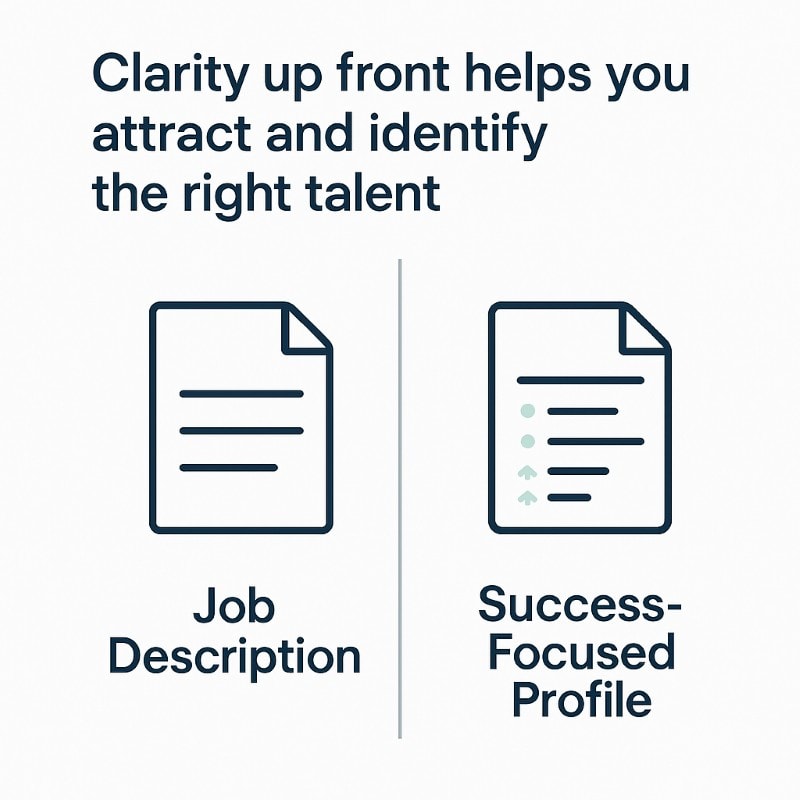
Define the Role Beyond the Job Description
Most job descriptions are vague laundry lists of skills. But high-performing employees don’t succeed because they checked every box — they succeed because their behavior matches the real demands of the job.
Start by defining:
- What outcomes this role must deliver in 3, 6, and 12 months
- What behavioral traits lead to success (e.g., detail-oriented vs. big-picture thinking)
- What challenges this person will face daily
Ensure these outcomes and success traits are aligned with the company’s goals and strategic objectives.
OAD’s behavioral assessment helps map these success traits in advance. For example, if the role demands consistent follow-through and autonomous decision-making, OAD identifies whether a candidate naturally thrives in that environment — before you ever schedule an interview.
Identify Cultural and Team Fit Requirements
Beyond individual performance, how will this person mesh with the team? It’s important to consider the work environment, as it greatly influences both team fit and candidate success.
If you have a collaborative, high-communication environment, a quiet individual contributor who prefers solo work might not thrive — even if they’re technically qualified. Culture mismatch is one of the biggest drivers of early turnover.
Howard Schultz, former CEO of Starbucks, built the company by hiring for values as much as skills. His philosophy: hire people who genuinely care about customers, team experience, and doing the right thing — even when no one’s watching.
Using OAD to identify team dynamics and compare candidates helps you avoid hiring someone who’s excellent on paper but a poor fit in practice.
Step 2 – Structure the Interview Process
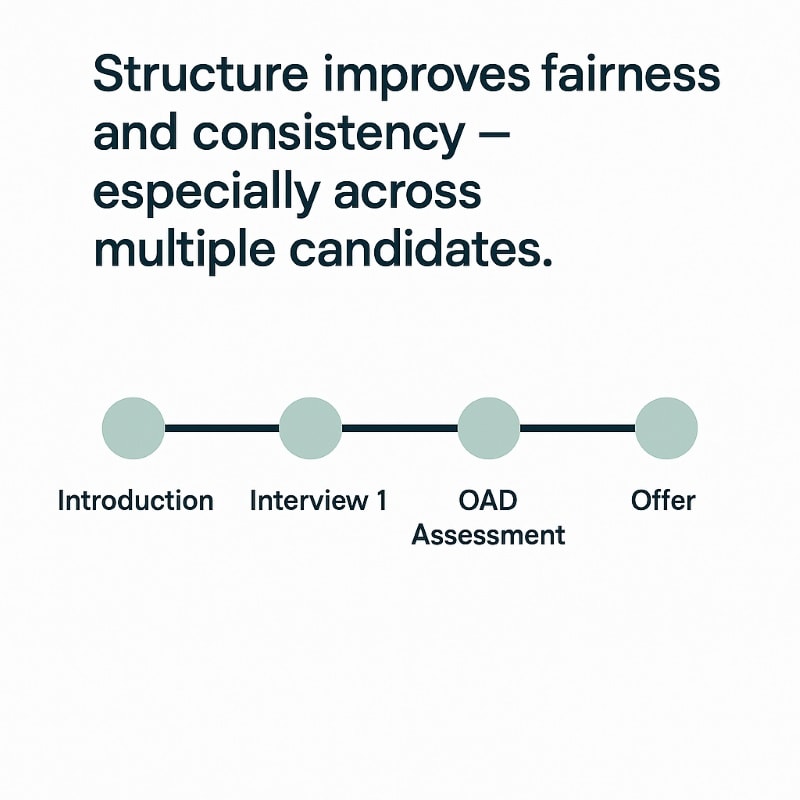
Even great questions fall flat if your interview process is disorganized. Conducting interviews in a structured and consistent manner is essential to improve hiring outcomes. A structured approach not only improves candidate experience — it also reduces bias and leads to better decisions.
Single vs. Multiple Interviews
Not every role requires a five-stage gauntlet, but the structure should match the complexity of the position. Some complex roles may require numerous interviews to thoroughly assess candidates and ensure the best fit.
For entry-level roles, a single well-structured conversation may suffice. For leadership positions, it’s smart to split the process:
- Intro Call: Screening for basics and communication style
- Skills Deep Dive: Role-specific technical or problem-solving focus
- Behavioral Interview: Assess fit, past decisions, leadership style
- Team Fit Panel (if applicable): Evaluate how the candidate interacts with potential colleagues
This progression helps you uncover patterns, not just isolated answers. And when each stage has a clear purpose, candidates feel more respected — and more engaged.
Prepare a Clear Rating System
Here’s where most companies go wrong: they rely on unstructured notes and gut debriefs after interviews.
Instead, use a standardized rating system for each key trait or question category. For example:
- Communication Skills: 1–5
- Problem-Solving: 1–5
- Cultural Fit: 1–5
With OAD’s two-page behavioral survey, you get a fast, objective data point that helps you compare candidates not just on how they interview — but how they’ll actually behave on the job.
A structured scoring system also encourages more honest team discussions and removes personal bias from the final decision.
Minimize Bias and Ensure Fairness
Minimizing bias in the interview process isn’t just a compliance issue — it’s a performance strategy.
Even seasoned hiring managers are susceptible to unconscious bias. Whether it’s favoring candidates who mirror your own background or placing too much weight on charisma, bias can cloud judgment and cause you to overlook great talent.
The solution? Structure and consistency.
By asking every candidate the same strategic questions — and evaluating them against clear, predefined criteria — you level the playing field and make better decisions. Tools like OAD’s behavioral assessment add another layer of objectivity, helping you focus on actual fit rather than first impressions.
Fair hiring isn’t just the right thing to do — it leads to stronger teams and smarter decisions.
Recognize and Counteract Common Interviewer Biases
Every interviewer walks into the room with personal filters — shaped by experience, expectations, and unconscious preferences. Left unchecked, those filters can derail even the most objective hiring process.
Take the halo effect: a single impressive trait — like confidence or a polished resume — creates a glow that overshadows other flaws. Or the horns effect, where one awkward answer early on taints your perception of everything that follows.
These biases are human — but they’re also avoidable.
Anchor your evaluation in job-relevant criteria. Ask yourself:
“Is this candidate demonstrating the specific traits and skills this role actually demands?”
Stick to a structured interview plan. Take notes tied to clear examples, not vague impressions. Use behavioral benchmarks and rating systems — like those found in OAD’s framework — to stay focused on actual fit, not instinct.
Because at the end of the day, the goal isn’t just to find someone likable — it’s to find someone capable.
Standardize Evaluation for Consistency
If you want consistent hiring outcomes, you need a consistent process.
Structured interviews — where every candidate is asked the same set of role-relevant questions and evaluated using a clear rating system — are one of the most effective ways to reduce bias and improve decision quality.
When everyone on the interview panel scores candidates using the same behavioral criteria, comparison becomes clearer — and more objective. Instead of relying on gut feelings or vague impressions, you’re using structured data tied directly to job success.
This is exactly why tools like OAD’s interview framework and behavioral assessments are so valuable. They create a common language across hiring teams and help shift evaluations from subjective opinion to evidence-based insight.
The result? Fairer interviews. Smarter decisions. And a much higher chance of hiring the right person — the first time.
Step 3 – Ask Strategic, Behavior-Based Questions
Interviewing isn’t about catching candidates off guard — it’s about surfacing the information that predicts how they’ll actually perform. Good interview questions are essential for uncovering a candidate’s true abilities and fit for the role.
Go Beyond the Resume
Most candidates can explain what they’ve done. The real question is how they did it.
Behavioral questions dig into decision-making, stress response, initiative, and real-world outcomes. These questions help assess a candidate’s ability to demonstrate relevant skills and adapt to challenges. Instead of asking “What would you do if…?”, ask “Tell me about a time when you…”
This subtle shift leads to specific stories that reveal a candidate’s thinking, resilience, and leadership patterns.
The STAR method — Situation, Task, Action, Result — is a useful framework. But with OAD, you can go further. You’ll know in advance whether the role requires assertiveness, collaboration, structure, or flexibility — and tailor your questions accordingly.
5 Categories of Questions to Include
- Situational Questions & Problem-SolvingSituational questions are a key category for evaluating a candidate’s problem-solving skills and adaptability. For example: “Tell me about a time you faced an unexpected challenge. What did you do?”
- Role-Specific & Technical“Walk me through a project where you used [core skill]. What was your role and the result?”
- Team Dynamics & Communication“How do you typically resolve conflict on a team? Give me a real example.”
- Adaptability & Learning“Describe a time you had to learn something quickly for your job. How did you approach it?”
- Self-Awareness & Reflection“What feedback have you received that surprised you — and how did you respond?”
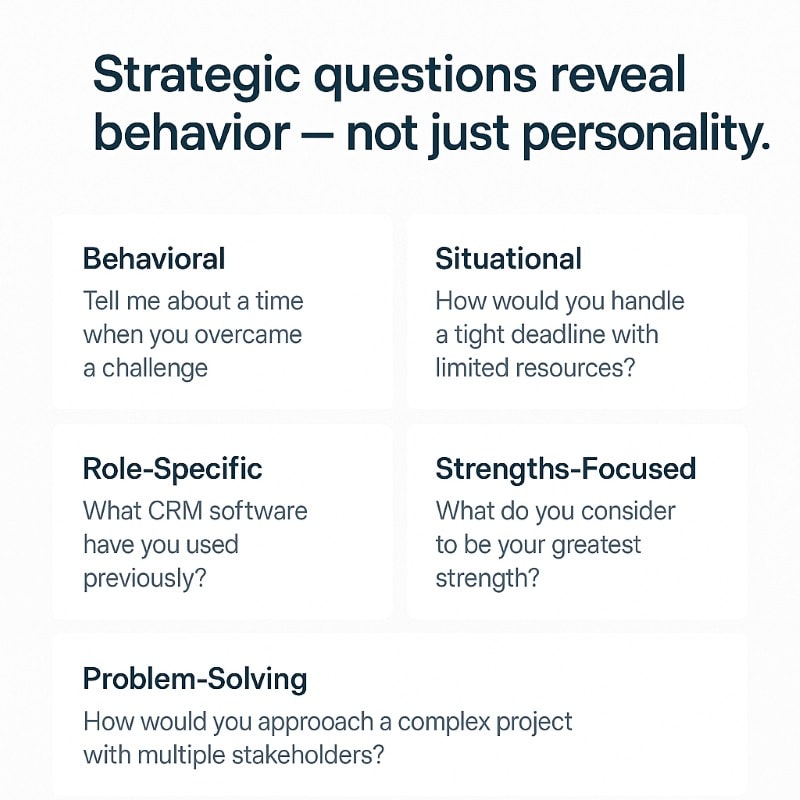
Hiring managers who ask these types of questions consistently get more valuable, honest insights. And candidates who genuinely fit the role will often light up when they get to talk about real challenges they’ve tackled — not just memorized interview answers.
Build Rapport and Handle Difficult Questions
Great interviews aren’t interrogations — they’re conversations.
When candidates feel psychologically safe, they share more honestly, think more clearly, and show you who they really are. That’s why building rapport isn’t just polite — it’s strategic.
Start by setting the tone: be present, explain the structure of the interview, and show genuine interest in the candidate’s experience. When difficult or sensitive topics arise — like gaps in employment or team conflicts — approach them with professionalism, curiosity, and respect.
The goal is to uncover the truth, not catch someone off guard.
A thoughtful, human interview experience reflects well on your company and helps you evaluate the person behind the resume — which is ultimately what leads to the best hiring decisions.
Techniques for Building Genuine Connection
Connection isn’t about small talk — it’s about presence.
Start every interview by showing genuine interest in the candidate’s story. Open-ended questions like “What drew you to this field?” or “What’s been the most rewarding project in your career so far?” invite authentic responses and immediately shift the tone from transactional to conversational.
As candidates speak, demonstrate active listening. Make eye contact, nod in acknowledgment, and take brief notes without breaking rapport. These nonverbal cues show respect — and signal that you’re truly engaged.
When a candidate shares an experience, go deeper. If they mention leading a project, ask:
“What challenges came up — and how did you lead through them?”
This kind of follow-up shows you’re not just checking boxes — you’re trying to understand how they think and operate.
Even small adjustments, like matching the candidate’s communication pace or mirroring body language, can foster a sense of mutual trust. And in that space, candidates offer richer insights — the kind that surface real fit and future potential.
Step 4 – Observe More Than Words
What candidates say is important — but how they say it can tell you just as much. Observing facial expressions can provide additional insight into a candidate’s confidence and engagement.
The First Few Minutes Matter
Within moments of walking into the room (or logging into the call), candidates are already giving you data:
- Are they making eye contact?
- Do they seem prepared or disoriented?
- Is their energy aligned with your company culture?
These first impressions shouldn’t determine the outcome — but they do provide valuable context.
Body language, posture, and tone often reflect how someone handles pressure, uncertainty, or new environments. Watch how they settle in, how they react to curveball questions, and how they respond when they don’t know something.
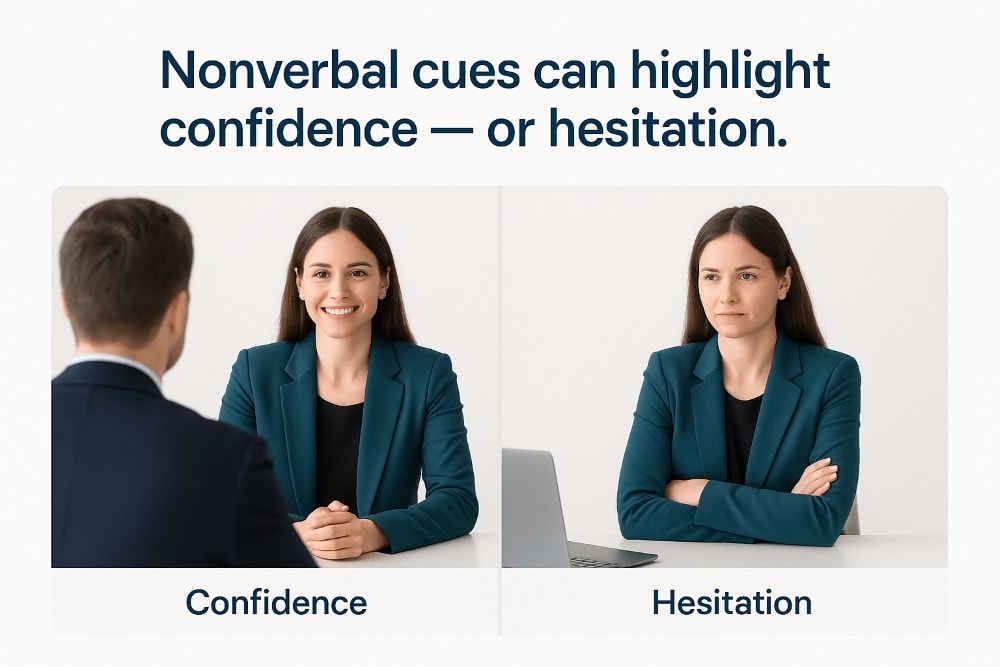
Active Listening = Better Insights
The best interviewers don’t just ask great questions — they listen deeply to the answers.
- Take light notes so you can maintain eye contact.
- Let silence do some of the heavy lifting — candidates often fill the gaps with their real thoughts.
- Pay attention to contradictions or overused clichés.
Jeff Bezos is known for being quiet in meetings — not because he lacks opinions, but because he’s listening for what others miss. In interviews, that same calm presence can give candidates room to show who they really are.
By listening intently and watching the signals behind the words, you’ll learn far more than any checklist can reveal. Active listening leads to a better understanding of the candidate’s motivations and fit for the role.
Step 5 – Sell the Opportunity (Without Overselling It)
Top candidates don’t just want a job — they want a clear picture of what they’re signing up for. If you want to attract the best, you have to sell the opportunity with authenticity. As an employer, presenting the role honestly and transparently helps ensure you attract candidates who are the right fit for your team and organization.
Be Transparent About the Role and Environment
Don’t sugarcoat the job. Instead, give candidates a realistic preview — the challenges, the learning curve, and what success actually looks like in the first 90 days. Clearly communicate what candidates can expect in terms of responsibilities, work environment, and growth opportunities.
This builds trust. It also filters out candidates who want the fantasy version of the job, not the real one.
Frame the role within the larger goals of the company. Show how their work will contribute to something meaningful. People don’t just want to clock in — they want to make an impact.
Showcase Career Growth and Development
Talk about the growth trajectory — not just promotions, but skill-building, mentoring, visibility, and recognition. Discussing professional development opportunities as part of the company’s commitment to employee growth shows candidates that you invest in their long-term success.
Candidates will often choose one offer over another simply because they can see a future with the company.
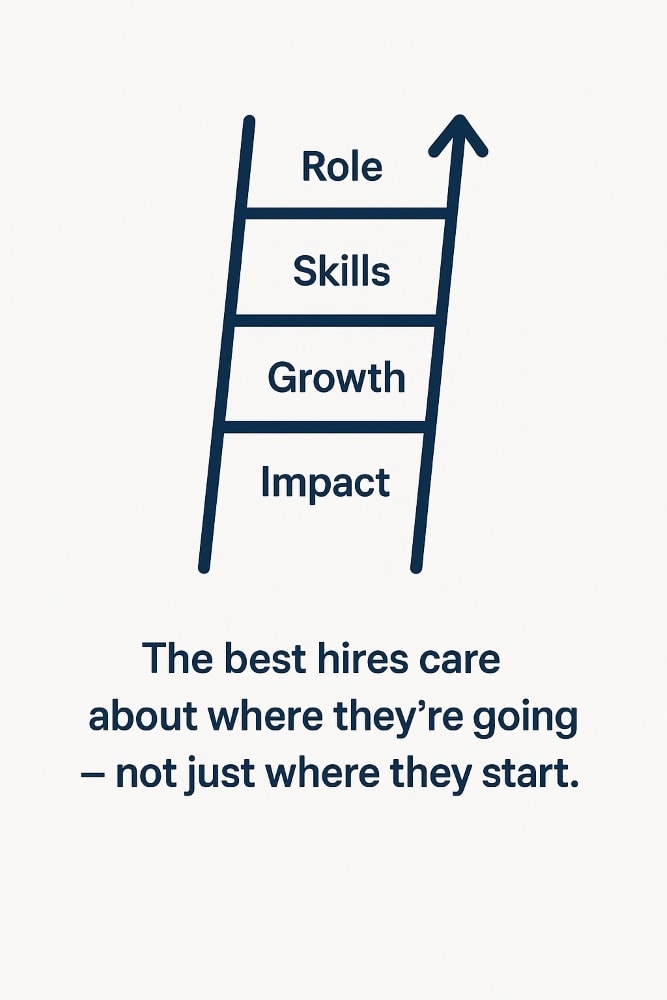
Give examples of current employees who grew into leadership roles. Share how you invest in development. This turns your interview from an evaluation into a compelling invitation.
And most importantly: back it all up with honesty. Overpromising leads to early turnover. Understating the value of the role leads to losing great talent. Find the honest edge — and own it.
Step 6 – Get Input from the Team
You’re not hiring in a vacuum. Bringing the team into the process helps uncover insights you might miss — and ensures everyone’s aligned before you make the offer. Team input is also valuable for evaluating and differentiating between other candidates, helping to ensure the best fit is selected.
Peer Interviews Can Reveal Hidden Red Flags
Letting a candidate meet with a future teammate (or a small panel) adds depth to your evaluation.
- Do they communicate respectfully?
- Can they hold their own without dominating the room?
- How do they react to different personalities?
Sometimes, candidates act differently when the “boss” isn’t in the room — and that version might be more revealing.
Peer interviews also give candidates a better sense of the team culture they’d be joining. It’s a two-way fit. Additionally, peer interviews can provide valuable perspectives on whether the candidate is a strong potential hire, helping to assess their alignment with company values and team dynamics.
Align on Evaluation Before the Offer
Once interviews are complete, bring your team together to compare notes.
This is where a structured rating system (introduced in Step 2) becomes crucial. Instead of vague impressions, you’re discussing concrete scores, patterns, and red flags.
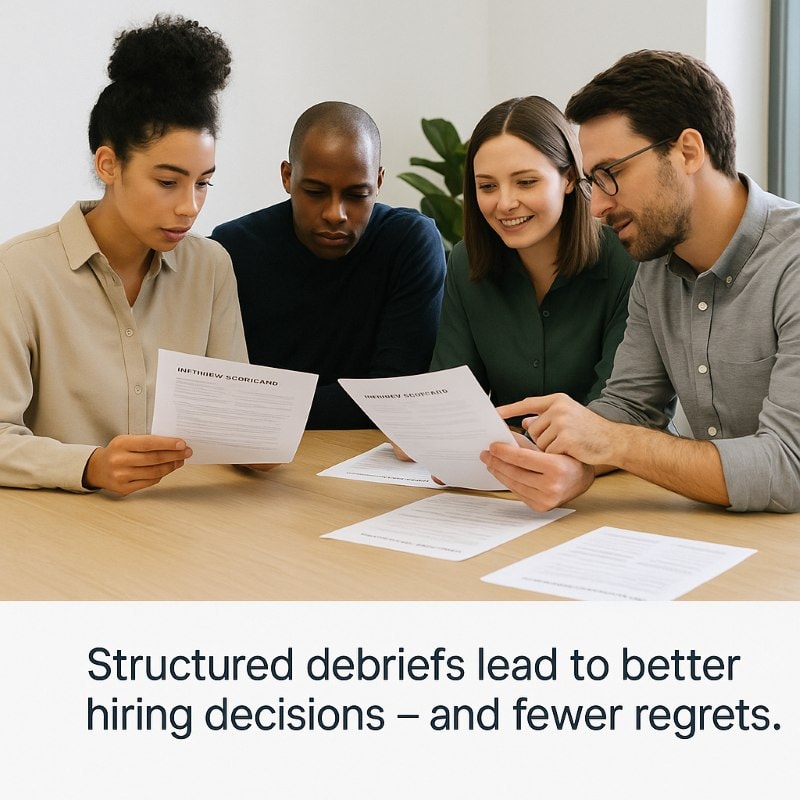
OAD’s assessment provides a shared language to discuss candidate traits objectively. It also highlights where someone might be a stretch fit — and whether that stretch is worth the risk.
Alignment now saves you from tension later. When the whole team feels confident that the right person has been hired, onboarding and performance ramp faster — and everyone wins.
Step 7 – Close the Loop With Confidence
The interview process isn’t finished until every candidate knows where they stand — especially the one you’re hiring. It’s important to communicate with everyone who was interviewed, not just the selected candidate, to ensure transparency and professionalism.
Make a Decision — And Act Fast
Good candidates don’t wait around. If you’ve found someone who fits the role and the team, don’t let bureaucracy or indecision slow you down.
Making quick decisions after the job interview demonstrates professionalism and respect for candidates’ time. Quick decisions show professionalism and keep your company competitive in the talent market. In fact, according to LinkedIn, top candidates are off the market within 10 days — yet most companies take 3–4 weeks to make an offer.
Move faster. Or lose them.
Communicate With All Candidates
The way you handle rejections says a lot about your company. Silence burns bridges. A short, respectful email builds your reputation — and keeps the door open for future roles.
If a finalist didn’t make the cut, consider offering brief feedback or encouragement. Share words of hope to reassure them about their prospects and encourage resilience in their job search. That transparency is rare — and memorable.
For your chosen candidate, go beyond the formal offer. Share why you’re excited about them, reiterate what stood out, and set clear next steps for onboarding. That energy is contagious — and it starts the relationship on the right foot.
Bonus – Use a Science-Backed Tool to Eliminate Guesswork
Even with great questions and sharp instincts, hiring is still a risk — especially when you’re relying on what someone says in a 45-minute conversation. Taking a structured interview course can further enhance your ability to assess candidates effectively by providing a systematic approach to preparing and conducting interview questions.
That’s where behavioral assessments come in.
The OAD survey gives you scientifically validated insights into how a candidate will actually behave on the job — not just how they present in the interview. In just two pages, you’ll see:
- Communication style
- Decision-making patterns
- Stress responses
- Work style and adaptability
Used by leadership teams across industries, OAD data complements your interviews by confirming what your gut might sense — or revealing what it missed.
Hiring isn’t just about making the best choice — it’s about avoiding costly mistakes. OAD helps you do both, without slowing your process or complicating your workflow.
Hiring Is a Skill — Treat It Like One
The best leaders don’t wing interviews. They prepare, observe, listen, and use tools that help them separate the good from the great. Becoming a good interviewer requires continuous learning and practice, focusing on building rapport, asking open questions, and demonstrating empathy.
Warren Buffett once said the biggest mistakes in business come down to people decisions. If you want to grow stronger teams and reduce costly turnover, treat every hire like the strategic investment it is.
You already know the cost of a bad hire. Now you have a system to avoid one.
Test OAD
Want to see exactly how OAD fits into your hiring process?
In just a few minutes, we’ll show you how top-performing teams use our behavioral data to:
- Speed up decisions
- Improve cultural fit
- Reduce turnover
- Build stronger, more aligned teams
Ready to hire with confidence? Start with the free Top Performer Profile: 7 minutes, results in 24 hours, no credit card.