When turnover rises quietly, it’s not an HR problem — it’s an organizational warning light. At OAD, we often see it start with small shifts — a manager delaying one-on-ones, a high performer going quiet in meetings. By the time HR feels the churn, culture has already started to slip. Every resignation, exit interview, and unfilled role tells a story about culture, leadership, or engagement slipping through the cracks. Understanding why employees leave is the first step toward building a workforce that stays — and performs.
What Workforce Turnover Really Means
Definition and Scope
Employee turnover refers to the number of employees who leave an organization within a specific period, whether by their own choice or through company decision. It includes voluntary turnover—when employees leave for better opportunities, burnout, or poor management—and involuntary turnover, which occurs when the organization initiates the separation due to performance issues, restructuring, or layoffs.
Understanding both sides matters. High voluntary turnover often signals cultural or leadership weaknesses, while high involuntary turnover might expose poor hiring practices or unclear role expectations. Either way, turnover isn’t just a number—it’s feedback.
Turnover Rates Across Industries
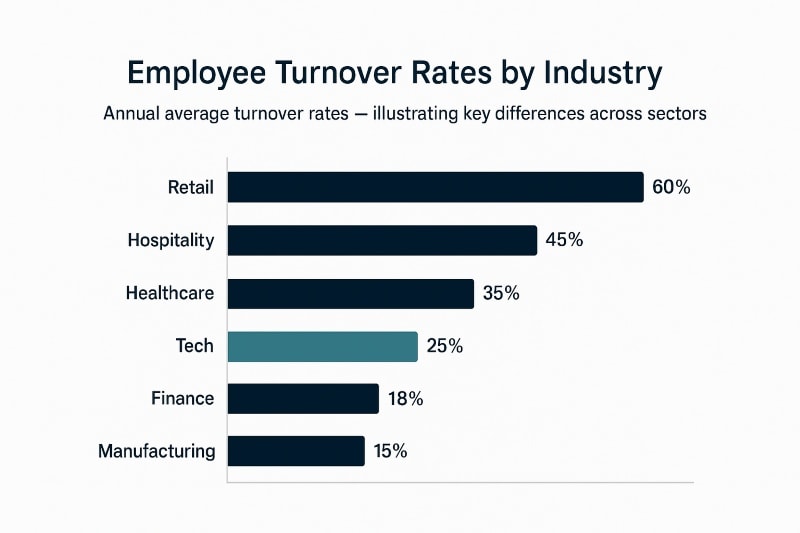
Turnover rates vary dramatically by sector. Staff turnover is especially pronounced in certain industries, with high employee turnover rates in hospitality often exceeding 70%, while tech firms typically experience lower turnover rates, averaging below 20%. The variance shows why cross-industry comparisons are misleading. According to Gallup and the Bureau of Labor Statistics, job openings data further illustrate these industry differences. These differences highlight the importance of benchmarking turnover rates within your own industry before labeling your numbers as “good” or “bad.”
Why Measuring Matters
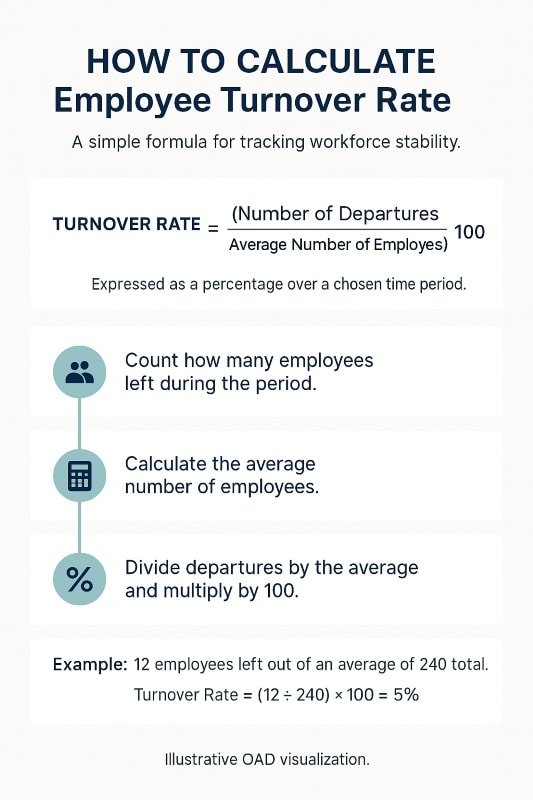
Tracking turnover helps companies evaluate workforce stability and pinpoint weak spots in management or engagement. Calculating the employee turnover rate—the percentage of employees who leave during a given period—provides a clear snapshot of workforce health. To calculate employee turnover, divide the number of employee separations (voluntary and involuntary) during a specific period by the average number of employees, then multiply by 100 to get a percentage. Accurate calculation is important to identify trends, distinguish between voluntary and involuntary turnover, and make informed decisions to address root causes. Without this data, organizations risk reacting to symptoms instead of causes.
Why Employees Leave — The Real Causes Behind Turnover
Leadership and Culture Failures
Turnover rarely starts with a resignation letter—it starts with a mismatch between a leader’s behavioral style and what their team actually needs. At OAD, we can measure that mismatch long before it turns into disengagement. Gallup’s research shows that up to 70% of engagement variance is tied directly to leadership quality. Employee engagement is directly influenced by leadership, and higher engagement levels are linked to lower turnover rates. Gallup quantifies it as engagement variance; at OAD, we see it as a mismatch between a leader’s behavioral style and what their team actually needs. Leadership misfit is predictable — and preventable — when you measure it. Poor communication, lack of trust, or micromanagement erodes morale faster than any pay issue, often resulting in low morale among staff. When people feel undervalued or unheard, disengagement turns into departure.
Bad management isn’t just unpleasant—it’s expensive. It drives talent out the door and quietly poisons those who stay. Supporting current employees is crucial to prevent further turnover, burnout, and low morale.
Lack of Growth and Career Development
One of the strongest predictors of voluntary turnover is career stagnation. Employees who can’t see a clear path for advancement, including career advancement, or who feel their skills are underutilized, start scanning for exits. Providing structured career development opportunities, mentorship, and internal mobility programs helps prevent that. Creating opportunities for growth and promotion helps employees stay engaged and develop professionally. In one OAD client organization, turnover dropped 27% after career paths were mapped to behavioral strengths—because employees weren’t just told they could grow, they saw how.
Design teams with data, not gut feel.
Most org-design decisions come down to role fit, leadership style, and team dynamics. OAD reads those signals from a 7-minute behavioral survey, so you can reconfigure roles and teams with evidence instead of guesswork.
Work-Life Balance and Burnout
No bonus compensates for chronic exhaustion. No bonus compensates for cognitive fatigue. OAD data shows that burnout often peaks when people are placed in roles that constantly fight their natural behavioral energy. At OAD, we’ve seen burnout data spike in cultures that reward responsiveness over results. Poor work-life balance, long hours, and unclear boundaries lead to employee burnout, particularly among high performers. When “always on” becomes the culture, turnover becomes inevitable. Offering flexibility, realistic workloads, and genuine support for well-being isn’t a perk—it’s a retention strategy that directly contributes to employees happiness and helps retain top talent.
External Pull Factors
Not every resignation signals failure. Sometimes, employees leave due to unsolicited job offers, relocation, or personal reasons outside the company’s control. In many cases, employees are attracted by a new job at a different company, seeking better opportunities or career advancement. Some may even transition to new employment quickly, often without much notice or prior discussion with management. However, when multiple top performers accept offers elsewhere, it often reflects a lack of engagement or recognition internally. Tracking these exits helps leaders identify patterns before they become trends.

Spotting the Warning Signs Early
Recognizing Emerging Patterns
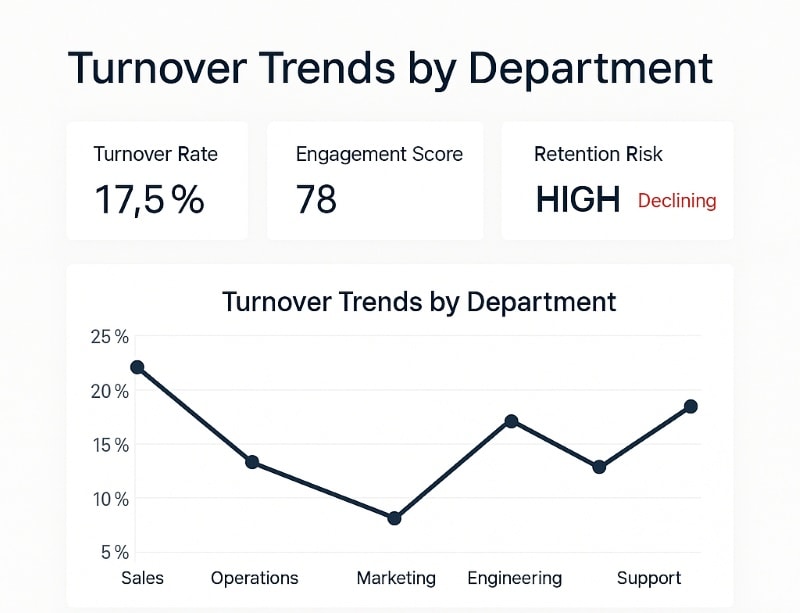
High turnover rarely arrives unannounced—it whispers first. Think of Jeff Bezos’s ‘Day 1’ principle — complacency starts in silence. When performance reviews soften or collaboration slows, those are the whispers leaders can’t afford to ignore. Rising absenteeism, lower engagement scores, or an uptick in internal conflict often foreshadow departures. When certain teams or departments start losing people faster than others, it’s usually not coincidence—it’s culture decay localized to that area. Sometimes, one department experiences higher attrition and requires targeted attention and management strategies to address its unique challenges. Leaders who act only after exit interviews are already too late.
Using Data to Predict Turnover
Modern HR analytics tools make it possible to identify risk long before an employee hands in their notice. Metrics like performance dips, decreased participation in meetings, or reduced collaboration can serve as early indicators of disengagement. The smartest organizations don’t just collect this data—they interpret it to anticipate who might leave and why. Human resources teams play a critical role in analyzing turnover data and acting on these insights to develop effective retention strategies.
Exit Interviews as a Diagnostic Tool
Exit interviews often reveal what surveys can’t. At OAD, we treat exit interviews as a mirror for leadership maturity — what people say when they’re leaving is often what they were too afraid to say while staying. It’s essential to conduct exit interviews with departing employees to gather honest feedback about their reasons for leaving and identify areas for improvement. By identifying recurring themes—poor management, limited growth, or burnout—companies can address systemic problems instead of blaming individual cases. The goal isn’t to convince someone to stay; it’s to learn enough that the next person doesn’t want to go.
Measuring Turnover the Smart Way
Understanding the Formula
The employee turnover rate is calculated by dividing the number of employees who left during a specific period by the average number of employees in that same timeframe, then multiplying by 100.
Formula:(Total separations ÷ Average number of employees) × 100 = Turnover rate (%)It’s not complicated, but it’s powerful. This metric tells you whether your workforce is stable or quietly unraveling. Gallup estimates that the cost of replacing an employee can range from one-half to two times the employee’s annual salary, highlighting the significant financial impact of turnover on organizations.
Choosing the Right Time Frame
Turnover can be measured monthly, quarterly, or annually—each serving a different purpose.
- Monthly: Ideal for spotting sudden spikes or department-level problems.
- Quarterly: Balances precision with trend visibility.
- Annually: Useful for strategic benchmarking against long-term goals.
The key is consistency. Changing time frames too often skews patterns and misleads analysis.
Benchmarking Against Industry Standards
A turnover rate of 15% might be catastrophic in manufacturing but normal in retail. Comparing your numbers against industry benchmarks and company size helps determine what’s acceptable. Data from sources like the U.S. Bureau of Labor Statistics or Gallup provides valuable context for HR leaders aiming to retain top talent.
Turning Data Into Decisions
Tracking numbers isn’t the goal—improving retention is. The ultimate objective is retaining talent and enhancing organizational performance. Leaders should use turnover data to spot systemic weaknesses, like underperforming managers or roles with unclear expectations. When turnover metrics become a leadership KPI, not just an HR report, accountability improves across the organization. Warren Buffett once said, ‘What gets measured gets managed.’ Turnover is no exception — when leaders own it, culture follows.
The Hidden Cost of High Turnover
The Financial Fallout
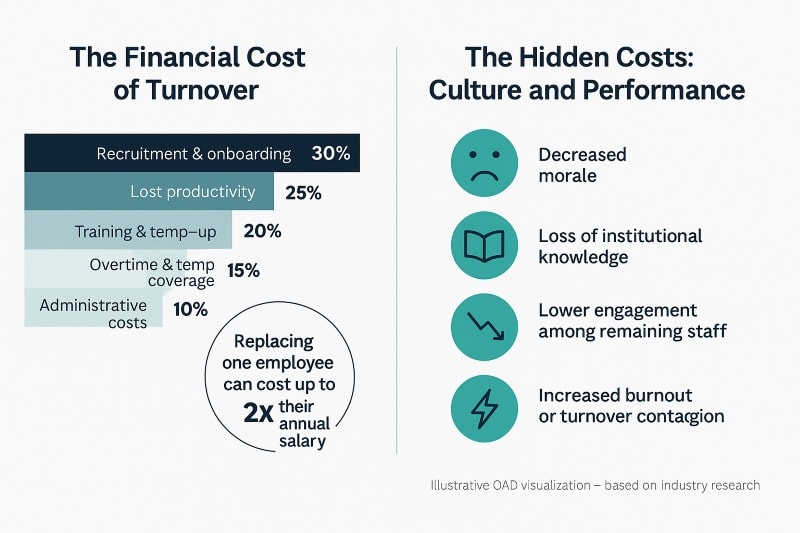
Every employee who walks out the door takes money with them. One CFO we worked with calculated that each resignation cost his division nearly the same as launching a new product line. The math gets personal fast when turnover hits your P&L. Research by the Society for Human Resource Management (SHRM) estimates that replacing an employee can cost 50% to 200% of their annual salary, depending on role complexity and seniority. That includes recruiting, onboarding, and training—not to mention the productivity lost while new hires ramp up.
The Ripple Effect on Performance
High turnover doesn’t just drain cash; it erodes team performance and morale. When employees constantly train replacements, institutional knowledge fades and collaboration suffers. The result? Lower output, more mistakes, and a workforce too fatigued to innovate. Over time, the best employees—the ones picking up the slack—start leaving too.
Culture Damage and Brand Erosion
A revolving door damages more than operations; it scars your reputation. Job seekers notice high turnover on review sites, and word spreads faster than any employer brand campaign can recover. Once your company becomes known as a “stopover,” attracting top talent turns into an uphill battle.
The Leadership Blind Spot
Many executives still underestimate turnover’s total impact because it’s spread across multiple budgets—recruiting, training, lost productivity, and engagement initiatives. But the truth is simple: high turnover exposes a leadership or hiring mismatch, and ignoring it guarantees repeat costs.
Companies using behavioral and cognitive assessments, like OAD, often see lower turnover because they align hiring decisions with job fit and long-term potential. The science doesn’t just help you hire smarter—it helps you keep the right people longer.
In addition, HR software can help organizations track, analyze, and reduce turnover by providing data-driven insights, streamlining HR processes, and supporting proactive retention strategies.
Fixing the Problem: Proven Strategies to Reduce Turnover
Strengthen Leadership and Management Practices
If turnover starts with bad management, retention starts with better leadership. Train managers to coach rather than command, communicate expectations clearly, and recognize achievements consistently. When employees feel respected and supported, loyalty follows naturally. Leadership accountability—not HR policies—creates retention. When respect and recognition become leadership KPIs, turnover doesn’t just fall—it stabilizes, because belonging becomes measurable.
Prioritize Career Growth and Internal Mobility
People rarely leave when they can see a future where they are. Create career development pathways, mentorship programs, and transparent advancement criteria. Offer cross-department projects to expand skill sets and show employees their growth matters. The goal isn’t to trap people—it’s to make staying the better option.
Foster a Healthy Work-Life Balance
Overwork is not a badge of honor. Encouraging reasonable hours, flexible schedules, and genuine rest signals that the company values sustainability over burnout. When employees believe their well-being is protected, turnover drops and engagement rises.
Offer Competitive Compensation and Benefits
Fair pay is table stakes. But beyond salary, meaningful perks—like professional development stipends, wellness programs, and recognition initiatives—build long-term satisfaction. Compensation alone doesn’t retain people; feeling valued does.
Build a Culture of Recognition and Belonging
Culture isn’t what’s written on walls—it’s what shows up in the data when employees describe how they actually feel working there. Celebrate contributions, encourage open communication, and involve employees in decisions that affect them. Belonging is the most underrated retention tool in business.

Exit Interviews: Your Most Underrated Data Source
Listening Before It’s Too Late
Exit interviews aren’t just formalities; they’re confessionals. When done right, they reveal the real reasons people leave—long before those reasons drive others away. Instead of checking boxes, ask open-ended questions about leadership, workload, and engagement. You’ll hear what anonymous surveys never capture.
Turning Feedback Into Action
Collecting insights means nothing if they die in a spreadsheet. Categorize exit feedback by theme—management quality, career growth, culture—and identify recurring red flags. If “lack of recognition” or “no advancement path” keeps appearing, that’s a strategic failure, not a coincidence. The smartest companies close the loop by visibly addressing these issues.
Distinguishing Functional vs. Dysfunctional Turnover
Not every departure is bad. Functional turnover—when underperformers leave—can strengthen teams. Dysfunctional turnover, on the other hand, drains high performers and damages morale. Tracking the ratio of these two helps leaders understand whether turnover reflects healthy evolution or deeper problems.
Building Trust in the Process
Employees only speak honestly when they trust confidentiality. One client only started getting honest feedback after switching to third-party interviews. Suddenly, themes of poor communication and favoritism surfaced — insights that were invisible before. Using third-party facilitators or anonymous digital surveys ensures candor without fear of retaliation. The more honest the data, the more valuable the insight.

Building Long-Term Retention Through Career Growth
Why Growth Drives Loyalty
Employees don’t leave companies that invest in their future. When people see a clear career path, they develop a sense of belonging and purpose that transcends paychecks. Career growth and development aren’t just engagement tactics—they’re psychological anchors that keep top performers committed.
Creating Development Pathways
Formal training and mentorship programs show employees that the company is serious about helping them succeed. Pair emerging talent with experienced mentors, offer access to skill-building workshops, and provide coaching for leadership readiness. Growth shouldn’t be accidental; it should be engineered into your culture.
Encouraging Internal Mobility
When ambitious employees hit a ceiling, they don’t stop climbing—they look elsewhere. Encouraging internal mobility allows people to explore new challenges without leaving the organization. Promoting from within not only retains institutional knowledge but signals that hard work is recognized and rewarded.
Aligning Career Growth with Organizational Goals
When employees’ personal ambitions align with business objectives, engagement soars. Use performance reviews to discuss career aspirations and match them to organizational priorities. Growth shouldn’t be a side conversation—it’s a core business strategy.

Creating a Culture That Keeps People
Culture as the Ultimate Retention Strategy
Policies don’t keep employees—culture does. We’ve seen teams double retention after something as simple as weekly recognition huddles or transparent promotion paths. Culture isn’t a memo — it’s behavior on display. A positive workplace culture fuels engagement, belonging, and pride. When people feel respected, heard, and recognized, turnover rates fall naturally. A healthy culture isn’t accidental; it’s designed and modeled daily by leadership behavior.
Recognition and Appreciation
Employees stay where they’re valued, not just paid. Regular recognition—whether public praise, private acknowledgment, or milestone celebrations—creates emotional connection. Appreciation transforms ordinary workplaces into communities people don’t want to leave.
Psychological Safety and Open Communication
If people fear speaking up, they disengage. Building psychological safety encourages honest conversations about challenges before they escalate into resignations. Open dialogue between leadership and staff is the cheapest and most effective retention tool you have.
Embedding Values Into Everyday Practice
Culture lives in small decisions—who gets promoted, how feedback is delivered, and how success is defined. Aligning company values with daily actions builds trust and authenticity. When employees see integrity in motion, loyalty follows naturally.

Turning Insight Into Action
Key Takeaways
Workforce turnover isn’t inevitable—it’s a reflection of how well your organization understands, values, and supports its people. High turnover rates expose hidden cracks in leadership, culture, and hiring decisions. The most successful companies don’t just track turnover; they treat it as a performance signal.
Reducing turnover begins with clarity: know why people leave, listen to what they say, and act before it happens again. Prioritizing career growth, engagement, and recognition transforms retention from a policy into a culture of commitment.
Your Next Step
If turnover keeps costing you time, money, and talent, it’s time to measure what really matters.
Start with the Top Performer Profile to see how scientifically validated behavioral insights can help you hire smarter, predict retention risks, and build a workforce that stays for the right reasons.