Hiring has become a volume and complexity problem. Roles evolve faster than job descriptions, skills gaps widen, and hiring teams are expected to move quickly without lowering the bar on quality or fairness.
This is where AI in recruiting has moved from experiment to infrastructure. SHRM’s 2025 Talent Trends research found that AI adoption in HR tasks climbed to 43% of organizations in 2025, up from 26% a year earlier, and recruiting is one of the first places that adoption shows up.
AI in recruitment is not a side project anymore. It is becoming a permanent layer in talent acquisition strategies, changing how organizations attract, screen, and select talent.
Used well, AI recruiting tools handle repetitive tasks across the hiring process and surface better data for decision making. They free recruiters from manual, time-consuming work so they can focus on the higher-value activities that drive better talent outcomes. Used poorly, they add noise, hide bias behind algorithms, and damage the candidate experience.
The question for HR professionals is no longer whether to use AI, but how to implement AI in recruiting in a way that protects human judgment and improves hiring outcomes.
What Is AI in Recruiting, Really?
Key AI Concepts HR Professionals Should Understand
AI in recruiting refers to the use of artificial intelligence, machine learning, and related techniques to automate or augment parts of the recruitment process.
At a basic level, AI systems learn patterns from historical data. Machine learning models can be trained to recognize skills in resumes, predict job fit, or rank candidates based on past hiring outcomes. Natural language processing (NLP) helps tools interpret job descriptions, resumes, and candidate messages in plain language.
Generative AI adds another layer. It can draft job ads, outreach messages, or interview questions and summarize candidate profiles. In recruiting, generative AI is often embedded inside other platforms rather than used as a standalone solution.
The point is not the technology label. The point is what each type of AI model actually does for your hiring process.
Types of AI Recruiting Tools and Where They Plug In
AI recruiting tools sit on top of or alongside your core systems: applicant tracking system (ATS), HRIS, CRM, and collaboration tools.
Common AI powered tools in recruitment include:
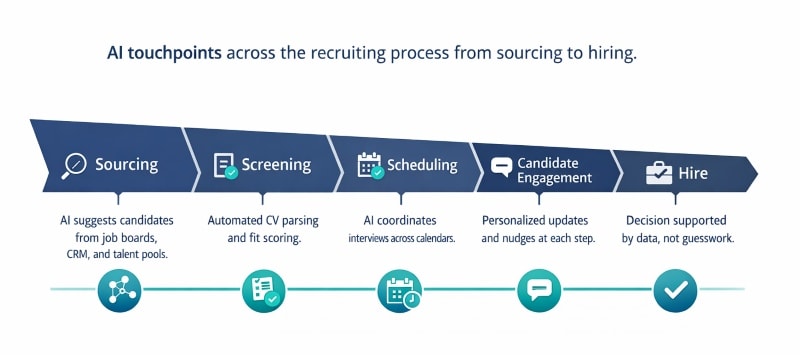
- Candidate sourcing tools that scan job boards, social networks, and internal databases for profiles and use AI to match candidates to relevant job opportunities by analyzing skills, experience, and interests.
- Candidate screening tools that read resumes, compare them to job descriptions, and flag qualified candidates.
- Candidate matching tools that predict fit between a candidate and one or more open roles.
- AI chatbots that answer candidate FAQs and keep job seekers informed during the hiring journey.
- Interview intelligence tools that capture and analyze interview conversations for consistency and job relatedness.
These AI tools do not replace human recruiters. They shift where recruiters spend time, from administrative tasks toward relationship building and decision making.
AI in Recruiting vs Traditional Recruitment Software
Traditional recruitment software focuses on workflow: posting jobs, collecting applications, tracking stages, and recording notes.
AI in recruitment adds another layer: predictive analytics, pattern recognition, and continuous learning. For example:
- Instead of simple keyword filters, AI driven recruitment tools can interpret skills clusters and adjacent experience.
- Instead of static dashboards, AI insights can highlight which job boards produce the best talent, which hiring teams move too slowly, and where candidates drop out.
The most effective setups combine structured recruitment process discipline with AI powered tools that surface the right data at the right time.
Where AI Supports the Hiring Process End-to-End
Using AI to Write Job Descriptions and Job Ads
Poorly written job descriptions make everything else harder. AI powered tools can help HR teams draft clearer, more inclusive job descriptions faster.
Typical use cases include:
- Generating first drafts of job descriptions based on role templates and required skills.
- Optimizing job ads for readability and search, so the right candidates can actually find them.
- Flagging potentially biased language that might discourage applicants from underrepresented groups.
Human oversight remains essential. Writing job descriptions is still a judgment call. AI can suggest phrasing and structure, but human recruiters and hiring managers must confirm that the content reflects the real role and culture.
Candidate Sourcing Across Job Boards and Talent Networks
Candidate sourcing is another area where AI recruiting tools add concrete value.
AI powered solutions can:
- Scan job boards, CV databases, and professional networks to identify prospective employees who match the skills, experience, and location criteria.
- Rediscover talent already in your system by matching previous applicants against current openings.
- Build shortlists for hiring managers based on skills gaps and talent gaps identified in workforce planning.
For HR professionals committed to proactive hiring strategies, these tools make it easier to maintain a diverse talent pool instead of restarting the search from zero for every vacancy.
AI Screening and Ranking Candidates
Screening and ranking candidates is often where AI in recruitment shows the biggest time savings. Automated resume screening tools can read large volumes of applications and compare them to job descriptions and predefined criteria.
Use cases:
- Screening candidates for basic qualifications and must have skills.
- Ranking candidates based on likelihood of fit, using patterns learned from past successful hires.
- Highlighting non obvious profiles whose experience maps to the core requirements, even if keywords do not match perfectly.
Speed is the easy win here. The harder part is making sure the speed does not cost you good candidates, so human recruiters still need to review edge cases and challenge the model when it appears to miss promising people.
Automated Interview Scheduling and Coordination
Automated interview scheduling is a low risk, high impact starting point for AI in recruiting.
AI scheduling tools can:
- Read calendar availability for hiring teams.
- Suggest interview slots to candidates.
- Schedule interviews automatically, streamlining the process for both candidates and recruiters.
- Handle rescheduling and reminders without involving a recruiter every time.
This reduces time to hire by eliminating the slow back and forth that often delays the interview process. It also frees HR teams from a high volume of manual coordination.
Candidate Engagement With AI Chatbots and AI Agents
AI chatbots and more advanced AI agents can sit within your career site, application portal, or messaging channels.
Typical functions:
- Answering candidate questions about the role, hiring process, and company policies.
- Guiding job seekers through application steps and required documents.
- Providing real time updates on application status, next steps, and timelines.
This improves candidate experience by giving prospective employees consistent information and faster responses than email alone. The key is to keep messaging factual, transparent, and clearly identified as AI, not a human recruiter.
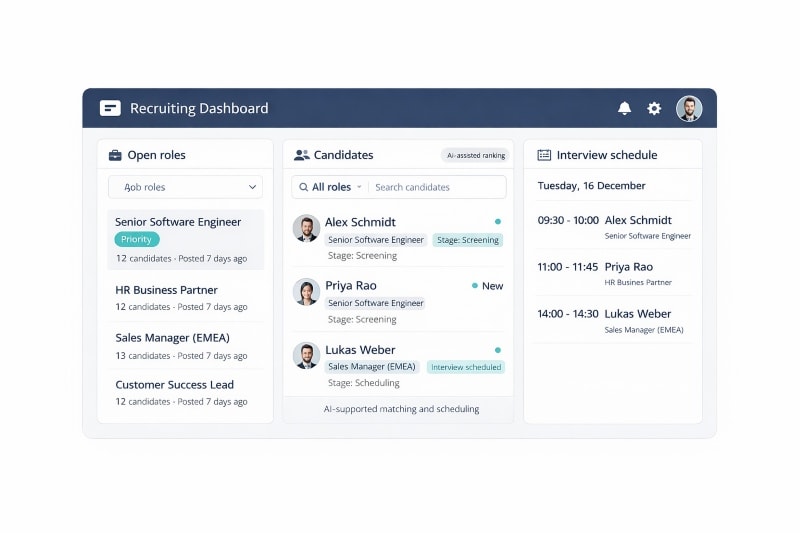
Benefits of AI in Recruiting for HR Teams and Hiring Managers
Reducing Time to Hire and Administrative Work
AI in recruiting is particularly effective at reducing manual, low value tasks:
- Automated resume screening cuts down the time required to review large applicant volumes.
- Automated interview scheduling removes email chains and calendar juggling.
- AI powered tools can prepare summaries for hiring managers, so discussions focus on fit instead of basic facts.
How much time and cost you save depends on your volume and how much of your process is still manual. Measure your own time to hire and cost per hire before and after, rather than relying on vendor averages.
For HR teams, this means less time spent on administrative tasks and more bandwidth for strategic work.
Improving Candidate Experience Across the Hiring Journey
Candidate experience is not a soft metric. Poor communication, long gaps between stages, and unclear expectations directly affect your ability to attract and close the best talent.
AI helps recruitment teams:
- Provide timely updates during each stage of the hiring journey.
- Answer common questions instantly via AI chatbots.
- Personalize outreach at scale without asking recruiters to rewrite messages from scratch every time.
Job seekers experience a more transparent and predictable process. That matters most for in-demand candidates, who are often weighing more than one offer and will not wait on a slow process.
Building a More Diverse Talent Pool
Used carefully, AI recruitment tools can support diversity and inclusion goals.
Examples:
- Candidate sourcing tools can expand your reach beyond a narrow set of universities or previous employers.
- Debiased job ads and job descriptions can attract candidates who might otherwise self select out.
- Structured candidate screening criteria can help reduce the impact of unconscious bias in early shortlisting.
However, diversity benefits are not automatic. Organizations need to define what “diverse talent pool” means in their context and maintain human oversight to ensure AI systems do not simply repeat historical patterns.
Supporting Data Driven Hiring Decisions
AI driven insights can support better decision making when HR professionals and hiring managers interpret them correctly.
Useful examples include:
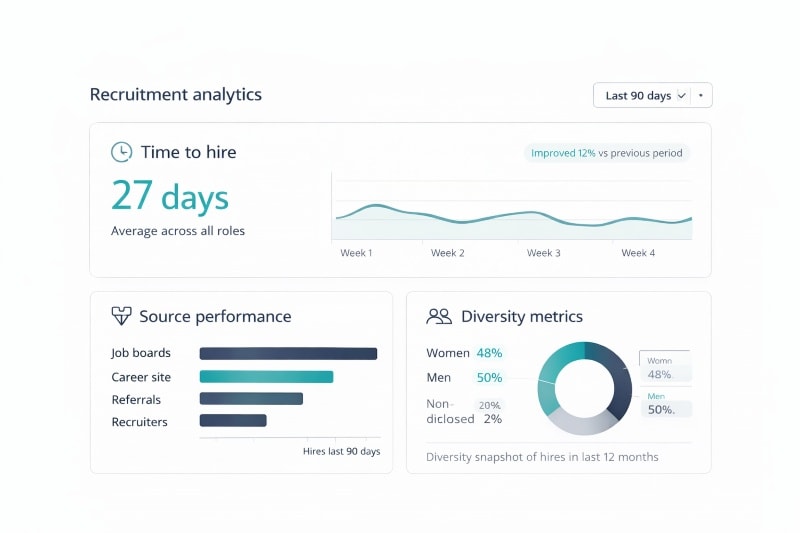
- Identifying which sourcing channels produce high performing hires, not just high application volumes.
- Understanding where candidates drop out of the recruiting process and why.
- Linking candidate attributes and assessment scores to job performance and retention over time.
This allows recruitment teams to refine talent strategies based on evidence rather than anecdotes. For more on this, see our articles on behavioral assessments and smarter hiring.
Building a Business Case for AI Recruiting
A business case for AI recruiting starts with the problem, not the tool. Name the pain points in plain numbers: how long time to hire takes for key roles, what a hire costs, and where qualified candidates fall out of the process.
Then show what AI would change: automating repetitive admin, speeding up candidate communication, and giving hiring teams better data for decisions. Be clear that the goal is to give recruiters more time for relationship building and judgment calls, not to replace them.
Stakeholders are most convinced by evidence from your own process. Run a small pilot, measure time to hire, candidate quality, and candidate feedback before and after, and address concerns about human judgment directly by showing where people stay in control of decisions.
Creating a Strategic AI Recruiting Plan
Start by deciding what you want AI recruiting to achieve: faster hiring for high-volume roles, better quality of hire, a more diverse candidate pool, or less admin for recruiters. Pick one or two goals, not all of them.
Next, review your current recruiting process and tech stack to find where AI would make the biggest difference. That might be resume screening, predictive analytics for sourcing, or a chatbot that answers candidate questions. Choose tools that fit your goals and integrate cleanly with your existing systems.
Then write the plan down: timelines, budget, who owns what, and how you will measure success (time to hire, quality of hire, candidate engagement). Review the results regularly and adjust, using feedback from recruiters, hiring managers, and candidates, so the tools stay aligned with what the business actually needs.
Developing an AI Recruiting Budget
An AI recruiting budget needs to cover more than the subscription. Include setup and integration with your ATS and HRIS, data and security work, and training time for HR teams and hiring managers.
Tie spending to the outcomes you expect. Shorter time to hire lowers cost and helps you win candidates faster, and better quality of hire shows up later in performance and retention. Prioritize the tools most likely to move the metric you care about most.
Review the budget as you learn. If a pilot does not deliver, cut it. If one use case clearly works, that is where the next investment should go.
Ensuring Data Quality and Security
AI recruiting tools are only as good as the data they learn from. If your historical hiring data is incomplete, inconsistent, or biased, the tool will reproduce those problems at scale.
Candidate data is also personal data. Protect it with encryption, controlled access, and regular audits, and make sure your setup meets the privacy rules that apply to you, such as GDPR and CCPA. Ask every vendor how they store, use, and delete candidate data.
Treat data quality and security as ongoing work, not a one-time setup. Monitor for gaps, fix issues quickly, and review your safeguards whenever you add a new tool or data source.
Ensuring AI Recruiting Compliance
AI in hiring does not change your legal obligations. Employers remain responsible for fair, non-discriminatory hiring under EEOC guidance and the laws that apply in each location, whether a human or a tool made the first cut.
In practice, that means structured and documented selection criteria, regular checks for adverse impact across candidate groups, and human review of final hiring decisions. It also means being transparent with candidates about how AI is used and getting consent where required.
Write down your policies for how AI tools may be used, who reviews their outputs, and how often you audit them. Work with legal and compliance teams, since rules on automated hiring tools are changing quickly in several jurisdictions.
Risks, Bias, and the Need for Human Oversight
Where Human Bias Creeps Into AI Systems
AI models learn from historical data. If a company’s previous hiring decisions favored certain profiles, there is a real risk that AI systems will replicate those preferences.
Common issues include:
- Overweighting certain schools, employers, or career paths.
- Using proxies like zip code or employment gaps that correlate with protected characteristics.
- Training on performance ratings that themselves reflect bias.
The result can be AI recruitment tools that appear objective while still embedding human bias.
Why AI Will Not Remove the Need for Human Judgment
AI in recruiting can process more data than any human recruiter. It does not get tired, bored, or distracted. But it also does not understand context, team culture, or the informal dynamics that make someone effective in a specific organization.
Human judgment is still required to make the decision. Structured tools like the OAD Survey can support it by adding validated behavioral data. People still need to:
- Interpret AI insights in light of business context and strategy.
- Weigh tradeoffs between technical skills, growth potential, and culture contribution.
- Challenge AI recommendations where necessary.
Removing human judgment from hiring is not only risky from an ethical perspective, it is also bad business.
Practical Guardrails for Ethical, Compliant AI in Recruiting
To maintain trust in AI driven recruitment, organizations should:
- Maintain human oversight for all final hiring decisions.
- Document how AI tools are used in the recruitment process and which decisions they influence.
- Run regular audits to check for disparate impact on different candidate groups.
- Work with legal, compliance, and data privacy teams to ensure regulations are respected.
External research and recent commentary continue to highlight the legal and reputational risks of ungoverned AI use in hiring.
Implementing AI Recruiting Tools in Your Organization
Align AI Implementation With Your Talent Strategy
Before buying any AI recruiting tools, clarify the problem you are trying to solve:
- Is the priority reducing time to hire in high volume roles?
- Is it improving candidate experience for critical senior hires?
- Is it closing skills gaps in specific parts of the business?
Map these priorities to your existing recruiting process and identify where AI powered solutions add real value.
Choosing AI Powered Solutions That Fit Your Tech Stack
AI in recruiting rarely operates alone. It needs to integrate into your ATS, HRIS, collaboration tools, and reporting environment.
When evaluating AI recruitment tools, focus on:
- Integration options with your current systems.
- Transparency into AI models and how they rank candidates.
- Data retention, privacy, and security practices.
- The level of configuration your HR teams can control.
Avoid solutions that promise “fully automated hiring” without clear explanations of how decisions are made.
Training Recruiters and Hiring Managers To Work With AI Tools
AI in recruitment changes how daily work looks for HR teams and hiring managers.
Training should cover:
- How AI models work at a basic level so users understand strengths and limits.
- How to review AI insights critically rather than accepting them at face value.
- How to maintain human oversight and document decision making.
HR professionals need confidence that AI helps recruiters rather than replacing them. Hiring managers need clarity on new expectations in an AI supported hiring process.
Continuous Monitoring and Iterative Improvement
AI implementation is not a one time project. Organizations should:
- Monitor KPIs such as time to hire, candidate satisfaction, and diversity metrics before and after AI implementation.
- Collect feedback from recruitment teams, hiring managers, and candidates.
- Adjust workflows, tuning rules, and occasionally revisiting AI vendors as needs evolve.
This continuous improvement mindset keeps AI in recruiting aligned with the organization’s strategy rather than becoming a static black box.
Measuring the Impact of AI in Recruiting
Core KPIs for AI in Recruiting
To assess whether AI in recruitment is working, focus on a balanced set of metrics:
- Time to hire for key roles.
- Cost per hire in high volume environments.
- Quality of hire, using performance and retention indicators.
- Candidate experience ratings or Net Promoter Scores.
- Diversity and representation within shortlists and hires.
Tracking only speed or only cost can lead to poor outcomes. The right talent matters more than the fastest hire.
Using AI Insights To Refine the Recruiting Process
AI driven insights can highlight points where the recruiting process needs adjustment:
- If large numbers of candidates drop out after a particular interview stage, review what happens there.
- If specific job boards produce large volumes but low quality, redirect sourcing spend.
- If certain teams consistently move slowly, support them with clearer SLAs or different interview structures.
In this way, AI powered recruiting tools become part of broader talent strategies, not just stand alone apps.
Knowing When AI Is Not Working as Expected
Warning signs include:
- Consistent discrepancies in how AI ranks candidates from different demographic groups.
- Strong disagreement between human recruiters and AI recommendations in many cases.
- Negative feedback from job seekers about AI chatbots or interview experiences.
These signals indicate a need to revisit AI models, data inputs, or configuration. Human oversight is what keeps AI systems aligned with both ethics and business goals.
The Future of AI in Recruiting and Talent Acquisition
From Role Based Hiring to Skills Based, Predictive Hiring
As AI recruiting tools mature, they support more skills focused and predictive approaches to hiring.
Examples:
- Predictive analytics that flag emerging skills gaps before they become urgent.
- Candidate matching across multiple roles, not only the one applied for.
- Workforce planning scenarios that connect hiring to long term capability building.
This shifts talent acquisition from reactive backfilling to proactive capability building.
Generative AI for Employer Branding and Candidate Communication
Generative AI can help HR teams:
- Draft consistent job ads and outreach campaigns aligned with the employer brand.
- Personalize candidate communication without writing every message from scratch.
- Create internal knowledge resources on the recruiting process for hiring managers.
Human review remains important. AI generated content must be checked for accuracy, tone, and alignment with company values.
AI Driven Assessments and Candidate Matching for Long Term Fit
AI driven assessments increasingly support candidate screening and candidate matching by:
- Evaluating skills through online tasks or simulations.
- Structuring interview questions around competencies and behaviors.
- Identifying patterns in candidates who perform well and stay longer.
The risk is over indexing on what has worked in the past and excluding valuable nontraditional profiles. This is where behavioral science and structured assessment frameworks matter.
Where AI in Recruiting Ends and Behavioral Science Begins
Why Personality, Behavior, and Human Insight Still Matter
AI in recruitment can process resumes, screen candidates, and predict fit to a role profile. It cannot fully account for how someone will respond to a specific manager, team dynamic, or pressure environment.
Behavioral tendencies and motivation strongly influence job performance and retention, especially in leadership, sales, and team critical roles. Human insight informed by data is still necessary.
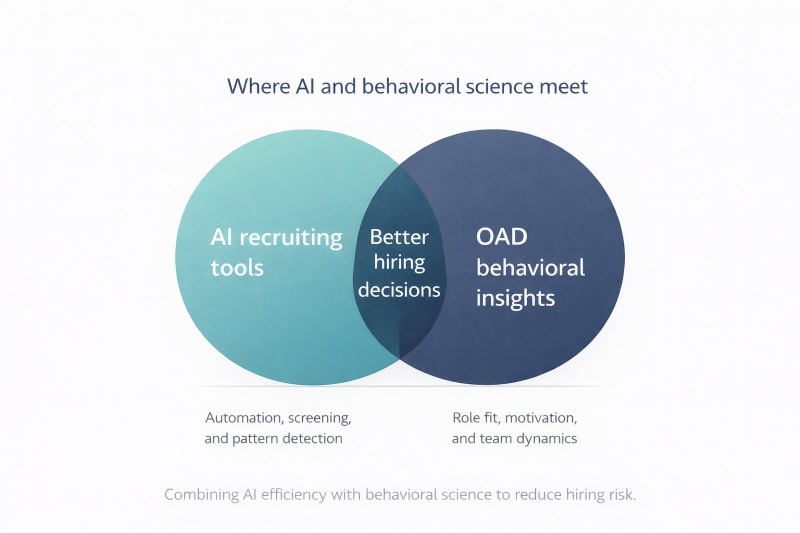
How OAD Complements AI Driven Recruitment
This is where OAD’s approach fits with AI driven recruitment.
AI recruitment tools help you:
- Source more candidates.
- Screen and rank them efficiently.
- Reduce time to hire.
OAD’s validated behavioral diagnostic then helps you:
- Understand how shortlisted candidates are likely to behave in real work environments.
- Evaluate fit for specific roles, teams, and managers.
- Reduce the risk of expensive mis-hires that traditional screening cannot detect.
Instead of choosing between AI technology and behavioral science, high performing organizations combine them, with the behavioral data used as one structured input alongside interviews and other evidence.
Design teams with data, not gut feel.
Most org-design decisions come down to role fit, leadership style, and team dynamics. OAD reads those signals from a 7-minute behavioral survey, so you can reconfigure roles and teams with evidence instead of guesswork.
Using Assessments To Validate AI Shortlists
A practical model looks like this:
- Use AI recruiting tools for candidate sourcing, candidate screening, and interview scheduling.
- Once you have a shortlist of qualified candidates, use OAD to assess behavioral fit and role alignment.
- Integrate these insights into structured interviews and final hiring decisions.
This combination ensures AI in recruiting delivers speed and scale, while OAD’s behavioral science protects decision quality.
How To Get Started With AI in Recruiting
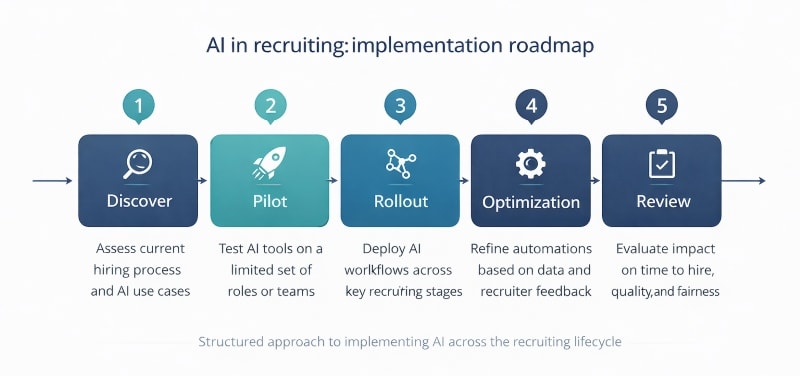
A Phased Roadmap for HR Teams and Recruitment Leaders
To implement AI in recruiting responsibly:
- Start with one or two clear use cases, such as automated interview scheduling or resume screening for high volume roles.
- Define success criteria up front, including both efficiency and fairness metrics.
- Involve recruiters, hiring managers, and legal early to align expectations.
Avoid deploying AI across the entire recruitment process without a controlled pilot.
Pilot Use Cases That Deliver Quick Wins
Common early pilots include:
- Automated interview scheduling for frontline or high volume roles.
- AI powered resume screening where you receive thousands of applications.
- AI chatbots for candidate FAQs on the careers site.
These use cases reduce administrative tasks quickly and provide learning data without handing full control to AI.
When To Bring in Partners for Deeper Insight and Support
As AI implementation matures, organizations often realize that technology alone does not solve deeper talent questions.
This is the point to:
- Bring in assessment partners such as OAD to add a behavioral science layer to AI shortlists.
- Align AI recruitment tools with leadership development, succession planning, and broader talent strategies.
If you want to see how behavioral data strengthens AI supported recruiting, start with the person you already trust most in the role. The free Top Performer Profile takes 7 minutes, returns results in 24 hours, and needs no credit card.
Conclusion: AI Supported, Human Led Recruiting
AI in recruiting is reshaping how organizations attract, screen, and select talent. Used well, AI helps HR teams reduce time to hire, automate repetitive tasks, and improve candidate experience. It can support more diverse talent pools and more evidence based hiring decisions.
Used without human oversight, AI recruitment tools risk amplifying bias, harming candidate trust, and damaging your employer brand.
The most effective talent acquisition strategies treat AI as a powerful set of tools inside a human led hiring process. Human recruiters, hiring managers, and executives stay accountable for defining what “the right talent” means and for making final decisions.
For organizations that want both speed and quality, combining AI driven recruitment tools with a validated behavioral diagnostic such as OAD provides a balanced path forward.