Most organizations don’t have a “team performance problem.” They have a measurement problem.
Leaders see missed deadlines, rising rework, stalled decisions, or low team morale and reach for motivation talks, new tools, or a reorg. The outcomes rarely change because the real drivers are usually behavioral and structural: role clarity, decision rights, trust, and how the team actually runs work day to day.
This playbook is built for HR leaders, hiring managers, and executives in 50+ employee companies who need a practical way to improve team effectiveness without turning it into a culture project, especially those focused on scaling teams through strategic hiring and leadership decisions.
What is team performance?
Team performance is the team’s ability to consistently produce the outcomes it is responsible for, at an acceptable quality level, within real constraints (time, budget, dependencies), without burning people out.
That definition matters because it forces a shift from vibes to evidence: outcomes, quality, speed, reliability, and sustainability.
Team performance vs. individual performance
Individual performance answers: “Is this person doing their job well?”
Team performance answers: “Is the entire team producing results together?”
A team can have high individual performers and still fail:
- Work gets stuck in handoffs.
- Decisions take too long.
- Conflict gets avoided until it explodes.
- Ownership is unclear, so nothing moves.
Google’s research on team effectiveness is useful here because it points away from “find better people” and toward “build better conditions.” Psychological safety, dependability, structure and clarity, meaning, and impact are repeatedly emphasized as practical drivers of effective teams.

Team effectiveness, team dynamics, and team health
These get mixed up constantly. Separate them:
- Team effectiveness: how well the team delivers outcomes (speed, quality, reliability).
- Team dynamics: the interaction patterns (communication, conflict handling, decision making).
- Team health: the sustainability layer (engagement, trust, morale, workload, psychological safety).
McKinsey frames “team health” as something that can be measured and improved, and that healthier teams benefit the broader organization. That’s the right mental model: you can treat team performance as an ongoing process, not a one-time fix.
Who this playbook is for
This is for you if you need to, especially when you’re trying to match roles to people’s natural behavioral traits, and you need to:
- Diagnose performance gaps without guesswork.
- Improve team success across project teams and cross functional teams.
- Build consistent execution in hybrid or distributed environments.
- Make team behaviors measurable enough to manage.
Expected outcomes for teams and leaders
If you apply the playbook properly, you should see:
- Clearer team goals and fewer stalled priorities.
- Faster decision making with fewer reruns of the same debate.
- Higher delivery reliability (project progress you can predict).
- Better role clarity and fewer ownership disputes.
- Measurable improvements in engagement and retention risk over time.
Context matters. Engagement is not the only metric, but it is a useful warning signal at scale. Gallup’s State of the Global Workplace reporting shows global engagement can move meaningfully year to year, and manager engagement is a major lever. Layer in tools that provide early risk alerts for burnout and disengagement so you can treat it as an operational risk, not a morale issue.
Assess team health and team effectiveness
If you skip this, you end up doing performance theater: workshops, tools, and “alignment” meetings that change nothing because nobody agreed on what was broken.
The goal of this section is simple: get a well rounded view of how the team works today, then tie it to outcomes you can track.

Run a team health diagnostic with standardized measures
Start with standardized measures because they reduce politics. You want a baseline that is consistent across teams, not a debate club.
Use a short diagnostic that covers the drivers most linked to effective teams:
- Psychological safety (can people speak up, raise risks, admit mistakes)
- Dependability (can people rely on each other to deliver)
- Structure and clarity (clear goals, roles, decision rights)
- Meaning and impact (why the work matters, whether it feels consequential)
These drivers show up in Google’s work on team effectiveness and are a practical starting point for most teams, across functions and geographies.
If you need something extremely lightweight for a first pass, SHRM’s “team effectiveness checklist” approach is designed for quick diagnostics and structured discussion.
Practical rule: keep the diagnostic short enough that people actually finish it. Consistency beats perfection.
Collect quantitative metrics and qualitative feedback
You need both, because either one alone lies.
Quantitative (performance data) examples:
- Delivery reliability: percent of commitments met (project progress vs plan)
- Cycle time: time from “start” to “done” for typical work
- Quality: defects, rework rate, customer escalations, incident count
- Decision latency: how long key decisions sit unresolved
- Capacity health: overtime trends, backlog growth, work in progress
Qualitative (feedback sessions) examples:
- Short anonymous prompts: “What slows us down most?” “Where do we lose time?” “What conflicts never get resolved?”
- Structured small-group discussions to compare perceptions and find consensus issues (SHRM explicitly recommends this flow: distribute, discuss, identify consensus gaps, agree actions).
Do not treat qualitative feedback as “soft.” It is often the fastest way to find the root cause behind the numbers.
Map diagnostic results to key performance drivers
This is where most teams derail. They collect data, then jump straight to solutions. Map first.
Use a simple translation layer:
- Low dependability → missed handoffs, unclear owners, weak follow-through
- Low structure and clarity → unclear team goals, fuzzy success criteria, decision churn
- Low psychological safety → hidden risks, late surprises, passive resistance
- Poor communication norms → duplicated work, slow coordination, confusion in virtual teams
- Weak decision making → bottlenecks, escalations, “waiting on approval” paralysis
McKinsey’s team effectiveness work emphasizes that context determines which behaviors matter most, so don’t assume one universal fix. Match interventions to what your diagnostic reveals.
Identify constraints: team context, resource constraints, virtual teams, cross-team blockers
Before you blame “team dynamics,” check the obvious structural problems that make good performance impossible:
- The team’s mission conflicts with how success is measured.
- Dependencies on other teams are unmanaged.
- The team has no decision rights, but is held accountable for outcomes.
- Resource constraints force constant priority thrash.
- Virtual teams have no standard async update rhythm, so visibility collapses.
Also, keep an eye on the manager layer. Gallup’s global workplace reporting highlights that manager engagement has been under pressure and that it matters for wider engagement and performance. If managers are overloaded and undertrained, team performance will reflect it.
Identify high performing teams and the drivers of high performance
High performing teams are not “the teams with the smartest people.” They are the teams where work moves.
They make decisions without drama, surface problems early, and deliver predictably. That is mostly behavior and structure, not charisma.
Traits of high performing teams (behavioral signals you can observe)
Look for signals you can see in normal work, not slogans on a wall:
- They keep commitments. Work finishes when it is supposed to, at an acceptable quality level. Google flags dependability as a core driver of team effectiveness.
- They have structure and clarity. Goals, roles, and expectations are not vague. Google’s model explicitly calls out structure and clarity.
- They handle tension early. Disagreements surface, get processed, and do not rot into passive resistance.
- They communicate in a predictable rhythm. People are not guessing what is happening, especially in virtual teams.
- They take interpersonal risk when needed. High-performing teams can name inconvenient truths and have hard conversations.
If you want one clean lens: do team members feel safe enough to raise risks early, and does the system convert those risks into action? If not, performance will eventually wobble.
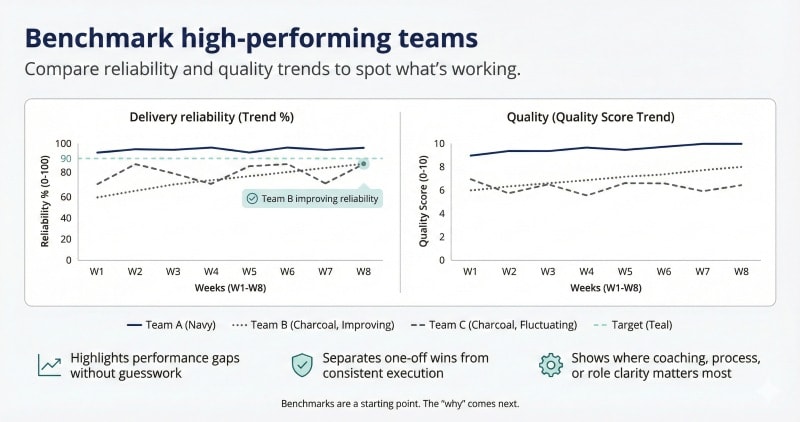
Benchmarking: what to compare across teams
Benchmarking is not a beauty contest. It’s a way to find which drivers correlate with better outcomes in your environment.
Pick a small set of comparable metrics:
Outcome metrics (lagging):
- Delivery reliability (commitments met)
- Quality and rework (defects, incidents, escalations)
- Customer impact (NPS trends, complaint volume, churn drivers where relevant)
Operational metrics (leading):
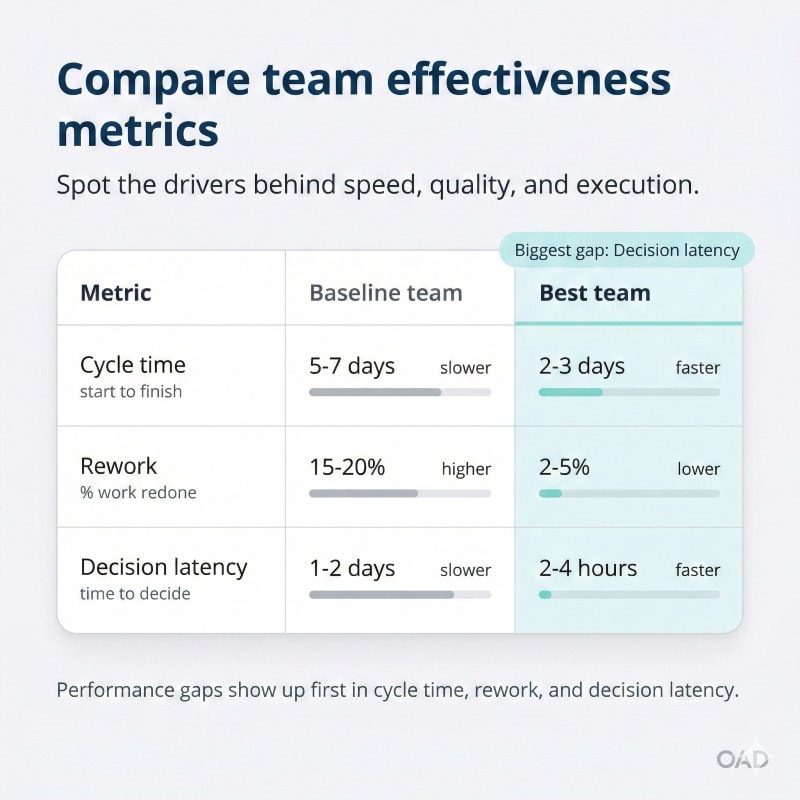
- Cycle time (how fast work moves)
- Work in progress (how much is started but not finished)
- Decision latency (time to approve, resolve, or unblock)
- Dependency drag (how often another team blocks delivery)
Then compare:
- Your best team vs your worst team
- The same team across two quarters
- Project teams vs cross functional teams
This is where you spot patterns like: “Our best teams decide faster,” or “Our best teams have clearer ownership,” instead of guessing.
Prioritize drivers that move outcomes: trust, communication, innovation, decision making
If you try to fix everything, you fix nothing.
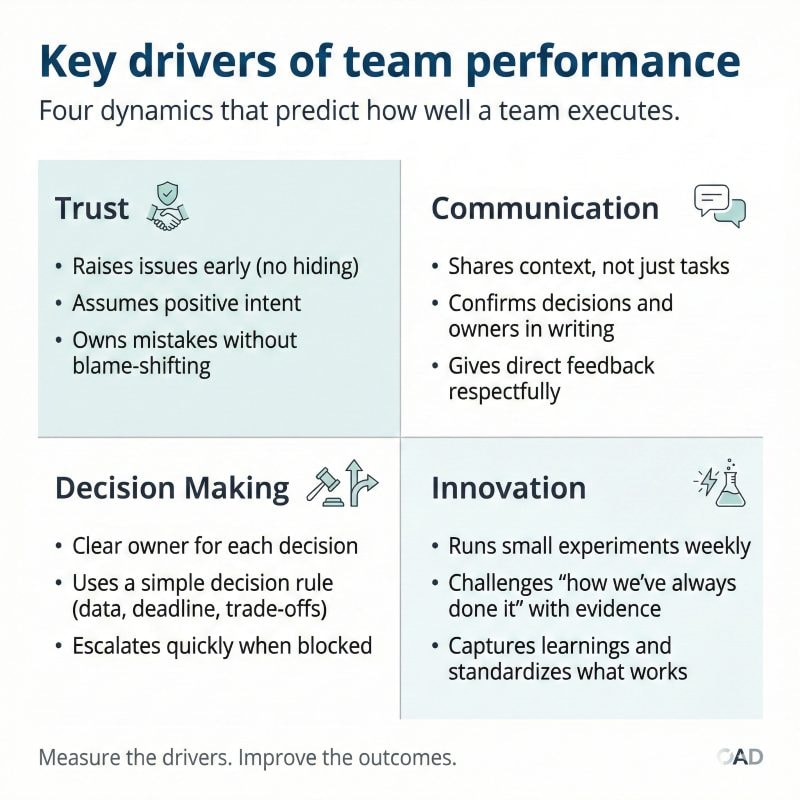
McKinsey highlights four areas that show up as meaningful differentiators: trust, communication, innovative thinking, and decision-making. The practical takeaway is not “be more innovative.” It’s “pick the weakest driver and improve it with observable behaviors,” and for communication in particular, use structured approaches to assess communication skills during hiring and promotion decisions.
Trust is not a motivational poster. It’s operational. In a Harvard Business Review piece based on interviews with 1,000 U.S.-based office workers, high-performing teams were separated by specific trust-building behaviors like proactive tension management and keeping colleagues in the loop.
Deloitte’s recent research on high-performing teams in the AI era also lands on “enduring human capabilities” (connected teaming, curiosity, resilience) as differentiators, which is another way of saying: tools do not save broken team behaviors.
So your prioritization rule:
- Choose one driver with the clearest performance link.
- Define two to four behaviors that represent “better” in that driver.
- Measure before and after.
Common failure patterns you can diagnose fast
These are the “it looks like a people problem but it’s actually a system problem” classics:
- Unclear mission: the team’s mission changes weekly, so execution becomes random.
- Weak role clarity: nobody owns outcomes, so everything becomes shared responsibility.
- Slow decisions: approvals become bottlenecks, so teams wait instead of moving.
- Conflict avoidance: risks stay hidden until delivery breaks.
- Communication noise: more messages, less clarity, especially across time zones.
If you see these patterns, don’t jump to training. Fix the structure first: roles, decision rights, and the team’s operating rhythm.
How do you improve team performance?
You improve team performance the same way you improve any system: isolate one driver, change one behavior, measure the result, repeat. For leaders and external partners, augment this with behavioral coaching tools that reveal how people respond to stress and change.
Most teams fail here because they launch “initiatives” instead of running controlled improvements.
Practical interventions: pick one driver, run one change, measure the result
Use this loop:
- Choose the performance gap (late delivery, rework, slow decisions).
- Identify the driver (role clarity, dependability, trust, communication).
- Define one behavior change (what will people do differently next week).
- Track one leading metric and one lagging metric.
- Run it for 2–4 weeks. Keep it boring. Boring works.
Google’s work on team effectiveness is useful as a driver checklist because it keeps you anchored on conditions you can influence (clarity, dependability, psychological safety, meaning, impact).
Create a team charter with agreed team behaviors and communication expectations
A team charter is not a manifesto. It’s an operating agreement, and it becomes even more powerful when every team member has their own application access to behavioral and development insights.
Include only what you will actually enforce:
- Team mission in one sentence (what outcomes the team owns)
- Decision rules (who decides, who advises, how fast)
- Communication norms (what goes async, what needs live discussion)
- Conflict rules (how to surface and resolve tension early)
- Reliability rules (definition of done, handoff standards, response times)
Why this matters: high-performing teams don’t “leave collaboration to chance.” They define it. That shows up directly in research on trust behaviors in high-performing teams.
Implement short-cycle experiments for continuous improvement (2–4 week loops)
Most “continuous improvement” is just meetings.
A usable experiment looks like:
- One habit to change (example: decisions above $X require a documented owner and a 48-hour deadline)
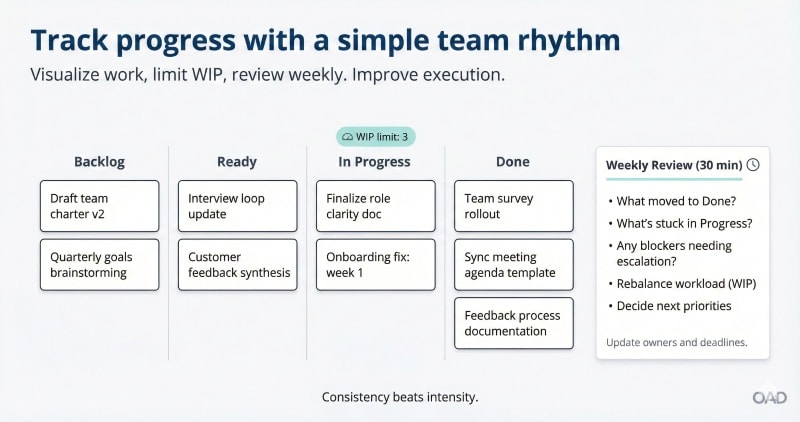
- One ritual to support it (example: weekly review rhythm where blockers and decisions are cleared)
- One measure (example: median decision latency, cycle time, rework rate)
Short cycles matter because teams are complex. You need feedback fast, or you’ll argue forever about what “should” work.
Establish governance to ensure follow-through (owners, cadences, escalation path)
If nobody owns the improvement work, it dies quietly.
Governance does not mean bureaucracy. It means:
- One owner per intervention
- A weekly cadence to review progress
- A simple escalation path when another team blocks progress
- A decision log so choices do not get relitigated
This is especially important in cross functional teams, where ambiguity produces slow approvals, duplicated work, and stalled delivery.
Hold regular retrospectives to embed improvements and prevent backsliding
Retrospectives work when they are structured and tied to outcomes.
Keep them tight:
- What created friction last cycle?
- What slowed delivery?
- What decision got stuck and why?
- What will we stop, start, continue?
The aim is not catharsis. It’s operational learning.
Trust is part of this. High-performing teams proactively address tension instead of letting it rot. That behavior shows up as a differentiator in research on trust in high-performing teams.
Project teams: setup, metrics, and delivery
Project teams fail for predictable reasons: vague scope, fuzzy ownership, and progress that gets reported instead of measured. Many of these issues start at hiring, which is why using a quick, validated behavioral survey before interviews helps you staff project teams with people whose natural work styles fit the roles.
Fix the setup, then the delivery gets easier.
Define project scope, team objectives, and success criteria at kickoff
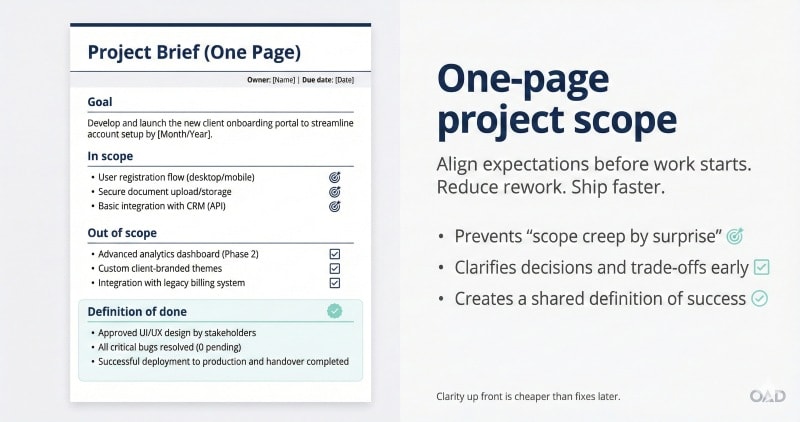
Write down, in plain language:
- What “done” means (deliverables, quality bar, acceptance criteria)
- What is explicitly out of scope
- Who the customer is (internal or external)
- What trade-offs are allowed (speed vs quality vs cost)
If you cannot define success criteria, the team will spend the project arguing about what success was supposed to be.
Also define the team’s mission for the project in one sentence. Teams move faster when they do not have to interpret the goal every week.
Break goals into specific tasks with single owners
“Shared responsibility” is where work goes to disappear.
Break goals into tasks with:
- One owner (accountable for completion)
- Clear dependencies (who needs what, by when)
- A definition of done (so quality is not debated at the end)
This is the same logic as role clarity at the team level. When structure and clarity are strong, teams execute with fewer stalls. Google’s team effectiveness model calls out structure and clarity as a core driver for effective teams.
Track progress with milestone reviews and leading indicators
Milestone reviews should not be performance theater. They are decision points.
Use two layers:
Milestones (lagging):
- Phase completion
- Deliverable acceptance
- Release readiness
Leading indicators (predictive):
- Cycle time for key work items
- Work in progress (too much started, not enough finished)
- Decision latency (how long approvals and blockers sit)
- Rework rate (signals quality risk early)
If the leading indicators are trending the wrong way, you adjust timelines or scope before the milestone becomes a public failure.
Special case: software development team rhythms
Software teams are not magically different. They just feel different because they ship in smaller units.
Keep the operating rhythm simple:
- Short planning cadence (what is the next slice of value)
- Weekly progress review (what moved, what got stuck, what decisions are needed)
- Lightweight retro (what to change next cycle)
For distributed teams, standardize async updates. Visibility is the first thing that collapses in virtual teams, and then execution follows.
Design teams with data, not gut feel.
Most org-design decisions come down to role fit, leadership style, and team dynamics. OAD reads those signals from a 7-minute behavioral survey, so you can reconfigure roles and teams with evidence instead of guesswork.
Cross functional teams: design and governance
Cross functional teams fail in a specific, boring way: nobody owns the outcome, everyone owns an opinion, and decisions take forever. This is especially obvious in revenue organizations, where building high-performing, well-matched sales teams and sales leaders requires clear roles and decision rights across functions.
Fixing cross functional performance is mostly governance: roles, decision rights, escalation, and shared objectives.
[Image: Cross functional leadership group reviewing a decision-rights map for a product launch. Alt: “Decision rights and role clarity for cross functional teams”]
Clarify roles and decision rights
Start with two questions:
- Who is accountable for the outcome?
- Who has the authority to decide when trade-offs appear?
Without explicit decision rights, you get slow approvals and a hidden veto culture.
A practical approach:
- Use RACI (or similar) for major deliverables, not every micro-task.
- Define “decision owner” for each high-impact decision (budget, scope, priority, hiring, go-live).
- Put a time limit on decisions. If a decision can wait forever, it will.
This aligns with what Google’s team effectiveness work calls “structure and clarity” as a core condition for effective teams.

Set shared objectives aligned to organizational outcomes
Cross functional teams die when each function optimizes its own metrics.
A shared objective should be:
- One measurable outcome (customer, revenue, risk, delivery, quality)
- One quality constraint (what you will not sacrifice)
- One time horizon (quarter, half, program phase)
If you cannot agree on the shared objective, you do not have a cross functional team. You have a recurring meeting.
McKinsey’s team effectiveness work emphasizes that performance depends on multiple factors including trust and communication, and that team context matters. Shared objectives are how you stop context from becoming an excuse.
Establish a rapid escalation path for cross-team blockers
Escalation is not “tattling.” It’s throughput.
Define:
- What counts as a blocker (dependency, approval, resource conflict)
- When it escalates (example: stuck longer than 48 hours)
- Who resolves it (named role, not “leadership” as a vague cloud)
- What decision is required (approve, deprioritize, swap resources)
If you do not build an escalation path, people learn to work around the system, and you get invisible risk until delivery breaks.
Reduce the negative consequences of ambiguity
Ambiguity has a cost. It shows up as:
- duplicated work
- handoff delays
- conflicting priorities
- slow decision making
- exhausted high performers acting as informal glue
This is why “collaboration” is not a cultural value. It is an operational design problem. High-performing teams don’t leave collaboration to chance, they define it.
Engage team members: roles, development, and accountability
Engagement is not free. It is usually the downstream result of clarity, fairness, and a workload that doesn’t punish competence.
Your job is to make it easy for team members to do good work without needing heroics.
Role clarity with RACI (or similar) and “definition of done”
Role clarity is a performance multiplier. It reduces friction, rework, and passive conflict, especially when you understand what actually motivates each person and how they prefer to work.
Use two tools together:
- RACI (or RAPID, DACI): clarifies who is responsible, accountable, consulted, informed.
- Definition of done: clarifies what “complete” means, so quality doesn’t get argued at the end.
Keep it practical:
- Apply RACI to key deliverables and recurring processes.
- Keep definitions of done short and visible (task board, checklist, template).
Google’s team effectiveness research highlights structure and clarity as a major driver of effective teams, which is exactly what role clarity operationalizes.
Monthly 1:1s focused on development, workload, and engagement
Most 1:1s fail because they are status updates. You already have meetings for that. Stop wasting the most valuable feedback channel.
A good monthly 1:1 covers:
- Workload reality (what’s unsustainable, what’s blocked)
- Development and skill gaps (what to build next)
- Role fit (what energizes vs drains)
- Expectations and feedback (what “good” looks like this month)
Gallup repeatedly emphasizes the manager’s role in engagement. Treat 1:1s as a core management process, not an optional soft practice.
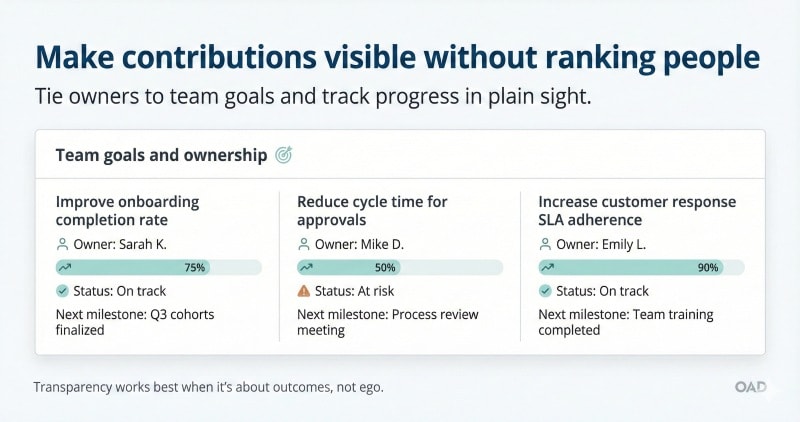
Make individual contributions visible and tied to team goals
Visibility is not micromanagement. It’s coordination.
Publish contributions in a way that helps the team:
- Link work to team goals, not vanity metrics.
- Make progress visible in a shared system (task board, project tracker).
- Avoid ranking people publicly. That fuels politics and kills collaboration.
This is where many teams get it wrong. They try to “increase accountability” by increasing pressure. The smarter move is to increase clarity, then accountability becomes natural.
Motivate team members with autonomy, competence, and feedback loops
Motivation advice is usually useless because it ignores the environment.
What works consistently:
- Autonomy with clear boundaries (what they own, what outcomes matter)
- Competence growth (skill gaps addressed, not ignored)
- Tight feedback loops (fast signal on what’s working)
Deloitte’s research on high-performing teams emphasizes human capabilities like connected teaming and resilience as differentiators, which are strengthened by real feedback and development, not slogans.
Team development stages and targeted interventions
Teams do not become effective by “bonding.” They become effective by reducing friction as the work and relationships evolve, and by using validated psychometric data on how people naturally operate to design roles and interactions.
Use stages as a diagnostic lens, not a personality test.
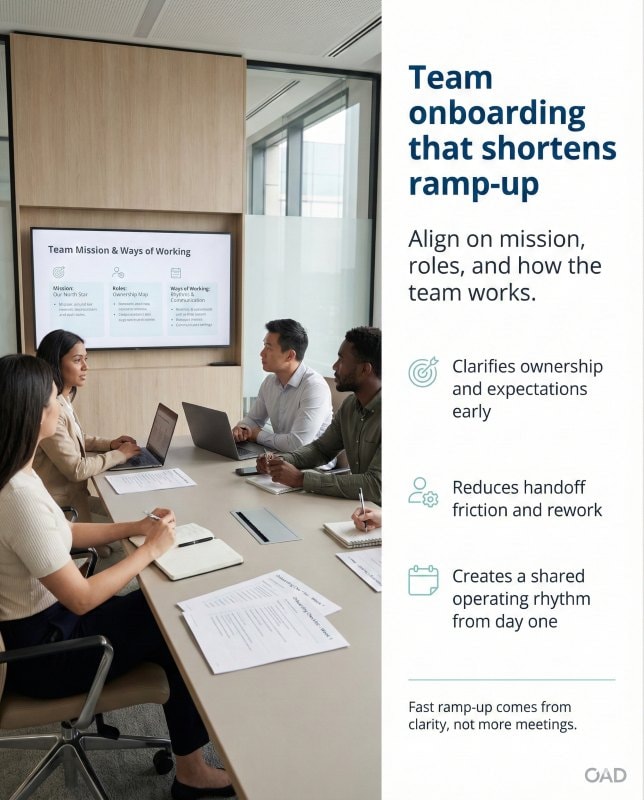
Onboarding to accelerate ramp-up when the team begins or changes composition
Every new hire changes the team’s operating system. Pretending otherwise is how you end up with quiet confusion and performance gaps.
A strong onboarding design includes:
- Team mission and priorities (what matters this quarter)
- Role clarity (what this person owns, what they do not own)
- Decision rights (who decides what, and how fast)
- Tools and processes (how teams work here: updates, task boards, handoffs)
- Relationship map (who to go to for what)
This is “structure and clarity” in practice, which is a consistent driver in Google’s team effectiveness findings.
Storming-to-norming interventions when conflict persists
Some conflict is normal. Persistent conflict is a throughput problem.
If conflict keeps recurring, it is usually one of these:
- unclear roles or overlapping ownership
- unclear priorities or competing incentives
- unspoken norms about communication and feedback
- decisions made without buy-in, then resisted later
A practical intervention looks like:
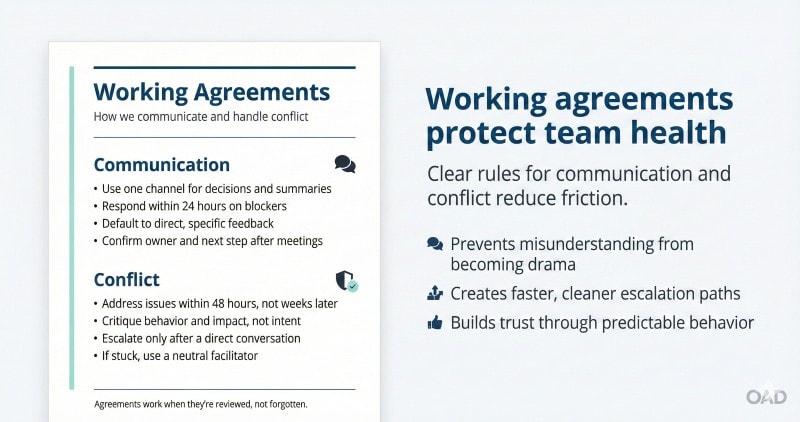
- a short reset workshop focused on roles, decision making, and working agreements
- explicit norms (how we disagree, how we escalate, how we close decisions)
- a commitment to surface issues early, not at the end of a project
Research on high-performing teams highlights proactive tension management as a trust-building behavior. The point is not harmony, it’s faster resolution.
Capability-building based on skill gaps and complementary skills
Skill gaps are not a training problem by default. They are often a workflow design problem.
Start with:
- What work is repeatedly failing or slowing down?
- Which skills would remove that bottleneck?
- Who needs depth vs who needs baseline competence?
Then choose the lightest intervention that solves the constraint:
- pairing or shadowing for fast transfer
- short internal playbooks for recurring tasks
- targeted training when the skill is genuinely missing across the team
Deloitte’s work on high-performing teams emphasizes human capabilities and learning agility as differentiators, which is consistent with building competence deliberately instead of hoping it appears.
Strengthen team relationships without wasting everyone’s time
Relationship strength matters because it reduces coordination cost. But most relationship-building is poorly designed.
Use work-based relationship building:
- short “how I work” profiles (communication preferences, escalation style)
- explicit “working agreements” (response times, meeting norms, feedback rules)
- regular retrospectives focused on friction, not feelings
Google’s model points to psychological safety as a meaningful condition for team effectiveness, and that is built through consistent behaviors, not forced vulnerability exercises.
How teams work: rituals, tools, and processes
Teams don’t “work well” because they have good intentions. They work well because they have a repeatable operating rhythm that makes progress visible and problems hard to hide.
This section is the boring core. It’s also the part that actually changes outcomes.
Weekly review rhythm for progress checks and problem solving
A weekly review is not a status meeting. It’s a control system.
Agenda that works:
- What outcomes were achieved last week?
- What is the team committing to this week?
- What is blocked (and who owns unblocking)?
- What decisions are needed (and by when)?
Keep it short. The purpose is to maintain visibility and clear obstacles before they become delivery failures.
This also supports dependability, which Google identifies as a core condition for effective teams.
Standardize async updates to increase visibility (especially for virtual teams)
Async updates are the difference between a distributed team that operates and one that slowly dissolves into confusion.
Standardize:
- Where updates live (one system, not five)
- When updates happen (set a cadence)
- What format updates use (short template)
Template example:
- What I completed
- What I’m doing next
- What’s blocked
- What decisions I need
This reduces meeting load and increases clarity across time zones. It also prevents the classic failure mode where the loudest person becomes the source of truth.
Use a visible task board for the entire team (single source of truth)
If work is not visible, you cannot manage it.
Your task board should show:
- all active work (not just what leaders think is active)
- owners for each item
- status (not vague, use clear stages)
- blockers
- due dates only where they matter
Avoid the trap of making the board perfect. Make it honest.
A visible board also makes “shared responsibility” problems obvious, because owners are missing.
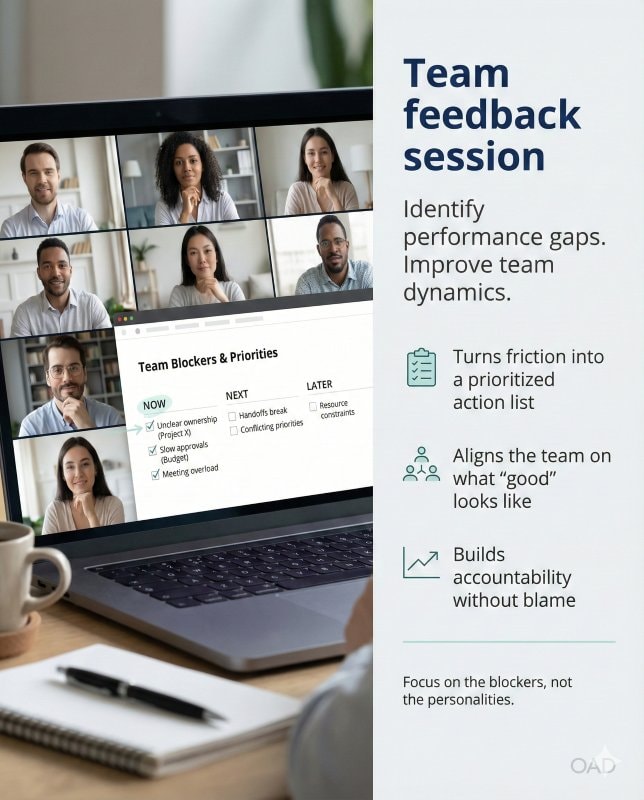
Feedback sessions that improve performance, not morale theater
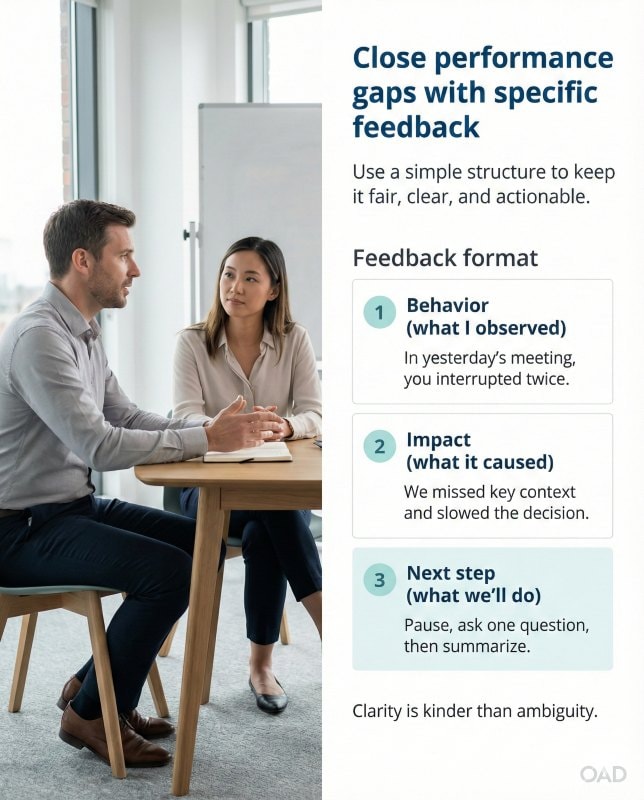
Feedback is operational when it:
- is specific (one behavior, one impact)
- happens close to the event (fast feedback loops)
- ties to standards (definition of done, team charter behaviors)
- includes next steps (what changes, who owns it)
HBR’s trust research points to keeping colleagues informed and managing tension proactively as behaviors that separate high-performing teams. Feedback sessions are where you make those behaviors normal.
Set performance goals and KPIs
If your goals are vague, your KPIs become decorative. If your KPIs are decorative, people default to opinions. Then you get politics instead of performance.
Good goals make trade-offs explicit and make progress measurable.
Set three SMART performance goals per quarter
Three is enough to focus. More than three usually means none of them matter.
A SMART team goal should be:
- specific (one outcome)
- measurable (clear metric)
- achievable (given constraints)
- relevant (tied to organizational outcomes)
- time-bound (within the quarter)
Examples (adjust to context):
- Reduce cycle time for priority work from X to Y by end of quarter.
- Improve delivery reliability from X% to Y% for committed milestones.
- Reduce rework rate (or defect leakage) by X% without reducing throughput.
When you use numbers, they must come from your baseline. Don’t import targets from someone else’s business.
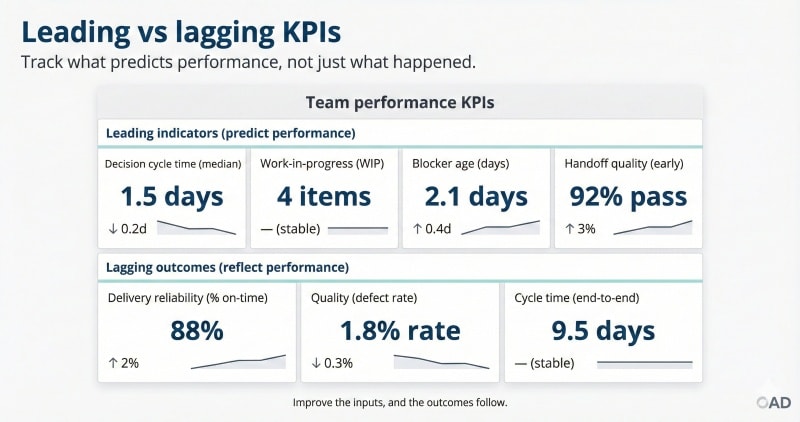
Leading vs. lagging KPIs
Lagging KPIs tell you what happened. Leading KPIs tell you what is about to happen, and you can tie both to scalable behavioral insight tools and pricing plans for different team sizes.
Lagging KPIs (outcomes):
- delivery reliability (commitments met)
- quality outcomes (defects, incidents, escalations)
- customer impact (complaints, churn drivers, satisfaction trends)
Leading KPIs (predictors):
- cycle time
- work in progress
- decision latency
- blocker age (how long blockers sit unresolved)
- rework signals early in the process
Use one or two of each per goal. If you track everything, you manage nothing.
Assign owners and review KPI progress weekly
A KPI without an owner is a chart with feelings.
For each KPI:
- assign one owner responsible for updates and interpretation
- define the weekly review rhythm (where it’s discussed and what decisions follow)
- set trigger thresholds (what “off track” means and what happens next)
Weekly review matters because it keeps the system honest. Quarterly reviews are post-mortems.
Close performance gaps with data, not opinions
When a KPI is off track, ask these in order, and consider whether behavioral fit for key roles or emerging risk signals like burnout and disengagement are part of the underlying issue:
- What changed in the work, the team, or the constraints?
- Which driver is most likely responsible (clarity, decisions, handoffs, skills, capacity)?
- What is the smallest intervention we can test in the next 2–4 weeks?
This is where OAD’s positioning fits naturally: performance issues often trace back to persistent misfit between role demands and how people naturally work. If a team keeps stalling around decision making, conflict handling, or collaboration, that’s not always a “training” problem. Sometimes it’s role fit and team composition.
Design teams with data, not gut feel.
Most org-design decisions come down to role fit, leadership style, and team dynamics. OAD reads those signals from a 7-minute behavioral survey, so you can reconfigure roles and teams with evidence instead of guesswork.
Scaling to a high performing team culture
Scaling is where good ideas go to die. Not because people hate improvement, but because rollout usually ignores context and overloads managers.
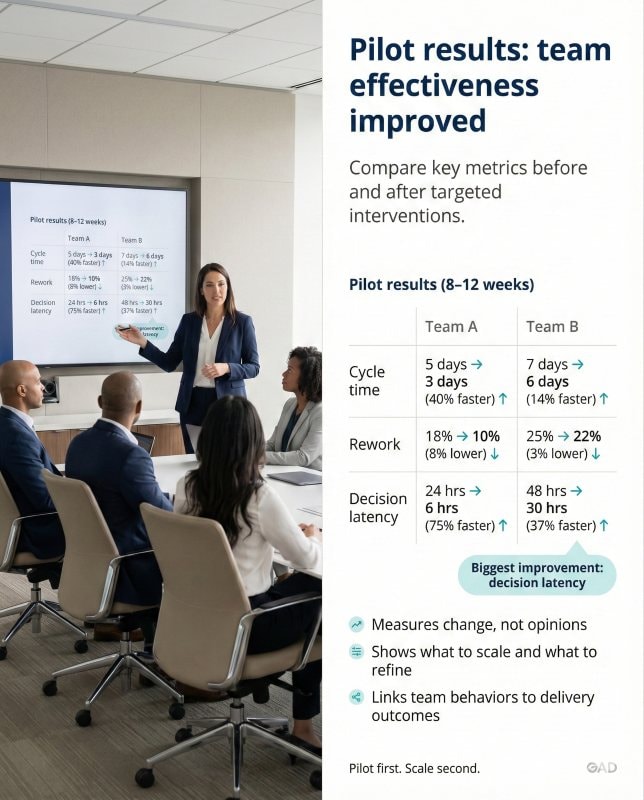
Treat scaling like product rollout: pilot, measure, adapt, then expand.
Pilot team-effectiveness programs with high-impact teams first
Start with teams that meet two conditions:
- Their outcomes matter (revenue, customer impact, operational risk).
- Their leadership is willing to run a real improvement cycle (measure, change, review).
Pick one or two drivers and run the loop for 6–8 weeks:
- baseline metrics
- intervention
- weekly review
- post-pilot readout
This prevents the classic mistake: rolling out a “program” before you know what actually works in your org.
Create a train-the-trainer rollout for broader adoption
If everything depends on one HR person, it will not scale.
Train internal facilitators (HRBPs, ops leads, senior managers) on:
- how to run a diagnostic
- how to map results to drivers
- how to choose one intervention and measure it
- how to run weekly reviews and retrospectives
Give them templates, not theory:
- team charter template
- decision-rights template
- weekly review agenda
- experiment plan template
Embed team health metrics into performance reviews responsibly
This is where people get stupid.
If you turn team health into a blunt rating tool, you will get fake survey data and risk-avoidance behavior. Instead:
- use team health as a diagnostic and improvement input
- focus on trends, not single snapshots
- evaluate leaders on whether they run improvement cycles, not whether their scores are “perfect”
Use team health measures to trigger support, not punishment.
Keep what works: scale only what demonstrably improves overall performance
Your scaling rule:
- if an intervention improves a leading KPI (like cycle time or decision latency) and the lagging KPI (delivery reliability or quality), it graduates
- if it doesn’t, kill it or modify it
This is how you avoid turning “team effectiveness” into an endless initiative with no outcome.
Key takeaways
Prioritize team health behaviors over individual heroics
If you need heroics to hit targets, the system is broken. High performance should look boring: consistent, predictable, repeatable.
Focus interventions on measurable drivers of team effectiveness
Don’t launch programs. Change one driver, measure, then decide.
Iterate quickly and scale what demonstrably improves team success
Short cycles beat long initiatives. Always.
FAQ: Team performance and performance management questions
What are the 5 C’s of performance management?
There isn’t one universal, globally agreed “5 C’s” model. Different frameworks use different C-words.
The version that’s most useful in practice is this:
- Clarity (expectations, role, goals)
- Consistency (regular check-ins, fair standards)
- Coaching (development, skill gaps, feedback)
- Communication (timely, specific, two-way)
- Consequences (reinforcement, accountability, decisions)
If your organization uses a specific 5 C’s model, standardize it and teach it. The content matters less than consistency and follow-through.
What are the four pillars of team performance?
A practical four-pillar model that maps to real drivers:
- Clear goals and role clarity
- Strong execution system (rituals, task visibility, ownership)
- Fast decision making (decision rights, escalation, governance)
- Trust and communication (psychological safety, conflict handling, feedback loops)
If one pillar is weak, you’ll see it in cycle time, rework, missed deadlines, or morale.
How do you improve team performance (fast) without burning out the team?
Fast improvement is about removing friction, not adding effort:
- cut work in progress
- clarify ownership
- shorten decision cycles
- standardize async updates
- run one 2–4 week experiment tied to one KPI
If the only way to “improve performance” is longer hours, you’re borrowing from the future.
What metrics should you track to measure team effectiveness?
Pick a small set:
- delivery reliability (commitments met)
- cycle time (speed of execution)
- quality and rework (defects, incidents, escalations)
- decision latency (time to resolve key decisions)
- team health trend (pulse on clarity, workload, psychological safety)
Track them weekly. Review them weekly. Otherwise they’re just decorations.
How do you improve team dynamics in cross functional teams?
Start with structure:
- shared objectives tied to organizational outcomes
- clear decision rights
- an escalation path with time limits
- visible work and owners across functions
Then improve behaviors: feedback norms, conflict handling, and communication cadence. Dynamics improve when the system stops rewarding ambiguity.
Conclusion: a practical next step for leaders
If you want better team performance, stop looking for the perfect workshop. Run a diagnostic, pick one driver, change one behavior, measure it, repeat. For founders, CEOs, or PE partners steering that change, this means combining long-term-fit hiring and promotion decisions with behavioral due diligence on leadership teams in deals and, for smaller firms, applying the same discipline when you hire your first employee and design your initial team.
If you want to replace gut feel with structured data, start with the free Top Performer Profile and its psychometrically validated decision-making framework, and compare your next hires and internal team placements with evidence, not assumptions.