AI is already inside most talent acquisition functions, whether your HR teams planned for it or not. It shows up as resume screening, sourcing recommendations, interview scheduling, candidate engagement chatbots, and now generative AI that drafts job descriptions and outreach in seconds.
Used well, AI can reduce repetitive tasks, shorten time to hire, and bring more consistency to early-stage decisions. Used poorly, it can harden bias, leak sensitive data, and give hiring managers a false sense of certainty.
AI in Talent Acquisition: How It’s Changing Hiring Decisions
Artificial intelligence recruitment tools increasingly shape who gets seen, who gets shortlisted, and how quickly candidates move through the recruitment process. The biggest shift is not “AI replacing recruiters.” It’s artificial intelligence changing the inputs humans use, especially in high-volume roles, and organizations that leverage AI in talent acquisition can gain a significant competitive advantage.
The rapid evolution of HR technology, driven by artificial intelligence, has transformed recruitment, retention, and HR decision-making processes in recent years.
Where generative AI adds value in recruiting
AI technology can enhance candidate experience and reduce recruitment costs when used for tasks like job posts and candidate outreach. Generative AI is strongest where the output is text or summarization: job posts, candidate outreach, interview notes, candidate FAQs, and internal status updates. It is not inherently good at judgment.
The biggest risks to manage during AI adoption
The risks are predictable:
- Bias and uneven outcomes (often inherited from training data, proxy variables, or as inherited bias in AI systems because algorithms are created by humans, who may unintentionally embed their biases into the technology, leading to unfair hiring practices)
- Privacy and compliance issues (especially with candidate data)
- Over-automation, where human judgment quietly disappears
A useful framing is the NIST AI Risk Management Framework, which organizes risk work into governance, mapping context, measuring risk, and managing it across the lifecycle. As many organizations implement AI at scale in talent acquisition, they are starting to encounter challenges such as data integration, algorithm biases, and the necessity for human oversight.
Responsible AI use is essential, with transparency around the use of data and algorithms in AI recruitment being critical to build trust with candidates and mitigate ethical risks.
What is AI in talent acquisition
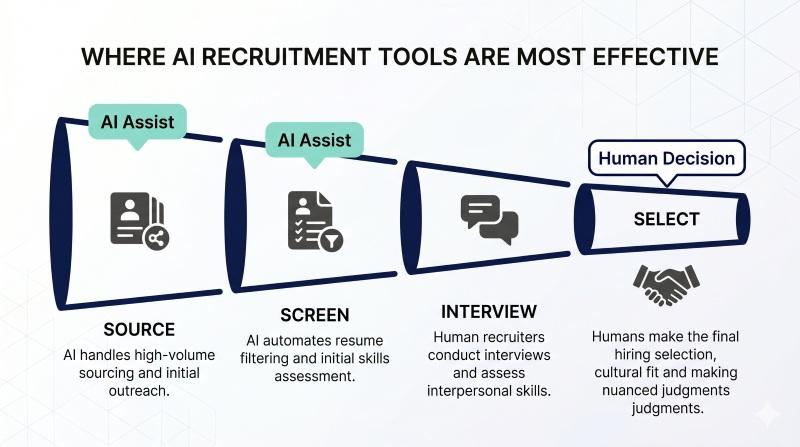
AI in talent acquisition means using artificial intelligence—specifically algorithms and AI models—to support parts of the hiring process: sourcing, screening, scheduling, evaluation support, and analytics. “Support” matters here. In most responsible setups, the system assists and humans decide.
AI models are often used for predictive analytics in recruitment, helping to improve hiring quality and support more objective decision-making, especially when paired with scalable behavioral insight plans.
Generative AI vs. predictive analytics vs. machine learning
- Generative AI produces content (text, summaries, suggestions). It’s useful for drafts, not verdicts.
- Predictive analytics estimates likelihoods (for example, the probability a candidate progresses, or a forecast of pipeline health).
- Machine learning is the broader set of methods that learn patterns from data to make predictions or classifications.
What “AI-powered tools” typically do
In practice, AI-driven recruitment tools usually do one of these:
- Rank or recommend (candidates, job matches, outreach targets)
- Classify (screening flags, skill tags)
- Automate coordination (schedule interviews, reminders)
- Summarize (resume highlights, interview notes)
- Report (dashboards, funnel diagnostics)
Many applicant tracking systems now integrate AI to automate resume screening, enhance candidate matching, and streamline the recruitment process.
Where AI fits in the hiring process
AI applications work best when the process is already structured. If your hiring practices are chaotic, AI will just scale chaos.
- Sourcing and attraction: talent sourcing, matching candidates, personalized job recommendations. AI solutions can automate sourcing through job boards and other channels, streamlining the initial stages of recruitment.
- Screening and shortlisting: resume screening, knockout questions, early-stage ranking.
- Interviewing and evaluation: interview scheduling, structured note support, consistency checks.
- Selection and offer: decision support, comp comparisons, approvals routing.
- Onboarding and early signals: workflow automation, early retention signals (with caution) supported by risk and readiness alerts.
AI-driven recruitment processes can streamline candidate screening and other time-intensive tasks like sourcing, resume screening, and interview scheduling. This allows recruiters to focus on high-impact activities and leads to faster time-to-fill for open positions.
The most common AI recruitment tools (by function)
Most TA technology stack discussions get messy because people mix “tool category” with “vendor brand.” For decision-making, function is the cleaner view.
Leveraging AI tools can enhance talent acquisition strategies by improving efficiency, supporting better decision-making, and elevating the candidate experience, making AI a transformative force in recruitment processes.
Resume screening
AI-assisted resume screening can tag resumes, highlight relevant experience, and reduce manual review time. The risk is proxy bias (for example, penalizing non-linear careers) and over-weighting prestige signals.
Matching candidates and talent sourcing
AI tools help quickly identify and prioritize top candidates, ensuring that the best-fit applicants are engaged before competitors can secure them. AI can improve the quality of hires by helping organizations discover the right candidates with less effort compared to traditional manual processes, and 74% of companies reported that AI has improved their quality of hire by providing more objective data-driven insights into candidate selection.
Design teams with data, not gut feel.
Most org-design decisions come down to role fit, leadership style, and team dynamics. OAD reads those signals from a 7-minute behavioral survey, so you can reconfigure roles and teams with evidence instead of guesswork.
These tools recommend qualified candidates and surface passive candidates by pattern matching across profiles, skills, and job descriptions.
Candidate engagement
AI-powered chatbots and messaging tools handle FAQs, status updates, and basic qualification. They can improve responsiveness, but they can also feel cold or misleading if you do not disclose AI use.
Interview scheduling
Low risk, high value. Automate scheduling, reminders, rescheduling, and time zone coordination. This is where “leverage AI” is almost always rational.
Interview support and analysis
AI in talent acquisition can assist in analyzing interviews by reviewing interview data to reduce bias and improve the hiring process. This ranges from structured interview note templates to analysis of transcripts. Treat anything that claims to “read personality” or “predict fit from facial cues” as high risk and likely indefensible.
Reporting and predictive analytics
Dashboards can identify funnel drop-off, source quality, and recruiter capacity constraints. Predictive analytics can be useful, but it is easy to confuse correlation with truth.
Generative AI workflows that actually work
Generative AI becomes useful when you treat it like a drafting assistant with strict review rules.
Job descriptions and job posts
Use generative AI to draft and refine job descriptions, then enforce a human review checklist:
- Role outcomes are measurable
- Requirements are realistic (no “10 years” for a 3-year-old tool)
- Language is inclusive and compliant
- Must-haves vs. nice-to-haves are separated

Outreach and candidate engagement
Use it for first drafts, not final sends. Review for tone, accuracy, and legal risk. Generative AI is notorious for confidently inventing details.
Summaries and recruiter productivity
Summarize resumes, interview notes, and hiring manager feedback into structured formats. This can reduce repetitive tasks without touching decision rights.
If your goal is better decision making, pair content automation with structured, validated evaluation such as the OAD Survey personality assessment. You can test OAD to see how data-driven trait insights compare to gut feel in your next shortlist.
Metrics that prove AI is helping (not just “busy”)
Baseline first
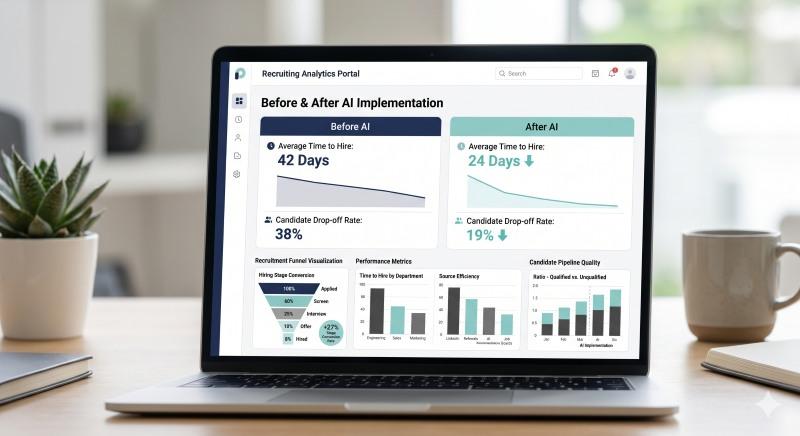
Before implementing AI tools, capture baseline metrics for the same roles and teams. Otherwise, every “improvement” is storytelling.
Core efficiency metrics
- Time to hire and time in stage: AI-powered tools and chatbots streamline candidate communication and automate repetitive tasks, making them highly effective in reducing time to hire.
- Funnel conversion rates by stage
- Recruiter workload and throughput
AI can reduce cost-per-hire by as much as 30% by automating repetitive tasks and allowing recruiters to focus on high-value activities.
Outcome metrics
- Early retention (30/90 days) by role and source, informed by motivation and driver insights
- Hiring manager satisfaction (structured, not vibes-based), including how well new hires demonstrate communication skills assessed during interviews
- Quality of hire proxies (role-specific performance signals)
Design teams with data, not gut feel.
Most org-design decisions come down to role fit, leadership style, and team dynamics. OAD reads those signals from a 7-minute behavioral survey, so you can reconfigure roles and teams with evidence instead of guesswork.
Candidate experience indicators
- Response time
- Drop-off rates during screening and interview scheduling
- Complaints or confusion about AI use
Risks: bias, privacy, and degraded decision-making
Where bias enters
Bias often appears through:
- Training data that reflects historical inequities
- Proxy variables (school, zip code, employment gaps)
- Feedback loops (models trained on past “successful” hires)
- Human behavior copying AI outputs (automation bias)
Research continues to show that people can mirror biased recommendations from AI systems, which is exactly why “human in the loop” is not enough unless the loop has controls.
Privacy and compliance (global view, US-lean)
Rules vary, but the direction is consistent: more transparency, more accountability, tighter controls on automated decision support.
In the EU, many recruitment and employment AI use cases are treated as high-risk, with explicit expectations for effective human oversight.
In the US, requirements are fragmented by jurisdiction. A concrete example is NYC’s Local Law 144 approach to “automated employment decision tools,” including notice and bias audit requirements.
Over-automation and false confidence
The most common failure mode is not malicious bias. It’s quiet erosion of human judgment:
- Recruiters stop reading full profiles
- Hiring teams accept rankings as truth
- Exceptions disappear (“the system didn’t pick them”)
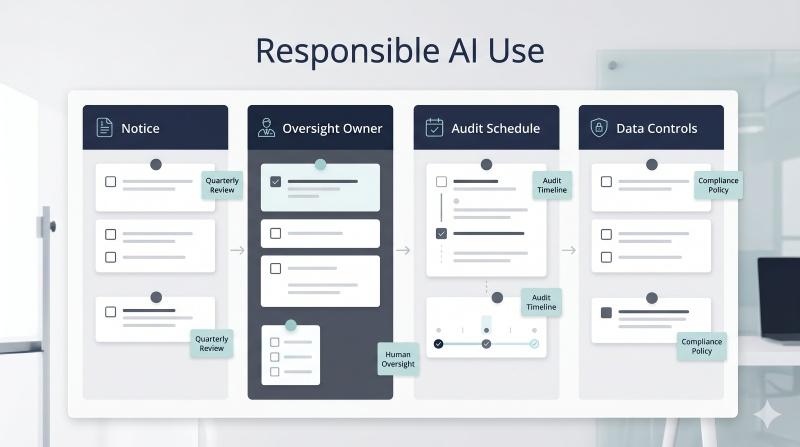
Responsible AI in recruiting (minimum viable governance)
If your governance plan is “we trust our vendor,” you do not have governance. Equipping leaders and coaches with behavioral coaching insights makes it easier to apply governance in day-to-day decisions.
Responsible AI use is crucial in addressing the challenges and pitfalls of implementing AI in talent acquisition. To ensure effective and ethical implementation, organizations should focus on strategic AI adoption, which involves a structured and intentional approach with a clear action plan.
Use a lightweight version of established frameworks. NIST AI RMF is a solid baseline for organizations that want a practical structure without a full compliance theater.
Minimum viable governance includes:
Human oversight and accountability
- Define which steps AI can assist and which steps require human sign-off, emphasizing that evaluating candidates and making strategic hiring decisions benefit from human insight and a human touch to ensure a good fit and foster genuine connections.
- Assign owners for model monitoring and escalation
- Document decision responsibility (especially when challenged)
The EU AI Act’s human oversight framing is a useful benchmark even outside Europe: systems should be designed so humans can effectively oversee them during use.
Transparency to candidates
- Tell candidates when AI is used in screening or assessment support
- Explain what data is used at a high level
- Provide a channel for questions
Audit cadence and drift checks
- Review pass-through rates across demographic groups where legally permitted
- Monitor changes in model behavior over time
- Revalidate after major workflow or data changes
AI implementation roadmap for TA teams
1) Pick one workflow to pilot
Choose a narrow use case with measurable impact. Good pilots:
- Interview scheduling automation
- Drafting job descriptions with structured review
- Candidate FAQ automation with clear disclosure
- Resume screening assist with strict human review rules
2) Integrate with ATS and the TA technology stack
Keep data flow simple. Minimize copying candidate data into random tools. Prefer integrations that keep data inside controlled systems.
3) Define success metrics and stop rules
Success metrics should include:
- Efficiency (time to hire, time in stage)
- Quality proxies (retention, hiring manager scorecards)
- Fairness checks (where possible)
Stop rules matter: what evidence would make you pause, rollback, or redesign?
4) Iterate with structured reviews
Run reviews with recruiting teams, HR professionals, legal, and hiring managers. Make misuse visible early.
How to evaluate AI recruitment tools (vendor due diligence)
Data sources and governance questions
Ask vendors:
- What data trains the system?
- What data is stored, and for how long?
- Can data be deleted on request?
- How do they handle customer data separation?
Bias mitigation evidence
Request documentation on:
- Bias testing methodology
- Audit support (especially where laws require it)
- Monitoring approach post-deployment
If you operate in NYC, Local Law 144-style bias audit expectations are not theoretical.
Security, integration, support, total cost
Evaluate:
- SSO, access controls, logging
- Integration effort with ATS
- Ongoing monitoring costs
- Training and change management requirements
FAQ: AI in talent acquisition
Is AI recruiting legal?
Sometimes, with conditions. Legality depends on jurisdiction and usage. Expect more requirements around transparency, audits, and oversight, especially for systems that materially influence hiring decisions.
How do you prevent bias in AI-driven recruitment?
You do not “prevent” it once. You manage it continuously: control inputs, test outcomes, monitor drift, and keep humans accountable for decisions.
What are the best AI tools for talent acquisition?
The best tools are the ones that solve a specific bottleneck in your hiring process and can be governed. Low-risk, high-value categories include scheduling and workflow automation. High-risk categories include automated ranking without transparency.
How do you measure whether AI improves hiring outcomes?
Track baseline metrics first, then measure changes in time to hire, funnel conversion, early retention, and structured hiring manager evaluations. Avoid vanity metrics.
Will AI replace recruiters or hiring managers?
AI will replace unstructured, repetitive work faster than it replaces decision-makers. Hiring decisions still require accountable humans, especially as regulation tightens around oversight.
Next steps with OAD
AI can make recruiting faster. It does not automatically make it more accurate.
If you want AI adoption to improve hiring outcomes, focus on two things:
- Automate the low-risk operational load (scheduling, comms drafts, summaries).
- Strengthen evaluation quality with structured, validated signals.
OAD fits into the second category: a scientifically validated behavior fit assessment layer that helps hiring teams evaluate candidates consistently, with transparency and human oversight using behavioral team insights software. If you want to see how it performs in your own roles, you can test OAD and compare candidates with data instead of gut feel.