Organizational Design Best Practices: What is Organizational Design?
Organizational design is the deliberate way you shape roles, teams, decision rights, and workflows so your business model can execute. It is guided by fundamental principles that ensure alignment with strategic goals and adaptability in a changing environment. Effective organizational design requires careful planning, including thorough assessment, strategic goal-setting, stakeholder involvement, and ongoing adjustments. Before making design decisions, it is essential to gain insights into the current state of the organization through data collection and analysis. Organizations develop structures, strategies, and processes through deliberate design efforts to better align with their objectives. The ultimate aim is to create an effective organization capable of achieving its mission and business objectives.
Why organizational design must align with business strategy
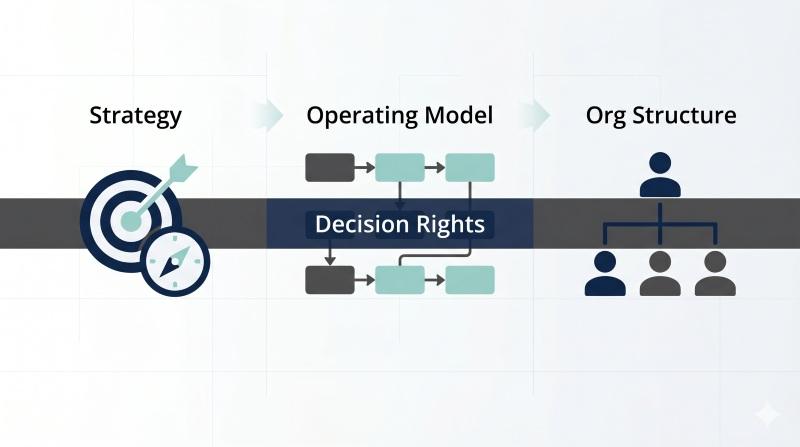
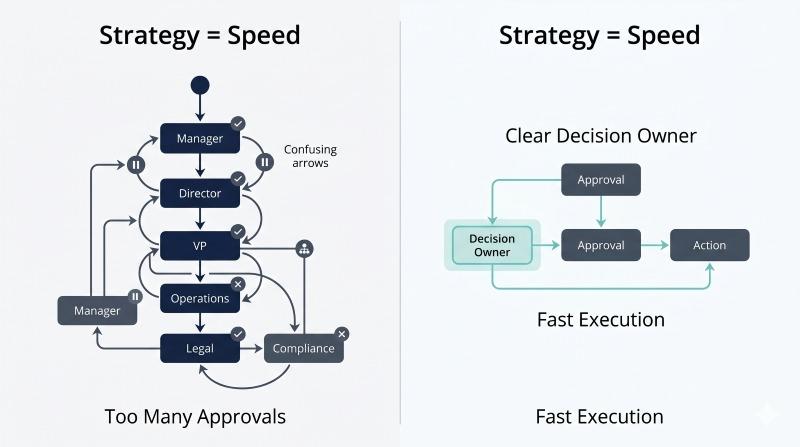
If your strategic priorities say “speed,” but your organizational structure adds approvals and handoffs, the strategy loses. The structure must be intentionally aligned with your objectives and the organization’s strategic goals, ensuring that every element supports what matters most. A clear focus on strategic priorities—such as internal versus external orientation or market focus—is essential for effective alignment and adaptability. Same for “innovation” inside a structure that punishes risk, or “customer value” inside a design that optimizes internal departments over end-to-end delivery.
Organizational strategy is the most important starting point for organizational structure and design, as it determines the optimal design based on the company’s vision, mission, and goals.
Two things make misalignment expensive:
- Reorgs are common and often under-deliver. McKinsey reports that less than a quarter of organizational redesign efforts succeed.
- Uncertainty reduces productivity. HBR notes that reorg uncertainty is linked to noticeably reduced productivity in about 60% of cases.
So the goal is not “a cleaner org chart.” The goal is strategic alignment: your structure, decision-making processes, and operating model should make it easier to achieve strategic goals with less friction.
Strategy dictates structure (not the other way around)
Start with what the business must win at:
- Value proposition: what customers pay for, and why you beat alternatives
- Competitive advantage: speed, quality, cost, specialization, trust, access, brand
- Strategic goals: growth, retention, margin, expansion, product shifts, new channels
- External environment: regulation, talent market, technology shifts, supply constraints
These elements should be aligned with the organization’s objectives to ensure the structure supports performance, efficiency, and long-term success.
The five factors that greatly impact organizational design are strategy, environment, technology, size and life cycle, and culture.
Then translate that into design choices:
- Where you need fast decisions, reduce layers and clarify decision rights.
- Where risk is high, centralize critical standards but keep execution close to customers.
- Where scale matters, standardize support functions and core processes.
Competitive advantage comes from execution, not diagrams
Most “organization design” failures are really execution failures:
- unclear responsibilities
- too many direct reports with no management capacity
- duplicated work across business units
- slow decision making because no one owns the call
- operating models that don’t match the business model
Effective organizational design should prioritize long-term effectiveness, ensuring that changes support sustainable results and adaptability rather than just short-term fixes. Improved efficiency in organizational design eliminates, streamlines, and reduces redundancy in processes, saving time and lowering operational costs.
Design has to make execution easier. Otherwise you get a prettier chart and the same missed opportunities.
How people analytics improves organizational design decisions
Good org design uses data to answer two questions:
- Where is the work breaking down? (structure and process)
- Why are people struggling in roles? (role fit, capability, motivation)
By collecting and analyzing data, you gain insights into your organization’s strengths and weaknesses, which informs better design decisions. Gathering feedback from stakeholders at all levels—including leadership, management, and staff—is crucial for identifying areas where the organizational structure may hinder performance.
People analytics helps you move from opinions to evidence:
Use workflow and performance data to spot bottlenecks
Look for signals that the current organizational structure is fighting the work:
- cycle time increases (decisions, approvals, delivery)
- rework rates and quality escapes
- overload in specific roles or teams
- coordination costs (meetings, escalations, “alignment” time)
- uneven performance measures across similar teams
This tells you where the design is creating friction in customer value delivery.
Use behavioral data to reduce role-fit risk
Structure changes fail when the people side is treated as an afterthought. Gartner finds only 32% of leaders globally get employees to adopt changes in a healthy way. That’s not a motivation problem. It’s usually a design and enablement problem.
Behavioral and role-fit data helps you:
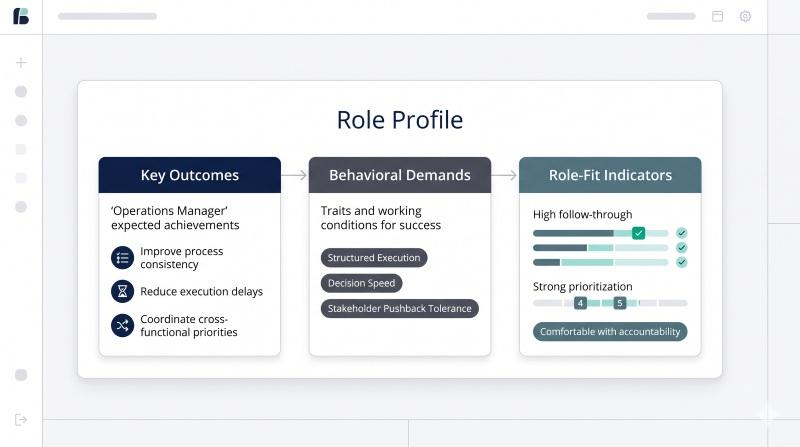
- match responsibilities to the behavioral demands of the role
- identify where managers will struggle with decision load
- reduce burnout risk created by unclear priorities and constant escalation
- avoid putting “nice on paper” leaders into roles that require speed, conflict tolerance, and accountability
This is where OAD’s angle matters: use structured behavioral assessment results from a clinically validated OAD Survey as one input to validate whether your new roles are realistic for the people you have (and the people you plan to hire).
Design teams with data, not gut feel.
Most org-design decisions come down to role fit, leadership style, and team dynamics. OAD reads those signals from a 7-minute behavioral survey, so you can reconfigure roles and teams with evidence instead of guesswork.

Fundamental organizational design principles
These are the fundamental principles that hold up across industries, geographies, and operating models. The twelve fundamental principles of organizational design include alignment with business strategy, specialization, coordination, flexibility, simplicity, customer focus, innovation encouragement, communication, accountability, scalability, employee empowerment, and sustainability. Additionally, Goold & Campbell propose five organizational design principles: specialization, coordination, knowledge and competence, control and commitment, and innovation and adaptation. Ignore any of these fundamental principles and your current design turns into a weekly firefight.
Clear roles, responsibilities, and decision rights
- Every critical outcome needs a clear owner.
- Every team needs an explicit scope.
- Every decision needs a named decision-maker, not “the group.”
If you cannot answer “who owns this” in 10 seconds, you have a design problem, not a “communication issue.”
Fit to the business model and value proposition
Your structure is not a personality test for leadership. It is a tool to deliver your value proposition.
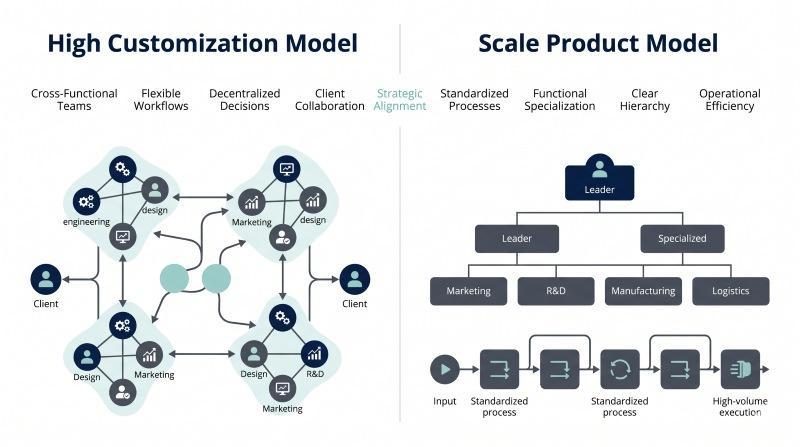
- High customization usually needs tighter customer-facing coordination.
- Scale products usually need stronger standardization and platform thinking.
- Regulated industries need clear control points, not vague “alignment.”
Designed for the external environment
Markets shift. Regulations shift. Talent supply shifts. Technology shifts. Your structure should let you respond without a full reorg every year.
- Keep changeable work modular.
- Reduce dependencies that create delays.
- Make escalation paths short and explicit.
Minimize decision friction and management time
If managers spend most of their week arbitrating unclear ownership, you are burning capacity on avoidable coordination.
Typical symptoms:
- endless pre-meetings
- decisions bouncing between departments
- unclear “direct reports” loads that exceed management bandwidth
- constant “priority resets” with no trade-off decisions
Design should reduce the number of decisions that require senior attention.
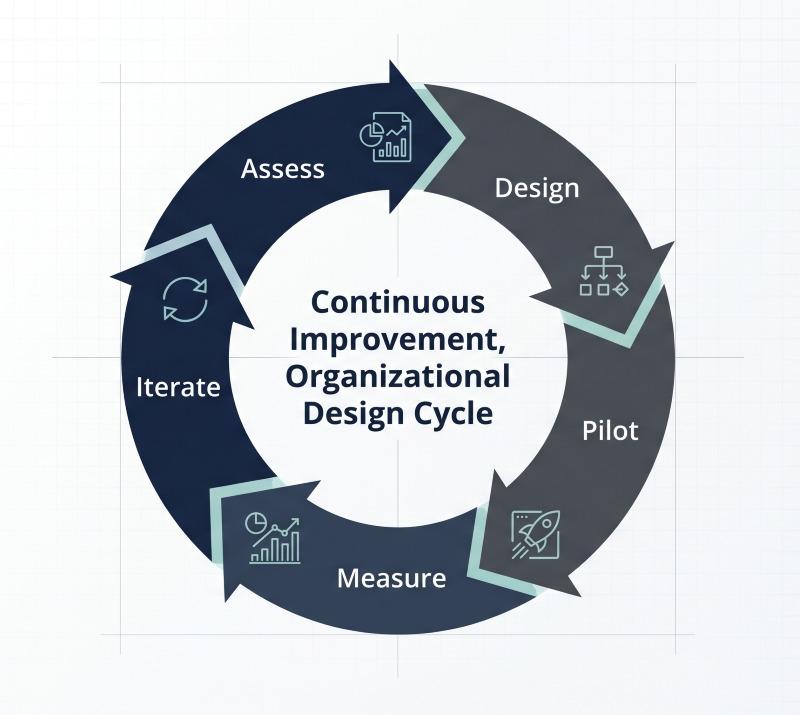
Continuous process, not a one-time project
Org design is closer to product management than architecture. You ship a version, measure it, then adjust.
This doesn’t mean constant churn. It means a stable operating cadence for improvements.
Protect customer value across handoffs
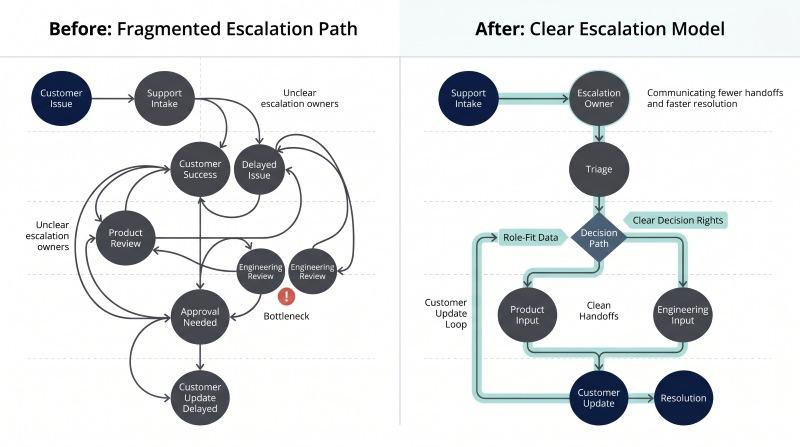
Most customer pain is born in the gaps between teams.
If customer value depends on five teams behaving like one team, you need either:
- fewer handoffs, or
- stronger operating mechanisms (decision rights, shared metrics, clean interfaces)
Organizational design principles checklist (practical)
Use this as a quick diagnostic before you spend months “aligning.” Careful planning is essential when using this checklist—thorough assessment, strategic goal-setting, stakeholder involvement, and ongoing adjustments are crucial to ensure your organizational design aligns with business objectives. Key practices in organizational design include keeping structures simple with minimal layers and fostering cross-functional collaboration.
Role clarity and measurable outcomes
- Each role has a short purpose statement.
- Outcomes are measurable (quality, speed, cost, customer impact).
- Responsibilities do not overlap without an explicit rule for who decides.
Flexibility without chaos
- Teams can adapt quickly without breaking core standards.
- Exceptions have a process.
- Escalation paths exist, and they are used consistently.
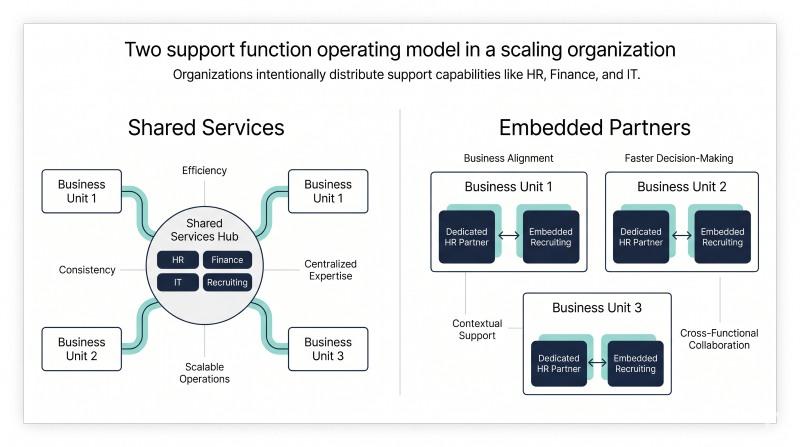
Scalability in structure and operating model
- Support functions (HR, finance, legal, IT) have clear service models.
- Growth does not require doubling meetings and approvals.
- New business units can be added without reinventing the company.
Performance measures tied to strategic goals
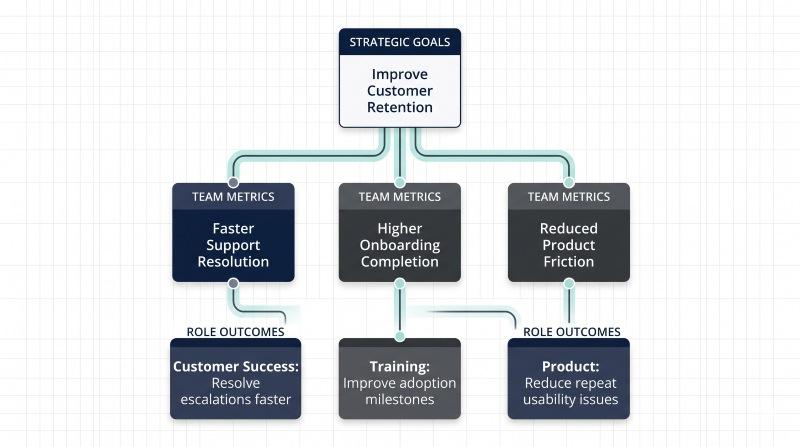
- KPIs map to strategic priorities.
- Teams share at least one metric across handoffs.
- “Local optimization” is actively discouraged by design.
How to align organizational structure with customer value and strategy
This is where most companies lie to themselves. They say “customer-centric” and then organize the whole company around internal departments. Public relations, as a crucial component of organizational structure, plays a key role in marketing and brand management by fostering external communication and strengthening brand reputation. For example, business models targeting retail stores require a tailored organizational design that aligns production, marketing, sales, and public relations functions to the unique needs of the retail environment. Ultimately, organizational strategy is the most important starting point for structure and design, as it determines the optimal organizational design needed to achieve strategic objectives and deliver customer value.
Map structure elements to strategic outcomes
Pick 3–5 outcomes that matter this year (examples):
- shorter lead time
- higher renewal rates
- better quality
- lower cost-to-serve
- faster market entry
Ensure that these mapped outcomes are directly aligned with your organization’s objectives, so that your design efforts support strategic goals and drive meaningful results.
Then map the formal elements that control those outcomes:
- structure (teams, reporting lines)
- processes (handoffs, approvals, planning cadence)
- technology (systems that create or remove friction)
- decision rights (who can commit resources)
When centralization helps (and when it kills speed)
Centralize when:
- you need consistent risk controls
- you need a single standard (pricing rules, security, compliance)
- customer experience breaks when teams diverge
Decentralize when:
- speed and local context matter
- customer needs vary by segment or region
- decisions are reversible and frequent
Hybrid is normal. The trick is to centralize the rule and decentralize the execution.
Operating model vs organizational structure (and why you need both)
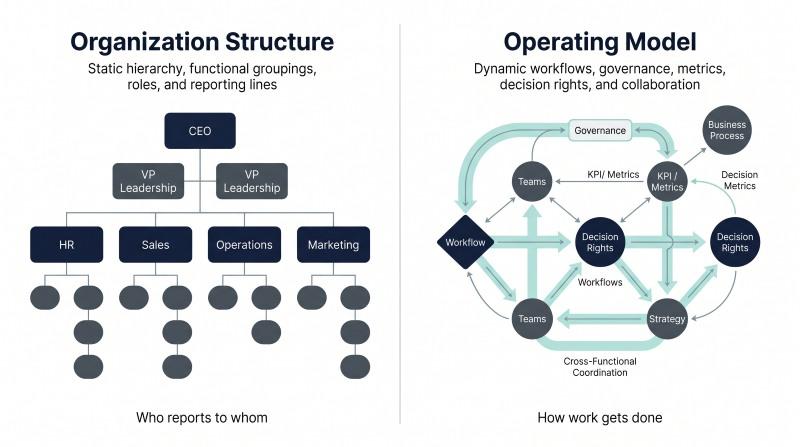
- Organizational structure is who reports to whom and how teams are grouped.
- Operating model is how work happens: decision-making processes, planning, handoffs, metrics, and governance. Technology plays a significant role in shaping the operating model by enabling decentralization and improving coordination through digital tools, which leads to more flexible organizational structures. These digital tools also facilitate external collaboration with partners, clients, and remote teams, enhancing communication and coordination beyond internal boundaries.
Common failure mode: you redraw the org chart and keep the same old operating model. That creates confusion, stress, and performance dips, which is exactly what HBR warns about with reorg uncertainty and productivity decline .
Organizational design process playbook (step-by-step)
Step 1: Document the current organizational structure
Collect:
- current org chart(s), including dotted lines
- role descriptions and actual responsibilities
- list of business units and support functions
- how decisions currently get made (not how it’s “supposed” to work)
Deliverable: a one-page “current state” map.
Step 2: Diagnose the current design with data
Use people analytics to spot where the design is failing and gain insights into the current state by analyzing data such as:
- overload (work hours, span of control, meeting load)
- bottlenecks (queue time for approvals, cycle time)
- performance variance across similar teams
- customer friction signals (tickets, churn drivers, SLA misses)
Keep it directional unless you have clean data. Invented precision is worse than honest uncertainty.
Step 3: Run stakeholder interviews that don’t turn into theater
Interview a sample across:
- executives (strategy and constraints)
- managers (operational reality)
- employees (handoffs, blockers, clarity)
- customer-facing roles (where customer value breaks)
- key support functions (what slows work)
Goal: identify friction patterns, not collect opinions about who should “own” something. During these interviews, focus on building commitment among stakeholders to ensure their engagement and buy-in, which is critical for the successful adoption of organizational changes.
Step 4: Prototype structure options quickly
Sketch 2–4 options in low fidelity:
- functional
- product/customer segment
- matrix (only if you have governance maturity)
- pods/squads
- geography (where relevant)
For each option, define:
- decision rights (who owns what)
- direct reports and spans
- handoffs for customer value delivery
Step 5: Evaluate trade-offs and pick a pilot
Every structure trades something off. Be explicit:
- speed vs control
- innovation vs standardization
- specialization vs flexibility
- global consistency vs local fit
Pick one business unit or region to pilot first.
Gartner’s data on healthy change adoption being achieved by only 32% of leaders is a useful warning here: pilots reduce change risk by shrinking the blast radius. Ensure that the design principles you implement during pilots are chosen to support long term effectiveness, so the organization remains adaptable and sustainable as it scales.
Step 6: Pilot, implement, and scale the new design
A pilot is where most “org design theory” meets reality and gets humbled.
Pilot scope rules (so you don’t accidentally pilot the whole company):
- Pick one business unit, one region, or one end-to-end workflow (for example: lead-to-cash, order-to-delivery, incident response).
- Keep the interfaces stable where possible. Avoid changing five upstream and downstream teams at once.
- Define what “success” looks like in operational terms before you start.
During the pilot, track:
- cycle time and rework
- decision turnaround time
- customer-impact measures (quality, resolution time, retention drivers)
- employee load and engagement signals (meeting time, escalation frequency, overtime patterns)
Implementation sequence that doesn’t create chaos:
- Clarify decision rights and escalation paths first
- Update role charters and responsibilities
- Shift workflows and handoffs
- Update metrics and governance cadence
- Then adjust reporting lines if needed
Step 7: Refine the design based on pilot findings
Most pilots surface predictable gaps:
- decision rights were unclear in edge cases
- managers were overloaded by new responsibilities
- teams optimized locally and broke cross-team flow
- support functions weren’t aligned to the new operating model
Treat this as input, not failure.
Make changes in tight loops:
- fix one bottleneck at a time
- document what changed and why
- keep the operating model stable long enough to measure
Step 8: Scale rollout using phased waves
Scaling is a rollout problem, not an org chart problem.
Wave planning checklist:
- define which teams move in wave 1, 2, 3
- lock the governance cadence and decision owners
- align HR systems (titles, job descriptions, comp bands) before each wave
- train managers on decision rights and responsibilities
People analytics, behavioral data, and role fit
Org design fails when it ignores how people actually behave under real work conditions.
A practical approach is to combine data from systems that give every employee their own secure behavioral profile and insights access:
- work data (performance measures, workflow friction, capacity)
- role data (responsibilities, decision load, stakeholder complexity)
- behavioral data (how people act under stress, ambiguity, conflict, and pace)
Use behavioral assessment results to reduce misalignment
Behavioral data is not there to label people. It’s there to reduce avoidable risk in role placement and hiring.
Use it to answer:
- Does this role demand fast decisions, high conflict tolerance, and strong prioritization?
- Does the incumbent (or candidate) consistently behave that way under pressure?
- Where will the role’s behavioral demands create burnout risk?
This is where OAD fits: use structured behavioral results and Job Behavior Insights role fit reports as one input to validate whether the design is realistic for the people who must execute it.
Correlate motivators with role requirements
If the role requires constant cross-functional negotiation, but the person is motivated by deep independent work, motivation insights from OAD highlight the gap and you get:
- slower decisions
- avoidance of hard conversations
- rising escalation volume
- performance that looks “fine” until it suddenly isn’t
This is not a character issue. It’s a mismatch.
Flag burnout and flight risk with early indicators
You don’t need mind-reading. You need basic signals, especially in high-stakes contexts like post-acquisition private equity integrations:
- persistent overload
- increasing meeting volume with decreasing output
- rising handoffs and escalations
- declining quality or rework spikes
- manager span-of-control creeping upward without support
Use these as prompts, along with Risk & Readiness Alerts that flag burnout and flight risk, to adjust structure, responsibilities, or operating mechanisms before you lose top talent.
Validate leadership potential without gut feel
Leadership in a redesigned organization often requires:
- prioritization under ambiguity
- decision ownership
- accountability without micromanagement
- fast conflict resolution
Behavioral and performance patterns, supported by behavioral tools for data-driven coaching, help you predict who can handle that shift, and who needs support, coaching, or a different role.
Governance, accountability, and decision rights
If decision rights aren’t explicit, you will get informal politics. People will call it “culture.” It’s not. It’s missing structure.
Define governance forums and cadence
Keep it simple. Most mid-sized companies need three layers:
- Weekly execution forum: resolves operational blockers fast
- Monthly performance forum: reviews performance measures tied to strategic goals
- Quarterly design review: assesses whether structure and operating model still fit strategy and the external environment
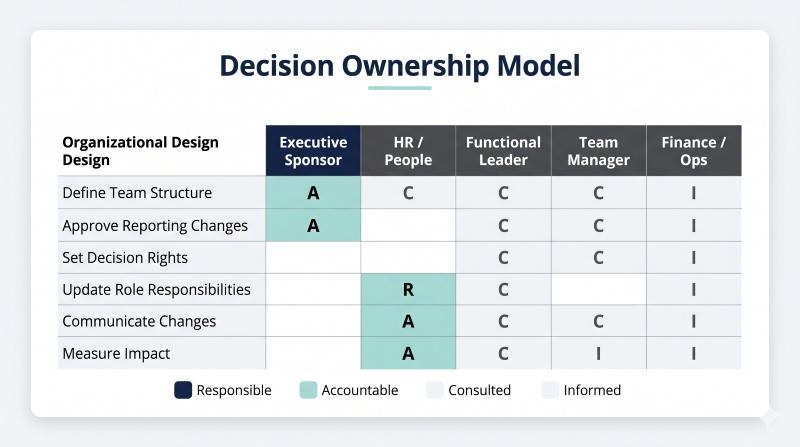
Assign clear decision owners for structural changes
Define owners for:
- role definitions and accountabilities
- team boundaries and interfaces
- operating model changes (handoffs, approvals, planning cadence)
- escalation rules and exceptions
If “everyone owns it,” no one owns it.
Create escalation paths for design conflicts
Escalations should be:
- short (max two hops)
- time-bound (decision SLA)
- documented (so the same conflict doesn’t repeat forever)
HR + COO partnership (strategic advisor model)
In mid-sized companies, the Chief Operating Officer (or equivalent operations leader) often becomes the anchor for operating model discipline. HR and People Analytics should act as strategic advisors by providing, often in partnership with founders and CEOs making long-term fit hiring decisions:
- role architecture
- assessment and role-fit validation
- change enablement support
- measurement discipline tied to strategic priorities
Change enablement, communication, and culture
Change enablement is the part everyone claims to do, then replaces with a slide deck. However, true organizational design best practices require building commitment among stakeholders to ensure successful change enablement and adoption of new strategies.
Craft a simple change narrative for employees
One page. No slogans.
Include:
- what is changing and why (linked to strategic goals)
- what is not changing (stability matters)
- what decisions move faster now (practical benefit)
- what employees should do differently next week
Prepare role-specific FAQs for managers
Managers need answers to:
- what decisions they own now
- what they escalate and to whom
- how performance will be measured
- what “good” looks like in the new responsibilities
Schedule training to support new responsibilities
Training should be functional, not motivational:
- decision-making frameworks and thresholds
- how to run the new governance cadence
- how to use new role scorecards and performance measures
- how to handle handoffs without ping-pong
How to measure if organizational design is working
If you can’t measure it, you can’t manage it. If you measure the wrong things, you reward the wrong behavior.
Set KPIs tied to strategy outcomes
Choose a small set, aligned to strategic priorities:
- customer value measures (quality, retention drivers, time-to-resolution)
- speed measures (cycle time, decision turnaround)
- cost measures (cost-to-serve, rework)
- people measures (retention in key roles, overload signals)
Run quarterly design health reviews
A design review should answer:
- Where is the operating model breaking down?
- Which decision rights are unclear or ignored?
- Which handoffs create customer friction?
- Where is management time being consumed unnecessarily?
- What changed in the external environment that should drive design updates?
Create clear triggers for iteration
Examples of iteration triggers:
- cycle time rises for two consecutive periods
- escalations increase beyond a defined threshold
- customer friction signals spike
- turnover rises in key roles
- duplicated work becomes visible across business units
Case studies, tools, and templates for mid-sized companies
Mid-size SaaS case study (behavioral data applied to design)
Behavioral analytics are also critical when you need to build and lead winning sales teams.
Situation: A growing SaaS company scaled headcount and introduced more layers, but decision speed slowed and customer issues escalated.
What they changed:
- clarified decision rights for product, customer exceptions, and priority trade-offs
- reduced handoffs by creating an end-to-end ownership model for a key customer workflow
- rebuilt role profiles based on actual decision load and stakeholder complexity
- used behavioral assessment results to validate role fit for newly created leadership roles
Result pattern (directional):
- fewer escalations to executives
- faster decisions on customer-impact issues
- clearer accountability and less cross-team ping-pong
- improved retention in critical roles due to reduced ambiguity and overload
No magic. Just less ambiguity, better decision rights, and roles matched to behavioral demands.
Design teams with data, not gut feel.
Most org-design decisions come down to role fit, leadership style, and team dynamics. OAD reads those signals from a 7-minute behavioral survey, so you can reconfigure roles and teams with evidence instead of guesswork.
Templates you should use (and stop improvising)
- Operating model one-pager
- value stream overview
- key teams and interfaces
- governance cadence
- shared metrics
- Decision rights matrix
- decisions that matter
- owner, approver, consulted, informed
- escalation rule
- Role charter template
- purpose
- outcomes and performance measures
- responsibilities and boundaries
- key interfaces and handoffs
- Role-fit evaluation checklist
- behavioral demands
- decision load
- stakeholder complexity
- pace and ambiguity tolerance
Legal, compensation, and HR integration notes
Reorgs break in HR systems when the “people plumbing” gets ignored.
Align compensation changes with new roles
If responsibilities expand, but compensation doesn’t, you create:
- disengagement
- quiet resistance
- attrition in roles you just made more critical
Do a basic comp alignment pass:
- role scope changes
- decision scope changes
- market benchmarking where available
- internal equity review
Update job descriptions and HR systems
Update:
- job descriptions to match actual responsibilities and outcomes
- reporting lines and spans
- performance measures
- recruiting profiles for redesigned roles
This prevents the common failure where the company “changes” but hiring keeps selecting for the old model.
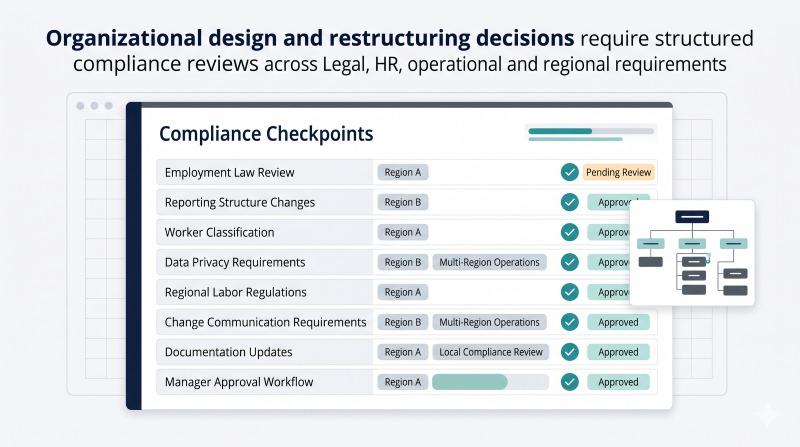
Document compliance checkpoints (global with US tilt)
Keep it principle-based (local counsel handles jurisdiction details):
- ensure role changes don’t violate local labor requirements
- document material changes to role scope and reporting
- track consultation requirements where applicable
- handle redundancy and redeployment processes cleanly and consistently
FAQ (People Also Ask)
For hiring and culture, you can complement org design work with behavioral interview questions that assess cultural fit.
What are the best practices for organizational design?
Align structure and operating model to strategy, define decision rights, reduce handoffs that damage customer value, validate role fit, pilot before scaling, and measure outcomes tied to strategic priorities.
What are the principles of organizational design?
Clarity of accountability, fit to business model, adaptability to the external environment, efficient decision making, continuity through iteration, and protection of customer value across workflows.
How do you align organizational structure with business strategy?
Start with strategic goals and the value proposition, then map the required outcomes to structure choices, decision rights, workflows, and performance measures. Validate with data and pilot before scaling.
What is the difference between an operating model and organizational structure?
Structure is how teams are grouped and who reports to whom. The operating model is how work actually happens: governance, decision rights, workflows, planning cadence, and metrics.
What are the steps in the organizational design process?
Document current state, diagnose with data, interview stakeholders, prototype options, define decision rights and trade-offs, pilot, refine, scale in waves, and run ongoing design health reviews.
How do you measure whether a reorg worked?
Use strategy-linked KPIs: decision speed, cycle time, customer value measures, cost-to-serve and rework, and people signals like overload and retention in critical roles. Review quarterly and iterate based on defined triggers.
Next steps
If you want to reduce org-design risk, don’t rely on opinions and org charts alone. Validate role demands and leadership fit with structured behavioral data from the OAD Survey.
If you’re redesigning teams, changing decision rights, or scaling a new operating model, start with the free Top Performer Profile: 7 minutes, results in 24 hours, no credit card. Explore scalable OAD pricing plans for every team to validate role fit and leadership demands before misalignment turns into turnover and slow execution.