Most organizations do not fail because people “lack talent.” They fail because the organization’s structure makes good work hard: unclear accountability, slow decisions, conflicting priorities, and metrics that reward the wrong behavior.
The goal of principles of effective organization is simple: build an operating environment where strategy turns into execution reliably, and performance improves as an ongoing process, not as a once-a-year reorg.
What are the principles of effective organization?
These guiding principles show up again and again in effective organizations and high performing organizations, regardless of industry. Effective workplace organization relies on clear goal-setting, open communication, delegation, and adaptability. Streamlined processes and clear roles maximize output and efficiency, ensuring that organizations can achieve their goals and continuously improve.
1) Strategic alignment comes first
If your strategic priorities are unclear, the org chart becomes a political map instead of a delivery system. Start by defining a small set of strategic outcomes and translate them into organizational goals each team can own.
Practical test:
- Can every leader explain the top 3 strategic goals in the same way?
- Can teams name what they will stop doing to focus?
2) Clear accountability and decision rights
High performance requires decisions that are fast, high-quality, and consistently executed. When decision rights are vague, everything turns into meetings, escalations, and “alignment theater.” Delegating authority fosters responsibility, accountability, and innovation among employees, empowering them to drive organizational success and continuous improvement.
McKinsey’s research on organizational health and performance repeatedly points to alignment and execution discipline as a driver of outcomes, and notes that investments in organizational health during transformations can materially impact TSR, which is why founders and CEOs benefit from a science-backed system for strategic hiring and leadership decisions.
3) Fit-for-purpose structure
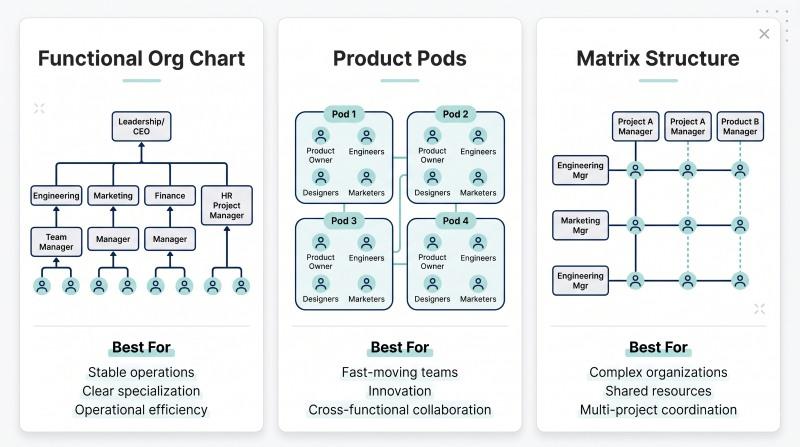
There is no universally “best” organization’s structure. Different structures solve different problems:
- Functional models protect expertise.
- Divisional models protect speed and accountability by market.
- Matrix models increase coordination but raise decision cost.
- Product/pod models increase customer focus but require strong role clarity.
Importantly, structures must be designed to adapt quickly to changes in the environment or market, ensuring the organization remains responsive and resilient.
4) Measurement and feedback loops
You cannot “culture” your way out of missing data. Define a small set of key performance indicators that reflect outcomes, not activity. Then track progress in a regular operating cadence. Effective measurement and analysis of KPIs are crucial for tracking progress towards organizational excellence, enabling data-driven decision-making. Utilize tools such as surveys and data analytics platforms to gather feedback and operational data, supporting continuous improvement.
Gallup’s engagement meta-analysis links engagement to outcomes like productivity, profitability, turnover, and customer metrics, which is why measurement must include people and performance indicators together.
5) Continuous improvement as an operating system
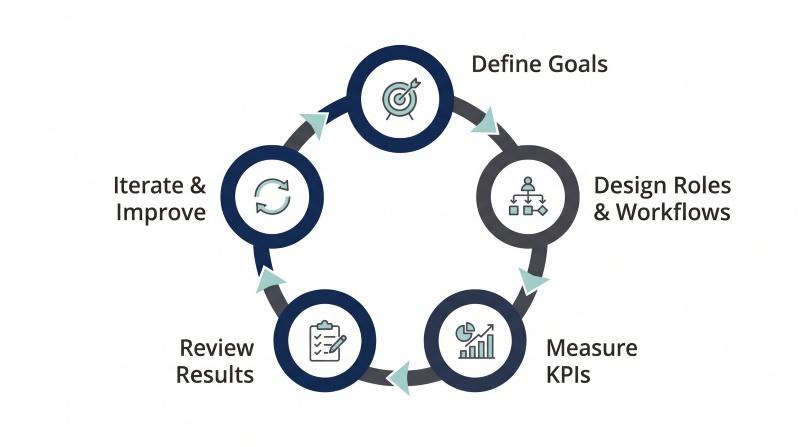
Continuous improvement (and continual improvement) is not a poster. It is a continuous process: review, learn, adjust, repeat. The structure must support it with clear owners, time, and data.
Organizational design principles that hold up in practice
This is where organizational design principles stop being theory and become a design checklist.
Organization development is a field that provides research-backed principles aimed at improving organizational effectiveness, guiding companies to encourage cooperation, foster flexibility, promote growth, and create a leadership-oriented culture to stay competitive and adaptable.
The twelve fundamental principles of organizational design include: alignment with business strategy, specialization, coordination, flexibility, simplicity, customer focus, innovation encouragement, communication, accountability, scalability, employee empowerment, and sustainability.

Design principle 1: Define strategic outcomes and constraints
Write down:
- What must improve (cost, speed, quality, customer satisfaction, innovation)? A clear vision is essential for setting strategic direction and inspiring teams to achieve these improvements.
- What cannot break (compliance, safety, service levels)?
- What trade-offs you accept (for example, slower decisions to reduce risk).
Design principle 2: Align roles and resources to outcomes
A well designed organization has roles that map to outcomes. That means:
- clear responsibilities
- clear authority
- minimal overlap
- explicit handoffs
Engaging the workforce is fundamental to achieving organizational excellence; a motivated workforce that feels valued is more likely to contribute their best efforts and drive overall success, especially when leaders understand what truly motivates employees and how their behavioral needs differ.
This is where many orgs quietly lose performance: multiple roles share partial responsibility, so nobody owns the result.
Design principle 3: Design around customers and workflow reality
If your org design ignores how work actually flows, you get local optimization: each team looks “busy,” but the customer experience degrades.
Customer-centered design often requires cross-functional clarity:
- who owns the customer journey stage
- where escalation goes
- what “done” means across teams
Design principle 4: Build coordination into the structure
Coordination cannot rely on heroics. Use mechanisms that make collaboration normal:
- shared KPIs across dependent teams
- standardized handoff checklists
- decision forums with clear decision owners
Establishing effective communication channels is also essential for avoiding silos, ensuring that information flows smoothly between teams and supporting overall organizational effectiveness.
Design principle 5: Design for future growth, not today’s firefight
If you expect future growth or sustainable growth, you need scalability:
- repeatable team templates
- clean role definitions
- onboarding that ramps people quickly
- decision rights that do not bottleneck at one leader
McKinsey’s Organizational Health Index framing emphasizes alignment, execution, and renewal as predictors of long-term performance, which is exactly what “design for growth” is trying to protect.
How to choose the right organization’s structure
A practical way to choose between different structures is to start from the problems you must solve.
Organizational design is the process of structuring an organization to achieve its goals most effectively, aligning structure with business objectives, strategy, people, processes, and technology.
Use these selection criteria
- Speed vs control
- Need speed: fewer layers, clearer decision owners, fewer handoffs.
- Need control: stronger governance, defined approvals, deeper expertise.
- Complexity and interdependence
- High interdependence increases coordination cost. If you choose a matrix, you must invest in decision rights and conflict resolution.
- Innovation vs efficiency
- Innovation needs autonomy and fast learning loops.
- Efficiency needs standardization and tight process control.
- Talent market and manager capability
- Some structures assume high manager skill and strong routines. Without that, performance collapses.
Warning signs your current structure is failing
- Decisions take longer than the problem’s half-life.
- People escalate because peers cannot decide.
- Accountability is unclear, so performance conversations become personal.
- Teams hit targets locally but the company misses outcomes globally.
A practical organizational design process (step-by-step)
This is the design process you can run without turning your org into a perpetual reorg.
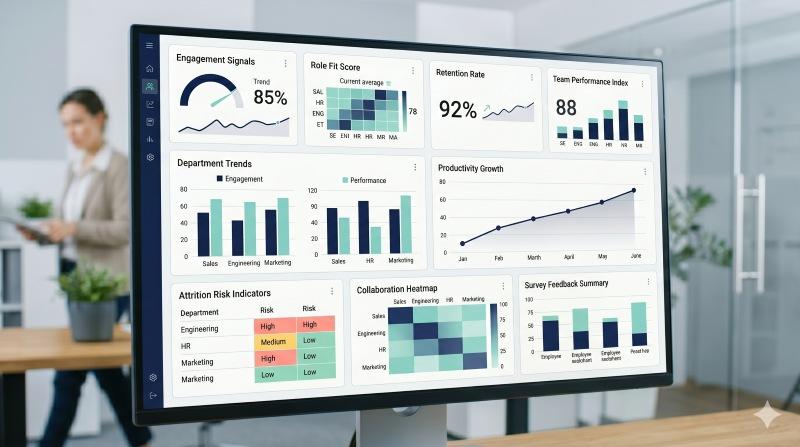
Step 1: Assess the current structure with people and performance data
Start with facts:
- where work slows down (cycle time, backlog, rework)
- where quality drops (defects, customer complaints)
- where talent risk is rising (turnover, internal transfers, burnout signals), which is especially critical in contexts like private equity portfolios where leadership fit can make or break a deal
- where decisions stall (approval queues, meeting load)
Use data analytics and quick, validated behavioral surveys to reveal role and team fit to identify patterns by function, layer, and team. Engaging various stakeholders across the business in the change process helps secure buy-in and provides valuable insights into what works and what doesn’t, and tools like risk and readiness alerts that flag burnout and turnover risk make these signals more actionable.
Design teams with data, not gut feel.
Most org-design decisions come down to role fit, leadership style, and team dynamics. OAD reads those signals from a 7-minute behavioral survey, so you can reconfigure roles and teams with evidence instead of guesswork.
Step 2: Map decision rights, workflows, and reporting lines
Document:
- key decisions that drive outcomes
- who currently decides
- who should decide (closest-to-information principle)
- reporting lines and escalation rules
Many organizations discover their real structure here: not the org chart, the influence network.
Step 3: Fix role design before changing boxes on the chart
Common fixes that create immediate lift:
- simplify role descriptions
- remove overlap
- define authority and accountability explicitly
- set “decision rules” for recurring choices
Step 4: Pilot the new design in one area
Do not roll out a new design everywhere at once unless you enjoy chaos.
Pilot in one department where:
- the workflow is measurable
- the leader is committed
- you can compare before/after results
Step 5: Collect quantitative and qualitative feedback
Quant:
- KPI movement
- cycle time
- quality and customer satisfaction indicators
- engagement/retention signals
Qual:
- where confusion increased
- where decisions got faster or slower
- what work became easier or harder
Step 6: Regularly review and iterate
Treat org design as an ongoing process:
- quarterly review for friction and KPI drift
- semiannual review for structural changes (team templates, reporting lines)
- annual review for strategy alignment and capacity planning
Deloitte’s work on org design capability highlights that many leaders prioritize redesign but far fewer feel confident executing it, which is why cadence and method matter more than “bold reorgs.”
KPIs for organizational effectiveness
If you want organizational effectiveness, your KPIs must connect structure to outcomes.
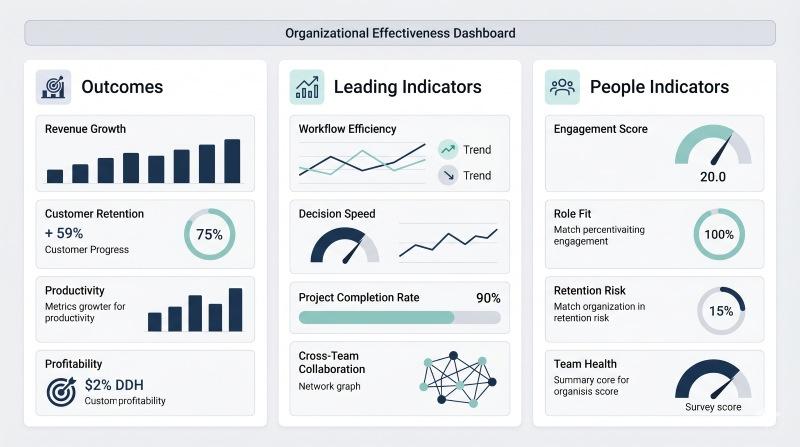
A useful KPI set covers three layers
1) Business outcomes
- revenue growth / margin (where relevant)
- customer satisfaction or customer retention
- quality metrics (defects, escalations)
- time-to-delivery / cycle time
2) Execution system indicators
- decision cycle time for key decisions
- handoff failure rate (rework, reopened tickets)
- meeting load and approval queues
- time-to-fill and time-to-productivity for critical roles
3) People and capability indicators
- employee engagement
- regrettable turnover
- internal mobility and promotions
- manager effectiveness signals (span health, coaching cadence)
Gallup’s meta-analysis is a reminder that engagement is not “soft.” It correlates with operational and financial outcomes, so it belongs in the KPI set, not in a separate HR report nobody reads.
Leadership and culture that make the structure work
Structure sets the default behavior. Leadership reinforces it or undermines it.
Open lines of communication, active listening, and regular feedback ensure alignment with company objectives, and many companies use these practices to drive organizational excellence by hiring leaders whose communication skills have been rigorously assessed in the interview process.
Leadership style: reduce noise in judgment
Two leadership behaviors matter most in org design:
- making decisions with clear criteria
- holding accountability without ambiguity
Effective leaders lead by example, driving improvements, alignment, and success within an organization through their actions and management practices, and many benefit from behavioral tools that give coaches deeper insight into how they lead under stress.
If leaders “override” the system constantly, the system stops working.
Leadership development: build manager capability where structure depends on it
In commercial organizations, this often includes developing sales leaders whose behavioral profile fits the demands of building high-performing teams.
If you flatten layers or expand spans, managers need stronger routines:
- 1:1 cadence
- coaching skill
- clear performance expectations
- early intervention for burnout risk
McKinsey’s research and related commentary often underline that decision making excellence is not as common as leaders assume, which is why decision rights architecture and leadership routines are non-negotiable.
Culture: treat engagement as an outcome of the system
Engagement improves when:
- roles make sense
- decisions are fair and fast
- goals are clear
- feedback is consistent
Treat culture as the result of a design that works, not as a substitute for design.
Operating cadence and continuous improvement
This is where organizational excellence becomes repeatable instead of aspirational.
To maintain competitiveness and growth, organizations must engage in ongoing evaluation and adaptation, ensuring their principles of effective organization are consistently applied and refined, and many teams rely on scalable behavioral insight plans that grow with the organization to support that evolution.
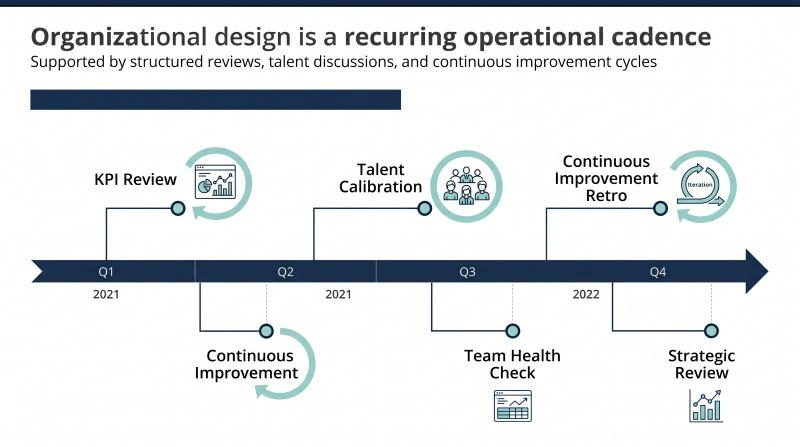
The minimum viable cadence
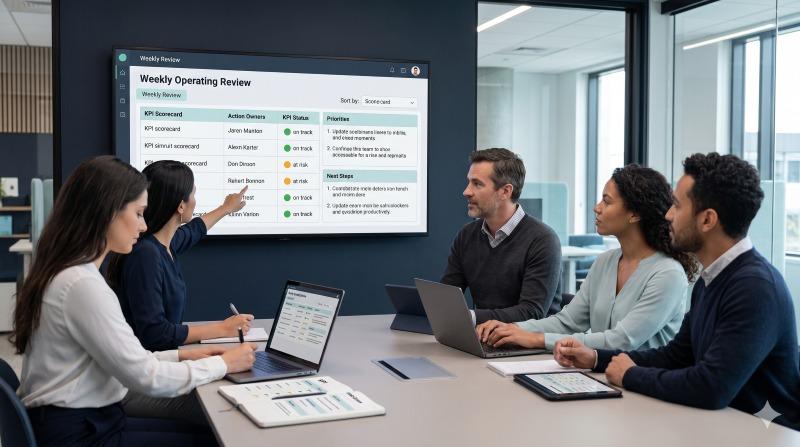
- Weekly: team execution review (KPIs, blockers, decisions)
- Monthly: cross-functional operating review (handoffs, dependencies, resource shifts)
- Quarterly: strategy-to-execution review (priorities, capacity, talent risks)
- Semiannual: org design review (structure adjustments, role clarity, decision rights)
McKinsey’s transformation research suggests that embedding organizational health efforts over time can produce better performance outcomes than treating change as a one-off event.
Common failure modes and fixes
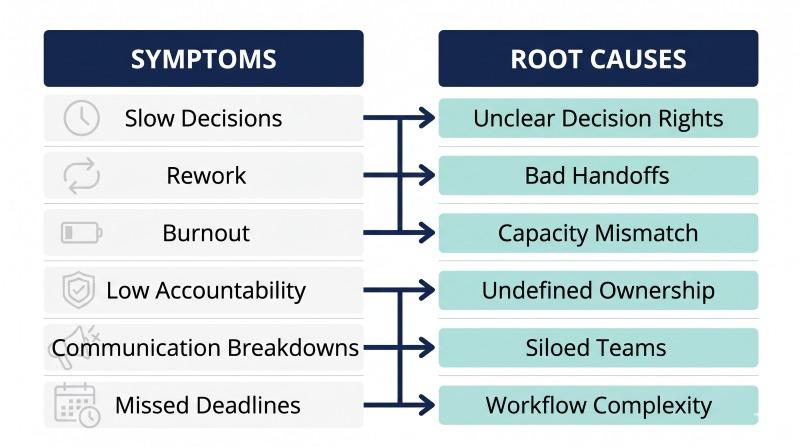
Achieving organizational excellence is not just about avoiding failure—it’s about positioning your company for success. Success results from continuous improvement, effective leadership, an engaged workforce, and adaptive organizational design. Organizations can position themselves for success through strategic initiatives and ongoing evaluation. Even the best organizations encounter challenges, but understanding the principles of effective organization can help you identify root causes and implement targeted solutions.
Failure mode 1: Slow decisions
Fix:
- define decision owners
- reduce approval layers
- set decision SLAs for recurring decisions
Failure mode 2: Role overlap and internal conflict
Fix:
- rewrite roles around outcomes
- clarify accountability vs contribution
- remove duplicated ownership
Failure mode 3: KPI clutter and no signal
Fix:
- cut KPIs to the handful tied to strategic goals
- add leading indicators (decision time, handoff failures)
- review KPIs in an operating forum with action owners
Failure mode 4: Reorg fatigue
Fix:
- pilot before scaling
- keep structural changes semiannual, not monthly
- focus on mechanisms (decision rights, cadence, templates) over chart reshuffles
Most org design projects fail at the same point: leaders debate structure without reliable signals about role fit, leadership style, and team dynamics. A structured assessment approach, including behavior fit reports that match roles to personality, gives you data to reduce judgment noise, especially when roles change or teams are reconfigured.
Design teams with data, not gut feel.
Most org-design decisions come down to role fit, leadership style, and team dynamics. OAD reads those signals from a 7-minute behavioral survey, so you can reconfigure roles and teams with evidence instead of guesswork.
If you want to see how OAD performs on your own roles and teams, you can start with Top Performer Profile and compare decisions with data instead of gut feel.
FAQ (People Also Ask)
What are the main principles of organizational design?
Strategic alignment, clear decision rights, role clarity, workflow-based design, measurable KPIs, and an operating cadence for continuous improvement.
What are examples of key performance indicators for organizational effectiveness?
Business outcomes (customer satisfaction, quality, cycle time), execution indicators (decision cycle time, rework), and people indicators (engagement, regrettable turnover, time-to-productivity).
How often should you review organizational design?
Review performance and friction quarterly. Make structural adjustments semiannually unless there is an urgent business shift.
What makes an organization “high performing”?
High performers are also deliberate about hiring for culture add, often using behavioral interview questions designed to assess cultural fit alongside data from assessments.
Fast, high-quality decisions; clear accountability; measurable outcomes; strong management routines; and a structure that supports execution and renewal.
How do reporting lines affect performance and accountability?
Reporting lines define who sets priorities, who coaches performance, and how decisions escalate. Unclear reporting lines create slow decisions and weak accountability.
Conclusion: applying principles of effective organization without overengineering
The principles of effective organization are not complicated, but to maximize organizational performance, it is crucial to implement these principles effectively. The hard part is discipline:
- align the structure to strategic goals
- clarify decision rights and accountability
- measure what matters with KPIs tied to outcomes
- run a cadence that makes improvement continuous
If you want to validate role fit and leadership signals as you design or redesign teams, test the Top Performer Profile and bring behavioral data into the decisions that shape performance.