Most organizations say they want high performing teams. Then they invest in individual training, a motivational offsite, and a few optimistic posters about “collaboration.” Predictably, team performance barely moves.
Team coaching is different. It treats the team as the unit of change and improves how the group makes decisions, handles conflict, shares ownership, and executes under pressure. When done well, team coaching transforms performance by changing the system the work happens in, not just the individuals doing the work.
Coaching Teams for High Performance: What is Team Coaching and How is it Different from Executive Coaching and Team Building?
Team coaching is an ongoing, structured process that improves how a team works together toward shared outcomes, especially in complex, fast changing environments. It focuses on team dynamics, shared goals, decision-making quality, and the team’s ability to learn and adapt together, not just individual growth. The International Coaching Federation (ICF) frames team coaching as moving beyond one-to-one dynamics to strengthen collective purpose and team potential. A clear sense of purpose and vision is foundational for fostering open communication and collaboration among team members.
In practical terms, team coaching targets the behaviors that drive results:
- How decisions get made and revisited
- How conflict shows up, gets avoided, or gets resolved
- How feedback flows (or doesn’t)
- Whether a clear sense of roles and expectations among team members is foundational to team effectiveness
- Whether the team can learn quickly without blame
- Whether people speak up when something is off
Effective teams share a clear purpose, mutual trust, accountability, and psychological safety, which are essential for open communication.

Team coaching vs executive coaching: when the “whole team” is the real unit of change
Executive coaching is typically one leader working on self-awareness, leadership behavior, and performance. Useful, but limited when the real bottleneck sits in the system around them.
Use team coaching when the business problem looks like:
- Leadership is competent, but the leadership team is misaligned
- Decisions stall in meetings, then get relitigated afterward
- Collaboration is polite but low-trust
- Accountability is fuzzy, so follow-through is inconsistent
- The team needs better collective intelligence, not another individual hero
Executive coaching can support the leader. However, effective leaders must also lead teams through systemic change, not just focus on individual development. Team coaching fixes the “we” problem.
Team coaching vs team building: outcomes, not activities
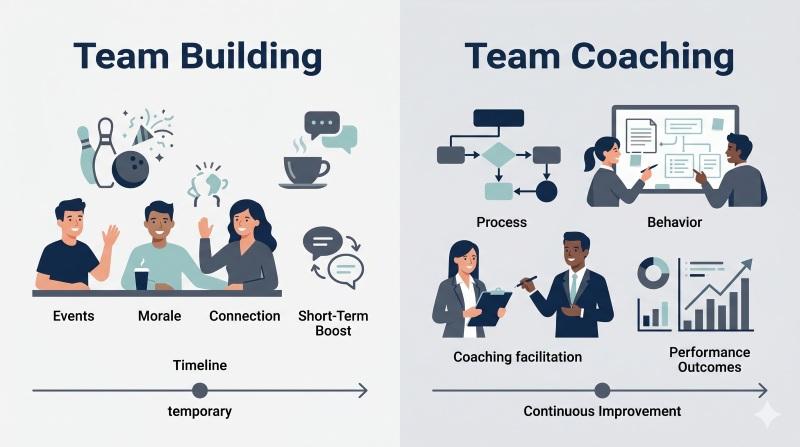
Team building is often a short-term activity designed to improve connection and morale. It can help relationships. It rarely changes how work actually gets done once everyone is back in the same old meeting patterns.
Team coaching is tied to real work, real decisions, and real outcomes over time. It is about creating an environment where collaboration, feedback, and continuous improvement are intentionally fostered, so the team’s capability to operate better under complexity, conflict, and change is built—not just feeling nicer for a week.
A blunt way to tell the difference:
- If the goal is “we should get along better,” you’re in team building territory.
- If the goal is “we must execute better, faster, with fewer breakdowns,” you want team coaching.
What high performance teams look like in practice (outcomes you can measure)
“High performance” is meaningless until you define outcomes the business can see. For most leadership teams, it comes down to five measurable categories:
- Decision making: faster decisions with fewer reversals
- Execution: predictable delivery, fewer fire drills
- Quality: fewer defects, fewer escalations, less rework
- Innovation: more useful experimentation, less risk-avoidance
- Employee engagement and wellbeing: energy and retention that do not collapse during pressure cycles
High-performing teams share a clear purpose, mutual trust, accountability, and psychological safety, which are essential for effective collaboration.
This is not just “people stuff.” Gallup’s 2020 meta-analysis (276 organizations, 96 countries, 2.7M employees) found meaningful performance gaps between top- and bottom-quartile business units, including 23% higher profitability and 18% higher productivity (sales) in more engaged units.
Team coaching earns its keep when it improves the behaviors that create those outcomes.
Design teams with data, not gut feel.
Most org-design decisions come down to role fit, leadership style, and team dynamics. OAD reads those signals from a 7-minute behavioral survey, so you can reconfigure roles and teams with evidence instead of guesswork.
Map desired outcomes: decision making, delivery, quality, innovation, employee engagement
A practical mapping exercise for HR and executives that also sharpens hiring decisions through behavioral interview questions for cultural fit:
- Pick two “hard” outcomes (delivery, quality, profitability, cycle time).
- Pick one “people” outcome (engagement, retention, wellbeing).
- Translate them into observable team behaviors (how meetings run, how conflict is handled, how feedback works, how ownership is shared).
- Set a baseline before coaching starts.
This mapping process brings greater clarity to team objectives and roles, ensuring everyone understands what success looks like and how to contribute.
You do not need 15 KPIs. You need 4–6 that the team can influence weekly.
The team dynamics behind performance: trust, role clarity, open communication
High performing teams usually look boring from the outside: clear roles, clean handoffs, fewer drama spikes.
The difference is rarely raw talent. It’s the team’s operating system:
- Role clarity: who owns what, and how decisions get made
- Trust: people assume positive intent but challenge weak thinking
- Open communication: issues surface early, not after damage is done
- Shared ownership: the team protects outcomes, not egos

When to use team coaching (and when it’s a nice to have)
Team coaching is a strong lever when performance is blocked by coordination problems, not individual capability. Clients often experience significant improvements in team effectiveness and outcomes when coaching addresses these coordination challenges.
Common triggers: growth, restructure, new leaders, hybrid, fast changing environments
Use team coaching when you see patterns like:
- Meetings produce discussion, not decisions
- Teams agree in the room, then undermine decisions afterward
- Cross-functional work is slow because ownership is unclear
- Conflict is either avoided or explosive
- Managers are stuck “translating” between functions
- Hybrid or global teams are misreading tone, intent, or urgency
These challenges are increasingly common in today’s complex and interconnected world of work, where rapid change and global collaboration demand new approaches to team dynamics.
Google’s Project Aristotle famously pointed away from “who is on the team” and toward conditions like psychological safety as drivers of team effectiveness, highlighting how strong communication skills within teams become a core performance advantage.
Readiness checklist: leadership support, time, shared purpose, willingness for regular feedback
Team coaching fails when the organization wants outcomes but refuses the conditions.
Minimum readiness markers:
- Senior leader support (time, priority, cover)
- A real business problem to solve (not “let’s do coaching”)
- Willingness to run regular feedback loops
- Agreement that the coach will surface uncomfortable dynamics
- A basic time budget (short, consistent cadence beats “big” sessions)
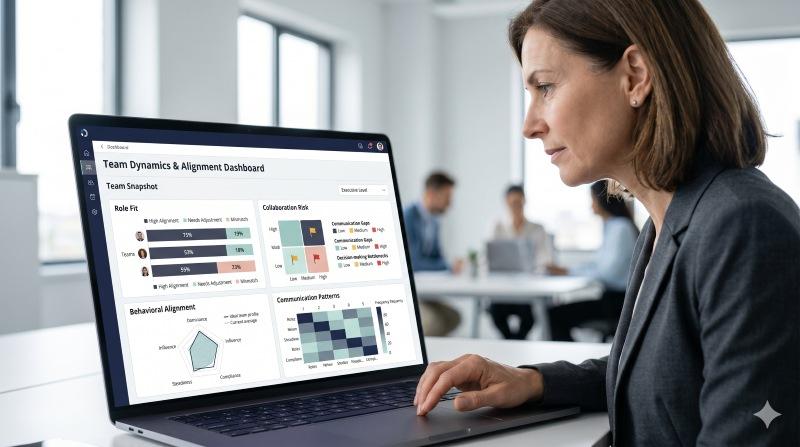
If you want to reduce guesswork while you build the plan, you can start with Top Performer Profile to baseline role fit and the behavioral traits that often shape collaboration patterns in your teams.
Approaches that work: coaching high performance teams with a systemic method
The most useful framing: treat the team as a living system. You’re not “fixing people.” You’re improving how work flows through the group, with the systemic approach aiming to help teams reach peak performance.
Choosing a model and cadence (coaching sessions, sprint check-ins, reflective pauses)
A practical cadence that fits real companies:
- Monthly deeper coaching sessions (60–90 minutes)
- Biweekly or sprint check-ins (15–30 minutes) focused on one behavioral experiment
- Reflective pauses right after delivery moments: launch, incident, escalation, quarter close
The goal is repetition. Teams learn through cycles, not lectures.
Coach role boundaries: confidentiality and escalation rules
This is where most programs get vague and then implode.
Define up front:
- What stays in the room
- What can be shared as themes (without attribution)
- When the coach must escalate (harassment, ethics, legal risk)
- Who sponsors the program and how sponsor check-ins work
If the team thinks coaching is surveillance, you lose psychological safety before you start.
The ICF team coaching competency model emphasizes ethical foundations and the unique dynamics of coaching teams, not just individuals, and pairing that with behavioral tools for coaches helps translate those dynamics into concrete leadership experiments.
Maturity path: from coach-led to self-led teams learn loops
You should not need the coach forever.
A clean maturity trajectory:
- Coach creates structure and language for feedback and decisions
- Team practices predictable rituals (check-ins, conflict protocols, retrospectives)
- Team self-corrects without the coach prompting it
- Coaching becomes occasional tune-ups, not a crutch
Throughout this progression, providing coaching tools and resources—such as training sessions and shared platforms—helps teams build the skills and confidence needed to move from coach-led to self-led practices.

Team coaching methods that change behavior (not just conversations)
Peer-coaching and shared learning cycles
Peer-coaching builds “collective ownership” fast, if it’s structured:
- Rotate who brings a real case
- Use a fixed question set (clarify, challenge, commit)
- End with one action and a follow-up date
Keep it short. If it becomes therapy, performance drops.
Simulations and behavioral experiments
High performance teams do not “intend” their way to change. They test small behaviors, which is especially critical when you’re building and coaching winning sales teams where small behavioral shifts compound into revenue impact.
Examples:
- Run one meeting where decisions must be written in a decision log
- Replace debate with “advocacy + inquiry” rules for one topic
- Test a 10-minute pre-mortem before launching a project
- Assign a rotating “process observer” to flag communication breakdowns
Retrospectives and shared ownership for follow-through
Retrospectives are where teams learn without blame.
Rules that work:
- Separate “what happened” from “why it happened”
- Identify one system fix (process) and one behavior fix (interaction)
- Assign a single owner and a check date

Executive coaching for leadership teams (how to align the top team to team performance)
Team coaching gets traction faster when leaders stop behaving like a set of individual executives and start behaving like a real unit. Executive team coaching not only aligns leadership but also fosters stronger relationships among team members, which supports trust, collaboration, and ultimately drives high performance for founders and CEOs scaling their organizations.
Align coaching to business priorities and board-level goals
In US contexts, leadership teams often have clear board-level expectations (growth targets, margin targets, risk controls). Globally, the language varies, but the need is the same: translate strategic intent into team behavior.
Practical alignment questions:
- What decisions must get faster this quarter?
- What conflicts are we avoiding that are costing us?
- Where are we duplicating work due to mistrust or unclear roles?
Success metrics for leadership teams: behavior plus outcomes
Track both, and weigh them against scalable pricing options for behavioral tools so the investment matches the value you’re creating:
- Outcome metrics: cycle time, delivery reliability, escalations, turnover
- Behavior metrics: decision clarity, follow-through, feedback cadence, conflict resolution speed
Psychological safety and open communication (how top teams build trust)
Psychological safety is not “being nice.” It is a performance condition: people can speak up, raise risks, and challenge ideas without social punishment. This environment not only supports open communication but also enhances employee well-being by reducing stress and fostering trust, especially when leaders understand what truly drives and motivates their people.
Coaching can significantly boost employee engagement by fostering strong relational connections between leaders and employees, which is essential for creating a supportive workplace environment and for reducing the post-deal friction that can derail private equity portfolios without a deliberate people strategy.
HBR has repeatedly pushed back on the sloppy version of psychological safety, calling out misconceptions like “it means being nice” or “it requires a trade-off with performance.”
Active listening, conflict protocols, and regular feedback rituals
Keep it operational:
- Active listening: reflect back what you heard before you rebut
- Conflict protocol: name the issue, name the impact, propose options
- Regular feedback: short, specific, behavior-based, tied to outcomes
If your feedback system relies on courage alone, it will fail.
Psychological safety across global teams: norms, culture, language
Global teams need extra precision:
- Clarify what “direct” means in your team
- Make turn-taking explicit in hybrid meetings
- Use written summaries to reduce misinterpretation
- Normalize “I might be missing context” as a standard phrase
Google’s team effectiveness work also emphasizes defining what a team is and making norms explicit, which matters even more across geography and time zones.
Tools, diagnostics, and measurement (how to measure progress and ROI)
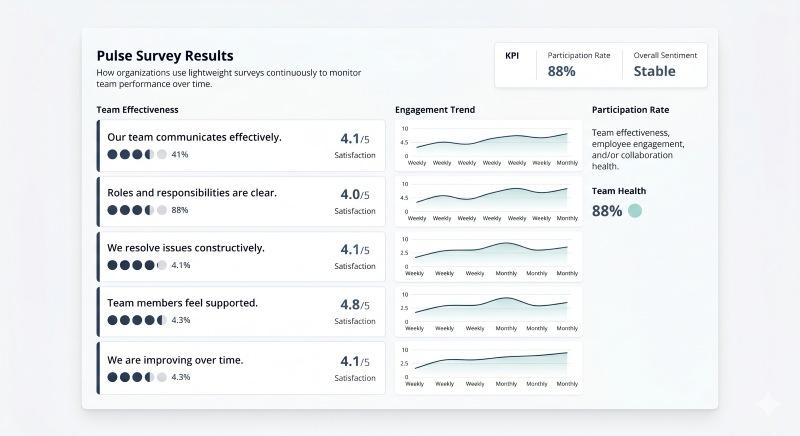
Baseline diagnostics and pulse surveys (measure progress without vanity metrics)
A decent baseline includes:
- Role clarity (decision rights, ownership)
- Communication quality (information flow, escalation speed)
- Trust and psychological safety indicators
- Engagement signals (energy, intent to stay, workload sustainability)
Gallup’s engagement research is useful here because it links engagement to performance across large datasets, not just opinions, while predictive risk alerts for burnout and turnover help you intervene earlier with specific teams and leaders.
KPIs and ROI: what to track weekly vs quarterly
Weekly (team-controlled):
- Decision latency (how long key decisions take)
- Follow-through rate (commitments completed)
- Escalations created vs resolved
- Retro actions closed
Quarterly (business outcome):
- Delivery reliability
- Quality incidents
- Turnover in key roles
- Engagement trend
Where OAD fits: validated data to reduce guesswork in team development
Team coaching often fails when it becomes guesswork plus charisma.
OAD’s angle is simple: use validated behavioral and personality data to reduce blind spots in how people work, communicate, and respond under pressure. That supports better role fit, clearer expectations, and fewer predictable friction points as teams develop.
Design teams with data, not gut feel.
Most org-design decisions come down to role fit, leadership style, and team dynamics. OAD reads those signals from a 7-minute behavioral survey, so you can reconfigure roles and teams with evidence instead of guesswork.
Implementation roadmap (how team coaching transforms organizations)
Pilot one leadership team, then scale (train-the-coach, embed into performance cycles)
A workable rollout that is much easier when everyone has secure individual application access instead of shared links and static reports:
- Pilot with one leadership team (clear scope, outcomes, cadence)
- Capture patterns that generalize (decision rules, feedback rituals)
- Scale through internal capability (train-the-coach)
- Embed into performance cycles (quarterly planning, project kickoffs, retros)

Common challenges and mitigations: resistance, overload, bias
- Resistance: start with leader modeling and a tight coaching contract
- Overload: timebox everything and prioritize consistency over volume
- Bias: use multi-source feedback and observable behavior, not “vibes,” supported by behavior fit reports that match roles to personality instead of relying on resumes alone
FAQ: Team coaching for high performance (PAA-style)
What is the difference between team coaching and team building?
Team building is typically an event or activity to improve connection. Team coaching is an ongoing process tied to real work outcomes, team dynamics, and measurable performance improvements.
How long does team coaching take to improve team performance?
Most teams see early behavior shifts in weeks if cadence is consistent. Sustainable performance change typically takes multiple cycles (often a quarter or more), because teams need repetition, feedback, and real-work practice.
How do you measure team coaching ROI?
Measure a small set of outcome KPIs (delivery reliability, quality incidents, turnover, engagement trend) and a small set of weekly behavior indicators (decision speed, follow-through, escalation resolution). Tie improvements to baseline and compare trend lines quarter over quarter.
How much does team coaching cost?
Costs vary by region, coach experience, and scope. The better question for buyers is cost relative to the business impact: decision delays, rework, churn, and missed execution typically dwarf coaching fees once measured honestly.
What does the International Coaching Federation say about team coaching?
ICF has published Team Coaching Competencies that build on core coaching competencies and address team-specific dynamics and ethics.
Conclusion: turning team coaching into a repeatable system
Team coaching works when it is treated as a performance system: clear outcomes, observable behaviors, tight feedback loops, and measurement that leaders trust. It fails when it is treated as a motivational accessory.
Effective team coaching also helps teams reflect on their collaboration, facilitating awareness and guiding honest conversations to design better ways of working together. By fostering these practices, team coaching builds stronger trust within teams, leading to better collaboration and reduced friction.
If you want to see how OAD performs on your own roles and teams, you can test the Top Perfromer Profile and compare team fit and hiring decisions with data instead of gut feel.