If you’re leading HR or a team in a 50+ employee company, you’ve seen the pattern: initiatives launch, enthusiasm spikes, then motivation quietly leaks out through unclear priorities, inconsistent managers, and work that feels interchangeable.
This playbook is built for HR leaders, founders, and people managers who need practical ways to boost employee motivation without turning it into a “culture” theater project. The goal is straightforward: stronger employee engagement, better employee performance, and higher employee retention, with methods you can actually run inside real teams.
Why It Matters To Motivate Employees
Employee motivation is not a “nice to have.” It is a measurable driver of organization-wide business performance, especially in mid-sized companies where one disengaged manager can drag down an entire function.
Motivated employees are more productive, innovative, and committed to the success of the business. A lack of motivation is often the first step on the path to employee disengagement, which can have real implications for a company’s bottom line.
The business case is bigger than morale
When workers are engaged, organizations tend to see better productivity and lower turnover. Gallup’s engagement research frequently ties higher engagement to lower absenteeism and higher productivity across business units.
For global context: Gallup’s State of the Global Workplace 2026 report estimates that low engagement cost the world economy about $10 trillion in lost productivity last year, roughly 9% of global GDP. That’s not a vibe. That’s an economic number with teeth.
Disengagement shows up as real money leaving the building
The same Gallup report found that only 20% of employees worldwide were engaged in 2025, down from a peak of 23% in 2022. Gallup ties much of that drop to managers: manager engagement fell from 31% to 22% over the same period.
Mid-sized companies feel this faster because:
- Teams are tightly coupled (one weak link affects output immediately).
- “Many employees” still means limited redundancy.
- Processes are often lighter, so manager behavior matters more than policy.
Motivation reduces turnover, and turnover is expensive
Even if you ignore productivity entirely, retention alone justifies this work. SHRM provides tools for calculating turnover cost because it’s not just recruiting fees. It’s ramp time, lost output, and team disruption.
Use sourced ranges when you can (role-dependent), but don’t get trapped trying to find the “one true number.” The practical point is simple: if motivation improves retention even slightly in key roles, the ROI can be material.
What “motivation” actually means in practice
Motivation is not permanent enthusiasm. It’s the likelihood someone will:
- apply effort without being chased,
- solve problems instead of deflecting them,
- give useful employee feedback,
- go the extra mile when the moment requires it (rare, but valuable),
- stay long enough for their skills to compound.
And yes: “more money” matters, but it’s not the only lever. Pay can prevent dissatisfaction; it rarely fixes poor leadership, unclear career growth, or a workplace where employees don’t feel valued.

What motivates employees
Employee motivation is not mysterious. Humans just love pretending it is, so they can avoid doing the basics consistently.
Motivation usually comes from a mix of intrinsic motivation (the work feels meaningful, you’re improving, you have control) and extrinsic motivation (pay, benefits, job security). The trap is treating “more money” as the only lever. Pay matters, but it does not fix poor leadership, chaotic priorities, or a workplace where employees feel unheard.
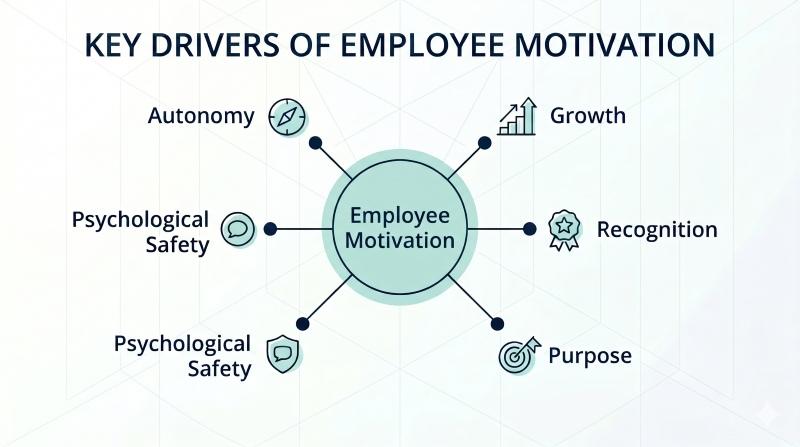
In practical HR terms, the strongest, repeatable drivers tend to cluster into five buckets. To motivate employees, leaders must create an environment where these drivers are present:
- Autonomy: People can make decisions about their work without constant permission.
- Growth: Clear development, new skills, and believable career growth (not a fantasy corporate ladder).
- Recognition: Employees feel valued through specific, timely acknowledgement.
- Purpose: Work connects to outcomes and the company’s mission in a way that feels real. Employees who feel their work has purpose are more invested.
- Belonging and safety: Psychological safety, strong relationships, and teams where employees feel heard.
These drivers are not “soft.” Gallup’s engagement research ties engagement to outcomes leaders actually care about: retention, productivity, and lower absenteeism.
Signs employees feel disconnected
Disengagement is rarely loud. It’s usually quiet compliance.
Watch for patterns like:
- People stop giving useful employee feedback. Meetings go polite and empty.
- Output becomes “minimum viable.” Fewer ideas. Less initiative.
- “Other departments” become the default scapegoat.
- Managers report that “many employees” feel tired, resistant, or hard to move.
- You see performance variability increase, especially across teams with different managers.
What to check quarterly
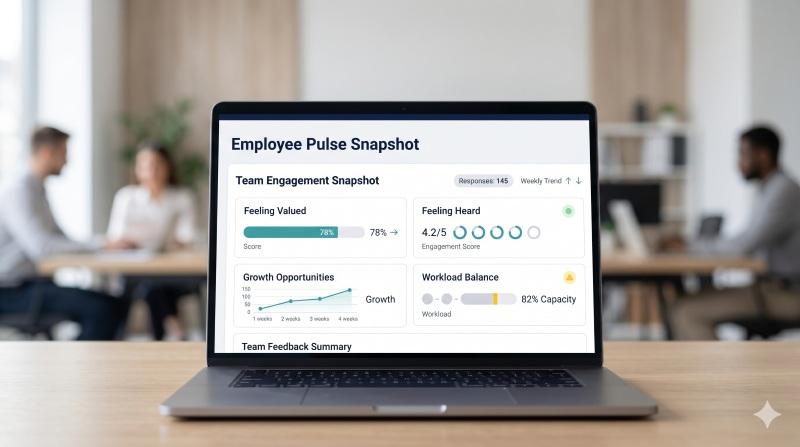
Run a short pulse quarterly (or monthly for known hot spots) that covers:
- Employee engagement (energy, commitment, intent to stay)
- Employees feel valued (recognition, fairness, respect)
- Employees feel heard (voice, follow-through)
- Psychological safety (comfort speaking up)
Then do the part most companies skip: close the loop. Publish what you heard, what you’re changing, and what you’re not changing and why. A feedback system without visible action is just a more efficient way to teach employees silence.
How to motivate employees
This is where most motivation advice becomes useless because it tries to motivate everyone the same way. Don’t.
In fact, when asked what would improve their performance, the top answer from employees is often greater clarity about organizational goals and expectations, which highlights the importance of targeted engagement.
Use a simple operating model instead:
- Pick two levers per team (from the five below).
- Run a 6–8 week pilot.
- Measure: engagement pulse plus behavioral signals (retention risk, internal movement, performance).
- Keep what works, drop what doesn’t, repeat.
Involving employees in goal setting can lead to greater clarity about what the organization needs them to do, which can improve their performance and motivation.
This avoids the classic mid-sized company failure mode: launching 12 “culture initiatives” and finishing none.

1) Psychological safety so employees feel heard
If people don’t feel safe, they will not tell you what’s wrong. They will update their CV instead. Open and respectful communication is crucial for managers to foster psychological safety.
What managers should do consistently:
- Ask for dissent early: “What am I missing?”
- Reward candor: thank people for raising issues, even if the answer is “not now.”
- Make it specific: “Name one thing slowing you down this week.”
Fostering a psychologically safe, inclusive, and collaborative environment with open communication is essential to motivate employees. Creating a safe space for feedback encourages team members to share ideas without fear of judgment.
A simple script for a safer 1:1:
- “What’s the most frustrating part of your week right now?”
- “What’s one thing you want me to stop doing, start doing, or continue doing?”
- “If you were in my role, what would you change first?”
If you add an anonymous channel, treat it like a smoke alarm. It tells you there’s a fire. It doesn’t replace managers doing their jobs.
Manager quality is repeatedly highlighted in Gallup’s engagement work as a major driver of engagement variation. If you want teams engaged, you don’t start with posters. You start with managers.

2) Growth opportunities and employee development without the corporate ladder trap
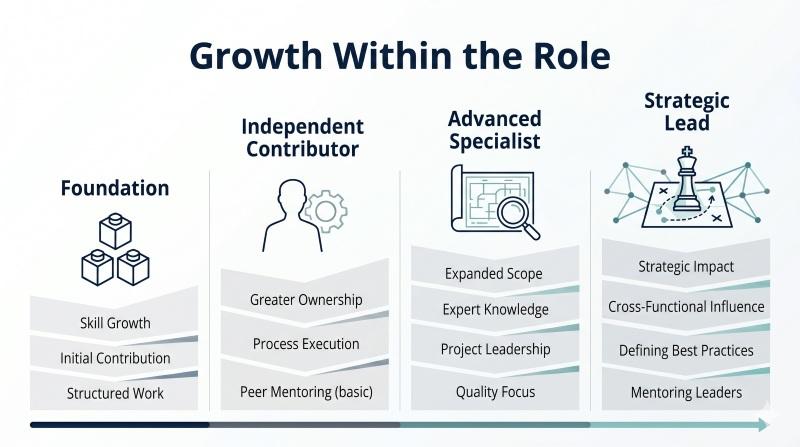
Most mid-sized companies cannot promote everyone. That’s fine. The alternative is not stagnation. It’s skill progression. Companies should invest in employee development to motivate employees and foster engagement.
Three growth options that work without constant promotions:
- Skill paths: clear skill levels for a role (same title, higher capability and scope)
- Stretch ownership: temporary ownership of a problem, client, or internal process
- Internal mobility: planned lateral moves to build breadth and reduce flight risk
Studies show that 73 percent of employers believe offering career advancement opportunities is important, but only 49 percent of employees say their employer actually creates these opportunities.
If roles require “few skills” today, build the next layer: teach the skills that make the job more valuable. Providing opportunities for career promotion, skills development, and further education shows employees that you’re with them for the long haul, which can enhance their performance abilities. That’s how you get career growth without lying about promotions.
3) Recognition so employees feel valued
Recognition fails when it’s vague, late, or automated.
What works:
- Be specific about the behavior: “You handled that client escalation calmly.”
- Tie it to impact: “That saved the team two days and protected the relationship.”
- Do it close to the moment: next day, not next quarter.
A 2019 Employee Engagement Report states that only 1 in 3 employees felt their hard work was recognized the last time they went the extra mile, and only 25 percent said they felt consistently valued by their employers.
Build simple rituals:
- 5-minute weekly “wins” round
- peer shout-outs tied to company values (sparingly, not as forced theater)
- manager checklist: recognize one person per week for a concrete contribution
Creating a gratitude-centered workplace is one of the easiest and most affordable ways to boost employee performance and decrease turnover, as employees are more motivated to do their best when they feel appreciated by their employer. Positive feedback helps employees feel valued in their roles, which can lead to increased motivation and a lower likelihood of quitting their job within the next year. Celebrating both small and large wins fosters motivation.
Employees feel valued when recognition is consistent and fair, not when it’s loud.

4) Autonomy and purpose tied to the company’s mission
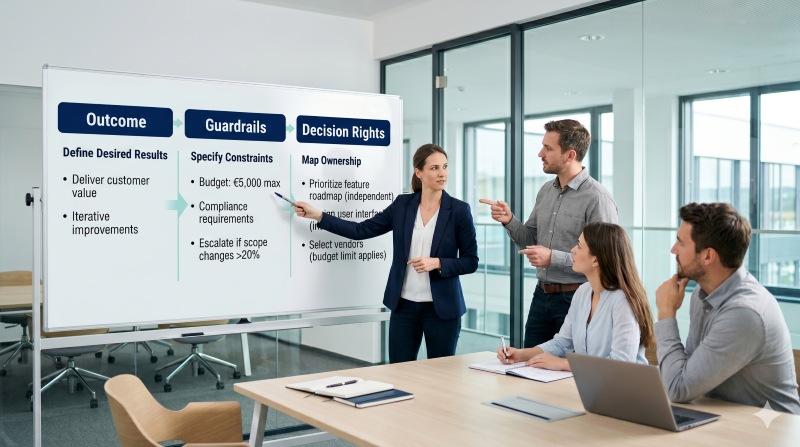
Autonomy is not “do whatever you want.” It’s clear outcomes plus freedom in execution.
Two practical moves:
- Clarify decision rights: what the team decides without escalation
- Define outcomes: what “good” looks like, in plain language
Purpose should be role-level, not slogan-level. “We change the world” is meaningless. “Your work reduces customer churn by preventing X” is purpose.
5) Work design and work life balance
Work life balance is not a perk. It’s workload design, boundaries, resources, and support. Employees need support from their employers to improve work/life balance, reduce stress, and feel valued, especially during times of organizational change or increased challenges.
High-impact fixes:
- Remove one recurring meeting that creates no decisions
- Fix one tool/process bottleneck that wastes hours weekly
- Put guardrails on “urgent” requests so everything isn’t urgent
Promoting a healthy work-life balance and preventing burnout enhances employee well-being. Effective employee motivation strategies include recognizing individual achievements, providing autonomy, offering professional growth opportunities, and creating a supportive environment.
If you want better engagement, stop rewarding constant availability. Paid time off that people are afraid to take is not a benefit. It’s a liability dressed as policy.

Improve employee feedback systems
If your employee feedback process is “annual survey plus hopes and prayers,” you don’t have a feedback system. You have a ritual that trains people to stop talking.
Most feedback breaks for three reasons:
- Poor leadership follow-through: employees share issues, nothing changes, trust drops.
- Vague questions: you measure feelings, not friction.
- No closed loop: no public decisions, no owners, no timeline.
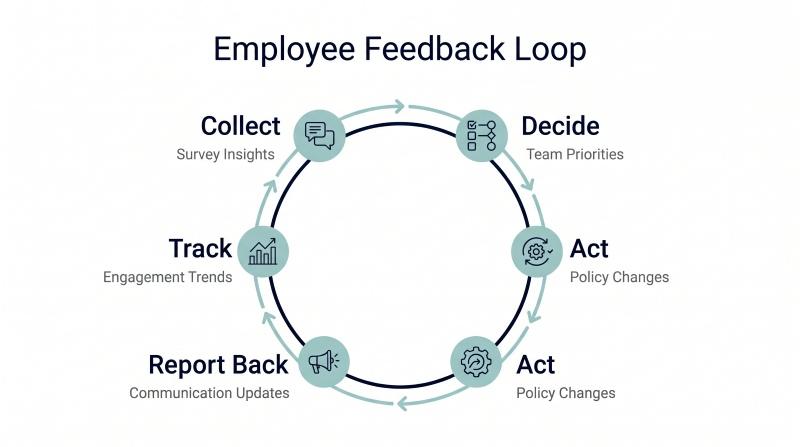
A closed-loop feedback process is boring, which is why it works:
- Collect: short pulse + one open text question (“What is slowing you down most?”).
- Sort: themes by impact (retention risk, productivity drag, team conflict).
- Decide: 1–2 actions per team, not a company-wide “we’ll do everything.”
- Report back: what you will do, what you will not do, and why.
- Track: next pulse checks whether employees feel heard.
When recognition is part of the loop, it gets even simpler. Research covered by Harvard Business Review shows symbolic recognition (thank-you notes, public acknowledgement, certificates) can lift morale without big budgets.
Measure and boost employee motivation
Motivation is easy to talk about and annoying to measure. Still worth doing.
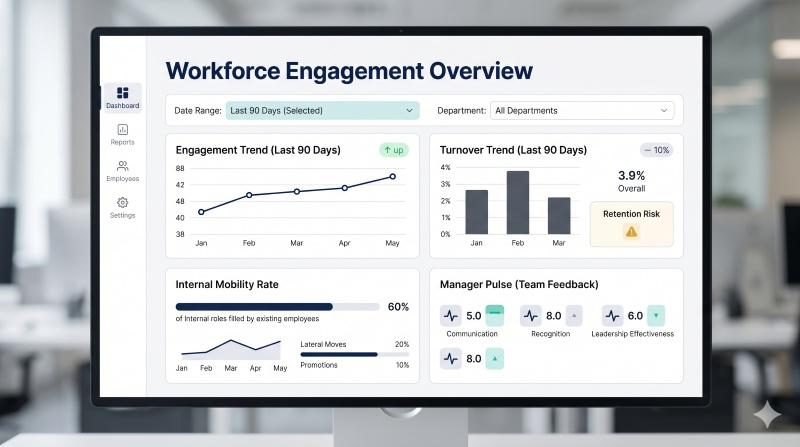
Use two layers:
1) Survey signals (what people say)
Keep it short. Track trends, not perfection:
- employee engagement
- employees feel valued
- employees feel heard
- psychological safety
- work life balance strain
2) Behavioral signals (what people do)
Look for movement before results show up in revenue:
- employee retention (voluntary turnover, regrettable loss)
- internal mobility (moves, stretch ownership, project uptake)
- absence patterns
- performance variability by team and manager
Why managers matter so much: Gallup’s global research consistently shows manager engagement is a key factor in team engagement shifts, and its 2026 report shows manager engagement down nine points since 2022.
For leadership accountability, a “dashboard” can be a one-page monthly view. If you need a data warehouse to see basic trends, the problem is not analytics. It’s avoidance.
Quick wins to boost employee motivation this week
Quick wins are only useful if they remove friction or rebuild trust. Anything else is corporate cosplay.
- Recognition sprint
Ask each manager to recognize one specific contribution daily for five days. No generic praise. Tie it to impact. - Fix one bottleneck per team
Remove one pointless recurring meeting, one broken tool process, or one handoff delay. This has a tremendous impact because it changes daily work, not posters. - Clarify expectations and goals
Publish role expectations and the next 30-day priorities. Disengagement loves ambiguity. - Run a manager coaching mini-sprint
One skill per week: 1:1 structure, feedback script, recognition quality, decision rights. Gallup’s reporting highlights how manager training and consistent conversations matter for engagement.
Design teams with data, not gut feel.
Most org-design decisions come down to role fit, leadership style, and team dynamics. OAD reads those signals from a 7-minute behavioral survey, so you can reconfigure roles and teams with evidence instead of guesswork.
Long-term programs that sustain employee motivation and retention
Short wins fade. Systems stay.
While quick wins can spark initial excitement, sustainable motivation requires a deeper, ongoing commitment. To truly motivate employees, organizations must create a positive workplace culture, one that intentionally fosters appreciation, gratitude, and a sense of value. Creating a workplace culture that encourages strong relationships among employees is important for employee happiness and motivation. This means embedding recognition, feedback, and growth opportunities into the fabric of daily work, not just as one-off events.
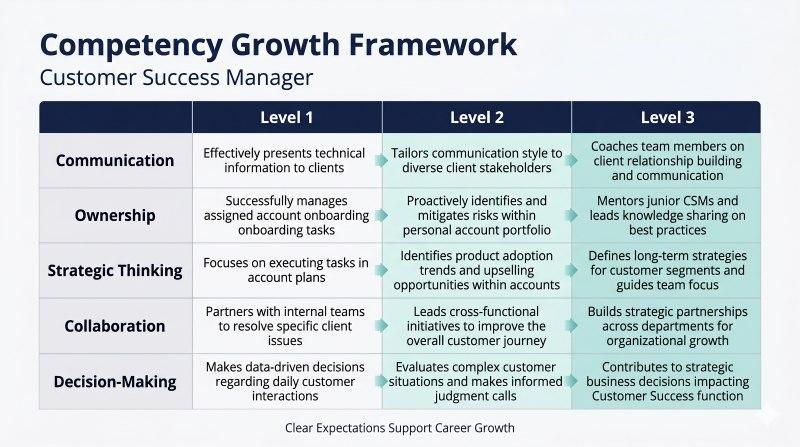
Competency-based progression (beyond the corporate ladder)
Build progression inside roles so people can grow without needing a title every 12 months:
- skill levels with clear behaviors
- scope increases tied to business outcomes
- pay bands aligned to capability, not tenure
This reduces the “same level forever” problem that quietly kills motivation.
Mentorship with outcomes
Mentorship fails when it’s vague. Give it structure:
- match by skill goal
- 8–12 week cycle
- simple deliverable (new skill, project, confidence in a role transition)
Standardized manager training
Promoting high performers into management without training is how you manufacture poor leadership at scale. Gallup reporting notes many managers lack formal training and engagement suffers when managers struggle.
Minimum viable manager training for mid-sized companies:
- how to run 1:1s
- feedback and coaching basics
- recognition that works
- decision rights and accountability
- psychological safety behaviors
Design teams with data, not gut feel.
Most org-design decisions come down to role fit, leadership style, and team dynamics. OAD reads those signals from a 7-minute behavioral survey, so you can reconfigure roles and teams with evidence instead of guesswork.
How to know it’s working
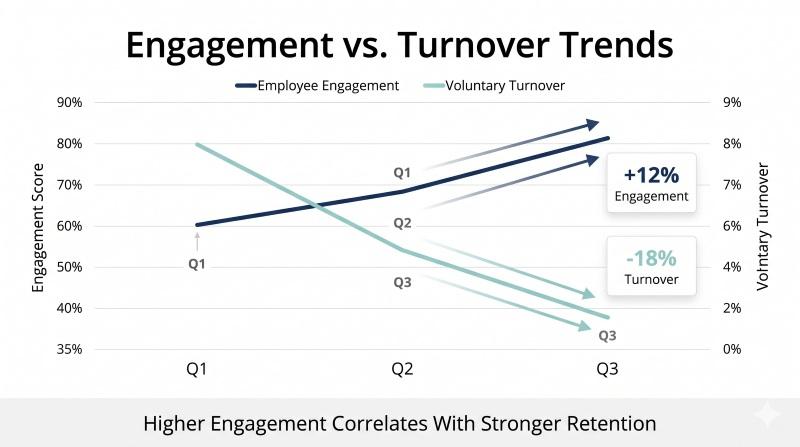
You’re looking for directional movement, not perfection.
Track:
- employee engagement trend (up and stabilizing)
- employee satisfaction and “feel valued” items improving
- voluntary turnover down, especially regrettable loss
- internal mobility up (career growth signals)
- manager effectiveness improving via 360 feedback and team signals
Also watch for the subtle win: employees start giving honest employee feedback again. That only happens when they believe someone will act.
FAQ
How do you motivate employees?
Focus on the five drivers: psychological safety, growth opportunities, recognition, autonomy, and purpose. Pick two per team, pilot for 6–8 weeks, measure, then iterate.
What motivates employees the most?
It depends on context, but the most durable mix is: fair pay as a baseline, then growth, autonomy, and being treated like a competent adult. Recognition amplifies all of it when it is specific and timely.
How do you motivate employees who only want more money?
First, verify pay is market-competitive. If it is not, fix it or accept turnover. If it is competitive, shift the conversation to growth opportunities, scope, and autonomy. People often ask for money when they do not see a future.
How do you motivate employees without spending more?
Improve the work: remove friction, clarify priorities, strengthen manager conversations, and fix recognition quality. Symbolic recognition can improve morale without major cost when done well.
How do you motivate employees with low engagement?
Start with the manager and workload reality. Engagement drops when employees feel unsafe, unheard, or overloaded. Measure psychological safety, fix the biggest friction point, then rebuild trust through visible follow-through.
Where OAD fits
Most motivation programs fail for a simple reason: they assume everyone is motivated by the same things and respond the same way to the same manager.
In reality:
- different roles require different behavioral patterns
- different teams need different management approaches
- poor fit creates chronic stress, lower performance, and retention problems
This is where OAD supports better outcomes. A validated behavioral diagnostic helps you understand how candidates and employees are likely to operate in a role, how they respond to feedback, and what conditions help them perform. That gives HR and managers a better understanding of what will actually move the needle, instead of rolling out generic “engagement initiatives” to everyone at once.
Start with the person you already trust most on your team. Get your free Top Performer Profile: 7 minutes, results in 24 hours, no credit card. Then use it to compare roles, candidates, and team fit, and focus your manager effort where it will actually change outcomes.